
3—
The Master at Work:
Richard de Fournival's Bestiaire d'amour
Aestho-autogamy with one unknown quantity on the male side has long been a commonplace. For fully five centuries in all parts of the world epileptic slavies have been pleading it in extenuation of uncalled-for fecundity. It is a very familiar phenomenon in literature.
Flann O'Brien, At Swim-Two-Birds
If the disciple wavers indefinitely when faced with women interlocutors, what then of his superior, the master? At the apex of the scholastic institution of mastery, the magister appears in a nearly invincible position. In Thomas Aquinas's own portrait, "Like the mountains, the masters are elevated above the earth and thus first illuminated by the rays of the sun."[1] On ground level, the master presides over a network of pedagogical and intellectual relations. He is its guarantor, as the miniature from the Bestiaire d'amour depicts it, orchestrating the labor of writing and supervising his disciples (Figure 6). He is thus responsible for the continuity of mastery. In Aristotelian terms (as indeed in Flann O'Brien's playful ones), the master's charge involves a type of reproduction: replicating the masterly persona and his system through his own work.[2]
In the literature of the magistri , any extended dealings with women were represented as a threat to this process of replication. In fact, so threatening did this appear that the idea of dialogue with women—of colloquium mulierum —was classified as a sin.[3] In pastoral manuals and treatises on linguistic arts, this sin was numbered together with cursing or bad language (turpiloquium ) and buffoonery (scurrilitas ). All three were considered to express a desire for the filthy and foul; a desire, if we translate literally, to disfigure (ex insolentia feditatis ). This conception of disfigurement gets to the heart of the problem of any dealings between clerkly figures and women interlocutors. First of all, by dint of speaking with them the
clergy risks defiling their privileged languages of learning. When their words are directed toward personae identified by scholastic thought in base, material terms, the words themselves are debased; so too the subjects under discussion. It is as if all that clerks represent through their exchanges with women could be befouled. The world of learning itself could be disfigured.
Such a conception of the colloquium mulierum may well have been ritualistic—a sin in name only. Its definition in these thirteenth-century treatises smacks of the clerical habit of creating fantastical categories for the sake of analysis. Yet the fact that it was formulated at all and recurred in scholastic writing signals just how problematic the dialogue between clergy and women was taken to be. For the powerful figurehead of the clergy, the magister , it posed the gravest problems of all.
Nowhere is this threat more clearly dramatized than in the Lamentations of Matheolus . Not only does the masterly protagonist brave the interdiction against colloquium mulierum , but he consorts with a woman as a bigamist. The consequences for his identity are devastating: "I used to be a master" (Iamque eram magister).[4] From the opening line, the Lamentations traces a story of degradation. It narrates what is another expulsion from Eden: a clerical fall from grace. This time a woman is shown to cause an exile from the mountains of masterly dominion. The so-called lamentations that follow are in fact a powerful diatribe against women. Because of the demoted master's desire to disfigure, he is reduced to speaking nothing but a disfiguring language: slander, blasphemy, expletives.
Matheolus is the alter ego—the dark shadow—of the master. As such, he provides the counterexample against which we can best study how the master undertakes dialogue with a woman. Matheolus's disgrace represents the position the reputable master figure must avoid at all costs. Although they both break the taboo of colloquium mulierum , the reputable master must find a way of maintaining his formidable authority while pursuing dialogue with women interlocutors. My test case will be Maître Richard de Fournival's Bestiaire d'amour .[5] This thirteenth-century text is exemplary on two counts. In the framework of a master's address to a woman interlocutor, it casts the narrator in the double role of pedagogue and lover. While he is more intelligent than the disciple figure, he approaches the woman in a similarly amorous way. And this combination of roles raises the question of his masterly control, a question that becomes all the more charged because it is associated with the signature of "Maistre Richard de Fournival." A celebrated polymath of the high Middle Ages, Fournival exemplifies the magister 's intellectual command.[6] Indeed, his farranging philosophical, literary, and scientific learning suggests the model
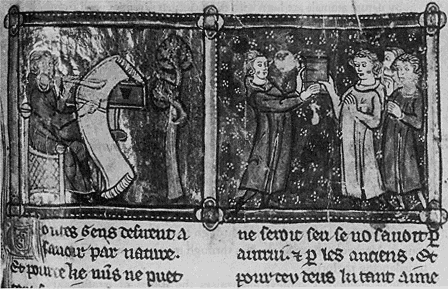
6. The master's work in progress: from writing to book production.
Oxford, Bodleian Library, Douce 308, fol. 90 verso.
By permission of the Bodleian Library, Oxford.
of Aristotelian mastery coalescing in Parisian university circles during the mid-thirteenth century.[7]
These two aspects of Fournival's Bestiaire , structural and biographical, will focus our inquiry on the master's relations with women. Examining how the Fournival master's intellectual authority is established will help chart the dynamic of mastery—what it is that separates and does not separate Richard's master from his alter ego Matheolus. It will also lead to the overarching issue of the symbolic domination of women created by the master's discourse.
Laying the Groundwork
The Bestiaire master allies himself straightaway with the intellectual leaders of the day through the Aristotelian language he invokes.[8] His subject is a favorite of scholastic disputation and commentary. Beginning with the incipit, he teases out the principal concepts of Aristotle's Metaphysics :
All men desire to know. An indication of this is the delight we take in our senses; for even apart from their usefulness they are loved for themselves; and above all others the sense of sight.
By nature animals are born with the faculty of sensation, and from sensation memory is produced in some of them, though not in others. And therefore the former are more intelligent and apt at learning than those which cannot remember.
The animals other than man live by appearances and memories, and have but little of connected experience; but the human race lives also by art and reasonings.[9]
Rationality, knowledge, memory: the Bestiaire master works through the very traits that distinguish men and women from animals, and more importantly, that explain men's rule over all.[10] In his address to the inscribed woman reader, he uses these Aristotelian terms to suggest his rule over her. This rule the alter ego Matheolus squanders. Whereas the Bestiaire narrator works to secure his rule through such formidable scholastic reasoning, Matheolus bewails the loss through invective: one goal, two counterbalancing rhetorics.
The Metaphysics subtext also raises the issues of irrationality and knowledge based on the senses. As the corresponding opposites of the ruling traits, they are implicitly aligned, in the master's schema, with "woman."[11] If he claims the powers of rational knowledge, she, then, is allotted all that is irrational and purely sensory.[12] In the most extreme terms, woman is thus limited to an animalistic existence. Such a theorem is crucial for the Bestiaire 's composition of a series of bestiary exempla. The master's letter to a woman reader involves various lessons concerning animals that, given this implicit conception of woman, are meant to be adopted easily by her.[13] The presumption is that one beast should recognize another.[14] By reading the master's commentary on the hedgehog or the crocodile, she should identify so completely with these animals that she should defer immediately to his erudition. As a result, not only is he meant to gain control over her, but his theorem on women's animalistic nature should be reinforced as well. In this, the Bestiaire master's attitude differs little from his alter ego's. It is a matter of degree. Since his authority is completely shaken, Matheolus figures a woman in the most terrifying bestial terms. Woman becomes "a hermaphroditic monster and shows herself to be a chimera" (Femme est hermafrodite monstre et pour chimere se desmonstre; Lamentations , II, lines 4127, 158) Out of his control, she turns into a wild, sexually ambiguous beast (and, we might add, into pure illusion).
This series of associations—the animalistic/the feminine/the deference to man's rule—brings us to the issue of mastery's dynamic. Our question then becomes: how is the Bestiaire narrator to command the
favor of his woman reader? The sequence of bestiary exempla derived from an authoritative Aristotelian tradition is used to create a dynamic of domination and subordination between the master and his female correspondent. Given his erudition, the master starts off from a dominant position. And his disputational commentary on the exempla exaggerates that dynamic. For one thing, his account of human erotics shifts between bestiary exempla for different types of aggression or servility. It moves back and forth between figures for predatory and passive behavior, between, for instance, the viper who attacks the unsuspecting, and the careless monkey captured at once. Furthermore, the gender coding of the master's exempla fluctuates. Far from using exempla systematically to assert the case of masculine dominance, the master comments upon types for masculine passivity, as indeed for feminine aggressiveness. The viper signifies for the Bestiaire narrator a feminine tendency to lash out at the lover, while the monkey is a lover too easily beguiled by women. This alternation of gender types maps the master's effort to prescribe the woman reader's reaction. Each time he shifts from an exemplum detailing masculine traits to one exemplifying those that are feminine, we glimpse the master-narrator working to ordain the woman's response. If he can use his gendered learning to dictate to her, then his intellectual mastery will be confirmed in the process.
This strategy is hardly implemented without a hitch. The more the Bestiaire master alternates between masculine and feminine exempla, the more complicated his goal of commanding the woman becomes. This alternating pattern signals the master's difficulty in projecting relations of pliancy onto her. And that uneasiness comes through in a second pattern. The Bestiaire narrator is liable to change the gendered lessons of the exempla. An animal conventionally read as masculine can metamorphose in the space of the master's commentary into a feminine one and vice versa. Such semantic mobility, coupled with a structural one, suggests how checkered his campaign to induce the woman's yielding is. His tendency to revise the gendered sense of his own material is symptomatic of the larger problem of the master's intellectual authority. To understand this trouble in relation to the woman reader, it is as important to trace the sequence of change in bestiary exempla as it is to examine what each exemplum entails.
Take the case of the tiger exemplum. Introduced to describe the master's seduction, it signifies a creature mesmerized by its own image in a mirror. Medieval bestiaries conventionally treat the tigress and not the male of the species.[15] In the framework of the master's teaching, this animal should lend itself "naturally" to interpreting the woman's behavior. It
conveys perfectly notions of feminine vanity and self-absorption. In the master's rendition, however, its conventionalized gender is recast to represent his predicament:
Oïl, miex fu je pris par mon veoir ke tigres n'est al mireoir, ke ja tant ne sera corchie de ses faons, s'on li emble, ke s'ele encontre un mireoir qu'il ne li covingne ses iels aerdre. Et se delite tanta regarder la grant beauté de sa bone taille, k'ele oblie a cachier chiax ki li ont emblé ses faons, et s'areste illuec comme prise.
(Segre, 40–41)
Yes, I was better seized through my sense of sight than the tiger in the mirror. For however enraged she is when one has stolen her cubs from her, if she encounters a mirror, she has to fix her eyes upon it. And she delights so much in looking at the great beauty of her good form that she forgets to hunt those men who stole her cubs. She stands there as if seized.
What of this subtle shift, where the master assumes the feminine position himself? On one level, the masculine and feminine coding of his exempla appear interchangeable.[16] Little does it seem to matter whether an animal is typed by one gender or another, since the master's erudition empowers him to manipulate the interpretation as he sees fit. On a still deeper level, however, such a switch should alert us to just how tricky it proves for the master to wield his authority over his woman correspondent. The fact that he identifies subjectively with the tigress betrays a certain narcissism. Like the Freudian subject fascinated with women depicted as "beasts of prey," the master-narrator exhibits his own feminine weakness; his attraction is an expression of his feminized narcissistic impulses.[17] Drawn toward what he is trying desperately to overcome, the Bestiaire narrator exemplifies the male subject enthralled and repulsed by the self-absorbed, indifferent woman.
Herein lie the initial signs of the master's difficulty in imposing his intellectual authority on the woman reader. At the very juncture where the Bestiaire could use the tigress exemplum to set up the woman's obliging response to him, instead it collapses so-called feminine experience and the master's together. The bestiary commentary becomes a mode of autoreflection (or in Flann O'Brien's terms, of aestho-autogamy, of replicating the male self via a feminine persona). Furthermore, it comprises the place where the master scrutinizes himself obsessively via the woman. Not only is she the screen for his reveries, but she is supposed to be titillated by them. His learning becomes more and more self-engrossed.
This narcissism informs the narrator's revision of a number of exempla. The wolf, described as a timorous creature paralyzed by a man's gaze,
is introduced to represent the first phases of attraction. Following bestiary tradition, the master considers the animal feminine, thus highlighting her silence: "She then lost the courage to refuse [him]" (elle a puis perdu le hardement d'escondire; Segre, 11). Yet once again the master applies the exemplum to his own predicament:
Mais pour chu ke jou ne me puc[h] tenir ne souffrir de vous dire men corage avant ke je seüse riens del vostre, m'aveis vous eschivé. Che vous ai oï dire aucune fois. Et puis ke je sui primerains veüs, selonc le nature del leu j'en doi bien perdre le vols.
(Segre, 11–12)
But since I cannot bear and fail to tell you my intimate feelings before I know of yours, you have rejected me. I have heard you say this once. And since I am the first one spotted, according to the nature of the wolf, it is fitting that I lose my voice.
Claiming a feminine type of speechlessness for himself can be a self-serving gesture. The master is quick to assume "feminine" silence insofar as it contributes to his own self-reflection. By adopting the weaker, feminine position, the master also tries to persuade the woman to follow suit. Yet at the same time, playing the she-wolf is a gamble for the master. His conversion of a "feminine" trait into a "masculine" one unsteadies his authority. The fact that the master is suspended by such specular moments suggests that his own control is weakening. At times the game of feminizing the self is more fascinating to the master than the task of taking charge of the woman reader. He is caught also by a self-canceling gesture.
When this play with the gendered significance of an exemplum accompanies a change in the sequence of masculine and feminine types, the tensions over the master's command intensify. The case of the wolf is particularly interesting in this respect because it marks the transition from portraits of a suffering lover to those of a self-defensive and, of course, predatory woman. In other words, it is reintroduced at a point where the narrator endeavors to project the woman reader's response:
Et ne vous mervelliés mie se j'ai l'amor de feme comparé a le nature del leu. . . . Et selonc le tierce nature si est ke s'elle va si avant de parolle ke li homme se perchoive k'ele l'aint, tout ausi ke li leus se vaingne par sa bouce de son pié, si set elle trop bien par force de paroles recovrir et ramanteler chu k'ele a trop avant alei. Car volentiers voet savor d'autrui chu k'ele ne veut mie c'on sache de lui, et d'omme k'elle quide k'il l'aint se set elle tres fermement garder. Ausi comme li wivre.
(Segre, 15–17)
And you should not wonder that I have compared woman's love to the nature of the wolf. . . . And according to its third nature, if the woman
goes so far with her words that the man realizes she loves him, just like the wolf who avenges herself biting the foot with her mouth, so too the woman knows how to recover and retrieve herself through her word when she has gone too far. For she wishes greatly to know of another what she never wants known of herself, and she knows how to protect herself stoutly against a man whom she believes to love her, like the viper.
In returning to the feminine gender of the wolf, the master focuses on a type of self-protective aggressiveness in the woman. No matter how authoritatively he comments on this trait, his commentary reveals his fear, for it raises the specter of women's vengeance. All the bestiary portraits here accentuate a violence in women that is cause for his alarm. The pattern is becoming clearer: the master-narrator first shows signs of weakness when he identifies narcissistically with the feminine; that weakness emerges full-blown when he complains of the destructiveness of women.
If we look closer at this pattern, the master's anxiety over control and his concern over a feminine violence are both linked to the woman's desire to know. "For she wishes greatly to know of another what she never wants known of herself, and she knows how to protect herself securely against a man whom she believes to love her, like the viper": a woman's appetite for knowledge is assessed as dangerous. And given the snake image, it can be fatally dangerous. By extension, the reader is figured as one who seeks knowledge in a savage manner. She is deemed wily and obstructionist because she aspires to her own self-knowledge. To portray women's "wish to know" in this negative light betrays the narrator's nervousness about its effects. The animus behind such a portrait is his urge to consider any knowledge acquired by women as a threat to his own. His desire involves limiting their knowledge. The aggressiveness he imputes to women thus increases in proportion to his fear over his ultimate sovereignty. The image of feminine harmfulness is commensurate with his own dread.
The Aristotelian character of the Bestiaire commentary suggests one further aspect of women's desire to know, namely, their rational potential. With the wolf/viper exemplum the master ruefully admits such a potential. In so doing, the distinctions between the Aristotelian metaphysical and biological understanding of rationality are brought to the fore. The incipit with which the master begins does not differentiate between women's and men's capacities. It defines the appetite for knowledge as a common human venture. By contrast, the biological theories informing the Bestiaire mark those differences. The distinctions between a rational man and a sensate
woman imply that while she may possess the faculties, she is incapable of developing them.[18] Biologically speaking, women's possibility of knowing is an exclusively sensory affair. This Aristotelian discrepancy runs straight through the Bestiaire . And the tensions it generates place the master's power over controlling the woman reader in jeopardy. That is why the biological learning, with all its exempla, must override the metaphysical. That is also why his admission of women's rational potential is the place where he must labor to prove his authority. In this sense, the master's formula—"For she wishes greatly to know of another what she never wants known of herself"—refers as easily to himself. The affirmation of his authority entails barring women from the practice of knowledge, just as it targets them as its privileged object. The Bestiaire master subscribes, in effect, to Capellanus's elimination of a female clergy. One of the conditions for exercising intellectual mastery in clerical discourse is canceling out its female counterpart—a move displaced onto the woman herself.
It is worth underlining the crucial link between the shifting gendered valence of the bestiary exempla and the narrator's concern over his intellectual mastery. The extent to which he revises the significance of his material through gender intimates his increasing struggle in securing his dominant position. At times this struggle is configured narcissistically: the master grapples with the woman's resistance by filtering it through myriad self-reflections. At times the full brunt of the struggle is acted out and displaced through various representations of the predatory woman. Whichever, the anxiety over his authority grows steadily until in the second part of the Bestiaire it reaches a crisis point:
Dont sui je mors, c'est voirs. Et ki m'a mort? Jou ne sai, ou vous ou jou, fors ke ambedoi i avons coupes. Ausi com de cell cui le seraine ocist, quant elle l'a endormi par son chant. . . . Si me samble ke le seraine i a grans coupes quant elle l'ocist en traïson, et li hom grans coupes quant il s'i croit. Et si je sui mors par itel ockoison, et vous et jou i avons coupes. Mais je ne vous ose susmetre traïson, si n'en metrai les coupes se sour moi non, et dirai ke je mismes me sui mors.
(Segre, 29–31)
So I am dead, it's true. And who has killed me ? I don't know, either you or I, we are both guilty. Just as when the siren killed the man whom she has lulled to sleep by her song. . . . It seems to me that the siren is culpable for killing the man treacherously, and he as well for having been so trusting. And if I am dead through such a murder, both you and I are guilty. But I do not dare to put the treason on your account, so I shall assume the guilt myself and I'll say that I have killed myself.
With the trope of the lover's death, the master's dread over the limits of his authority is transformed into dread of his failure to maintain control. This fatal lapse is figured by none other than the siren. Half woman, half beast, such a hybrid being displays a human capacity of reasoning together with the most powerful senses. This combination places the Bestiaire master's control in the severest jeopardy.[19]
The siren is the only bestiary exemplum in the entire narrative identified explicitly as a human female. Herein lies her double importance: at a pivotal point in seducing the woman reader, the siren emblematizes the master's endeavor to convert his dread into an instrument of control. The identification of the siren with a woman enables him to reinforce biologically the link between the feminine and the noxious. It thereby creates the circumstances for blaming the woman reader. With the usual strategy of taking the weaker position, the Bestiaire narrator is shown to shift the burden of culpability (read: fear) away from himself, toward the woman. And this transfer involves another measure of narcissism. No sooner does he confess a joint guilt than he pretends to take it all upon himself. In an extravagantly servile gesture, he claims to have killed himself. So enormous is the anxiety of losing control that clerical discourse depicts man, narcissistically, as woman's willing victim. In the Aristotelian terms of the Bestiaire , not only is woman typed a nefarious creature, but man is represented succumbing to her animalistic and sensorial impulses.
This process of converting anxiety into a form of control culminates with the exemplum that represents splitting open the female body.
Si m'en avés ochis de tel mort com Amours apartient. Mais sevous voliés vostre douc[h] costé ouvrir, tant que vous m'eussiés arousé de vostre bone volenté, et douné le biau douc[h] cuer desirré qui dedens le costé gist, vous m'ariés resuscité. Quar c'est la sovrainne medechine de moi aidier que de vostre cuer avoir.
(Segre, 56–57)
Thus you have killed me with the kind of death belonging to Love. But if you wanted to open your gentle side so that you sprinkled me with your good will and gave me the beautiful, gentle, and desired heart that lies in your side, you would have resuscitated me. For the sovereign medicine to help me is to have your heart.
The figure of the lover's death is countermanded here by that of a woman's bodily sacrifice. Having complained at such great length about feminine violence toward him, the master transfers that danger onto a female body, depicting how she suffers division. What's more, that division is figured as freely chosen. In the master's scenario, it is the woman who offers herself
up physically to the lover. Like the pelican who feeds others with its own flesh, the woman is to submit to vivisection as proof of her desire to save the lover. As a rule, this pelican exemplum was interpreted theologically. Its image of breaking the body for others and of resuscitation was linked to Christ's sacrifice.[20] And yet as this exemplum is deployed in the master's scheme of things there is nothing charitable or life-giving about it. On the contrary, it signifies the most acute malaise over surrendering physically to women. Moreover, it signals the effort to displace the threat of scission onto her. In order to avoid his death, the master endeavors to persuade his woman reader to undergo it willingly herself.
Danielle Régnier-Bohler has argued that the figure of the dissected female body demonstrates the power it exerts upon the imagination of medieval clerisy.[21] Confronted with it, a clerkly persona such as the Bestiaire master proceeds to divide and conquer. By portraying the division and even dismemberment of the female body, he attempts to reestablish authority over it: he dehumanizes it as a brute form. Few images could better reveal the clerical determination to control his woman reader than that of the broken female body with its heart extracted.
It is worth noting that all three animals used to illustrate woman's necessary self-sacrifice are identified as male. "The father lion resuscitates his young"; "The father pelican pierces his side and sprinkles the young with the blood of his side" (Segre, 54, 55–56). With the third beast, the masculine identification is especially glaring: "You should give me your heart to be freed from my torment, as the beaver does. This is an animal with a member containing medicine . . . well it knows it is being hunted only for that member, so it sets upon it with its teeth, tears it off and drops it in the middle of the path (Segre, 57–58). What would be the effect of this figure of castration?[22] If we cannot fathom the medieval receptions of such a figure, particularly by women, at the very least we can acknowledge the masterly reflex to dictate women's behavior according to male types. The pressure brought to bear here is not only gendered, but fundamentally sexualized. That the image of torn male genitalia is the high point of the Bestiaire 's commentary bespeaks the depths of clerical insecurities. It also conveys this master's willful insistence to overcome them by imagining a woman's physical submission.
Lest there be any doubt about this aim, we need only look at a passage toward the end of the text:
Et pour c[h]ou dist Ovides que amours et segnourie ne puent demourer ensanlle en une caiere. Et li poitevins qui en sievi Ovide si dist: "Non pot l'orgueill od l'amour remanoir"; et li autres qui redist: "Non pos poiar s'el non descen," il le dist pour c[h]ou que puis qu'ele estoit plus
haute et il plus bas, que a c[h]ou que il fuissent ouni il couvenoit que ele descendist et il montast. Et la raisons de ceste iveleté si est prise de c[h]ou que c[h]ou est un meïsmes chemins qui va de Saint Denis a Paris et qui vient de Paris a Saint Denise.
(Segre, 88–89)
Wherefore also Ovid said that love and mastery cannot remain together on a single throne; and the Poitevin who followed Ovid in this, said, "Pride cannot coexist with love." And that other for his part said, "I cannot ascend if she does not descend" meant that, since she was higher and he lower, she must descend and he ascend to be one. The reason for this equality is to be found in the fact that the same path goes from St. Denis to Paris as from Paris to St. Denis.
(Beer, 31)
In the proverbial formulation "I cannot ascend if she does not descend," the Bestiaire master discloses the unspoken constant of much medieval vernacular literature. While the majority of personae and poets proceed on this basis, they invert the roles and simulate a woman in ascendancy, with the lover, correspondingly, down and—often—out. By sharp contrast, our narrator acknowledges the dialectic animating representations of the inferior male persona. In order to insure the master's authority, the dame must be brought down. The image of the master/lover on the rise confirms the objective of his ultimate dominance.
Nevertheless, this precept is phrased in the diplomatic terms of parity. Quoting no less than the magister amoris , Ovid, the Bestiaire narrator maintains that erotic relations between men and women are not compatible with the idea of sovereignty—a phrase Jeanette Beer translates in terms of mastery. Her choice is well founded, for if we continue to the end of the passage, an Aristotelian order of intellectual mastery reasserts itself. Equality means establishing each persona in his/her rightful station. It involves a hierarchy that necessarily places the woman in a lesser and beholden relation to the master.
Following directly after this analysis of equality/mastery is the one and only first person plural of the text: "And so I say that if you desire that we love each other . . ." (ausi di jou ke se vous voliés ke nous nos entramissiesmes; Segre, 89). That the master presumes the woman's longing for their love demonstrates just how this equality is to be understood. This is a virtual prescription. The woman is represented in a position in which she is not to interpret her equality as she so desires but rather according to the master's design of their common purpose. His speaking for her illustrates the desired outcome of the master's work—that his intellectual mastery hold the ultimate power over the woman's reactions.
As it is, the Bestiaire does not substantiate that power. Such masterly narratives do not, in the end, yield any sign of the woman reader's compliance. The course of the master's learned commentary leads to a hiatus. No matter how subtle or comprehensive his analysis, the impetus to realize his authority through the woman's action is interrupted. His massive advantage in learning does not enable the master to bring every subject and every interlocutor under his control. When it comes to women interlocutors, the vernacular master is not ready to make a determinatio (determination)—that concluding stage in scholastic disputation where every question is finally resolved and every interlocutor falls into line behind the magister . Ironically, he is situated in much the same unsettling position as the disciple. The difference is that the disciple internalizes his insecurity while the master externalizes his. The first traces of the master's anxiety appear in the vacillating gender types of his bestiary lessons. It breaks through explicitly in the expression of his own death. Faced with this unnerving picture, the master struggles with his sense of loss of control by projecting it onto the woman interlocutor.[23] The image of her fractured body offers a spectacular instance of his externalized fears.
Forcing the Issue of Women
If the idea of mastering women intellectually is left hanging in the balance, masterly narratives such as the Bestiaire continue to force the issue. As a whole, they suppress the problems of achieving such mastery by persisting in the attempt to do so. Even in the most precarious moments, the master resorts to shows of intellectual force—to attempting to overpower a subject such as women when it threatens to defeat him. While the Bestiaire does not explicitly represent such force, there are other, related didactic narratives that give us a clear sense of what it might involve. The Commens d'amour , often attributed to Richard de Fournival, offers the following account as part of a master's commentary on man's erotic life:
Si avint une fois ke, par nuit, il entra el gardin de la chambre ou s'amie gisoit, et attendi tant k'ele issi bors pour li deporter; dont fist il tant par carnins et par enchantemens, dont il savoit assés, qu'il le fist endormir emmi liu del gardin. Et chil qui desirans estoit et escauffés, jut a li carnelment pour chou ke se volentés fust acomplie; et puis si fist .I. petit d'escrit, et en cel escrit estoient escrit tell mot: "Chis chastiaus qui lonc tamps a esté assegiés par grant force d'engien, a hui esté brisiés"; et puis prist .I. petit de sa robe a enseignes et le mist avoec l'escript, et
mist l'escript deseure le cose qui tant avoit esté desiree, et le laissa toute descouverte dusques a le poitrine, et s'en parti. Et quant li carnins fu passés, et ele s'esvilla, et se trouva ensi descouverte et trouva l'escript mis desus le fleur de ses membres, si le liut, et vit bien ke chils i avoit esté a sa volenté; adont dist ele: "En .VII. ans vient aighe a son caneil; tant cache on le cerf ke on le prent; et j'ai esté prise, et chils a eu le merchi qu'il queroit, ne mie par mon gré ne par ma volenté; et de ceste premiere merchi ne me seit il gré si adroit, et de la seconde, s'il l'avoit par ma volenté, il m'en saroit gré; dont li couvient il avoir."[24]
And so it happened one time that at night, he entered the garden of the room where his lady was lying, and he waited for her to come out to enjoy herself. Through various charms and spells, about which he knew a great deal, he put her to sleep in the middle of the garden. And he, who was most desirous and excited, took carnal pleasure in her until he accomplished his will. And then he made a little text and in his writing were written the words: "This castle that was so long under siege by great force of cunning was finally broken." And then he took a small bit of her dress as a sign and placed it with the writing and he put the writing on the very thing so long desired. Leaving her uncovered up to the chest, he departed. And when the spell broke and she awoke to discover herself nude and with the written note placed on the flower of her body, she read it and saw that he had had his way with her. So she said: "In seven years, water finds its channel; the stag is chased for so long that he is finally taken. I have been taken and he who had the favor he sought, had it neither with my pleasure nor consent. Of the first favor, if he had the right, he is not grateful to me for it; of the second, if he had it with my consent, he would have been grateful to me for it; so it is fitting for him to have it."
That the lover is figured as having sex with his unwitting female partner is the least surprising element of this scene. Though veiled by dreams, the commonplace of a woman's sexual yielding is barely occulted. The narration sets it up as something inevitable, even banal. What is out of the ordinary here is the conjunction of the violated female body and the lover's writing. Her sexual anatomy is entwined with his textualization of it: "and he put the writing on the very thing for so long desired." The inscription of sex gains a carnal dimension, so much so that the commentary of the masterful lover seems to rival the act itself. Moreover, what is written represents a quintessential allegorical formulation. The lover's message is cast in those familiar Ovidian terms of an assault on love's castle. As such it epitomizes a widely used clerical discourse on women, one that is the particular privilege of the elite magistri .
Is this not a masterful show of force—this time depicted physically?
Unlike the Bestiaire master, the Commens persona exercises his control over the woman carnally and then, as if to confirm it definitively, he leaves a written trace. The outstanding sign of his authority is the ability to textualize his experience, to turn it into learning. The work mentioned by the Bestiaire narrator at the end of his letter—"but if you had kept me in your service, I would show you through my work" (mais se vous m'avies retenue, je vous monsteroie bien per ovre; Segre, 102)—is doubly achieved here. The Commens masterly figure enjoys the fruits of his labor both physically and intellectually.
I single out the Commens scene for two reasons. First of all, it offers an emblem for the clerical tendency to transform intellectual mastery over women into a form of domination. Indeed, it makes clear how such a dominance is represented invariably in carnal terms. The man's allegorical writing affixed to the woman's sex illustrates the way in which masterful exegesis can slip into the domination of women by representing their physical submission. Learning is proven masterful insofar as it considers the issue of women's sexual yielding. Such scenes reveal how closely the clerical practices of disputation and writing are bound up with figures of subordinating woman. To dispute is to argue the case for women's necessary and proper deference. And what passes for textual knowledge is a wealth of material on women as carnal entities. In fact, if we look back over the various didactic narratives we have surveyed, they all promote a final lesson of disputing and commenting authoritatively on women's bodies. From didactic texts to allegories, the task of entering the masters' ranks involves knowing women in a physical sense. Although such knowledge does not comprise carnal knowledge strictly speaking, it is no less powerful. Therein lies the potential for symbolic domination. Representing masters and disciples disputing the subject of sex with women can be a domineering form of discourse. Whether this domination is consistent throughout medieval vernacular narrative is unclear. The Bestiaire , as well as the narratives of discipleship, would suggest otherwise. But the principal aim underlying the spectrum of didactic works is nonetheless to establish such symbolic domination.
The Commens scene is telling for a second reason. By representing the woman's reaction to her rape, it introduces the issue of a woman's response in general. Within the narrative, the woman's reaction is largely complicitous. Speaking a proverbial language of popular wisdom, she confirms the master's allegorical sententia : it is fitting that women be taken. While this woman is figured regretting her unaccounted-for pleasure, at the same time she envisages her likely consent and the man's gratitude. In this master's rendition, the woman comes around to acknowledging how her consent ratifies the fait accompli of a man's will.
Beyond the narrative, however, this issue of a woman's response raises questions about the impact of the master's authoritative learning about women. No matter how uniformly such learning is relayed through the didactic and allegorical narratives we have been studying, the very idea of women responding challenges it. From an oppositional position—even according to the master's criteria—the woman's response implicitly disputes the sexualized learning about women. The woman's response thus raises a still larger question about the symbolic domination created by the vernacular discourse of mastery. How extensive is this pattern of domination in high medieval French narrative? If we begin to think in terms of responses not as individual speech acts, but as distinct texts, that pattern may not persist uncontested. Conceptualizing the discourse of mastery from the point of view of respondents other than the male disciple may open up a different picture.