
Appendix—
On the Origin of the Celtic Cross:
A New Interpretation
by Walter Horn
Developed ring crosses have been universally believed to derive from a simplified, condensed version of the encircled Roman Christogram.[1] Figure 64 shows a typical example from a Romano-British house in Lullingstone, Kent. The design consists of the first two letters of Christ's name in Greek, X (Chi ) and P (Rho ), encircled by a triumphal wreath.[2]
By the early fifth century in Europe the Chi-Rho had been simplified from a six-armed figure into something resembling a Latin cross with a P-shaped curl on the upper shaft. The fifth-century sarcophagus of Bishop Theodore in Ravenna displays both the original type and the new, simplified, version, both still surrounded by a wreath. In western Britain by the fifth century the design had been further simplified by substituting a simple circle (or two concentric circles) for the floral motifs of encircling wreaths. This simplification is exemplified in a slab cross from Kirkmadrine in the Rinns of Galloway, diocese of Whithorn (Fig. 65).[3] Finally, the Chi-Rho was converted into a simple cross with equal arms, a Greek cross, as exemplified on the tombstone of an Irish king called Voteporix, who died in the province of Demetia, in southwest Wales, around 550 (Fig. 66).[4] In this form the condensed Chi-Rho was used throughout the Christian world as an important sign of consecration and blessing. In Ireland it was widely diffused and is seen on the Ardagh chalice and in the Book of Durrow.
The developed Irish ring cross is a later phenomenon. The Chi-Rho with arms of equal length (as in Figs. 64 and 65) is replaced by a Latin cross that is too tall to be enclosed by a circle. Instead, the ring forms an integral part of the composition, stabilizing the relation of shaft to transom (see Figs. 60–62). The earliest developed Irish ring cross now known, according to Pádraig Lionard, to whom we owe the most recent and most authoritative study of this subject, is to be found, as I have already mentioned (see pp. 80–83), on a cross slab of Clonmacnoise (see Fig. 60) inscribed "Or Ar Chuindless," that is, "Pray for Chuindless," the abbot of Clonmacnoise attested for the years A.D. 720–724 (Lionard 1961, 126).
A cross slab with a developed ring cross from the Old Church of Kirkinriola, County Antrim, had been assigned to the first half of the seventh century by such scholars as H. C. Lawler and Seán Ó'Ríordáin, who identified the name Degen, to whom this slab is dedicated, with that of a North Irish Bishop Degan or Dagan, who was active in 605 and died in 639 (Lawler 1940, 26; Ó'Ríordáin 1947, 112). Lionard rejects this identification (in a footnote
[1] Irish experts hold this opinion, most notable among them Pádraig Lionard, 1961, 95–169.
[2] This scheme in turn is descended from the Roman imago clipeata , the shield portrait surrounded by a laurel wreath that a triumphant Roman general would hang from his vexillum, or trophy standard. The Christogram was adopted by Constantine in the fourth century as his trophy standard and thereafter became popular throughout Christendom (Roe 1965, 217–18).
[3] Thomas, Early Christian Archaeology , 1971, dates this slab cross before 500 (107, Fig. 48).
[4] Ibid., 110, Fig. 50.
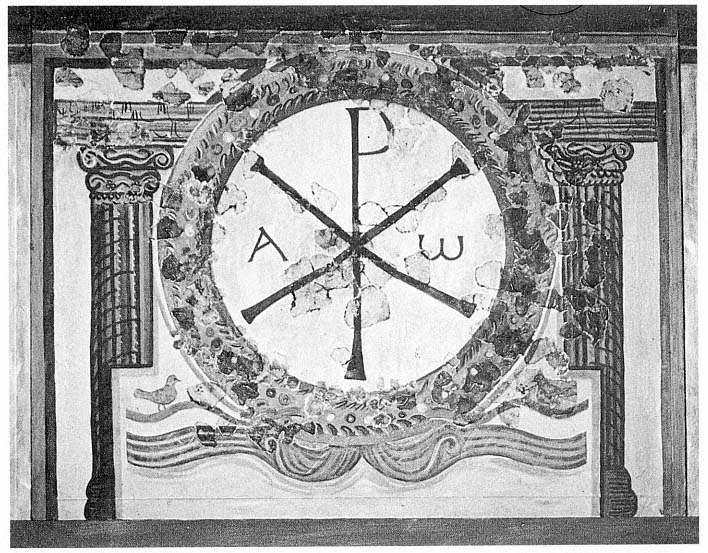
Fig. 64
Lullingstone, Kent. Fresco from a Roman villa. Photograph courtesy of the British Museum.
The Christogram encircled by a triumphal wreath is the Romano-Christian model for simple
Celtic ringed crosses.
only; 127, n. 3) without giving any reasons—but his skepticism, even unexplained, is easy to share, for there is not the slightest evidence anywhere in Ireland (or in the related Celtic territories of England, for that matter) that would support the assumption that the developed ring cross existed there as early as the seventh century. This type of cross made its appearance in the eighth century, but even then appears to have been relatively rare. In the ninth century it reached an almost unbelievable popularity that stopped with an uncompromising suddenness by the end of the century.
Conditions in the monastery of Clonmacnoise suggest the ubiquity of the developed ring cross in ninth-century Ireland. In his study of the grave slabs of this monastery, Stewart Macalister describes and reproduces no fewer
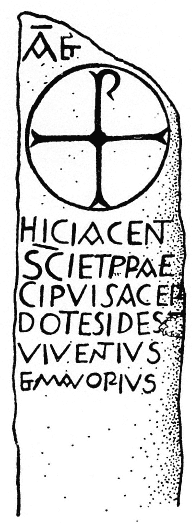
Fig. 65
Kirkmadrine, Rinns of Galloway,
diocese of Whithorn. Cross slab,
probably late fifth century. Its
vertical stem still shows the loop
of the P of the Christogram from its
Romano-Christian model. From
Charles Thomas, The Early
Christian Archaeology of North
Britain .
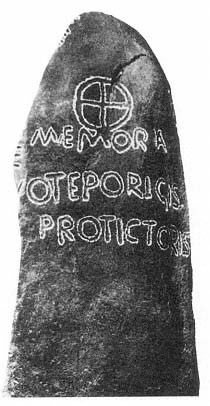
Fig. 66
Tombstone of Voteporix. Above the
king's name an equal-armed cross is
enclosed in a ring formed by two
concentric circles. From Charles
Thomas, Britain and Ireland in
Early Christian Times, A.D. 400–800.
than 112 of them with the ring-cross design. He points out that this entire body of Celtic crosses must be assigned to the years between 800 and 880 (Macalister 1909, 106). This is only a part, but a significant part, of the total story. "Only one true ringed cross," Lionard tells us, "is dated to the tenth century," and "there is no evidence for a survival into the eleventh century" (127).
Students of Celtic iconography have believed that the transformation of the ring cross with equal arms into the developed ring cross was an autochthonous Irish development.[5] I had no reason to question this belief until the summer of 1984 when during an incidental visit to the Minneapolis Institute of Arts, I was startled to find a Coptic burial shroud of wool and linen that
[5] For a superb analysis of the traditional Irish view, see Ó'Ríordáin, 1947, 108–14.
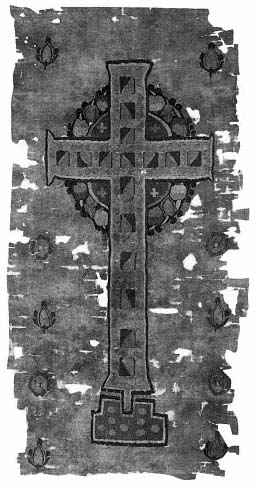
Fig. 67
Coptic burial pall, fifth to seventh century.
138.4 by 68.9 cm. The linen and wool fabric
is embroidered with a developed ring cross,
a design that became common on Irish cross
slabs and high crosses in the eighth and ninth
centuries. The vertical shaft terminates in a
tongue that rests in a groove in the base, a joint
characteristic of timber architecture but not used
in stone construction.
Photograph courtesy The Minneapolis Institute of Arts.
the museum's catalogue assigned to the fifth to seventh century (Fig. 67).[6] The cross shown in this textile is so strikingly similar in design to Irish ring crosses of the eighth and ninth centuries that it is difficult to preclude a developmental interconnection.
Embroidered on the Minneapolis shroud is the image of a large Latin cross with a wreath attached to its arms. The embroidery clearly represents a wooden cross, for its shaft has a tongue at the lower end, which rests in a deep groove made for it in the base. Such tongue-and-groove joints are typical of wood construction but are not at all characteristic of stone carving. That the cross could be detached from its base suggests that it served two functions, one stationary, the other processional.
When I discussed the Coptic shroud with Lotus Stack, the curator of textiles at the Minneapolis Institute of Arts, she showed me photographs of the narthex of St. Sophia in which there seem to be representations of developed ring crosses. From modern photographic views it is difficult to determine the exact nature of the original design of the mosaics. Observations made in 1847–1849 by the Fossati brothers, however, seem to confirm the presence of developed ring crosses. After removing the whitewash that had been applied over the mosaics of the narthex when the church was converted into a mosque, the Fossati brothers made drawings of what they discovered (Fig. 68). The mosaics they brought to light in this manner date from the ninth century, as Cyril Mango has shown.[7]
I must stress that I have not been able to discover any convincing evidence of developed ring crosses at St. Sophia that antedate the ninth century. The sixth-century mosaics in the soffit of the narthex, discussed in volume 1 of Thomas Whittemore's Mosaics of St. Sophia at Istanbul , show beautiful examples of Latin crosses forming part of the original sixth-century mosaics of the church (one of these is shown in Fig. 69) but not a single ring cross (Whittemore 1933, Pls. 5, 7, 9, 11).
In a fascinating study entitled "Origins of the Free-standing Stone Cross in Ireland: Imitation or Innovation?" (1987), Nancy Edwards looks at the literary sources attesting the distribution of freestanding wooden crosses of Latin shape in seventh-century Europe. One of the most startling references she examines is in Adamnan's De locis sanctis , where a wooden cross of this shape is said to stand in the place where Christ was baptized: "In eodem sacrosancto loco lignea crux summa infixa est" (In this sacred spot a tall wooden cross is implanted). This text, as Edwards correctly infers, identifies the ultimate Near Eastern prototype of the Latin cross.
Crosses of similar shape, Edwards points out, are mentioned in Adamnan's Life of Columba , written in 688–692, and in Bede's Ecclesiastical History . All of these texts, which she cites word for word, demonstrate that wooden crosses of Latin shape that could be either stuck into the ground or carried were common in seventh-century Ireland and in the Celtic territories along the nearby coast of England. But in Byzantium, as Whittemore has shown, they appear as early as the sixth century (Fig. 69). Thus we must con-
[6] This shroud has been discussed by Lotus Stack, curator of textiles, the Minneapolis Institute of Arts, in Bulletin de Liaison du Centre Internationale d'Etude des Textiles Anciens , 1984. An extended version of the same essay is being published in a delayed issue of the Minneapolis Institute of Arts Bulletin 66 (1983–1985).
[7] Mango, 1962, Figs. 42, 44, 45, and 93. For the date of the mosaics, see Mango, 93–101.
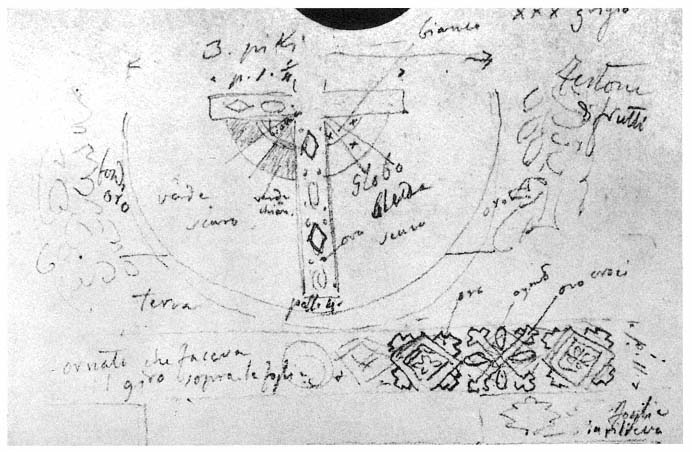
Fig. 68
St. Sophia, Istanbul. Developed ring cross in the mosaics of the narthex. Ninth century. Drawn by the Fossati brothers.
From Cyril Mango, Materials for the Study of the Mosaics of St. Sophia at Istanbul .
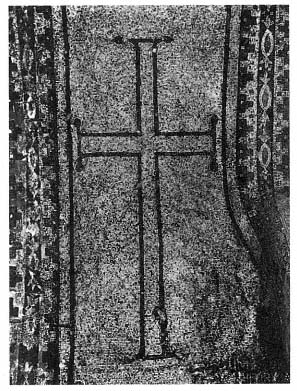
Fig. 69
St. Sophia, Istanbul. A mosaic from the original sixth-
century decoration of the narthex of the church,
located in the soffit of bay C of the south cross.
From Thomas Whittemore, The Mosaics of
St. Sophia at Istanbul .
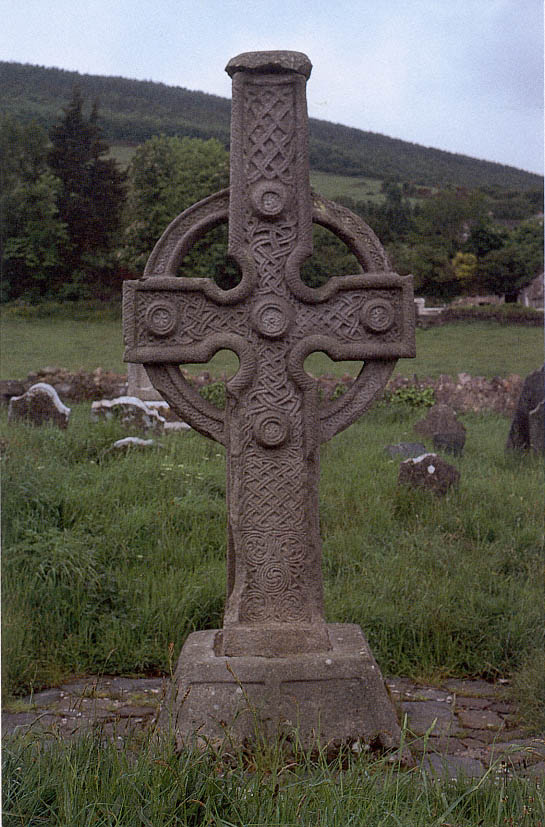
Fig. 70
Ahenny, County Tipperary. High cross (the so-called North Cross), generally assigned to the eighth
century on the basis of geometrical motifs and interlacing spirals comparable to those in the Book of
Kells.
Photograph by Walter Horn.
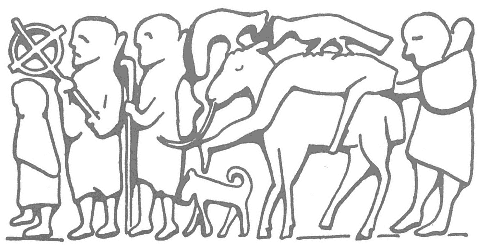
Fig. 71
Ahenny, County Tipperary. High cross (the so-called North Cross). A relief on the east side
of the base of the cross. Drawing from Françoise Henry, Irish High Crosses; in her L'Art
Irlandais there is a photograph of this carving.
tend with the possibility that the phenomenal spread of the Latin cross in seventh-century Ireland and Celtic England likewise received its primary impetus from the Near East.
It is worth mentioning in this context that of the seven crosses of Latin shape reproduced by Charles Thomas in his Early Christian Archaeology of North Britain (1971, Pls. 3 and 4 and Figs. 54, 59, 81, 93, and 98), none seems to antedate the seventh century. In his "Genesis of the Celtic Cross" Seán Ó'Ríordáin expressed the view that the Irish high crosses, which can be dated to the eighth and ninth centuries, are skeuomorphs translating into stone the developed ring-cross design embodied in identical crosses fashioned in wood.[8] He based this contention on the depiction of such a cross in a relief on the famous North Cross of Ahenny (Fig. 70) and on the recumbent cross slab of Clonmacnoise (see Fig. 60). The relief at Ahenny shows two priests leading a procession in which a decapitated warrior is being carried home on his horse. One priest holds a crozier; the other carries a ring cross set on a long handle (Fig. 71). The apparent ease with which he carries this cross strongly suggests that it was fashioned of wood.
The recumbent cross slab of Clonmacnoise shows a cross of almost identical design, the foot of which ends in a point—another unmistakable sign of wood construction. Ó'Ríordáin, in his discussion of these monuments, draws attention to the striking architectural parallels of this translation into stone of motifs originally conceived in wood: the curved stone finials of many early Irish churches, which imitate in stone the crossing of the decorated extremities of the gable barge boards of timbered churches.
Unquestionably, both the widespread popularity of ring crosses and their monumentalization into the great high crosses are uniquely Irish phenomena. But it cannot be said with the same assurance that the conversion of the simple ring cross into the developed ring cross is an autochthonous Irish development.
The design on the Coptic textile in the Minneapolis Institute of Arts compels us to conclude that the shape of the developed ring cross as well as the custom of carrying crosses fashioned in this manner in religious processions was influenced by new stimuli from Egypt that reached the Celtic territories of Ireland and England in the eighth century.
[8] Ó'Ríordáin, 1947, 108–14. W. G. Collingwood, in his study Northumbrian Crosses of the Pre-Norman Age , 1927 (5–9, 11, 137), postulated a wooden model for the English high crosses of stone; cf. Champneys, 1910, 75, 215.
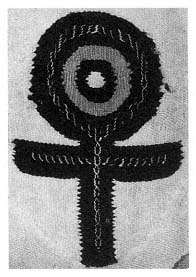
Fig. 72
Woven ankh, an age-old Egyptian
symbol for life, displayed at the
State Pushkin Museum of Fine
Arts in Moscow, assigned by
Shurinova to the fourth century.
From Shurinova, Coptic Textiles
in the State Pushkin Museum
of Fine Arts, Moscow .
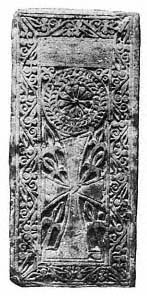
Fig. 73
Coptic stela from Edfu,
now in the British
Museum (B.M. 1520),
where it is assigned to
the fifth to eighth
century A.D. It shows
an elaborate version
of the ankh. From
Badawy, Coptic
Art and Archaeology .
Future studies devoted to this problem will have to face an intriguing question: Is the developed ring cross of the Minneapolis shroud a historical descendant of one of the most ancient and ubiquitous Egyptian symbols, the ankh (Fig. 72)?[9] In Early Christian times this symbol was incorporated into such stunning designs as the carving of a stela from Edfu (Fig. 73), consisting of a large Latin cross that carries on its shaft a beautifully tiered and richly ornamented circular enclosure whose diameter is as wide as the transom of the cross beneath it.[10]
My first intuitive response to the question was a clear-cut no. Nevertheless, in our context it is significant that this symbol for life, the ankh, had been important to Egyptian iconography for over a thousand years before the conquest of Egypt by the Romans.
Another combination of ring and cross to which I would draw attention in this connection is in the mosaic paving of the chancel in the North Basilica of Ostracina, built in the sixth century A.D. (Fig. 74). In the paving a cross with arms of equal length is entirely enclosed in a circle. To transform a design of this kind into a developed ring cross would call for no more than a simple extension of the shaft and transom of the cross beyond the enclosing circle.[11]
This step seems actually to have been taken in a non-Christian Egyptian weaving that Klaus Wessel assigns to the fifth century (Fig. 75). In it the head of a youth whom Wessel identifies as Mithras (1963, 236), wearing a Phrygian cap over a crop of curly hair, occupies the center of a circular enclosure. From this enclosure the four arms of a cross, decorated with lions, extend outward to a rectangular frame. It does not matter that this weaving is not Christian. What matters is that it is Egyptian. Klaus Wessel tells us that it was "im Kunsthandel" when he saw it (236). I have not found it referred to anywhere else, but draw attention to a weaving of similar design and clearly
[9] The Latin term for this symbol, crux ansata , means "cross on a handle"; the obligatory form of this handle was a circle, supported by a cross. On the history of the ankh in Egypt from pharaonic through Early Christian times, see Maria Cramer, 1955.
[10] In Badawy, 1978, 215, this stela is dated "A.D. V–VIII." Another example of the same design, from Fayum, is now in the Staatliche Museum of Berlin (see Badawy, 212, where it is dated "A.D. VI–VII."
[11] Fig. 74 is from a drawing reproduced by Badawy, 1978, 85, on the basis of a study by Jean Clédat entitled "Fouilles à Khirbet el Flousiyeh." This study is so poorly cited that it is impossible to establish whether it is an article or a book. I did not find it referred to in any library catalogue under the name Jean Clédat and could not trace it in any other way.
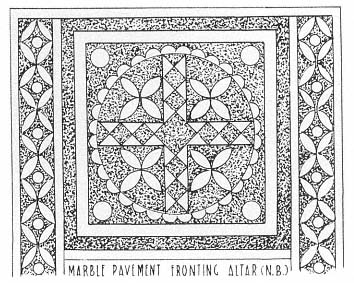
Fig. 74
Marble encrustation in the floor of the chancel of the North
Basilica of Ostracina, built in the sixth century A.D. From Badawy,
Coptic Art and Archacology .
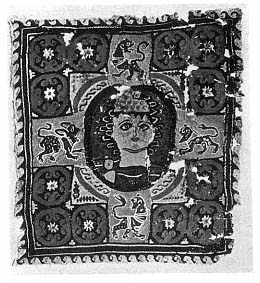
Fig. 75
Non-Christian Egyptian weaving attributed to
the fifth century A.D. , showing the head of
the Persian God Mithras within a circle
superimposed on a cross.
From Klaus Wessel, Koptische Kunst:
Die Spätantike in Ägypten .
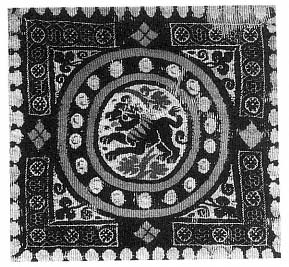
Fig. 76
Christian Egyptian weaving attributed to the fifth
century A.D. , showing a running lion within a circle
superimposed on a cross. From Shurinova, Coptic
Textiles in the State Pushkin Museum
of Fine Arts, Moscow .
Christian derivation that is in the collection of Coptic textiles of the State Pushkin Museum of Fine Arts in Moscow (Fig. 76). Shurinova (1967) assigns it to the fifth century. It shows a running lion in a circular enclosure that is superimposed on the arms of a cross.
In the Mithraic and the Moscow textiles we come as close to the developed Egyptian ring cross of the Minneapolis shroud as one could possibly expect to come in a preceding stage.