
The Circumstance of Revision:
Looking at Himself Being Looked at Looking at His Work
Although viewer and maker are separate identities imagined as placed and divided from one another outside the depicted scene, they are the same actual person with two sides or faces—namely, the artist, whose positions as maker and viewer of the image are twisted together as a single identity in the continuous sequence of his work. To make the image he must view it, and to view the image he must make it. He is constantly exchanging one position for the other—coming around his hands with his gaze, coming around his gaze with his hands. And at the same time, he is looking over his shoulder—for another is gazing back at him and at the twists he accomplishes in and as his work. In looking at him looking at his work, this other—the ruler still outside the scene—causes him to twist himself to attend to the other's gaze. In all of this, then, revision becomes re-vision; the artist looks again at what he is doing, and, in looking again, he may not be looking with entirely the same eyes or even with his own eyes at all, for meanwhile he has been looking back to see how the other is looking at him and his work.
Like the figure of the right-hand enemy at the reverse bottom, other telling slips in the progress of his work are symptoms of the artist's double "two-sidedness," the fact that he must come around himself to make and view the work in front of him at the same time he must turn away from it to attend to
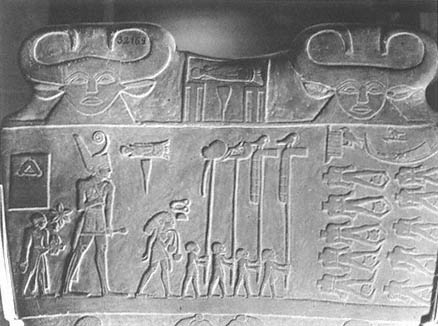
Fig. 47.
Detail of Narmer Palette, obverse: (left to right) sandal bearer, Narmer, scribe
priest, standard bearers, and ten decapitated enemies.
Photo courtesy of Werner Forman.
what is behind him. For example, to draw the ten decapitated enemies on the obverse top (Fig. 47), he needed to turn the palette (left hand coming around right) at right angles to the vertical orientation of the register ground lines. He placed the first small enemy figure in the top row against the side edge, the ground line. With his hands coming around his gaze and perhaps thinking of the enemies on the reverse bottom, he drew the enemy's feet both facing right. Doing exactly the same for the next enemy (that is, for the figure second from the left in the top row of enemies), with his gaze in turn coming around his hands, he recognized the compositional difficulty he was creating for himself. With the third enemy in from the left, he turned the two feet to face inward. In this passage his power as artist—his ability to take possession of making and viewing as an uninterrupted, undisturbed condition of replicating and
revising—seems to be confirmed even as the trace of the danger of discomposure persists. As artist, he seems to have escaped what he represented to be the case for his depicted subjects, for whereas the depicted enemies' arms are bound and their heads lopped off, the hand that drew them moved freely with the gaze, always taking control as the work threatened to go out of control. Here we can accept his "mistake" as a successful revision, suppressing a possible difficulty and even adding greater descriptive detail to this passage of depiction.
But when the maker must depict himself in the scene, the two-sidedness of his identity as an agent in control of his work and the fact that he is followed, or shadowed, by another catch him up in a twist. At the introduction to the narrative on the obverse top, the scribe-priest marches in the ruler's retinue in front of the ruler himself—or the ruler follows behind him—to inspect the ten decapitated enemies, the ruler's handiwork and, in the canonical form of the image, a metaphor for the palette itself. Slung over his left shoulder the scribe carries his two paint pots with the rope hanging down in front of his torso. One pot would contain red ink for a preliminary sketch of a text or pictorial composition or for making rubrics and the other black ink for its completion. Whether or not this figure depicts the maker of the Narmer Palette—we cannot confirm it literally—he represents scribes and artists, makers of pictures and texts.[2]
The real artist's interest in him is figured in the complex sequence of slips and revisions in the cutting. For one thing, the artist could not quite manage the two paint pots. They seem to hang impossibly in front of rather than beside or behind the figure, although the rope hangs down his torso and is clutched by his left arm in such a way that the pots could be carried only by being slung over the left shoulder. Here we might recover the mistake as an element of the image. For example, perhaps the descriptive function of this passage of depiction required the artist to inform his viewers of the person's occupation—and somehow he had to depict the paint pots otherwise out of view, like the lead bowman's quiver of arrows, slung over the shoulder, on the Hunter's Palette (Fig. 28).
Why not then do what the maker of the Hunter's Palette had done, and hang the paint pots properly over the right shoulder (on the viewer's left) and "behind" the figure? The maker's problem here is that working from left to
right he had obviously produced the figure's right arm and right shoulder already —with or without rope and pots; and working from left to right, he was forced into an awkward arrangement for the left shoulder: he had no choice but to place the paint pots "in front of" it. In fact the right arm, despite its failure, is a revision of an earlier attempt, cut over something else after the torso and left shoulder had been completed. The new right arm cuts off part of the old left hand. It seems likely, indeed, that the old right arm would have carried the rope and paint pots in proper orientation hanging behind the back. Why then revise the work by moving the rope and paint pots to the other side, the figure's left, and recutting his right arm to hang down rather than clutch the rope, as it probably did in the initial version?
The answer lies behind the figure even farther—that is, where the figure of the ruler is placed. Working from left to right, the artist had placed the scribe's back, right foot close to the forward, left foot of the ruler in the same way the ruler had been placed close to his sandal bearer following behind him at the left edge of the composition. But then it turned out that the figure carrying rope and paint pots over the right shoulder would be too close to the ruler's mace to be fitted in comfortably. Therefore, in what must have been the first revision in this sequence of recuttings, the scribe's back, right leg (on the viewer's left) had to be stretched out at just enough of an awkward angle to put him out of the ruler's way; the right leg angles up from the ground line with an extreme tilt. And then, in relation to the figure's excessively long right leg (on the viewer's left), his forward, left leg coming down to the ground line (on the viewer's right) would appear stumpy, like a peg leg protruding from his skirt—so the skirt is cut at an upward slant toward the front to provide room for a longer, "taller" forward leg matching the back one. Despite this effort the figure would still appear too stooped or lame, dragged backward by the paint pots; so the paint pots come around to the front, the left arm clutching the rope is produced, and the back, right arm, formerly clutching the rope holding the pots, is cut over again. Note, then, that at one point in the sequence of recuttings, the figure would be carrying two sets of paint pots, one over each shoulder.
By this point in his work of revision, the artist was unable to handle the right arm. He did not know which part of it to show himself or the
viewer—back, left side, right side, or front—and awkwardly revealed a little of each: precisely because the ruler comes up forcibly behind him, more of the maker now comes "into view" in the scene of representation.[3] The new right arm and hand—used by a right-handed artist, like the maker of the Narmer Palette, to wield the brush or hold the chisel—hang loose and useless; and its hand finally comes out as a peculiar upside-down version of the hands of enemies acknowledging the ruler (as on the reverse bottom zone of the palette and on the upright fleeing enemy on the Battlefield Palette [Fig. 331]). The left shoulder carrying the paint pots clutched by the left arm is completely twisted around itself. Everything becomes contorted or useless precisely because the artist attempted to revise the figure away from the ruler coming up close behind. There is no confidence in this effort; no full composure can result.
As a replication revising late prehistoric images, the Narmer Palette seems, on the evidence of its internal stratigraphy, to have been made under the very conditions it represents in narrative and symbol. It was made with the ruler just about to wield his blow standing beside and behind the maker, perhaps not literally over his shoulder but certainly close enough—sometimes too close for comfort. The ruler was close enough for the maker to turn his head away from the replication he was making, an activity determined by the history and the general conditions of intelligibility of late prehistoric representation, and toward the person of the ruler coming up behind him. He had to make room for the ruler, both in the image itself and in the making of it. Despite what the narrative and the symbolic images seem to say in their deliberated, literal presentations, the maker seems to have been caught partially unaware. He did not quite see the power and danger of the ruler, or right away; his corrections—of the entire tradition of replication, and of his own image as a deliberated correction of that tradition and of itself—revise him away from his failure to see and toward a greater recognition of the ruler.
The artist's knowledge must have come both pro-and retrospectively. Late prehistoric representation had implied that the ruler is decisively powerful and dangerous (Figs. 28, 33), but the maker could not know how much ground the ruler had gained until he looked over his own shoulder and found him standing there. The work, in other words, had to be hit by the very blow it narrates and symbolizes. The narrated or symbolic blows are only in representation, but the
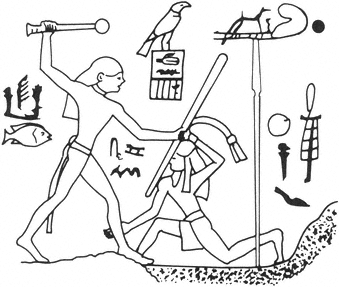
Fig. 48.
Carved ivory label from Abydos, showing Den smiting
his enemy, First Dynasty. After Spencer 1980.
blow that hits them is real. It hit the maker himself as he composed the image, inevitably losing full control over the replication. The measure of proficiency, subtlety, and sophistication he and earlier makers had achieved in the ongoing elaboration of late prehistoric representation is noticeably disrupted, as if he had been almost pushed aside by the identity looking over his shoulder to inspect the representation of itself.
As a symptom of what it represents, the revision precipitated by the maker of the Narmer Palette could be selected for continued replication as a coherent symbol when other, later image makers, following his example, turned to face the ruler, now fully on this side, the viewer's and maker's side, of the text rather than on its reverse (Figs. 48–50). His revision is no longer uncomfortable, no longer the cause of discomposure or confusion, when later image makers no longer look over their shoulders—when they turn to work with the ruler directly in their field of view and as the frontal field of view. Discomposure will be reserved now entirely for the enemies of the ruler who do not see and acknowledge him (Figs. 51, 52). And with the ruler no longer beside or behind
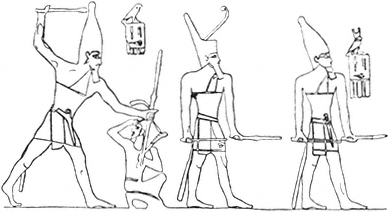
Fig. 49.
Cliff relief from Wadi Maghara (Sinai), showing Sekhemkhet smiting his enemy
and standing in majesty, Third Dynasty. After Petrie 1896.
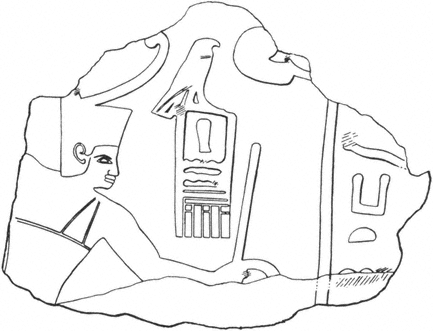
Fig. 50.
Cliff relief from Wadi Maghara (Sinai), showing Sanakht smiting his enemy,
Third Dynasty. After Gardiner and Cerny[*] 1952–55.
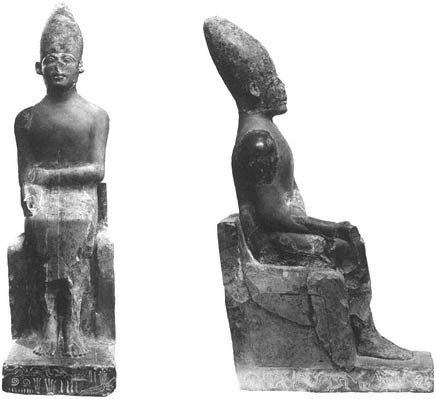
Fig. 51.
Limestone seated figure of Khasekhemuwy in majesty, with figures of his enemies incised
on the base (see Fig. 36), late Second Dynasty.
Courtesy Ashmolean Museum, Oxford.
them, but rather in front, later image makers ceased to narrate the story of his sideways, oblique, and contested advance from the wild outside representation—off to the side, from the back—into the world they could represent. The representable world, directly before them, becomes the ruler. More exactly, it does not matter whether they look straight ahead or over their shoulders when in any case they must face the ruler who can still take them from behind.