
2. Change through Action
How can developments in modern society be explained? Why is change so rapid and intense on the one hand and so slow on the other? How can developments of different magnitudes be related to one another?
If these questions are to be answered properly, it is necessary to have some kind of conceptualization of permanent change, and not to simply attempt to explain current arrangements as an extension of past trends. Everything is in permanent flux.
The conceptualization of social change must also take into account that different structures do not simply exert influence independently of one another; they also exert influence on one another. Thus, inequality in the distribution of resources and power in the economic sphere is neutralized by political institutions, such as universal suffrage, social guarantee systems, and public services, in such a way that civic society and capitalism mutually encourage one another (Marshall [1949] 1977).
Furthermore, learning effects also occur in the process of social change. Rapid developments in one society serve as models for change in other societies. This statement applies both to positive developments and to instances of pathology such as refusals to work and protest movements.
Thus change means that altered or even new actions or modes of behavior generate a whole series of ramifications, not simply repetitions of the past.
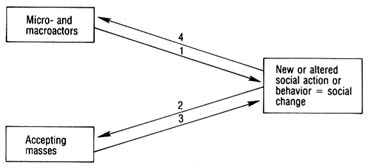
Both microsocial and macrosocial changes occur. Microsocial change is the altering of action or the initiating of new action on the part of a small number of actors who are aware of one another. Macrosocial change encompasses the alternations in action or the emergence of new interrelationships of action that involve many actors who are not aware of one another. Often changes on the macrosocial level can be traced back to changes on the microsocial level: a new or altered action or behavior is always generated or discovered in elementary interrelationships of action and developed as a habit by individual actors in small groups (Relationship 1 of Model 1). The actors attempt to transfer the action or behavior to other groups, or these groups follow suit (Relationship 2 of Model 1).
For example, a new attitude to family size, a new sexual behavior, or a new medical discovery may be adopted initially by a small number of actors before being exhibited to others as a model or gradually becoming appreciated by others and then deliberately imitated. Social change can also be given impetus when new personalities take over macroactor roles, for example, new party leaders and presidents, innovative entrepreneurs and labor union leaders with initiative, church leaders who convey a "message," productive scientists and academics, or imaginative legislators. Individuals and elites with an innovative orientation tend to rise to the top and usher in societal change especially at times of crisis (Nisbet and Perrin 1970, 320).
Change is introduced by either personalities, significant actors, or very small groups who exploit elements of the current social and material situation. If change is to be set in motion by significant actors, it needs to be taken up by many others and introduced into everyday action and behavior. It must be able to be transferred and must allow the
Model 1.
Actors and Social Change
possibility of others adjusting to it. Hence the following distinctions among actors may be drawn:
1. Microactors who introduce alternations but act or behave in isolation and do not succeed in transferring the alternations to others or who do not set any processes of adjustment into action.
2. Microactors who interact with others among the masses and who generate alternations or adjustments.
3. Macroactors who address themselves to large masses, or whose behavior is relevant to them, but whose actions are not adopted or whose behavior has no effect.
4. Macroactors who assert themselves in processes of transfer and adjustment.
Action or behavior carried out on a mass scale—or its rejection—(Relationship 3 of Model 1) affects the position of the micro- and macroactors producing the innovations (Relationship 4 of Model 1). Mass acceptance of new actions and modes of behavior strengthens the innovators' positions in the first instance. The initial effect is one of creating prestige. Soon, however, the actors thus singled out become relatively weaker as the accepting masses improve their living situations by adopting the new action or mode of behavior. Nothing much has changed for the original innovators. They had already been able to put these actions and behavior modes into practice, and in the long run they are unable to derive advantage from the gratitude of the accepting masses. These interrelationships are laid out in Model 1.
Parsons's differentiation between change within the system and change of the system (1951, 480) is no more than a relative distinction. The mass of microactors within an interrelationship of action are able to bring about as much change as can successful macroactors from without: the end result in either case is the emergence of a new relationship of action. The
classic illustration of the first case is the American Revolution. At the outset none of the macroactors, nor any small group, had any notion of the action interrelationship that was later to arise in North America. Yet step by step the actors and groups moved away from the status of being a British colony: "I never had heard of any Conversation from any Person, drunk or sober, the least Expression of a wish for separation, or Hint that such a Thing would advantageous to America" (Benjamin Franklin, cited in Rossiter 1956, 41).
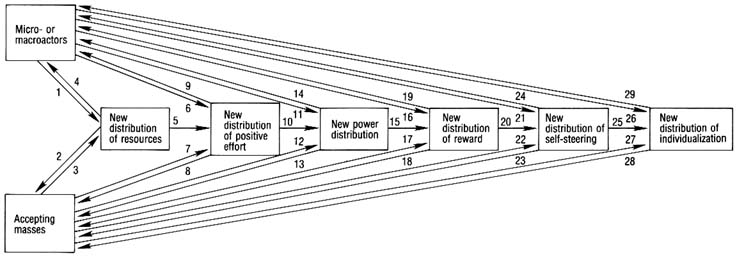
In modern societies, as elsewhere, the chief concern is with a secure and better life, which first means survival, then living the good life. This, however, can only be achieved if in each case a certain new level of resource mobilization can be attained. Anyone wishing to survive or to raise his or her living standards has need of the assistance and cooperation of other actors. These other actors, as carriers of resources, can be activated (Relationships 1 and 2 in Model 2) to generate additional positive achievement if they are promised rewards or threatened with punishment. Because rewards provide a stronger motivation to produce the desired positive effort than punishment, elites substitute rewards for punishment as the production of goods and services grows (Haferkamp 1983).
To refer to Model 2, raising the resource potential (Relationship 3) has the unintended consequence that those in possession of the new resources become more important in relation to the owners of the old resources (Relationship 4). This means that the new resource holders are able to generate more positive effort in comparison with other important micro- and macroactors (Relationships 5–7) and that the relative weights of positive effort are altered (Relationships 8–9). But now some power needs to be conceded to the new carriers of achievement, so that power is ultimately shared with them. This sharing of power affects the distribution of rewards (Relationships 15–19) and the possibility of self-steering (Relationships 20–24) and individualization (Relationships 25–29).
The trends toward growth and downward distribution are the unforeseen consequences of the mobilization of resources that occurs in all stratified societies. If this path is not taken and resources at the lower levels of society are left unutilized, societies remain below their potential level of performance. If no drive is made to raise the level of achievement among the masses, less power is generated than is possible. And if power is not shared and the interrelationships of action are controlled not by increasing rewards but by the use of punishment, then the forces at the top ruin the very interralationships of action they wish to profit from. The historical examples of the fall of the pharaonic empires (see Wittfogel 1938) and the major problems faced by socialist societies in the present day come to mind in this regard (see Senghaas 1982, 277).
Model 2.
Actors, Growth and Downward Distribution
The arguments formulated thus far serve to explain many different developments. Resources are exploited to a much greater extent in modern societies than elsewhere. This has had many consequences, the most immediate of which is the greater part entrepreneurs have played. It is possible to continue in this vein and explain many differences between modern societies and nonmodern ones. But let us turn to the end of the chain of influences, to extreme individualization. It is particularly advanced in the United States and least developed in Japan; Western Europe, including West Germany, lies in between. Evidently, however, the degree of individualization is not correlated with resource mobilization, for in this respect there are no telling differences between the United States and the German Federal Republic, and Japan is remarkable for its particularly high degree of mobilization.
Even among the intermediate links in the causal chains of Model 2, the combination are not maintained as we would expect. Can it be said, for example, that in the United States, with so many subcultures, we also encounter the highest measure of political participation in general? Or that in West Germany, with its pronounced leveling of authority, we find the work performance at the lowest levels that would be appropriate to such conditions? And how can the incidence of counterdevelopments and pathologies be explained? Do we find that the production of toxins and pollution is at its highest level where the most resources have been mobilized? Do minorities have a particularly strong blocking power where the spreading out of achievement-orientation is especially advanced? Why do resources for achievement remain unused? Why do monopolies of power exist that are not based on appropriate achievement? Something more than just resource mobilization and its consequences needs to be added to our model of actors and interaction efforts if we are to understand and interpret the development of modernity. I believe that two other additional factors are essential:
1. Contractual action, which makes everything, including ascription, the object of negotiation.
2. Radical values of equality.
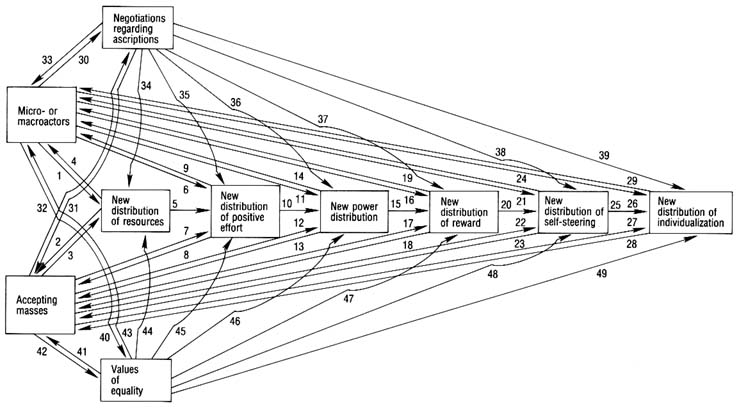
Both factors are typical of modern societies, albeit in different ways from one society to another, and they are the most significant elements of action in these societies. The influence exerted by these two factors on the change toward individualistic modern society is presented in Model 3. This model shows the complex relationship between the fundamental processes of change and the hallmarks of modernity. Macroactors, together with microactors endowed with initiative, assign others to a place in the status hierarchy (Relationship 3 in Model 3), and their ascription are either accepted or rejected (Relationship 31). When significant actors
Model 3.
Actors, Growth, Downward Distribution, Negotiations Regarding Ascriptions, and Values of Equality
interact with the accepting masses, recognized ascriptions emerge (Relationships 32–33). These ascriptions then have effects on the various types of distribution (Relationships 34–39). Actors also create new values (Relationship 40), which are either internalized or rejected by the masses (Relationship 41). This interaction leads in turn to a recognized system of values (Relationships 42–43), which also exerts its influence on all the distributions (Relationships 44–49).
In the following section I concentrated on contractual action regarding the ascription of positive effort, how this trend became widespread, and how it influence the processes of social change that lead to modern societies (Relationships 30–39).