
Baldassare Donato, Madrigals to 1553
We have already glimpsed Baldassare Donato several times in previous chapters — Donato the maturing choirboy who gained favor in the salons of Venice, was made right-hand man to Willaert, and informant to the Procuratori. Donato's beginnings are in some respects an inverse reflection of Perissone's. Whereas Perissone entered San Marco only in 1548 after several years of scrambling to publish and to perform under private aegises, Donato was already mounting the chapel hierarchy at a comfortable pace by 1545-46, in his mid- to late teens. Yet neither of the prints that unveiled the Venetian school in 1544 — Doni's au courant Dialogo della musica or Rore's Secondo libro — showed any sign of him. Donato's first published work appeared only with Scotto's edition of Rore's Terzo libro of 1548 when Donato was about eighteen to twenty-two years old — still young but hardly precocious by the standards of a Parabosco.[69] Unlike Perissone's compositional career, then, Donato's seems to have been hatched directly from his breeding in the chapel.
Donato's first published madrigal was a setting of Petrarch's sonnet S'una fed'amorosa, un cor non finto (no. 224) that showed him already adept in the diction and counterpoint reserved for sonnets.[70] Petrarch's poem, compounded of seven conditional clauses resolved only in the final verse, deploys a rhetorical strategy ready-made for the continuously woven polyphony and slight motivic variation developed by Willaert. The entire sonnet consists of a large paratactic chain, reinforced by anaphora and structured by linking together in additive series several of its ubiquitous "if" clauses. Since the verb of the main clause is postponed all the way until v. 13, the poem's essential form can be gleaned from the opening and closing lines (1-4 and 12-14):
S'una fed'amorosa, un cor non finto, If faithfulness in love, an undeceiving heart,
Un languir dolce, un desiar cortese, A sweet languishing, a courteous desire,
S'honeste voglie in gentil fuoc'accese, If virtuous longings kindled in a noble fire,
S'un lungh'error in cieco laberinto . . . , If a long wandering in a blind labyrinth . . . ,
. . . . . . . . . . . . . . . . . . . . . . . . . . . . . . . . . . . . . . . . . . . . . . .
S'arder da lunge et agghiacciar da presso, If to burn from afar and freeze close by
Son le cagion ch'amand'io mi distempre, Are the reasons that I untune myself with love,
Vostro, Donn', è'l peccato et mio fia il danno. Yours is the wrong, Lady, and mine may be the loss.
[68] The words are Venier's; see the Appendix to this chap.
[69] On Donato's age I follow Ongaro, "The Chapel of St. Mark's," who thinks he was probably on the younger side of the four-year span given.
[70] For a full transcription see my "Venice and the Madrigal in the Mid-Sixteenth Century," 2 vols. (Ph.D. diss., University of Pennsylvania, 1987), 2:656-67.
In setting this sonnet Donato appealed to the plainest possible motivic idiom, avoiding individual semantic emphasis in favor of a language that would play up the poem's local syntactic and rhetorical differentiations while still countering any pull toward articulation. The setting's dearth of syncopation or sustained progressions by fifth and its proliferation of two-note declamatory groups help check the possibility of any forceful approaches to cadence. The entire setting uses only one diminished cadence: it takes place at the end of the first couplet, but with textual and contrapuntal cadences displaced from one another (see mm. 14-16 in Ex. 55) and only the cantus's noncadential bb-flat sharing the text with the cadencing contratenor. The only other cadences in the first quatrain fall at the end of v. 4, both simple cadences, the first (mm. 26-27) emphasized with an f-sharp in the cantus, the second with an undiminished half cadence (mm. 31-32).
All of this contrasts greatly with Donato's madrigalian settings from his first solo collection of 1550, a medley of light madrigals for four voices and canzoni villanesche alla napolitana published as Le napolitane, et alcuni madrigali a quattro voci.[71]Le napolitane points up the loose affinity of villanesche with lighter four-voice madrigals, both of which profited from Donato's natural gifts for vivid, animated rhythms and sharply etched melodies. None of the madrigals in it are sonnet settings. Indeed the opening number, Vaghi pensier che così passo passo, setting the third stanza from Petrarch's canzone no. 70, serves as a reminder that single canzone stanzas — even Petrarch's — were thought of by composers in a way more akin to poetic madrigals than to weightier sonnets (as poets conceived them).
Vaghi pensier is a compact mix of endecasillabi and settenari. With its emblematic lament on the stony lady culminating in the famous incipit from Dante's Rime petrose, it must have made good capital with literary-minded book buyers. (The stanza had already been singled out for musical treatment by Parabosco four years earlier; see Table 9, no. 16.)
Vaghi pensier che così passo passo Yearning thoughts, which thus step by step
Scorto ma'havet'a ragionar tant'alto; Have led me to such high speech:
Vedete che madonna ha 'l cor di smalto You see that my lady has a heart of such hard
Sì forte ch'io per me dentro no 'l passo. Stone that I cannot by myself pass within it.
Ella non degna di mirar sì basso She does not deign to look so low 5
Che di nostre parole As to care about our words,
Curi, che 'l ciel non vuole, For the heavens do not wish it,
Al qual pur contrastand'io son già lasso; And resisting them I am already weary;
Onde come nel cor m'induro e 'naspro, Therefore as in my heart I become sad and bitter,
"Così nel mio parlar vogli'esser aspro." "So in my speech I wish to become harsh." 10
[71] The print also included villotte by Perissone. The last three numbers in it are Donato's settings of Venier's stanzas in praise of Venice (see Chap. 4 nn. 78-79).
Between publications of S'una fed'amorosa in 1548 and Le napolitane in 1550 Donato published a single ottava setting, O felice colui ch'al suo volere, in Scotto's Fantesie, et recerchari a tre voci, accomodate da cantare et sonare . . . con la giunta di alcuni altri Recerchari, et Madrigali a tre voci of 1549 (1549 ), a print that includes works by Willaert, Rore, and others. (Einstein's statement that this was the first appearance of Donato's music in print is of course incorrect; The Italian Madrigal 1:448.)
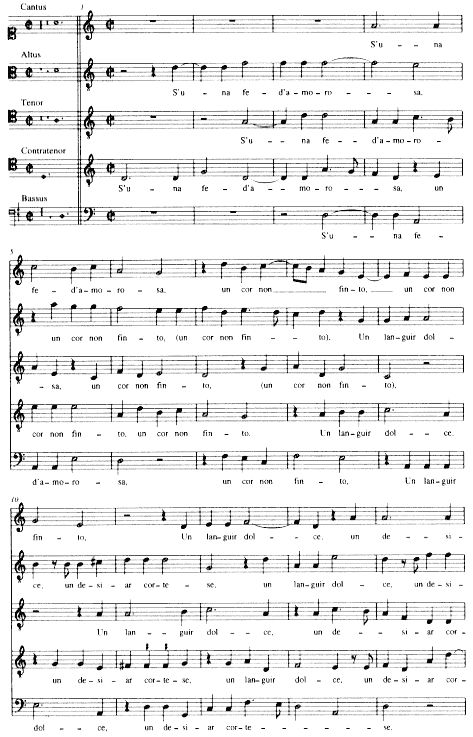
Ex. 55.
Donato, S'una fed'amorosa, un cor non finto (Petrarch, no. 224),
mm. 1-32; in Cipriano de Rore, Terzo libro a 5 (Venice, 1548) (RISM 15489 ), p. 13.
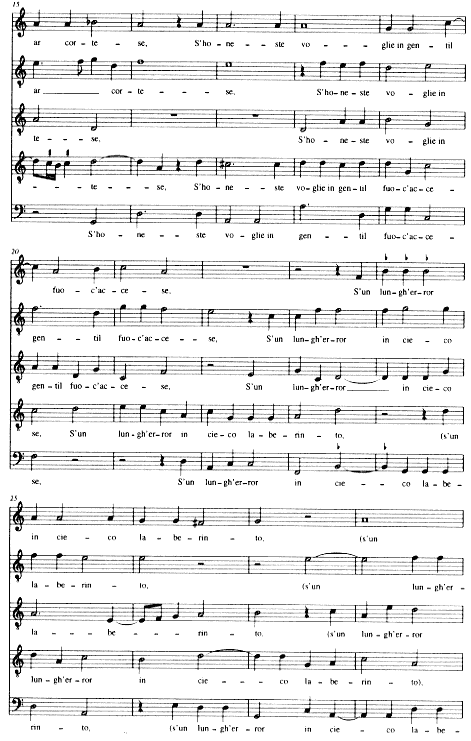
Ex. 55
(continued)
(continued on next page)
(continued from previous page)
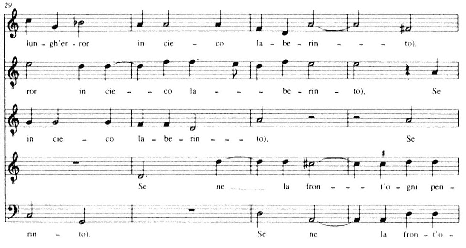
Ex. 55
(continued)
Donato's style here so much avoids the heavier manner of Willaert's and Perissone's sonnet settings that Einstein likened it to that of the young Palestrina.[72] Sealing off the four lines of piedi with a sectional break, Donato recognized the stanza's segmented character, as earlier madrigalists had done in setting canzoni and ballata-madrigals, and also (like them) built his setting out of crisp, short phrases and a metrically uniform imitative technique. Cadences like the ones in Ex. 56 assemble the voices in homorhythmic declamation (mm. 38, 43, and 48), or else they converge successively by pairs.
Donato's generally careful declamation helped project the stanza formally, rather than elaborating it rhetorically, but he also embellished the text in line with the lighter traditions that especially suited his natural gifts. Thus, for example, the end of v. 3 ignores declamatory demands altogether, applying a graceful decorative melisma in the manner of chansonesque madrigals. Following the lead of Rore's recent Vergine bella setting (and unlike Willaert's madrigals), voices do not always sing the complete stanza, but often drop out to reduce textures epigrammatically without reinstating omitted text. Donato lingers only for formal reasons, like the standard reiteration of the last line. This is one place, at Petrarch's deft elision into Dante's text, where a more arduous rhetoric might be expected, but Donato ventures nothing but a few consecutive six-three chords on "aspro" and a single four-three appoggiatura. If Donato's S'una fed'amorosa avoided semantic intensity in favor of sober recitation, Vaghi pensier avoids it to preserve an air of light lyricism.
[72] The Italian Madrigal 1:452. For a complete transcription see Feldman, "Venice and the Madrigal," 2:668-76.
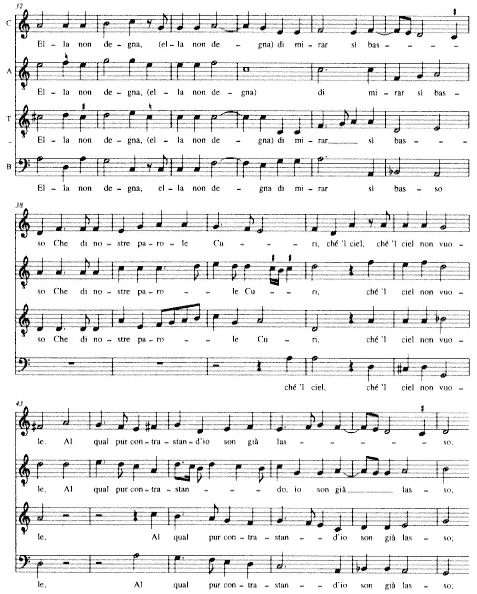
Ex. 56.
Donato, Vaghi pensier, che così passo passo (Petrarch, no. 70, stanza 3),
mm. 32-48; Le napolitane, et alcuni madrigali a 4 (Venice, 1550), p. 1.
Donato's first full-fledged print of madrigals was not issued until 1553, under the title Il primo libro d'i madregali a cinque & a sei voci, con tre dialoghi a sette.[73] The book bore a mysterious and intriguing dedication to one Cardinal of Sant'Angelo, whom Donato called his "sole benefactor."
To the most Illustrious and Reverend Monsignor, Cardinal of Sant'Angelo, my sole Lord and Benefactor. Baldassara Donato.
Most Illustrious and Reverend Monsignor, my most honorable patron: Two symbols used to be specially assigned by the ancients to the sun, the bow and the lyre — the bow because with the arrows of its rays it [both] strikes and gives life to everything; the lyre because, placed in the midst of all the other planets, almost as the norm and temperament of all the others, it guides the softest and the grandest celestial harmony. But we, owing to our disproportioned senses, fail to hear it. It is fitting that the moderns should give the same to Your Most Illustrious and Reverend Lordship, sun and ornament of this age — you who with the rays of your many virtues and with your splendor and that of your ancestors manifest and kindle everything and who with your lyre of internal reasoning and prudence so well harmonize the affects of your soul in the midst of the other princes that both in great fortunes past and in the glory of the present one could barely discern which was greater in you, grandeur or charm, happiness or humanity, forcefulness or mildness. Beyond this it will suit you when the time comes to you, taking the place of your most blessed forefathers, to temper amongst all the other princes the harmony of the Christian Republic. Owing to this renown, then, the dedications of works in all fields are due to the name of your Most Illustrious and Reverend Lordship. But those of music are most due to you. My having therefore collected some of my efforts in this science I consecrate them to you, as to their true and appropriate recipient, considering that the virtue of your sacred name must make the harmony of my labors sweeter and more welcome to whomever will hear them. Kissing your sacred hands with this, I pray for you a happiness equal to your merit.[74]
[73] A complete ed. may be found in Sixteenth-Century Madrigal, vol. 10, ed. Martha Feldman (New York, 1991).
[74] ALL'ILLUSTRISSIMO ET REVERENDISSIMO Monsignor, Il Cardinale di Santo Angelo, Signor & Benefattore unico. Baldassara Donato.
Illustrissimo & Reverendissimo Monsignore, Patrone Colendissimo. Due insegne si solevano da gli antichi spetialmente dar al sole l'arco et la cetra: L'arco perche con le saette de suo raggi ferisce & vivifica ogni cosa. La cetra perche posto in mezzo di tutti gli altri pianeti quasi norma et temperamento de gli altri guida la celeste armonia soavissima et grandissima. Ma da noi per la sproportion del nostro senso non udita: L'istesso conviene che moderni dieno a Vostro Illustrissima et Reverendissima .S. Sole & ornamento di questa età, Il quale co raggi di tante virtu vostre, & dello splendore Avito & proprio illustrate, & infiammate ogni cosa, & con la cetra dell'interna ragione & prudenza accordate in mezzo a gli altri Principi cosi bene gli affetti del vostro animo, che nella maggior fortuna passata et nella grande d'hora mal s'e possuto scorgere qual sia stata maggiore la grandezza, o la piacevolezza, la felicita, o l'humanita, l'amplitudine o la mansuetudine, Oltre che a voi converrà, quando per l'eta vi sarà concesso occupando il luogo del vostro Santissimo Avo temprare fra tutti gli altri Principi l'armonia della Christiana Republica: Per questo nome dunque le dedicationi de componimenti in ogni scientia sono dovute al nome di Vostra Illustrissima & Reverendissima .S. Ma quelle della Musica le sono dovutissime: Havendo io per tanto raccolte alcune mie fatiche in questa scienza le consacro a lei come ad obietto loro proprio et adequato: Considerando che la virtu del vostro sacro nome dovra render piu dolce & piu aggradevole l'armonia di queste mie fatiche a chiunque le udira, & basciandole con questo le sacre mano le prego felicita eguale al suo merito.
Though signed by the composer, Donato probably could not have crafted such an extended Neoplatonic conceit without the aid of an acquaintance or house editor versed in letters (if indeed he authored it at all). The language seems designed to complement august aspects of the book itself, with its full panoply of five-, six-, and seven-voice works (twenty-six in all), its sumptuous stylistic and topical variety, and its several ceremonious dedicatory works.
Given this, it is fitting to realize that the Cardinal of Sant'Angelo is identical to Ranuccio Farnese (1530-1565), member of the powerful Farnese family who ruled Parma from 1545. Remembered today especially for the famous portrait of him painted by Titian in 1542 (Plate 20), Ranuccio was the son of Parma's first duke Pierluigi Farnese, grandson of Alessandro Farnese (better known as Pope Paul III) and a cardinal from the age of fifteen.[75] Corroboration of his identity comes in the print's inaugural piece, which gives his Christian name in the variant Rinuccio, together with various allusions to the family's history and the fleur-de-lis on its coat of arms.[76]
Mentre quest'alme et honorate rive While you make these life-giving
Co' tuoi purpurei gigli And honored shores bloom
Fai fiorir d'ogn'intorno, All about with your purple lilies,
Rinuccio, de le cose al mondo Dive, Rinuccio, divine among the things of the world,
Odo il tuo Tebro e'l sacro Vaticano, I hear your Tiber and your sacred Vatican 5
Quasi un de suoi più chiari et degni figli, Sighing for you, almost as one of their
Sospirarti lontano, Worthiest and most eminent sons, far away,
Pur attendendo il dì del tuo ritorno, And still awaiting the day of your return,
Sperando l'un le sponde Hoping to see fertile again,
L'altro le sue pendici The one its banks, the other its slopes, 10
D'Olive et palme riveder feconde, With olives and palms,
Quai le fer già le tue sante radici, As your holy roots already make them,
Et de tuoi gigli tutta Italia et Roma And all of Italy and Rome [hoping]
Ornarsi anchor la gloriosa chioma. To crown themselves gloriously with your lilies.[77]
Nothing is known of Ranuccio's relationship to Donato and the Primo libro a 5 & a 6 apart from this book. Perhaps Donato came to the attention of the Farnese family through Willaert, whose setting of the sonnet Mentre al bel lett'ove dormia Phetonte,
[75] See the genealogy in Emilio Nasalli Rocca, I Farnese (Varese, 1969), Table II and p. 108, which explains that Ranuccio came to be called "Sant'Angelo" for the name of his church. See also the Table in Edoardo del Vecchio, I Farnese, Istituto di Studi Romani (Città di Castello, 1972), and on Ranuccio, pp. 107ff. On Titian's portrait and its subject see Harold E. Wethey, The Paintings of Titian: Complete Edition, 2 vols. (New York, 1971), vol. 2, The Portraits, pp. 98-99, and Plates 109 and 111-14, including details. See also Georg Gronau, "Zwei Tizianische Bildnisse der Berliner Galerie: I, Das Bildnis des Ranuccio Farnese; II, Das Bildnis der Tochter des Roberto Strozzi," Jahrbuch der königlich preuszischen Kunstsammlungen 27 (1906): 3-12.
[76] For a description of the Farnese arms see G. B. di Crollalanza, Dizionario storico-blasonico delle famiglie nobili e notabili italiane estinte e fiorente, 3 vols. (Pisa, 1886-90; repr. Bologna, 1965), 1:392, and for the arms showing the lilies described in the poem, Lina Balestrieri, Feste e spettacoli alla corte di Farnese, Quaderni parmigiani, no. 6 (Parma, 1981), front matter.
[77] My translations of this poem and the dedication were much aided by advice from Linda Armao.
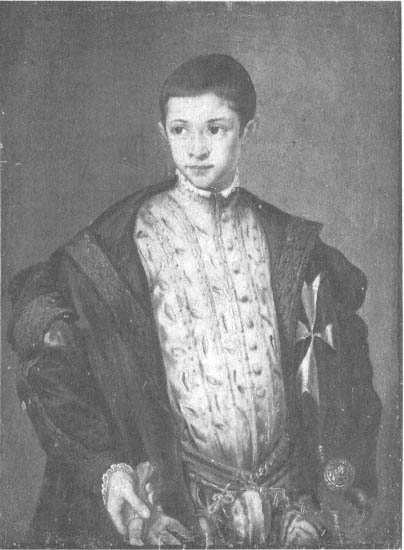
20.
Titian, Portrait of Ranuccio Farnese, 1542.
Photo courtesy of the Gemäldegalerie, Staatliche Museen
Preussischer Kulturbesitz, Berlin.
published in 1548, appears to celebrate the heroics of Ranuccio's father, Pierluigi, on the occasion of the Farnese's takeover of Parma and Pierluigi's assumption of Parma's dukedom in September and October 1545.[78] Other texts in Donato's book celebrating famous families may form part of a complex of tributes to the Farnese (though none of these has the positive markers of Mentre quest'alme ). The ottava rima Pianta beata,
[78] The setting was published in Rore's Terzo libro a 5 (RISM 15489). The identification of the poem's probable occasion and dedicatee was made by Helga Meier in her edition of Willaert, Opera omnia, vol. 14, Madrigali e Canzoni Villanesche, AIM (Neuhausen-Stuttgart, 1977), p. x.
che già fosti degna (no. 18), in particular, exalts the "Fronde de vincitor felice insegna / A cui fan sempre i più bei spirti honore" (branch of the victor, happy insignia, to which the most beautiful spirits always pay homage). Later it calls up the "Rami sacri felici almi'et beati" (sacred branches, happy, life-giving, and blessed) as part of a final two-verse acclamation that occupies nearly half the length of Donato's setting. The final dialogue, "Ahi miserelle, ahi sventurate noi, " celebrating Pluto, Proserpina, and Hymen, probably evolved as an intermedio that formed part of a staged wedding celebration. Only Italy's wealthiest families, like the Farnese, typically produced such celebrations, but no positive clues of a connection to them exist.[79]
Following roughly the form of the Musica nova, Donato's Primo libro a 5 & a 6 contains seventeen five-voice madrigals, six six-voice madrigals, and three seven-voice dialogues, in no traditional modal order (see Table 13). Surely the desire to position the dedicatory madrigal at the book's opening and order its madrigals by numbers of voices superseded modal concerns. Nevertheless, like nearly all Gardane's prints, Donato's book groups works with like pitch systems — hence nos. 4-6 are all in cantus durus on E, nos. 10-13 all share the type

The Primo libro a 5 & a 6 stresses sonnets, but not to the exclusion of other poems. Half of the book's twenty-six numbers are sonnet settings, only ten of them complete. All but one of the complete settings divide after the octave; the single exception, set continuously, is no. 10, on a light May Day text. Otherwise only the dialogues dispense with this two-part arrangement, two of them resetting texts from the Musica nova (nos. 24 and 25). The remaining thirteen works divide between cinquecento poetic madrigals (nos. 1, 11, 15, 19, and 26), ottave rime (nos. 4, 12, 13, 14, and 18), a canzone stanza by Petrarch (no. 3), and two ballata-madrigals (nos. 16 and 23). In addition to somewhat older poets like the Venetians Andrea Navagero and Pietro Bembo, the book makes notable use of a younger group of poets who were intimates of Domenico Venier's literary salon: Giovanni Battista Amalteo, Lodovico Dolce, and Fortunio Spira. Donato, as we saw in Chapter 4, may have gotten to know Venier when he set his three patriotic stanzas for a public festival in the city (the settings were published as the final three numbers in Donato's Napolitane of 1550), and the sonnet setting no. 9 almost surely celebrated one of Venier's noble academists, Lorenzo Contarini (see n. 79).
Donato's first book shows a facility for counterpoint and melody as endearing as Perissone's and just as fit to win admirers and freelance work from wealthy patrons.
[79] On Ahi miserelle see Einstein, The Italian Madrigal 1:452-53.
One other setting, no. 9, Angelico intelletto hor che nel seno, on a sonnet lamenting the death of one "Contareno," eulogizes another nobleman, a member of the prominent Venetian family also called Contarini. The sonnet's emphasis on the deceased's intellect leads me to think that it referred to Lorenzo Contarini, the philosopher, Latin scholar, and member of Venier's circle, included as interlocutor in Parabosco's I diporti, who died on 8 November 1552; see A. Venturi, "Contarini, Lorenzo," in Dizionario biografico degli italiani, vol. 28 (Rome, 1983), pp. 231-33.
[80] On Gardane's practice of grouping works by some combination of system, ambitus, and/or final see Mary S. Lewis, "Antonio Gardane and His Publications of Sacred Music 1538-55" (Ph.D. diss, Brandeis University, 1979), pp. 184-91. For the argument that Gardane was arranging by tonal type and not mode see Powers, "Tonal Types and Modal Categories," esp. p. 461.
| ||||||||||||||||||||||||||||||||||||||||||||||||||||||||||||||||||||||
(Table continued on next page)
| |||||||||||||||||||||||||||||||||||||||||||||||||||||||||||||||||||||||||||||||||||||
Only rarely, as in his fourth-mode setting of Petrarch's spiritual sonnet I vo piangendo, scored for low male voices, did Donato essay the same dark effects as Willaert. More often his work followed that of other disciples at San Marco in reconciling Willaert's rhetorical lessons with a lighter style, approximating Bembist ideals without clinging to such introverted declamation as Willaert's.
Indeed Donato did so while borrowing from Willaert in less concealed ways than Perissone. His setting of I vidi in terra employs the same tonal type as Willaert's,
But the most striking borrowing comes at the beginning of the seconda parte, where Donato adopted almost every facet of Willaert's composition (cf. Ex. 58a below with Ex. 58b) — the lengthy movement by fifths, the pacing and development of the declamatory rhythm, and even much of the voicing and many of the individual motives. The passage is little more than a rescoring of Willaert's original. Here Donato's imitative practice verges on the kind of submissive reverence contemporary Venetian literati exhorted for imitating Petrarch.[82] The same can be said of both his other resettings of Musica nova texts, the two dialogues "Liete e pensose " and "Che fai alma, " which (again) mimic Willaert in ways that are less camouflaged than Perissone's. For "Che fai alma, " in fact, Donato closely adapted the polyphony of Willaert's entire exposition.[83]
[81] To follow a complete score, see my ed., pp. 214-21.
[82] On this matter see Chap. 5 above and Thomas M. Greene, The Light in Troy: Imitation and Discovery in Renaissance Poetry (New Haven, 1982).
[83] See H. Meier, "Zur Chronologie der Musica Nova, " p. 78. On the concision that typically marks Donato's adaptations see David Alan Nutter, "The Italian Polyphonic Dialogue of the Sixteenth Century," 2 vols. (Ph.D. diss., University of Nottingham, 1978), p. 107.
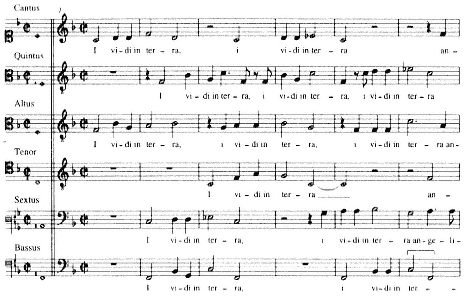
Ex. 57A.
Willaert, I vidi in terra angelici costumi (Petrarch, no. 156),
mm. 1-6; Musica nova (Venice, 1559), no. 19.
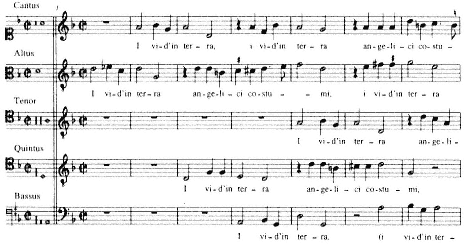
Ex. 57B.
Perissone, I'vid'in terra angelici costumi (Petrarch, no. 156),
mm. 1-7; Segondo libro a 5 (Venice, 1550), p. 6.
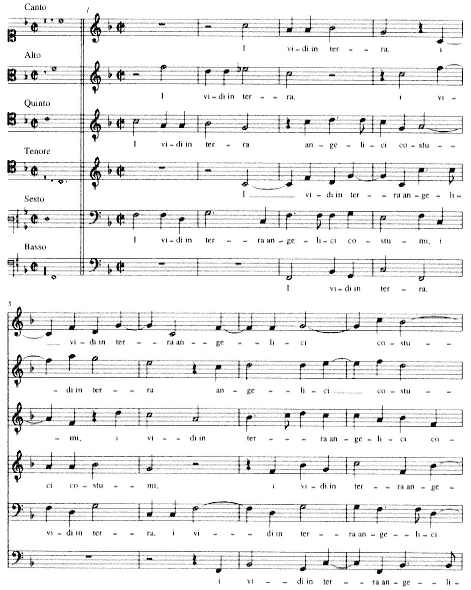
Ex. 57C.
Donato, I vidi in terra angelici costumi (Petrarch, no. 156),
mm. 1-8; Primo libro a 5 & a 6 (Venice, 1560), p. 28.
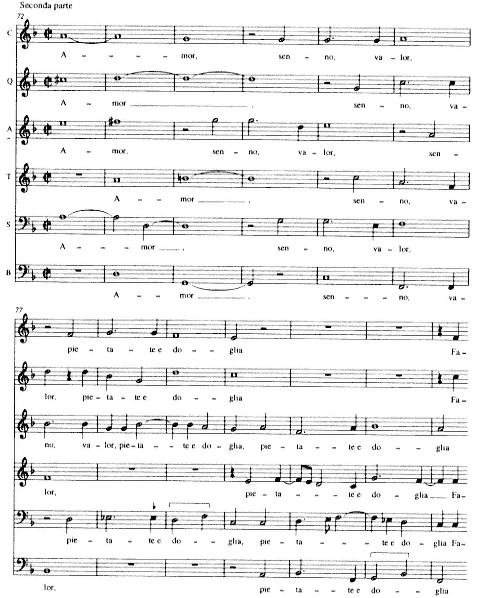
Ex. 58A.
Willaert, I vidi in terra angelici costumi (Petrarch, no. 156),
mm. 72-83; Musica nova (Venice, 1559), no. 19.
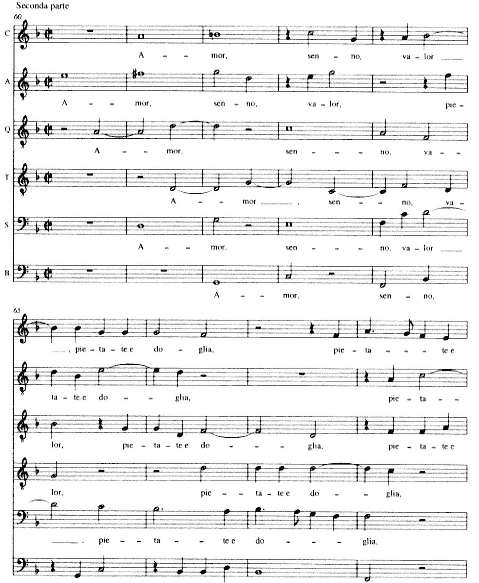
Ex. 58B.
Donato, I vidi in terra angelici costumi (Petrarch, no. 156),
mm. 60-68; Primo libro a 5 & a 6 (Venice, 1560), p. 28.
These are not the sorts of furtive borrowings to thread the counterpoint with witty glosses, perceptible only to the canniest observers. They are servile acts of praise, readily identified by any listener well acquainted with the model. Given Donato's relation to Willaert as both close collaborator and subordinate, it comes as no surprise that his imitations took the form of public homage.
By their simultaneous gestures of overt tribute and self-display, imitations of this kind allow us privileged scrutiny of the public debts disciples paid their masters at the same time as they paradoxically illuminate disciples' styles in nonemulatory works. Donato's setting of Dolce's Scalda, Signor, il mio gelato core (no. 21) forms a case in point. As a spiritual sonnet, Scalda, Signor aligned itself with a pious Petrarchan rhetoric through direct supplications to God, calling for a somber diction as naturally as Petrarch's secular sonnets did. Donato set Scalda, Signor with the same proportions as Musica nova settings, yet asserted his own voice by fashioning a more melodious and metrical exemplar of the spiritual style. Such lyricism is even more surprising in Donato's other spiritual madrigal, on Petrarch's I vo piangendo, a text that he might have set more like Scalda, Signor. I vo piangendo lacked a model in either Willaert or Rore but had a direct antecedent in Parabosco's setting of its octave, published in 1546. Donato's madrigal shows no relation to Parabosco's, except that both use Phrygian mode and avoid chiavette (in fact Donato's dips into the lowest possible tessituras with the cleffing c4c4F3F4F5, as compared with Parabosco's c1c3c4c4F4; cf. Table 9, no. 14 with Table 13, no. 5). In other respects Donato's setting forms a virtual antitype to Parabosco's, collapsing the entire sonnet into a scant 89 breves as against the 104 Parabosco used for the octave.[84]
Once outside the imposing domain of Petrarchan sonnets and close cousins like Scalda, Signor, Donato's knack for pithy execution, distinctive motives, and melodic grace led him to author wonderfully fresh madrigals. In his settings of poetic madrigals, in particular, Donato's stylishness, lyricism, and wit went unsurpassed by his contemporaries. A good example of these melodic gifts is the anonymous Sarra, vostra beltate è tanta e tale (no. II), an encomium to the Sarra apostrophized in the incipit, where Donato's cantus sparkles its way through the plagal octave d to dd, with semiminims lighting down by thirds (mm. 14-15), before reaching the final g (Ex. 59). Another madrigal, Lodovico Martelli's Da duo occhi lucenti (no. 16), unveils the opening conceit on the beloved's "two eyes" with a tongue-in-cheek musical icon: two lone voices in homorhythm. Still other settings — Il primo dì del bel fiorito maggio (no. 10) and the octave of Bembo's Cantai un tempo, et se fu dolce il canto (no. 17) — turn to breezy triple meters and sprightly melismas (note the rhapsodic example of the latter in Ex. 60).
With this playful melodic bent, Donato must have been a great hit in the salons of Venice. Yet not all his 1553 settings of lighter texts are so insouciant — most notably his setting of Spira's ballata-madrigal, Non è, lasso, martire (no. 23).
[84] See Einstein's description, The Italian Madrigal 1:452.
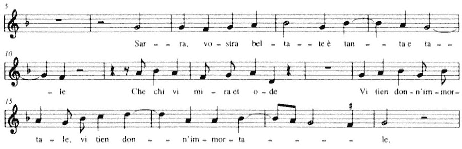
Ex. 59.
Donato, Sarra, vostra beltate è tante e tale, cantus,
mm. 5-18; Primo libro a 5 & a 6 (Venice, 1560), p. 16.
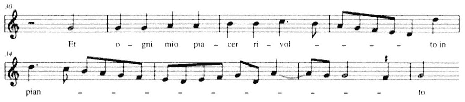
Ex. 60.
Donato, Cantai un tempo, e se fu dolce il canto (Pietro Bembo),
cantus, mm. 30-37; Primo libro a 5 & a 6 (Venice, 1560), p. 22.
Non è, lasso, martire It is not, alas, a martyrdom
Il convenir per voi, Donna, morire, To agree for you, Lady, to die,
Se la cagion de la mia mort'è tale If the cause of death is such
Che fa lieve ogni male; That it lessens every suffering.
Ma quel che mi tormenta But what torments me 5
È che del mio morir sete contenta, Is that my death contents you,
E ch'al primo veder d'altro amadore And that at the first sight of another admirer
Cangiaste 'l vostro core. You changed your heart.
Non è, dunque, martire, Is it not, then, a martyrdom
Il convenir per voi, Donna, morire? To agree for you, Lady, to die? 10
Already in 1545, when Spira's text was published in the first of the Rime diverse series, its form was a throwback to the old madrigal-with-refrain popular with poets like Lodovico Martelli and Dragonetto Bonifazio in the twenties and thirties. Like Bonifazio's Amor mi fa morire (see Chap. 7 nn. 18-19), Spira's poem elides the ripresa 's return by means of a slight rhetorical transformation. In keeping with the poetic device, the music that begins the madrigal returns to end it (mm. 54-72), neatly joined by means of an expressive cross relation, C-sharp/C. However old the setting was in 1553 (it could well have been newly written, or as old as eight or
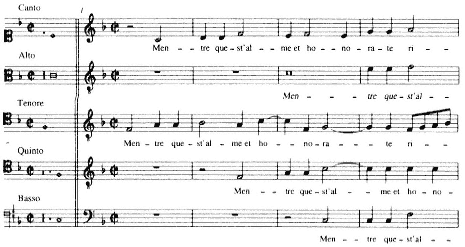
Ex. 61.
Donato, Mentre quest'alme et honorate rive, mm. 1-4;
Primo libro a 5 & a 6 (Venice, 1560), p. 1.
ten years), it resembles Verdelot's six-voice madrigals on similar texts[85] — not only their form but their calm, graceful rhythms. Non è, lasso, martire begins with a chansonesque dactyllic figure and disposes the opening verse with a minimum of fuss, avoiding any syncopation until the cadential figure occurs after eight bars. The metrical regularity of the opening endures throughout, with balanced, lucid expositions introducing each new line of text. Choirs of voices often deliver the text in consort, with even-paced counterpoint declaimed in semiminims (like that setting v. 4), adding a chansonesque metric feel. Apart from the cross relation noted earlier, these steady rhythms accompany a pervasive diatonicism.
Such tonal-rhythmic simplicity is shared by Donato's several celebratory settings, which were probably recent creations. The dedication piece Mentre quest'alme begins with a similar dactyllic figure but in a triadic form appropriate to the enunciatory rhetoric of celebration; and the same figure later opens out more spaciously in the invocation to the dedicatee "Rinuccio" (Exx. 61 and 62). Another occasional piece, Pianta beata, realizes this style of choral celebration more fully through its quick triadic exchanges and clear registral shifts. Like those of Non è, lasso, martire, the rhythmic motives of Pianta beata are simple and square and its soundscape diatonic as well. Yet as an ottava rima, Pianta beata's formal-tonal organization is based on the distich principle. The conjunction of simple diatonicism, motivic simplicity, and ottava form is natural, since historically the form was aligned with declamatory song. Even though, as a six-voice setting, Pianta beata has a fair share of imitative
[85] I refer to those published in the collection of 1541 and reprinted in 1546 [RISM 154619]. See also Verdelot's Madonna, qual certeça on a ballata-madrigal by Bonifazio, in H. Colin Slim, ed., A Gift of Madrigals and Motets, 2 vols. (Chicago, 1972), pp. 379-81, with the text on p. 446.
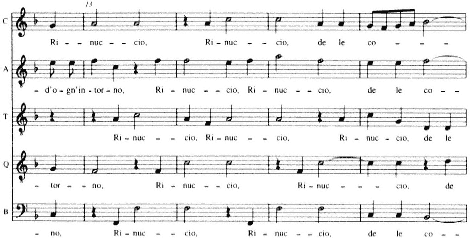
Ex. 62.
Donato, Mentre quest'alme et honorate rive, mm. 13-17;
Primo libro a 5 & a 6 (Venice, 1560), p. 1.
counterpoint, each one of its couplets finishes with a strongly marked cadence joined by at least five of the six voices.
Pianta beata is one of five ottave rime in the Primo libro a 5 & a 6, a higher number than found in any other print in the Venetian repertory. Ottave rime are more at home in Perissone's Primo libro a 4 (the only other print I have dealt with in these chapters to include them, not counting Venier's stanzas in Donato's Napolitane ), since Perissone's four-voice book straddles the fence that separates song from polyphony. By contrast, none of the ottave Donato set in the Primo libro a 5 & a 6, save Pianta beata, looks formally or stylistically different from his madrigals: indeed some seem to merge the rhythmic vivacity of the madrigals with the polyphonic complexity of larger forms. Laura, le selv'et le campagne apriche (no. 12), a gamesmanly series of wordplays on the Laura-Paura homonym, is such an ottava setting, gamboling in widely displaced points of imitation and ebullient declamation.
Unlike any of his peers' collections, Donato's Primo libro was reprinted twice, in 1557 and in 1560. By that time the Willaertian madrigal was already on the wane, and Donato himself published no new books until his first for four voices of 1568. In later years Donato's prestige in the chapel continued to rise as he repeatedly found success in the administrative ranks of San Marco. In addition to regular salary increases, he was made maestro of a newly formed cappella piccola at St. Mark's in 1562,[86] and in 1590 finally became maestro di cappella—a position in which he died
[86] See Ongaro, "The Chapel of St. Mark's," pp. 153-56 and Document 259, on the formation of the cappella piccola, and on Donato's raises in salary, passim.
in 1603, succeeded by the local musician Giovanni Croce. Donato thus takes his place in a neat line of succession from Willaert, Rore, and Zarlino to Monteverdi, who eventually replaced Croce's successor in 1612. His turn toward administration corresponds to the creative trajectory of the madrigal, which had already begun to move out of Venice shortly after Donato published his book. By the mid- to late 1550s exciting transformations of Willaert's style were no longer ventured by composers in Venice but by Rore in Ferrara and, later on, by his students Giaches de Wert and Luzzasco Luzzaschi in Ferrara and Mantua through the 1590s. It is in their works, as well as in those of Luca Marenzio and others, that the lineage of multi-voice madrigals from midcentury can be followed, culminating in Monteverdi's provocative madrigal collections from the turn of the century.