
The Old-Fashioned Way
And one was provided. The inventor, Robert Jemison Van de Graaff, conceived a grand idea at the onset of his career, as a Rhodes scholar at Oxford, where he arrived with an engineering degree from the University of Alabama and professional experience with the Alabama Power Company. From Oxford, where he earned his Ph.D. in physics in 1928, he went to Princeton as a National Research Fellow, and soon had a prototype accelerator working at 80 kV. Its principle would have been plain to Benjamin Franklin. An endless belt of a good insulating material running vertically between two pulleys picks up electricity from a point discharge at the bottom and delivers it, again by point discharge, to a large insulated spherical conductor at the top (fig. 2.7). The lower electrical spray comes from any rectified source. The upper spray continues, irrespective of the potential attained by the sphere, which exerts no electrostatic force at its internal surface, until the field at the external surface suffices to break down the air. In a later refinement (fig. 2.8), a second set of points adroitly placed removed electricity of the unwanted sign from the sphere on the belt's downward journey and eliminated the rectified source by connections that allowed the amplification of any slight charge present on the belt. Since the practical limit to the potential of the sphere is the dielectric strength of the air, the way to millions of volts was to increase the sphere's radius (and so lessen its external field at a given potential) and the dielectric constant of the surrounding medium (and so raise the field at which breakdown occurs). To make good on the second possibility, the entire machine must be encased in a vessel that can be evacuated or filled with a gas or fluid under pressure. The first small pressurized model operated in 1932.[25]
By mid August 1931 Van de Graaff could charge a brass sphere mounted on a glass stick to about 750 kV. Between two such spheres, one positive and one negative, an inspiring potential difference of 1.5 MV could be maintained. It, and the trivial cost,
[25] E.A. Burrill, DSB, 13 , 569–70, and PT, 20:2 (1967), 49–50; H.A. Barton, D.W. Mueller, and L.C. van Atta, PR, 42 (1932), 901; Van de Graaff, Compton, and van Atta, PR, 43 (1933), 152–5.
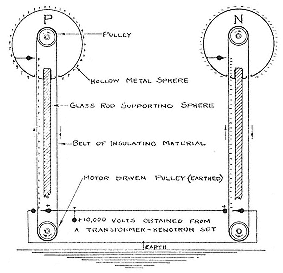
Fig. 2.7
Principle of the Van de Graaff generator. Charge
sprayed on the endless silk belt at the bottom leaves
by corona discharge at the top; it is derived in the
first instance from a transformer. Van de Graaff,
Compton, and Van Atta, PR, 43 (1933), 152.
about $100 for the entire outfit, inspired Karl Compton, who brought Van de Graaff to MIT as a research associate (he became associate professor in 1934) and arranged some heady publicity. The newly formed American Institute of Physics held a dinner for scientists and journalists at the New York Athletic Club; the machine, in an alcove in the dining room, looked like "two identical rather large floor lamps of modernistic design." Van de Graaff demonstrated for his supper, and also for Paramount and Pathé news; he allowed that he saw no difficulty going to 10 MV with two balls each 20 feet in diameter on towers 20 feet tall. Compton misguessed that this big machine would provide alpha particles in a current "so enormously larger than that from radium, that the experiment opens up the possibility of transmutation of the elements on a commercial scale;" and he miscalculated that it could be done for a few hundred dollars.[26]
[26] Quotes from New York Times , 6 Nov 1931, 1, 6, and 11 Nov 1931, 1, 17; J. Boyce to Lawrence, 17 Nov 1931 (3/8); Van de Graaff, PR, 38 (1931), 1919–20;Van de Graaff, Compton, and van Atta, PR, 43 (1933), 154.
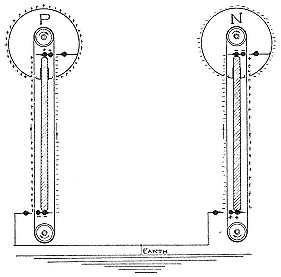
Fig. 2.8
An improved Van de Graaff generator. The points are
arranged so that the belt charges the sphere when
going down as well as when going up; the system
works with any stray charge, no transformer being
required. Van de Graaff, Compton, and van Atta,
PR, 43 (1933), 153.
There remained what Lawrence, who recognized Van de Graaff as a competitor, called the "old problem of a high vacuum tube." Those who thought they had solved the problem regarded the matter differently. As one of Lauritsen's students wrote him after witnessing one of Van de Graaff's demonstrations, "His scheme is really very good and actually works . . . [and] would make a very fine combination with one of your tubes." Lauritsen eventually did build a Van de Graaff machine.[27] Tuve's group rushed to do so. In September 1931 Tuve drove Van de Graaff and his easily portable equipment to Washington and hooked it up to the segmented tube. With a charging current of 40 µA and 600 kV on the spheres hooked in parallel (plate 2.3), the tube carried a
[27] Lawrence to Cottrell, 21 Nov 1931 (5/3); Cassen to Lauritsen, 12 Nov 1931 (Lauritsen P, 1/8); Nahmias to Joliot, 21 Sep 1937 (JP, F25), on progress of installation of Lauritsen's Van de Graaff.
proton beam of not quite a millimicroamp (mµA), not enough to burn a hole in cardboard, but enough to make tracks in a cloud chamber. Tuve studied the working apparatus closely and got a spark to his nose for his curiosity. It did not discourage him from reaching higher, for 1.4 MV, half the theoretical value of the maximum potential restricted by the dielectric strength of normal air surrounding a sphere two meters in diameter. (A useful rule of thumb: the theoretical maximum in MV equals the radius in feet.) Simultaneously, Coolidge, supported by GE, planned a high-current version at 1 MV, and Van de Graaff, seconded by the Research Corporation, went forward with one requiring two 15-foot spheres.[28]
The two-meter sphere, which cost $700, worked well with the million-volt tube insofar as it could be tested outdoors, where it sparked and fluttered under bombardment by bugs and dust and threw lightning bolts that reduced its redwood base to splinters. The Carnegie Institution's Department of Terrestrial Magnetism had no place for the wonder it had built. We read in its annual report for 1931/32: "A highly satisfactory equipment for the production of high energy particles, particularly of high-speed protons, is thus ready for use as soon as operating space becomes available."[29] During the late fall of 1932, while awaiting the construction of suitable housing off-site (the Carnegie Institution's executive committee approved a building fund in January 1933), Tuve and his associates made a version about one meter in diameter for the space that had belonged to the Tesla coil. With this machine, their desire to do nuclear physics was at last requited. It consisted of two hollow hemispheres of aluminum joined by a short cylindrical section containing the belt, one pulley, an ion source, and the high potential end of a segmental discharge tube. The belt brought about 180 to 200 µA; the sphere held 400 to 600 kV; the tube transmitted as much as 10 µA of proton beam, constant in energy to perhaps 3 percent, to the target. The x rays
[28] Tuve to Lauritsen, 11 Dec 1931 (Lauritsen P, 1/8); Cottrell to Lawrence, 11 Nov 1931 (5/3); Boyce to Lawrence, 17 Nov 1931 (3/8); Fleming to van de Graaff, 19 Dec 1931 (MAT, 8); Tuve, JFI, 216 (1933), 26; Wells, Jl. appl. phys., 9 (1938), 677–80.
[29] CIW, Yb, 31 (1931/2), 230; Tuve, Hafstad, and Dahl, PR, 48 (1935), 317; Fleming to J.M. Cork, 5 Dec 1932, on costs.
incidentally produced drove the experimenters into a hut outside the twelve-inch concrete walls of their laboratory, where they worked by remote control. (Their conservative value for the safe tolerance of radiation was ten times the dose from cosmic rays.) In the operation of the tube, Tuve's group had some advice from Lawrence, whose own investigations had by then acquainted him with the ability of coaxial cylindrical electrodes to focus a beam and with the excellences of certain "Apiezon" oils made by Metropolitan-Vickers as the working fluid of vacuum pumps. With this setup the Department of Terrestrial Magnetism was able to set right some sloppy results reported by Lawrence's Radiation Laboratory.[30]
In 1933 the two-meter machine found a home and Van de Graaff's 15-foot giant threw its first sparks in a disused blimp hanger in Round Hill, Massachusetts. Tuve's photogenic apparatus (plate 2.4), with four belts and two concentric shells (the inner, one meter in diameter), reached 1.2 MV under favorable conditions. Lawrence visited it and was impressed. "I must say that Tuve's apparatus is performing better than I expected," he wrote the Research Corporation after his inspection. "Seeing Tuve's apparatus perform makes me much more enthusiastic about van de Gr[a]aff's outfit than I was before."[31] By then, November 1933, the cyclotron could give more volts, but at far less current, than Tuve's "outfit." As for Van de Graaff, his 1.5 MV model gave a charging current almost a million times Lawrence's beam, as his patron Compton liked to observe, and his giant one held promise of another factor of ten (plate 2.5 and fig. 2.9).
"Experience to date indicates that there is in sight no unsurmountable obstacle to the construction of [10 MV Van de Graaff] generators." When Compton spoke these words—which were realized long after the war, by a technology not available in the
[30] Tuve to Cottrell, 24 Jan 1933 (MAT, 4); Cottrell to Lawrence, 16 Sep 1932 (5/3); Tuve to Lauritsen, 11 Nov 1932 (Lauritsen P, 1/8), claiming 800 kV; Tuve to E.W. Sampson, MIT, 22 May 1934 (MAT, 13/"lab letters"), re Lawrence's advice; Tuve, Hafstad and Dahl, PR, 48 (1935), 318–20, 329–32, 337; infra, §4.1.
[31] Tuve, Hafstad, and Dahl, PR, 48 (1935), 321–5; Lawrence to Poillon, 20 Nov 1933 (15/16A). Lawrence based his opinion on Cooksey's negative report on the performance of Tuve's machine in January; Cooksey to Lawrence, 25 Jan 1933 (4/19).
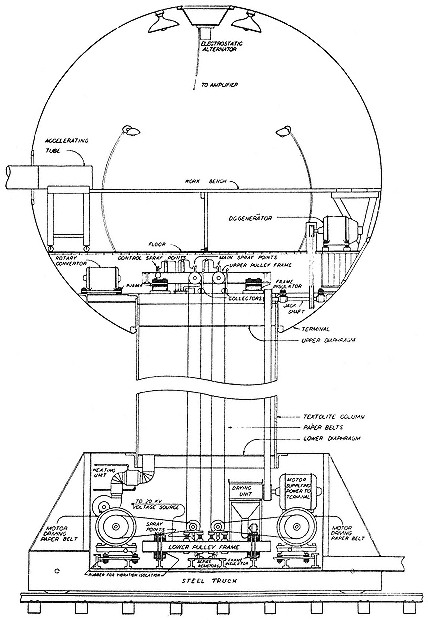
Fig. 2.9
An insider's view of the 15-foot generator. It delivered 1.1 mA to the accelerating
tube under a tension of 5.1 MV. Van Atta et al., PR, 49 (1936), 762.
1930s—Van de Graaff's original model was showing off at Chicago's Century of Progress Exposition, "producing millions of volts for the enlightenment of the visitors."[32] But neither this nor any other million-volt plant was the first to accomplish the purpose of all, and bring that enlightenment to physicists vouchsafed by the disintegration of the atom.