
Chapter One—
Evangelical and Catholic Propaganda in the Early Decades of the Reformation
In the spring of 1524 the Leipzig city council petitioned its duke on behalf of its printers. The printers, the council explained, were complaining bitterly that they were in danger of losing "house, home, and all their livelihood" because they were not allowed "to print or sell anything new that is made in Wittenberg or elsewhere. For that which one would gladly sell and for which there is demand," the council continued, referring to the torrent of Evangelical pamphlets pouring from the presses in Wittenberg and elsewhere, "they are not allowed to have or sell. But what they have in over abundance," namely Catholic treatises, "is desired by no one and cannot even be given away."[1]
The Leipzig printers had reason to complain. The empire-wide production of pamphlets had skyrocketed, increasing more than forty-fold since 1517, with the great bulk of this product promoting the Reformation movement.[2] Since 1521 the Leipzig printers had to watch from the sidelines because their staunchly Catholic duke, Georg the Bearded, would not allow the printing of Evangelical treatises in his lands. The Leipzig printers had gone from being the leading publishers of the leading publicist, Martin Luther, to being onlookers.[3] Instead, they were required to produce Catholic rebuttals that by their own report no one wanted and that could not even be given away. They had been shut out of the West's first full-fledged media campaign and cut off from a financial bonanza.
This chapter investigates what the Leipzig printers were missing out on, the attempt by Evangelical publicists led by Martin Luther to use
the recently invented printing press to reach as large an audience as possible to persuade them to overturn the old faith and embrace a new understanding of Christianity and the church. It may strike some as anachronistic to speak of a media campaign in the early sixteenth century. But in means, method, and scope, the Evangelical publishing blitz of the early 1520s has all the earmarks of a modern campaign. Some detailed consideration may persuade.
The Media
The printing press was invented in the Holy Roman Empire in about 1450, seventy years before the outbreak of the Reformation. By 1500 printing presses existed in over two hundred cities throughout Europe. In the Holy Roman Empire and the Swiss confederacy there were some sixty-two presses by 1520 and Cologne, Nuremberg, Strasbourg, Basel, Wittenberg, and Augsburg were the leading publishing centers. With the exception of Cologne, which remained Catholic, the presses of these towns became the nerve centers of the Evangelical media campaign, flooding the cities of the empire with aggressive little pamphlets advocating radical reform.
The Reformation perfected the use of the small booklet or pamphlet as a tool of propaganda and agitation.[4] Frequently in quarto format—that is, made up of sheets folded twice to make four leaves or eight pages—and without a hard cover, these pamphlets were handy, relatively cheap, readily concealed and transported, and accordingly well suited for delivering their message to a large popular audience. They could be easily transported by itinerant peddlers, hawked on street corners and in taverns, advertised with jingles and intriguing title pages, and swiftly hidden in a pack or under clothing when the authorities made an appearance. They were ideal for circulating a subversive message right under the noses of the opponents of reform.
Contemporaries simply called such a pamphlet a libellus or Büchlein , a booklet or little book. Their nature is better captured, however, in the German term Flugschriften , which means literally "flying writings." This designation was first attested in the late eighteenth century (1788) and was borrowed from the French feuille volante or "flying (loose) leaves." Although the content and use of these booklets could and did vary widely, the connotations of a Flugschrift or "flying writing"—a piece of printed material that is short, spontaneous, often unpretentious, and transitory—fit most of these writings quite well.
The great majority of these pamphlets were brief. Over half of those identified and microfilmed by the Tübingen Flugschriften project under the direction of Hans-Joachim Köhler were less than eight leaves in length—two quarto sheets making sixteen pages. The average was about sixteen leaves—four sheets folded in quarto format to make thirty-two pages. A scant quarter of the pamphlets were longer than this, although a few could extend to book length.[5]
In addition to being short, these pamphlets were generally unpretentious and relatively cheap. Although a few of the pamphlets contained multiple woodcuts, most were unadorned except for the title page, which might display a woodcut border or a single woodcut illustration with, perhaps, some relevance to the content of the pamphlet. The handy quarto size, perfect for cheap but still legible type, the small number of sheets, and the modest decoration (if any) meant that these works could be turned out quickly and cheaply by printers. They did not demand the same heavy investment in paper and multiple sets of type that conventional books did. They also took less time to produce and could therefore be sandwiched between larger print jobs and whipped out quickly to respond to changing events. The small size and ease of production also allowed for relatively inexpensive prices. Although the evidence is sketchy at best, Köhler believes that a good estimate of cost would be one or two pennies (Pfennig) per sheet, which would make for a cost of, say, eight pennies for average pamphlets of four sheets yielding up to thirty-two printed pages. This is about a third of a day's wage for a journeyman artisan, equal to the price of a hen, or a kilogram of beef, or a pound of wax, or the cost of a wooden pitchfork—not insignificant, but certainly within reach of the "common man," the pamphlets' intended target.[6]
The propaganda pamphlet was not new, of course, nor was its use by publicists who wished to sway a large popular audience. From the beginnings of printing there was occasion for short publications of this size and format.[7] In the years leading up to the Reformation pamphlets had been used, for example, in an attempt to mobilize the broader German public in support of Emperor Maximilian's policies. The press was also exploited for its propagandistic potential in the so-called Reuchlin affair, which saw many of Germany's humanists locked in a propaganda struggle with those churchmen, mainly Dominicans, who wished to seize and destroy Jewish writings. Both before and during the Reformation, the printing press was used quite
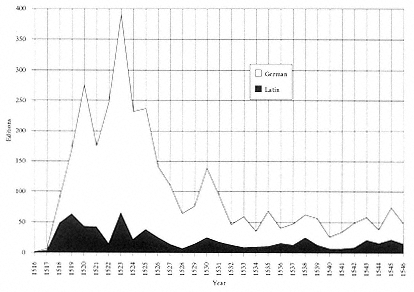
Figure 1.
Editions of Luther's Works by Language
effectively for a propaganda campaign against the Turkish menace in the East.[8] What was new in the Reformation, however, is the sheer scale of the propaganda effort.
Köhler estimates that approximately 10,000 pamphlet editions (first editions and reprints) issued from the presses of the German-speaking lands between 1500 and 1530.[9] Of these almost three-quarters appeared between 1520 and 1526, and most were due to the Reformation movement. Martin Luther alone was responsible for approximately 20 percent of the overall total.
Here are the statistics drawn from the Tübingen project and my own tabulation of the editions of works by Luther (see figure 1 and tables 1 to 4). From 1517 through 1518, the first year of the Reformation movement, there was a 530 percent increase in the production of pamphlets. Production continued to expand rapidly through 1524, increasing nearly eight-fold over this six-year period. Printings of Luther's works also grew rapidly from 87 printings in 1518 to a high of 390 printings in 1523 followed by a gradual decline into the 200 range. The peak year for the overall production of pamphlets came in 1524, which saw the publication of more than 16 percent of the pamphlets produced through the whole thirty-year period from 1501 to
| |||||||||||||||||||||||||||||||||||||||||||||||||||||||||||||||||||||||||||||||||||||||||||||||||||||||||||||||||||||||||||||||||||||||||||||||||||||||||||||||||||||||||||||||||||||||||||||||||||||||||||||||||||||||||||||||||||||||||||||||||||||||||||||||||||||||||||||||||||||||||||||||||||||||||||||||||||||||||||||||||||||||||||||||||||||||||||||||||||||||||||||||||||||||||||||||||||||||||||||||||||||||||||||||||||||||||||||||||||||||||||||||||||||||
| ||||||||||||||||||||||||||||||||||||||||||||||||||||||||||||||||||||||||||||||||||||||||||||||||||||||||||||||||||||||||||||||||||||||||||||||||||||||||||||
1530. The crucial early years of the Reformation, 1520 to 1526, saw almost three-quarters (73.9 percent) of the total produced in the thirty-year period. Over six thousand editions appeared in this seven-year period, representing conservatively over 6.6 million copies. "The average level of annual production during these seven years was almost four times as high as during the years 1518/19 and 55 times higher compared to the period pre-dating 1518," Köhler observes,[10] adding, significantly, that the production of pamphlets fell off after 1525–1526 but nevertheless remained at a level "almost twice as high as in 1518/19 and more than 20 times higher than before 1518."[11] In other words, the supply of pamphlets continued to be more than adequate to reach a large audience with its message of advocacy.
This outpouring of pamphlets possesses one other characteristic that is decisive for its designation as a media campaign: the drastic turn to the vernacular. Only a small fraction of the population in sixteenth-century Germany could read, and an even smaller fraction could read Latin. So Latin publications were addressed to a relatively tiny learned audience, made up primarily of clerics and members of the learned professions. Vernacular publications could still be read by clerics and learned professionals, but they were also accessible to laity literate in the vernacular. Accordingly, when learned authors wrote controversial treatises in the vernacular, they had a relatively popular audience as their target. We shall have reason to return to this point when we consider the Evangelical and Catholic publicists and their respective audiences. Suffice it to note here that the early years of the Reformation movement saw a massive publication effort in the vernacular. As Köhler shows, the number of pamphlets written in German rose seven-fold from 1519 to 1521, and the proportion of German to Latin pamphlets completely reversed itself, going from about three Latin pamphlets published for every German one to three German pamphlets for every Latin one.[12] In the following year the presses of the empire put out nine German pamphlets for every one Latin pamphlet. Equally telling are the figures for the printing of Luther's publications.[13] In 1518 not quite half of the printings were in German. In 1519 this figure rose to over six in ten, then in 1520 and 1521 around eight in ten, and for the rest of the decade around nine in ten.
It is the magnitude of the effort, and its overwhelming use of the vernacular, that justifies designating this the West's first large-scale media campaign.
| |||||||||||||||||||||||||||||||||||||||||||||||||||||||||||||||||||||||||||||||||||||||||||||||||||||||||||||||||||||||||||||||||||||||||||||||||||||||||||||||||||||||||||||||||||||||||||||||||||||||||||||||||||||||||||||||||||||||||||||||||||||||||||||
| |||||||||||||||||||||||||||||||||||||||||||||||||||||||||||||||||||||||||||||||||||||||||||||||||||||||||||||||||||||||||||||||||||||||||||||||||||||||||||||||||||||||||||||||||||||||||||||||||||||||||||||||||||||||||||||||||||||||||||||||||||||||||||||
The Evangelical Publicists
In the course of his dissertation on Andreas Bodenstein von Karlstadt, Alejandro Zorzin identified the leading eighteen Evangelicals publishing pamphlets in German during the early years of the Reformation movement (1518 to 1525).[14] In the order of vernacular publications through 1525, both first editions and reprints, Zorzin's statistics, reproduced in table 5, are quite revealing.[15]
The first thing to note from table 5 is the preponderance of clergy. Of the eighteen leading publicists only four were laity: Philipp Melanchthon (who nevertheless taught theology at Wittenberg), Hans Sachs, Ulrich von Hutten, and Hartmuth von Cronberg. Sachs was a shoemaker and Meistersänger , and Hutten and Cronberg, disaffected
| |||||||||||||||||||||||||||||||||||||||||||||||||||||||||||||||
nobles. In general the authors of the flood of pamphlets were also members of the learned elite. Even most of the pamphlets that purported to be by a "poor unlearned god-fearing layman" were in fact by learned authors, frequently clerics.[16] This pretense is itself revealing because it indicates how, for a few crucial years, the elite not only attempted to reach a broad audience but found it advantageous to pretend that they were speaking for the very audience they were trying to reach.
As Zorzin's statistics show, Martin Luther dramatically outpublished the other Evangelicals in the vernacular during this crucial period. The period 1518 to 1525 saw over eleven times as many printings of Luther's vernacular works as of the next nearest "competitor," Karlstadt. Even the combined production of the other seventeen authors (807 editions) is exceeded by Luther almost two to one. Although I strongly suspect that Luther was outnumbered by the combined total of all Evangelical pamphlets published during this period,[17] there can be no doubt that his was still the dominant voice. This dominance justifies, I believe, a closer statistical look at the printing and reprinting of Luther's works.[18]
The most massive printing and reprinting of Luther's works came in the pioneering years of the Reformation movement. Half of the life-time printings appeared by 1525 and three-quarters by 1530. This is not to minimize the astonishing productivity of the last fifteen years, but only to put it in perspective. Over eighteen hundred printings of works by Luther had flowed from the empire's presses by the end of 1525. More than an additional five hundred printings had appeared by the end of the decade. Eighty-five percent of these publications were in German. It is also worth noting that two of every five printings through 1525 and one in three through 1530 were sermons, not polemics or theological treatises. The market was seeking out edifying accessible publications. As figure 1 and tables 1 to 4 show, the period of maximum printing and reprinting was the half decade 1520 to 1525. This fact is also reflected in the ratio of reprints to first editions. The ratio was remarkably strong through 1525, with an average of almost six reprints for every first edition. It declined fairly dramatically after 1525, suggesting a waning interest in Luther's works among the buying public. The period 1526 to 1546 averaged only a bit over three reprints for every first edition.[19]
The period of maximum reprints coincided with the period of maximum geographic appeal, measured by where works were reprinted.[20]
In the pioneering years of the Reformation movement (1516 through 1525) over a third of the printings occurred in southern cities, especially Augsburg, Strasbourg, and Basel (see tables 3 and 4). After 1525 Luther became increasingly a regional author, writing largely for central and northern Germany. The printings in southern cities dropped to between a half and a third of what they had been during the heyday of the Reformation movement. The period from 1526 to 1535 also witnessed the fiercest controversy over the Lord's Supper, when the religious leaders of Strasbourg, Augsburg, and Basel were locked in an often vitriolic quarrel with Luther over the proper understanding of Christ's presence in the Supper. Basel, an early and enthusiastic center for the printing of Luther's works, did not join the Wittenberg Concord in 1536 that ended the quarrel between Luther and the south German cities of Strasbourg, Augsburg, and several others. In fact, Basel ended up sheltering Andreas Bodenstein von Karlstadt, Luther's first opponent in the quarrel over the Lord's Supper, until his death in 1541. It is not surprising, then, that after 1525 Basel effectively ceased to publish Luther, especially in German.
But the period after 1525 lies largely outside the ambit of this study. For the crucial early years of the Reformation movement, Luther clearly and decisively dominated the presses of all the German-speaking lands. Since a successful media campaigned normally requires a fairly consistent message, Luther's dominance within the Evangelical publishing effort may have helped provide this essential coherence. In addition, the other publicists saw themselves in substantial agreement with Luther, and often loudly announced their support for his position. As we shall see in subsequent chapters, they were partly mistaken about this, but their intent is still significant. They thought that they were all saying much the same thing and attempted as best they could to reinforce each other's message. The divergence only became apparent in late 1524, when splits in the Evangelical ranks were opened by the press to public view, delighting Catholics and distressing Evangelicals throughout the German-speaking lands. It was after this split became apparent to all that reprints of Luther significantly declined and became increasingly restricted to northern and central cities of the empire (see figure 1 and tables 1 through 4).
The Catholic Publicists
One of the most striking characteristics of the Evangelical media campaign in the early years of the Reformation is the extent to which the
Evangelical publicists operated almost unopposed. In fact, Catholic publicists were unable to offer a large-scale and credible response to the Evangelical barrage until years if not decades after the Reformation movement got underway.[21] Some statistics should makes this clear.[22]
Comparative statistics based on incomplete data can only be suggestive. Nevertheless, a simple comparison between the vernacular editions of the Catholic publicists and the output of one Evangelical, Martin Luther, suggests the wildly unequal battle for the hearts and minds of literate laity in the first decades of the Reformation (compare table 2 with tables 6 and 8). Over the period 1518 to 1544, Luther's publications (that is, printings and reprintings of his works in German, excluding Bible translations) numbered at least 2551. For the same period the Catholic publicists produced 514 printings (or 542 if all undated printings are to be counted within this time span). In stark terms this translates into about five printings of Luther for every Catholic printing. If consideration is restricted to works by Luther that contained clear anti-Catholic material (that is, if nonpolemical works and polemical works directed exclusively against other Evangelicals are excluded), the ratio drops to about five to three (875 for Luther to 514 for the Catholics), a much lower but still striking difference in output. And of course Luther was seconded by a number of other prolific Evangelical authors. Chapter 3 offers some reasons for the disparity between the publishing effort of Catholics and Evangelicals.
The geographic distribution of Catholic printings presents some additional striking patterns on the matter of influence. Since the shipment of books and treatises was costly and could add substantially to the price of a work, treatises often spread geographically by reprinting. It was normally cheaper, especially for vernacular treatises, to reprint a work in a distant town than to send a large shipment from the place of original publication. This is not a hard and fast rule, and so conclusions based on this assumption must be tentative. Nevertheless, place of publication is not an unreasonable measure of range of influence of a publication.
If the data are broken down geographically and then chronologically, we find the following development (see tables 7 and 8). During the initial years of the Reformation movement (1518–1524), Catholic controversial literature was published in a wide variety of centers, including cities such as Strasbourg and Augsburg, which were later to become Evangelical. Half of these works were in Latin. As the Reformation advanced and Evangelical cities prohibited the publication of
| |||||||||||||||||||||||||||||||||||||||||||||||||||||||||||||||||||||||||||||||||||||||||||||||||||
Catholic polemical works, two printing centers came to dominate the production of Catholic controversial literature: the western, Rhenish city of Cologne (assisted slightly by its southern neighbor, Mainz) and the two eastern printing centers of Ducal Saxony: Leipzig and Dresden. From 1525 to 1539, when Ducal Saxony turned Evangelical, these two centers accounted for about half of all Catholic controversial literature in general and half of Catholic controversial literature in German. Cologne and Mainz, two ecclesiastical centers, continued to produce works largely for a learned audience; less than a sixth of the controversial works they produced were in German. By contrast, Leipzig and Dresden in the lay principality of Ducal Saxony issued more than three German treatises for every two in Latin. Nevertheless, overall production of controversial literature in German steadily declined throughout the period.
In 1539 the Catholic Duke Georg of Albertine Saxony died; his principality turned Evangelical and Catholicism lost its eastern printing center. Shut off from the presses of Leipzig and Dresden, Catholic publicists turned to Cologne, Mainz, and Igolstadt. Mainz, a minor center up to this point, began producing works in fairly large numbers with about a quarter of the production in German. Ingolstadt, too, began producing in greater numbers with about a fifth of the production in German. But overall, German production still continued to decline. It was not until mid-century that this trend reversed and Catholic controversial writers increased their production of vernacular works.
It is striking that it was a lay principality, Ducal Saxony, and not an ecclesiastical center such as Cologne, that contributed most to the effort to reach a broad, lay audience. In the decade of the 1530s, while Cologne's presses were producing almost exclusively for a learned elite (85 percent of their production was in Latin), over 50 percent of the total output of controversial literature in the vernacular for all of Germany flowed from the presses of Leipzig and Dresden! This is no statistical fluke. For the whole period, 1518 to 1555, Leipzig and Dresden accounted for over a quarter of the vernacular printings, despite the fact that not a single Catholic work in the vernacular was published the fact that not a single Catholic work in the vernacular was published after 1539. At least two factors were at work here. On the one hand, there was the influence both of the patronage of Ducal Saxony's staunch Catholic ruler, Duke Georg, and of the individual efforts of several publicists, especially Johann Cochlaeus. On the other, there was the indifference or even hostility in Catholic eccelesiastical circles towards addressing the laity on religious issues.
| |||||||||||||||||||||||||||||||||||||||||||||||||||||||||||||||||||||||||||||||||||||||||||||||||||||||||||||||||||||||||||||||||||||||||||||||||||||||||||||||||||||||||||||||||||||||||||||||||||||||||||||||||||||||||||||||||||||||||||||||||||||||||||||||||||||||||||||||||||||||||||||||||||||||||||||||||||||||||||||||||||||||||||||||||||||||||||||||||||||||||||||||||||||||||||||||||||||||||||||||||||||
| |||||||||||||||||||||||||||||||||||||||||||||||||||||||||||||||||||||||||||||||||||||||||||||||||||||||||||||||||||||||||||||||||||||||||||||||||||||||||||||||||||||||||||||||||||||||||||||||||||||||||||||||||||||||||||||||||||||||||||||||||||||||||||||||||||||||||||||||||||||||||||||||||||||||||||||||||||||||||||||||||||||||||||||||||||||||||||||||||||||||||||||||||||||||||||||||||||||||||||||||||||||||||||||||||||||||||||||||||||
Duke Georg of Saxony appears to have understood and exploited the press in the Catholic cause more than any other Catholic ruler, including the various ecclesiastical princes. An author of several controversial treatises himself, he also supported the efforts of other publicists.[23] Two of his chaplains, Hieronymous Emser (1478–1527) and Johannes Cochlaeus (1479–1552), made major contributions to the controversial effort, and it seems likely that it was Cochlaeus's published defense of Catholicism that especially recommended him to Duke Georg (and to Emser himself) as Emser's replacement in the post. Cochlaeus in turn, although not without considerable personal sacrifice and numerous pleas for financial assistance to often indifferent Catholic rulers, subsidized the printing of various other Catholic publicists including the Benedictine abbot of Altzelle, Paulus Bachmann (1465–1538), Georg Witzel (1501–1573), who converted to Protestantism for a time and then returned to Catholicism, and the Dominican Johannes Mensing (1480–1541/47).[24]
Not only did one lay principality dominate the Catholic controversial effort in the vernacular, a handful of authors, most of them patronized by Duke Georg, accounted for nearly half of the printings from 1518 to 1555. Witzel, Cochlaeus, Emser, the Ingolstadt theologian Johannes Eck (1486–1543), the Dominican Petrus Sylvius (ca. 1470–1536), and the Franciscan theologian, jurist, and satirist Thomas Murner (1475–1537) produced nearly half of the vernacular printings for this period (see table 9). In all this Witzel and Cochlaeus, both supported by Duke Georg, were the most significant actors. Witzel's out-
| ||||||||||||||||||||||||||||||||||||||||||||||||||
put accounted for one out of every eight printings from 1518 to 1555. Cochlaeus was second with one printing of every ten. For the period 1518 to 1539, when Duke Georg died and Albertine Saxony turned Evangelical, Cochlaeus was the leading publicist with one out of eight printings. For this same period he accounted for over 20 percent of the literature issuing from Leipzig and Dresden. As already mentioned, Cochlaeus also subsidized the printing of a number of other authors' works.
Were it not for the efforts of Duke Georg of Albertine Saxony and his stable of publicists, the Evangelical media campaign would have been almost unopposed in the vernacular. As it was, the Evangelicals still dominated the presses for several decades. This dominance helps explain the rapid and successful spread of the Reformation.
The Audience
"The Reformation was an urban event." Such is the judgment of the historian A. G. Dickens, summing up a wealth of recent scholarship.[25] But to the extent the Reformation was an urban event, it was a minority event as well. About 10 percent of the population of the Holy Roman Empire lived in cities that ranged in size from about fifty thousand inhabitants for a city such as Nuremberg to around two thousand inhabitants, a more typical size for the great majority of towns and cities. These were obviously not the great metropolises we are familiar with today. As is often the case even in major shifts in Western history, the great bulk of the population did not—at least at first—participate actively in the change. It was activists, first of all in the city but also, as recent scholarship has shown,[26] in the countryside, who propagated or opposed the Reformation.
More than an urban event, the Reformation was an oral event. Even within the cities, where the literacy rate of perhaps 30 percent greatly exceeded the overall literacy rate of perhaps 5 percent, most urban inhabitants learned of the Evangelical message from sermons and conversation rather than from books, pamphlets, or even pictorial propaganda. So what does it mean with literacy rates so low to speak of the "first Western mass media campaign"? To get a handle on this question we need to explore the issue of literacy itself in sixteenth-century Germany as well as the "two-stage communication process," discussed by the Köhler,[27] by which pamphlets influenced "opinion
leaders" such as preachers, teachers, and government officials who in turn passed the message[28] orally to much larger numbers of people.
Obviously only the literate could read these pamphlets for themselves.[29] It has been estimated that overall literacy in Germany in the early sixteenth century was around 5 percent. Although literacy rates were higher in the cities, perhaps in the area of 30 percent for men, cities themselves enclosed no more than 10 percent of the empire's population. In other words, those learned in Latin were a minority among the literate; the literate were a minority within the cities; and the cities enclosed a minority among the empire.[30] The Reformation, then, was a "minority phenomenon," and the audience for the views of the learned may have been small indeed.
These simple statistics have gone a long way to debunking the romantic or confessional myth that Reformation theology galvanized a whole nation. Much to the good, they have also induced some historians to seek other forms by which the ideas of the learned might have been transmitted, such as sermons and other means of oral transmission, and pictures, rituals, and other forms of nonverbal communication.[31] But these statistics may conceal a more complicated situation in which the printed views of the learned reached a larger audience than the literacy statistics suggest.
While we must recognize that the theological concerns of the learned reached the general population through intermediaries and that the message could be transformed in the process of transmission and reception; nevertheless, we should not make the mistake of thinking that a printed message could reach only those who were able to read. It may be a conceit or at least a naïveté of our modern, literate culture to fail to recognize how well the illiterate could get access to the printed page. One reader could share the fruits of his or her reading with hundreds and even thousands of other people. Miriam Chrisman has shown in the case of Strasbourg that during the crucial period 1520 to 1526, the learned wrote large numbers of vernacular treatises aimed at a more popular audience. These and other pamphlets of the early Reformation are replete with suggestions that the reader share his reading with the illiterate. For example, in the dialogue Karsthans , examined in some detail in chapter 4, the characters of Murner and Luther both urge Karsthans to have their books read to him, and the character of Karsthans himself speaks of having his son read the books to him.[32] And when the reader was a preacher, the "multiplier effect" could be large indeed. In his Christian Apology of 1523, in which he
expounded at length on Luther's teachings, the Strasbourg preacher Mattheus Zell stated that he was now putting in writing what he had already taught orally and at length to more than three thousand people.[33] A treatise such as Luther's 1520 On the Freedom of a Christian might see twelve reprintings within a year or two of its publication, representing, say, thirteen thousand copies. But one preacher, such as Mattheus Zell, who read this treatise and incorporated its message into his sermons, could multiply its influence many times over.
Even with this, too much may have been conceded to the skeptics. If we assume conservatively that each printing of a work by Luther numbered one thousand copies, we are talking about an output for Luther alone of 3.1 million copies during the period 1516 to 1546. And this total does not include the numerous whole and partial editions of Luther's Bible translation, which, as we shall see in a later chapter, conveyed Luther's central convictions with particular force. Moreover, Luther was only one Evangelical author, albeit by far the most prolific, producing fully 20 percent of the pamphlet literature of the first three decades of the century.[34] If, for the sake of argument, we assume that for every five treatises that Luther published other Evangelicals published an additional four treatises, which is roughly the ratio found in the city of Strasbourg, then we have another 2.5 million copies. Although Catholics were badly outpublished by the Evangelicals in the vernacular—printers produced about five vernacular treatises by Luther to every one Catholic treatise—Catholic authors still contributed at least another 600,000 copies. This all adds up to a bit over six million copies or one exemplar for every two people in the empire, literate and illiterate, or twenty copies for each literate member of the empire.[35] Publication statistics such as these show that we may need to rethink the whole issue of literacy in the sixteenth century.
I have noted before the importance of vernacular publications for reaching a mass audience. Even though only a tiny fraction of the German-speaking people in the early sixteenth century could read, the fraction that could read Latin was much smaller. The mix of Latin and German publications in the overall publishing effort of both Evangelicals and Catholics should tell us something, therefore, about the audience sought by each group of publicists.
In the crucial early years of the Reformation movement, from 1518 through 1524, only two out of every five Catholic controversial works
—that is, works written against Evangelicals and in defense of the Catholic faith—were in German (see table 6). This rose to nearly half from 1525 to 1529, only to fall again in the subsequent decades. For the full period 1518 to 1555, three out of every five Catholic controversial works were in Latin.
This Catholic effort differed markedly from the Evangelical pattern. Consider Martin Luther's production over a comparable period, 1518 to 1544 (see table 2). While Catholics published three Latin controversial works for every two German ones, the ratio for Luther's works was strikingly different, four German works for every one Latin one. In the crucial period 1518 to 1529, when the battle for the minds of the urban laity was at its hottest, more than 80 percent of the overall printings of Luther's works, and nearly as many of those containing anti-Catholic polemics, were in the vernacular. This and the other statistics for the printing of Luther's works exclude the numerous printings of his German translation of the Bible. For the same crucial period, slightly less than half of the Catholic printings were in German.
This comparison suggests some conclusions about the goals, and perhaps the popularity, of the two groups of publicists. The Evangelicals appear to have targeted their argument to a broad audience, including all literate laity. Catholics, in contrast, may have been addressing a smaller audience of what we might term "opinion leaders" such as clerics, councilors, and rulers. This difference may also reflect the more scholastic background of the Catholic publicists. To be sure, Evangelical vernacular publications may have simply sold better, thus encouraging reprints. Recall the petition of the Leipzig council on behalf of its printers with which this chapter opened.
If we can assume that printers in choosing what they published followed not only their personal religious convictions but also the wishes of the market—they were, after all, in the business to make a profit or they did not stay in the business long—this lopsided dominance by Evangelicals of the vernacular market for controversial literature strongly suggests that the literate laity supported Protestantism in far greater numbers than they supported Catholicism. This says nothing about why they supported Protestantism and preferred Evangelical writings to Catholic, but it makes the preference abundantly clear.[36]