
Padre Burguera
Raymond de Rigné was not the only person who thought he had a divine mission to chronicle the apparitions. In late October 1931 a sometime-Franciscan made his first appearance. He, even more than Rigné, became a central figure in the affair and the bête noire of diocesan authorities. Like the other promoters, he brought his own philosophical casserole to the great spiritual potluck that the visions had become.
Amado de Cristo Burguera y Serrano was born in 1872 into a Carlist family in the agricultural market town of Sueca, Valencia. At age sixteen he entered the seminary in Valencia; three years later he joined the Franciscan order. By then he was already gathering material for what would be his first work, a seven-volume encyclopedia of the Eucharist, which he published with family money in 1906, when he was thirty-three years old. Thereafter Burguera returned to Valencia and Sueca, supposedly because of chronic laryngitis, and the diocese allowed him to live apart from his order. He served as diocesan censor of books and in 1910 and 1911 published moral evaluations of eleven thousand plays and work of literature in four volumes.
From 1917 to 1925 Burguera wrote biographies of two Sueca women (one of them had been the family seamstress) whom he chose to dub "Venerable" and "Servant of God." In these credulous books the holy women revealed the future, saw images weep and show emotion, played with the baby Jesus, heard the Child reveal private sins, and suffered from the devil's interference. Burguera later found these features at Ezkioga, where he considered unmasking the devil one of his major tasks.[28]
Burguera, Roberta Miralles, 27, 112, 118-124; Burguera, Ildefonsa Artal, 38, 180-181.
As the official chronicler of Sueca, Burguera wrote a two-volume town history. This work too reflected his intense, passionate nature. Like nearby Gandí and Cullera, Sueca has the feel of a Renaissance city-state, a nation unto itself that creates deep loyalties in its citizens and sharp rivalries with its neighbors. Burguera was a product of this environment, an extreme form of Iberian sociocentrism. His successor as chronicler, Fermín Cortés, told me that local people had considered Burguera slightly unbalanced but nonetheless sincere and of pure and good faith. Burguera he said, wrote from vital necessity. While normally good-natured and entertaining, Burguera was extremely excitable on matters of religion and brooked no contradiction. Never one to avoid a battle,
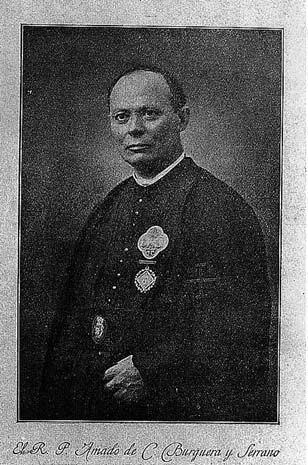
Padre Burguera, 1920. From his history of Sueca
he took on local spiritist healers in his sermons. He offered them a prize of one thousand pesetas if they could demonstrate one genuine cure. Cortés thought Burguera was the kind of person whom in earlier times the Inquisition would have burned at the stake.[29]
Andrés Ferri Chulio, Sales, 2 December 1983; for patriotism see Burguera, Historia de Sueca, 1:110-117. Fermín Cortés, Sueca, 5 December 1983; B 298-299.
As we might expect from someone who undertook a magnum opus on the Eucharist, Burguera was not reluctant to apply his vigor or to invest his self-importance in matters beyond local history. Poor health seems to have been a pretext not only to avoid the direct supervision of superiors but also to see the world. In 1914 Burguera went for his health to Lourdes, to Paris, and finally to Paray-le-Monial, where he knew there was an institute for Eucharistic studies. Its director was the elderly Baron Alexis de Sarachaga, a half-Russian, half-Basque retired diplomat who had converted from a frivolous liberalism to a
devout integrism. Beginning in 1873 Sarachaga spent a fortune on apologetic publications, a museum to the Eucharist for pilgrims, and an association for the Social Reign of Jesus Christ, all at the Paray-le-Monial shrine to the Sacred Heart.[30]
Burguera, De Dios a la Creación, 41-46. Sarachaga's collaborator Victor Drevon organized the national pilgrimages of 1873-1878: Cinquin, "Paray-le-Monial," 187-196 and, for museum, 248.
If Burguera thought that a one-man encyclopedia was impressive, he was unprepared for the baron's scheme, which was to show that the entire history of natural and human creation was a preparation for the Social Reign of the Sacred Heart. Burguera (here "we") described Sarachaga in words similar to those used by others to describe himself: "We thought, as we listened, that we were hearing a lecture from a man who was a little nutty, but we were intrigued by so much knowledge, however strange, and we were convinced, finally, that our intellectual equipment was no match for that of Sarachaga."
By the time the baron died in 1918 he had produced twenty-eight volumes of studies, mostly "scientific" and archaeological, as part of the project for universal knowledge. When Burguera and Sarachaga met in 1914, Sarachaga was casting about for ways to generate more of an impact. Few persons seem to have heard about, much less taken seriously, his "École Bardique" or his "Instruction Supérieure Diplomatique" ("according to the rules and disciplines of the Sacred Heart"). Sarachaga found a willing disciple when he told Burguera the visit was providential and asked him to hold a "Chair of Eucharistic Pomp" in Spain. Burguera needed little encouragement to sense that he had a mission. He felt that the esoteric Ars Magna of the thirteenth-century savant from Mallorca, Ramon Llull, would appeal to Sarachaga. It did, and the baron encouraged Burguera to use the work to seek out a universal sacred language.[31]
Burguera, De Dios a la Creación, 45-49.
As a result of this unusual stimulation, Burguera decided after the death of Sarachaga to write the projected universal divine history himself. He published the first two volumes in 1932. They are most curious (disparatados, Spaniards would call them). Burguera identifies a sacred ur-language linking, for instance, Chinese with Berber, and he asserts that Catalan-Valencian-Mallorcan is not a Romance but an Iberian language, like Basque. He claims the words in Llull's glossary were used in the Garden of Eden. He identifies a kind of sacred world geography of four prototypic natural features—"the pyramid," "the boat," "the crater-grail," and "the sphinx"—which he calls "telluric symbol-signs." And he shows great interest in the lost continent of Atlantis. Much of this work Burguera drived from Sarachaga's fanciful research, but some came from his own studies and visits to museums throughout Europe and in the Holy Land. There are similarities with the later pop archaeology of Eric von Dániken and Jorge María Rivero San José. Yet in this long and strange work there are also moments of beauty, as when Burguera goes into detail about the number of plant and animal species in the world and then points to the complexity and perfection of each. And the overall plan, while crude, has a distant resemblance to that of the French philosopher Teilhard de Chardin.[32]
Burguera's disciple Juan Castells told me that the revised third volume, in manuscript, which related the Ezkioga visions to all of previous history, was lost in the Civil War. Burguera appears to have visited museums in Rome, Paris, London, Bern, Jerusalem, Nazareth, Cairo, and Tetuán. He would have enjoyed an equivalent work, the two-volume, large-format Rivero San José, Cantabria, Cuna de la Humanidad, which with color photographs and an analysis of toponyms demonstrates that the area around the village of San Sebastián de Garabandal, the site of visions of the Mary by four girls in the early 1960s, was originally the Garden of Eden.
Burguera connected this project to a school, Studium Catholicum, which he founded in one of his family's orange groves outside Sueca. He designed it as a day school similar to those of the contemporary reformer Padre Andrés Manjón. It was also to train catechists. With so much of Spain falling away from Catholicism, Amundarain, Aulina, and Burguera's future adversary, Echeguren, had all given time and thought to catechism for adults. Topped by a statue of the Sacred Heart of Jesus, the building was completed in 1931, hardly an auspicious year. Three days after the burning of religious houses (11 May 1931), Burguera gave an intemperate sermon against the Republic and the town authorities temporarily banished him.[33]
B 665.
At the request of an acquaintance, this curious, intense, authoritarian, opinionated, and credulous man went to Ezkioga. He arrived on 13 November 1931, after attendance had fallen off in the wake of the Ramona fiasco. He met Iñaki Jaca, a boy seer, Patxi, Ramona, and a young girl seer from Ormaiztegi and he learned about José Garmendia's visit to Francesc Macià in Barcelona. He quickly classed the seers he observed by their type of trance and evaluated their visions as divine, diabolical, or human. His learning impressed the local doctor, Sabel Aranzadi, who asked him to sit for two days on the commission examining the seers.[34]
Motive for visit, from Juan Castells, Sueca, 6 December 1983, p. 4; B 43; B II 625 n. 53, 627-628, 631-632, 636. Iñaki claimed one hundred visions by the time of this meeting.
Burguera received several "proofs" of the apparitions. Two took place in the village of Bakaiku (then Bacaicoa) in Navarra. There on November 17 he observed eight children, first in the schoolhouse and then down by the river, who saw the Infant Jesus of Prague. Burguera's prior study of the Infant Jesus in Sueca must have quickened his interest. When the children were running and playing, not in trance, one of them came up to Padre Amado and said, "It was my mother who carried your suitcase in l'Espluga de Francolí." Burguera was astonished, for the boy referred to an incident that took place thirteen years earlier and that he had never been able to fathom.[35]
First proof, B II 633 n. 57; Juan Castells, Sueca, 6 December 1983, p. 5; for Bakailu, B 40, B II 637, and Castells.
According to what his disciple Juan Castells told me in Sueca, Burguera had gone to take the baths at l'Espluga in Tarragona. He arrived by train in the evening and found no way to get to his lodgings. The station manager advised him to go back to Barcelona, for thieves made it unsafe to go into town on foot. A woman turned up to ask him if he wanted to go to town, but he was abrupt with her, telling her it was none of her business. He was about to take a train back to Barcelona when the woman returned, asked him again if he wanted to go to town, picked up his bag, and set off walking fast. He followed. It was raining, but it seems neither she nor he got wet. The woman left him at the hotel saying, "Remember me to God." The desk clerk assured him that there was no woman like that in the town. The episode, rather like Manuel Irurita's mysterious train stop, had troubled Burguera, and other priests he consulted had not been able to explain it. So when the child seer told him that it had been the child's (spiritual) mother, Burguera recognized a sign to believe in the visions.
Burguera often retold the second proof in Bakaiku. There he observed María Celaya in trance, and on November 19 he accompanied her to Ezkioga, where she had visions as well. When he saw her again at Bakaiku on November 22, she revealed to him that eight days earlier there had been an attempt to break into and burn down his Studium Catholicum in Sueca but that the vandals had been repelled by the Sacred Heart of Jesus. Burguera quickly returned to Sueca to see what had happened. Indeed, he said, he found hatchet marks on the door and the mark of flames. It appeared to him that the flames had come at the vandals from inside, from the Sacred Heart.[36]
B 352, 664; Castells, Sueca, 6 December 1983, p. 4; Burguera also told these proofs to the Navarrese believer Pedro Balda: interview, Alkotz, 8 April 1983, p. 5, and Balda to Guerau de Arellano, 9 November 1937, AC 264.
Burguera's first stay in Ezkioga and Navarra did not make much of an impression on the seers or their more prominent followers. At that point he was just one more curious cleric. The second volume of his universal divine history had already passed ecclesiastical review, so he smuggled into it sixteen pages on the apparitions. He did so in a chapter on the beauty of God's art in creation, emphasizing the beauty the seers saw in the face of the Virgin Mary. He noted approvingly that two child seers had visions in which the child Jesus and the Virgin referred to the "official dishonoring of God" by the Constituent Cortes. But he snorted at the deputy Antonio de la Villa's idea that "the miracles of Ezquioga were a way of rallying the forces of the Traditionalists and the Basque-Navarrese Nationalists to rise up against the Republic." Rather, he saw the apparitions in the longer perspective. The evil, he pointed out, "was not just of this century, but also in all of the previous ones. We have reached a point in which science, art, history, literature, and social development are all Satanized."[37]
B II 634-635, 637, 694. The book was still in press in mid-1932 (prologue to La Verdad).
The multivolume opus itself, so long in the writing, was still Burguera's main preoccupation in 1931; it took him a while to assimilate what he had seen in Ezkioga and adjust his enterprise to the virtually unlimited scope for knowledge of the divine that the many seers offered. At any rate, he did not return to Ezkioga until 27 June 1932, but when he did, he was ready to write a defense of the visions as a work on its own. Over time he came to consider Ezkioga the climax of world history, the logical crowning point of all his previous endeavors, and the means by which God would once and for all reunite the human and the divine.
In the long run Burguera planned to write "a big book, well-documented and carefully verified," on the apparitions. In the short run he wanted to write a rebuttal of the Jesuit José Antonio Laburu's lectures discrediting the visionaries (see chapter 6). On his arrival in Ezkioga Burguera immediately started evaluating the seers, separating "the dross (not much and naturally occurring) from the gold." An expedition of Catalans was in Ezkioga on the day of his arrival, and either that week or the next they showed him the manuscript defense of the visions by the wealthy Carlist politician Mariano Bordas Flaquer. On very short acquaintance, they asked Burguera to write a prologue. Within three weeks the diocese of Segorbe had approved the booklet and the prologue.[38]
Bordas Flaquer, La Verdad, 8-10; ARB 151. The prologue is dated in Ezkioga July 5, the censure July 22. The bishop of Segorbe, Luis Amigó, was a devout Capuchin from the Valencian region. He dedicated his order of Capuchin tertiaries to Our Lady of the Sorrows (see Ramo Latorre, Mensaje, 151-152).
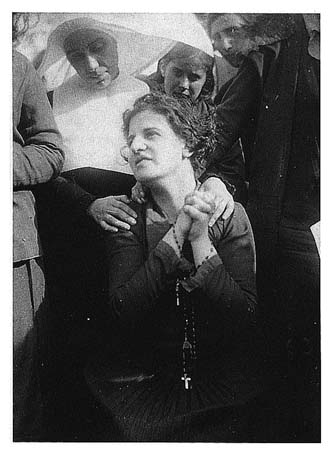
Pilar Ciordia in vision, probably 13
July 1932. Photo by Joaquín Sicart
A visit with Burguera became a fixture of the Catalans' weekly tours. He would tell them the latest messages, explain the different kinds of trances, and place the visions in a wider context. On July 17 he told them that four days earlier he had been working on his book when he heard that three schoolgirls on an excursion from Pamplona were in trance on the vision deck. Twice he went out to examine and test the seers and speak to the entire group about the mercy of the Mother of God. After many hours the visions ended and a nun came to say that two of the seers had messages for him. The first was Pilar Ciordia, a woman who lived at a Pamplona convent school. She claimed that she had been present in spirit when Burguera had delivered the sermon in Sueca that had caused his banishment and that the Virgin had then pointed him out as her (the Virgin's) defender in Ezkioga. Ciordia said she had recognized him at once when he got up on the vision deck. Burguera believed her.
Burguera also believed the second seer, Gloria Viñals, a student at a different school in Pamplona. She claimed that in February of 1932 she too had had a
vision of Burguera in Sueca in which the Virgin had also pointed him out as her defender in Ezkioga. Viñals's proof was that the Virgin told her that once she had carried him through the air to a lodging house, which Burguera again must have taken to refer to the episode in l'Espluga de Francolí. These seers persuaded Burguera that the Virgin wanted the "big book" he planned to write about Ezkioga. Note here a cumulative process. Burguera believed the visionaries essentially because they said the Virgin had chosen him to lead others to believe the visionaries. The Catalans believed Burguera in turn because he said that the seers said that the Virgin said the Catalans had been specially chosen to be told to believe the visions or to tell others about them.[39]
B 665-667; ARB 119-120, 124, 234. Ciordia thereby claimed her visions began before those of Ezkioga.
As the chronicler authorized by the Virgin of Ezkioga, Burguera needed the texts of the messages of the seers. In 1932 few of the thousands of vision texts had circulated. He had no chance to obtain the messages in the notebooks and printed questionnaires of the informal commission; by 1932 the parish priest of Ezkioga, firmly opposed to the visions, held this material closely. But he could obtain some of the messages seers wrote in their own notebooks or dictated to friends and confessors. Burguera obtained the messages of the Pamplona seers when they were in Ezkioga or when he went to see them in Navarra. Sympathetic priests provided him with the messages of Evarista Galdós, Martín Ayerbe, and Marcelina Mendívil. And his friendship with the Catalans gained him access to their favorite seers, Benita Aguirre, José Garmendia, and María Recalde. With Recalde a priest from Valladolid, Baudilio Sedano de la Peña, was especially helpful.
Baudilio Sedano de la Peña and Cruz Lete
I went to see Don Baudilio in 1982 at the instance of the family with whom he had boarded at Ezkioga. A short, chubby man with a dirty worn cassock, unctuous and jovial, but with darting eyes, he was then seventy-six years old. He lived in Valladolid in a squalid apartment above a convent of Franciscan nuns, for whom he served as chaplain. As we talked, the smells of the pastries and cookies they baked drifted up from the kitchens below. I later learned of his extreme secretiveness about the large portion of time he gave to visions and visionaries and that only the name of that one Basque family (which, like many others I talked to, wishes to remain anonymous) would have got me in the door. As it was, on my repeated visits from Madrid he let me into his confidence only gradually and partially. He loaned me first some prints and then the glass plates of photographs of visionaries, but it transpired later that they were not in fact his. I never got to see his store of documents and he eventually gave me copies of the Burguera book only at exorbitant cost. Nevertheless, he did let me look at a typewritten memoir of his involvement with the Ezkioga visionaries and Padre Burguera.[40]
On 5 August 1969 Lourdes Rodes recorded Sedano's reminiscences in Barcelona; hereafter: Sedano tape.
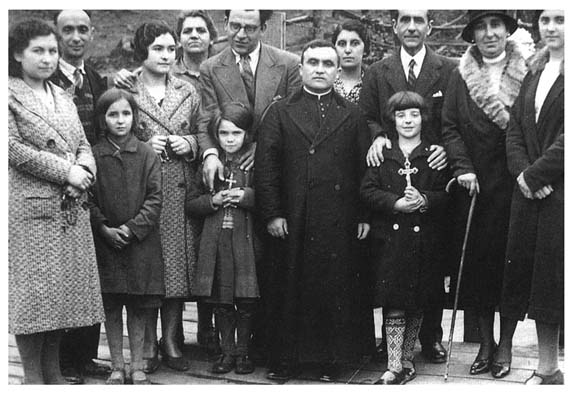
Baudilio Sedano de la Peña and Vidal Castillo (wearing glasses) with seers and believers,
including a stockbroker and his wife from Bilbao, winter 1931–1932. Photo by José Martínez
Sedano was born in a village of the province of Burgos in 1906 and trained as a priest and a contralto for cathedral choirs. His first post was in Sigüenza and his second was in the cathedral of Valladolid, where he was also chaplain of the convent. In 1931 he read newspaper reports of the visions. With money he had won after buying a lottery ticket with Ezkioga in mind, he went there at the end of July.
Like Burguera, he felt he had particular proof that the apparitions were true. He saw Benita Aguirre after a vision run down the hill, pick a man out of the crowd, and give him a private message. Sedano kept an eye on the man, who prayed on the hillside with tears streaming down his face. When Sedano approached him, the man said he was from Tenerife and that there was no way Benita could have known him, yet she had revealed secrets about the state of his soul. For the first year or so Sedano went to Ezkioga every two weeks and stayed about four days. He did so with utmost discretion, fearing reprisals from his diocese or protests from the priests at Ezkioga. He took down María Recalde's messages as early as September and arranged for her to save them for him. María's son remembers that he came to Durango about once a month.[41]
Sedano told me that the archbishop of Valladolid, Remigio Gandásegui, was curious about the visions and told him to take notes. Gandásegui, from Baracaldo, was the Spanish bishop who had gone most often to Limpias and he was also a Lourdes enthusiast. After a near-fatal heart attack in 1932 he summered at the Ordizia estate of the doctor Benigno Oreja, himself an Ezkioga sympathizer. Sometime after the Vatican closed the book on the case, Sedano was forced to proclaim his submission.
Sedano also provided Burguera with the messages from the seer many people considered the most convincing, Cruz Lete Sarasola of Itsasondo. Lete studied first at a grammar school in Ordizia and then at a normal school in Pamplona. He was thus one of the most educated seers, and the solid reputation of his family enhanced his credibility. When he was home in the summer or fall of 1931, he went to the apparition site out of curiosity and began to have visions. He told Sedano that the Virgin instructed him not to resume his studies in Pamplona and above all not to return to the apartment of the freethinking family where he had been boarding. At the insistence of his parents, he did go back to Pamplona, but when he was going up to the flat, the Virgin appeared to him and he fell down the stairs. When he tried to study, he found that all he could see in his books was blank pages. He said that in his first vision at Ezkioga after his return, the Virgin asked him jokingly, "Did you study a lot?"
Tall, thin, and austere, Lete was a striking seer. Many of his visions were of Christ and he often settled into Christlike stances. A Catalan referred to him in vision as having "an angelic tenderness." And Sedano said that "just hearing him pray the seven Hail Marys of the Sorrows of the Holy Virgin gave you such a feeling of sadness that it was obvious that it did not come from him but that he was seeing something extraordinary that could only be the Holy Virgin." Like others, Lete said the Virgin had told him that he would die soon. A Basque sheepman recalled Lete's private messages from the Virgin to those around him: "Some people would laugh, but he got them serious and weeping."[42]
ARB 12-13; Sedano tape, 11-12; elderly sheepman, Ikastegieta, 4 April 1983. On 15 December 1931 Lete predicted his own death (Gratacós, "Lo de Esquioga"). He said the Virgin confirmed to him Ramona's divine wounds, Evarista's ribbon from heaven, and Rigné's second marriage. I have texts of visions from 25 October 1931 until 8 February 1932. He dictated others to Ramona's friend, the Bilbao artist José de Lecue: Lecue to Cardús, Bilbao, 20 February 1934. According to Lecue's niece in 1984, Lecue eventually gave all his records to the diocese.
In the fall of 1931 Lete had a vision of the Virgin in which she pointed out a heavenly friar as Juan de Dios, the founder of the Brothers Hospitallers, and asked Lete whether he wanted to join the order. He did, and she instructed him to write the superior of the house in Ciempozuelos near Madrid. Lete and some of his friends were admitted. They are said to have participated in spiritual exercises with the Jesuits at Loyola before leaving. Lete's last vision at Ezkioga, of Roman soldiers crucifying him, may reflect the visual imagination of the exercises (see text in appendix).[43]
SC E 278; vision declaration signed in Ezkioga 8 February 1932 by Cruz de Lete, 2 sides, private collection.
Sedano had been taking down Lete's visions and was present at this one. He accompanied Lete as far as Valladolid, where he put him up for a night. In Sedano's chapel Lete said in vision that many who believed in the apparitions would later disavow them. He went on to Madrid, reappearing in the Ezkioga story only a year and a half later when his edifying death (he died confidently singing a hymn) provided the believers with their first saint.[44]
Sedano tape, 13-16.
Burguera was frustrated in his attempts to gain documents from other seers, including some of the most famous ones. Their refusal placed him in a quandary—how could those who saw the Virgin not cooperate with someone the Virgin herself had chosen? Ramona Olazábal's spiritual director was the curate of Beizama, Francisco Otaño, and he retained her vision texts in case there was an official inquiry. Allegedly on the Virgin's orders, Ramona kept Otaño's role
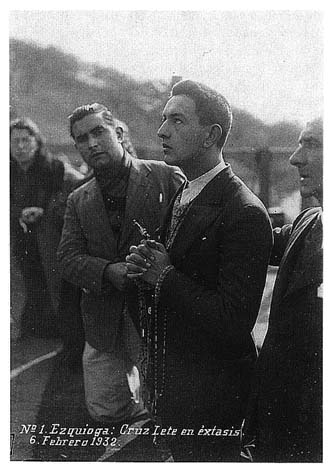
Cruz Lete in vision, 6 February 1932. Photo by Joaquín Sicart
secret and gave messages to no one else. Because she would not cooperate with him, Burguera judged her visions diabolical. But he left her the option of changing her mind.[45]
His verdict alienated him from Lecue and Cardús, but they did not publicly challenge him, R 65; SC E 481/ 25-26 and 35-37; Cardús to Ayerbe, 15 January 1934. Francisco Otaño Odriozola was born in Zizurkil in 1883 and became coadjutor of Beizama in 1910. After Laburu's lecture he forbade Ramona to go to Ezkioga. He soon relented, but Ramona's visions ended anyway on 15 August 1932. He wrote Cardús about twenty letters from October 1932 to December 1935. In late 1933 he was reputedly composing Ramona's biography.
In the summer and fall of 1932 most of the believers recognized Burguera as their expert defender. Free from the supervision of a religious order and without a fixed post in Valencia, he was less vulnerable than other believing priests. Thus he was active in the planning of the chapel at the vision site and he contacted the sculptor who made the image of the Virgin. With the chapel complete and the arrival of the image imminent, the spirits of the believers revived. In honor of the Virgin's birthday, a female seer claimed that the Virgin wanted Burguera to run a kind of festive contest of three theological questions. The Virgin would provide a prize. On September 4, after all had performed the stations of the cross, Burguera read out the questions to about three hundred persons on the vision
deck. Four days later three thousand persons came to hear the replies. For three hours seers and believers proposed their answers. No one guessed what the seer wanted to hear, so, she said, the prize was hers. This strange episode exemplifies Burguera's two sides: on the one hand, the authoritarian leader of thousands of docile believers, a master of sacred ceremonies; on the other, an innocent subject to the most flimsy of visionary claims.[46]
B 42; for sculptor, Burguera, Compendio, 294; for contest, ARB 98-102: "What was the first miracle wrought by God?" "What is the place on earth that is above heaven?" "What is the distance from heaven to hell?" Answers: "The creation"; "The place where the Virgin Mary is to be found in body and soul"; and "Only the fallen angels know this [distance], for only they have traveled it."
Burguera and Rigné were similar in a number of ways. Both wrote and paid to publish numerous books. Both had independent wealth, although Rigné seems to have started out with more. Both sought in vain recognition and respect. Both had been to Lourdes and had a great openness toward extraordinary manifestations of the supernatural. And both were about to come head to head with church and state.
But there were contrasts as well. Rigné was an advocate for chaste nudity, while Burguera considered nudism the ultimate sign of Satan's dominion. While both were the stuff of heretics, Burguera, like Calvin, also was the stuff of the inquisitor general. Both were constitutionally incapable of taking orders, but in Burguera's case it was because he preferred to give them, whereas Rigné was too playful or obstreperous for hierarchy in any form. Burguera saw himself as a grand spiritual director who distinguished the good from the bad, the sacred from the profane, the just from the unjust. Rigné was constantly challenging these categories and taking pokes at the classifiers.
Like the other patrons, Rigné and Burguera were in such close symbiosis with seers that without them some seers would not have maintained—in some cases would not have gained—their fame. And wittingly or not, each guided the seers into pronouncements of a certain nature and away from other themes and other directions. They connected the rural seers to the wider literate society. But they filtered and bent the light that passed through them. This distortion became especially evident as the diocese closed in on seers and patrons alike.