
2
Before Science: The Early History of Authenticity Testing
God knew the truth—and could be asked
Robert Bartlett,
Trial by Fire and Water
Appearances may deceive. People often have reasons to present themselves as something other than what they are. To foil the human tendency to dissimulate, techniques have been devised everywhere to bypass what people say and tap the underlying truth by other means. Foremost among these techniques are authenticity tests. Although qualifying tests are more prominent today, in preindustrial society, authenticity tests were the primary form of testing. This chapter, a historical review of authenticity tests, provides a context for the subsequent discussion of their contemporary usage. Moreover, analysis of their early forms allows further insights into the distinctive features of tests in general.
As already explained, tests are representational devices. The ultimate purpose of a test is to discover target information, of which the test result is a sign or representation. While deceptions may be artful, the truths beneath tend to be simple and stark. Therefore, the information sought in authenticity tests is usually
of an either/or form: genuine or impostor, honest or deceitful, faithful or heretic, innocent or guilty. Folklore provides a rich source for the variety of ingenious tests that might be used to answer such questions.
Identity
Tests frequently appear in folklore as means to determine someone's true identity: long-lost kinsman, heir to the throne, fugitive criminal, and so on. The testable sign of this target information may be some telltale capacity, as when a stranger is accepted as brother because he can accurately recount an event that occurred in childhood or when, as in an Indian tale (reminiscent of Latter Day Saint prophet Joseph Smith), a man's identity is certified because he is the only one who can read a magic book.[1] The future King Arthur, Wagner's Sigmund, and Odysseus were similarly identified by the unique ability to withdraw a sword embedded in a stone or tree or to bend a certain bow. Conversely, the inability to accomplish a task may unmask an impostor, as when, again in a story from India, a false bride was undone when she was unable to finish the true bride's weaving.[2]
Characteristics of the body are commonly used as signs in tests of identity. Fitting a slipper was the means of identifying Cinderella, and similar tests are found in many other folktales.[3] In the Ozark tale, "The Soot on Somebody's Back," a pretty girl is repeatedly raped in the darkness, perhaps by one of her brothers. On the third night, she places a dish with soot and grease beside her bed and smears some of it on the back of her unknown assailant. The next day, at the invitation of the eldest (whom the sister had taken into her confidence), the six brothers go swimming, and one of them never comes back.[4] Distinctive scars, birthmarks, and other permanent body characteristics frequently serve in folklore as the basis of tests for identifying kin, friend, or foe. A New Zealand Maori marked for vengeance was known to have overlapping front teeth. A suspect was tested by having a woman perform a lascivious dance in front of him, causing him to laugh. This enabled his enemies to see the telltale sign, and he was soon in their hands.[5]
Tests of identity may pertain to class membership as well as to specific individuals. One test for vampires is to check for their lack of a reflection in a mirror, and Japanese folktales relate how it is sometimes possible to determine if certain individuals are mischievous foxes who have taken human form by looking for the tips of their tails peeping out from under their clothing. Strangers who claim to be of noble blood may be tested to determine if they possess the requisite sensitivity, as happens in the story of the princess and the pea. A male version describes a prince who said he thought he was sleeping on a heavy beam, which turned out to be a hair in his lower bedding.[6]
Character
Many tests in folk literature are designed to ascertain if an individual merits trust or some great benefit, such as a king's daughter as bride and/or a kingdom (or half of one, anyway). Cleverness or judiciousness may be tested by asking candidates to solve riddles or answer questions; courage and ingenuity are signified by enduring frightening ordeals or fulfilling assignments that require perilous quests or impossible tasks. To determine his successor, William the Conqueror is said to have asked his sons what kind of bird they would prefer to be. The first said a hawk, because it resembles a knight; the second said an eagle, because all other birds fear it; and the third said a starling, because it makes its living without injury to anyone. The third was chosen.[7] Cinderlad, the hero in the folktale, "The Princess on the Glass Hill," was tested on several occasions. First he demonstrated his courage by spending several nights in a barn despite terrifying manifestations that had driven his older brothers away, for which he was rewarded with three magic horses and suits of armor. Later those magical accoutrements enabled him to accomplish the impossible task of riding up a glass mountain and thus to claim the princess seated atop it as his bride, together with half her father's kingdom. Numerous European and Arab folk traditions include the tale of the peasant girl who helped her father win a dispute by solving riddles. Her cleverness caught the attention
of the king, who resolved to test her further by setting her to impossible tasks, which she succeeded in accomplishing. This sufficiently impressed the king that he married her and made her his trusted adviser.[8]
Chastity, an issue on which folktales indicate that a woman's word is not invariably reliable, is a common subject for testing. Italian stories describe several devices. One is to lead a woman of questionable virtue to a place where there are two fountains. In the presence of a chaste woman, the fountain that produces clear water flows, but if she is unchaste, the other, muddy, fountain gushes forth. A litmus test of the issue was to set her before a picture that would change color depending on her condition.[9]
Tests that may be classed under the general heading of loyalty are extremely common. The fidelity of spouses is a common subject of tests, the wife nearly always being the one whose behavior is scrutinized. The Bible establishes a ritual procedure whereby a wife suspected of adultery must drink consecrated water, which will cause her to miscarry if she has been unfaithful.[10] The representational structure of the test is clear: the test result (whether or not she miscarries) differs from but signifies the target information (whether or not she has committed adultery). The British tale, "The Loving Wife," recounts how a husband pretends to be dead in order to test his wife. True to his suspicion, he had hardly been laid out before the wife entertained a young man in her bedroom. The "corpse" jumped up and attacked the pair with a stick.[11]
Feigning dire circumstances also occurs in folktales when the fidelity of friends is to be tested. A ruse that usually succeeds in unmasking false friends is to inform them that all one's money is gone. Another test is to carry a slaughtered animal in a bloody sack to one's friends, telling them that one has killed a man and asking them to help get rid of the body.[12]
As King Lear learned to his undoing, the true feelings of relatives may also be other than they appear. A test in such circumstances was devised when three sons disputed the inheritance from their father. The father's corpse was exhumed, and the sons were told that the one who could shoot an arrow closest to the heart would have the estate. The two older brothers let their
arrows fly, but the youngest could not bring himself to shoot. The estate was awarded to him, for he alone had demonstrated true love for his father.[13] Similar is King Solomon's trenchant test for determining which of two claimants was a baby's true mother.[14]
Biblical precedent (this time the temptation of Adam and Eve in the Garden of Eden) is also visible in stories of how the obedience of servants might be tested. The master ushers the servant into the dining room and invites him to partake of anything of the sumptuous feast that is spread before him, save one covered dish. The master then leaves, and eventually, the servant, unable to contain his curiosity, raises the lid of the forbidden dish. A mouse jumps out and runs away. When the master returns and checks the dish, the absence of the mouse is taken as evidence of the servant's disobedience.[15]
Honesty, Guilt, and Innocence
Tests of various sorts have always been used to help decide law cases, especially in the absence of more direct forms of evidence such as the testimony of unbiased eyewitnesses. Perhaps the simplest test in judicial procedures is the testimony of biased noneyewitnesses, or compurgation. Compurgators were character witnesses who swore not to the facts of the case but to the integrity of the person they supported, who was usually their kinsman.[16] The number of supporters varied with the nature of the crime and the circumstances. In medieval Wales, a woman accused of infidelity could disprove the charge with seven compurgators, but fourteen were necessary to answer a second charge, and a third charge would be dismissed only on the oaths of fifty.[17] To rebut a charge of murder by savage violence or poisoning, Welsh law demanded no less than 600 compurgators.[18]
Compurgation qualifies as a test by our definition, in that it is an intentional and indirect effort by an organization (in this case, a court) to gain knowledge about an individual. It is not a very complex or instructive sort of test, however, because the gap between the information derived from the test and the target information is narrow indeed. For the Welshman accused of
murder by savage violence, for example, it is merely the difference between 600 of his relatives swearing that he would not do such a thing and the court's judgment that he did not do it. From our perspective, medieval legal tests become much more interesting when they move from seeking evidence from human witnesses to soliciting it from God. Divine judgment was sought primarily through trial by battle and by ordeal. As with compurgation—perhaps even more so—battle and ordeal were intended to be used only when more direct forms of evidence were lacking. In thirteenth-century Catalonia, for example, "if the accuser can prove his charge through authentic charters or through trustworthy witness, then that proof should be admitted and battle should not be adjudged . . . [for] men may have recourse to the judgment of God only when human proof fails."[19] And the twelfth-century charter of Tournai specifies that an assault to which there are witnesses will be judged according to the accounts of the witnesses. If there are no witnesses and the assault occurred during the day, the accused may clear himself by a "sevenfold compurgation," but if it occurred at night without witnesses, the trial is to be by ordeal.[20] As Bartlett explains, "In the case of an attack in the dark with no witnesses, there really might be the temptation to wonder who could know the truth of the matter. The ordeal offered a solution at just this point. God knew the truth—and could be asked."[21] But since God could not be expected to answer in plain language, the question was posed by orchestrating a situation in which the either/or outcome could be read as a message from God.
Trial by Battle
Framing the test in the form of trial by battle (also known as the wager of battle) amounts to letting rival claimants fight, with the assumption that victory represents God's judgment in favor of the combatant who is in the right. The main biblical precedent is found in the story of David, the shepherd boy who challenged the huge, well-armed, and battle-experienced Philistine champion Goliath in full confidence that, with God's help, he would prevail.[22]
Trial by battle was widespread in the early Christian era in Europe. In Ireland, "so general was it, indeed, that St. Patrick, in a council held in 456, was obliged to forbid his clergy from appealing to the sword, under a threat of expulsion from the church."[23] "No legal procedure was more closely connected with feudalism, or embodied its spirit more thoroughly than the wager of battle."[24] By the thirteenth century, however, French kings were attempting to abolish it as they strove to centralize power in their own hands and courts, while nobles clamored to retain it as a means of maintaining their privileges and independence vis-à-vis the crown.[25] Eventually, the monarchy prevailed and the wager of battle dwindled, at different rates in different places, until by the fifteenth century, it was an oddity.[26]
English law adopted trial by battle late (it was introduced by William the Conqueror) and was also late in abolishing it. One of the more common circumstances in which it might occur was in connection with the "appeal of death." This provision of English law held that within a year and a day after an individual had been acquitted of murder in a jury trial, the widow or next of kin of the deceased individual might demand a second trial. As a private suit, this second trial normally took the form of trial by battle. In 1774, an effort was made in the House of Commons to terminate the right of appeal of death in the colony of Massachusetts Bay (as part of a bill to punish rebellious colonists for the Boston Tea Party). This occasioned considerable protest that the erosion of fundamental rights, beginning in America, might soon come home to England itself, and the offending provision was struck before the bill could be passed. In 1818, more than two and a half centuries after trial by battle had ended in France, an Englishman named Thornton was acquitted of murdering a girl. Her brother claimed the appeal of death, and Thornton maintained his innocence and readiness to prove it by combat. The court certified the validity of the proceedings, and a trial by battle was scheduled. A crowd gathered, and the duel was precluded only by the failure of Thornton's challenger to show up. It was only the following year, 1819, that the right of appeal of death was finally abolished in England, and it may have been abolished as late as 1837 in South Carolina.[27]
When in full flower, wager by battle spilled well beyond combat between the principals to a controversy. It was common for a suitor to accuse one of the witnesses against him of perjury and demand to have the truth of the matter revealed by battle between them. In thirteenth-century England, a litigant might even challenge his own witness to battle if the latter's testimony was not to his liking. And in both English and French courts of that time, the loser of the case might appeal the verdict by challenging the judge.[28]
It was generally considered inappropriate for women, the physically disabled, and ecclesiastics to engage in combat personally, so they were usually represented in trial by battle by champions. For example,
When Gundeberga, the Frankish wife of the Lombard king Charoald (626–636), was accused of treason, a deputation from her relatives suggested, "Order the man who brought this charge to arm himself and let another man of Queen Gundeberga's party proceed to single combat with him. By the conflict of these two the judgement of God will be made known, whether Gundeberga is innocent or guilty of this charge."[29]
Although in principle they should be represented by champions, in actuality, priests and monks were not always of pacific personality, and many accounts tell of churchmen avidly pursuing their interests by means of the wager of battle.[30] Women too might occasionally represent themselves in combat. German law lay down certain procedures to be followed when a woman faced a male opponent:
The chances between such unequal adversaries were adjusted by burying the man to his waist, tying his left hand behind his back, and arming him only with a mace, while his fair opponent had the free use of her limbs and was provided with a heavy stone securely fastened in a piece of stuff.[31]
One might puzzle over such niceties. After all, David's encounter with Goliath proved that the support of the Lord is sufficient to
overcome any disadvantage. Nevertheless, the men of the Middle Ages went to great lengths to ensure that when they placed their fate in God's hands, the odds as calculated in this world were not against them. Doubtless this was because the logic of trial by battle did not conform fully to the precedent of David and Goliath, where the human odds were so heavily on one side that divine intervention was credible only if it favored the other. One could scarcely attribute a victory by Goliath, that is to say, to an act of God. Trial by battle, however, aimed to create a circumstance rather like casting lots (a procedure that was also used in medieval trials and disputes), wherein the odds were so even that no human prediction of the outcome was possible. Then the result, regardless of the side it favored, could be attributed to God's intervention.[32]
Thirteenth-century English law made fine distinctions as to what disabilities would excuse an individual from trial by battle. The loss of molar teeth was not adequate for disqualification but the lack of incisors was, for the latter were held to be important weapons.[33] If the adversaries were unevenly matched, measures might be taken prior to the battle to equalize them. "Thus the knight who demanded that his antagonist should undergo the destruction of an eye to equalize the loss of his own . . . was strictly within the privileges accorded him by law."[34]
These refinements make Welsh rules pertaining to twins appear all the more remarkable. Under Welsh law, twins were considered to be a single person; they received, for example, but a single share of the family inheritance. But the legal status that spelled disadvantage in one arena worked an advantage in another, for if a twin became involved in wager by battle, he and his brother would take the field as one man.[35]
The scruples about equal odds operated only between social equals; when adversaries of different rank met in trial by battle, it was often a different story. If noble met commoner in judicial combat in France, the noble might enjoy the right of fighting on horseback with knightly weapons while the commoner would meet him on foot, armed with shield and staff. Such would be the case, at any rate, if the commoner had the audacity to be the challenger; if the noble condescended to challenge the commoner
they would meet on equal terms.[36] While interclass duels did occur on occasion, for the most part, the wager of battle was very much the province of the aristocracy. In thirteenth-century Germany, a superior need not deign to fight anyone below his social station. A Jew could not decline the challenge of a Christian, but presumably the Christian was immune from challenge by a Jew.[37] More fundamentally, in a sharply stratified social system consisting of an armed nobility and an unarmed peasantry, the lower stratum of society lacked the training and, it was doubtless thought, the fineness of mind and sense of honor to engage meaningfully in the wager of battle. Another sort of test was deemed to be more appropriate to judicial needs pertaining to the lower classes: the ordeal.[38]
Trial by Ordeal
Ordeals of various forms are found all over the world. In medieval Europe, the three most popular were the ordeals of hot and cold water and of hot iron. The oldest of these—of Frankish origin and the only form to be mentioned from the earliest reference to trial by ordeal in about A.D. 500 until about 800—is hot water. The procedure required that the individual reach into a boiling caldron to retrieve some object, normally a ring or a stone.[39] During the reign of Charlemagne, 768–814, several other forms of ordeal came into being, and for the next four centuries, ordeal was a major judicial instrument. The ordeal of cold water called for the individual to be cast into a stream or pond. The ordeal of hot iron initially required the person to walk over nine red-hot plowshares; somewhat later, carrying a red-hot iron for three paces increased in popularity.[40]
As with trial by battle, the ordeal was a test that established conditions where, in the absence of witnesses or other sufficient human evidence, the decision of innocence or guilt was referred to God. In the case of cold water, God would signify his judgment by causing the innocent to sink and the guilty to float. This was thought to be so because water, a pure substance, rejects evil. Hincmar, Archbishop of Rheims (845–882) and major advocate for the ordeal, explained that the guilty party "is unable to sink into the waters over which the voice of the majesty of the Lord has
thundered, because the pure nature of water does not receive a human nature which has been cleansed of all deceit by the water of baptism but has subsequently been reinfected by lies."[41] In the ordeals of hot water and hot iron, the innocent emerge unharmed, while the guilty suffer grievously. The rationale for this is, variously, that with the help of God, Shadrach, Meshach, and Abed'nego walked unscathed through Nebuchadnezzar's fiery furnace,[42] that the burning bush through which God communicated with Moses was not consumed by the flames,[43] that Lot was not harmed by the fire that destroyed Sodom,[44] that the faithful will not be harmed by the flames on judgment day, and that fire seeks and burns out wickedness, to which it has a natural antipathy.[45]
Precisely what qualified as not being harmed by the hot water or hot iron is not, however, entirely clear. The suspect's hand was bandaged after carrying the hot iron and was inspected three days later. Bartlett states that if the hand "was 'clean'—that is, healing without suppuration or discoloration—he was innocent or vindicated; if the wound was unclean, he was guilty."[46] This is a clear indication that the innocent were anticipated to be burned. On the very next page, however, he refers to expectations that innocent suspects would not be burned at all by hot iron or hot water. Perhaps these matters varied with time and place and with the prejudices of those who officiated at the ordeal.
Most important, ordeals by their very design traded in miracles, and miracles tend to become increasingly miraculous with time and retelling. Hence the most memorable accounts of ordeals seldom concern themselves with nuances in how well a wound is healing. A favorite motif is the queen who, accused of adultery, vindicates herself by the ordeal. A prototype is the case of the barren Queen Teutberga of Lotharingia. In 858, King Lothar, her husband, wished to marry his mistress and legitimize their children in order to have an heir to his throne, so he accused Teutberga of a variety of sexual crimes. Her innocence was proven by the ordeal of hot water, undergone on her behalf, however, by one of her retainers.[47] The embellishment of the theme is apparent in the
account of the ordeal undergone by Queen Emma, Edward the Confessor's mother, [which] is certainly fictional. . . . Emma was
accused by the villain of the piece, Robert of Jumieges, the Norman archbishop of Canterbury, of adultery with a bishop (a not uncommon conjunction). The queen offered to undergo the ordeal of hot iron; Robert of Jumieges unwillingly agreed, but only if he could specify particularly rigorous conditions: "let the illfamed woman walk nine paces, with bare feet, on nine red-hot ploughshares—four to clear herself, five to clear the bishop. If she falters, if she does not press one of the ploughshares fully with her feet, if she is harmed the one least bit, then let her be judged a fornicator." The queen, resting her hopes on her innocence and on the help of St Swithun, walked over the ploughshares "and did not see the fire nor feel the burning." In gratitude she gave to St Swithun nine manors, one for each ploughshare, and the bishop accused with her did likewise.[48]
Events that brought down the guilty were no less miraculous than those that uplifted the innocent. Brother France Maria Guazzo recounts the sad tale of a man convicted of heresy by the ordeal of hot iron in Strasbourg. While he was being conveyed to the stake to be executed, he was exhorted to confess his sin and repent, so that he might not suffer the eternal fire of Gehenna. He did so, and immediately his hand was healed. When the judge presiding at the execution saw no trace of a burn on the hand, he concluded that the man must be innocent and released him. Then the complications began:
This man had a wife not far from the city, who had heard nothing of what we have just told. When he came to her rejoicing, and saying: "Blessed be God, who has today delivered me from the death of my body and my soul!" and told her how it had been, she answered: "What have you done, most unhappy one, what have you done? Have you recanted your true and holy faith because of a moment's pain? It would have been better for you if your body could have been burned a hundred times, than that you should once draw back from the true faith." Alas! who is not seduced by the voice of the serpent? Forgetting the great goodness of God to him, forgetting that undoubted miracle, he listened to his wife's advice and again embraced his former heresy. But God did not forget to avenge Himself for so great ingratitude, and wounded the hand of each of them. The burn re-appeared upon the heretic's
hand, and since his wife was the cause of his returning to his error she was made a partaker in the backslider's pain. The burn was so severe that it penetrated to the bones of their hands: and because they dared not in the town give vent to the cries which the pain wrung from them, they fled to a neighbouring wood where they howled like wolves. What need I say more? They were taken and led back to the city and together cast upon the fire which was not yet quite extinguished, and were burned to ashes. What, I ask, is the truth of the matter? Does the flame follow heresy, even as a shadow follows the body?[49]
Although, in general, the ordeal was considered to be appropriate to lower classes while the nobility had more frequent recourse to compurgation and trial by battle, certain rank and other distinctions may also be drawn between types of ordeals. If a person of quality was to be tried by ordeal, hot iron was the means of choice, hot water and cold water being suitable for plebeians.[50] Another distinction, this time between hot iron and cold water, had to do with speed of result. Trial by hot iron demanded a three-day waiting period before the verdict could be determined by the condition of the bandaged hand, while the result of the cold water ordeal was immediate: the individual either sank or floated. There was, therefore,
no neutral period of waiting in which crowds would disperse and emotions calm, and the cold water trial of heretics was thus particularly susceptible to crowd influence and mob justice. At Soissons in 1114, for instance, the condemned heretics were lynched by the crowd while the bishop's court was still discussing the sentence.[51]
One might be tempted to imagine that trial by ordeal waned as the European mind lost its confidence in miracles in the face of advancing rationalism and naturalism. Such, however, was far from the case. The heyday of the ordeal came to a close in the twelfth century, long before such new modes of thinking had taken root.[52] Ordeal was done in not by protoscientists who doubted miracles but by scholastic theologians who accepted them implicitly. Their main argument (which applied to trial by
battle as well as to trial by ordeal) was that these techniques tempted God. They set up situations that invited—even presumed to guarantee—a miracle to be performed by God in the interest of justice. But, the scholastics argued, a miracle is a free act of God; it may or may not occur for God's own good reasons. Therefore, ordeal and combat are unreliable as judicial tests, and those who promote them are impious in their belief that human connivances can force the hand of God. Such arguments had been advanced, even by popes, as early as the ninth century. However, they had effect only as the centralized church grew in power and influence. By the early thirteenth century, that process had reached the point that an official condemnation of trial by ordeal by the Lateran Council of 1215, under the papacy of Innocent III, was sufficient to bring the practice essentially to an end.[53]
Tests of Witches
Well after its suppression in the thirteenth century, trial by ordeal reemerged in the great persecutions of witches in the fifteenth, sixteenth, and seventeenth centuries. In many ways, witchcraft was the ideal crime for detection by ordeal: its secrecy made more empirical forms of evidence hard to come by, while its alliance with the devil made it particularly loathsome to everything pure and to God, who might therefore be expected to be more than a little willing to signal the truth through the outcome of the ordeal. In 1594, Jacob Rickius, a judge from Bonn, addressed the problems of evidence in witchcraft trials and the importance of the ordeal. He wrote to the effect that
the offense is so difficult of proof that there is no other certain evidence than the ordeal; that without it we should be destitute of absolute proof, which would be an admission of the superiority of the Devil over God, and that anything would be preferable to such a conclusion.[54]
The most popular ordeal for witches in this period was cold water, in the procedure known as "swimming a witch" (fig. 1). As the famous witch-hunter, Matthew Hopkins, practiced it in sev-
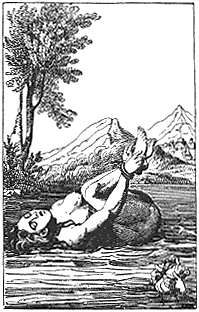
Figure 1.
The witch swims! Illustration from
Montague Summers's The Discovery
of Witches: A Study of Master Mat-
thew Hopkins. Commonly Call'd
Witch Finder Generall . Published
by Cayme Press, London, 1928.
enteenth-century England, the suspect would be tied, right thumb to left big toe and left thumb to right big toe, and then lowered into the water by means of a rope tied around the waist. The test was repeated three times, and if the individual floated, it was proof of witchcraft.[55] Rationales offered for swimming witches in this period stressed the witch's satanic connections. For example,
In 1583, a certain Scribonius, on a visit to Lemgow [Lemgo, in northern Germany], saw three unfortunates burnt as witches, and three other women, the same day, exposed to the ordeal on the accusation of those executed. He describes them as stripped naked, hands and feet bound together, right to left, and then cast upon the river, where they floated like logs of wood. Profoundly impressed with the miracle, in a letter to the magistrates of Lemgow he ex-
presses his warm approbation of the proceeding, and endeavors to explain its rationale, and to defend it against unbelievers. Sorcerers, from their intercourse with Satan, partake of his nature; he resides within them, and their human attributes become altered to his; he is an imponderable spirit of air, and therefore they likewise become lighter than water.[56]
Curiously, in southwest Germany of the 1640s, the contrary notion, that the innocent would float and the guilty sink, prevailed. Before using it in earnest, the Bavarian army resolved to test the test and so offered twelve thalers to any innocent citizen who would volunteer to undergo it. A man came forward and validated the test by floating on three trials. Then the army swam a number of suspected witches (soldiers' wives, for the most part) and executed several of those who sank.[57]
Swimming witches in the sixteenth and seventeenth centuries never commanded the official legitimacy that the ordeal had enjoyed during the medieval period. It was done primarily by peasants and viewed scornfully by the educated elite.[58] Even some of the most ardent witch-hunters viewed the ordeal with skepticism. Dominicans Kraemer and Sprenger, authors of the famous fifteenth-century manual on witchcraft, Malleus Maleficarum , surmised that witches might come through the ordeal of hot iron unscathed because the devil would intervene to protect them. They even opined that persons who offered to undergo trial by ordeal should for that very reason be suspected all the more of being witches.[59]
Another test for witches was to search for certain telltale marks on their bodies, which might have been placed there by the devil during their initiation ceremony.[60] They were often red or blue in color and might take the form of the footprint of a hare, toad, dog, spider, and so on. A distinctive feature of devil's marks was that they do not bleed and are impervious to pain. Witch-hunters would arm themselves with long needles for pricking suspicious marks to determine if they could draw forth blood or a reaction of pain.[61]
Other bodily features such as warts, boils, and even hemorrhoids or the clitoris were sometimes identified as special marks
of the devil. These were taken to be teats at which the devil himself or imps would suck blood from the witch. (Imps were spirit familiars that the witch would send out to do mischief.) Such teats tended to be found on the eyelids, armpits, lips, shoulder, or posterior of men and on the breasts or genitals of women. The bodies of suspects were minutely examined for these unnatural teats, and candidate growths were probed and jabbed with needles to ascertain if they would bleed or produce pain.[62] John Taylor reports how in colonial America the body of executed witch Goodwife Knapp was examined for devil's marks after it was taken down from the scaffold.[63] An argument broke out among several women concerning whether certain appendages (of the genitals, certainly) were witches' teats. One of the women claimed that they were not, on the grounds that she had them herself. The other women rebuked her, and (perhaps realizing the possible consequences of what she had been saying) she finally yielded.[64]
Goodwife Knapp was but one of many suspected witches subjected to postmortem examinations. Although this seems not to have been the case in the West, some cultures contain the belief that individuals might be witches without being aware of it. The sure test to identify them is autopsy. Among the Azande of the Sudan, after death, the intestines of a suspected witch would be removed and carefully examined for witchcraft substance: a blackish, oval swelling. If found, that constituted proof that the deceased was indeed a witch.[65] The Kaluli of Papua New Guinea believe that virtually all deaths are caused by witchcraft. In vengeance, an individual suspected of being the witch responsible for a death might be killed in a surprise nocturnal raid on his longhouse. The body would be dragged outside, opened, and an individual holding a position neutral between the relatives of the suspected witch and his killers would examine the condition of the heart. If it was firm and dark in color, the individual was not a witch, but a yellowish heart soft in texture identified the person as a witch.[66] These testing procedures by autopsy have a number of factors in common with trial by ordeal. They share the assumption that a determinate, either/or condition actually exists: the individual in question either is or is not a witch. In each case, the avowed purpose of the test is to ascertain the true answer to
that question. A test, with its indirect or representational mode of knowing, is necessary because direct knowledge of the matter is impossible. In the European case, this stems from the inability to look at the contents of people's hearts (figuratively speaking) and minds, while for the Kaluli, a test is required because one cannot look at the hearts (literally speaking) of the living. One procedural difference is whether the victim is killed before the test (as the Kaluli do) or after it (the European way).
Torture
After the suppression of trial by ordeal in the thirteenth century, torture became an important means of determining innocence or guilt in European courts.[67] As with ordeal and combat, torture was used particularly for those "invisible" crimes for which witnesses or other tangible evidence tended to be lacking: adultery, heresy, witchcraft, and so on.[68] Torture, however, relied for its result directly on the suspect rather than on asking God to produce a miracle. It was applied with great alacrity in the persecution of witches during the fifteenth, sixteenth, and seventeenth centuries. For one thing, it was believed that witches could be induced to remove their spells by beating or working other violence on them. It was necessary to pursue this tactic with diligence, however, because a witch would probably persist in the denial of being the author of the spell in question. If one hurt them badly enough, they would usually confess and undo their mischief.[69]
Torture was also used as a means of releasing the witch from bondage to the devil. The limitations that normally constrained torture were often disregarded in the case of suspected witches because the devil was believed either to prevent the witch from feeling the pain or at least to encourage the witch to endure it. The ultimate breakdown and confession was conceived as the witch being finally wrenched from the power of the devil and liberated to speak the truth.[70]
It was an impossible situation for the victim, who was considered either to be an unrepentant witch, in which case torture continued and intensified, or a penitent witch, in which case
execution followed shortly. Johannes Junius, burgomaster of Bamberg, was caught in this snare in 1628:
Junius had been accused of witchcraft and tortured until he confessed. His letter, written in a hand shaky from his sufferings, and smuggled from prison to his daughter, begins, "Many hundred thousand good nights, dearly beloved daughter Veronica. Innocent have I come into prison, innocent have I been tortured, innocent must I die. For whoever comes into the witch prison must become a witch or else be tortured until he invents something out of his head."[71]
Many people of the time were blinded to such (to us) obvious injustice by the conviction that confession was a blessed victory for everyone concerned, including the witch, because the grip of the Evil One on a human soul had been broken. As Guazzo put it, rapturously,
The Divine Shepherd in His unspeakable mercy and loving kindness again and again recalls to the fold His sheep that have been carried away by the wolf and again He feeds them in the celestial pastures; and so when witches have been cast into prison and have confessed their sins, not grudgingly and under the stress of torture, but willingly and with penitential joy, it may well be said that they obtain the opportunity to avert so great and eternal a calamity from themselves at the small expense of their most wretched lives.[72]
Torture differs from ordeal because, as a direct means of wringing confession out of a suffering prisoner, torture is not a test. Probably many pitiable souls, quailing before the impending agony of the boiling caldron or the hot iron, were also moved to confess. But such fear was in principle only a by-product of the ordeal; the expectation was that the possibility of pain should be a matter of no consequence to the faithful. The point of the ordeal was to read the ability of the suspect to go through with it, or the condition of wounds resulting from it, as a sign of something else: God's pronouncement of the individual's innocence or guilt. Ordeal was in that sense an indirect means of acquiring knowledge,
and thus it satisfies one of the defining features of a test. Torture, however, applied pain not as an appeal to God or in quest of a sign of anything. It was simply a technique of raising the stakes to the point that suspects—particularly slaves and lower-class people, whose word was not considered to be very reliable—would finally abandon their lies and reveal the truth. Therefore, torture is no test because, for all its paraphernalia and horror, it is merely a form of the direct means of gaining information by getting someone who knows to reveal it.
Analysis
We have defined a test as a representational technique applied by an agency to an individual with the intention of gathering information. Unpacking that definition with respect to tests from preindustrial society will clarify some of the fundamental elements of the logic of testing and will indicate certain consequences of testing—both intended and unintended—that will reappear in various guises in later chapters.
A Test is a Representational Technique . . .
Test results are important not in themselves but as indicators of some other, "target" information. It is therefore essential in the analysis or critique of any test to know how representation operates in it. In considering cases of representation, it is convenient to distinguish between the "signifier" and the "signified." In testing, the signifier is the test result, while the signified is the target information—what the test is designed to reveal. So in one test for witchcraft, the teats found on a suspect's body are signifiers, and the signified is the (presumed) fact that the individual is a witch.
Signifiers may be related to signifieds in different ways. Two of the most important ones are "metaphor" and "metonymy." Metaphor is the relation of resemblance or replaceability. The sign of the cross that a Roman Catholic traces on the forehead and torso resembles the shape of the cross on which Jesus was crucified and
is therefore a metaphoric signifier of it. Occasionally, in circumstances where the religion of the Dinka (a tribe of the Sudan) calls for the sacrifice of an ox and one is not available, a cucumber will be substituted with the promise that a beast will be sacrificed as soon as possible.[73] Although the cucumber bears no resemblance to an ox, it nevertheless signifies it metaphorically because it replaces or "stands in" for the ox.
Metonymy refers to the relationship of contiguity, or co-occurrence. Cause and effect, given their co-occurrence, constitute one type of metonymy. "Where there's smoke, there's fire" is a case in point, the effect (smoke) being a metonymic signifier of the cause (fire). Metonymy may also be noncausal. For example, a neon sign depicting a martini glass signifies a cocktail lounge by metonymy, because that vessel is (in our society) conventionally found in cocktail lounges.[74]
Tests rely on both metaphor and metonymy, and examples of each are visible in the tests that have been discussed above. Teats and devil's marks are metonymic signifiers of witches: such appendages and marks were thought to be found in association with witches, in the same way (logically at least) as martini glasses are found in association with cocktail lounges. The test in the story of the princess and the pea likewise relies on metonymy. It is assumed that a property invariably found in association with princesses is inordinate sensitivity. A test is conducted to determine whether a particular young woman has that property; if so, she must be a princess. Finally, metonymy underpins the logic of ordeal and trial by battle. God favors the righteous, the truthful, and the innocent; he abandons the heretic, the false, and the guilty. Therefore, victory in trial by battle, absence of pain or wounds in the ordeals of hot iron and hot water, and sinking in the ordeal of cold water metonymically accompany—are associated with—truth and innocence, while the opposite results are metonymic signifiers of dishonesty and guilt.
Some examples of trial by battle and ordeal also contain metaphor. Occasionally the test is undergone by a proxy, a champion for a woman or an infirm man in trial by battle or a servant who undergoes the ordeal in place of the accused (as happened when Queen Teutberga was tried for sexual misconduct). The proxy is
a metaphoric representation or signifier of the principal in the case. In its logic, if not in all particulars, the situation is similar to the Dinka sacrifice of a cucumber as a stand-in for an ox.
Another way that metaphor operates in testing is that the subject's behavior in the test is taken to be similar to—and therefore representative of—that person's behavior in many other situations. Examples are the ersatz mother who accepted Solomon's proposal to cut a disputed infant in half, the young man who could not bring himself to shoot arrows at the heart of his father's corpse, and the servant who opened the forbidden dish. In each, the assumption is that the subject will behave in the future (or has behaved in the past) in a manner similar to the behavior demonstrated in the test. This assumption underwrites the extension of the test result to the broader conclusion as to whether the subject is a true mother, a loving son, or an obedient servant. The test, that is to say, stands as a metaphoric signifier of the subject's more general conduct or character. This type of logic may be the most common to be found in all testing.
Nearly all tests achieve their representational character by the principles of metaphor or metonymy. Which of them is in play, and how, will be one topic of analysis for the various, more modern tests that will be discussed in later chapters. For the moment, it is crucial to recognize that metaphor and metonymy are not part of the nature of things but are rooted in culture. No intrinsic, invariable connection exists, for example, between the signifier "Omaha" and any particular signified. In Siouan languages, it refers to a tribe; in contemporary American English, it most commonly signifies a Midwestern city (but also a Siouan tribe and a beach in Normandy); and in Tahitian, it means "to urinate." A cucumber may stand in metaphorically for an ox, or a champion for a damsel, only because the conventions of the time and place provide for it. Similarly, cultural conventions alone certify that where there are teats there are witches, that victory in combat signals the favor of God, and that a loving son cannot bear to shoot arrows at the corpse of his father.[75]
This point takes on great significance when we remember that the ostensible purpose of testing, preindustrial and since, is to reveal the truth about some purely objective, independently ex-
isting state of affairs. But what has just been said proves that this cannot be the case. Because representation is an essential component of any test, and because what counts as representation is a matter of social convention, tests provide information about reality as construed by culture . On the basis of certain bodily appendages or blackish swellings on the intestines, empirical evidence visible to anyone, fifteenth-century Europeans and African Azande made unequivocal decisions about who was a witch and who was not. But it does not follow that there objectively were witches in Europe of that time or in Zandeland. That conclusion depends on what the evidence means or signifies, and that is a product of the cultural understandings prevailing at a particular time and place. This is the nature of all testing, including the tests of honesty, vocational interests, and intelligence that prevail in contemporary America. No less than the Kaluli determination that a person is or is not a witch on the basis of the color and texture of the heart, these too rely on the cultural construal of what certain facts mean.
. . . Applied by an Agency to an Individual. . .
The design of the test and its administration are in hands other than those of the test taker. They decide if the circumstances merit a test, they oversee its application, they interpret its results, they determine what action (reward, punishment, whatever) is to be taken. It is, very simply, a matter of power.
The control of the situation by someone other than the subject of the test is obvious in the case of the master who told his servant to eat of anything spread on the feasting table save for one covered dish, or in the story of the princess and the pea. In these examples, the subject is not even aware that a test is being conducted. Someone else unilaterally establishes the conditions of the test, observes the subject in those conditions, and reaches a conclusion. The power differential is still more vivid and overwhelming in judicial tests. They demand the accused ones to gather compurgators to testify to their innocence, to fight or find a champion, to thrust arms into boiling water, to carry red-hot iron in the hands or walk on it with bare feet. And through all the prayer and
pleading, protesting, promising, and pain, they dispassionately watch, inspect, evaluate, and decide. They swarm over the body of a suspected witch, meticulously inspecting it for birthmarks, boils, and sundry appendages (genital and otherwise), pinching and probing with fingers, pricking with needles. They strip the person naked, tie toes to thumbs, cast the wretch into the water, and clinically calculate the buoyancy while the suspect suffers the agony of near-drowning.
It does not end here. Those accused of evildoing are reduced to the point not only of enduring the ordeal but even of asking for it, perceiving it to be the only avenue available to prove their innocence. And when they do, that indispensable fifteenth-century guidebook to witch-hunters, the Malleus Maleficarum , cautions in an exquisitely heartless twist that those who offer to undergo ordeal to clear themselves probably do so out of confidence that the devil will bring them through successfully. Therefore, they should be all the more suspected of witchcraft.[76] And finally, those who are disfigured by ordeal, broken by torture, and sentenced to burning at the stake are expected to be grateful to their inquisitors and tormentors for having set them free from the grip of evil and having restored their candidacy for God's saving grace at the negligible price of their miserable lives.
Who are the "they" that exercise such power over those unfortunate enough to be accused of criminal activities? It is not really the executioners, torturers, and witch-hunters, for these are only agents. The same, ultimately, may be said of the accusers who begin the process and the judges who preside over the end of it, pronouncing the sentence. As with the "they" who control prices, decree the rate of unemployment, set the need for higher taxes, and establish vital national interests in today's world, the "they" who exerted power over the individual by means of the tests of preindustrial society are much greater, diffuse, and pervasive than any human individual or even any group. It is ultimately the total sociocultural system that dominates, inexorably expressing itself and evolving by working out the implications of its structure and fundamental principles.
However, as Foucault has so perceptively noted, the power exercised by ordeal, torture, and public execution was limited.[77]
The measure of power is not how much pain and suffering it can produce but how efficiently it can achieve its ends. Witchhunting, for example, died out in Europe after the middle of the seventeenth century because developments in education, preaching, and pastoral care among the common people proved to be a more effective (if less dramatic) means of establishing religious discipline and containing heresy than burning witches.[78] Judged by the results, power applied through the boiling caldron, the hot iron, the torture chamber, and the executioner's scaffold was comparatively feeble. It has since been replaced with subtler but more pervasive and effective expressions of power. Among these, as will become apparent, are the tests of industrial and postindustrial society.
. . . with the Intention of Gathering Information
The authenticity tests of preindustrial society are aimed at getting at the truth of matters such as a person's identity, fidelity, feelings, innocence, or guilt. They rest on the assumptions that a true or authentic state of affairs does exist and that testing is a means of ascertaining what that truth is when it is concealed from direct observation. This holds for contemporary tests as much as for those of preindustrial society.
These assumptions are mistaken. Because of their representational quality, tests measure truth as culturally construed rather than as independently existing. This has already been demonstrated. But there is more. By their very existence, tests modify or even create that which they purport to measure. Consider first the tests of royal blood in the tales of the princess and the pea and the prince who was unable to sleep because a hair buried in his bedding felt to him like a large beam.[79] The logic of these tests, as presented in the stories, begins with the assumption that people of royal blood have inordinately fine sensitivities. This assumption validates the following test situation: if this stranger is of royal blood, then she or he will be able to perceive something as insignificant as a pea or a hair in the bedding. What is being tested is the status of a specific individ-
ual, on the basis of a general proposition about a class of people. But in the effect of their telling, the logic of testing in these stories runs in the opposite direction. It conveys the message that because this prince or that princess was disturbed by a hair or a pea concealed in the bedding, persons of royal blood must have inordinate sensitivities. That is, a general proposition about a class of people is being promulgated on the basis of stories about the experience of some individuals of that class. Therefore, these tests in folklore help create the circumstance they purport to measure: they are among the devices that ingrain in people's minds the belief that aristocrats are by their nature refined and superior to commoners.[80]
These tests with peas and hairs are so fanciful that they certainly never actually took place, although that does not detract from their indoctrinating function. A test from folklore that could conceivably occur with the reported result is the master who tested his servant's obedience by inviting him to partake of any dish in a sumptuous feast save one covered dish, which contained a mouse that would escape if the lid were lifted. This test also fabricates what it purports to measure. Imagine that the test were actually conducted. It is entirely possible that an utterly loyal and obedient servant would raise the lid, not with any intention of taking what is inside but simply out of curiosity to see what it is. Nonetheless, he is dismissed as disobedient, and, insofar as his reputation is affected by the episode, he is treated accordingly by others. Hence the test literally made him, at least in the eyes of the world, into something that he had not been prior to it.
This test has another, more general fabricating capacity that has nothing to do with actually applying it. As with the princess and the pea or the prince and the hair, this story conveys a message. This time it is a message about the proper relation between master and servant. The good servant, it states, is blindly obedient to any command of the master, no matter how irrational, inconsequential, or unjust it may appear. Moreover, the message continues, the servant who deviates from this ideal is liable to summary punishment. In this way, the story about the test perpetuates the power of the dominant class.[81]
The capacity of tests to fabricate that which they are presumed to measure works not only through folktales about tests but also—probably more so—through tests actually conducted. Consider tests for witchcraft. The Kaluli of Papua New Guinea really would remove and examine the heart of an individual killed on the suspicion of witchcraft, and if it was soft in texture and yellowish in color (as some hearts really are), they took that as physical evidence that the individual was indeed a witch. In this way, the test bolstered and verified the proposition that there are witches, a proposition that, in our time and place, is false. In precisely the same way, Europeans a few centuries ago really did tie unfortunates' toes and thumbs together and cast them in the water to observe whether they would sink or float. The outcome in the case of the more buoyant was taken as proof that the particular individual was a witch. And, of course, nothing could stand as better evidence for the general proposition that witches exist than proof that certain individuals are witches. Again, the reversal of logic is apparent. Ostensibly, the testing situation moves deductively from general to specific: there are witches, they have certain properties, this individual has those properties, therefore this individual is a witch. But so far as the proclamation of a message is concerned, the logic moves in the reverse, inductive direction: this individual has certain properties, those properties are characteristic of witches, therefore this individual is a witch, therefore witches exist. As with the capacity of stories such as the princess and the pea to promote attitudes about intrinsic differences between the classes, this is another example of the capacity of testing to create what it purports to measure.
It was, of course, too late in the case of the proven Kaluli witch, but in Europe, those who had tested positive as witches were invited to discourse on their black arts, to describe their intercourse with Satan, imps, and other denizens of evil, and to implicate others who had joined in witches' rides and participated with them in the obscene sabbat. Some of the confessions were remarkably detailed and vivid. Matthew Hopkins, the seventeenth-century English witch-hunter, records the revelations of a witch from Maningtree, in Essex, and even claims to have been an eyewitness to certain events (see fig. 2).
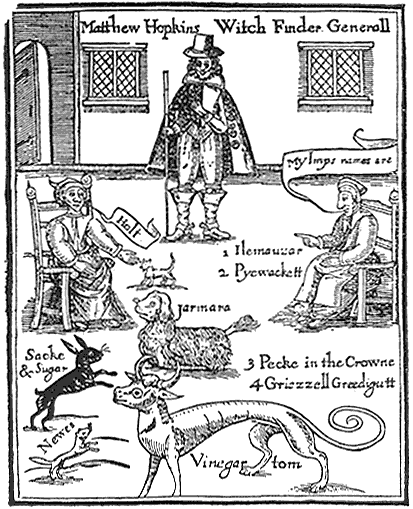
Figure 2.
Frontispiece from Matthew Hopkins's The Discovery of Witches .
So upon command from the Justice they were to keep her from sleep two or three nights, expecting in that time to see her familiars , which the fourth night she called in by their severall names, and told them what shapes, a quarter of an houre before they came in, there being ten of us in the roome; the first she called was
1. Holt , who came in like a white kitling.
2. Jarmara , who came in like a fat Spaniel without any legs at all, she said she kept him fat, for she clapt her hand on her belly, and said he suckt good blood from her body.
3. Vinegar Tom , who was like a long-legg'd Greyhound, with an head like an Oxe, with a long taile and broad eyes, who when this discoverer spoke to, and bade him goe to the place provided for him and his Angels, immediately transformed himselfe into the shape of a child of foure yeeres old without a head, and gave halfe a dozen turnes about the house, and vanished at the doore.
4. Sack and Sugar , like a black Rabbet.
5. Newes , like a Polcat. All these vanished away in a little time. Immediately after this Witch confessed severall other Witches, from whom she had her Imps , and named to divers women where their marks were, the number of their Marks , and Imps , and Imps names, as Elemanzer, Pyewacket, Peckin the Crown, Grizzel, Greedigut etc.[82]
Hopkins would swim accused witches, search, probe, and prick them for teats and devil's marks, prevent them from sitting down or sleeping, and force them to walk incessantly as part of his confession-provoking procedures.[83] He went on, curiously, to deny the use of "any torture or violence whatsoever,"[84] but torture was generally a favored technique for loosening the tongues of suspected witches. In circumstances where torture would intensify until a confession was obtained, a great many victims certainly fabricated stories they knew to be entirely false just to stop the pain.[85] And yet these confessions must have acquired tremendous existential import for those who made them. They terminated the agony of torture, and they were the basis for the subsequent sentence of death. While being led to execution, often by the terrible means of burning at the stake, confessed witches were earnestly exhorted to repent of the deeds they had described,
for the salvation of their eternal souls. With such ultimate meanings in play, it would be anything but surprising if many of those accused, convicted, and executed as witches came to believe their own confessions, no matter how fabricated they may have been at the beginning, with desperate sincerity.[86] In that event, tests for witches, especially when seconded by torture, contributed to the creation of a reality devoutly affirmed not only by zealous inquisitors and a credulous populace but also by at least some of those convicted of the crime.
Conclusion
Several important generalizations have emerged from this analysis of the tests of preindustrial society.
1. The testing situation entails the application of power over the subjects of tests. Such power is to a degree in the hands of the persons who order and administer the tests, but it inheres more importantly in the organizations they represent and especially in the total social system.
2. Given the intrinsic representational character of all tests, and given further that what counts as representation is a matter of social convention, tests are not and cannot be measures or indicators of some purely objective, independently existing state of affairs or reality. They are concerned instead with reality as constructed by culture.
3. Related to and expanding the second generalization is the third generalization that tests are important in the array of mechanisms whereby culturally constructed realities are formed. Tests, that is to say, act to transform, mold, and even to create what they supposedly measure.
While it is possible to draw these generalizations with special clarity from an analysis of the tests found in preindustrial society, they are not limited to those tests. Indeed, the major objective of the following chapters is to demonstrate that they hold as strongly (if, occasionally, more subtly) for testing as it is currently practiced.