
Chapter IX—
Pedrollén
If instead of going north from the city of Salamanca the Cuarto de Armuña, one goes south and southwest toward the mountains that separate the province from Extremadura, one crosses a very different countryside. The rise out of the valley of the Rio Tormes is more gentle, and, going southwest, one passes through a region in which the land rolls in long waves, with outcroppings of shale like whitecaps on the waves. The rich, deep earth of Armuña rapidly gives way to brownish gray soil, often too thin to plow. Today grass pastures studded with live oaks (dehesas is the term for such lands) alternate with regions of grain fields. Towns are few and small, and cultivation is carried on in large estates, many of them devoted to raising cattle, for which the acorns of the live oaks (encinas ) are one of the main sources of food. This is the Charro district of Salamanca, as famous in its own way as La Armuña is in its.
Almost thirty kilometers southwest of Salamanca, in a saddle between two hills of encinas, is Las Veguillas, the only sizable town for about ten kilometers in any direction. Just before one reaches it, one passes a well-cared-for estate called Pedrollén. It occupies a broad hollow, 940 meters above sea level, surrounded by a rise of low hills. The hollow has carefully tilled grain fields, flat enough to serve as an airfield in the Spanish Civil War. Some of the hillsides are farmed; the rest are dehesas supporting. handsome black cattle. At the center, by the road, is a cluster of houses surrounded by trees and flowers, the living quarters and farm buildings of this prosperous finca.
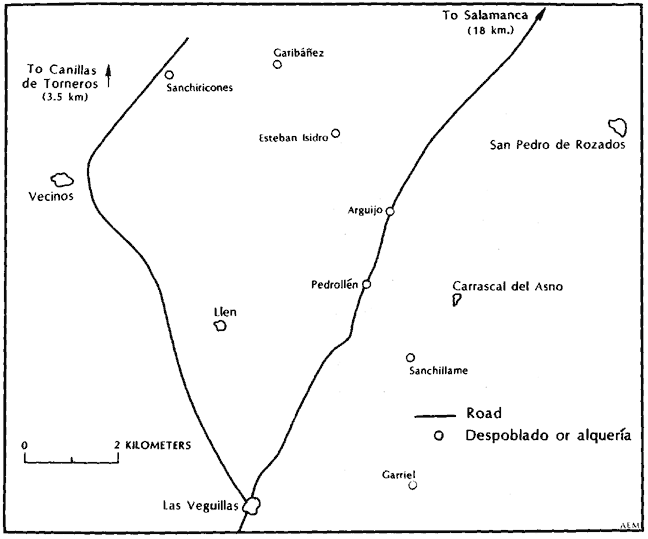
Map 9.1.—
Pedrollén and Its Environs
At the time of the catastro, Pedrollén was within the Cuarto de Peña de Rey of the partido of Salamanca. The catastro describes it as one-fourth league from east to west and three-fourths from north to south.[1] An alquería, it lacked a government of its own and came under the jurisdiction of the alcalde of San Pedro de Rozados, seven kilometers to the northeast.[2] It was what was known as a término redondo or coto redondo, that is to say, the entire unit was a single property, although in this case various individuals owned shares in it and divided the income from it.[3] Bordering on it were the despoblado of Sanchillame, the alquerías Arguijo and Garriel, and the lugar Llen (Map 9.1). In 1786 Pedrollén, Arguijo, Garriel, and Llen had only six households among
[1] AHPS, Catastro, Pedrollén, resp. gen. Q 3. The entire catastro of Pedrollén is in one volume.
[2] Pedrollén, maest. segl., f. 2r.
[3] Pedrollén, resp. gen. Q 3. According to David Vassberg, Land and Society, 169–70, the terms coto redondo and término redondo were applied in the sixteenth century to areas for which the crown had sold enclosure permits that prohibited open grazing by animals of other owners. This is probably the origin of the terms.
them, forty people. Sanchillame, a despoblado, did not have a separate census return; one guesses another family lived there.
The region had not always been so thinly populated. In 1534 Llen (then called Layn) had twenty-three vecinos, over eighty people. At that date Pedrollén and Carrascal del Asno were counted together and had sixteen vecinos, about sixty-five people; in 1786 they had populations of ten and seventeen respectively. The decline appears to have been continual since the sixteenth century. The census of 1712, which was usually underenumerated, shows seventeen vecinos for Pedrollén, Arguijo, Garriel, and Llen; at the time of the catastro there were twelve; in 1786, I estimate nine and a half (the half a widow) (Table 9.1).
The catastro records the area of Pedrollén as 1,009 fanegas, but how this compared with La Mata's 1,073 fanegas is hard to say, because Pedrollén followed an old practice of defining a fanega of land as the area sown with a fanega of grain (with the result that a fanega of good soil was smaller than a fanega of poor soil).[4] There was little further resemblance between the two places. In Pedrollén only 220 fanegas (22 percent) was used as arable, and this was divided in three fields, or hojas, each of which was sown only once in three years. One hundred forty-five fanegas was classed as pasture (prados de secano), and the rest, 64 percent, was uncultivated monte alto covered with encinas, used for the harvest of acorns and for wood to make charcoal. The average annual product of a fanega of land was five reales; in La Mata it was forty.[5] Four houses marked its center, along with two granaries (paneras), two haylofts (pajares), and three smaller buildings used for a forge and shelter for the animals.[6]
The income, or aprovechamiento, from Pedrollén was legally divided into eighteen shares (partes ), which belonged to two artistocrats and two religious foundations (Table 9.2 and Figure 9.1). The catastro does not say when or how this unusual division took place, but it went back a long time, for we know from another source that don Andrés Villalón and his wife doña María Villafaña established a patronato in the church of San Julián of Salamanca in 1501, endowing it with nine of the eighteen shares in Pedrollén.[7] The four current owners did not manage the
[4] See Pedrollén, maest. ecles., at end. On this widespread European practice, see Mendras, Vanishing Peasant, 62. Measures of land varied depending either on the time it took to plow the land or the amount of seed the land required. In Spain the amount of seed appears to have been the most common basis for measurement.
[5] Statistics on income per fanega come from analysis done for Part 3.
[6] Pedrollén, maest. segl.
[7] The record of the sale in AHPS, Contaduría, libro 850, ff. 410v–411r.
| ||||||||||||||||||||||||||||||||||||||||||||||||||||||||||||||||||||||||||||||||||||||||||||||||||

| ||||||||||||||||||||||||||||||||||||||||||

Figure 9.1.
Pedrollén, Ownership of Shares, 1752
estate themselves but rented it to a single individual (colono ), who became responsible for its administration. The catastro has no information on how the contract between them was made, whether the tenant negotiated with them individually or, what was more likely, the four employed a common agent to deal with him.
The makers of the catastro were required to specify the rent and income of tenants on ecclesiastical lands. We have seen before how their replies make possible an estimate of the total rent paid by the vecinos of a locality. I have assumed that secular landowners charged the same rent as ecclesiastical; in the case of Pedrollén this is certain since it was all leased under one contract. The makers of the catastro calculated that the tenant paid one-sixth of the grain harvests as rent, and they assigned the entire income from the meadows and monte to the owners (meadows and monte were never attributed a large annual product; in Pedrollén it ran from 2 to 6 reales per fanega). According to the extent and quality of land and the expected harvest from it, the total rent comes to about 41.5 fanegas of wheat, 11.0 fanegas of rye, and 2,700 reales per year. At prevailing local prices, these payments convert to 242 EFW.[8] As will be explained soon, the catastro may have overestimated the productivity of Pedrollén's arable by about a third, and if so, the rent is also overestimated by 17 EFW. In the absence of the lease, we can posit that the tenant paid 225 EFW, although one must be suspicious of the figure because it rests so heavily on the amount paid for pasturage, calculated on a very rough measure.
The farmer who could undertake such a contract was a man of considerable substance. His name was Francisco García Serrano, a widower forty-eight years old, whose only family living with him was a son of nineteen. Besides the furnishings of his house, his farm utensils, tools, carts, and other equipment, he owned an extensive assortment of livestock (Table 9.3). From its listing one can see that in addition to his crops, García Serrano produced for the market wool, cheese, cattle, lambs, pigs, goats, chickens, and turkeys. In fact he had so many animals that Pedrollén could not support all of them, and all except the oxen pastured elsewhere part of the year, "where there is best accommodation" ("donde mas comodidad halla").[9]
His was a diversified establishment, geared to extract all possible profit from the estate, and it required a number of hands to run. Living
[8] Pedrollén, resp. gen. Q 14: fanega of wheat, 15 reales; fanega of rye, 9 reales.
[9] Pedrollén, maest. segl., f. 2v.
| ||||||||||||||||||||||||||||||||||||||||||||||||||||||||||||||||||||
with him, García Serrano had eleven men servants, ranging in ages from twelve to thirty-eight, and three women servants. Three men were vecinos of nearby towns; they must have left their families behind to come to work in Pedrollén. Three others had the same last name as the tenant, García (Gerónimo, aged twenty-four, Lorenzo, aged eighteen, and Marta, age not given); it is a common name but perhaps they were relatives taken in partly as a family obligation. In addition there were two shepherds, one sixty and the other forty-two, both married, with four sons and five daughters between them, the youngest a baby boy of two months at the time of the count. García Serrano and the two shepherds were the three vecinos of the alquería. Altogether twenty-nine people were living in its four houses, with only the four or five youngest children not contributing labor to its economy.[10]
As for La Mata and Villaverde, the catastro provides sufficient information to formulate an approximation of the income of this small group, both collectively and individually. Multiplying the number of fanegas of each class of arable land by the stated annual harvest, one obtains a total annual harvest of 248 fanegas of wheat and 66 of rye, that is, 288
[10] Pedrollén, libro personal de legos.
| ||||||||||||||||||||||||||||||||||||||||||||||||||||||||||||||||||||||||||||||||||||||||
| ||||||||||||||||||||||||||||||||||||||||||||||||||||||
EFW (Table 9.4). More of the harvest here was in rye than in La Armuña, because it was needed to supplement pastures for the large number of livestock.[11] One can expect a more reliable figure, however, from the record of the tithes for the previous five years (1747–51), which indicates a mean harvest of 215 EFW (Table 9.5). This is only 75 percent
[11] See García Fernández, "Champs ouverts," 694.
of what the catastro evaluated that the land produced. There is, of course, the possibility that the tenant of Pedrollén succeeded in hiding some of his crops from the tithe collector, perhaps not very difficult since the latter had to come from the town of Canillas de Torneros, twelve kilometers away, to whose parish Pedrollén was attached. I shall proceed, however, on the assumption that the tithes were an honest tenth of the crops.
Since a fanega of arable was the area sown by a fanega of grain and there was a three-year rotation, the annual seed requirement must have been one-third of the total area of each kind of arable land (Table 9.4), 57 fanegas of wheat and 16.5 of rye (a total of 67 EFW). The yield-seed ratio varied from 3.5 to 6 for wheat (overall 4.4) and 3.5 to 4.5 for rye (overall 4.0). These are low returns, emphasizing the marginal quality of the soil in this region.
The vecinos also paid tithes on their animal products, partly in kind and partly in money, so that one can again estimate their income from this source (Table 9.6). Lambs, wool, and cheese were said to be contributed at the rate of one in ten. It is less easy to know how many other animals were produced because the tithes on them were paid in money. On cattle, horses, mules, and donkeys, the rate was eight maravedís per head (thirty-four maravedís is one real). The average annual payment over five years was thirty-four reales and nine maravedís, equivalent to 146 animals. Since there were only 136 of these kinds of animals in the estate, the figure is too high. On the other hand, a mean of 16.4 lambs per year in tithes (only 10 for the latest year reported, 1751) did not
| ||||||||||||||||||||||||||||||||
| ||||||||||||||||||||||||||||||||||||||||||||
cover all the lambs born, for García Serrano and the shepherd Juan Benito between them had 332 lambs under one year at the end of 1752.[12] They must have paid some of the tithes on lambs in coin, and the tithes in coin may also have included payments for goats, chickens, and other minor animals. We can estimate the annual income from the larger animals (including sheep and goats) by using the method in Appendix K (Table 9.7). This method covers cheese and wool as well, so that Table 9.6 will not figure in the calculation of the gross and net income of Pedrollén. The method does not cover fowl. Chickens were worth twenty-four maravedís, and turkeys, two reales. Let us guess another seventy-five reales from them.
The total income from livestock comes to 596 EFW. From farming the gross harvest is 215 EFW. If the rent was 225 EFW, as estimated, it represented 28 percent of the product of the exploitation. The share taken by the rent was really higher, however, for part of the livestock was pastured elsewhere.
The other regular charges and expenses of the establishment must be deducted to obtain the net income. The tenant and one shepherd paid for pastures part of the year outside the alquería. No figure is specified, we can only guess 500 reales of 33 EFW. The tithes and other charges all left the community, since it had no church. Four-ninths went to the par-
[12] Pedrollén, maest. segl.
ish of Canillas de Torneros, three-ninths to the owner of the prestamo (a convent in Segovia), and two-ninths (the tercias reales) to the University of Salamanca. The first fruits were 2 EFW, and the Voto de Santiago, 1 EFW.[13] The catastro specifies only one payment to the crown, the servicio ordinario y su quince al millar, 9 reales and 3 maravedís. It says the place also paid rentas provinciales and millones, but does not state the amounts.[14] However, from a summary of the royal taxes of the province in 1795, we learn that the "old encabezamiento" of Pedrollén, presumably the one in effect in 1752, still valid in 1795, was 147 reales and 24 maravedís for alcabalas, 118 reales and 6 maravedís for cientos, and 29 reales and 2 maravedís for millones, a total of 19.7 EFW.[15]
Striking a balance of expenses against gross income produces a net income for the estate of 424 EFW (Table 9.8). Divided among the twenty-nine people living on the estate, this gives a per capita income of 14.6 EFW. Yet a close look at the resources of the community uncovers an additional source of income. García Serrano owned fifteen yokes of oxen and employed eleven hired hands. With his son and himself, he could keep thirteen plow teams at work. They planted only about seventy-five fanegas of land a year in Pedrollén, roughly enough to use the time of three and a half plow teams and drivers.[16] The time of the other workers and yokes must have been applied outside in the neighboring alquerías and despoblados. Within Pedrollén three and a half yokes would each account for a net harvest of 25 EFW, after deduction is made for seed, rent (one-sixth of the grain harvest), tithes, and other charges. If each yoke returned the same net harvest outside, then García Serrano received about another 240 EFW from this source, raising the net product to 664 EFW and the per capita income to 22.9 EFW (Table 9.8).
This is the highest per capita return that we have encountered so far, but it should not mislead us into thinking that all the inhabitants were wealthy. Virtually all the gross income went initially to García Serrano, except for what the shepherd Juan Benito obtained from his animals. According to Appendix K a fair estimate is that Benito's eighty female sheep and fifteen female goats produced 43 EFW, but probably 5 EFW went for rent on pastures and tithes. Out of the balance left to him, García Serrano would have to pay wages and keep for his servants. The
[13] Pedrollén, resp. gen. Q 15.
[14] Ibid. Q 27.
[15] AGS, Dirección General de Rentas, Hacienda, legajo 2664, Salamanca (1795), Relación de los Pueblos.
[16] See Chapter 7, n. 30.
| ||||||||||||||||||||||||||||||||||||||||||||||||||||||||||||
catastro says that he, his son, servants, and one jornalero earned 2.5 reales a day but does not say for how many days a year. In La Mata the figure was 120 days per year, in Villaverde 180. The latter figure, more suitable to a place with multiple activities, gives them an annual income of 30 EFW. The three vecinos of nearby towns would have had to take this much back to their families to make their stay worthwhile. The eight male servants (four were under eighteen) and three female servants probably earned little more than their keep, the adult males perhaps 12
| ||||||||||||||||||||||||||||
EFW, the others 10 EFW.[17] The two other vecinos of Pedrollén, both shepherds (also called jornaleros, the catastro erred in speaking of only one jornalero in specifying incomes) had families. Benito had a wife, a son of twelve, and three daughters; Manuel Martín a wife, three sons (aged fourteen years, ten years, and three months) and two daughters. If they had incomes of 12 EFW per capita, Benito would have taken an additional 32 EFW from the net income of Pedrollén and Martín 72 EFW (not counting the baby). Wages and subsistence of the twenty-nine persons in the community then come out as in Table 9.9, a total of 330 EFW. The balance remaining to García Serrano would be 300 EFW. There are many unknowns in calculating both his gross income and his expenses, so that this is a very rough figure, but one can say that his economic status resembled that of the top labradores of La Mata, whose net income was between 230 and 350 EFW, possibly equal to that of Juan Rincón, the richest of them all. In Pedrollén, however, he stood alone above his servants and employees as a man of wealth and power. With only one son, he could well save, probably investing in extending his establishment, if land were available in the vicinity for arable and pastures.
[17] These are the wages I have used in La Mata and Villaverde (Tables 7.13 and 8.18).
Yet his position as tenant of a coto redondo left him vulnerable to the demands of the owners. The dangers he faced are evident in cases that came to the attention of the Council of Castile. In the decade of the 1760s, when the advisers of Carlos III undertook to reform the conditions of landholding, they had before them, among complaints from various parts of the country, two from tenants of the cotos redondos of the Charro district. The tenant of Sanchiricones, about ten kilometers northwest of Pedrollén, protested that the cathedral chapter of Salamanca, owner of six of eight shares in the place, had raised his annual lease from 6,406 to 16,112 reales in 1763. Similarly the tenant of Terrones, about the same distance from Pedrollén to the southwest, reported in the same year that the cathedral chapter, full owner of this coto redondo, was demanding 20,000 reales rent, whereas at present it was 12,500 and only six or eight years previously it had been 9,400. The tenants affirmed that they could not pay such rents and, if dispossessed, would be ruined for lack of pasture to support their livestock. Nevertheless, the cathedral chapter was relentless and threatened to move its own herds into the places. At the petition of the two tenants and the sexmeros procuradores generales (deputies) of the cuartos (or sexmos ) of the partido of Salamanca, who defended the interests of the vecinos, the Council of Castile stepped in to protect the tenants, forcing arbitration in the first case and encouraging a settlement out of court in the other but in neither case stating that the rent should be held at its current level.[18] The experience of these two tenants shows that such men, including García Serrano of Pedrollén, were under pressure to pay to the limit of their abilities. Their potential for saving was under the keen observation of the owners of the alquerías or their agents, who were intent on squeezing as much as they could out of their colonos. Whether García Serrano was able to maintain the income of 1752 is thus open to question. If he and his successors could continue on similar terms, they should have been in a good position to respond to the disentail of Carlos IV, perhaps not to buy a share in Pedrollén but at least to invest in land elsewhere.
2
Something happened to the establishment, however, about which I have no information. Thirty years later, at the time of the census of 1786,
[18] Mem. ajust. (1784), expedientes 2 and 4, §35–50 and §57–59. Expediente 2 is reprinted in Revista de trabajo 17 (1967): 148–53.
only ten persons remained in Pedrollén. There was a girl under seven, two boys and two girls between seven and fifteen, and five adults, all between twenty-five and thirty-nine. The adults consisted of a married couple, two single males, and a widow. We do not know their names or the relationship among them. García Serrano would have died, but his son would now be fifty-three. The census lists no such person. Perhaps he and other residents of Pedrollén had succumbed to an epidemic of malaria that struck much of central Spain including this region in 1785 and 1786.[19] If so, the widow may have been his, raising several of their children and keeping the establishment going with the aid of a married couple. The rest would have been shepherds and servants. Still, three adult men would have had difficulty maintaining the entire establishment that had existed in 1752. They must have given up leases to neighboring places. One senses that the estate had been through a crisis and a new start was being made, but control over its fate lay elsewhere, with the owners or their agent.
When the intendant of Salamanca received the royal orders calling for disentail of ecclesiastical properties, Pedrollén was just the kind of place that would first attract his attention. Its shares belonging to religious institutions fell under the terms of the decree of September 1798; they could be readily transferred by a simple deed; and they would command a high price. He put them up for auction in 1799, and the final deeds were both signed in November of that year. The same person bought both, doña María del Rosario Vélez y España, widow of a regidor of the ayuntamiento (city councillor) of Salamanca.
The 1 3/4 shares belonging to the benefice of the parish of San Martín fetched 26,320 reales. The 9 shares (half the entire property) of the patronato founded by don Andrés Villalón and his wife in 1501 in the parish church of San Julián cost her 135,350 reales. She paid for both with vales reales.[20] The rent for Pedrollén in 1752 was 225 EFW, and if it had kept pace with the rise in price of wheat, doña María del Rosario's 10 3/4 shares would give her 5,375 reales (at the current wheat price of about 40 reales). She was expecting a return of 3.3 percent on her capital, but since she paid in vales reales, which at the end of 1799 were worth only about one-third their face value in hard currency,[21] her real expected re-
[19] Pérez Moreda, Crisis de mortalidad, 336–44. Pérez Moreda cites a contemporary document listing 7,606 ill and 271 dead in Salamanca province in 1786.
[20] First sale: AHPS, Contaduría, libro 850, f. 410r–v; second sale, f. 410v–411v. They are recorded in Madrid, AHPM, A2965 and A3063, where it is stated that payment was in vales reales.
[21] See Appendix D.
turn was about 10 percent. This is a far higher rate of return than the annual 2.5 percent on arable fields that buyers were prepared to get[22] and provides evidence that large properties went relatively cheaply.
Within a year of the royal order, 60-percent interest in Pedrollén had changed hands. Whereas laymen held 40 percent of it before, they now held 100 percent. Since the new owner resided in Salamanca city, the city did not lose any interest in the alquería, but the transfer represented a serious blow to its religious institutions. Furthermore 60 percent of it was now in the hands of one person; previously the largest share had been 50 percent. And this 60 percent was not entailed, as all the shares had previously been. A major step had been taken in the process that made the Pedrollén of today the property of a single individual.
In this process the tenant never had a chance of participating. The smaller share was sold for about 660 EFW, the larger for 3,400 EFW. Even the smaller share cost one and a half times the net annual production of the estate. García Serrano might have achieved savings to acquire the smaller share, but only because he owned the means to farm in more than one alquería. The current tenant probably had no such economic potential. He could only watch his landlords change and hope that the new one would be no more exacting than the old. A quarter of a century later, in 1826, the population of Pedrollén was twelve, with three vecinos (Table 9.1). There were only two more people than in 1786, and their future was no brighter than it had been then. Disentail did not reverse the demographic decline that began in the sixteenth century or improve the condition of the men and women who worked the land and tended the livestock.
[22] See above, Chapter 5, section 3.