
2
The Batak as They Were
Palawan Island lies west and south of the main body of the Philippine archipelago, along a line running northeast from Sabah in the island of Borneo (see fig. 1). The fifth largest island in the Philippines, Palawan is home to three indigenous tribal peoples: the Palawan or Palawano, a shifting cultivation folk inhabiting the mountains in the south; the Tagbanua, another group of shifting cultivators inhabiting the riverbanks and valleys of the central mountains; and the Batak, a Negrito people inhabiting the north central part of the island.
The Spanish encountered Palawan in 1521, when the survivors of Magellan's expedition stopped there to seek provisions during their search for the Spice Islands. Based on his reading of Pigafetta's chronicle, Fox (1982:19) believes that the people they met may have been Tagbanua. In any event, their reception was friendly, and the Spanish apparently found food in abundance (Blair and Robertson 1903–1909, vol. 33, pp. 210–211). Spain, however, showed little interest in Palawan during its 350-year rule of the Philippines. Not until 1622, when five Recollect fathers reached the island of Cuyo, well east of Palawan in the Sulu Sea, did she attempt to garrison or establish missions in the region. There fol-
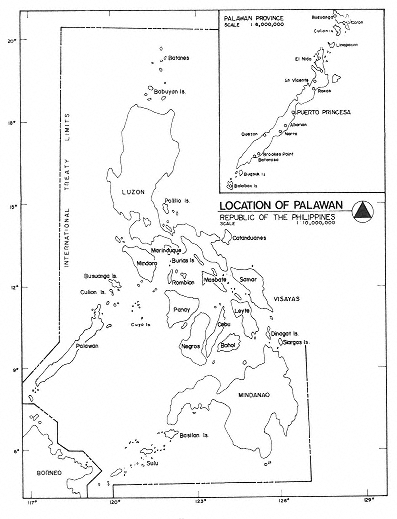
Figure 1
lowed sporadic efforts to extend Catholicism and political control of the island, particularly in the north. For the most part, these efforts came to nothing. Spain did construct a church and a fort at Taytay, a considerable distance north of the Batak. But until late in the nineteenth century, Cuyo Island, which had become the capital of Palawan Province, remained her only important outpost in the region.
More than lack of interest accounted for Spain's limited impact on Palawan proper: throughout most of her rule in the Philippines, Spain was locked in futile and costly combat with seagoing Muslims, who emanated from the sultanates of Sulu and Brunei, for political control of the more southerly portions of the archipelago, including Palawan. Despite numerous attempts, the Muslims never succeeded in capturing the fort at Taytay, but no Spanish outposts farther south on Palawan were secure from attack. The Spanish gained the upper hand in combat against the swift Muslim sailing craft only after 1848, when they acquired steam vessels (Saleeby 1908:221–223; Fox 1982:22). Even then, Muslims continued to raid Palawan's indigenous population for goods and slaves until the American occupation of the Philippines. Islam, too, retained its cultural presence in southern Palawan: the Palawano there show Muslim influence, and large numbers of Muslim migrants from Sulu and Cagayan de Sulu have settled in the region since the late eighteenth century (Conelly 1983:40).
By the midnineteenth century, some migrant lowland Filipinos were apparently already present in limited areas on Palawan's southern coast, on parts of the west coast, and in the extreme north. But only after 1872, when the town of Puerto Princesa was founded on a small, east coast bay on the middle part of the island, did Palawan become a destination for significant numbers of migrant lowlanders, first from Cuyo Island and later from throughout the Philippines. Even then, Palawan remained a little-known area on the periphery of Philippine economic and political life until well into the twentieth century (ibid.:39). In 1903, the total popu-
lation of Palawan Island was estimated to be only 10,900 persons (National Economic and Development Authority [NEDA] 1980); most of these were probably Tagbanua or Palawano. Today, Palawan remains extensively forested and sparsely populated, and it is commonly regarded as the Philippines' last frontier. But, like all frontiers, it is rapidly becoming settled. In 1980, the island's population was approximately 270,000.
Of Palawan's three tribal populations, the Batak were always the fewest in number and the most localized in distribution. At the turn of the century, about 600 to 700 Batak inhabited a series of river valleys along a 50-kilometer stretch of coastline northeast of what is today Puerto Princesa City. As now, they closely resembled other “Philippine Negritos,” both in their mobile hunting and gathering lifeway and in the physical attributes—short stature, dark skin, and curly hair—that earned these distinctive-looking people their name.[1] Approximately two dozen ethnolinguistically distinct groups of such peoples are found in the Philippines, including the Mamanwa of Mindanao and a series of groups known variously as Agta, Ayta, Aeta, Ata, or Ati scattered widely in northern, eastern, and west central Luzon, the Bicol Peninsula, and the islands of Panay and Negros. Philippine Negritos, in turn, resemble other small, dark, hunting and gathering folk of Southeast Asia, in particular, the Andaman Islanders and the Semang of the Malay Peninsula. Collectively, “Southeast Asian Negritos” have long been presumed to represent the surviving remnants of what was once a more widespread and more racially and culturally homogeneous population (e.g., Cooper 1940; Fox 1952). Such claims remain speculative. A more recent, and probably sounder, view is that each group of Southeast Asian Negritos represents the outcome of long-term, local evolutionary development under similar ecological conditions (Solheim 1981:25; Rambo 1984).
Philippine Negritos have been unevenly studied. The best known ethnographically are those of Zambales in west cen-
tral Luzon (Reed 1904; Fox 1952) and the various Agta or Dumagat groups in northeastern Luzon (Vanoverbergh 1937–38; Peterson 1978; Griffin 1981). The Batak did not receive significant scholarly attention until after World War II. Charles Warren's fieldwork among them during 1950–51 led to a master's thesis (1961) and a series of publications (notably, Warren 1959, 1964, 1975). More recently, the Batak have been the subject of a doctoral dissertation by Rowe Cadeliña (1982).
I describe here the Batak lifeway as it probably was during the closing decades of the nineteenth century. The basis for my reconstruction is Batak oral history, comparative data on other, less disturbed Southeast Asian foraging populations, and the only two significant historical accounts of the Batak: a manuscript written in Spanish in 1896 by Manuel Venturello (1907), a member of the Puerto Princesa municipal council and a report by E. Y. Miller (1905), an American army lieutenant. I also make use of Warren's (1964) ethnography, which was based in part on these same sources. My purpose is not to determine whether in 1880 the Batak were “pure hunter-gatherers” (they were probably not). Rather, I want to establish two points: first, at that time, the Batak were still firmly committed to a hunting-gathering way of life in which other subsistence activities were recent or peripheral, and second, in 1880, they were still demographically, socially, and culturally intact.
My emphasis is on settlement pattern, subsistence economy, and those aspects of culture most closely tied to the business of making a living. Given the nature of my sources, my account must be largely qualitative, although I will hazard some quantitative estimates of those aspects of Batak adaptation of greatest comparative interest: local group size, frequency of mobility, length of workday. I have eschewed the temptation to report here any of the quantitative data (which instead appear in chap. 3) on such facets of the present-day Batak hunting-gathering economy as time allocation patterns or returns to labor at forest camps. For
reasons explained below, however “aboriginal” life at contemporary forest foraging camps may appear, data obtained at them are of doubtful value for purposes of reconstructing the past.
A Tropical Forest Foraging Adaptation
Traditional Territory
Palawan Island occupies a unique geological position in the Philippines. It lies at the northern edge of the Sunda shelf, separated from the main part of the archipelago by deep ocean waters but from Borneo by only 50 kilometers of shallow sea. When ocean water levels dropped dramatically during the Pleistocene glaciations, portions of the Sunda shelf were exposed as land bridges that connected Palawan to Borneo and thence to the Southeast Asian mainland. This circumstance explains the close present-day affinities between Palawan and Bornean fauna and the failure of a number of animal species (including some hunted by the Batak) to reach the remainder of the Philippine archipelago.
A chain of mountains runs the length of Palawan and is responsible for some marked climatic differences between the east and west coasts. Although the entire island generally has a June to December rainy season and a relatively severe January to May dry season, the western and northern parts of the island receive considerably more rainfall than the east coast, much of which is sheltered from the southwest monsoon. Indeed, the east coast of Palawan receives only about 1,600 millimeters of rain a year, making it one of the driest areas in the Philippines (Wernstedt and Spencer 1967:438). With regard to vegetation, such seasonally dry tropical environments contrast in important ways with humid tropical environments. In the humid tropics—roughly, where temperatures are consistently high and where average monthly rainfall is not less than 100 millimeters for any month of the
year—are found the tall, lush, and species-rich evergreen rain forests often associated with this region (Hutterer 1983:178). In those tropical areas affected by marked and prolonged seasonal droughts, however, as in that part of Palawan where the Batak live, forests are consistently reduced in height, density, and species richness. Paradoxically, seasonally dry forests generally provide more plant food for human consumption than do rain forests. The latter have little vegetation at ground level, most potential plant food being in the canopy. But seasonally dry forests typically have a variety of more accessible trees, shrubs, and vines producing carbohydrate-rich seeds, fruits, and tubers. Such forests also tend to have more clustering of individuals of the same species than is found in forests of the humid tropics (ibid.:180–181).
Because of the rainfall regime and the soil and topography, Palawan has only limited agricultural potential. Rivers are characteristically short and steep, and the coastal plains are generally narrow. The kinds of fertile, alluvial soils most favorable to irrigated rice cultivation are found in only a few coastal areas. In the hills and mountains, thin and relatively infertile sandy clays and clay loams prevail (Wernstedt and Spencer 1967:437–438). Cashew and other tree crops prosper in Palawan, however, and recent years have seen considerable government interest in developing the uplands through various sorts of agroforestry projects.
Figure 2 illustrates that part of the island inhabited by the Batak. The area is rugged and mountainous. In some places, the mountains fall directly into the sea; elsewhere, there is a narrow coastal plain up to a few kilometers in width. Nine successive valleys whose rivers empty into the east side of the island compose the principal homeland of the Batak. From south to north, these are the Babuyan, Maoyon, Tanabag, Tarabanan, Langogan, Tinitian, Caramay, Quinaratan (Rizal on some maps), and Buayan River valleys. Today, most of these provide the names for a series of lowland communities strung along the highway that winds
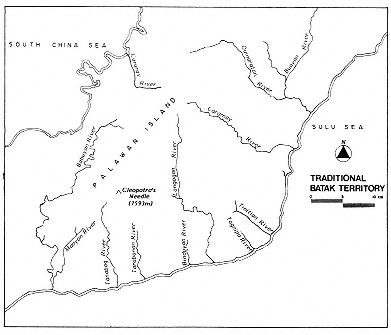
Figure 2
up the east coast of the island from Puerto Princesa City to Roxas. In terms of distance along the coast, Batak territory lies adjacent to a 60-kilometer section of coastline from the mouth of the Babuyan (58 km north of Puerto Princesa) to north of the Quinaratan. The coastline of Palawan makes a sharp turn between Langogan and Caramay, however, and the headwaters of the first five of these east coast river valleys are, in fact, all found on the various slopes of Cleopatra's Needle (1,593 m), a prominent cone-shaped mountain lying in the center of the island.
Some early sources report that Batak also traditionally inhabited a small area of the west coast of Palawan, on the Caruray River (see fig. 2). Indeed, much of Venturello's account derives from firsthand observations made during “the six years that [he] lived in Caruray at a place near the Batacs” (1907:549). Miller's oldest informants even claimed that the Batak of the Caruray area “are the ones from whom the [Batak] tribes of both coasts sprung” (1905:186). In contrast, Conklin's (1949:272) map of the distribution of the Batak shows them limited to the east coast, and I could find no contemporary Batak residents in the Caruray area. My own informants, however, agreed that Batak did once inhabit the Caruray area and that the present-day “tribos” there, an unusually dark-skinned folk known as “Caruraynen” and today regarded as a kind of Tagbanua, are of Batak descent. My own interpretation (in chap. 4) is that the Caruray River valley was once an alternative residence for the group of Batak who traditionally inhabited the Buayan River valley (fig. 2), from which it is easily accessible. The “Buayan” Batak, now extensively intermarried with Tagbanua, share some physical and linguistic features with the Carurayan “Tagbanua,” with whom they in fact claim some affinity.
Excluding the Caruray region as anomalous, a crude estimate of the total area of aboriginal Batak territory may be obtained by totaling the separate areas of the nine successive east coast river valleys, following all drainages back to the spine of the island or to where they abut the watersheds of
adjacent river valleys. The area thus obtained (shaded on fig. 2) is approximately 1,200 square kilometers, and it appears that despite its considerable size, the Batak were thoroughly familiar with it. Present-day Batak preserve remarkable inventories of place-names to identify various points on the streams and watersheds of their respective river valley. For example, along the meandering, 36-kilometer main course of the Langogan River, between its mouth and its head-waters at the spine of the island, Batak identify 90 distinct locations. More than 300 other features—mostly tributary streams, forest zones, and ridge tops—are identified elsewhere in the valley. Thus, a total of about 400 features are identified across the entire river basin, an area of approximately 240 square kilometers, for an average of about 1.7 named features for every square kilometer.
Settlement Pattern and Social Organization
At any one time (or even in any one year), of course, the Batak occupied or visited only a fraction of their territory. They were a highly mobile people, however, broadly dispersed across the landscape in a series of transitory forest and riverine camps of constantly shifting size and membership but always consisting of a cluster of related, nuclear families (Warren 1964:89). As with other bilaterally organized peoples in this part of the world, nuclear families are the basic Batak production and consumption units. Such families make their own decisions concerning residence, activities, and relations with other people, and each is potentially self-sufficient economically, for a man and woman working together can obtain all the necessities of life (Estioko-Griffin and Griffin 1981:98; Endicott and Endicott 1983:5).
At the close of the nineteenth century, approximately twenty to fifty Batak families were associated with each of the river valleys that composed their traditional territory. The inhabitants of each apparently saw themselves as some-
what different from the Batak of neighboring river valleys. How extensive such differences may have been is difficult to reconstruct, but a suggestive comparison may be drawn with the socioterritorial organization of the Agta of northeastern Luzon and the Batek of the Malay Peninsula. Both are foraging peoples resembling the Batak, but their aboriginal settlement patterns are still relatively intact. The Batek reside within a nesting series of socioterritorial units, each more inclusive than the preceding one. The everyday residential units of family and camp fall within wider “river valley groups” and “dialect groups.” When a dialect group spans several river valleys, differentials in social interaction are such that subtle cultural differences arise between valleys, as with respect to particular religious beliefs (Endicott and Endicott 1983:9–11). Agta settlement pattern is much the same (Rai 1982:61–83).
It appears that a greatly atrophied version of what was once a comparable form of socioterritorial organization still persists among the Batak today. Residents of the six southernmost river valleys, for example, share a single dialect, while two other dialects (one now moribund) are indigenous to the remaining three river valleys. It is also said that only in two river valleys did Batak ever practice their distinctive honey-season ritual.
A headmanshiplike institution may have given some political expression to the feelings of social and cultural solidarity shared by residents of the valley. Certain older men, by virtue of personality, emerge as natural leaders and become the focus of a residential aggregate. The opinions of such individuals are respected but are not binding; the others are free to argue or to leave (Estioko-Griffin and Griffin 1981:98). The degree to which such leaders traditionally influenced the affairs of Batak in an entire river valley (rather than day-to-day residential clusters; see below) is unknown. Warren does speak of a Batak “kapitan” for each river valley, but Batak political organization has been changed greatly by
extensive borrowings from the Tagbanua and incorporation into the modern Philippine political system (Warren 1964:93–95).
Beyond any more structured social or cultural differences among Batak inhabiting different locales, each individual Batak has a powerful emotional attachment to the particular river valley in which he or she grew up. Similar attachments have been reported for the Agta (Griffin 1981:32) and the Batek (Endicott and Endicott 1983:5), and they are rooted at least in part in the practicalities of everyday life. Typically, one's closest kin are found there, and there, too, one gains an intimate knowledge of the terrain and the location of important subsistence resources. Not surprisingly, in these circumstances, most nuclear families ordinarily confined their movements to their river valley. Most marriages, furthermore, were between inhabitants of the same locale—a practice that, in turn, helped to maintain subcultural differences among river valleys. To be sure, marriage between Batak inhabiting different river valleys also occurred regularly and ensured that most Batak had kin in many locales. But the Batak were isolated enough and their numbers (both overall and within river valleys) were robust enough so that they had little opportunity, inclination, or need for marriage with members of other ethnic groups. They were, in short, still self-recruiting. As recently as 1950, when demographic disruption was already extensive, Warren observed that the Batak “seldom married Tagbanua” and that out-group marriage in general was only “occasional” (1964:65).
Whatever similarities or communities of interest all of the Batak inhabiting a single river valley may have shared, they did not ordinarily reside together. From the standpoint of the everyday business of making a living, the most important aspect of settlement pattern was the smaller living group in which the Batak went about their day-to-day affairs. Nuclear families may have been independent production and consumption units, but cooperation in production and sharing in consumption are central characteristics of hunting-gathering
societies. Among the Batak, the principal social organizational context for economic cooperation and food sharing was the camp, a temporary residential aggregate sometimes consisting of only two or three nuclear families, sometimes many more.
A Batak camp consists of series of leaf shelters, each with a hearth in front. The shelters are cone-shaped dwellings constructed by placing palm fronds or wild banana leaves over a triangular framework of three or four poles that are positioned on the ground in a semicircular fashion and tied together near the apex with bark or rattan. Each nuclear family has its own shelter and hearth, as do any widows, widowers, or (at times) adolescents living in camp. The shelters are at varying distances and randomly located with respect to one another. Fairly steep slopes are sometimes favored, in which case simple floors are constructed. Camps can be located almost anywhere but are always near a water source, whether a riverbank, stream, or seep. They may also be located under rock overhangs (leaf shelters are not entirely waterproof) or on tops of boulders or rock outcroppings above streams (to escape mosquitoes and other pests).
Camp size and duration varied with resource availability, season, and inclination. At times, it was said, the entire population of a river valley—as many as forty families—would camp together. But more common, apparently, were extended family clusters of two to five households. Unfortunately, none of our turn-of-the-century observers of the Batak had much to say about settlement pattern. But the Cummings expedition of 1911–12 did report that the Batak lived in groups of two to three households (Field Museum 1983). Also, Warren believes that the Batak lived in small bands until the end of the Spanish era. He reports that even in 1950, and when the Batak were not at their (recently organized) settlements, they were dispersed in “highly transitory” groups of ten to twenty individuals (Warren 1964:89, 1975:68).
After two or three weeks, it is said, a group of Batak
camped at a particular location would deplete local resources or tire of the area. They would then move elsewhere in the forest and establish a new camp. This memory estimate of past forest camp mobility, equivalent to about 17 to 26 residential moves per year, is consistent with ethnographic observations of other, more isolated Southeast Asian hunting-gathering populations. Rai observed local groups of Agta to change residence 20 times per year (1982:105–107), and Kelly, using data obtained during the 1920s, estimates that Aeta bands shift residence 22 times annually and Semang bands, 26 times annually (1983:280–281).
The Batak deployed from such camps to search for food. A few subsistence activities—fish stunning, communal pig hunts—involved all camp members in a common effort. Most subsistence activities, however, were conducted by smaller task groups, formed according to inclination and the activity at hand. Thus, a group of three women might go off to fish or to dig tubers or two men might go in search of honey. In this fashion, men and women came and went throughout the day. Any adults remaining in camp would look after any children who had been left behind (Endicott and Endicott 1983:7–8).
As food was brought into camp, it was shared with others. While food sharing was a central aspect of camp life, it was not done indiscriminately. Just how much food sharing occurred one hundred years ago is, of course, a moot point. The following description of food sharing in contemporary Batek camps is strongly reminiscent of the way Batak talk about food sharing in the past.
Meat and vegetable foods are shared according to the same principles: that food is shared first with one's own children and spouse, then with parents-in-law and parents, and then with all others in camp equally. The result is that small amounts of meat, such as a small bird, and vegetables may not extend further than the immediate family. Usually, however, meat comes into camp in the form of monkeys or other
animals large enough to ensure that all families in camp receive a share. Each household can normally procure enough tubers in a working day to last it a day or two, depending on the size of the family. Despite each family's having an independent supply of tubers, plates of cooked tubers are shared with each family in a small camp or with an equivalent number of families in a large camp. In times of need a family without food thus receives a share of vegetable foods, and in times of plenty the sharing takes on the appearance of a ritual exchange. (Endicott and Endicott 1983:8)
Resource Utilization
The Batak traditionally exploited food resources in three major resource zones: the forest, freshwater rivers and streams, and along the seashore. The first two zones were the most important. Tropical forests contain numerous useful plants and animals, and rivers provide a variety of protein foods. Ecozones in themselves, the latter also break the closure of the forest, which results in a distinctive growth of herbaceous vegetation at river's edge (Rambo 1982:264). The Batak were cut off early from effective access to the ocean (see chap. 3), and none of the historical sources mentions any Batak use of coastal resources. Many of the adults still living today did periodically visit the seashore during their youth to fish in the surf, collect clams, or make salt. But based on the Batak's own version of their past, foods obtained from the ocean, tidal flats, coral reefs, or strand were never of more than secondary importance. Indeed, Warren (1964:46) was told that in the distant past, the Batak did not fish in the ocean at all. The possibility that the Batak once extensively utilized coastal resources cannot be ruled out entirely, however; reef shellfish, for example, are important to Agta along the Pacific coast who often camp at river mouths (Griffin 1981:32, 35).
Tables 1 and 2 show the principal animal and plant foods the Batak say they once utilized. Much could be said about
| ||||||||||||||||||||||||||||||||||||||||||||||||||||||||||||||||||||||||||||||||||||||||
| ||||||||||||||||||||||||||||||||||||||||||||||||||||||||||||||||||||||||||||||||||||||||
| ||||||||||||||||||||||||||||||||||||||||||||||||||||||||||||||||||||||||||||||||||||||||
| ||||||||||||||||||||||||||||||||||||||||||||||||||||||||||||||||||||||||||||||||||||||||
these, but here I will only discuss the more important ones and describe the ways they were obtained, loosely distinguishing among gathering, fishing, and hunting. For stylistic convenience, I write partly in the present tense, but it should be noted that I am attempting to describe the subsistence economy that may have prevailed one hundred years ago.
GATHERING . Wild yams and wild honey once provided most of the carbohydrates in the Batak diet. Approximately eight species of yams or other tubers were consumed. Each is seasonal and favors a particular environmental zone, where there is considerable clustering by species. The seasons of each species do not coincide, however; nor do their characteristic microenvironments. Thus, some yams were always available somewhere, although it was necessary to search for them. When and in what numbers harvestable wild yams will be found is somewhat unpredictable, but the Batak return annually to some areas known to have good stands. In general, though, yams were like other subsistence resources: they were sought and obtained by forest camp task groups going out in different directions over a period of time until the readily collected supply was exhausted. Small groups of women, together with their children, normally gathered yams, although men dug for them as well and helped carry loads back to camp (Endicott and Endicott 1983: 12–13).
Kudot and abagan were the two most important wild yams (see table 2). Kudot is available from July through May. Its shallow, large tubers are easily dug, but they contain a poisonous alkaloid, dioscoreine, and must be peeled, thinly sliced, soaked in water, and rinsed before cooking and eating. This leaching process takes approximately three days, although it can be shortened by using seawater instead of fresh water. Abagan is available from September to July. While it may be roasted or boiled immediately, without processing, and is in fact quite tasty, its long, slender tubers grow deep in the ground and can be difficult to dig up.
The Batak collected the honey of five species of bees
during a honey season lasting from March to September. Seasonality in the availability of honey reflects seasonality in the food supply. The Batak identify about fifteen species of trees that flower between March and August and are thus important to bees. Honey collecting is a male activity, normally done in two steps. Suitable hives first had to be located, and to this end, men usually went out alone, walking transects in the forest while looking and listening for bees. (Of course, they also discovered hives in the course of other subsistence pursuits.) Those who were merely searching for hives often left their collection equipment behind, on the grounds they would not find a hive anyway or the hive they discovered would be so large that assistance would be needed or so small that collection would have to be postponed. If the finder of a hive did not plan to collect its contents immediately, he left a marker nearby to inform other would-be collectors that this particular hive was claimed.
Collection of honey from a previously located hive was normally done by a task group of two or three men assembled by the finder. A large and relatively aggressive bee (Apis dorsata? ) provided the bulk of the Batak's honey supply. This bee characteristically builds a large comb on the underside of a seemingly inaccessible tree branch high in the forest canopy. The Batak, however, are skillful and daring tree climbers. If the main trunk is sufficiently gnarled or covered with vines, a man simply climbs it, cutting steps as necessary. Younger or lighter men may dispense with climbing the main trunk altogether, instead climbing the latticelike lianas that hang from the canopy to the forest floor. Once in the treetops, the Batak easily move from branch to branch and even from tree to tree. The necessary collection equipment is prepared in advance. A small, smoking torch of bark or bark cloth is used to drive the bees off the comb. Pieces of comb are then broken off, wrapped with the paperlike covering of a palm trunk, placed inside a container woven from rattan, and lowered to a companion waiting on the ground. The collectors first relax and eat their fill. Comb rich in larvae is
wrapped in tree leaves to take back to camp. The honey from the remaining comb is squeezed into basins of palm or tree bark, which are, in turn, emptied into bamboo storage containers. Up to 15 liters could be extracted in this fashion from a single large hive.
Other important gathered foods included palm shoots and rattan pith and various kinds of greens. Like wild yams, many of these supplementary vegetable foods are seasonal and irregularly distributed. Some of these foods could always be obtained in the vicinity of a forest camp, however. Finally, although the Batak recognize a large number of edible fruits, only a few, such as the wild rambutan, apparently were of more than secondary or incidental importance in the diet.
FISHING . Rivers and streams provided much of the animal protein that Batak consumed on a daily basis. “Fishing” is a broad term used here to include a variety of techniques used to exploit aquatic food resources, such as hook and line, stunning, damming, jigging, and simple collection by hand. Both men and women, singly or in pairs, fish with hook and line. A favorite time is the afternoon, partly because a Batak can assess then what protein food might be available for dinner, and if there is none, he can go fishing. Before trade goods were available, Batak fashioned their hooks from wood or bamboo and their lines from tree bark.
A more ambitious fishing technique entailed mobilization of all the members of a camp to stun the fish in a section of river or stream. Large quantities of a particular kind of bark were obtained, twisted and pounded, and then soaked in the stream to release the stunning agent, which temporarily interferes with gill function. As the stunned fish floated to the surface, they were collected by waiting men, women, and children. As many as forty or fifty persons, it is said, would participate in this activity. In another communal fishing technique, practiced when the rivers ran low at the height of the dry season, a section of stream or river was dammed off, rechanneling the flow into a flat area where any fish could be
caught by hand. River eels are a prized food, and a variety of ingenious methods were employed to obtain the elusive creatures. In one, a sort of underwater snare was set at dusk, using a small fish as bait and an overhead tree branch to set the hook. If the attempt was successful, an eel would be found dangling from the tree the next morning. In another method used at night, an injured frog was tied to the end of a stick and dangled in shallow water at river's edge. When an eel came to investigate the smell, it was killed with a club.
Finally, several important aquatic resources, for example, turtles and small crabs, were simply collected by hand. Most important, however, were the univalves, which are small black mollusks inhabiting the undersides of stones in rivers. Univalves are abundant and, unless the rivers are flooding, always available. A basketful can be obtained on short notice if nothing more appealing is available for dinner. Collection is easiest during the night, when they lie on the tops of rocks and, with the aid of a torch, are easily seen from above the water.
HUNTING . “Hunting” embraces a variety of methods for obtaining forest animals. Culturally and perhaps also economically, wild pig was the most important. It is the only wild animal that is the focus of any ritual activity (e.g., hunting charms), and Batak hunters consider themselves, first and foremost, to be pig hunters. Both the bow and arrow and the spear (the latter in conjunction with hunting dogs) are employed today to take pigs. Batak now say they have “always” hunted with spears. But use of spears was not reported by Miller (1905) or Venturello (1907), which suggests that the spear/hunting dog complex may have been acquired in more recent times from the Tagbanua (see Conelly 1983:366–368).
Bow and arrow hunting is unquestionably “Batak.” The bow is of palm; the arrow is of rattan, with a bamboo point. Ambush hunting by solitary archers was the most common technique. Fallen fruits are a major food source for wild pigs,
and the Batak identify about fifteen species of trees whose seasonal fruits are of sufficient interest to wild pigs to justify an ambush attempt near one of them. During any month (although not necessarily every day), an ambush hunter could locate a tree with its fruit rotting on the forest floor. A pig arriving to feed was shot from a distance of 3 or 4 meters, either after a soundless stalk or from a blind previously constructed high in a nearby tree.
A communal pig hunt was more distinctive. A line of women would ascend a mountainside shouting and beating the bush and thus driving any pig in the area toward a line of waiting archers at the top. A group of at least 15 to 20 men and women was required, with 50 to 60 said to be optimal. Venturello apparently observed such a hunt firsthand. He provided the following colorful narrative:
The most interesting and peculiar way among [the Batak] in hunting the wild boar and perhaps the most certain and complete method is the following: All of the people of the settlement, including women and children, will go to a place known by them to be the trail of the boar. The place is usually some point of the mountainous land lying along the sea. Certain men who are skilled in shooting the arrow take a position well selected, where in all probability the animals will pass. The women and children and unoccupied men will spread about in the woods, breaking forth into terrible shrieks, some howling and others barking like dogs. These shouts and noises bewilder the boars, which hasten toward the positions taken by the shooters who await them with bow and arrow. Very often they escape the darts and jump into the sea. But two bancas having previously been prepared and manned, the poor animals cannot escape that way. This hunt usually continues for a day and even longer. Afterwards they return to their houses with the spoil. (1907:554)
Several ingenious hunting techniques were used to obtain a variety of other forest animals. Some, like the Palawan peacock or the scaly anteater, were exceptionally tasty and
only a relatively infrequent part of the Batak's diet; others, like the gliding squirrel, may have contributed to the Batak's meat supply to an extent comparable to wild pig. Gliding squirrels are primarily nocturnal and are taken during daytime hours by surprising them in their nests, which are typically located well above the ground in holes in tree trunks. As any untoward noise on a nest-bearing tree may cause the nest's inhabitants to depart before they can be captured, the hunter often climbs an adjacent tree and works from there. He uses a long pole to maneuver a pluglike tube made of bark and filled with dry leaves into the nest opening. With the squirrels thus prevented from escaping, the hunter then climbs to the nest and ignites the contents of the tube, drawing out the air from the nest and asphyxiating the occupants. A lucky hunter might catch an entire family of four or five in this fashion. Gliding squirrels might be the primary object of the hunt or they might be taken in the course of searching for pigs or honey.
Some animals, such as anteaters and porcupines, were captured with the hands or killed with a pointed stick or club when encountered. Snares were used to take jungle fowl. Monkeys and other small mammals were taken with the blowgun—also once used, it is said, to repel would-be Muslim slave raiders. How important the blowgun may have been for subsistence purposes, in comparison to the bow and arrow, is impossible to know, for the weapon fell into disuse after World War II. At the time of Warren's postwar field-work, the Batak apparently still had blowguns but used them “infrequently for hunting” (Warren 1964:44). Today, the blowgun has disappeared entirely, and only the oldest Batak men report that they hunted with them during their youth. Turn-of-the-century observers, however, all reported that the Batak used blowguns (e.g., Miller 1905: 183-184), and Cole, based on his 1907 visit, even described it as their “chief weapon” (1945:82). It may be that changing dietary preferences and growing market involvement led the Batak to abandon the blowgun about the time they began using
spears and hunting dogs and, perhaps, became more preoccupied with hunting wild pigs.
I do not want to offer any argument concerning whether one of these subsistence activities was in some way traditionally “more important” than another or whether one sex traditionally contributed more than the other to the food supply. These are not unimportant questions, but they simply cannot be answered in any reliable way for the Batak based on what they do or say today. The salient point, in my opinion, is that all the evidence suggests the Batak found wild plant and animal food resources sufficiently varied and abundant that they could indeed have subsisted by hunting and gathering alone, did they ever need or choose to do so.
Just how reliable this food supply was and how much work normally was necessary to obtain it are questions that are similarly unknowable, but the urge to speculate is irresistible. While the Batak generally view the past as a time of plenty, they do say that their forebears knew hunger. But such hunger, it is said, was only experienced from “time to time” and, even then, only for a day or two. It seems to me a reasonable enough, perhaps likely, proposition that even under the old subsistence regime, food periodically ran short. A single, late season rainstorm can make trails difficult, rivers impassable, and people cold, wet, and miserable. Further, people do, after all, procrastinate or grow lazy now and again, and food is not always found where it is sought. Hence, any arcadian notions that one never went hungry in the tropical forest should be laid aside. There may even be some truth to the Batak's claim that when food was scarce, the rattan waistbands traditionally worn by women for decoration also helped to minimize hunger pangs.
As for how much “work” the Batak did to obtain the food they ate, four hours a day per adult seems an appropriate estimate. I arrived at this by deflating the current work load (chap. 3) to take account of the resource depletion and market involvement that today affect Batak subsistence behavior
and also to take account of similar work load estimates for other, more isolated Southeast Asian hunting and gathering populations (e.g., Fernandez and Lynch 1972:45). For example, Endicott has attempted to reconstruct how much work the Batek would have to do if they dug tubers to obtain the calories they now get by collecting and exchanging rattan and thus obtained all of their food by hunting and gathering. He estimates that men would work about 34-1/2 hours per week, yielding the same average per adult—about 28 hours per week—as my own estimate (Endicott 1984:40). I return to the question of length of the Batak workday below (chap. 3).
Trade, Agriculture, and the Aboriginal Southeast Asian “Hunting and Gathering” Adaptation.
The account of Batak subsistence activity at the close of the nineteenth century is idealized in several obvious ways, one of which is the absence of any mention of possible Batak involvement with other subsistence pursuits—trade, agriculture—besides hunting-gathering. To be sure, the Batak themselves are emphatic in their claim that in the distant past their ancestors survived only by hunting and gathering. Projected far enough into the past, this proposition is indisputable. But the fact is that at the close of the nineteenth century, the Batak were already engaged in some trade and some agriculture. Unfortunately, however, there is little evidence that can be brought to bear on the intriguing question of precisely when the Batak (or any other Philippine Negritos) first became involved with these activities.
Agriculture is likely the newer of the two pursuits. Venturello apparently thought that agriculture was then a recent acquisition. “Twenty-five or thirty years ago,” he wrote, “the Batak were nomads. They formed no rancherias and slept
wherever night overtook them” (1907:547). His account is self-contradictory, however, and the reader is unsure of what to conclude from passages such as the following.
The Batacs of the mountain engage neither in agriculture nor in commerce. They show no kind of interest or love for planting palay which is their principal food; neither do they care to plant the tubers which are a substitute for rice in times of scarcity. For this reason there is much misery when there is no harvest. Scarcely one family among them will plant in their badly prepared soil 6 gantas of palay, and seed fields are very rare that contain 25 gantas of seed. (Ibid.:553)
Miller (1905:183) had even less to say about Batak agriculture, commenting only that “they do not cultivate the soil, except to set out a few plants which yield edible roots, and in a few places plant small fields of rice.” Of course, a casual or ethnocentric observer could make similar observations about Batak agriculture today, and so we are scarcely able to conclude that agriculture was a recent acquisition at the time the Batak were observed by Venturello and Miller.
Actually, a case can be made that rice may have been acquired by the Batak only in the latter part of the nineteenth century. The Batak themselves still make statements like “Rice is new here” and “I don't know where that rice came from.” Perhaps it was introduced by migrant Cuyonon swidden farmers, pushed outward from their home island of Cuyo by population growth and declining soil fertility to search for frontier lands for rice cultivation. By the nineteenth century, many Cuyonon traveled by sailboat to Palawan each January to make their swiddens on rich, virgin forest soils, returning home in September with their newly harvested rice. Many of these farmers eventually settled permanently in Palawan and founded scattered communities along the coastal plain. In that part of Palawan inhabited by the Batak, Cuyonon came to employ them to assist in the chores of field clearance; it
may be that the Batak learned the techniques of rice cultivation from these early lowland arrivals. The Batak do speak of a prerice agricultural complex, in which millet, yams, taros, and sweet potatoes were the principal crops planted. But there is no evidence on the possible antiquity of such a complex in Palawan. [2]
Contemporary observers of other Philippine “hunting-gathering” peoples now stress the antiquity of agriculture among them. Rai (1982:165–166) estimates that the Agta have practiced some horticulture for at least two hundred years, and he points to some sketchy evidence that other Negrito groups have practiced it even longer. Estioko-Griffin and Griffin (1981:97) say that rumors of remote present-day Agta who neither trade nor cultivate “seem to be without substance.” They believe that “all but the most remote Agta” were involved with horticulture after about 1900, noting that the group had been in regular contact with farming peoples since the earliest Spanish attempts to conquer the Cagayan Valley (ibid.:102). Qualifying statements, however, often call attention to the limited dependence of Negrito groups on farming. Thus, Agta families in the Casiguran area make swiddens, but even today, “few do it every year” (Headland 1975:249).
A large part of deciding when particular groups of people began to practice agriculture lies, of course, in identifying what “agriculture” in fact is. Reviewing current knowledge of the history of Southeast Asian agriculture generally, Hutterer (1983) has correctly criticized a long-standing tendency to regard hunting and gathering and agriculture as fundamentally different kinds of subsistence pursuits. While it is true that farmers manipulate their environment to increase food production, hunter-gatherers do so as well, deliberately or inadvertently. Thus, hunter-gatherers are known to disperse the seeds of valued wild fruit trees, to use fire for clearance, and to replant wild yams after collection or to otherwise look after wild plants of interest to them. Such activities are not far from the characteristic agricultural activities of domesti-
cation and cultivation, and they have probably gone on for a very long time indeed (ibid.:171–177).
Trade relationships involving Negritos and centering on the exchange of commercially valuable forest products for foodstuffs and manufactured goods are probably of still greater antiquity. All turn-of-the-century observers of the Batak commented on their involvement with trade. Alfred Marche, an early European visitor to Palawan, wrote a colorful narrative. Although it is of limited utility with regard to the Batak, he does report that he visited Babuyan in 1883 in the hope of seeing the Batak, “who came sometime to bring almaciga (copal), which they exchanged for rice, but the strong rain of the preceding day made them stay in the mountains” (Marche 1970:224). Miller (1907:547) noted that the Batak brought copal to the coast to exchange for “rice, beads, and bolos.” And, according to Venturello:
Now they have commercial relations with strangers and admit them with hospitality and confidence. Among this number they choose one who inspired them with confidence and gave them protection. The Batacs give to him the title of agalen, which means friend. He it is who provides all they need, such as bolos, cooking utensils, etc., including rice in times of scarcity; in exchange for these articles bringing to him almaciga, bejuco, and wax. (1907:547)
Venturello apparently believed that Batak trade relations were relatively new. In the passage cited earlier, he reported on Batak located more remotely who still engaged “neither in agriculture nor in commerce” (ibid.:553).
Other kinds of evidence suggest, however, that the Batak may have engaged in trade for centuries. According to Hutterer (1977), based on ceramic evidence, foreign trade contacts with the Philippines, in general, began sometime during the period from the tenth to the twelfth century, and foreign trade may be of even greater antiquity than a preoccupation with Chinese ceramics suggests. South China is known from documentary evidence to have carried on a vigorous trade
with the Philippines at least since the early thirteenth century (Fox 1967; Conelly 1985). Although there is no unambiguous reference to Palawan in early Chinese documents, Kress (1977:46) believes that the island was involved in the Chinese trade from the beginning, that is, for about one thousand years. The first documentary evidence of such involvement comes from the early seventeenth century: in a letter to the king of Spain, Recollect missionaries who had settled on Palawan commented favorably on the productivity of its forests and noted that rattan, beeswax, and edible bird nests were common trade items (Blair and Robertson 1903–1909, vol. 21, pp. 309–310). By the latter part of the eighteenth century, and as the sultanate of Sulu grew in influence, trade in rattan and copal flourished between British merchants in northern Borneo and Muslim traders in southern Palawan (Warren 1981:138).
Unfortunately, nothing is known about when the Batak first became involved in Palawan's external trade. But other Philippine Negrito groups are known to have engaged in trade for hundreds of years. In the 1600s, for example, trade (subsequently stopped by the Spanish colonial government) was reported between Pampanga Negritos and Chinese (Larkin 1972:48). The Spanish themselves bartered with some Negrito groups, exchanging tobacco for beeswax, which was needed to strengthen Spanish looms (Rahman 1963:144). Rai (1982:154) surmises that Agta-lowlander trade must be at least three hundred years old. While the evidence is circumstantial, an assumption of Batak involvement in trade for at least a comparable period seems justified.
In practice, collection and exchange of commercially valuable forest products and hunting and gathering of wild foods for subsistence purposes fit so closely together in this region—and have fitted so closely for so long—that there may be little point in speculating about what a “pretrade” Southeast Asian hunting-gathering adaptation might have been like. Indeed, the view that any of the world's remaining hunting-gathering peoples were isolated until recently from
regular social interaction with their more settled neighbors is now widely questioned. It has long been assumed, for example, that Pygmy populations inhabited the tropical rain forest in the Congo Basin long before the advent of agriculture in the region (e.g., Turnbull 1965; Cavalli-Sforza 1977). But based on their research among the Efe Pygmy, who obtain much of their subsistence from the Walese, their horticultural neighbors, Bailey and Peacock (n.d.) have questioned whether the Efe or any other human population ever inhabited the African rain forest independent of contact with agricultural peoples.
Similarly, Fox (1969) has criticized the view that such South Indian hunter-gatherers as the Birhor and Chenchu are some sort of isolated and independent cultural “leftovers” from the past. He argues that their entire economic regimen is geared to trade and exchange with the more complex agricultural and caste communities within whose orbits they live (ibid.:141). While they are not residentially enclaved, Indian hunter-gatherers otherwise resemble the occupationally specialized, hereditary caste groups that evolved with wider Indian civilization. They may dwell in the forest, but they are not self-sufficient there, for they regularly obtain essential subsistence and ceremonial goods from an outside society that they, in turn, supply with “desirable, but otherwise unobtainable, forest items such as honey, wax, rope and twine, baskets, and monkey and deer meat” (ibid.). Furthermore, such vital aspects of tribal social structure as settlement pattern and family and kin organization all reflect a distinctive lifeway as forest-dwelling traders or “professional primitives” (Fox 1969; see also Morris 1982).
The cases of the Birhor and the Chenchu may be extreme, if only because these peoples evolved within the orbit of India—a civilization both economically and socially complex. But recently, two more isolated and seemingly classic cases of “surviving hunter-gatherers,” the San of the Kalahari and the Punan of Borneo, have been reinterpreted along similar lines by Schrire (1980) and Hoffman (1984), respec-
tively. Both critically reassess the available evidence and argue that these allegedly “pristine” hunting and gathering peoples, or peoples very much like them, have actually been in regular outside contact with surrounding populations for centuries. Both also criticize as too facile the tendency of earlier anthropologists and observers to dismiss any observed “effects of contact” as if they were a recent “overlay” on an otherwise pure hunting and gathering base (Schrire 1980:12).
In summary, in 1880, the Batak were already engaged in some trade and some agriculture. Although the available data are inadequate to determine how recently these activities might have begun, it seems reasonable to conclude that the Batak then were still an endogamous and largely self-sufficient population, demographically and culturally intact and still firmly committed to a hunting-gathering economy.