
3—
Forging Farther Afield—
Friends, "Family," and Foes
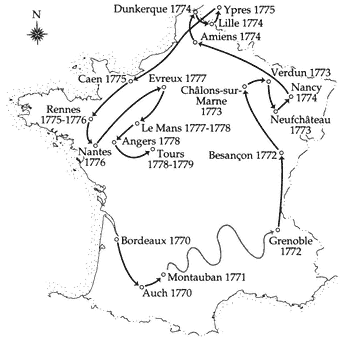
New Strains, Private Needs
31—
Friendship and Fortification:
Bordeaux, Spring 1770
This prosperous city with its crescent-shaped tidal port dominates the Guyenne region, whose people have a reputation for being intractable, boastful, and extremely frank.[1] Du Coudray certainly appreciates the frankness, especially in the person of Duchesne, whom she gets to know still better now during a rather quiet and anticlimactic teaching spell here. Things go so smoothly that she really can relax and socialize. Local villages send young women, each with 60 livres generously contributed by the parishioners—nearly twice what Turgot used to give students in the Limousin.[2] One of the midwife's trainees will even become a teacher here in her own right, an extremely rare case of the job of demonstrator being passed to a woman.[3]
Primarily this stop, a watershed in her life, serves the purpose of emotional refueling. Du Coudray has been on the road a full decade; she is fifty-five. She had feared coming here, but now Boutin is gone, and it turns into a delightful occasion instead. Simply being here at last plays something of a cathartic role. In her relief she can take stock of her situation.
About many things she has been absolutely stoic. Her traveling, for example. She has looped north, east, south, west, north again, south again, west again, covering with these tours and detours well over two thousand miles. Often the dusty roads are crowded with noisy farm wagons, heavily laden donkeys, flocks of bleating sheep and full-uddered cows, and of course numerous boisterous voyagers on foot—indigent seasonal migrants, students, peddlers, musicians, traveling players, pilgrims to various religious shrines, compagnon artisans on their formative tour de France . These latter stroll in merry, often rowdy bands, scattering sometimes to distribute themselves behind or alongside carriages for shelter from the winds.[4]
The upper classes journey also, to parties or operas in other towns, adding to the general clutter and congestion.
There are no rules of the road, and frequently the many wagons and carriages jockey for position on routes too narrow even for one of them, capsizing or at the very least listing precariously, careening wildly, shaking up and injuring the passengers. More often than not there are too many creatures and things crammed into the small space, loud snorers, incontinent revelers, mothers with crying children, lap dogs, parrots, and the ubiquitous cloaks, parcels, and umbrellas. It is impossible to find a comfortable position. Horses act up, coachmen get drunk—or grow horn mad or whip crazy and decide to have a race. Wheels, axles, and reins break. On steep hills, as in Poitiers, everyone needs to empty out and walk, or even help to push the still-heavy carriage. These vehicles are uncomfortable, with their oilcloth flaps barely keeping out the elements. They have little suspension and so bump, plunge, creak, and lurch along on roads that in some provinces are little more than rocky dirt paths. Soon Turgot will make some innovations in transportation, such as lighter, spring-cushioned carriages that can reach their destinations faster by traveling through the night.[5] For now, though, because area tolls and regional frontiers are not manned after dark, the distance can be covered by day only and the traveling seems to take forever.
And all over there are beggars—crowds of wretched folks, files of them at inn doors, swarms of them in and around churches, interrupting rests, meals, and even prayers with their importunity.[6] Winter, of course, brings another set of problems, the piercing blasts of cold being the least of them. Mud, ice, floods, and poor visibility greatly increase the number of accidents on the road. Carriages fill with freezing water at every ford. Warm weather has its own drawbacks; sickness of one sort or another routinely follows a ride through pestilential, marshy plains. And there are wolves, especially in the forests that come right up to the roadside. And muggers, smugglers, highway bandits who often kill. "We advise our public," reads a notice in the Gazette de France , "that there is no substance to the rumor spread about regarding a robbery of the coach to Lyon and the assassination of its passengers."[7] The fact that carriage companies must so protest to reassure the public about safety reveals the true conditions that prevail. Much apprehension surrounds travel; passengers often prepare their last will and testament
before embarking on a long voyage, and some have been known to die of apoplexy.
Of these hazards, which are legion, of the inevitable headaches, sore rumps, bruised or even broken bones, indigestions, fevers, and terrors of the journey, du Coudray says next to nothing. She has borne them with indomitable strength of character. Her consistent demand for two weeks' rest upon her arrival in a town before beginning her class and for another two weeks' rest to fortify herself before setting out on the next trip speaks more eloquently than words of the physical and emotional toll of her travels. But she has kept her feelings to herself, hiding any vulnerability, any scars to her body or spirit. In those few instances where her letters do reveal some distress—at Angoulême, Bourges, Issoudun, Périgueux—she hastens to move on to an upbeat subject, never allowing herself to dwell on problems for long or to leave a dejected impression. Her resolution to establish her mastery of the monumental job entrusted to her has prevailed. She has not dared to falter before admirers or critics. Above all she will not expose herself to accusations of female delicacy. Perhaps she made, long ago, a conscious choice to suppress and silence her personal needs in exchange for the right to function like a man.[8]
Such spartan endurance, however, can turn eventually to exhaustion, such exaggerated self-reliance can change to deep yearning for emotional intimacy. Earlier du Coudray hinted at the loneliness of the nomadic life, the lack of opportunity to make friends. Now in Duchesne she has finally found one, and he becomes a kind of lifeline. She has discovered him just in time, because she will soon be traveling much greater distances than before. Her trip thus far has been mostly in the center of France, in pays d'élection where the intendant's influence is most powerful. But she must next reach farther afield to the outskirts, to areas with which she is not familiar, areas added more recently to the country, where the king's influence is therefore less accepted. Feelings of affection, so long pent up, now give her new strength, new energy. If she worried formerly that such ties would "weaken" her, she sees here that she can let down defenses without falling apart or losing momentum. She has confronted this city, exorcised her Bordeaux demon, opened up her heart. She can tackle the tasks of the future honestly and whole now, facing squarely her felt needs, finding balance, acknowledging a
kind of hunger she has ignored or refused to admit. It has been said that the first discipline required of a leader is that he or she have no friends, and ever since the start of her mission and the dizzying expansion of her role she has coped alone, steadied herself, kept her own counsel, and proven her professional competence and capacity to lead. But now she senses she can give free rein to these new stirrings of the soul. Her letters will be looser once the floodgates open here in Bordeaux, permitting the midwife's ink to flow more freely.
And there is another change. She has spent the last decade getting, losing, regaining, and maintaining her bearings essentially by herself. Until now this has been very much a solo performance. But here, before leaving, she adds to her traveling team a helper, a Bordeaux surgeon named Coutanceau. She still remains very much in charge, and in fact her extant letters from this period do not mention him at all. Does she yet realize or even begin to imagine the significant part he will play?
32—
The Suitor and Other Calamities:
Auch, 19 December 1770
Monsieur—Read me when you have the time.
I don't know if you remember a certain marriage proposal to my niece when I was in Bordeaux. It was a fortune offered for her. If you recall, I refused all these advantages. I saw nothing but vices in this young man, and my governess as well as my niece saw nothing but 30,000 livres. The importunities of the mother and of the sister of the young man showed they wanted to pawn off this scoundrel on me. I left even refusing from the mother a pension for Monsieur her son that she offered me to train him further. After so much stubbornness on my part, I suddenly reflected that in the event that I should die, [my niece] would reproach me for having opposed a so brilliant fortune. This idea seized me like an inspiration: What do I risk? say I to myself. His views are monstrous. When people live together, facts strike a young person more than all the advice in the world. I resolved then to put him to the test, supposing that if I was mistaken and that he has more virtue, this could make a suitable engagement. But God who gave me inspiration for this trial was good enough to surpass my expec-
tations. A letter negligently discarded and luckily found, in which he wrote to Mme his mother that he gave up the rest of his legitimate inheritance in exchange for 4 louis, reversed the fortune of my niece, and as the strongest feeling she had for him was interest, you can judge, Monsieur, that this little inclination, or love if you will, took flight immediately. But to join antipathy to disdain, a last stroke brought the whole thing down. He left for Bordeaux at the time of the fair. He stole from my niece a small lined ring box of little value but a treasure more precious to her than that of St. Denis. He came back but the box was lost, and all her jewels. What a flood of tears, what indignation against him, and what joy for me that she could regard him with all the scorn he deserved. The maid, touched by the little one's weeping and affected by the trick he played on her, could have strangled him. I must tell you too, Monsieur, that he took from my cupboard a gold knife with a little lined case of the same metal. This knife, just by chance, I wanted to show to someone, and I couldn't find it at all. Luckily for my staff, I am not hasty to accuse. I wanted to discover it before I punished, but a second inspiration came to me, and I suspected him of taking it away. I stopped all the crying I was causing in the house. I assured them I knew who. I was not wrong. The young man returned, and in a firm and confident tone, fixing him with my eyes: Give me back my knife and my case. He pulled it from his pocket, and [so] happily I did not lose these two little personal effects. Even if he had had for me only the defect of lying, for I don't think there can be a man in the world who equals him, I could never have allowed, you realize, Monsieur, all of these scenes. I could no longer stand the sight of him. However, I was charitable enough, in order to avoid a great scandal, not to throw him out immediately, and I have continued to feed, lodge, and have his laundry done since his return from the fair of Bordeaux. I wrote to madame his mother that it was not possible that I keep M. her son any longer, that his blunders did not suit me, and that, combined with the debts he incurred, I was really always alarmed. You will be good enough, Monsieur, to read Mme Rodes's letter that I'm enclosing . . . [and my notes about] the debts he had and that I paid. You will do the greatest thing in the world, you will be good enough to go find her and to settle this affair. I
see no other hope for me than this approach by you. You see what faith I have in your way of thinking. . . . I have every reason to dread on the part of the mother troubles of a different kind from her son's. It's in your hands that I put my interests. I could not do better. With anyone else I would worry that the charms of the young man's sister would outweigh the claims I could inspire, but with you I have nothing to fear. It is enough that my cause is that of justice.
I have yet another story to tell you. The subdelegate of Pau does not want me to bring my good works there. Speaking of the good, M. Esmangart [the newest intendant of Bordeaux] could oblige me if he agreed to. The états of Bigorre want two machines as soon as possible. I will send them yours, which are all ready, and will receive for them needed money right away. It is only to you that I tell this, and especially as I am about to go on vacation. . . . Answer me as quickly as you can, a thousand thousand pardons. I am, with all feelings of esteem and veneration, your very humble and very obedient servant,
du Coudray[1]
How complicated and messy things have suddenly become! So the midwife has had a young scamp under her roof since summer, when they all came and set up house here in Auch, not far from Frère Côme's hometown of Tarbes, where the monk has asked her to enlighten the region as a personal favor. Du Coudray has had her share of calamities since her arrival, including an illness she diagnoses as overwork.[2] And she relates them liberally now to her friend Duchesne.
She had written to him earlier in a dither asking for help, because she misplaced a receipt showing she had cleared a debt of 600 livres. Du Coudray is usually remarkably organized and meticulous in her record keeping, despite the fact that nothing has a permanent, stationary filing place, so she is half crazed over the missing slip of paper. Hopeful that officials in Paris will remember her reimbursing them, she tells Duchesne: "if they have the slightest doubts, I will not hesitate for a moment to be accountable." What courage it must take to make this gallant statement when she has absolutely no extra funds, indeed, barely enough to manage at all. "If you only knew my chagrin, I cannot express it to you, and that I
cause you problems just makes it worse. I will rest easy only when this matter is settled. I will take great pains not to be careless even as I experience such dismay." Meanwhile, however upset she is, her teaching obligations must be met. "I will use for this meeting the machine made for Agen because mine is soaking wet—my thriftiness in sending my trunks by water transport nearly cost me the total loss of the little I possess. That's another experience! I have many things, Monsieur, to tell you about the reception that I got here, but I am too preoccupied by our cursed matter. May the angels accompany you. I will await your response with all the vivacity of my impatience."[3]
This money matter is satisfactorily resolved by Duchesne, for it is not mentioned again. Either the receipt is found, or the Paris officials let it drop, or Duchesne is a dear enough friend to cover it from his own pocket and never say. He next does another favor and sees to it that every one of the surgeons du Coudray designates as a demonstrator does indeed get his commission—in Agen, Monflanquin, Périgueux—in spite of "all the difficulties that the cabal of the community of surgeons ordinarily gives rise to." She thinks long and hard about who best deserves these coveted appointments, so Duchesne honors her wishes and immediately expedites her orders.[4]
Now comes the biggest crisis, a matter of greed, betrayal, and a fifteen-year-old girl's heartbreak. Du Coudray's household help get very emotionally involved in this drama concerning their mistress's family and the bad seed in their midst. And who is this "niece," Marguerite Guillaumanche, who abruptly appears as such a central protagonist? She is probably first mentioned as the "apprentice" in Bourges. Had her parents, illiterate peasants from Tallende, turned her over to the midwife, or had she recently been orphaned? Was there perhaps some very distant relationship?[5] The midwife's clear understanding that preaching self-righteous sermons has no success with adolescents sounds like the insight of a seasoned guardian. Chances are they have had quite a few years together already. Is she also remembering some stubbornness in her own distant past? In any case, du Coudray, playing the maternal role, feels responsible for providing her niece with future security by marrying her off sensibly. And the money is tempting.
But the midwife, a keen judge of character, will not be the dupe of this feckless young man. The letter shows that, perhaps for lack of companionship of female equals, she has conversations with herself
in the privacy of her brain to decide on a course of action. Unscrupulousness cannot go unpunished; as mistress of the house she must educate them all. For the first time, too, the midwife confronts her own mortality. What will happen to her ward when she is gone?
There is still further cause for alarm—of which she does not speak to Duchesne, though it is deeply disquieting. The administration has decided, unaccountably, to sponsor another midwifery manual, of over 250 pages, by a doctor named Joseph Raulin. That Pau and Bayonne have just rejected her offer to "bring the good there," thus defying Frère Côme's wishes, is bad enough, but now there is this other matter of Raulin's rival publication. His Succinct Instructions . . . for Midwives in the Provinces , printed "by the ministers' orders," has immediately sold out in first edition and is already being reprinted in large numbers. What ministers? the midwife wonders.[6] Literate women in the parishes—dames distinguées —are being asked to read this work regularly to illiterate women and to engage them in conversation on the subject so that they become familiar with the art of childbirth.[7]
Raulin's book appears to be catching on fast. A new dictionary of the trades declares that his instructions are all that country women need in order to learn to deliver babies properly.[8] His text, like du Coudray's, has pictures, but they are twelve unhelpful illustrations of babies floating in acrobatic positions in unfolded wombs that look like geometric puzzles. These pictures do not compare in utility or beauty to the colored ones in the Abrégé . In fact, the rival publication has no particular merit that the midwife can discern. There is a lengthy section on religion and the crucial importance of baptism, all of which can be found in her book too, of course, but Raulin has cleverly devoted to this material a disproportionate number of pages, thus winning the resounding approval of the Paris Faculty of Theology.[9] Is this perhaps a rebuke because du Coudray's text is more secular?
In any case, it is not a good development. Of course, the new book cannot substitute for her actual teaching. Deep down she understands that. It is nonetheless an affront and a scare, for it is no mere private undertaking by Raulin, but a government-supported project. Who exactly commissioned Raulin's book? Politically, things are more turbulent than ever. The king's man d'Aiguillon was actually brought to trial this spring by the Parlement of Paris, a trial that dragged on for several months until the king held a lit de justice
and quashed the proceedings. Louis's new controller general, Terray, is doing his best to back up the crown, but the chorus of parlements protesting royal policy and appealing instead to public opinion grows louder and louder. Just last month Chancellor Maupeou declared, as Louis did four years ago at his famous session of the scourging, that parlements are nothing but courts of law, have no legislative authority, and are forbidden to act as one body. This political conflict seems to be coming to a head, and the midwife surely finds it unsettling and confusing to try to follow from afar.
Was it worth spending so much of her personal funds last year on illustrations for her Abrégé only to see the book get lost among competitive publications? She is not flattered by the idea of imitators. She does not know Terray. Is he against her for some reason? She must keep her head and monitor this situation carefully. The knife almost stolen from her just now, and reclaimed, seems in some way symbolic of her need to insist on her rights here, to jealously guard what is hers, to arm and defend herself. This knife is no mere trinket, but one of many priceless gifts given in recognition of her extraordinary efforts wherever she has taught, her legacy of successes. In her household she has confronted the foe, recovered the goods, and restored order. She must now do the same in her job, do all she can in the outside world to save her mission.
New tests, new challenges. But just how widespread is this ministerial mutiny? How much trouble is she really in?
33—
Coutanceau, "Provost" and Partner:
Montauban, Winter 1771
This pink brick city, once a hotbed of Protestantism, is now a center for the manufacture of textiles. In fact, there is so much spinning of wool and hemp, so much weaving, such a spread of these industries even into the countryside, that the peasants sometimes neglect the land.[1] Du Coudray has been impatient to get here early, ahead of the game, so she can start making machines before beginning her lessons. In Auch she was sick for a spell;[2] now she has much catching up to do filling numerous back orders. This is, too, a way to get her mind off her worries. She tells Duchesne she is eager "to put myself to the task."[3]Ad operam is indeed a guiding principle for the midwife; lying fallow depresses her, and work seems therapeutic.
We now hear more about the sixth and newest member of her band, thirty-three-year-old Jean-Pierre Coutanceau, a surgeon from a medical family in Bordeaux.[4] Somehow in the short period since he joined them he has assumed a very special role. Du Coudray is for the first time admitting that she needs assistance. Although young enough to be her son, he is treated as an equal, a colleague. She obviously already admires and trusts him, for she sends him to do a course in her stead a bit to the north, in cozy, affable Cahors.[5] They give Coutanceau the perquisite of a few hundred livres that usually goes to the midwife. The two seem to have agreed on this, although it is not clear if he contributes the money for shared household expenses or if it is his exclusively.[6] Du Coudray is regarding him still more appreciatively since the fiasco with her niece's suitor. She counts on Coutanceau, who is as steady and reliable as the younger man was shiftless, calls him her "provost," and passes on to him many demonstration and teaching responsibilities. Having an intelligent and loyal adult along has to be an enormous comfort. Perhaps he can become a permanent fixture, an extra pair of hands she will be able always to rely on.
Such have probably been her thoughts lately, for more and more she treats their relationship as a partnership. Is she instinctively insulating herself from adversity? Never before has she given a helper this kind of status, but now she hesitates to proceed alone. She is heading next into the south of France, an area full of conservative pays d'états —Pau, Toulouse, Foix, Perpignan, Montpellier, Aix—where having a male surgeon partner might indeed be an advantage.
But an odd thing is about to happen. Even with Coutanceau's company and cooperation, she will be repeatedly cast out, forced to wander as if in the desert. She disappears now from public view for over a year, her mission seemingly suspended, her whereabouts entirely unknown and unmarked in the official correspondence.
34—
"Happy As a Queen":
Grenoble, 16 June 1772
Monsieur—
I write to you almost from the other world. I am in Grenoble happy as a queen: a charming intendant, a secretary worthy
of him, inhabitants full of gratitude, and lots of intelligence in the subjects. This has made amends for the ennui in which I found myself in Toulouse, traveling calmly along across six provinces in my carriage. Can it be imagined, I was turned away. I do not know what will be my destination, if I will go to Trevoux or to Besançon, but at least let me find there the same zeal and readiness to receive me [as I find here]. I am writing to M. Esmangart to ask that he please give to M. Brochet, surgeon in the city of Périgueux, the commission I had obtained for M. La Combe who just up and died on me [qui s'est laissé tout bonnement mourir ]. I am not telling the intendant that I am urged to do this by the demoiselles Bertin, but I am asking you to second me so that such supplicants not be disappointed. So oblige me, Monsieur, and give it your attention as promptly as possible. I count on all your kindness toward me. A ton of fond wishes to Mme Duchesne, please, [and] to your sons. You will favor me with a reply as soon as you've expedited this matter, so that I may report to the demoiselles Bertin. I am for life, with feelings of pure attachment, Monsieur, your very humble and very obedient servant,
du Coudray[1]
Where has the midwife been? For thirteen months she sank from sight and Duchesne has heard not a word. In March 1771 she was still in Montauban,[2] by April 1772 in Grenoble. But in between she had been compelled to keep moving, had been unable to stop anywhere to teach. It was certainly not for want of trying. There was some major problem in Toulouse; as she reports to her friend now with considerable shock, several places actually refused her. Narbonne did. And Montpellier.[3] The latter is perhaps not surprising, for this city has a very strong medical faculty, the great rival of Paris; they do not believe they can use any help from this woman trained in the capital. So there she is, reduced to a fugitive! It is so shameful that she chooses silence rather than attempting to tell Duchesne the details of what happened.
But we can conjecture. Throughout late 1770 the parlements had grown flagrantly disobedient and provocative. On the night of 19 January 1771 the chancellor Maupeou effected a coup, a complete purge of the law courts, banishing the recalcitrant magistrates to remote, desolate corners of the country. In June d'Aiguillon, so hated
by the refractory parlements , was made secretary of state for foreign affairs. Maupeou, Terray, and d'Aiguillon now constitute the so-called triumvirate of ministers, determined to see that the king's will be done, that his edicts be imposed and forced into law. In the eyes of many, not just the privileged nobility, Maupeou's maneuver was an act of naked despotism, and the royal midwife almost surely suffered the resentment and hostility directed toward the monarch.
There were other reasons for her rejection in these southern regions. The intendant St. Priest, in April 1771 and again in November, put du Coudray off as politely as possible, referring to bureaucratic complications with the powerful états , suggesting she try again sometime in the future.[4] These areas are in any case notoriously inhospitable to female practitioners. Elizabeth Nihell's fierce attack on accoucheurs has just been translated into French, with an updated diatribe against the Frenchman Levret who advocates forceps. The Midi apparently makes no distinction between such belligerent feminist midwives and du Coudray: none of them are welcome. Despite seeing that her slightest attempt to alight provoked such antagonism, the royal midwife was too proud to bow, scrape, and explain herself.
The setbacks during this year of enforced leisure, when she could gain no foothold anywhere, must have raised the specter of her whole mission fizzling ignominiously. But she does not permit herself to wax maudlin in letters. In fact, it would seem she wrote no letters during her wanderings, and resumes contact only now after the humiliation is over and past. Even today she gives just the sketchiest picture of those many months. She will not be seen as the plaintive exile. Some things, some feelings, are beyond description. If they go unreported, however gravely wounding, they can lose their edge and fade away.
Du Coudray somehow again now musters all her ardor for Grenoble. She has been in this capital city of Dauphiné for two months, where the locals, even the most rustic, are known for friendliness to outsiders.[5] Technically this is also a pays d'état , but the états have not met since 1628 and a much more progressive atmosphere prevails. Here the king's intendant, Marécheval, has considerable influence. He has been truly excited about du Coudray's arrival, writing before she came to both lay and clerical administrators in surrounding towns that they "must be convinced in advance of the utility
cities can derive from her intelligence. It should interest citizens of all orders." An avis has been printed up and circulated, explaining how her mission came about. It is based on Le Nain's Mémoire but much more succinct.[6] Perhaps because of the recent hiatus in her teaching, Marécheval believes it wise to reintroduce her; she has not been lately on people's minds. In response, numerous villages have sent students to take advantage of "this important school."[7] The midwife trains some very talented women here, and being appreciated again is sweet.[8]
Even with Duchesne, du Coudray prefers to display her proud moments and keep low moods to herself. Now that her routine is picking up again she feels like reconnecting, sharing her feelings but also reestablishing her businesslike mode. Duchesne takes care of the favor she asks for the surgeon protégé of Bertin's daughters.[9] She has, of course, much to thank the former minister for; without his help all those years ago her mission might never have gotten going at all. Du Coudray is feeling so much better that she can even speak flippantly of the inconvenient death of one of her demonstrators. Finding replacements for her trained disciples is at best a bother. She is regaining her sense of humor. And she again pushes, however charmingly, for what she wants, returning time after time to the favor she needs and insisting on a reply so she'll know it has been taken care of. Her epistolary pressures are in full swing once more. She is back to her old tricks.
Politically now too, in the summer of 1772, things have settled down considerably. The royalist "triumvirate" has been in power for some time, and the parlements have been subdued and replaced by courts more cooperative with the crown. D'Aiguillon, the new minister of foreign affairs, seems sufficiently impressed with the midwife's mission, and especially with Coutanceau, that he grants him permission, even though he is not a military man, to don the surgeon-major's uniform.[10] It was good to bring him along after all.
35—
Networks, Newspapers, and Name Games:
Besançon, 16 November 1772
Crisp, confident, and vigorous, the midwife has been executing numerous tasks in this capital of Franche Comté, another erstwhile pays
d'état, land of plentiful, exquisite fish, superb big game, abundant wheat, and wine. But the roads here are known to be dangerous, too closed in by menacing woods, too narrow and rutted, too overgrown.[1] As a consequence the trip from Grenoble, not so far as the crow flies, took an inordinately long seven days.[2]
Du Coudray had pushed herself with unusual aggressiveness on this intendant, La Coré, writing in May from Grenoble with a detailed enumeration of her talents. Dreading another idle spell, she is resolved to preserve her new momentum in a long, strong trajectory. In case La Coré shares the prejudice against accoucheuses that she encountered in the south, she stresses her connection with surgeons especially. The awkwardness of the letter shows that she is not relaxed. She has, it seems, almost gone to Besançon once before. This time the trip really must materialize.
I do not doubt that the sentiments of humanity that you have always held will have you learn with pleasure of my proximity. . . . Your reputation inspires me. . . . I have made such a round of visits but despite the postponement I never forgot about you. I am in Grenoble. Everyone in this province supports the beneficence of M. de Marécheval. He is loved, you are, Monsieur, and you are everywhere, and I can do the same for yours. I thought of doing the Lyonnais, but the impossibility of M. de Flessel setting up this establishment only hastens the satisfaction of being with you. . . . My brevet . . . removes all difficulties. I enclose a recommendation from the surgeons of Rochefort that might make yours interested in seeing operations that so much resemble nature. I have here, as I have had everywhere, a great number of [surgeon-students]. I will await your answer, and I will be painfully afflicted [douloureusement pénétrée ] if obstacles interfere with your desires and with the eagerness I have to support you.[3]
Du Coudray makes it hard to deny her. Plans have not worked out for her to teach in Trévoux near Lyon,[4] so she simply can't let Besançon fall through, for the memory of her year of rejection still smarts. She is in luck, as it turns out. The subdelegate of Besanqon, Ethis, having heard the highest praise for the midwife from Grenoble,[5] is very ready and willing to accommodate her. They have a good working rapport, though no close friendship. She has told him bluntly, "I need time to rest before starting."[6] Without such acknowledgment of her limits, she would soon be irretrievably spent.
Since mid-August she has been living and teaching in a house
on the rue St. Vincent, not far from the square in front of the governor's palace, where there is a fountain in the shape of a nude seated woman with water spurting from her breasts. Ninety-four students have come, but Ethis and du Coudray herself have had to advance nearly all of them money, as their parishes fell far short of covering their living expenses.[7] This is unprecedented. Ethis will later be obliged to go in hot pursuit of the funds from these delinquent villages, threatening them with lawsuits and arrests if the responsible parties do not pay up.[8] The midwife, however, knows full well she will never again see the sums she "lends" these poor women. Certainly she needs the money, but she is also aware that they are far worse off than she. Besides, they are an investment for her, in the immortality of her life's work, in the future (fig. 8).
Something else is new here also. A particularly intense selection process has taken place, with many letters exchanged between the midwife and the parish priests. Usually the students are all lined up for the midwife beforehand, but here the priests consult her on each choice, addressing her variously as "the very deserving dame du Coudrez approved by the King," "midwife proposed by His majesty for instructing," "established by the King," "his Majesty's deputy in the whole extent of the kingdom," "midwife by special appointment," expecting her to be intimately involved in the shaping of her class. One girl is "sheepish and timid" and "has never left her village" but is being sent anyway, "informed of your consideration and kindness toward this sort of person." Another painfully shy girl is nevertheless "rich in character." Du Coudray interviews them all, then sends off cheerful and efficient notes to Ethis telling him her decisions. In one case she has to explain to "surprised" town officials why she rejects a practicing midwife in favor of her untrained daughter; she wants fresh, open, malleable minds that do not need to unlearn bad habits first. Only one pupil is supposed to be sent from each town, but the curé of Héricourt, embarrassed because his best volunteer is Lutheran, begs du Coudray's "dear person" to accept a Catholic girl as well, to balance things out. Protestant midwives are technically against the law, for it is feared that they will not baptize babies, yet in this region there are many of them.[9]
One particularly supportive priest is helped by a good word du Coudray puts in for him with the cardinal. In return she asks for his assistance making certain that her students get clients and are
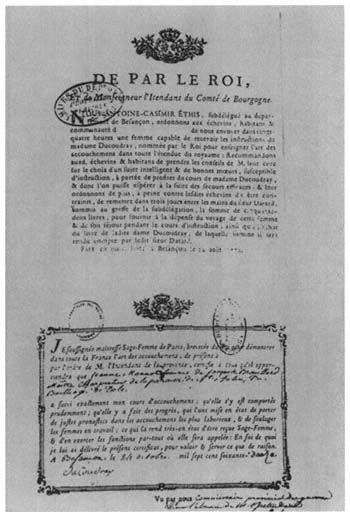
Figure 8.
On top is a call sent by the subdelegate of Besançon on behalf
of the king, recruiting suitable midwifery students from each village, to
be carefully selected by the parish priest and financially provided for during
the lessons. Below is a typical diploma awarded by Mme du Coudray
at the completion of the course.
not squeezed out of their rightful job. She fights aggressively on this point, to make sure her system of birthing prevails. Priests in each parish, she suggests, should refuse to recognize any midwife at baptisms except the one trained by her. Mothers so obstinate that "they prefer to die in the hands of ignorant women than to call to their aid the new one" can choose an old matron if they wish, but in du Coudray's system both the mother and the matron will be liable five sous each to pay for the baptism. A shrewd boycott indeed. "Shame and stinginess together" will soon win the village women over to the new trainee. You must sometimes, she explains, force "the good" on a public too backward to recognize it themselves.[10]
The midwife develops a special closeness with her students here in Besançon, perhaps because she protects so strenuously their right to practice. She hears about their bad livers and hearts, traumas with their children, and always their immense gratitude to her, for everything. "As for me, my dear lady," writes one succinctly, "I will never forget you."[11] Another thanks du Coudray for being such a sympathetic listener and sends her a gift she received at a noble baptism. This woman is falsely accused of a crime, and complains that she is at a great disadvantage because her adversaries are "rich and well protected." Her honor and all her earthly goods are at stake, and she begs du Coudray to intercede in her behalf with the intendant, "for which I will not stop being grateful as long as I live."[12] The teacher is as sensitive to her students as she is harsh with the old matrons. The hardship she must cause these "other" women, who have practiced for years and are now being pushed aside by girls with a couple of months' training, is nowhere in her thoughts. Saving babies is her sole goal, and creating a new set of victims in the process does not appear to deter her.
That she is noticeably hardened against the older matrons here might be because she finds more than the usual birthing atrocities in this region. A supporter of hers will later explain that she beheld
horrible spectacles devised by ignorance and cruelty to deliver a woman with a malpresentation, the account of which makes one tremble. She was called to a poor peasant, exhausted by a long labor: they had sat her on a chair with a chopping block under her thighs, on which they cut with a butcher's knife all the emerging parts of a live child; one stepped on the head and pieces of limbs of this child upon entering the room, and to pull the rest of this victim out of this unfortunate mother's body, they tugged and tore it with handles of soup
ladles and hooks from a scale by turns, under which the woman expired in this sad moment.[13]
Even du Coudray, exposed constantly to upsetting sights, found these abominations too much.
The local newspaper has just carried two extensive articles on her lessons, which are credited with having "ended . . . abuses so contrary to the public good, prevented the shedding of an infinity of tears . . . avoided the extinction of families." She is working longer hours than ever, teaching from eight in the morning to noon and then from two to seven in the evening, with only Sundays off. Including surgeons, she has 120 students. The reporter, waxing rhapsodic, portrays a saintly midwife, nearly beyond recognition.
Mme du Coudray shuns praise. Her modesty cannot admit it. Let us just say then that she taught with much order, neatness, and precision. Her method employs no hooks or other metal instruments, which are alarming and dangerous, but only the dexterous hand. She has as assistants M. Coutanceau, of ample erudition and experience, and Mlle de Varennes, faithful follower of Mme du Coudray her aunt. All the students, male and female, filled with gratitude, praise the seigneur for having given them this favorable opportunity, and to show him thanksgiving Mme du Coudray in her rare piety thought it appropriate to say, last Sunday . . . at 9 in the morning at the Capucins, a mass with offering of blessed bread. . . . She took the sacrament of the Eucharist along with most of her students.
The intendant, the newspaper reports, has generously prepared and presented special leather-bound copies of the Abrégé to each of the graduates.[14]
The second article laments that more men are not willing to study with du Coudray, mistakenly thinking they have nothing new to learn. These men should "banish such vain politics, the fear of blushing," and "base sentiments of misplaced pride" and open themselves to enlightenment.[15] The dean of the University of Besanqon's medical faculty, who attended the midwife's course, adds his voice too: "We see only too often enormous mistakes made in childbirth by the very ones who call themselves experts in this profession."[16] This kind of blindness and stubbornness on the part of men, coupled with the rashness of untrained matrons, the dean observes, results in the kind of horror scene the midwife witnessed in the region.[17]
These press reports raise several questions. First, how has Coutanceau been persuaded to stay on permanently as part of the crew? The midwife has been turning over her gratuities to him since Bordeaux. Was that all the coaxing he needed, or did he have other reasons for wanting to stay? Second, why does du Coudray suddenly style her "niece" as "Mlle de Varennes"? Maybe it is part of some aristocratic role-playing to enhance the prestige of the group and wipe out memories of the bruising year of rebuffs. Du Coudray, after all, has seen fit to assume for herself a surname complete with noble particle to suggest a lineage of status, and the younger woman is supposedly her relative. A third question concerns why the midwife thinks Besançon is worth a mass. Is it because, just now when she is eager to wind things up and leave, the province turns out to have no money whatsoever to pay her? A display of piety might help. It certainly didn't hurt her rival Raulin get a lot of support and attention for his birthing manual.
Today, chafing at the bit, she writes to her contact M. St. Etienne at the projected next stop, Châlons-sur-Marne. By happy coincidence, she somehow already knows and likes this man very much. Did they perhaps befriend each other during her hard vagabond year when he was on another administrative assignment in a different region? In any case, he is about to take Duchesne's place as her best confidant. She seems positively giddy at the prospect of their imminent reunion. Delayed here, she must wait a full month for the Treasury to be replenished so she can collect payment for the many machines she is leaving in the Besançon region. "I cannot wait to see you again, and without this reason I would have left immediately. I embrace you always, while waiting to be able to tousle your head, goodbye, hello. I am very respectfully, your little servant, du Coudray. P.S. Dear me how we will gossip!"[18]
Is du Coudray actually flirting? For a woman nearing sixty, this petite servante sounds positively girlish. It is impossible to be sure. But St. Etienne is clearly a kindred spirit for whom she feels enormous affection, and she is bursting to tell all. Periods of relief, release, unwinding seem essential to her now to punctuate the grueling routine. Bonds created by chatter, laughter, good times, hilarity even, have become vital necessities. And between her and St. Etienne there is something very special. This is her most ebullient letter to date, a complete change from the self-conscious gravity of
some and the breezy efficiency of others. Whatever their relationship is, here in anticipation of their meeting she expresses a boisterous, almost visceral joy.
36—
Flirtation in Champagne:
Châlons-sur-Marne, March 1773
A dalliance perhaps? Certainly an especially good time. Sharing the limelight now with her niece and M. Coutanceau, the midwife has spent the winter in this walled city with its shady canals, situated in a large plain in Champagne.[1] Rouillé d'Orfeuil, the intendant, is solicitous, though he is away on rounds and not here to supervise things himself. His official, St. Etienne, has taken over in his absence, adding several incentives to attract students. The first two—the offer of free lodging in Châlons and an assurance that extra earnings from the practice of their new art will never be subject to the taille —have been tried before, but the third—exempting their husbands from the hated corvée , the enforced labor on royal roads, as long as the midwives remain professionally active—is an innovation.[2]
Nevertheless, things have not gone entirely smoothly. The fanfare has upset one combative surgeon, who casts aspersions on du Coudray's book and its "sloppy" way of "laying the foundations of this establishment." Luckily, this attack does not sway Rouillé d'Orfeuil from his loyalty to the midwife and her enterprise.[3] But there have been other difficulties as well. Some curés have had trouble recruiting students; one who could not find anyone to volunteer sends a compensatory poem instead, lauding the intendant for his farsightedness on this important issue.[4] The problem in gathering recruits for the courses is perhaps related to how hard women work the land in this area, where the chalky soil would form an almost solid crust, broken only by an occasional black pine, were it not for the combined power of men and women.[5] Those students who do come, though, get printed certificates on which the promise of tax exemption is clearly spelled out.[6]
Du Coudray is so happy. Deeply appreciative of Rouillé d'Orfeuil's support, she writes to him: "One feels in this province all the good you do for it. I will neglect nothing, so that your kind intentions will be carried out. I only regret that I will not have the hap-
piness of seeing you."[7] However much she likes writing and receiving letters, the midwife also looks forward to meeting people in the flesh. In this case, however, there is ample compensation for the intendant's absence. St. Etienne is helping with everything, rounding up more students, selling machines, turning a lackluster beginning into a smashing success for du Coudray. She can relax. He is one conquest already made.
Beyond the likelihood that St. Etienne is unmarried—her subsequent letters to him never include greetings to a wife, as is her custom with Duchesne—we know very little about him, except for the unprecedented coquettishness he inspires on the midwife's part. Nowhere else in her extant letters does she speak or behave this way, loosened up, even playful. He and only he, in her extensive correspondence, will be addressed as "Monsieur and Dear Friend." Perhaps a romance really does blossom between them. But if so, it never sways du Coudray from her path. Aeneas may have slowed down for Dido, but the midwife does not seem to skip a beat. Whatever the nature of this interlude, it gets transformed by her into yet another business relationship, does not make her stray, stay, or even delay. Really, St. Etienne is far more of a facilitator than an obstacle, helping her achieve and indeed surpass her goals. More and more she sees that mixing pleasure with work enhances her effectiveness. She need not take it all so terribly seriously.
And now things are picking up, getting lively. Surgeons in surrounding towns fight for the chance to become her demonstrators, hearing of the midwife's courses through public announcements at the meetings of their guild. Male pride and professional rivalry ensure that initial reactions are rarely enthusiastic, but in the end many compete to be chosen, and sometimes there is acrimonious argument and even foul play as they vie for the coveted assignment. The nearby city of Troyes is a case in point. One Picard, a master surgeon, had with a gesture of irritation read out loud the notice of du Coudray's coming in a scornful tone, stressing that anyone traveling to Châlons to attend the course would lose valuable business on the home front and that, in any case, it is indecent and demeaning to be taught by a woman. Having elicited the desired negative reaction, Picard was dispatched to the mayor of the city to report that nobody was interested. Once there, however, he betrayed the fold, taking advantage of the interview to slip an idea to the town officials:
his own son-in-law would be a willing candidate. Hearing of this deception, the community of surgeons nominated a member of their guild, M. Simon, as well, and Troyes was eventually obliged to send both men. As things stand now, though, only one can officially be named demonstrator. Simon, eager for the designation and disturbed by the irregularities of the procedure, has reminded the intendant that he once sent him some verses, for which an unspecified return favor was promised. Has the time come to make good on that promise? But Picard's relative is a favorite of the subdelegate of Troyes, and in the end it is he who gets the commission and the machine, though only after an intense and ugly struggle. Similar dramas are played out in many towns. Sometimes surgeons literally come to blows in their scramble to be chosen to help bring du Coudray's science to the villages.[8] The Affiches, annonces et avis divers de Reims et de la généralité de Champagne reports that some surgeons even join the classes for women to reap additional profit from the "rare talents" of the aunt and niece and the "precision" of Coutanceau.[9]
All in all the stay here ends up a huge hit, thanks to the extra help and encouragement from St. Etienne.[10] Letters from fans inundate du Coudray, and do not abate after her departure.[11] Rouillé d'Orfeuil, who has already given her numerous silver presents as tokens of thanks,[12] also sees to it that the towns in his jurisdiction order twenty-three of her machines—a record for one region and a handsome profit for her.[13] Now that such large numbers of these mannequins have to be produced, du Coudray has begun to make a less expensive, less elaborate version in linen, for which she charges only 200 rather than the previous 300 livres. She is working on other shortcuts, alternative ways of fabricating the models more quickly. She once dreamed of such gigantic orders; now she recognizes that they sap her strength even as they replenish her purse.
Her purse has been replenished in yet another way. A new, third edition of her Abrégé has been published here in Châlons-sur-Marne, in response to growing demand for such birthing manuals.[14] Du Coudray realizes she must keep hers available in abundant quantities, saturating the market so that the increasingly popular rival book by Raulin does not jump in to fill the vacuum. Once unique of its kind, her simple text is serving as a model and has inspired a fashionable trend, for others quickly see, as she did years ago, that a new public requires new kinds of reading matter, books that marry word and image and serve as ready reference.[15] These days du Cou-
dray must defend her literary and professional property as never before.
37—
"I Cost Nothing":
Verdun, 17 June 1773
Monsieur and Dear Friend,
Finally, thank God, my course is finished, and the machines also. We had 108 students; we are all in collapse. Our sojourn because of our bad health was altogether disagreeable. And by another heap of bad luck I still don't know when I can get out of here. On the faith of what M. de Calonne told me, that all was arranged with M. de la Galazière and the exchange made between them . . . for Verdun . . . [and] Nancy . . . , CRASH [patatras ] all plans are broken. I have had to write to Flanders and I await the response, which only redoubles my ennui. I am taking a little trip of four days to go to Metz. It is not so much, my handsome man, for my amusement as for my curiosity, to see the machines that the magistrates ordered from Paris. I know they are not worth much, for in spite of this expense the city also bought mine, but if there is something good about them, and that I don't know, I swear to you I will always take it. That's the purpose that drives me there.
Just imagine, Monsieur, that I am not yet paid by Besançon, isn't that shameful? Anxiety is beginning to overtake me. It is awkward to have my rest time now, and yet because of delays of this kind, to find myself in embarrassed circumstances. Again, if you were in charge all would be well.
The machine for Ste. Menehould will be delivered by the coach to the address of the magistrates. The surgeons and these men seem to want it, for they write me of their impatience to receive it. As for the two others, they will go to you. About the one for Rocroy, if I were to believe M. Lamarre, it would be destined for him. He claims to have gotten news that M. d'Orfeuil would intercede for him. This matter will be decided. But in truth, I fear he confuses his dreams for reality, for I have no more faith in all he tells me than in my slipper. But this machine will do very well in the hands of one M. Girardin, surgeon at Rauvay near Rocroy, who seemed to us a real man of
honor. He would have an additional advantage, for he has his son with him . . . [and] one or the other can go to Rocroy to give the lessons. By the way, the woman from Montfaucon came to find me. This poor woman has already done nine deliveries with the greatest possible success, but she has not yet received her book. And I told her I would ask you for it right away. I embrace you with all my heart, as well as dear Miss Frinon. Fanfan does too. The rest of my suite present their respects to you. I don't know if I will take with me the dragées [sugarcoated almonds] I am amassing. I am fed up with Theuveui. He is incapable of profiting from all the good I could teach him. This profession is not made for him with his extreme negligence. Goodbye, hello. Love me always. You owe it to the sentiments of friendship and gratitude with which I am, Monsieur, your very humble and obedient servant.
du Coudray[1]
Neither springtime nor the loveliness of this windy city on the river Meuse can cheer up du Coudray's household, not even the aniseed preserves so reputed in this region.[2] Everyone is exhausted, sick, and as always, short of funds.
The intendant Calonne has put his quite competent first secretary M. Cantat in charge, and the lessons have drawn a huge crowd and lasted four months.[3] But the midwife is uncomfortable. She does not trust Calonne. He has, after all, allowed the nearby city of Metz to purchase some machines from another source, and he endorses an unknown surgeon there rather than one of her disciples.[4] She thinks he is faithless and a poor planner. All this she confides to St. Etienne, and the letter writing does seem to cheer her. The act of composing these missives is somehow cleansing. That they are often dictated through a servant/secretary in no way diminishes their spontaneity or candor; du Coudray has no secrets from her staff. She sorely misses the efficiency of St. Etienne, and even more his caring and sympathetic ear. Is "dear Miss Frinon" perhaps a housekeeper, a maiden aunt, a younger relative of his who has befriended the midwife's niece (now referred to affectionately by her nickname, Fanfan)? The friendliness of the families and the openness with which du Coudray teases—"my handsome man," "love me always," "I embrace you"—suggests there was nothing illicit about their relationship. Rather, it comforts her to be reminded of past good times.
And she has many more complaints to unload! She is unhappy with one of her surgeon trainees and may leave him behind. He is a slacker, it seems, and it is an impossible burden to have in her household someone who does not pull his weight. Furthermore, the future hangs in the balance, for she does not know where to go next. They are all stuck here, marking time, so she busies herself by delivering lots of babies and gathering lots of dragées, the traditional compensation for such work.
She has been misled by Calonne into thinking that all was worked out for her to move on. Now, instead, she has to organize everything herself. She will soon, while waiting for things to be decided, write to Amiens, attempting to coax the intendant Dupleix, who she mistakenly believes to be stationed there:
The good that I do for humanity . . . is perhaps known to you, but in case you haven't heard, I do not doubt, (knowing your reputation), that you will seize with enthusiasm the offer I make to you. . . . The brevet with which I am honored authorizes me and makes me safe from the cabal that surgeons often instigate; anyway, the most zealous intendants don't even consult them. You will see, Monsieur, that I cost nothing. The King, who desires that this establishment be set up everywhere in his realm, has taken care of my honoraria. . . . I hasten to do this good [faire ce bien ] only as long as all cooperate with me and when those in power understand its full price, knowing how to animate the master and the disciples . (emphasis mine)[5]
This terse, self-congratulatory sales pitch reveals her impatience at having been victimized by administrative indifference before. She is, as she puts it, "the master" "I cost nothing" is of course not quite true, but she wants it believed that His Majesty keeps her in cash. What an enormous effort to explain her mission over and over again to these intendants! She must labor constantly to keep herself prominent in their thoughts.
That she has competition for her machines now is just the latest, newest problem, another major setback. Mlle Bihéron has of course been making anatomical models in Paris since the 1750s, but these are of wax. Now there is a Mme Lenfant on rue des Mathurins, who has begun to advertise in the Paris papers models made of cloth, "appropriate for surgeons, accoucheurs , and midwives to give them practice in the maneuvers of delivery. The natural proportions both
in the pelvis and in the fetus are exactly observed."[6] Du Coudray tells St. Etienne gamely that she is curious to observe these mannequins purchased from ateliers in the capital, to learn some tips, perhaps ways to cut costs. Her interest is predatory, for this item, of which she has been the main producer if not the sole inventor, now seems on the verge of becoming easily and more cheaply available. First there was a rival textbook, now a rival machine. Not only Bousquet in nearby Metz, but surgeons in southern areas where she had been turned away have started using these, buying them from manufacturers of dolls and automata in Paris who readily adapt to filling special orders.[7] Things are beginning to slip out of du Coudray's grasp. What has become of her exclusive rights? Feeling beleaguered, she obsesses in her letter about a copy of her book for one of her students in Montfaucon, a reminder of her authority, her authorial voice.
The psychological importance of her letter writing cannot be overestimated. What ultimately puts the midwife back on track again and again is her own inner sense of meaning, reanimated in the act of writing. It provides her steadying ballast. Here, for example, du Coudray works herself into a stronger managerial mode when she speaks of the distribution of her own machines. By weighing and judging the relative merits of the men she has trained and their suitability to become keepers of the mannequin, the midwife boosts herself in her own eyes. A large number of people constitute her network, and she is the final arbiter of their worth. This kind of affirmative reminder works as a tonic, regenerating her sense of purpose. The increasing momentum, the racing of her pulse, is almost palpable in the letter to St. Etienne, as she proceeds from a recitation of her problems to a renewed activist focus on her raison d'être and on what needs to be done. Her correspondence is her best medicine.
If only the men of Besançon will finally pay her, and if only the men who determine her next moves will organize themselves, she can get going again.[8] Instead they are negligent, forever getting their signals crossed. A full seven months ago Controller General Terray, in an apparent act of support for du Coudray, had authorized the purchase of eight or ten machines for the cities around Besançon, volunteering that his tax receivers would pay if the municipal officers refused to.[9] The midwife produced the machines in good faith,
but neither one group nor the other has come forth with the funds. Typical. She, on the other hand, gets things done, sticks to her obligations. In some sense she sees herself as more manly than the males with whom she deals. Her classes are methodical, her students amenable, obedient. One letter recommending someone for her course assures her that the pupil "will be a woman submissive to your orders, with whom you will be pleased."[10] Le Nain's Mémoire was careful to speak of the "mistress" and her disciples, but du Coudray transforms the phrase and calls herself the "master" (maître ). She is on a par with male authorities any day. Indeed, she functions a good deal better than many of them do. Why must she dissipate so much of her energy hounding debtors and incompetents?
38—
She "Partakes of the Prodigious":
Neufchâteau, Fall 1773
Things have worked out after all for the Lorraine. Traveling past firetrap houses, wood-roofed with no chimneys, from which smoke escapes, if at all, through ceiling holes or window slits, the midwife has also seen, in the Vosges area, huts sunk into the earth, damp comfortless dwellings with the inevitable dung heap by the door. Many of her students, she knows, will come from such homes. Neufchâteau itself is a small cloudy town where, despite their love for baba au rhum and madeleine cakes, the people are reputed to be cold and taciturn.[1]
For a while du Coudray had not known where she would end up. Mistakenly thinking the intendant Dupleix is in Amiens, she wrote to him from Verdun attempting to arrange a visit. He, however, turns out to be in charge of Brittany now and received her forwarded letter in Rennes, much farther away. Dupleix fervently wants her to come there, and makes a note to himself: "We must send a courteous letter to this woman that I know by her great reputation. This establishment would be very desirable, but the means are not easy. Promise her that I am looking into it."[2] Meanwhile her original plan nearer by materialized and she wrote again to Dupleix: "The intendant of Nancy, having had I think a letter from the Controller General, finally does want me, and I leave to go to Neufchâteau, which is the center of French Lorraine. The minister must write also
to the intendant of Strasbourg, who set his mind against [my teaching there] last September. As for you, Monsieur, I will write that you don't need it [right now]. I will be honored to let you know what happens, and although I have pledged myself to travel only step by step, as much for my health as for the considerable costs of my voyages, I will spare neither one nor the other to fulfill your wishes as promptly as possible."[3] Thus the midwife lines up a potential future engagement. With Dupleix duly informed by this little geography lesson, blandished by the sacrifice she is willing to make, and satisfied to stay on hold for a while, du Coudray has now come to Neufchâteau, traveling through the town of Domrémy-la-Pucelle, where Joan of Arc was born. Does she ever fancy that her own heroic mission to save France bears some resemblance to the efforts of that maiden?
Contrary to the midwife's advice, local lords and parish priests have sought volunteers among the ranks of matrons already practicing. Du Coudray knows this is stupid. One, for example, who has delivered hundreds of babies, protests that she is too old for the aggravation of having to take lessons and "would rather stop practicing midwifery than go." A second is so preoccupied with her duties at home that she could not concentrate, would have to rush back to preside at births of village women in her care. One curé after another, running into obstinacy on the matrons' part, reports that the recruiting efforts have been "to no purpose," "a pure waste of time," "not a single one wanted to follow [our invitation]."[4] Du Coudray had predicted this in a letter they initially ignored, and when they finally turn to her advice, ninety-two untrained but willing girls are brought in from surrounding towns and many more from Neufchâteau itself.[5]
They seem to stick together a lot even when not in class. Some stay with aunts and sisters, some at inns—two at the Poule Qui Boit, eight at La Croix d'Or—others in private rooming houses run by merchants and widows. They cook for themselves to economize and to keep each other company at mealtime, when they might feel especially homesick. A few are grouped together in a hospice run by the sisters of charity.[6] The surgeons who arrive next for their class are a varied bunch without the same cohesiveness.[7]
One of the midwife's male students here is none other than the surgeon-major M. Saint Paul, who has been a devotee of hers since
her stop in Poitou nearly a decade ago. He pours out to a friend a cascade of heartfelt praise. One must really see the superb du Coudray in action to believe the miracles she can work! Her lessons "surprised and enchanted me . . . realistic demonstrations . . . as well as happy and unfortunate positions that the practice of delivery presents. . . . All this chaos, hidden to the eye and often to the touch, is intelligibly disentangled by her, so much does her vast knowledge partake of the prodigious. Also the intendant of the Lorraine, who is gifted in general understanding of all the sciences, evinced surprised admiration at the demonstrations he came to see her do. He heaped upon her, in my presence, the most flattering eulogies, in my view most deserved."[8]
On the last day of the course, du Coudray is honored by the singing of a musical mass for all her successes with her 150 female and male students.[9] She amasses the familiar stack of thank-yous from adoring trainees pledging to be "eternally her student," and now M. Coutanceau is also gathering a following.[10] The midwife has enjoyed here a sense of settlement, an agreeable calm. There is much socializing. The intendant, La Galazière, has outdone himself to enhance du Coudray's comfort. And the subdelegate of Neufchâteau, M. Rouyer, is a friendly man with a gracious wife who opens their home to the midwife and her team, makes her welcome, and introduces her to his friends. She will remember his kindness and hospitality for a long time and will still be merrily reporting back to him about her odyssey many years later.
Designing a Dynasty
39—
Romance in the Entourage:
Nancy, 27 February 1774
The niece and Coutanceau have fallen in love! Any responsible guardian must organize her young ward's dowry. It is her protection. It is what she brings to the marriage, though it remains hers and can be reclaimed. So Du Coudray has hastened to Paris, leaving her provost in charge here in Nancy, a city proud of its history as the capital of the dukes of Lorraine, and recently made elegant by the erstwhile king of Poland, Stanislas Leszczynski, father-in-law of Louis XV. It is a thriving metropolis compared to tranquil Neufchâteau, but even here life is rather low key.[1]
Before leaving for Paris, du Coudray has of course seen to it that all is in perfect order. As the accommodations found for her were only meagerly furnished, she has discovered a source of secondhand goods that she can resell when she leaves. She booked lodgings for six months, but the turnout is so small that the stay will probably be much shorter. Neither the residence nor the classroom is in good shape. A locksmith-handyman has presented bills for replacing hinges, pins, eyebolts, cane, bells, wires, bolts, and hooks, and has also supplied or repaired binding, hoops, and spindles needed for making the machines.[2]
The students here are eager to buy their own copies of du Coudray's book, and a helpful surgeon named Didelot, who had earlier written a small midwifery manual of his own, is graciously assisting with the distribution of the recent third edition of the Abrégé .[3] What a comfort that he, unlike other male authors on obstetrics, makes no attempt to steal the midwife's luster. Far from it: he appreciates her contribution and has written passionately himself about the essential "multiplication of the human species," even providing a rudimentary statistical analysis of depopulation.[4] Literacy in this north-
ern part of France, above the St. Malo-Geneva line, is considerably more widespread than elsewhere. But pupils also want the midwife's book for its illustrations, and for its value as status symbol and souvenir. They clamor for it, making elaborate arrangements for its transport and delivery.[5] Nine machines are being ordered by surgeons to take back to surrounding towns, and two more expensive silk models for the Hôtel de Ville.[6] In general, though, the numbers of students are low, the pace slow, and there is not very much to keep the teaching team busy. At least as far as teaching goes.
Today Coutanceau answers a letter they have received from their friend Rouyer, who evidently accompanied them briefly to Nancy but then returned to Neufchâteau. Rouyer, who addresses the surgeon with an honorific title and clearly admires him, has requested more books and one of their old machines for his demonstrator. Coutanceau says he is having the women refurbish one of their used "phantoms" for him and that it will soon be on its way.
We still have twenty bound copies of [du Coudray's] treatise on Accouchements . Tell me the quantity you need and I shall send them. Be good enough to decide pretty quickly about this last matter because I will have more of them bound if I'm short of them for the dozen students to whom I am giving my course.
We have received since your departure two letters from Frère Côme who tells us of our next trip, to Douai, a city in French Flanders, or to Lille, capital of that province. I presume our stay in Nancy will not last long and I am delighted. I am bored with living in idleness. I am developing a distaste for pleasures. The theater, for which I longed, is becoming insipid to me. I taste real satisfaction only by being near the amiable Mlle de Varennes, who asks me to assure you that she loves you dearly. She doesn't at all mind exciting in me some sign of jealousy, and I of course promise that I will obey her. So you are my declared rival! I will do all I can do to supplant you. On your side, try as you will to make me yield my place if you want to steal from me my coquette.[7]
So here is a rare glimpse of Coutanceau himself. Though clearly captivated by feminine charms, he plans to write to du Coudray next week about business matters. He has been saving up many things to tell her and is eager to learn what is going on in the capital
and what the final decision might be on their next destination. This is a restless man. Even in his lovesick state he cannot enjoy cultural distractions or entertainment for long. His feelings for du Coudray's niece appear to be inextricably bound to his duties in their great joint mission. Proudly shouldering the responsibility of partner and agent in this enterprise, he takes over not only the instruction but also the business of books and machines in du Coudray's absence. And he is unfailingly correct, still maintaining the "de Varennes" masquerade even with Rouyer, not letting any secrets slip.
But the couple must be wondering how things are working out in Paris, where the midwife has gone to stake out the "family" claim.
40—
Brevet No. 3: The Succession:
Versailles, 1 March 1774
Brevet authorizing Mlle Du Coudray mistress midwife to hold conjointly with and to inherit from Dame Du Coudray her aunt, courses of public instruction.
Today . . . the King being at Versailles, His Majesty being informed of the talents and experience that Mlle Marguerite Guillaumanche du Coudray has acquired in the art of delivery under the direction of Dame Du Coudray her aunt that His Majesty chose by his brevet of 18 August 1767 to give public courses on the art of delivery in all the provinces of his realm, on the basis of reports made to His Majesty on the good that results from these instructions, and of the efforts and infinite cares that said Dame Du Coudray has taken to attain this, His Majesty thought he could not accord her a greater recompense than naming said Mlle Marguerite Guillaumanche du Coudray to conjointly, and as her heir, continue said courses. By this His Majesty wills that she be able to teach in the whole extent of the realm, jointly with or in the absence of her aunt, the art of delivery, and to hold public and private courses on all related subjects without her being troubled under any pretext whatever. . . .[1]
Seeing the seriousness of the romance, the midwife goes straight to the monarch and secures her "niece" officially as her conjoint and heir. She may even have initiated some formal adoption procedure, because His Majesty refers to the young woman by her aunt's surname. In any case du Coudray wasted no time, traveling in such a rush that, although she went right through Châlons, she did not stop even to visit St. Etienne. And it is a good thing that she hurried, for Louis XV is about to contract a fatal case of smallpox. This is the
third brevet he has granted her over the last fifteen years, each one more favorable than its predecessor. Despite all the ministerial upheavals, Louis XV himself has not wavered in his support. This brevet is, as it turns out, one of his last royal acts. Had the midwife put off her business a mere two months longer, she would have needed to deal with a new king.
41—
"A Reward So Justly Deserved":
Amiens, 15 April 1774
Du Coudray will soon be sixty. Ever since the scandal with her niece's unscrupulous suitor in Auch she has been determined to clarify and secure the young woman's future. Now she and Coutanceau are engaged and have posted their marriage bans here. Thanks to the midwife's tireless maneuverings the state has officially recognized that her niece is eminently qualified, with all her years as trainee and assistant demonstrator, to inherit the royal pension and mission in her own right. This gives the niece security. To du Coudray it gives a feeling of immortality. Extremely pleased with this guarantee from Controller General Terray and the king, she is focusing on it now, drawing strength from it to fortify her against new difficulties.
Today she writes letters to two special friends, Rouyer in Neufchâteau and St. Etienne in Châlons, sure that these loyal supporters will want to be kept abreast of her doings. It is more clear than ever how this process serves her. She writes with the spontaneous excitement of on-the-spot reporting, even though the cherished brevet has already been in her hands for six weeks. This knack has helped du Coudray adapt to her jolting lifestyle. She can wait for good moments and write in a state of composure. Her rhythms are erratic, months of routine punctuated by enormous upheavals and changes of scene. She is sometimes surrounded by people, other times very alone, always readjusting. But she is uniquely able to set aside time to replay things in her mind whenever she wishes, giving them fresh life, enjoying them again, often rewriting them in ways more to her liking than the reality. Her epistolary activity gives her the perfect respite from her solitude and her worries. And she can choose her moment, like this one, when she is actually rather demoralized, to inhabit instead a better world. Right now, feeling isolated and
uncertain, the correspondence allows her to connect with old and distant friends, to bridge time and space. It is conversation, it is company. She turns to it instead of brooding.
Getting settled in this city, the capital of Picardy, has kept her busy. Its people, according to the accepted wisdom, are excessively hotheaded; one is even advised to stay away from them unless looking for a fight. Yet the landscape belies this reputation with its serenity, its scattered windmills and misty horizons. Amiens itself has the largest Gothic cathedral anywhere in France, and an inordinate number of beggars; one report suggests that a third of the inhabitants of Amiens consists of the loitering poor in the streets. No one seems much to care.[1]
Du Coudray's experience confirms the province's apathy toward the public's well-being. Her course has been advertised only perfunctorily.[2] "Why can't you be here?" she writes to Rouyer. "I knew I wouldn't find you everywhere. What a difference! Believe me, everything happens here with a negligence that is not pardonable. I saw the intendant in Paris, and Mme de la Galazière. She asked me if I had been pleased with you. Guess what I said to her. They told me that this didn't surprise them, that they expected it and that they had placed me with you on purpose." She turns now to news of her achievement at Versailles, which, it develops, was a major coup financially for her as well. "I could not have been more satisfied with having made my voyage. I was Queen of the ministers! They couldn't have been more obliging. And I have the sweet expectation that for my own retirement compensation my 8,000 livres will keep coming for the rest of my life, instead of restricting me to a thousand ecus [3,000 livres]. I got the inheritance for my niece, so our future is provided for. . . . Embrace for me Mme Rouyer, M. and Mme Roussel. Tell me news of her health because I want you to write to me and keep me informed of everything that regards you. I am interested for my whole life."[3]
In contrast to this largely informative letter, she writes to St. Etienne a more affectionate but also more demanding one, bossy and revealing. Theirs was a closer, more complex relationship. She drops her defenses, intermittently. Things are good, but things are also bad.
Never was a voyage more successful. The six matters that took me [to Paris] were settled beyond my wildest dreams. I am promised that I will not be limited to a thousand ecus when I
retire, but that the 8,000 [livres] will stay with me by virtue of a reward so justly deserved. And I got the inheritance for Fanfan. I had not dared hope they would be so disposed in my favor. I also found ways to settle Fanfan's business . . . [since] the lieutenant general of Clermont just happened to be in Paris then. Everything worked out beautifully. I am in Amiens, but you are not here. They could not care less. I cannot tell you what a different attitude [there is] toward the general good. Everything goes limping along [cahin-caha ] and I have still never received a visit or any interest from the person who has your job here.
I don't know if the agricultural gazettes of other provinces reach you. I would like you to read the one from Soisson of the ninth of this month. There is an article about Soisson which concerns the establishment that intendance is setting up for the instruction of midwives. Lucky for me to be rid of them. I don't know whether you recall the repugnance I felt to be forced to go there. But in this article there is one thing that shocks me. That is that they proclaim [the teaching] more lasting [there] than elsewhere. You alone would be in a position to prove that M. d'Orfeuil as well as other intendants always had the intention to make this institution durable, since M. d'Orfeuil just had a number of women instructed by twenty-three demonstrators in each city where the machines were left. You do this whatever way you wish, and I think it is very necessary that it be put in the Gazette de France. Besides, it's only just to do this for M. d'Orfeuil, who stopped at nothing to produce such a great good and to make it more permanent than elsewhere.
Just think how those other courses are run. A demonstrator need only keep these women eighteen days! I have one of my disciples in Soisson, and I shall be informed of all that goes on there.
A thousand embraces from me to Mlle Frinon and from Fanfan, respects from M. Coutanceau. From me a thousand tender fondnesses.[4]
Feeling that she reigned royally over the ministers, du Coudray surely has something to celebrate. Her readjusted pension, 8,000 livres even in retirement, is that of a decorated military general; there
is only one category higher.[5] So, given this new measure of her importance, certain things must immediately be set straight for the record. She will not have her mission upstaged or the trail of triumphs she leaves in her wake overshadowed by press coverage of other midwifery projects. Her work should now be broadcast in the national newspaper, the Gazette de France . That she feels defensive is understandable. The journals of the capital, including the medical papers, have basically ignored her mission. The Journal de médecine has said nothing. The Gazette de santé devotes many articles to the appalling state of rural midwifery, but avoids all mention of du Coudray herself, discussing only male accoucheurs and their efforts to educate in this area. Her protest that she merely wants to vindicate the honor of the intendant d'Orfeuil is patently transparent: her own proper recognition is at stake here. Her mission is no mere fleeting episode; from the start, with her training of a network of teachers and demonstrators, the goal has been to perpetuate its impact, make it take root and endure forever.
Soisson is a particular sore spot for du Coudray. She may say good riddance, but the fact is that she was roundly rejected back in 1760 when there was talk of her going there from Clermont or Moulins. Hurt, she wrote it off as a hopelessly backward place. The subdelegate of the town of Ribemont near Soisson claimed to be entirely content with the state of things, even though in some villages the most experienced person around, in matters of birthing, was the shepherd.[6] The issue of her teaching there had arisen again in 1773 while du Coudray was in Châlons. By that time, however, a doctor from nearby Laon, Augier du Fot, had begun to discredit her. An aggressive man, he had made it his business to court such influential members of the scientific community as the great chemist Macquer, wooing him with fulsome letters, Latin epigrams, and rare cheeses.[7] He had ingratiated himself with the intendant in Soisson, Le Peletier, by persuading him that midwives, including du Coudray, are more dangerous with their hooks and fingernails than are cannons and swords, and that it is foolish to put "the life of men, the hope of future generations . . . in their hands."[8]
Recently du Fot has even won some support in Versailles, and he is publishing a ninety-page obstetrical manual endorsed by the Royal Academy of Sciences and Paris Medical Faculty. This echoes dis-
turbingly the incident with Raulin's rival book several years ago, but in fact it is worse. Du Fot is using the "phantoms" or machines made by Mme Lenfant in the capital.[9] His whole pedagogical program for Laon and Soisson is modeled on du Coudray's, but he acts as if she does not exist, exclaiming in his booklet: "May [my] establishment, the first of its kind, be imitated throughout France."[10]
A more complete annihilation of the midwife's mission, leaving no vestige or trace, cannot be imagined. Now, as if this were not bad enough, newspapers carry on about du Fot's teaching as a wonderful novelty. Du Coudray finds this almost unbearable, as her second letter reveals. Just when she leaves the subject behind in that letter, giving St. Etienne his orders, she again brings up Soisson, obsessively reiterating, almost as if even this special, loyal friend needs convincing that the superficial lessons being given there are altogether inferior to her own. That she has an informant in that town is small comfort; the reports only alarm her. She will not stand back and relinquish her priority as a pioneering figure. She will not be blotted out. Local newspapers can say what they wish, but the Gazette de France must carry news of her deeds throughout the entire kingdom.
Well, at least things are settled for her "niece," Marguerite Guillaumanche, "Fanfan," alias Mlle de Varennes, now, in the king's brevet, Mlle du Coudray, soon to be Mme Coutanceau. This eighteen-year-old woman, with her many names and public and private identities, whose real relation to du Coudray, if any, remains a mystery, is the closest thing the midwife has to a daughter. She has been quite passive in this story so far, her husband-to-be the far more significant player. But du Coudray has molded her in her own image and plans to pass on the mantle to her. At this point will the midwife begin to take her ward more seriously as an adult?
It is worth noting that now, with this new approval of a retirement pension equal to her salary, du Coudray could stop working any time and still get handsome compensation. She could turn things entirely over to the younger generation and take it easy. Instead, propelled by her promise to her king and to herself, she aggressively maintains her pace for another eight years, working ever harder in the face of increasing adversity.
First, however, this "Queen of the ministers" does treat herself to an extracurricular trip across the frontier.
42—
Overtures Beyond the Border:
Lille, 24 December 1774
To His Royal Highness Prince Charles . . . Governor of Austrian Flanders.
The infinite miseries that result from the incapacity of persons practicing childbirth determined His very Christian Majesty to authorize and commission Dame du Coudray to demonstrate throughout France this so necessary art and to give to his subjects lessons furthering their preservation, a most salutary step, whose great value and necessity Your Royal Highness can surely sense, since religion, humanity, and patriotism unite in it. We see far too often children perish without baptism, others buried alive, mothers dying, and those not killed by ignorance falling prey to infirmities even worse than death. Thus the state finds itself deprived of a multitude of subjects who, multiplying in their turn, would have made the population most abundant.
Dame du Coudray, being presently in Lille ready to finish her course, invites Your Royal Highness to form the same establishment in the Low Countries: to send her prévot [M. Coutanceau], who for the past five years has demonstrated for her this aspect of surgery, and to serve as his interpreter the person who has the honor of presenting this letter to you, who knows the Flemish tongue well and who has even translated into that language the treatise on childbirth written by Dame du Coudray. This person already took her course in Dunkerque and is following it again most exactly at Lille, which will put him in a position to offer his services to Your Royal Highness should he decide to do for the happiness of the Flemish what Louis XV did for that of the French. Her prévot would come to Brussels on 8 January next; Your Royal Highness would make use of this interval to dispatch orders so that fifty communities each send one woman, every one of whom will be provided with 20 livres' living expenses per month for as long as this course of instruction lasts, which would be six weeks or two months. Your Royal Highness would also give orders so that a surgeon from each principal city of the Low Countries come for the last month of the course to learn the
mechanism of the machine used by demonstrators, so that once back home he can instruct in his turn other fellow citizens on the same machine. Which each city would purchase, as Furnes and Nieuport already have, whose magistrates, knowing full well all the advantages of this instruction, sent a surgeon who, upon returning, started his own course. The magistrates ordered all surgeons and midwives in their jurisdiction to attend these lessons, threatening to train new subjects if they refused to profit from the enlightenment one must have to practice this art. The course being given now at Furnes is composed of thirty-five subjects. The price paid by the magistrates of this city for the machines was approved by [the appropriate official]. The expense once made, all that is required is maintenance. The demonstrators become very excellent accoucheurs by the daily practice of this art.
What assures me of success, in offering to Your Royal Highness this benefit, is the number of people that I found in the Queen's country who came with alacrity to learn and who sacrificed, in doing this, their time and a part of their resources.
Dame du Coudray can offer Your Royal Highness only these two months. She will not consider going anywhere until she receives the honor of a response. She has no doubts that she will be accepted, considering the good this establishment does for humanity. She has as guarantee the sentiment of love that enflames the heart of Your Royal Highness for the happiness of the people he governs.[1]
So this is how the midwife writes when approaching royalty directly! France now has a new king, Louis XVI, and du Coudray is negotiating with a relative of his Austrian mother-in-law, the empress Maria Theresa, who has enticed her to consider this cross-border excursion. How has this international contact between the midwife and the dowager monarch come about?
In the fall du Coudray had left Amiens for Dunkerque, an ocean port town, named for its church on the dunes, with an altogether Flemish flavor, well-paved streets, and high brick houses.[2] While teaching there she attracted the attention of the comte de Néry, trusted friend and scout of the Austrian empress. He reported about du Coudray: "All the doctors and surgeons agreed unanimously
that she was of a rare ability and that she joined to her theoretical and practical knowledge of the art of delivery the talent to communicate them with an admirable clarity, and that these advantages were enhanced still further by the patience and gentleness with which she gave her lessons, never getting discouraged by the low aptitude she found sometimes in her students." He added that her royal brevet is "shining testimony of the high opinion in which her talents are held."[3]
Since the 1750s the Austrian Netherlands has been concerned about the lack of well-trained midwives. Now that the empress's daughter Marie Antoinette has just become queen of France, Maria Theresa has taken a special interest in du Coudray's mission and insists that courses be set up in her domain while the famous midwife is so close by. She has dispatched many students to study with her in France, and has already ordered machines for several of her towns. The medical faculty of the University of Louvain, however, has claimed to have no confidence in du Coudray. Jealously guarding their turf for academically trained insiders, they refuse to admit that a woman can know enough about this art, which requires "a person very enlightened in anatomy and the other parts of medicine" to treat it in sufficient depth. Furthermore, her much-touted "machine . . . is no secret," and they already know all about it. Néry's glowing report has forced a reconsideration, however, and when du Coudray moves still closer, from Dunkerque to Lille, and word of the swooning adoration of her surgeon conquests in this city comes flowing across the border, the authorities in the Austrian Netherlands feel they must have her come. It is urgent, for when she finishes here at Lille the midwife will have only two months free before her next commitment, in Normandy.[4]
Lille is the richest, most populous city in French Flanders. Its fortifications and citadels still stand, built by Vauban as part of a "belt of iron" guarding the vulnerable northeast frontier of France.[5] Dog-drawn carts scurry about under somber, foggy skies. Constant crop rotation throughout the year enlivens the soil of the surrounding flatlands, and windmills are always busy, many pressing poppy-seeds for oil to light the city's lamps.[6] The practitioners here idolize du Coudray and fuel her ambitions.
The letter she writes today, on Christmas Eve, is actually addressed to Prince Charles of Lorraine, governor of the Low Coun-
tries, but there seems to be some conflating, some slippage in du Coudray's mind as she pictures the recipient. She is writing to the prince exactly as she would write to the empress herself. Her only nod to the elevated status of the addressee is her assumption of the third person, but even this breaks down in the penultimate paragraph. Otherwise, she is entirely undaunted, unleashing the same enthusiastic tumble of words, giving orders about the preliminary steps for setting up the course, using the conditional mode but all the while presuming that the thing will certainly come to pass. The only new wrinkle is that she volunteers M. Coutanceau to teach in her stead. Perhaps she is afraid of appearing disloyal to her own country, which might consider her trip to be some self-indulgent junket. The upshot, however, is that Maria Theresa insists on du Coudray herself; as a result, although she shuttles back often to nearby Lille, she goes in person to conduct the class. She has attracted the attention and high regard of yet another monarch. That the empress will settle for nothing less than her own presence must gratify her vanity. And the break, the novelty, will do her a world of good.
43—
A Wedding across the Flemish Frontier:
Ypres, 28 February 1775
This lacemaking town in Austrian Flanders has welcomed du Coudray and her crew ecstatically. She has been teaching since 16 January—assisted throughout by a translator, Van Daele, who is also an able doctor—and her lessons are packed with 130 students. Male practitioners from Bruges and Courtrai are here too. The Abrégé has been adapted into a Flemish version, printed in catechism form with questions and answers but based entirely on du Coudray's pedagogical strategy.[1] There has been such a commotion about her visit, such wild demand for her book, that pirate printers are circulating counterfeit editions which undercut her profit. Soon Maria Theresa will need to crack down and grant the approved publisher, one Jacques-François Moerman, an exclusive six-year privilege on the official Flemish edition (fig. 9).[2]
The surrounding towns have pooled 2,200 livres for du Coudray, and in addition some give her extravagant bonuses of up to 4 louis, or 1,000 livres. They know she has taken precious time for this, and
Figure 9.
Mme du Coudray's lessons in Flemish, translated by a Dr. Van Daele.
Courtesy of Wellcome Institute Library, London.
they want to make it worth her while.[3] This has been a clever move for the midwife, lifting her out of the somber melancholy of Amiens, fattening her purse, healing her pride. Perhaps she is destined to change not only France, but the whole of Europe?
Today, however, a much more personal event is taking place: the wedding of her niece to M. Coutanceau.[4] She is nineteen, he thirty-seven. It is exactly one year since the two had confided their mutual affection in a letter to Rouyer. During the interim the couple posted marriage bans in many cities, publicly making known their intention to marry in Ypres, Dunkerque, Amiens, Bordeaux—Coutanceau's hometown—and most recently in the parish of St. Catherine in Lille. Nobody voiced any objections. Just yesterday the curé in Lille "deputized and gave commission" to the curé in Ypres "to join in his name these two people" in the sacrament of marriage.[5] Coutanceau's students have dressed up in cockades and finery, escorting the happy couple festooned with garlands of flowers to St. Nicolas Church, and they have followed the ceremony with a splendid marriage feast.[6]
Du Coudray is curiously quiet about these festivities. How does she feel about it all? Her chatty letters of recent months have made absolutely no mention of the formal betrothal. Is it possible that in some odd way she does not approve of it but knows it must be? There is no question that she thinks highly of M. Coutanceau; unofficially he has been a member of her traveling "family" for years, reliable and trustworthy. But she has gone to considerable trouble to arrange that her niece will inherit her mantle precisely to avoid all confusion, lest anyone imagine Coutanceau himself the more obvious choice to succeed her. On the one hand she knows it is her duty in society's eyes to marry the young woman off; she was already preoccupied by that five years ago in Bordeaux. On the other hand she herself has thrived without any such ties to a spouse, enjoying freedom's great sweetness. Had she perhaps envisioned for her niece a similar independent course? In any case, something is very odd about her attitude and her silence.
The couple may even sense her ambivalence. It seems peculiar that they choose to marry during their one brief spell outside of France's borders, feted by students who are not even their countrymen and countrywomen. Do they wed in a foreign land because, caught up in the general euphoria of this change, they find the surroundings exotic? Or does the calendar constrain them? February
is the favorite wedding month for the French by a great margin. In their case, they couldn't have married earlier because the six-week course just ended yesterday, and the Catholic period of Lent proscribes weddings in March.[7] They are evidently too impatient to put things off until April. The moment may matter more than the location. Incredible as it sounds, du Coudray, who during this time kept shuttling the few miles back and forth across the frontier, may not even have attended the ceremony, for the note from the pastor in Lille says permission was given in that town by the niece's tuteur (guardian) for the underaged, unemancipated woman (women are considered "minors" until age twenty-five) to be wed elsewhere.[8]
One thing is clear. The great midwife is not dewy-eyed or sentimental about marriage. There's no point in romanticizing it. But she has come to depend on both of these people for the smooth functioning of her enterprise and must respect their wishes. Ignoring their mutual desire could imperil the whole mission. At the very least this union seems a reasonable business arrangement among professional colleagues. You can be resigned to the inevitability of a thing without seeing it as cause for particular rejoicing. As men go, Coutanceau is a good man. May he never complicate their lives.
Anyway, du Coudray already has her mind on her next stop, Normandy, though her supporters here wish she would not rush off so soon. M. Chastenet, a surgeon at the military hospital, reports that she is
a woman of the greatest worth, not only in her profession, in which she excels, but in her way of thinking, in her character, and in her conduct. I have never seen anything like it, and certainly this woman is a phenomenon. I am sorry that she was so briefly among us, but the little she was here produced the greatest good for the country. If only she had been able to stay longer she would have derived a great benefit for herself . . . [and] could have reaped an abundant harvest. She had already negotiated with Ypres, Courtrai, and Ghent; Brabant, the vicomté of Alost, Malines, Antwerp, Bruges, Louvain, etc. would have followed the same plan. Holland, without a doubt, would have wanted to have her, and it was a windfall for her. Her fortune would be made if, less attached to her duty and to the engagement she had agreed to with the intendant of Caen, she would have been willing to spend eighteen months in a country where they had already acknowledged her science and her talents. I sincerely regretted it very much. Mme du Coudray is not rich; she is of a certain age; her health will surely deteriorate from the fatigue of her voyages. Here everything was smooth for her easy transport from one city to an-
other and she would have earned in a short time what she will pursue futilely passing in France from one province to another, where she will [only] suffer affronts.[9]
M. Chastenet reads things correctly. Du Coudray is heading into some very rough waters.
Meanwhile, within a month of their marriage, the newlywed Coutanceaus conceive a child.
44—
Ministerial Mutiny?:
Caen, 2 July 1775
Du Coudray has been in this city, once the favorite of William the Conqueror, since spring.[1] She and her retinue, now at its largest with eight people, are elegantly housed. The intendant, Fontette, knows that she has sacrificed a lucrative stay in the Netherlands to honor her promise to his province, but she assures him that "you can count on me, and on all my solicitude."[2] The students are, as one curé says, eager to learn and "not idiots either." One woman has come with no money at all; du Coudray, as always, intervenes in her behalf and demands to know why she has not been properly funded. It develops that she was not the one chosen by her parish, and has simply struck out on her own without authorization to get herself trained by the famous midwife! Many surgeons have come also, from Bayeux, Cherbourg, St. Lo. Enthusiasm is high.[3]
But trouble is brewing, precipitated by Ormesson, the right-hand man of the new controller general, Turgot. He has begun to send around, at government expense, free copies of other midwifery manuals. Besançon, shortly after du Coudray's stay there, had received Raulin's textbook. Now Ormesson is distributing the one by Augier du Fot, du Coudray's bitter rival from the Laon/Soisson school. Luckily, when Fontette receives instructions to give out ninety of these catechisms on accouchement , he bothers to peruse them and sees that they are not at all equivalent to the midwife's Abrégé . Fontette is very protective of his honored guest du Coudray, and quite confused by this flagrant breach of faith in the capital. He writes to Ormesson for clarification, asking if the du Fot book "accords" with du Coudray's teaching, suggesting that "it would perhaps be troublesome if [it] did not." He and the subdelegate of Caen, Malafait,
decide that du Fot's book is under no circumstances to be distributed to her students, that they should receive her Abrégé only, the illustrated edition.[4] Such insubordination on the part of the king's own men in the provinces, their determination to defend du Coudray's interests against conflicting ministerial orders, must be heartening, but the rival books are elsewhere making serious inroads into du Coudray's potential market.[5] Versailles's betrayal is profoundly upsetting. Ormesson might only be doing Turgot's bidding, yet Turgot had once, back in Limousin, thought highly of her—or so she imagined.
She manages temporarily to put it out of her mind, for at least Fontette's support here is unfailing. He personally attends her course as often as he can in its huge room overflowing with chairs and benches, watching her demonstrate at her large table. He marvels at the harmonious atmosphere that prevails in her bursting classroom, and comments that du Coudray's female students would themselves be capable of teaching groups of others.[6] It is "a pleasure to see the unity and the satisfaction that reign between these women."[7]
The curés believe the midwife to be heaven sent:
Providence . . . delivers now and then one of those extraordinary subjects, useful to society in both the spiritual and temporal. . . . You confirm it, Madame, our century must thank [Providence] for destining to us a so necessary person as you . . . teaching the art of saving subjects for the Kingdom. This great well of religion that animates you at the expense of your tranquillity . . . [your] heroic unselfishness with your students . . . [because of this] you deserve in the end the reward of the faithful servant. . . . Who can, in fact, not recognize this, seeing coarse women from the depths of the backcountry, without principles or other education but that of knowing, connecting, and sometimes scrawling the letters of the alphabet, coming back [from you] filled as if by infusion with a science no less delicate than useful in its operations.
Du Coudray is a miracle worker. The surgeons of this town see her as a libératrice .[8]
Today, amidst the anxieties and the accolades, a more intimate matter distracts du Coudray. Trying to organize her next trip, she is writing to both Rouen and Rennes, seeking a place relatively nearby where they can keep busy a good long while; she wants to settle in for a full six months. "I have married [off] my niece. She finds her-
self pregnant. She will give birth around Christmas." This information is so flatly divulged, so economically and unemotionally stated. Of course, du Coudray is writing ahead to officials she does not know, to total strangers, and might be purposely avoiding mawkishness. But this blunt, bald statement of the facts also probably reflects her true view of the matter. She does not want her niece to travel at the end of her term, and in exchange for being able to stay a half year, her team is willing to do extra teaching.[9]
How does the midwife handle the prospect of a baby in the household? Babies are her business, yet ironically this is the first time a particular baby will have a pronounced impact on her life. One private pregnancy will complicate her public work delivering for the state. It will be both an amusement and an encumbrance, and the pragmatic du Coudray is already preparing for every eventuality. A wet nurse may be needed; her niece may be out of commission for a spell. The main thing is to get one of these intendants to commit. "Absolutely no old women nor any who already practice this profession," she tells officials in Rennes who inquire about her criteria for selecting students. She plays on the traditional antipathy between the province she is currently in and the one to which she would go, cajoling the next into still better behavior than its rival. "I hope that the Bretons will be as grateful for the boon you will procure them as are the Normans. I will leave this province well satisfied to have brought a blessing they so knew how to appreciate."[10] Meanwhile, to the intendant in Rouen, where it seems there is some trouble finding her adequate housing, she explains that she is willing to live very simply. Even a section of a building will do. "A thought has occurred to me, Monsieur, that would not be costly." If he is away she can use his house—only the rooms he designates, of course—"and your antechamber can be my classroom. I have been lodged this way several times. I do not demand magnificence, and I know how to adjust to anything to avoid too much expense." The intendant, however, claims to be living himself in a borrowed home. All renting agents are very busy and not even a small place is available. In spite of their eagerness to receive her, they fear that she might need to be put up somewhere other than Rouen.[11]
So nothing has been resolved, and time is running out. It is causing the niece undue anxiety, a bad thing when a woman is expecting, and the midwife's lease is up, forcing her to move to an auberge and pay out of her own pocket. She increases the pressure on
Rennes, now the more likely prospect, insisting that she needs to travel soon. In summer there can be more than fifteen hours of daylight, in winter as few as eight. "I want to take advantage of the length of the days," she will explain in September, by which time she is so desperate for a go-ahead that she instructs the carrier of the letter to wait for or even force a reply.[12] The hovering pays off, and the party with a very pregnant Mme Coutanceau will make its way in late autumn to Rennes.
45—
A Newborn and a Wet Nurse:
Rennes, 8 January 1776
Hello and Happy New Year. Accept, dear friend, all the sincerest wishes that my affection and esteem form for you. M. and Mme Coutanceau join me, as does even the little newborn. My niece delivered most happily on the Day of the Innocents [28 December], but she did have the sorrow of not being able to breast-feed, so here I am in the difficult situation I had pretty much foreseen of dragging along with us a wet nurse. Please give the news to M. and Mme Roussel whom you will be good enough to assure of all the good wishes we send to them. I owe him six livres and I am posting them under your name.
Send us your news and Mme Rouyer's. You will oblige us by keeping a tender memory of us for life. . . .
A postscript adds "Many kisses to Mme Rouyer and Mme Roussel and make sure you acquit yourself well of this duty, please."[1]
Nostalgic and effusive today, cast as she is for the first time in a grandmotherly role, the midwife is reaching out to whole families, reiterating her greetings particularly to the ladies, as if sensing an unusual connectedness to them just now. Business has yielded for a moment to tenderness, even gushiness. The exuberance of the new year and her excitement in spite of herself over the new arrival bubble through this short note.
The little boy is eleven days old, born and baptized on 28 December 1775 at St. Sauveur Church. Du Coudray is the godmother, one Godefroy Brossay de St. Marc is godfather, and the child has been christened Godefroy Barthélémy Ange, the middle name af-
ter Coutanceau's father.[2] With great accuracy the midwife had predicted less than three months into her niece's pregnancy that the baby would be born "near Christmas," and he arrived right on schedule. The timing is perfect; thanks to du Coudray's planning, the 15 October class has just ended and the next one has not yet started up. The group is being treated well here, in a nice apartment with separate attic accommodations for the servants. As in a fairy tale, they have been told "everything that you will need will be provided."[3] All in all, a comfortable place for this important event to have transpired.
Ensconced here in Rennes it is easy to forget the strangeness of the surrounding lands. The Palais de Justice was the scene just a few years ago of the stormy rebellion of the Breton parlement against the crown. Guidebooks describe the inhabitants of this province as headstrong but sociable, big drinkers who hold their liquor well and who love anyone who speaks ill of Normans.[4] Du Coudray and her company are housed in an area of old mansions that miraculously escaped the devastating fire of 1720, a giant blaze that reddened the sky for days.[5] The city itself has nothing Celtic or regional about it. Yet they have entered Brittany, one of the least French parts of France, isolated for centuries by its remoteness; full of mystery, nocturnal festivals, healing saints, medieval pardons; full of heath, furze, broom, and bog; full of its own legends, loyalties, and pride, its own very special tongue.
Here for the first time the language barrier is a potential problem in the midwife's teaching.[6] Officials in this region have not been easily convinced that French instruction will be of any use. Twice before, in 1765 and in 1773, du Coudray was to have come, but curés had responded that many of the volunteers from their parishes spoke only Breton and that therefore an expensive interpreter would be necessary. Quimper already had a quite competent Breton teacher and accoucheur ,[7] and French-speaking women seemed to disdain this profession, "which, by a crazy and singular quirk, is associated in certain parishes with unfavorable prejudices."[8] One curé had lamented "the blindness and scorn into which the profession of midwife has fallen since it became the province of a multitude of miserable old women addicted to debauchery and to a thousand ridiculous superstitions that make them the laughingstock of the populace." This attitude "has given an aversion and a kind of horror to all those
who pride themselves on their sensitivity."[9] One woman explains that her advanced French training has caused her problems and she is now prosecuting an old crone in her town.[10] Her eloquence and sophistication regarding legal redress against her enemy shows the class differences often masked by the linguistic issue. "I have the pain, after having sold what I had to advance myself in the art I practice and to pay for my reception, to see myself deprived of a very large portion of my income. The trial has been under way for some time." Pregnant women in the villages still prefer the locals who speak the dialect, even though she has saved many "women who without me would have indubitably perished."[11] Despite these problems, a new intendant, Caze de la Bove, has managed to gather seventy-two French-speaking students for du Coudray's first course, and will attract sixty for the second. But these are modest numbers compared to some recent groups.[12]
Obliged and determined now to attract consumers to her products and away from competing books and mannequins, du Coudray has begun making vehement entrepreneurial pronouncements; surgeons may work with her only if they pledge to be loyal, if they use only "my method of instruction" and demonstrate only on "the machine that I invented."[13] Not everyone cooperates; one town sees no point in buying a machine only to watch it "rot with worms and fall apart from decay."[14] But in the end about twenty are ordered. And du Coudray stipulates that the biggest city in the region must also purchase the expensive silk model and keep it in the Hôtel de Ville, making this a requirement for her teaching. "This machine stays in the archives . . . and it serves as a monument to humanity for the centuries to come " (emphasis mine). Demonstrators from all around can come study these pristine machines and repair their used ones accordingly, thus making the instruction durable. Citing her favorite example of Champagne, she points out that each of the twenty-three demonstrators there taught twelve students, so in the first year alone 276 women were trained according to her method.[15] The ripple effect, if things work properly, can be impressively lasting. Targeting posterity, du Coudray is going over the heads of those currently present. She is putting her stamp on the future.
But when she stops to think about it, her position is no longer secure. The nationwide Gazette de France finally has taken notice of her, publishing a short piece on the success of her teaching in Caen,
where she turned out 150 young women "perfectly educated."[16] It has not, however, discussed the wider impact of her mission, its pattern of broader significance for the nation. She had so looked forward to this exposure, yet finds the coverage meager and anticlimactic. The Gazette de santé continues to ignore her, describing instead courses given by men, though they are far less successful. A M. Le Grand who began teaching in Amiens after her departure has modeled his teaching on hers, but few students come, and even fewer stay. The paper makes excuses for the attrition because his lessons take place from 9 A.M. to 12 P.M. and 2 to 5 P.M. : "There are no chests that can inhale lessons so long and so frequent. . . . It is mentally impossible that a student retain such intense instruction, more capable of frightening the understanding and overwhelming the memory of those who receive it than of truly enlightening them on the manner of delivery, however good it might be from the mouth of M. Le Grand."[17] Nonsense! The midwife has always given much longer lessons than those and has rarely lost a student. But about her the medical press says not a word.
And the ministers are far less steady in their support these days. Turgot, controller general since Louis XVI's accession in 1774, did approve prizes for her best students, 300 livres for a first prize, 200 and 100 livres respectively for second and third place;[18] but he has his mind on other medical reform projects now. As of a few months ago he was busy forming the new Royal Society of Medicine in Paris, approaching the matter of public health on a much grander, more modern scale, using surveys and statistics. Perhaps what du Coudray is trying to do singlehandedly seems quaint to him now, artisanal, old-fashioned, or even wasteful. Also, it is not clear he even believes any longer that France has a population crisis, because there is much debate among physiocrats and demographers on the issue.[19] His assistant Ormesson, who has never liked the midwife, scribbles on a note he receives from Brittany requesting additional funds for more of du Coudray's machines that "the minister is not fully persuaded of the utility of this woman's lessons."[20] In any event, it seems Turgot has been beguiled by her rival Augier du Fot. At the latter's recent, untimely death the government paid 2,400 livres for five thousand copies of his book, which are being sent all about in lieu of du Coudray's more expensive manual. Turgot is even providing du Fot's widow with a modest pension.[21]
Dangerous times, these. If du Coudray has not lost ministerial support entirely, she is at least sharing it with many questionable players, many rivals and foes. She tries now to deflect the money allotted for prizes so that it will be used for the purchase of her Abrégé instead, arguing that the competition for awards set up among her students is divisive and benefits only three members of the group, whereas distributing a copy of her book to each of them makes them all feel equally important and proud, enhances their solidarity.[22] Du Fot's book is not the only competition. Raulin's Instructions succinctes has actually been translated into Breton and printed in a practical, split-page edition with text in both languages.[23] Anxiety is making her ill, and a case of gout now plagues her. Her leg bothers her so much at times that she sends little notes to officials right here in town rather than heave herself up and go see them, as is her custom. She is "tormented with mail" and asks for help with the voluminous correspondence. She fights to stay busy, yet the work overwhelms her.[24]
On top of everything else, a wet nurse has had to join the entourage—the ultimate irony. Du Coudray devotes an entire chapter of the Abrégé to "the qualities required of a good nourrice ," should one be needed,[25] but at least as many pages throughout the text to why one should be avoided at all costs. It is noteworthy that her dim view of wet nurses has only gotten worse with time. In her second edition, that of 1769, published ten years after the first, she added eight new pages on the problems they create. In fact, she explains, they are a major cause of depopulation, for most women who suckle for money are compelled to do so by their poverty and suffer from poor nutrition and still poorer sanitation. Some accept children knowing full well they have no milk. Others, more irresponsible than malicious, take the child into bed with them, then roll over and crush or suffocate them. "What number of children [are] dead or maimed by the negligence of their wet nurse? It is indeed shameful that the state loses so many subjects."[26] Du Coudray deplores hired "mercenary" help who might swaddle the baby in its own excrement, leaving it to cry itself to death.
But now, right in the midwife's very own household, Mme Coutanceau's milk has failed, and they have no choice but to hire a wet nurse. Honey in sugar water can work briefly, but is not an adequate long-term nutrient substitute.[27] Given her strong feelings on
this matter, du Coudray has almost surely selected a woman to fit the specifications she spells out in the Abrégé . This person, after all, will be responsible for piloting her grandnephew safely through his hazardous first years. She must be healthy, not the child of parents with transmittable maladies like gout, scrofula, or epilepsy. Her breast must be of "sufficient volume, not too large, not too small . . . not sagging, not too firm . . . but pear-shaped . . . the size and form of the nipple must correspond to those of a hazelnut. It must be pierced by several little holes enabling milk to easily escape so that the nursling has less trouble sucking. When the child leaves the breast, the milk, neither too thin nor too serous, should come out in several spokes, like water from a sprinkler. . . . Milk that is too watery does not nourish enough . . . that which is too thick, besides it being hard to get out, is difficult to digest . . . it must be white, smooth, and a little sweet."[28]
Wet nurses must not be too young or too old; youth is too hot, age too abundant in humors. The best age is from twenty-five to thirty-five. "They should have black or brown hair, not blonde or red or rusty," for these last have a disagreeable odor. If the skin is not white, at least it should not be livid, which announces a bilious temperament. One must examine the neck and under the chin "to check for scrofula. In checking the arms, one can tell by the number of bloodletting scars whether she has been sickly." She should not have her menses while nursing, for that diminishes the milk. "And she should not be cross-eyed, or have rotten teeth, which can cause bad breath capable of upsetting the child."
Never take a wet nurse right after she gives birth, because during that time her milk is good only for her own child and would be contrary to another nursling different in temperament. If her own child has died, one must determine whether this was from a contagious malady such as scarlet fever, venereal ulcerations, or scabies. If her child is alive, one can judge her on the basis of it. If its tone is bright red, if its skin is brittle, and if, examining it all naked, one find abrasions between the thighs, this will show the unsavoriness of the wet nurse, who will surely be still more remiss with a child she takes only out of greed. Particular attention must be given to her lifestyle, as the character of the woman who suckles will greatly influence the child. Is she prone to drinking, stealing, or some other moral weakness? Is she violent or unpredictable? Does either she or
her husband have the falling sickness? Does the couple get along? There must be no chance that "as they quarrel, or strike each other, the blows might fall on the child." In short, "one must neglect nothing to learn about all these circumstances, and one must never be swayed either by friends or by the hope of receiving gifts from the one chosen. Although [such bribery] does not seem a crime, it is one, and the child is often the victim of it, either in dying early or in living long in infirmity." In small towns where there is much gossip and little privacy one can easily find out about people's peculiarities.
Once the wet nurse is chosen, du Coudray gives elaborate instructions on nursing properly and safely. Until the age of one the woman must not take the baby into her bed, or lean over the cradle to nurse, or give nocturnal feedings when she might nod off and crush the infant. Instead, at the same time each evening, while she is wide awake, the wet nurse should feed the baby and wean him or her of the hazardous habit of waking and demanding to be fed during the night. Babies, she says repeatedly, must be seen by the wet nurses as "precious treasures" entrusted to their care.[29]
If du Coudray speaks thus of newborns in general, we can imagine her feelings toward the "priceless" infant in her own family. He is a baby among babies. Whether she exercised such rigorous scrutiny in choosing a woman to nourish and nurture him we cannot know with certainty, but it is a safe bet.
46—
"Attend, Monsieur, to My Little Interests":
Nantes, Summer and Fall 1776
Spaniards bring their wines, fine woolens, iron, silk, oils, oranges, and lemons to this busy Atlantic port; they leave with linen and other fabric, costume jewels, and wheat. The Dutch send their salt fish and spices in exchange for wines and eau-de-vie. The Swedes trade copper, the British lead, pewter, coal. They mix their business with amusements, visiting the nearby Pierre Nantoise, a rock on which, though it is steeply slanted and smooth, small boys dance gracefully for small change, defying the laws of gravity.[1]
But who has time for such diversions? Coutanceau is doing most of the teaching, and it is double the usual trouble. Du Coudray tells
the intendant: "I hope, Monsieur, that you will be good enough not to forget my nephew and his bonus. It is a matter I cannot let go by, because it would become prejudicial to me in the other provinces I still need to do and it is in truth very justly deserved because of the low comprehension of Breton women, especially those of Nantes. . . . My nephew has to repeat his demonstrations twice each week, something that has never happened to us before. And it is only by the strength of his efforts that we hope to train a few good subjects. So please attend, Monsieur, to my little interests and I will be much obliged to you."[2] Coutanceau has also been approached by officials in Vannes, who offer 300 livres to do a brief course.[3] Such teaching side trips bring in some much-needed extra money for the household, and in any case they are, as usual, all killing time waiting around to be paid for the machines.[4]
Many reminders are necessary before Coutanceau eventually gets his gratification.[5] Du Coudray has urged him to pursue on his own what is rightfully his, but his style is too obsequious. He, after all, is not pensioned by the king, and he cannot presume to deserve his aunt's treatment. "M. Coutanceau, nephew of the Dame Du Coudray, represents to your greatness that he has always been honored with a bonus given by the intendants with the approval of the minister. If, Monseigneur, you ask M. Caze de la Bove, he will not hesitate to assure you of the care he has taken for the instruction of students that he trained in four courses. . . . This bonus is ordinarily 25 louis [600 livres] for three courses, and the fourth will be at your pleasure. This gift does him too much honor for him not to urgently beseech your greatness to accord it to him." Only in the spring of next year will this money finally come through, and Coutanceau will get just the minimum 600 rather than any additional payment for the fourth course.[6] His third-person voice is too deferential; he is not making enough noise to be promptly and fully obliged.
Du Coudray's style is far bolder, and that is fitting. In her letters she is always the dominant "I"—present, in charge, commanding. In spite of the fact that Coutanceau presides over this set of classes, she is still widely recognized as the leader of the enterprise. It is she who receives the 400-livre gift of a gold box engraved with the arms of the city of Nantes.[7] And it is she who gets the rave review from the city officials; they commend the uprightness of her conduct, her talent, wisdom, and fairness, her courtesy with everyone
involved.[8] This is still her mission. The subtle shift, the gradual passing of authority from one generation to the next, will be tricky. Her junior partners, she realizes, need coaching, will have to learn to act with greater confidence, with the rhetorical energy of the "good of humanity" behind them.
Geographically, it would be far more convenient for du Coudray to head from here to the Tours area next, but she has promised to return to Normandy and teach in the inland, eastern part of that province. She will go now to Evreux, because Rouen does not want her. The claim of having failed to find housing is a feeble excuse masking the real reasons du Coudray is not welcome there. Rouen was the headquarters of Claude-Nicolas Le Cat, Frère Côme's archenemy, and his doctor disciples keep alive the hostility.[9] Moreover, professional controversy and scandal, rife in that town, have bared raw emotions.
Since 1772 Rouen has been split apart by an ugly feud between the corporation of surgeons and the midwives. On 23 July of that year one Blanchard, a veteran with twenty-six years of practice, had been called to assist a woman in labor, two of whose children she had successfully delivered before. She was maneuvering a very delicate breech birth when a surgeon entered, had a tantrum that he had not been summoned, pushed her aside, and with the help of his male assistant began to mangle things. "Regardless of your insults to me," the midwife had said, "I believe I am obliged to tell you that the child has its mouth turned against the pubic bone on the side of the mother's right hip. Pay attention to that, or it might die during your intervention." The two men disregarded her report, severed the already delivered trunk from the head that was still inside the mother, went in after the head with forceps, left without a word to the woman whose child they had killed, and eight days later had the Rouen corporation of surgeons bring Blanchard to trial for incompetence and insubordination.[10]
Blanchard, speaking for all midwives, defended herself eloquently and even amusingly, imploring the tribunal to "put a brake on the caprice, irresponsibility, and fury of a man who allows himself anything to make me accountable" for his crime. She claimed in just the space of those few days to have lost her credit and reputation with her clientele because of his defamation. In front of everyone
in the parlement courtroom she reminded the surgeon that she had once been his trusted friend, had given him many lessons at his request, had delivered his wife when he was so distressed by her cries that he ran from the room, crashing into two skeletons and sustaining such severe head contusions as he fell down that she didn't know whether to tend to him or to his laboring spouse. Now he was "hiding behind the curtain" and provoking his corporation to bring charges against her and to try to discredit all women in her profession. After outlining why, historically and morally, midwives had stronger claims to birthing expertise, she accused the surgeons of "jealous despotism." A doctor from Montpellier had even come to the defense of midwives at this very public and very talked-about trial, arguing that women could handle this branch of medicine at least as well as men and accusing surgeons of "oppression," even going so far as to suggest that midwives should instruct themselves and each other in an exclusively female network. Another doctor brought up the way accoucheurs deprive midwives of their pay. Rouen surgeons had been successfully squeezing women out of the birthing room; the gratuities offered to the midwife by parents and godparents—each would give anywhere from 24 sous to 6 livres—were routinely usurped by the surgeon who had attended the birth. Such extortion, concluded this doctor, one might expect to see in the deserts of Arabia, but not in civilized France.
This case had dragged on for years, flaring up again in 1774 and 1775 when the same patient gave birth again, triggering heated fights on these larger issues of professional and gender rivalry. It is now on everyone's lips once more. Only in 1779 will it finally be resolved, with an arrêt of the Rouen parlement ordering the surgeons to pay 1,000 livres in damages to the exonerated Blanchard, to expurgate from their writings anything hurtful or calumnious, and to post fifty copies of this decree around the city at their own expense. But even from the beginning the winds of popular opinion have been blowing in favor of the midwives, as they are now, and the surgeons refuse to have the spectacular du Coudray appearing in their midst to display her virtuosity. Frère Côme is in touch with the intendant of Rouen about this whole trial. He, who knows well how ruthless surgeons can be, is suggesting that a way be found to get midwives out from under their jurisdiction entirely.[11] Rouen,
then, is far too explosive at the moment to tolerate the presence of the national midwife, so Evreux it will be instead.
The route back up north actually takes the midwife through Angers and Le Mans, places she will need to return to. Sometimes the whole runaround so far afield must strike her as crazy. As it turns out, she will even overshoot Evreux and head to Paris first. She has had a lot on her mind. A trip to the capital feels necessary, for she now clearly senses things shaping up against her.
Detractors, Defenses, Dazzling Display
47—
The Attack:
Paris, 5 March 1777
Monsieur,
You did me the honor of saying to me when I had that of seeing you, that the courses in Moulins did not have much success. I have just found a memoir by the late M. Le Nain which will give you a very great proof of the contrary and you will easily sense that the greatest good does not always find advocates. If you wish to procure it in your province, decide quite soon so that I can make the arrangements accordingly. I have the honor to be with respect, Monsieur, your very humble and very obedient servant
du Coudray[1]
This snippy note, shot off from Paris to the intendant of Tours, reveals the midwife's displeasure at his attempt to deprive her of credit for a past accomplishment. She has had reason to go through her papers just now, and has unearthed Le Nain's early memoir, part of her arsenal of weapons against such indifference. She encloses it with her letter.
Several things have brought her here, first to check on the health of her dear Frère Côme, who was at death's door for a spell. The illness of this celebrated healer has alarmed the city; at one point the Journal de Paris mistakenly reported his passing. But he is recovering. She has come also for reassurance from old supporters like Bertin, for votes of confidence from new ministers—there has been a dizzying series of controller generals since the disgrace of Turgot a year ago—and for talks with the publisher Debure, who is to bring out yet another edition of the Abrégé . Most important of all, she entrusts to her friends here copies of the many letters and recommendations she has accumulated on her travels. These validating testimonials are her most precious possessions, far more meaningful to
her than the cumbersome gifts she receives, and she has been collecting them for seventeen years on Bertin's advice. Frère Côme has used this technique himself, depositing his saved letters of praise with his notary when one of his rivals attempted to defame his character.[2] Du Coudray's documents, powerful and eloquent affirmations of her past triumphs, could prove useful in an emergency. Her advocates here in the capital can deploy this evidence to defend her, if necessary, while she journeys on.
Such machinations are called for now because the midwife fears that a crisis is imminent. It has been building. At first it took the form of a conspiracy of silence. Du Fot's book was dangerous in its gross distortion of the facts, its flagrant denial of her accomplishments. He raves about the mannequins made by Mme Riel and Mlle l'Enfant, "whose intelligence and dexterity have perfected these models. . . . Useful people deserve the esteem and gratitude of the public when their talents . . . profit society. . . . Let's give each his due." There follows a list of twenty-six writers on obstetrics, from which she, of course, is missing.[3] Du Fot's friend J. J. Gardanne, royal censor of his midwifery manual but also editor of the Gazette de santé , has discussed male midwives as "generous citizens" and great "patriots" but has never acknowledged du Coudray's existence in his paper.[4] Nor has another health journal, the Gazette salutaire , which raves about books on midwifery by men and about heroic feats performed with forceps by male surgeons like Levret.[5] This paper rails against the "murderous ignorance of village matrons,"[6] and admires a school for midwives set up in Altenburg by the duke of Saxe-Gotha, concluding, "it is to be hoped for the good of humanity that this example be followed in other countries."[7] Du Coudray feels she has been the victim of systematic effacement.
Then there has been the belittling of her and her field. L'Anarchie médecinale , a popular exposé by a Montpellier doctor named Gilibert, has a merciless attack on lower-class "femmelettes" who try to meddle in medical matters but have no more chance of being right than an astrologer. Even educated women with pretensions as healers are hazards, Gilibert asserts, more so than poisons, swords, and daggers; they cause a degenerate race.[8] Tissot's wildly successful Avis au peuple sur la santé damns with faint praise, saying that, at best, one might come across a midwife who is "a little less misinformed."[9] Buchan's Domestic Medicine , translated now into French
and warmly received, criticizes female healers for "knowing everything, doing everything, except their duty. To hear them tell it, they are doctors, surgeons, apothecaries, they do not need anyone"[10] The Affiches . . . du Dauphiné advertises a course by a man in Grenoble. It does mention the earlier visit of du Coudray—"we remember still with what affluence people initiated in these mysteries flocked to [her]"—but the very language suggests something secretive and witchlike about her attraction, and the impact of her lessons is dismissed as "fleeting." Any real progress has been due to the male "gens de l'art who succeeded her, having more intelligence and aptitude."[11]
Lately the conflict has escalated, and a group is forming specifically against her. They will no longer tolerate her threat to their entrenched birthright of power, and mean to undo the king's mistake of having vested so much authority in this woman in the first place, allowing her to appropriate privileges and prerogatives hitherto associated exclusively with men, to act as a recognized celebrity of enormous consequence. She has something of the indestructible; difficulties appear to energize rather than thwart her. And the longevity of her reign—nearly two decades now—defies all odds. Worst of all, her widespread teaching activities have reinforced professional possibilities for large numbers of other women too. Although she has always been scrupulously careful not to mention this indirect result of her work, several intendants have recently noted it. Fontette in Caen and Caze de la Bove in Rennes just now, for example, both comment that her capable female students could easily train other students themselves with no help from surgeons, indeed, that "great union and satisfaction reigns among them."[12] This female bonding, observed admiringly by the two intendants, is seen by male medical practitioners as a disaster.
So her foes have been growing in number and she is attacked now frontally in print. A Doctor Nicolas of Grenoble has published a Cri de la nature en faveur des enfants nouveau-nés , denouncing women who think they are omniscient after a few lessons, targeting especially the famous midwife's students. "We are scarcely better off today than before la dame Du Coudray traveled through the provinces. . . . These women brought back from their voyages to the capitals only a lot of effrontery and an insolent but dangerous confidence."[13] Nicolas had written much of this as a knee-jerk reflex when du Coudray
was in Grenoble in 1772 but has held off publishing his book until recently when, inspired by Du Fot and Gardanne, to whom he refers constantly, he can jump on the bandwagon of du Coudray detractors. Her opponents are really gaining momentum; his is no longer a lone voice of protest.
Alphonse Le Roy is the newest and worst of this network of hostile doctors. He has published a Pratique des accouchements , dedicated to the king's first physician, in which he claims that women do not understand what they are doing and should be forbidden to write. Elizabeth Nihell's six-hundred-page book "contains absolutely nothing on the Art." This absurdly cavalier dismissal of the serious issues she raises is an emotional reaction against Nihell's vehement feminism, the kind of anti-male language that du Coudray has gone to such effort to avoid. But Le Roy makes no distinction between these two women: in his eyes they are equally out of control. He next sinks his teeth into the Abrégé . "This work does not substantiate the kind of reputation that this midwife has acquired. This new preacher who goes from city to city teaching and practicing with fanfare the art of delivery, this woman who they say has even gone so far as to obtain orders forcing surgeons to attend her courses, seems, in this work, to know absolutely nothing of the mechanism of childbirth. Even as she says she will reveal the art, she only designs the accessories and clings to the marvelous. Her ideas are often neither felicitous nor true." After listing her "vulgar errors that could only arise from blind routine," with liberal doses of sarcasm—"Mme du Coudray, to distinguish herself, now announces an even more marvelous discovery"—he sums up: "That is enough dwelling on the mistakes, as humiliating for reason as they are distressing for humanity, which is the victim."[14] Le Roy promises to bring about a "revolution" in the teaching and practice of childbirth. "Oh weeping women, do not fear any longer the instant that establishes your maternity. The art . . . can be perfected to the point of always assuring your days and most often those of your children." And he will be the savior![15]
Le Roy objects to du Coudray on a number of counts. As a man he finds something perverted, a kind of saturnalian misrule, in the notion of surgeons being taught by a midwife. A regent of the Paris Medical Faculty, an academic doctor trained in scholarly theory and Latin book learning, he is totally unsympathetic to a woman argu-
ing for the superiority or even equal worth of practice and experience. He does not respect the traditions of crafts and trades. He is Parisian and disapproves of the peregrinations of science throughout the countryside. The proper hierarchical arrangement calls for students to make the reverent pilgrimage to the center, the capital, the sanctuary of medicine, and to hear whatever the great masters there deign to divulge in their displays of erudition. No teacher of any worth or with any sense of dignity would willingly step down off such a pedestal and wander shamelessly about. The crux, though, is that Le Roy has a deep distrust of women, a notion he will continue to develop in all his writings. He considers them flawed by nature, useful only for understanding "human disorders. . . . The degeneration of the species always starts in nature with the females; studying the ills of women is to go back to the source of those of the whole human race. Woman is a feeble being whom pain besieges in the spring of her age, in the midst of her life, in the decline of her days."[16] So women as objects of study are pathetically weak; as agents of healing they are positively deadly.
Now Le Roy prints up a diatribe against the famous midwife and circulates this pamphlet far and wide. His broadside is the first outright attempt to slander her.[17] It is being distributed free with his book in the shop of his libraire , Le Clerc, on the quai des Augustins. In response, du Coudray selects for her Paris headquarters a new libraire , Debure, on the same street. Debure is putting out a new edition of her Abrégé and is well positioned to soon play an even bigger role in her defense. The new edition of her book is the beginning of her mobilization, reproclaiming her authenticity and special status. Unlike any previous edition, this one has her two brevets from the king published right with the text. It also states for the first time on the title page directly under her name that she is "pensioned and sent by the King . . ."—all this to show that she and only she is the genuine article (fig. 10). Let them try to question her legitimacy now.
So it is open war. This certainly helps explain the curt tone of du Coudray's letter to Tours. Permanent damage to her reputation must be prevented at all costs, and there is no time to lose. She needs to proceed with business as usual, continuing to travel at her characteristic clip, but she must now face two harsh facts. First, free and broadly circulated pamphlets can make or break a person, targeting as they do an increasingly sophisticated readership eager to involve
Figure 10.
Title page of the 1777 edition of the textbook,
where Mme du Coudray, under fire now from powerful
detractors, spells out her royal credentials directly under
her name for all to see. She also includes in this edition
printed copies of her brevets from the king, again to
underscore her legitimacy for any who would call her charlatan.
Courtesy of the UCLA Biomedical Library,
Rare Books Collection.
itself in judging all matters. As fissures develop in the Old Regime hierarchies, public opinion is appealed to more and more by those fighting for causes, and her detractors have turned to that new influential tribunal.[18] Second, doctors spurred on by the professionalizing tendencies of the Royal Society of Medicine are leveling accusations of charlatanism right and left. They are insiders, she is an outsider. They seem especially bent on shoring up their own prestige by negating the idea that a woman can be knowledgeable and skillful. Competence has become gendered in their rhetoric, and it is male.[19]
The midwife will have to deal with these new realities.
48—
Counterattack: "It Is the King Who Pays Me":
Evreux, 27 October 1777
"The great production of machines is finally done, and I plan to send them by way of Rouen next week according to your orders."[1] Du Coudray is immensely relieved today that this tedious work is over, for "it is very disagreeable to make one after another,"[2] and she is under so much strain lately. They have made many hundreds of these machines by now, and it gets no easier, building up the models with stuffing, yards of material, durable sutures, leather straps, bindings and sponges, all the organs made exactly to lifelike proportions. Usually the machines are constructed with an inner structure of wood or cane, but now the midwife uses real skeletons, and the traffic in corpses cannot be pleasant. A complaint came recently from the surgeon Barotte in Chaumont: "The pubic bones of the machine entrusted to me broke during my last course, which makes me presume that the pelvis Mme du Coudray used . . . was fairly corrupted, or that it was taken from a cemetery, because a fresh pelvis would not have done this."[3] She seems to be cutting corners.
Du Coudray and her party—her niece, nephew, a "boy for the machines," chambermaid, lackey, and a cook (perhaps brought just now from Paris as a special indulgence in her hour of need?)—are living in the marshalsea of this town,[4] joined by a guard who sleeps in the foyer of the great mansion because the front door fails to close securely.[5] The baby and his wet nurse seem to have been shed along the way; they have probably returned to the woman's native
village. On the surface all looks normal, for the midwife is going through all the motions of her established routine.[6]
But the pamphlet war begun in Paris has followed her here. Despite the immense popularity of the class, on 24 May the subdelegate reported to the intendant that a letter allegedly from Frère Côme was circulating, full of attacks on du Coudray, her teaching team, her method, and that it had "produced the most violent effect." The midwife had been frantic, so shaken by the formation of the claque in Paris that she easily doubted Frère Côme's loyalty too. "She was beside herself," unable to understand any possible motives for such a public betrayal.[7]
The subdelegate, who thinks very highly of the midwife, from the beginning suspected the letter to be a forgery and was dismayed by the pain it caused her. He tried desperately to reassure and calm down du Coudray so that the malicious writing would not wreak havoc on her entire operation. In mid-June the subdelegate went to the course himself to see if there was any substance to the noise about bad teaching or discontent.[8] On the contrary, the students reported "in a unanimous voice that they had nothing but a lively sense of gratitude to M. the intendant, who was good enough to obtain for them these advantages, and to Mme du Coudray, who has seconded those views with all her might." Seventy-one students signed a statement to this effect; presumably the others could not write.[9]
Another mean rumor also had to be squelched. Because the course had not occupied the students all day (perhaps the teacher is shortening the length of the lessons to conserve her strength), some had taken jobs and made some extra money through outside work.[10] They used some of that money to give du Coudray and her niece gifts, including a gold watch. It soon got around that the midwife had wrested the funds for these gifts from her students, had tyrannized and scared them, depriving the girls of hard-earned money they needed for food and lodging. The subdelegate, eager to vindicate her, has tracked down the person who put about the story of extortion, and he has also managed to learn the identity of the letter forger. The "nasty intrigue" is now over, and a punishment to fit the crime has been meted out.[11] The record says no more about the identities of the perpetrators, but they were almost surely inspired by the groups working against the midwife in Paris and Rouen.
Du Coudray has remained occupied, negotiating with Debure
about special discounts for students on the new edition of her Abrégé .[12] But these accusations of thieving vanity are ghastly. Do many, or any, believe them? For in fact, the exact opposite is true. These particular students have been very poorly provided for and borrow sums from her frequently. They have only nine sous a day: three for one and a half pounds of bread, three for a small piece of meat, one for salt and vegetables, two for a pot of cider.[13] Some have been forced to find extra work spinning cotton and wool, or sewing and knitting (a few even try to sneak their handiwork into the classroom).[14] It cannot please du Coudray to see them distracted in this way by tasks other than her lessons, and the last thing she would do is add to their financial hardship. The mere suspicion of rapacity is crushing.
The surgeons' antipathy to the midwife here is such that the intendant has had to bribe them with four louis each to attend the course.[15] One, coming from far away, gets this welcome home from a colleague: "You, sir, a student of the Hôtel Dieu of Rouen, a lieutenant of the first surgeon, and made to give lessons to a woman, you, going to receive them from Mme du Coudray! Are you not ashamed?"[16] Such cabals add fuel to Le Roy's accusation that surgeons study with du Coudray only under duress. The subdelegate reports that the midwife does none of the manual demonstrations anymore, that she is just not up to it these days. Coutanceau, whom this official finds a rather hard person, presides over all of them, and the tedium of performing these maneuvers again and again for such a large number of students has done nothing to loosen up the nephew.[17]
Somehow, though, du Coudray sees to it that the actual lectures, still given by her, are as spectacular as ever. She raised a few eyebrows by insisting on converting prize money into funds for purchasing her book, and by increasing the price of machines to 300 livres for the regular linen model and 500 for the silk one in the Hôtel de Ville.[18] But having observed her teaching closely, the subdelegate is now utterly convinced of her virtues, and he tells the officials of Le Mans, where du Coudray will go next: "You will find her a very amiable woman who in no way gives the lie to what her fame proclaims. Her truly estimable talents are supported by a lively and penetrating intelligence as fair as it is agreeable, adorned with useful knowledge and enhanced by the best society manners. With these qualities she cannot help but add to the consideration which she
has won by the services she has rendered to the state and to humanity and that she continues to render."[19] The intendant, de Crosne, has also been completely won over, reporting to Frère Côme that he is impressed with her "beyond all expression."[20] She will leave behind many conquests, 120 well-trained students, a slightly disgruntled used-goods merchant upset about a few damaged plates, and a green taffeta umbrella. The subdelegate, who had gotten to know her well during the gold watch scandal, will feel at her departure a keen sense of loss.[21]
How has du Coudray managed to bounce back from hurt and pain? Always happiest when taking action, she has notified her Paris contacts that the moment is finally ripe for a counteroffensive. They rapidly compose a written defense of her and her work to undercut the impact of Le Roy's libelous malignings and of the Evreux watch scandal. Their signal to print came from her soon after the forged letter episode of 24 May, and a censor approved their pamphlet on 11 June. The result is a twenty-two-page "Letter from a Citizen, Lover of the Public Good . . . in defense of the mission of Mme du Coudray who trains midwives throughout the realm for the King, attacked in a public writing." It is distributed free in large numbers by her bookseller, Debure, on the busy corner of the quai des Augustins and the rue Gît-le-Coeur on the Left Bank of the Seine, next door to Le Roy's publisher. This brochure contains a sampling of letters collected over the years by du Coudray from ministers of state, city officials, doctors and surgeons, regional administrators, curés, and of course her two brevets from His Majesty, testifying to the scope and longevity of her impact. The letters span the time from her earliest stop at Moulins to her most recent stay in Nantes. This is the kind of attention she had wanted but never gotten in the press. It is so satisfying, finally, to have her story made known to the public.
The letters themselves are preceded by four pages in which the anonymous editor-apologist gives the history of du Coudray's mission for the "political government . . . to preserve and even augment its state forces in all respects."[22] Du Coudray's success salvaging babies in Auvergne marked the beginning of her special work. "The noise of this marvel spread," and the national program was inaugurated. Next come some gory descriptions of rural delivery practices encountered by du Coudray before she introduced reforms; her method eliminates all these abominations once and for all. More
than four thousand students have been trained so far in the course of this "laborious mission," whose toilsome circumstances "triple the work toward the principal goal." It requires amazing zeal to surmount disgusts "against thousands and thousands of unpleasantnesses much more repulsive than we can imagine. To undertake and persevere in such a career, a person would have to be unique in every way, combining all qualities joined and sustained by religion, honor, and humanity, a prodigy the likes of which the provinces in this Kingdom have probably never seen before, and will not see again, unless this unique personage leaves several heirs and heiresses of her zeal and her way of instructing . . . whose reproduction will perpetuate such a precious memory."
The substantiating material presented proves definitively that du Coudray is beyond suspicion of charlatanism. Fourteen examples follow, the two royal brevets first, then some choice letters. Finally, the editor adds a short conclusion. It is now manifestly clear that Alphonse Le Roy accused her wrongly of coercing people to take her course. The national midwife would "never think of committing such violence. She is, on the contrary, very flattered when doctors and surgeons honor her with their presence in her lessons and elsewhere."
So, with the help of the Lettre d'un citoyen , du Coudray rises like the phoenix from near destruction. Her mission has been lauded before in long books—Roussel's Système physique et morale de la femme and the Etat de médecine , for example. The surgeon Pierre Süe's two-volume Essais historiques sur l'art des accouchements , being written around this time, keenly supports her and disparages Alphonse Le Roy, who has the presumption to think that "nobody before him understood a thing about childbirth." So familiar does Süe seem with the conflict between them that he might actually be the compiler/author of the Lettre[23] . But this pamphlet serves a new and different purpose from these endorsements in long books. Short, readable, accessible, it is her most effective vindication, a dramatic polemical reminder of du Coudray's service to the country and an admonition against national amnesia and ingratitude. And it works, softening some of her former adversaries. The Gazette de santé , probably as a result of this brochure, now mentions her work for the first time. Under its new editor, J. J. Paulet, a friend of Frère Côme's, it publishes a review of the latest edition of the Abrégé . Though critical
of some of the illustrations, the editor praises du Coudray's knowledge and her strength in surmounting obstacles, borrowing almost word for word from the Lettre , and concludes that the country should be grateful to her.[24]
This development reanimates du Coudray. It is in that renewed spirit that she reminds the dawdling intendant of Tours of her elevated status, ending with the flourish "it is the King who pays me." This is her second letter today.[25] To Rouen she writes about completed machines, about finished business. To Tours she writes briskly about arranging the future. Tidying up behind and laying ghosts to rest, then forging bravely ahead—this is the rhythm that keeps her going. Things may close in on her, but she stands her ground. Ten years ago lesser problems nearly led her to quit. Now, when she could easily retire at full pay, she deploys a fresh set of tricks to preserve her life's work. She will play the enemies' game, adapt her responses, roll with the punches. If blocked, she will go a different way.
49—
Courting the Neckers:
Paris, 31 December 1777
Back in Paris yet again, her second time this year, du Coudray needs to stay close to the pulse of the crisis. But she has just received an emergency summons from her nephew in Le Mans, where he has gone on ahead to start teaching. He is overwhelmed, and she must rush to his aid immediately, drop her personal business matters, cut everything short.
At least while in the capital she and Frère Côme have had time to discuss strategy, especially the deployment of the Lettre , which the monk distributes liberally as a "sample of what this unique woman is worth."[1] And she has managed to meet the new minister of finance, Necker, reputed to be a wizard with money. Bertin, somehow always present in the background, has put in a good word for her. "The advantages she can procure through the students she trains in her art, and the special good that I wish for her, will always lead me to eagerly approve whatever tends toward that goal."[2] Necker, well liked and powerful, was installed shortly after the midwife's March trip to Paris, and she has been eager ever since to get back here to meet with him. His job is nothing less than to save the coun-
try from bankruptcy. As a self-made millionaire with great success in banking, Necker is looked to as the treasury's savior.
He has announced that he plans to deal with the deficit by eliminating unnecessary offices, and du Coudray feared the man might not have been properly briefed, or briefed at all, about her mission. She cannot afford to remain silent and risk being swept off the books. Necker has a stated goal of reducing royal pensions. At least on this trip there has been occasion to persuade him not to reduce hers, and to alert him to her work.
She would, however, have liked more time to get to know his very influential wife as well, for Mme Necker is an avid supporter of hospitals and public health projects, and du Coudray will soon be requiring her assistance.[3] But Coutanceau is in a panic, and she must run to the rescue.
50—
Pandemonium:
Le Mans, 11 January 1778
A near riot that had to be subdued by a police squad! What a scene du Coudray has come upon. But listen to how she processes it.
Monsieur,
The number of students that my nephew received is so considerable that I abandoned all my business in Paris to get here as quickly as possible, but we have turned away a still greater number who now are counting on a second course. M. de la Boussinière, who is charming and who could not support you better, has explained to you the condition of those we sent back. . . .
This establishment must be forever. The good you wished to do would be only momentary, or else too expensive. Everywhere I have gone I have been able merely to get things started, and I made it perpetual in the following way: the intendants engage the municipal officers of each town within ten to twelve leagues of the chief city to purchase the machines I use for my operations, which cost 300 livres complete. Then the city corps chooses from the membership of the corps of surgeons the most zealous, to send him to me at the time allotted by you, Monsieur, to learn from me how to make use of this machine. Then
the surgeon becomes a demonstrator and instructs himself, if he does not already know it, in the art of delivery; he becomes an excellent accoucheur . [More] students, on the recommendation of the first ones trained by me, when they live near the demonstrator, come without great expense . . . or resistance . . . as long as you promise them something. The principal city must also buy a model machine, and the demonstrator of that city is in correspondence with the others [regarding] the maintenance of the machines. . . . All these ways together . . . make this establishment lasting.
The late M. Le Nain thought to inspire competition among the women by giving three prizes. This continued in several provinces, but these three prizes crown only three in approximately ninety-seven and caused so much trouble that I have changed the way this sum is distributed. I have had printed a book for my students which contains all necessary information about the positions of the woman, and twenty-six colored illustrations which remind them of the demonstrations they had, making this book essential for them. The sum for the prizes given previously is now used to give each of my students a copy of this book so that they all get the same honor, and when it is given to them by you, Monsieur, we add the King's arms, resulting in a cost of 6 livres 6 sous per copy.
M. de Crosne had funds to spend on the book and the machines because the women were financed by their parishes, or local seigneurs, or paid their own way, and consequently they cost him nothing. But you, Monsieur, who out of goodness have undertaken to feed and house these women—such expenditures might jeopardize the rest of my establishment. It would be better, if you approve, that my students in Anjou and Touraine be paid for by their communities. We will perhaps have fewer of them, but the surgeons entrusted to continue my demonstrations will fulfill your wishes for all the parishes of your generality. M. Rouillé d'Orfeuil did it this way in Champagne. There were twenty-two demonstrators and each one took about twelve students at a time, and little by little all parishes were served. I will await your decision so my publisher in Paris can send copies. This is how the establishment works, and it is worthy of you.
I have the honor to be, with respect, your very humble and very obedient servant,
du Coudray[1]
Perceived to be unruly, a huge convening of women had been forcibly put down, but the midwife has succeeded in getting things back on track, dedramatizing the situation. The intendant of Tours, a strange bird named du Cluzel, is responsible for the extraordinary mess. For months he dragged his feet, failing to respond to a veritable bombardment of correspondence about the midwife's visit. (Evidence suggests that he is somewhat scattered; on the top of one of Frère Côme's letters he scribbled that he no longer remembered if he had done anything about this matter or not.)[2] Finally from Evreux the midwife had said bluntly that she was winding up her "operations" and that his delay in replying was depriving other areas of her services. "So please make up your mind, Monsieur, because I must make an accounting of anything that causes me to remain in inaction."[3] This threat to report him to Versailles for wasting her time, combined with the aggressive letters from Frère Côme and especially the reading of Lettre d'un citoyen , had finally shaken du Cluzel into awareness and galvanized him into action. But then, careening from utter indifference to the extreme of generosity, he announced that all women attending the course would receive twelve livres each month from him! No other intendant has promised a supplemental stipend, much less one so extravagant.
The response was a wild stampede of 240 women. Pandemonium reigned, for Le Mans was not equipped to deal with such an influx. The mounted police, conservators of the public peace usually occupied with patrolling the outskirts of the city, had to be brought in to restore order. Ironically, this was the first time the midwife herself had not been present to open the course, and Coutanceau was clearly in over his head. So the midwife has come swooping down and trimmed the group to 135 students, with nearly as many waiting in the wings for the next course. The triage took two full days and caused many hard feelings. She sent home the old, the clumsy, the squeamish, the frail, who were obliged to retrace a long voyage, with cries of protest and dismay, especially from the husbands who accompanied them for nothing and missed many days of farm work and earnings as a result.[4]
The conscientious subdelegate here, Prudhomme de la Boussinière, is frustrated by the vagueness of his intendant and has written imploring him to be more precise about his rash offer. How was it to be implemented? "You see, Monseigneur, that we are groping in the dark, for want of knowing your intentions on the lodging and feeding of students."[5] In the end he had to take matters into his own hands and improvise, finding free room and board for the students in the homes of the bourgeois of the town. The city's drapers guild offered its assembly hall, near the great cathedral, for the lessons.[6] But even the well-meaning Boussinière has not done his homework thoroughly enough. Unfamiliar with du Coudray's training program for surgeon-demonstrators, he has made a frightening calculation. It will take many years and 47,200 livres, according to his reckoning, for the midwife herself to train one student from each parish in his region.
Du Coudray must be very annoyed that these officials have paid no attention to explanations of how her system works; nevertheless, the letter she writes today shows great restraint and patience, reassuring the intendant that they need not fear any such expenditure. She does insist, however, that she cannot again teach a class of such grotesque proportions, which creates unreasonable amounts of work for her and her nephew. It is too late to remedy the situation here, but she must check this dangerous precedent; at her next two stops she takes care to ensure that the money be used for things that can benefit her directly, like the purchase of her own products.
Her letter is, for the officials, a welcome revelation and a relief. Du Cluzel's first secretary, who hates to throw money away and thinks these country women are "often imbeciles and without aptitude," mourns the funds already lost on the first group,[7] but immediately prepares a printed announcement explaining that the second course will be handled differently. "If the intendant has decided to retract the 12 livres for students, it is only to be able to assure the success of the teaching. He will replace this good turn with the purchase of a work by Madame Du Coudray, of which he will give a copy to each student, in which engraved and colored illustrations can recall even for those who cannot read the maneuvers appropriate for each circumstance. You will learn soon the precautions he is taking to transmit to future generations the utility of this first establishment."[8]
Meanwhile du Coudray is working even more than her usual magic with the students. Boussinière reports that "she is worshipped among them to a point that it is difficult to describe." New motivating tactics are introduced to keep the enormous group riveted. She offers them little ribbon rosettes to decorate their hair, for example, as incentive for doing difficult maneuvers well. On the day he observes the class, many won these small tokens of encouragement, but the losers "felt so much sorrow that the session became a scene of tears and wailing that could not be calmed. It is by a number of similar methods that she reanimates their activity." Du Coudray, radiant being that she is, has managed to persuade all involved that her Abrégé is a prize infinitely more valuable than money.[9]
51—
The Niece's Rest Cure:
Forges-les-Eaux, Spring 1778
Overwrought, the midwife's niece has traveled to this peaceful resort spa with a chambermaid and a domestic, to take the waters. She has suffered some sort of breakdown and plans to stay until July.[1] Twenty-three years old, Mme Coutanceau is of a frailer constitution than her crusading aunt. True, she has endured the pains of childbirth, but supervised and delivered as she was by the nation's expert midwife this should not have been for her an event fraught with fear or peril. A weakness of some kind, however, had prevented her from providing the milk necessary to nurse her baby. Du Coudray had foreseen this, which suggests a history of fragile health. The niece's own baptism had taken place many days after her birth, indicating that even as a newborn she might have been too sickly to be taken to church immediately. Perhaps the sorrow of having to send her son away to a wet nurse, combined with the wear and tear of extremely demanding teaching since his birth, especially just now in Le Mans, has contributed to her present collapse.
Surely letters, now lost, were exchanged during this separation, concerning the young woman's recuperation, news of the new baby, how the course was going in her absence. Was du Coudray aggravated about the inconvenience, worried, magnanimous, businesslike? Was the niece apologetic, self-indulgent, defensive? All we know is that this rest cure at the mineral springs must be desperately needed,
or Mme Coutanceau would not have left at such an inopportune time. She must realize what her departure costs the teaching team, in both money and morale, and has not deserted them lightly. The infirm and the healthy bathe together here at the source through the lengthening evenings, and some come to this special spot as tourists just to admire nature and socialize. But du Coudray's niece must really be unwell to exact such a sacrifice from her aunt.
The trip from Le Mans has been long, through dense woods and across many streams that need to be forded, their swift waters rushing in under the carriage doors. Once here, however, the days are soothing, though quite structured. A century ago the routine at Forges was dominated by religious observances. One rose at six, went to the fountain and drank the invigorating waters until eight, walked in the gardens, attended the mass run by the Capuchin friars. Then one did one's toilette for the main dinner meal, served at noon. Some days at three in the afternoon actors from Rouen would give a performance. After a light supper at six in the evening one went to do litanies with the monks, liturgical prayers with invocations and supplications and alternative responses between clergy and congregation. Then one walked leisurely about until nine and retired to sleep. Not much has changed since then, except that the mass and sacred litanies are less a part of the ritual for most of the visitors, and the place has become more fashionable.[2]
Mme Coutanceau herself has undergone great transformations since the time of her birth to an obscure, illiterate peasant couple. She is now part of a celebrated team, traveling in state from place to place, holding as of four years ago a joint brevet with her aunt from the king. She had assumed for a spell the aristocratic pseudonym Mlle de Varennes and has rather learned to play the part. She even has some of the physical delicatesses and emotional susceptibilities of the noble lady. And right now those need to be indulged.
She has left the road show at the worst possible moment. Naturally du Coudray has had to finance her niece's unanticipated voyage, and it is a major hardship for her. The subdelegate of Le Mans who advanced her 2,000 livres explains that the high cost of this side trip has made her position "difficult and straitened"; she is in debt to a number of merchants, for she has no reserves at all. Short of help, du Coudray and her nephew work exceedingly long hours juggling more students than ever before, teaching from eight in the
morning until eight in the evening with only one break for the midday meal.[3] They are also feverishly busy making machines so that she can reimburse the subdelegate.[4] Le Mans gives her as a token of its appreciation a gift worth over 220 livres, a purse of crimson velour, embroidered with the arms of the city, containing silver pieces.[5]
The very rough beginning in Le Mans and the overwork notwithstanding, du Coudray reports brightly to the intendant: "Our course is going wonderfully, thanks to the intelligence and enthusiasm of our women."[6] More have excelled than have simply passed the examinations, thirty even getting a grade of "very capable."[7] And with the surgeons things are going unusually well: they seem reluctant to disperse even after all-day sessions.[8] Might this be the result of du Coudray's new tact in handling them, her psychological skill in finessing delicate relations? She is particularly mindful of the need for such sensitivity ever since Le Roy's accusation. She wants it clear that men attend her classes of their own volition. "In the letter of invitation to the surgeons," she instructed the intendant, "make sure that the word lesson is never included. This will revolt the pride of some, and maybe all of them at once. Say simply that you invite them to come learn with Mme du Coudray the mechanism of the machine she uses for her operations."[9] Learning with , rather than learning from , as she used to put it, suggests parity and cooperation.
So the younger generation has caved in under pressure, and du Coudray continues to be the sturdiest of them all. Her nephew could not launch the course alone; her niece could not withstand the stress. The resilient old midwife is made of sterner stuff. She won't allow what she has gone through to rule her life. It will take more than this to bring her down.
52—
Class/Mass/Vacation:
Angers, 1 July 1778
Monsieur,
After having carefully examined with M. de la Marsaulaye the plan for this establishment, we came to an agreement on the changes I have put in the margin, as the surest for perpetuating the good, and the most promptly. M. Rouillé d'Orfeuil, intendant of Champagne, has assigned twelve students to each
demonstrator. You could learn from him, Monsieur, what sort of recompense he gave them.
M. de la Marsaulaye is sending you no doubt the list of our women. Because of the high number we were not able to accept all the surgery students who applied and admitted only four, who are about ready to go back home. I promised them that I would ask you, Monsieur, to allow them to draw between them for a prize that, given by you, will honor them infinitely. It costs very little, a matter of 36 livres, and consists of a sharkskin box lined in silver containing six lancets, and at each end of the box is a silver plaque engraved with your arms, and the other those of the King, or of the city. I would like to have them hope that you will not refuse this because everything that is good is worthy of you.
I have the honor to be with respect, Monsieur, your very humble and very obedient servant,
du Coudray[1]
The subdelegate of this town, La Marsaulaye, has drawn up an elaborate plan for refresher courses and written it on the righthand half of the page, leaving the left column for du Coudray's corrections. These she has not hesitated to make, for she believes the plan puts her women in an unfavorable light, and she is bent on defending them. Her businesslike marginal notes—written in the third person so there will be no confusion about the identity of the "I"—insist on the importance of protecting her students from the cabals of surgeons that they may encounter, from their discouraging tactics and downright sabotage. Although du Coudray's own relations with surgeons have been good of late, time has shown that they usually treat her trainees badly, and sometimes send them back to repeat lessons. "It is easy to see that these women will not hold up under so many vexations, and it is to be feared that they will give up entirely. The mind of the peasant cannot be governed with such facility. Du Coudray knows this from her long experience." Surgeons who are genuinely eager to learn midwifery, on the other hand, "are as precious to instruct as midwives, because [otherwise] when they finish their apprenticeship they find jobs in towns and cities, and having had only the feeblest notion of this art they often do a great deal of harm, whereas if trained they do the greatest good possi-
ble."[2] The central issue, then, is competence, not gender, and she wants the officials of Angers to recognize this. Men who interest themselves especially in her mission should be rewarded. Hence the proposed set of lancets. Not a bad system, to bestow gifts and get the government to pay!
Angers, a city of blue-black roofs and red chimneys on the river Maine, is the scene of many festivals and fairs, such merrymaking, in fact, that nobody wants to leave town, so housing du Coudray's students has been a problem.[3] The subdelegate had wondered at first if lodging them could be imposed, forced on the townspeople like the obligatory billeting of soldiers, and had argued for it. Du Coudray's mission, he pointed out, is as much "in the King's interest," as the quartering of troops, so why not? She herself has requested accommodations for eight, anticipating her niece's return and perhaps a visit from the baby and his nurse.[4]
The mayor has meanwhile donated the Hôtel de Ville for the lessons. High on a hill at the top of a magnificent double staircase that ascends from the main town square across a garden, this city hall is a wondrous sight. But the midwife, whose accommodations are fairly distant from the Hôtel de Ville, cannot teach so far from her lodgings. She is putting on weight and getting no younger; she could never manage the climb. Even being shuttled back and forth in a carried chair, bumping about over so many narrow, winding, rutted streets and up and down that great hill is simply unacceptable.[5] The subdelegate reports to his superior that he considers this objection well founded, "once I saw her age and her size," so a classroom closer by is quickly arranged.
She has rarely taught men and women in the same class because it can cause problems. In Châteauroux recently a surgeon disciple of hers reported extreme bawdiness when he tried to instruct a mixed group: "the subject treated lending itself to off-color jokes, words became too free, even indecent."[6] Such scenes of hilarity seem unthinkable under the midwife's watchful eye; it is difficult to picture the oft-reported decorum slipping at all. Evidently, however, she does teach a mixed class here, including five surgeons from Angers's own Hôtel Dieu,[7] and some rowdiness does result, causing 100 livres' worth of damage to du Coudray's classroom by the end.[8] Keeping control of this group seems to have exhausted her.
She badly needs a break. Sales of the book and machine here
have totaled more than 3,500 livres; some time off is warranted. She has an acquaintance (une connaissance ) outside Tours to whom she has promised a visit, the only known instance of time strictly for socializing taken out of her rigorous schedule. About this friendship we as usual can learn nothing more, except that the midwife is tempted to stay there longer and revises her original plan of starting her Tours class on 1 October. The middle of November now sounds much better, she says, after the vintaging and vacations.[9] To observers she is looking old and heavy, ready for a rest. A concerned curé sends the midwife on her way with a thanksgiving mass and wishes for peace and health, blessing this "sincere friend of humanity" at the baptismal font.[10]