
8
Russia, Europe, and Asia After Locarno
Southwest Asia and the Soviet Security System
The Treaties of Locarno were of historic significance in that they incorporated the two most significant developments of post-World War international relations—the reconstruction of the Entente between France and England and the rapprochement between Germany and the victors of the war—and ratified a third—the influx of American capital. The rapprochement between Germany and the West provided material for apprehension in Moscow, although opinion differed regarding whether it posed an immediate threat to the USSR. The Anglo-French Entente, however, caused fear in Ankara and Tehran. The postwar colonial rivalry between Britain and France had created diplomatic space in which the governments of Turkey and Persia could maneuver; as a result, the two states had become increasingly independent of European control and influence, as had Afghanistan. A reconstituted Anglo-French Entente threatened that independence. What if the agreements London and Paris had made regarding reparations and security were extended to their colonial affairs? Reconstruction of the Franco-British colonial entente concluded in 1904 could lift from British colonialism the restrictions imposed by European high politics and unleash a newly confident imperialism in Asia.
By suggesting the possibility of a linkage between the security of Europe and Asia, the Locarno agreements constituted an important factor in the way international relations were regarded both in southwest Asia and in Russia. A settlement on the Rhine potentially endangered the modernizing nationalism of Kemal Pasha and Reza Shah. And to the collective leadership in Moscow, Locarno looked not only like an anti-Soviet front of European states but also like an agreement that could potentially transform the alignment of global politics. If the Western
European security pact were succeeded by "Locarnos" among the states on the frontiers of the USSR—in Eastern Europe, southwest Asia, and East Asia—then "hostile capitalist encirclement" would become a substantial reality.
The first line of defense against this possibility was encouragement for nationalist, anti-imperialist movements in Asia. The CPSU and the NKID agreed on this. As Chicherin explained the situation to the Fourteenth Party Congress, support for the nationalist regimes in Turkey, Persia, Afghanistan, and China was necessary for what he called "elementary security reasons." Leaving aside "general ideological perspectives" and "the ultimate goals of our policy," "the narrowly national-interest outlook" required close collaboration with these regimes.[1] At the same time, he took a clear stand in favor of an Eastern orientation for Soviet foreign policy. In what may have reflected the outcome of a debate within the NKID Collegium, he definitely rejected the possibility of abandoning support for Asian nationalism for the sake of closer relations with Europe and America. "Any speculation that through some changes in our Eastern policy we may gain any advantages in the West is nothing else than empty chat, based on the ignorance of history and our true position both in the West and in the East." "Indeed exactly at the present moment when our relations in the East turn out to be the main obstacle for final normalization in the West, we must unambiguously postulate the unquestionable importance of our present Eastern policy."[2]
To prevent the formation of hostile coalitions on the frontiers of the USSR either in Asia or in Europe, the NKID undertook a major diplomatic offensive in both regions. Its purposes were to prevent states on the borders of the USSR from being incorporated into what were viewed as diplomatic, economic, or military coalitions inspired by Locarno and led by Great Britain, and to prevent these states from being drawn into League-organized sanctions directed against the USSR. To these ends, the USSR concluded a series of bilateral treaties and trade agreements both with the states of southwest Asia and with those of the Baltic region. The first was a treaty concluded with Turkey in December 1925. Similar compacts followed with the two other states on the southern rim of the USSR, Afghanistan (August 1926) and Persia (October 1927).[3] The three treaties were then augmented by agreements concluded among the three states with the encouragement and sponsorship of the USSR—a Turco-Persian treaty in April 1926, a Perso-Afghan treaty in November 1927, and a Turco-Afghan treaty in May 1928. With the states on its northwest frontier, the USSR concluded treaties with Lithuania (September 1926), Latvia (July 1927), and Estonia (August 1927). Each of the treaties signed by Moscow con-
tained similar provisions for mutual nonaggression and for neutrality in the event of war with a third power Each party pledged moreover not to participate in commercial, financial, or military coalitions hostile to the other, to interfere in the internal affairs of the other, or to engage in hostile propaganda.
Construction of this elaborate and complex set of agreements was a remarkable diplomatic achievement. With these treaties the NKID precluded the formation of hostile economic blocs, neutralized adjacent states in the event of a second armed intervention, claimed a series of diplomatic victories in the aftermath of the Locarno "defeat," and helped stabilize the international status quo in the two regions. Narkomindel publicly represented them as an alternative security system, one incorporating bilateral agreements between nations rather than collective arrangements, sanctions, and other compulsory measures under the auspices of the League of Nations. Izvestiia proclaimed the treaties as "a new political system in international relations," "unprecedented in history," and the basis on which "true coexistence between this state and the [capitalist] world can be attained."[4] Rakovskii labeled the first of them, the treaty with Turkey, "our reply to Locarno." Chicherin explained it to the Central Committee as a document that should "serve as a model of the kind of agreements that we are ready to conclude with any country," and he announced that the Soviet government was prepared to conclude similar bilateral treaties with other states—including England. Such agreements represented "true pacifism," he stated, "in place of the phony noise of Locarno and Chamberlain's policy." These treaties, "and not the machinations of the League of Nations or pacts like Locarno," Litvinov added, "will really help to avert war."[5]
Significantly, two terms were missing from the rhetoric surrounding this succession of treaties. The spokesmen for Soviet foreign policy made no mention of forming a "united anti-imperialist front" in southwest Asia, such as had existed from 1921 to 1923, and they undertook no discussion of the prospects for socialist revolution there.[6] Indeed, the bilateral treaties marked another giant step in the historic compromise made by the initiators of global proletarian revolution with the forces of authoritarian and anticommunist modernization. At the very time the treaty with Turkey was under negotiation in 1925, the Turkish government made membership in the Communist Party of Turkey a criminal offense, arresting eighteen leading party officials and sentencing them to prison for a total of 177 years. The Soviet government ignored these actions; the NKID issued no protest; the publications of the Communist International greeted the proclamation with silence and continued to praise the government of Turkey for its progressive social legislation.[7]
In like manner, Soviet foreign policy objectives in the Arabian peninsula were derived from classical balance of power principles, and the methods their diplomats used there were uninformed by a theory of class relations. Chicherin took a keen interest in Arab affairs. As part of a counter-British policy in Arabia, he envisaged coordinating diplomacy in the area, at least tacitly, with the efforts of France, Italy, and the United States, as well as cooperating closely with Turkey in the region. He even considered sponsoring a Turkish-Arab rapprochement, after centuries of hostility. At the same time, he was intent on honoring the antipropaganda commitments his government had made to London at the time of the trade agreement of 1921 and the "Curzon ultimatum" in 1923 and instructed the Soviet representative in Hejaz to keep all his contacts "such as to preclude being seen as elements of anti-British agitation." In its relations with Arab leaders, Narkomindel aimed to strengthen their independence against British influence, to establish normal relations with them, and, above all, to foster Arab nationalism and unity. "In a nut shell, what we are after on the Arab issue," Chicherin wrote, "is to see all the Arab lands united into one state unity."[8]
Initially, conducting this policy entailed exchanging representatives (from August to October 1924) with Husein ibn-Ali, sharif of Mecca, king of the Hejaz, and leader of the Hashemite clan of the Kureish tribe to which the Prophet himself had belonged. Husein refused to recognize the Paris peace settlement and the League of Nations mandate system, and he supported the Arab cause in Palestine. Chicherin saw in him a source of trouble for the British. Soon, however, he identified the "vigorous, warlike, and powerful" (in Chicherin's words) Abdul-Aziz ibn-Saud, the leader of the Wahhabis of Nejd, as the "champion of Arab unification," a potential "prominent leader of the East," and a probable Soviet ally.[9] Because London had cut off the subsidy it had granted ibn-Saud during the World War as an anti-Turkish leader, Chicherin regarded him as available for alignment with Moscow. "We are sure," he told Philippe Berthelot during the Lausanne Conference, that a new Saudi-led Arabia "will eventually become our friend."[10]
Soviet diplomacy was conducted accordingly. In the war between Husein and ibn-Saud that began in the spring of 1921, the Saudi forces stood accused in the international community of damaging holy shrines as they captured first Mecca (October 1924) and then Medina (December 1925) from Husein and his son All. Chicherin instructed the Soviet representative in Tehran to undertake a defense of the Wahhabis against the charges. And when ibn-Saud took Jidda and proclaimed himself "King of Hejaz and Sultan of Nejd and adjacent territories" in January 1926, the NKID recognized the Saudi state almost immediately, thus making the USSR the first
country to do so. The following June at the Islamic Congress in Mecca, the representative of the Muslims of the USSR cast his ballot for the election of ibn-Saud as chairman of the congress—a position of importance if the Saudis were to be recognized as keepers of the holy places.[11]
For the Saudis, the USSR represented a way out of diplomatic isolation (Great Britain recognized Saudi sovereignty and independence only in May 1927) and toward recognition in the Arab world. For the USSR, Hejaz was a place from which to frustrate British predominance in southwest Asia as well as a channel for Soviet intelligence and influence over Islam. "Getting to Mecca is of crucial importance to us," Chicherin had written in 1924.[12] And it was so that they could travel to Mecca that the NKID appointed Muslims as counsels-general at Jidda—K. A. Khakimov (1924-26) and N. T. Tiuriakulov (1926-36). Because the hajj , the annual pilgrimage to Mecca, brought together Islamic leaders from Egypt to India, Mecca constituted, in the opinion of the NKID, an ideal listening post and contact point in their relations with diverse political movements among Muslim peoples. (Tiuryakulov actually performed the hajj and was greeted in Mecca as a pilgrim by ibn-Saud.)[13] Much to the consternation of the NKID, the OGPU (the Soviet state security service) obstructed the pilgrimage movement in the USSR. By contrast, Narkomindel recommended to the Politburo in February 1926 that "persons of influence in Muslim quarters who could promote our policy there" should be sent on the hajj "under the guise of ordinary pilgrims." "The best policy," the recommendation continued, "would be to bring the Muslim masses' spontaneous drive for the Hajj under our own control" and to provide the pilgrims with direct passage to the Red Sea on Sovtorgflot ships.[14]
By the end of 1926, the NKID Collegium had great expectations for its Saudi policy.[15] It hoped to strengthen the new king's position in southwest Asia, to use Russian good offices to improve his relations with Persia and Turkey, to prevent him from joining the League of Nations, to conclude a treaty of friendship with him, and to upgrade relations to the ambassadorial level. Ibn-Saud's son, Prince Faisal, made plans to visit Paris and Moscow, and it appeared as if another authoritarian modernizer in Islamic Asia, independent of the control and influence of Great Britain and with ties to the USSR, would emerge in southwest Asia. However, the friendship treaty was never signed, probably because ibn-Saud's Arabia was still formally under a British protectorate and was therefore vulnerable to any potential exertion of British power. The state visit was cancelled.[16]
Thus the Saudi kingdom did not become part of the Soviet post-Locarno security system. Nor did it become an important market for Soviet goods. The largest single export to the Arab world—prior to the discovery of
petroleum reserves on the Arabian peninsula—was gasoline/kerosene refined at Baku and shipped to Arabia via Batum. The deliveries agreed to in August 1930 did not arrive on schedule, however, and all modern services in the kingdom, from mail delivery to health care, came to a standstill.[17] Although Soviet-Saudi relations were upgraded to the ambassadorial level in 1929 and the state visit of Prince Faisal finally took place in 1932, the diplomatic mission in Jidda was closed in 1936 and never reopened. Ultimately, reactionary fears of social and political change precluded a rapprochement between the Saudi ruling family and those who had made the October Revolution.
In the aftermath of Locarno, the NKID directed its most all-out diplomatic effort in southwest Asia at Persia. On 16 October 1925, the day the Treaties of Locarno were initialed in Switzerland, Reza Shah announced that he would visit Berlin as well as Moscow during his imminent trip to Europe. When Soviet diplomats combined this statement with evidence of conciliatory steps taken by the British government toward Tehran, they became alarmed at the prospect that the Locarno of Europe was about to spread to southwest Asia. On both continents, apparently, the British were initiating coalitions with possible anti-Soviet purposes. "Hostile encirclement" loomed. The response of the NKID was to instruct Konstantin Yurenev, the veteran diplomat and polpred in Tehran (1927-33), to press for a treaty of neutrality and a new trade agreement. The arm-twisting, aimed at keeping Persia away from the Locarno powers, was intense.[18] On the day the shah announced his visit to Berlin, the Soviet government declared that it would temporarily suspend aid to Persia, and soon thereafter the USSR suddenly imposed a total embargo on Persian imports.
The trade embargo had disastrous consequences for Persian agriculture because the northern provinces of Persia were cut off from the rest of the country by poor communications and transportation and depended heavily on markets in the USSR. However, the most significant and effective pressure Moscow could exert on Tehran was manipulating the ethnic situation in northwest Persia. Political-geographical conditions along the Perso-Turkish frontier were not well defined, and the two countries disputed the location of their common border The area was populated by Kurdish tribes that moved readily from one location to another They resisted rule from Tehran, and that resistance was penetrated by the OGPU. Soon after Reza Shah announced his decision to visit Berlin, Chicherin began to issue hints that the USSR favored Turkey in its border dispute with Persia. And until a Soviet-Persian treaty was concluded two years later (October 1927), OGPU activity among the Kurds—conducted by a network of Soviet agents, mostly ethnic Armenians from Persia—con-
tinued and increased. It was centered at Saujbulagh and directed by the OGPU representative in Tabriz.[19] At one point, formation of a Soviet Kurdish Republic was even considered at the upper levels of decision making in Moscow as a way of winning the sympathies of the Kurds of Persia, Turkey, and Iraq for the Soviet cause. The NKID defeated this scheme, however, by pointing out the damage it would cause to relations with both Turkey and Persia.[20]
In early 1926 the NKID shifted gears and introduced a policy of conciliation toward Tehran in an effort to attract Persia into its counter-Locarno treaty system. Moscow renewed offers of economic and military assistance and declared the USSR neutral in the Turco-Persian border dispute. The NKID sponsored the negotiations that led to the Turco-Persian neutrality treaty in April, from which a settlement of the border issue was expected to result. However, negotiations on the Soviet-Persian treaty were protracted by pressure on Tehran from London and by the opposition of nationalist-minded parliamentary leaders led by the future prime minister and martyr to Iranian nationalism, Dr. Mohammed Mossadegh. In the end, negotiations were accelerated by Persian resentment of London's support for the claims of the Kingdom of the Hejaz to the Bahrein Islands and by Moscow's isolation anxieties resulting from the war scare of the summer of 1927.
Consequently, Moscow and Tehran concluded six agreements, including a bilateral treaty of neutrality and nonaggression and a commercial agreement in October 1927.[21] Together with the Perso-Afghan treaty concluded in November, they completed the construction of a security zone of international stability along the southern rim of the USSR. The particular agreements signed with Tehran offered more advantages to Russia than they did to Persia. Tehran agreed not to join anti-Soviet coalitions of any kind, and a British presence in the country was all but excluded. Articles V and VI of the 1921 treaty, allowing the USSR to send troops to Persia in peacetime, were confirmed. Anti-Soviet émigré organizations in Persia were dissolved and their headquarters closed. The USSR retained partial control over the sturgeon fisheries of the southern Caspian Sea, but the port of Enzeli, which Soviet forces had continued to occupy and which was the symbol of Soviet penetration of Persia, was returned and its name changed to Pahlavi.[22]
Weimar Germany and Soviet Russia
The Treaty of Berlin—the German-Soviet Neutrality and Nonaggression Pact of April 1926—was the second treaty in the Soviet post-Locarno, counter-League security system to be signed, following the treaty with Turkey and preceding those with Afghanistan and Lithuania.[23] A European
policy based on close ties to Germany and favorable relations with Turkey in the Middle East (along with détente with Japan in East Asia) were in Chicherin's eyes the crucial and indispensable elements of Soviet diplomacy, and had been so since 1921-22. In the context of the four-year-long Rapallo relationship, the Berlin Treaty had special meaning both in Moscow and in Berlin. Neither Soviet Russia nor Weimar Germany could have afforded not to conclude a formal agreement after Locarno. Failure to do so would have seemed an indication of serious discord between the two countries, the equivalent of a break in relations, something both Berlin and Moscow had a common interest in avoiding. However, different sets of considerations motivated Moscow and Berlin.
On the Wilhelmstrasse, Carl von Schubert feared that if Germany did not conclude an agreement with the USSR, the danger of a Franco-Soviet rapprochement would be heightened, the German economy would be disadvantaged by a decline in trade with Russia, and the domestic opponents of the Locarno rapprochement between Germany and the Western powers would be strengthened. Obversely, a treaty with Russia would enhance Berlin's position in international politics in that it would be associated with a USSR that was evolving toward increasing stability and prosperity under the conditions of NEP. And a neutrality agreement with the Soviet Union, when added to Germany's exemption from participation in League sanctions against the USSR, would strengthen German security. Germany would not become the battlefield of a war between Russia and the powers of Western Europe. Most of all, a German-Russian treaty would make clear to Warsaw that Germany would give Poland no assistance, either direct or indirect, in the event of a Polish conflict with the Soviet Union. In particular, no French military assistance would cross German territory. The time at which the Berlin Treaty was concluded was the period of greatest optimism for Weimar Germany's revisionist ambitions toward Poland. By keeping Poland militarily vulnerable, the Wilhelmstrasse calculated, Warsaw would be required to spend excessively on armaments. Polish public finances would be destabilized. A bailout by foreign capital would then become necessary. For its part in that rescue operation, Berlin would demand the return of the Polish Corridor and Upper Silesia.[24] The effect of the Berlin Treaty was to keep the issue of Poland's frontiers unsettled pending an international renegotiation of the borders of Eastern Europe.
In the explanation of Germany's Russian policy that Stresemann offered to the foreign ministries of Europe, he argued that Communism was not going to collapse in Russia and that the Berlin Treaty constituted the
least costly way of reintegrating Russia into world politics. To that end the treaty was not incompatible with Locarno, he maintained; it actually effected "the completion of Locarno" by easing Russian fears about it and by promoting European-wide international reconciliation. The British bought Stresemann's line. Chamberlain described the treaty to the Cabinet as "innocuous" and "in conformity with the Locarno model." Lord D'Aber-non, the British ambassador in Berlin (1920-26), called Stresemann's policy a bridge from Russia to Europe, and Chamberlain agreed. Germany could serve, he stated, as "the natural link between Russia and Europe," a connection that could "gradually give to Russian policy a western orientation, which would be the basis of cooperation between Russia and the other European powers." The best response to the Berlin Treaty, he thought, would be to demonstrate further to the Germans the advantages of cooperation with the West. To oppose the treaty would only "drive Germany further into the arms of Moscow."[25] In Warsaw and Prague, the foreign ministers of France's Eastern allies were alarmed by the treaty, and they were prepared to demand an explanation from Berlin. The worst thing to do, stated Edvard Benes, the Czech foreign minister, would be to act as "if nothing happened." However, the British Foreign Office restrained them. In Paris, Briand seemed to regard the treaty as primarily a British concern and fell in readily behind London's policy.[26] The relatively calm response of London and Paris, when compared with their reaction to the Rapallo Treaty four years earlier, demonstrated the extent to which Stresemann succeeded in integrating Germany's relations with Russia and its rapprochement with France, Britain, and the United States into a coherent policy that was understood and accepted in Europe and America.
Was the German-Soviet neutrality treaty consistent with the Treaties of Locarno? That depended on what "Locarno" meant, Litvinov cleverly pointed out when he reported the agreement to the Central Committee. If the Locarno agreements were pacific and integrative in intent, the Berlin Treaty was consistent with them, and the supporters of Locarno should welcome it. If, on the other hand, the Locarno powers aimed at forming an anti-Soviet coalition, then "we must admit that the [Berlin Treaty] does contradict the spirit of Locarno, and we can only rejoice that we have succeeded to some extent in depriving Locarno of its anti-Soviet sting." Regarding the significance of the treaties of Berlin, Locarno, and Rapallo for Soviet-German relations, Litvinov maintained that the Treaty of Berlin meant not only a resumption of the Rapallo relationship after the interruption of Locarno, but also "an amplification of the Rapallo Treaty." Radek stated most directly what the Berlin Treaty meant to Moscow. It guaran-
teed that Germany would not be recruited into an anti-Soviet bloc—a pledge "taken openly before the whole world," he wrote, not to become "a weapon in the war against the Soviet Union."[27]
The Treaty of Berlin was neither a "high water mark" in Weimar-Soviet relations nor a major step in a long decline in German-Russian friendship since 1922.[28] Analyzed in terms of realpolitik, the Treaty of Berlin controlled the damage that might otherwise have been done to the security interests of the USSR by the German rapprochement with the victors of the World War. How did it do so? In effect, Germany obtained at Locarno unrestricted freedom from participation in sanctions against the Soviet Union, both direct and indirect, military and economic. This did not, however, satisfy the requirements of Soviet security as the NKID defined them. The problem with the agreements concluded at Locarno was that they justified Germany's exemption from imposing sanctions in terms of Germany's disarmed status under the Treaty of Versailles, and that they were agreements to which the USSR was not a party. From the perspective of the NKID, the British were fully capable of allowing the Germans to rearm, thereby enabling Germany to participate in sanctions. Chicherin and Litvinov insisted that Soviet security could not be left simply to declarations exchanged between the Western powers and Germany. Nor were they content with the vague statements embodied in the long, loosely worded preambles and protocols the Wilhelmstrasse had been proposing to the USSR ever since negotiations had begun in earnest in June 1925. They insisted that Berlin undertake binding commitments to the Soviet Union, and that these commitments be expressed in the form of a short, precise, unequivocal, formal, and published treaty. The Treaty of Berlin did all this.[29]
It also defined Germany's place in Soviet foreign relations more definitely than had been done at Rapallo. Despite the anti-Versailles statements that appeared in the theses adopted by congresses of the Comintern, Soviet diplomacy had shown little interest during the years since 1922 in collaborating with Weimar Germany for the purpose of overthrowing the World War peace settlement. "Forcing Poland back to its ethnographical borders" was a phrase employed by the NKID to manipulate Berlin tactically; it was not an element of a grand design for rearranging the frontiers of East-Central Europe. Moreover, Soviet Russia's German policy was aimed not at isolating Germany in an exclusive relationship with Moscow but at improving relations with the other capitalist powers. In this context, the purpose of the Berlin Treaty was to preserve, repair, and buttress "the German bridge" to Europe. As Krestinskii reported back to Moscow, continued close Soviet-German relations would be useful in negotiations with
third parties. This was particularly important in April 1926, when Narkomindel was making its most serious effort to resume treaty negotiations in London.[30] The Treaty of Berlin, like the treaty with Turkey, was regarded as a model for similar agreements with other European states, including England and even Poland.
In 1926 a treaty with Poland was both an objective of Soviet security policy and a lever to be used on Germany in the negotiations that led to the Berlin Treaty. On the one hand, Litvinov told Brockdorff-Rantzau that the less forthcoming Berlin was in its promises of neutrality to the USSR, the more Moscow would need to consider bringing third powers into its security system.[31] On the other hand, Poland's strategic location made it vital to Soviet security. Without Polish participation, no significant military offensive could be conducted against the USSR. If Germany was the corridor for an attack on the Soviet Union, Poland was the door To obviate such participation, the NKID had in mind a three- to five-year Soviet-Polish nonaggression pact, and to obtain such an agreement, Chicherin informed Brockdorff-Rantzau, the Soviet government was prepared to reconfirm the results of the Russo-Polish War of 1920 as set down in the Treaty of Riga, to guarantee Poland's eastern frontier, and to write off large tracts of Byelorussian and Ruthenian territory—but not to guarantee Poland's border with Germany. It was imperative, he stated, to "create settled conditions along the western border [of the USSR] and above all prevent England from using Poland as a battering-ram against the Soviet Union."[32]
The Wilhelmstrasse objected to any arrangement that would satisfy or partially satisfy Poland's security requirements—whether by way of a guarantee treaty, a nonaggression pact, or even a treaty of arbitration and conciliation. Stresemann and Schubert informed the NKID during the Berlin Treaty negotiations that any such agreement would damage German-Russian trade relations and would be incompatible with the Soviet-German treaty under discussion.[33] In response, Litvinov and Krestinskii assured the Wilhelmstrasse verbally that the USSR would not join in an Eastern Locarno with Poland and the Baltic states and that it would not guarantee Poland's border with Germany. However, Moscow's distinction between Poland's eastern and western frontiers did not bridge the fundamental divergence between Russian and German policies in Eastern Europe, a divergence that rendered relations between Moscow and Berlin inherently unstable, despite the Berlin Treaty and Litvinov's periodic ceremonial reaffirmations of the Rapallo relationship thereafter.[34]
Soviet efforts to negotiate a treaty with Poland extended this instability. Following the signing of the Berlin Treaty, Litvinov informed the Central Committee that the USSR attached "the greatest importance" to a "lasting
agreement" with Poland.[35] And in August 1926 the NKID publicly offered to Poland a treaty of nonaggression and neutrality.[36] Warsaw rejected the idea of a bilateral pact and insisted instead on a multilateral guarantee extending to the Baltic states as well—in other words, an Eastern Locarno.[37] Moscow interpreted this as an indication of Poland's ambition to lead a coalition of Baltic states against the USSR. The NKID frustrated the Baltic bloc project by concluding a nonaggression and neutrality pact with Lithuania in September,[38] but discussions with Warsaw were inconclusive, and Polish-Soviet relations remained unsettled, leaving an extensive gap in the Soviet security system.
Nationalist Revolution in China
In May 1925 students from eight colleges in the Shanghai area gathered in the city's International Settlement to demonstrate against the system of unequal treaties by which the imperialist powers held their privileges in China and to protest warlord rule throughout the country. A citywide general strike, assisted by funds from Soviet trade unions, followed. Similar antiforeign demonstrations, strikes, and boycotts occurred in more than twenty cities, including Beijing and Wuhan. The May 30th movement, as it was called, set off a massive strike and boycott in Guangzhou (Canton) and Hong Kong, which lasted sixteen months, and led to two years of urban demonstrations, rural rebellions, and military conflict. Together these events comprise the Nationalist Revolution in China.[39]
The ECCI quickly recognized the May 30th movement as an event of historic significance. It signaled what Zinoviev called the beginning of "a new epoch of wars and revolutions."
The events in China [he stated] will doubtless have a tremendous revolutionizing significance for the other colonies and the countries dependent on imperialist England. Just as in its day the Russian revolution of 1905 had the greatest revolutionizing influence in Turkey, Persia, and China, the present great movement in China will, without doubt, have a tremendous influence on Indo-China, India, etc. The enormous contingents of oppressed humanity who live in the East, numbering hundreds of millions, will greedily seize on every item of news from revolutionary China and will concentrate their thoughts on how they themselves can organize and revolt against the oppressors, the imperialists.... China has revolted today: tomorrow Indo-China and India will rise.[40]
The ECCI Presidium assisted the May 30th movement by organizing a "Hands Off China" campaign among the parties of the International, a campaign aimed at snarling possible antirevolutionary intervention by the
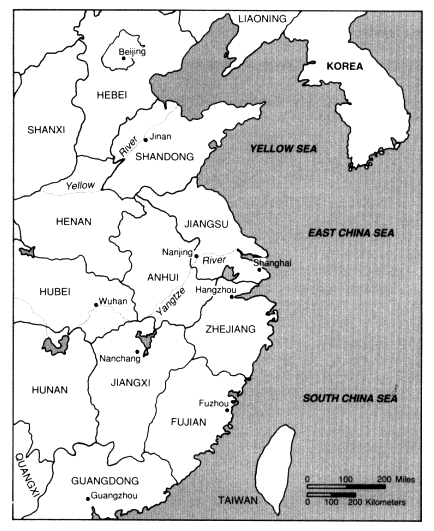
4. Coastal China in 1925
China powers—Britain, Japan, France, Italy, and the United States.[41] In addition, Chinese students, selected by the Control Committee of the Chinese Communist Party, were trained as Russian-speaking military officers and political workers at the Comintern-sponsored Communist University of the Working People of the East (KUTV) in Moscow. The first thirty of them arrived at the highly secret training center in the autumn of 1925; during the next two years over a thousand cadets would be trained. At the same time, Russian and other Soviet citizens were given training in
Chinese and other Asian languages by approximately 100 instructors of the university's Department of Asian Languages.[42] Thus, Soviet/Comintern involvement in the Chinese Nationalist Revolution was significant. Most important, Soviet military advisers in south China participated directly in planning and carrying out the Northern Expedition, the military campaign that extended the revolution from Guangdong Province into the Yangtze River basin of coastal central China in 1926-27. By the summer of 1925, Bliukher and his staff, working with GMD political and military authorities, had drawn up what he called "The Great Guomindang Military Plan,"[43] formally recommended the plan to Moscow, and urged financial assistance for it.[44]
To determine the value of Bliukher's plan, the Central Committee in Moscow appointed a secret commission to conduct an on-site inquiry in China in February-March 1926. The commission was headed by Andrei Bubnov, an early Bolshevik who had been a prominent Red Army staff officer during the Civil War and who directed the army's Central Political Administration and was a member of the Revolutionary Military Council. Its tasks were to study the work of the Soviet military missions in China, to assess the prospects of the Nationalist Revolution, and to make policy recommendations to the Central Committee. After hearing from an extensive list of Soviet representatives in both north and south China, including Borodin and Karakhan, the commission put the most optimistic possible interpretation on the information and opinion it had gathered[45] and recommended to the Central Committee that the requests of the GMD for military aid be met and that preparations be made for a military campaign to take place within six months.
In this way military advisers from the Red Army, political advisers from the Comintern, and cadres of the Chinese Communist Party were all committed to a massive revolutionary offensive. Never before or afterward did the leadership of the USSR risk assets on this scale in a revolutionary initiative extending beyond the protective umbrella that the forces of the Red Army could provide. Their decision to do so directly influenced the course of the Nationalist Revolution in China, the development of the Chinese Communist Party, the future of the international Communist movement, and the direction of Soviet high politics. How and why a decision of this historical magnitude was taken is one of the great "blank spots" of Soviet history.
What historical scholarship knows from evidence is that a Politburo special committee convened in February 1926 to review policy in East Asia did not recommend sponsoring a revolutionary military offensive in China. Chaired by Trotsky, the committee had as members—in addition to
Chicherin—Kliment Voroshilov, the chairman of the Revolutionary Military Council who would soon become people's commissar for military and naval affairs (1925-40), and Feliks Dzerzhinskii, head of the Cheka/GPU/OGPU (1917-26) and chairman of the Supreme Council of the National Economy (1924-26). The committee issued a report on March 25 entitled "Problems of Our Policy with Respect to China and Japan."[46] The analysis in the report was based on the axiom that the international situation had become more difficult and dangerous for the USSR, and for all opponents of imperialism, since the onset of capitalist stabilization. The immediate threat confronting them was the possible extension of Locarno (as they saw it) to Asia in the form of a British-led coalition of capitalist states directed against the Chinese Revolution. As a way of precluding an Asian Locarno, the report recommended a complex scheme of interrelated diplomacy and propaganda. The diplomatic task was to drive a wedge between the two primary imperialist powers in East Asia, Britain and Japan, and to prevent a renewed Anglo-Japanese alliance. That wedge would be formed by a tripartite pact among the USSR, China, and Japan. Tokyo would be attracted to this agreement by means of concessions in Manchuria that the Chinese government in Beijing would make to Japan. The Chinese government in turn would be persuaded to offer concessions to Japan because the CPC and the GMD would mobilize the articulate Chinese public in favor of such a policy through a propaganda campaign conducted in new journals of opinion, to be founded presumably with Comintern funds. The CPC and the GMD would be persuaded to mount this campaign by the argument that a Soviet-Chinese-Japanese diplomatic alignment would prolong the respite from imperialist intervention—something that was in the interests of both the Chinese and Russian revolutions.
Significantly, when the Politburo adopted the resolutions of the East Asian policy committee in early April, a statement submitted by Stalin was appended to them: "The Government at Guangzhou should in the present period decisively reject the thought of military operations of an offensive character, and generally any such actions as may provoke the imperialists to embark on military intervention." So, two months before it began, the collective leadership of the CPSU seems to have agreed to oppose a Northern Expedition. They envisaged instead a clearly defensive strategy, one that would utilize both propaganda and diplomacy to protect the revolution in China and, indirectly, the Russian Revolution as well. How then is the involvement of the Red Army and the Comintern in the Northern Expedition to be explained?
When Sun Yat-sen died in March 1925, he left behind two potential successors. One was Wang Jingwei, one of Sun's earliest followers and a
revolutionary hero. The other was Chiang Kai-shek, the pragmatic and nationalist-minded chief of staff of the National Revolutionary Army (NRA). Archival research indicates that Chiang always regarded the GMD's ties to the USSR as purely tactical. He was sharply critical of Sun Yat-sen's political rapprochement with Soviet Russia, although he was quite willing to accept military assistance in the struggle against the clique of warlords who supported the Beijing government.[47] Moreover, he resented members of the Soviet military mission in south China for their domineering attitudes, for their participation in what Chiang regarded as political matters, and for their control over the distribution of weapons and funds sent from the USSR. He suspected that one of them, Nikolai Kuibyshev, was conspiring with Wang Jingwei to abduct him and send him off to Russia. (Kuibyshev seems to have aroused Chiang's suspicions by dealing with Wang on military matters rather than with Chiang, who, he thought, was misappropriating funds.) On 20 March, at a time when both Borodin and Bliukher were absent from Guangzhou, Chiang launched a successful coup d'état, the results of which were manifold and far-reaching.[48] He removed Soviet advisers from politically significant positions within the NRA and deported those whom he found most objectionable. Wang went into temporary exile in France. Chiang's power was greatly enhanced. Within three months he was commander in chief of the NRA and had gained control over both the GMD Central Party Headquarters and the military, civil, and financial organs of the Nationalist government. And he saw to it that the position of influence and power held by the CPC as a "bloc within" the Guomindang was sharply curtailed.
The Soviet military and civilian advisers in Guangzhou were not forewarned of Chiang's coup; the CPC leadership was caught unawares; the Politburo and the ECCI Presidium in Moscow were taken by surprise. It took six weeks for them to recover fully and for the situation to be clarified as follows: First, in protracted and intense negotiations with Chiang, Borodin agreed to a sharp curtailment of the influence of the CPC within the councils of both the GMD and the NRA. Among the restrictions imposed on CPC activity, Communists would no longer head any of the bureaus at Guomindang Central Party Headquarters. At the same time, Borodin was able to use Soviet military assistance as a lever with which to limit the influence of the GMD right wing. On the same day that the Russian military mission turned over 8,000 rifles along with ammunition to the NRA, a prominent rightist politician was arrested.
Second, from within the Central Committee of the CPC there was renewed agitation in favor of abandoning the "bloc within" strategy and
withdrawing from the Guomindang and forming instead an interparty alliance of the two organizations. This move, its proponents argued, would enable the CPC to conduct an independent policy, to appeal directly to the urban and rural masses, and to arm the peasants of Guangdong—thereby providing the CPC with military forces to protect the party organization. When this proposal was discussed among the highest ranks of the CPSU collective leadership, Trotsky, according to his later statements, formally proposed the action. Zinoviev reportedly associated himself with Trotsky's position, thereby reversing his earlier stand. But apparently neither of them pressed the point and the "bloc within" strategy stood.[49] When the issue was fully resolved at a special Politburo session in May, Voitinskii was dispatched to China with specific instructions to correct the separatist tendency within the CPC.
Third, the leadership of the CPSU and of the Communist International agreed to support the long-anticipated Northern Expedition.[50] Borodin informed Chiang of this sometime in May, and Bliukher and his staff began to work on detailed plans for conducting the campaign. The supply of weapons from Russia, which had begun eighteen months earlier, increased rapidly. Chiang then acted quickly and launched the Northern Expedition on 1 June, apparently before Soviet advisers in Guangzhou and Beijing could agree either among themselves or with the Politburo and ECCI Presidium in Moscow regarding the timing and the objectives of the campaign.
These two decisions—(1) to arm Chiang Kai-shek and to support the Northern Expedition despite the coup d'état of 20 March and Chiang's evident intention to relegate the CPC to a weakened position within the nationalist movement, and (2) to instruct the CPC to remain a "bloc within" the Guomindang—set the China policy of the USSR on a disastrous course. Within little more than a year, the Soviet aid mission would be compelled to flee China as Chiang and the anti-Communist sector of the GMD decimated the CPC, destroyed its mass organizations, and ejected it from the Chinese nationalist movement.
The decision to arm Chiang did contain elements of rationality. Documentation from the Soviet military mission reveals that the advisers in Guangzhou favored continued support for Chiang because they regarded him as an authentic nationalist who would advance the global anti-imperialist struggle, and because they believed that they could exert decisive influence on him and, through him, direct the Chinese nationalist movement. In the aftermath of Chiang's coup, their intention, presumably one shared by Borodin as representative of the Comintern, was to concili-
ate Chiang by political concessions, to manipulate him through his vanity and lust for power, and to surround him with the political influence of the left wing of the GMD—of which the CPC was a significant component.[51]
For the decision to continue the "bloc within" strategy after Chiang had made evident his hostility to the CPC, Stalin and Bukharin have been blamed. When the disastrous consequences of the April-May 1926 decisions became obvious a year later, their China policy became the primary target of an attack launched by Trotsky, Zinoviev, and the United Opposition.[52] However, the responsibility of Stalin and Bukharin does not date from the decisions of April-May 1926, which were in fact taken by the Politburo and the ECCI Presidium without substantial opposition from Trotsky and Zinoviev. Rather, their responsibility is linked to the fact that the two of them held to this policy, as we shall see, not only through the spectacular military successes of the Northern Expedition in July-October 1926 but also through the equally spectacular defeats inflicted on the CPC in 1927. Why did they do so?
European and American scholarship has relied on two lines of argument.[53] One holds that the internal politics of the CPSU limited the policy alternatives available to Stalin and Bukharin. To wit, the most reasonable policy was to withdraw the CPC from the GMD and allow it to pursue an independent revolutionary strategy. This was the policy consistently advocated by a significant sector of the CPC leadership, including the founder and general secretary of the party, Chen Duxiu. However, this policy choice was politically unacceptable to Stalin and Bukharin because it was appropriated by Trotsky in the March to May 1926 period and then by the United Opposition as a whole from April through July 1927. According to this argument, Stalin was unable to "borrow" policies from his opponents for fear that doing so would disadvantage him in the struggle for leadership among Lenin's successors.
The second line of argument contends that Stalin would not have shifted course even if his policy choice had not been constrained by the leadership struggle. It asserts that the political strategies conceived by Lenin had a powerful and lasting influence on the political behavior of his successors, and on Stalin in particular. Lenin "taught" that the correct strategy for Communist parties in Asian anti-imperialist revolutions was support for the nationalist revolutionaries in "united fronts." From this revolutionary coalition, a "democratic dictatorship of the proletariat and peasantry" would emerge, and the proletariat would gain control of it. The "united front" would then terminate with the disposal of the non-Communist revolutionaries. In Stalin's words, Chiang Kai-shek would be used, "squeezed dry like a lemon, and then flung away."[54] In Stalin's narrow vision and rigid
thought, there were no alternatives to these Leninist precepts. Thus, this line of argument emphasizes Stalin's ideological obedience, his lack of political imagination, and the cautiousness of his strategic thinking. To these may be added a corollary developed in pre-1985 Soviet scholarship: During the Chinese Nationalist Revolution, as at other crucial junctures in Soviet foreign relations (most notably in 1941), Stalin engaged in "wishful thinking" that left Soviet foreign policy unable to adjust quickly to rapid changes in the international situation.[55]
However Soviet Russia's involvement in the conquest phase of the Chinese Nationalist Revolution was decided upon, it was initially rewarded. By October 1926, the NRA's expedition into central China was a military success, one in which Soviet military assistance played a significant role.[56] Bliukher and his staff planned the general strategy, and during the military campaign Chiang made no strategic decisions without consulting him. Fifty-eight Soviet military advisers, with a technical staff of eighteen, were attached to specific NRA units. They planned operations, oversaw their execution, and gathered intelligence. Sometimes they led attacks. Soviet pilots acted as scouts, terrorized enemy troops, and dropped bombs on tactical targets. The flow of supplies and equipment from the USSR increased once the Northern Expedition was under way. By August, six Soviet ships traveled regularly from Vladivostok to Guangzhou loaded with oil, large and small arms, and disassembled aircraft. CPC political commissars accompanied the Nationalist armies; Zhou Enlei was attached to the elite First Division of the First National Republican Army. And CPC organizers followed the troops, founding farmers' organizations in the countryside and reorganizing labor unions in the cities.
The ECCI celebrated the victories in China at its Seventh Plenum in December 1926. In the words of the "Resolution on the China Question" adopted there, the Northern Expedition had "effectively wiped out imperialist rule from half of China" and brought the Chinese Revolution close to the point at which the proletariat, led by the Chinese Communist Party, could take control of it.[57] The CPC was instructed not only to remain a "bloc within" the GMD, but also to enter the Nationalist government, which, the resolution maintained, contained the nucleus of a revolutionary democratic dictatorship of the proletariat, the peasantry, and the petty bourgeoisie. The primary task of the CPC was specified as leading the GMD and the Nationalist government leftward to a radical agrarian program in the newly liberated areas, a program that included arming the poor and middle peasantry and confiscating the land holdings of the warlords, the temples, and those gentry who opposed the revolution. The success of the revolution in China depended on this program, the resolution con-
cluded, and only the CPC could initiate it. European and American scholars have condemned these instructions as unimplementable and self-contradictory.[58] In response, the leading official specialist during the Brezhnev era on the Asian policy of the Comintern defended them as reasonable, flexible, and empirically based.[59] Subsequent research in archival Chinese sources has demonstrated that they undermined the efforts of Chen Duxiu to unify the CPC at the very moment he was on the verge of success.[60]
Scholars of all political persuasions have conventionally understood that it was at the Seventh ECCI Plenum that the definitive Stalin-Bukharin China policy was formulated, pronounced, and imposed on the CPC. By this time the leadership of the United Opposition had been removed from all important offices in the government, the party, and the Comintern. In particular, Zinoviev had been removed as president of the ECCI in October and the office then abolished by Comintern resolution. In his place, Bukharin gave the opening address to the Seventh Plenum and reported that, despite capitalist stabilization, the world revolutionary process was moving forward along three paths—in Russia, in England, and in China. Three sessions of the plenum were set aside for discussion of the Chinese question. Stalin, who openly participated in the workings of the CI for the first time, delivered an address to the China commission in which he attempted to set out in theoretical terms the strategies then in operation in China.[61] As conventionally understood, "The Resolution on the China Question" was the result of Stalin's decisive intervention, one that went without challenge from within the plenum.
This long-held belief was modified by research done in Soviet archives during perestroika .[62] An investigation of the transcript of the proceedings of the plenum contained in the CPSU Central Archives reveals that considerable and heated debate on the issue of agrarian revolution in China took place. The resolution itself—the immediate authorship of which was previously attributed by some sources to Bubnov, Raskolnikov, and Voitinskii and by others to Pavel Mif, the Comintern expert on East Asian revolutionary movements, or to Bukharin and Roy[63] —was actually formulated through the efforts of members of the CPC delegation to the ECCI Plenum, who were aided by Roy and Raskolnikov, both members of the CI Commission on China, and by William Gallacher, Dmitrii Manuilskii, and Sen Katayama, all members of the ECCI Presidium. Stalin's particular contribution to the deliberations was a proposal to add to the resolution a statement singling out the special role played by military conquest in the successes of the Chinese Revolution. This proposal was sharply criticized, and it was not incorporated in the resolution. Both Stalin and the ECCI
were thereby spared additional severe embarrassment when Chiang Kai-shek's allies deployed their armies against the CPC from April to July 1927.
A New Direction for Soviet Foreign Policy?
As "the world revolutionary process" progressed in China during the second half of 1926, no successes of similar magnitude could be credited to Soviet diplomacy in Europe. It was clear that the major capitalist powers would regulate their international relations without Soviet participation; it even seemed that their Dawes-Locarno relationships might well survive what were perceived in CPSU and Comintern resolutions to be their inherent contradictions. In the NKID, Litvinov and Chicherin did gloat considerably when Germany's admission to the League of Nations was delayed in April while a seat on the League Council was arranged for Poland. The anti-Soviet coalition that Chamberlain had tried to construct, they announced, had collapsed from its own internal contradictions. "Instead of the firm international structure in which Germany hoped to find its corner," Chicherin stated, "there is nothing but a heap of ruins."[64] Nevertheless, Stresemann's relations with Chamberlain and Briand survived the League Council crisis, and when Germany did join the League in September, Briand celebrated the event with a speech before the League Assembly proclaiming the rapprochement with Germany as the basis for world peace.
Meanwhile the last best hope for renormalizing relations with the Conservative government in England was lost. Following the aid given to British strikers in May, the demands of the diehards grew louder, and the Foreign Office made clear to the NKID that little could be done to improve Anglo-Soviet relations. In Paris, the return of Poincaré to office in July doomed any hope of a debt/loan agreement with France—to say nothing of a more comprehensive Franco-Soviet rapprochement. The strategy of walking westward over the German bridge, shored up by the Berlin Treaty in April, had produced few results. Rakovskii, who served in the diplomatic front lines as chargé in London and polpred in Paris, decided that the USSR was compelled to practice what he called a policy of "super-isolation."[65] The NKID did not adopt this policy, however. To the contrary, Soviet diplomacy constructed a set of bilateral neutrality and nonaggression treaties on the European and Asian frontiers of the USSR. And it undertook other significant initiatives as well, including a foreign trade offensive, a policy of participation in organizations of multilateral international cooperation, and a renewed pursuit of agreements with Europe and America.
These initiatives were a significant departure in Soviet foreign relations. In 1924 it had been assumed that, once normal diplomatic contacts had been established with the major capitalist powers, a breakthrough to debt settlements and long-term credits would follow as a matter of course, and that a far-reaching rapprochement between Russia and Europe and America would result. The policy of 1926 was more complicated. The first step was to contact representatives of European and American business and government and to convince them that the USSR was involved in a process of stable political and economic development. As this was acknowledged, economic relations (trade based on credits as well as on cash payments) would expand. Trade would in turn provide the basis for increasingly friendly political relations, and Soviet isolation would diminish.[66]
In their efforts to convince Europeans and Americans of the political and economic stability of the USSR, Soviet diplomacy had several instruments at its disposal. One was the image of Stalin that European diplomats in Moscow sent back to their governments. This depicted Stalin as the emerging leader of an increasingly stable USSR, as a strong, quiet, moderate, pragmatic politician, in contrast to Trotsky and, even more so, Zinoviev, who were identified in European and American diplomatic circles with policies of revolutionary excess.
A second instrument was participation in the organizations and agreements of multilateral international cooperation. In the aftermath of Locarno, the Soviet government agreed to join in the preparations for the World Disarmament Conference to be held in Geneva under the auspices of the League of Nations. [67] It did so without formally abandoning its objections to the League or its refusal to join the organization in its current form. The reason is patent. The USSR could not afford the intensified isolation that would have resulted from remaining outside the deliberations on disarmament while European security negotiations had concluded successfully at Locarno and Germany joined the League of Nations. However, three sessions of the League's Preparatory Commission on Disarmament were held beginning in May 1926 without the participation of the USSR. The Soviet government refused to send delegates to a conference in Switzerland until the Swiss government expressed its regret over the May 1923 assassination of Waclaw Vorovskii, secretary general to the Soviet delegation at the Lausanne Conference, and made pecuniary compensation to his daughter International diplomatic pressure on Bern brought a settlement of the question in April 1927, although the USSR and Switzerland did not restore diplomatic relations until 1946.[68] The USSR then participated in the World Economic Conference in Geneva in May and dispatched a Soviet delegation headed by Litvinov to the Preparatory Dis-
armament Commission the following November. The delegations to both conferences were instructed to take on as one of their primary functions the development of intensive personal contacts with Western governmental, diplomatic, and business representatives and to impress on them the political and economic stability of the Soviet system and the possibilities for mutually beneficial economic exchange. Sokolnikov represented the USSR at the economic conference, where he called for "peaceful coexistence between the two economic systems"—to the applause of the other delegations, "even the English," as one Swiss newspaper observed.[69] His most important work took place outside the conference hall, however, where, according to one observer, the Soviet delegation was "too busy ... obtaining loans and factory equipment to worry about the progress of world revolution."[70]
The third instrument was expanded trade. To improve commercial, financial, and political relations with the industrialized nations, the Soviets launched a trade offensive in September-October 1926, placing orders for machinery and other producer goods with companies in the United States, Britain, and elsewhere. It was as part of this offensive that Soviet diplomatic and trade representatives undertook the campaign to convince their Western counterparts that the Soviet political system was stable, that the economy was sound, and that the growth of their own economies depended on trade with the USSR. The political purposes of the trade offensive were well defined. In Britain, for example, it was intended to control the damage inflicted on Anglo-Soviet relations by Russian intervention in the General Strike. By convincing trading and banking circles in London of the value of economic relations with the USSR, the Soviets hoped that these circles would in turn influence the Foreign Office and the Cabinet toward a policy more favorable to the Soviet Union.[71] Thus, more extensive economic relations were to provide the basis for improved political relations.
What place did the Rapallo-Berlin relationship with Germany occupy in this new world of gradually improving economic and political relations with Europe and America? Since 1922 the NKID had used relations with Germany both to set the pace of relations with the other European states and as a model for those relations. Relations with Germany had in actuality developed more fully than those with any other country, and in 1926 Germany became the USSR's primary creditor. As a result of the Soviet-German Commercial Treaty of October 1925, the leading German banks granted the USSR a credit of 100 million marks, and in March 1926, as the Berlin Treaty was being concluded, the German Ministry of Economics announced a credit of 300 million marks for the purchase of locomotives, tractors, heavy machinery, and machine tools; 35 percent of the loan was
guaranteed against default by the German government, 25 percent by German banks, and 40 percent by manufacturers interested in the market for machinery in Russia. The funds for the loan originated with American lenders, primarily Dillon, Read, and Company, and were transferred through the Reichsbank and administered by the Ministry of Economics.[72] These were short-term, revolving credits; long-term loans were negotiated in 1930-31 by the German ambassador at that time, Herbert von Dirksen.
However, the conditions in which the diplomatic and economic interdependence of the Rapallo relationship had first developed no longer existed. The German rapprochement with Britain and France culminated in September with Germany's entry into the League of Nations and a celebratory speech by Briand. Almost immediately thereafter, he and Stresemann held a private luncheon meeting in the French countryside adjacent to Geneva. The exact content of their discussion was kept secret, but the event was highly publicized, and there was much speculation in the press that all the differences outstanding in German relations with France were about to be negotiated away.[73] At the same time, the economic policy of the USSR was transformed from one designed to promote recovery from the World War and the Civil War to one aimed at the industrialization of the country. The capital and technology requirements of the Soviet economy increased accordingly; German financial institutions were even less capable than they had been previously of fully satisfying those requirements; expanded trade with the United States, Britain, and other countries was necessary. As a consequence of these developments, the value of the Rapallo "special relationship" to German diplomacy and to the Soviet economy declined sharply.
The Wilhelmstrasse welcomed the end of Soviet dependence. So long as Soviet relations with Europe rested almost exclusively on Germany, Berlin ran the risk of becoming deeply entangled in almost any foreign conflict in which the USSR became involved. This complicated Stresemann's strategy of Westorientierung und Ostpolitik by posing the possibility that at some point Berlin might have to choose between London and Moscow and side with one against the other. The Foreign Ministry's policy response—the "Schlesinger line"—was devised by Moritz Schlesinger and approved by State Secretary von Schubert in July 1926. The resources of German diplomacy would be deployed when and where necessary in order to restrain the USSR from confrontation with other powers and to foster and strengthen Soviet economic ties with Europe and America. To this end, Germany would sponsor and direct the reintegration of the USSR into the world economy—and reap the diplomatic influence and international status that would come from doing so. In this manner, the Soviet-German rela-
tionship became what one historian has called "a potential force for European peace."[74]
One scheme devised on the Wilhelmstrasse, which apparently had the blessing of President Coolidge, was expected to work in this way: Private American loans to the USSR, perhaps guaranteed by the German government, would be used to purchase American cotton and the products of German industry, and the resulting German payments surplus would be allocated to a reduction in Berlin's reparations obligations. Another proposal would have made Germany the head of a German-American-French-Dutch investment group formed to make loans to Russia. Then, the Wilhelmstrasse calculated, as the interests of the other states became merged with those of Germany in an involvement in the Soviet economy, potentially dangerous confrontations between Russia and the West would become less likely. The place of the USSR in the world political economy would be stabilized and enhanced; ties between Moscow and Berlin would become less of a liability to Germany; and the position of Russia's German sponsor in world politics would be accordingly enhanced and strengthened. The danger that the USSR would enter into alignments and alliances unfavorable to Berlin as it emerged from economic and political isolation—perhaps resulting in Germany's own relative isolation—would be obviated by Germany's role as coordinator of the Soviet Union's expanding trade relations.[75]
In December 1926, the Politburo gave its formal approval to the policy aimed at improving relations with the industrialized capitalist states and to the decision to conclude agreements with them. In internal documents this policy may have been called politika dogovorennost , "the politics of understanding."[76] Although it was directed at improving relations with the United States, Britain, and France, as well as with Germany, official government statements referred less specifically to "the establishment and reinforcement of friendly relations with foreign states,"[77] thereby making the policy less vulnerable to the accusation that it constituted a rapprochement with the enemy. In a statement issued in Berlin and published in Izvestiia on 8 December, Chicherin characterized it as "the gradual improvement and consolidation of our relations with other countries.[78]
Gradualism was the crucial new ingredient in Soviet foreign relations. Adoption of a policy of gradually developing mutual understanding indicated an abandonment of the expectations of 1924 that comprehensive settlements with the world powers would follow rapidly upon the establishment of diplomatic relations. Instead, piecemeal agreements would be concluded with them and relations of confidence would develop gradually as socialism evolved in the USSR. Soviet foreign policy in the post-Locarno
era had a common basis with the strategy of internal development adopted during the era of "socialism in one country." Both were premised on the belief that socialism would be constructed peacefully and gradually out of the conditions of NEE
The adoption of politika dogovorennost coincided with a dramatic change in the composition of the policy-deciding bodies of the CPSU. In response to the emerging Stalin-Bukharin alliance and to the doctrines of economic development and foreign relations that the two of them propounded, Trotsky, Zinoviev, and Kamenev formed a United Opposition in April 1926. When they failed to convert the leadership to their position, they suffered the political consequences. In October, Trotsky was expelled from the Central Committee and the Politburo. At the same time, Kamenev lost his candidate membership on the Politburo and was compelled to surrender control of the Moscow party organization, although he remained a member of the Central Committee and was appointed polpred to Italy. The other opponent of "socialism in one country," Zinoviev, who had lost his position on the Politburo the previous July, was dropped from the Central Committee along with Trotsky and surrendered control of the Leningrad party organization. He was also relieved of all Comintern duties, including the presidency of the ECCI. At the Seventh Plenum in November-December, Kamenev was dropped as a delegate and addressed the body for the last time. The office of president was abolished, and Bukharin took over leadership of the Communist International.[79] The spokesmen for the majority that emerged on the Central Committee and in the ECCI with the forced retreat of the Opposition were Stalin, Bukharin, and Rykov. And it was they who assumed responsibility in late 1926 for the foreign relations of "socialism in one country," including the politics of understanding.
The latter had strong implications for the Rapallo-based "special relationship" with Germany. As a common approach to all industrialized capitalist countries, the policy of understanding had two corollaries: (1) that Soviet foreign relations would no longer depend primarily on Germany as the USSR's channel to Europe and as the pacesetter and model for relations with other European states; and (2) that favorable relations with the United States, Britain, and France were to be cultivated with less consideration for the relationship with Germany. Thus it represented a crucial turn in Soviet foreign relations, a new policy course. Not wanting to make Russian economic development dependent on German intercession with the other powers, the Soviet government rejected the schemes for German-organized investment consortiums advanced by Berlin.
Moreover, the policy of understanding contained within it the embryo of a still more fundamental shift away from the established precepts of
Bolshevik foreign relations. Downgrading the relationship with Germany and including all capitalist states in a single policy initiative suggested that Soviet diplomacy would depart from the practice of exploiting the contradictions between the victors of the war on the one hand and Germany on the other This constituted a departure from one of the axioms of Leninist foreign policy—that the antagonisms inherent in the peace settlement could be counted on to advance both Soviet security and "the world revolutionary process." It also directly contradicted the 1925 version of "the catastrophic premise" expressed in the Political Report of the Central Committee to the Fourteenth Party Congress—that the Dawes Plan would bring revolution to Germany, that Locarno would bring war to Europe, and that proletarian revolution would emerge victorious.
There is some basis for hypothesizing that an alternative foreign policy was being advanced in late 1926 and early 1927. At the Seventh ECCI Plenum in November-December, Bukharin suggested that "a new war between the imperialist powers in Europe" would have destructive effects greater than those of 1914-18 for the entire Continent, the USSR, and the international Communist movement. At the same time, he denied the existence of "a real revolutionary situation" in Germany and stated that Germany was the one power in Europe most likely to increase the international tensions that would lead to another world war. It was time, he stated, for both the government of the USSR and the Comintern to abandon their policies of support for the defeated powers and instead to promote a program of security guarantees aimed at achieving a "real world-wide peace."[80] In this call for a reorientation of the foreign relations conducted by the USSR and the ECCI, Bukharin moved Germany conceptually from the ranks of the victims of imperialism to one of its representatives. When he then did so explicitly at the Moscow Party Conference in January, the German Foreign Ministry lodged a protest in Moscow, and Chicherin, in a letter addressed to Stalin and Rykov, sharply criticized Bukharin's statement as damaging to Soviet-German relations.[81]
Thus, in addition to a new course for Soviet diplomacy, rudiments of an alternative set of foreign relations for the ECCI and for the USSR seem to have existed in late 1926. Central to these relations were the questions whether a second imperialist war was the necessary cause of proletarian revolution in Europe and of the final victory of socialism, and whether Soviet security was to be premised on a perpetual antagonism among the capitalist nations. These questions, together with the announced willingness of the government to participate in multilateral international organizations and agreements, formed the basis for a possible whole new direction in Soviet foreign policy. However, this was not the only concept of
foreign relations propounded in late 1926; nor was it the dominant one. The official foreign policy concept of the ECCI and of the Central Committee majority differed significantly. The resolutions and theses of both these organizations regarded the revolution in China as the harbinger of "a new era of wars and revolutions" and as the portent of the end of "the temporary stabilization of capitalism." Stalin meanwhile developed his own personal variant of the party line, one that contrasted sharply with Bukharin's. It counted heavily on contradictions among the capitalist states and foresaw a new war "in a few years time." With this, Chicherin disagreed, denying to the Fourteenth Party Congress that war was in sight.
So by late 1926 the intentions of Bolshevik foreign policy had become diverse, complex, and in some cases contradictory. The Communist International was supposed to preserve its identity as the organization of international proletarian revolution while coordinating its stands with the requirements of Soviet national security. The Chinese Communist Party was to remain a vulnerable "bloc within" an increasingly menacing Guomindang, which was in turn advised and armed by Russians. The cause of the nationalist authoritarian modernizers of southwest Asia was to be promoted with the expectation that they would resist imperialist penetration on the southern rim of the USSR, and with the knowledge that they would extinguish domestic Communism. At a time of military unpreparedness and relative diplomatic isolation, the construction of socialism in Russia was to be protected by the protests of working-class organizations in Europe against capitalist intervention. The persistent exclusion of the USSR from the councils of the world powers was to be overcome by demonstrating the economic and political stability of the country and the willingness of the Soviet government to participate in the organizations and agreements of multilateral international cooperation.
Perhaps the most crucial contradiction was the simultaneous hope for improved relations with Great Britain, the United States, and Japan on the one hand and the effort to undermine their position in China on the other In a search for economic agreements with Europe and America, Soviet foreign policy depended on the stability and prosperity that these countries were achieving within the Locarno security system with its underpinning of American loans. At the same time, the Soviet regime directly and immediately threatened international stability, if no longer in Europe or Islamic Asia then certainly in support of the Nationalist Revolution in China. Chicherin recognized the difficulties that involvement in the "anti-imperialist struggle" in Asia created for the quest for "peaceful coexistence" with the capitalist powers. He had stated them clearly in 1924:
In our world policy there exists an extremely difficult question. There is a difference in attitude on our side to the West and the East. Our goals, both economic and political, are formulated in different ways in the East and West. The West however, watches what we are doing in the East. We can not act in the East without regard for our actions in the West. How can this problem be resolved?[82]
The crisis of 1927 would demonstrate just how critical the problem was and how difficult it was to resolve.