
Throwing Cable Over the Derrick
Naturally, the whole object of securing leases was to drill wells that produced oil. Drilling attracted a second classical character of the industry — the oil driller. As in the United States, drilling was accomplished on several legal bases. The large firms hired North American drillers, nearly all of whom had prior experience on a monthly salary. Usually these drillers were also given opportunities to share a percentage of the production. Many drillers served as wildcatters, working purely on the speculation that a property in which they had some financial interest, or for which they worked without a wage, would yield production. This could be very risky. Most wells — probably 75 percent — were dry holes. But wildcatters might also gain great individual wealth. Much of the drilling work in Mexico, like growing carrots, was seasonal. Rigging and equipment could be moved easily only during the dry season. From June to September, the rains prevented mules, horses, and the five- and ten-ton Caterpillar tractors from hauling the equipment over the muddy roads.[26] The Mexican oil boom occupied many drillers, all foreigners. Few Mexican workers ever participated in this aspect of the business. The technology was alien to them, known only to the American or European drillers, who were loath to transfer it to any Mexican.
The drilling crews in Mexico had come down from East Texas. These Texans, Oklahomans, and Midwesterners had learned their craft from the Pennsylvanians, who had taught the oil industry to others around Beaumont and Corsicana. They behaved very much as they had in East Texas, except in coping with the enormous gas pressures of the Tamasopo limestone. That required some innovations. W.M. Hudson, who in 1906 had come to Tampico with some farmers from Llano, recognized this element of danger in Mexico. He and a partner had bought the Santa Fe Ranch, which had twenty-one kilometers of frontage on the Pánuco River at Topila Estero. Having witnessed the Dos Bocas blowout from afar, Hudson knew that the gas pressure in the limestone formation was ferocious.
Shortly after Potrero del Llano had come in, Waters-Pierce agents from the refinery at Tampico came to lease Santa Fe, forty miles upriver. As owner, Hudson was to receive 20 percent of production. "We'll agree in this contract to drill as many as three wells," the Pierce agent told Hudson. "If it's oil, we'll punch the ground full of holes."
They drilled the wells with standard percussion tools, the rig having been hauled up the Pánuco River on a barge. At two thousand feet, the sudden release of gas in the well blew the drill stem out through the derrick. A shower of rocks then followed from the well casing. Within five minutes, the rocks destroyed the timbers 110 feet atop the derrick and oil began to flow out at a rate of 17,000 bd. The manager had a dam placed across a creek below the well, and the flow of crude collected in this makeshift earthen reservoir. Hudson later inspected the rocks that had been blown out through the well. They looked like "creek boulders," round and smooth but coated with asphalt. Almost all the rocks were larger than the diameter of the pipe out of which they had passed! Hudson and two partners made about $25,000 apiece in selling their well to Pierce.[27]
When Pierce took over Santa Fe, they brought in Clinton D. Martin. Martin had dropped out of college, where he had acquired little scientific education to begin with, and entered the oil business in 1901 in Kansas. In the next twelve years, Martin worked for a pipeline company and three different refining firms. Then he came to Mexico for the Compañía Mexicana de Combustibles, Waters-Pierce's new production company. As soon as Pierce took over the Santa Fe wells, however, they all went to salt water. Martin eventually drifted out of Mexico and returned home.[28]
El Aguila had obtained some of its early drillers from the European oil fields. E.J. Nicklos learned his trade as a teenager in Galicia, a part of the Austro-Hungarian empire, in the 1890s. His father had helped build a refinery. As a young student, Nicklos broke into the business by rolling barrels around the refinery's yard. In 1907, he was hired through the auspices of the Pearson's business office in London. His crew consisted of Canadian drillers and an English bookkeeper and carpenter. They used the Canadian pole-tooled derricks, which operated on the same principle as cable tools except that the drill was suspended on iron rods instead of cables. Little scientific knowledge was involved in site selection. Dr. Orchesky, a geologist with experience in Galicia, directed the crews to drill near the oil seepages. The Pearson group set Nicklos to drilling with two rigs in Chiapas. He gathered together an eighty-man Mexican crew to drag a forty-horsepower boiler through the rain forest, hacking away the foliage with machetes as they went. Guy wires held up the smokestacks. He struck oil at five hundred feet, but it was no gusher. About 120 bd flowed gently through the ten-inch casing and slowed considerably after several days. The creek into which
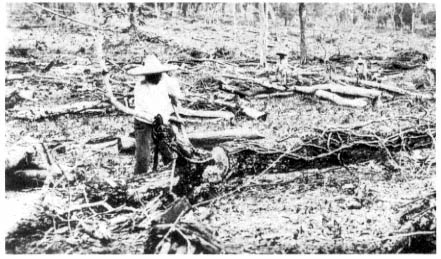
Fig. 6.
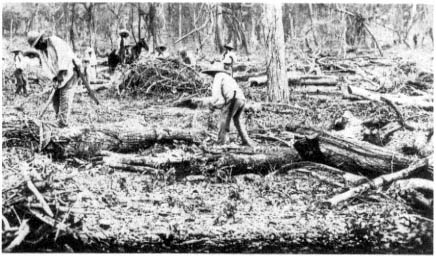
Preparation of an oil drilling site, c. 1913. Mexican workers clear the dense rain-forest
vegetation of the Golden Lane in preparation for well drilling. from the Eberstadt Photo
Collection, courtesy of the Barker Texas History Center at the University of Texas.
it flowed was dammed up, and the crude set afire so it would not seep into a nearby village. The Pearson group could not find enough crude in Chiapas to justify pipelines, storage tanks, and export terminals.
Nicklos later moved to Tampico, where he performed some drilling for the Shell Company of Corona, formed in 1912. "I got some [cable] tools together and started contracting," he reminisced. Corona gave Nicklos one-half interest in the wells that he brought in near Pánuco. There the gas pressure continued to present the drillers with problems and dangers. Nicklos recalls bringing in a well in 1920:
[A]s soon as you'd hit . . . the oil, why, the water would start coming out first and the oil was behind it. Well, as soon as the water started boiling over we'd start getting the tools out as quick as we could, but we never did get them out all the way. The last three or four hundred feet of the cable was thrown right back over the top of the derrick, then land, perhaps a hundred, two hundred feet away from the hole. But we had all of our steel and iron and everything covered up with big heavy logs or timber or planks and also the gate valves, so that if the tools did come and happen to hit then wouldn't set off a spark and . . . [start] a fire.[29]
In December of 1921, Nicklos pulled out of Mexico and deposited his considerable earnings in the Houston National Bank.[30]
These early drillers later learned to cope with the extraordinary gas pressure. During drilling, they set the heavy casings in concrete cellars with elaborate tubing configurations beneath the derrick floor. Thus, the drillers could pinch back the well almost immediately after the oil was struck.[31] When the well was flowing, the crews separated the gas from the crude oil. Huasteca's veteran geologist, Ezequiel Ordóñez, in 1932 estimated that the oil companies had vented or flared a total of one billion cubic feet of gas from the wells of Mexico during three decades of oil production. Very little gas was used beyond the energy needs of the isolated oil camps. A gas pipeline to Mexico City's urban population could have been five hundred kilometers long just to negotiate the passes of the Sierra Oriental. At one of Doheny's big wells, a tube was attached to the well head, separating the gas from the crude and shunting it to a nearby hilltop, where it was flared. The torch at this site burned continuously for ten years.[32]
Among the drillers and field personnel who worked for competing companies, there was great camaraderie. They lent each other fishing tools to get the drilling tools out of the wells. Another drilling contractor once lent Nicklos a boiler in Pánuco until another drilling rig could be shipped out from Tampico. The cooperation extended to the geologists as well. Everette DeGolyer, who had become the head geologist for El Aguila, collected extensive records of the activities of other com-
panies. He even had copies of their well logs and drilling records.[33] DeGolyer traded information with others. The fact that C. Willard Hayes and DeGolyer were employed by El Aguila did not prevent them from sharing their knowledge and experiences with geologists like Stanford University's Ralph Arnold and V.R. Garfías and others, like Mr. Cummings, who was employed by East Coast Oil.[34]
Some drillers attempted to wildcat on their own accounts. Although it remained speculative, drilling did have a certain logic. "Drilling, in practically every case, has shown that no commercially productive well has been drilled farther than 1/4 mile distant from some sort of surface evidence, such as seepages, asphalt deposits, or gas emanations," explained Arnold, "and in many instances negative results have been obtained much nearer than this to good surface indications."[35] Outside of these areas, drilling would be more or less hit or miss, usually miss. Drillers and geologists located wells by "walking or going over the country and noticing the general contour and the surface layout."[36] As yet, no one used sophisticated instruments to find oil.
The many wildcat drillers who failed did not leave a record of it. A few who did strike it rich wrote about it later. Mordelo L. Vincent told of his successful drilling at Tepetate in 1914. There he and a partner had discovered an important oil field, but the blowout had forced the casing back up through part of the derrick and a plume of oil and gas roared out. Vincent's inexperienced crew fought unsuccessfully for days to place a valve on the runaway well. Finally, an agent for Gulf Oil arrived. "I know the spot you are in," he told the partners, "and I know you can trade if you want to. Gulf Oil is prepared to give you one million smackers for this lease, plus 33 1/3 royalty, and we will move our experienced crews in here, plug this wild bastard, and drill another well right beside it." "Shake hands with a millionaire," replied Vincent.[37] Some of these oilmen, like Vincent and Nicklos, left Mexico wealthy and others, penniless. Yet, together they developed the Mexican oil industry during the great boom much as they and their peers had accomplished in Pennsylvania, Ohio, Illinois, California, Texas, and Oklahoma.
Along the coastal plain from Chiapas to the Pánuco River, these men set down more than seven hundred oil wells during the great Mexican oil boom. One-half of those wells produced crude petroleum in commercial quantities.[38] Despite the large number of producing wells, Mexico's major production was really taken from a small number of prolific wells. They had been drilled to depths of between 1,700 and 3,000 feet, at which point the men would stop if the well flowed to salt
water or nothing at all. The producing wells were allowed to flow of their own pressure, without pumping. In 1914, for example, most producing wells were yielding from 15 to 200 bd. Every company relied upon one or two great wells. El Aguila had Potrero del Llano No. 4, which ran 37,000 bd; and Alazán No. 4, yielding 17,000 bd. Huasteca had Juan Casiano No. 7, flowing at 12,000 bd.[39] Wildcat drillers working speculatively on their own accounts merely rounded out production. They were hoping to drill a well that could be sold to the bigger companies or to find that one "gusher," against all odds, that would make them a big company. It had been the same in U.S. oil booms.