
Town Building and Industrial Diversification
In 1853 James Blakely, with the help of local resident and surveyor Luther White, laid out the town of Brownsville on his claim along the banks of the Calapooia where the stream flows out onto the plains of the Willamette Valley. Blakely named the village in honor of his uncle and nearby settler, Hugh Brown, who had established a small store in the vicinity as early as 1849–50.[32] Modified and refined expressions of residents' attitudes about landscape and the environment are detectable in the founding and growth of this and other early Calapooia towns.
In 1859 the partnership of Brown, Blakely, James McHargue, and Robert A. Johns established Brownsville's first manufactory, a flour mill. The mill needed a water race. But because a minor heir of Eliza Spalding held the title to the best property for the race, the mill partners had to request special permission from the territorial government to purchase a right-of-way. Forty-three locals signed the petition. In their supplication, they pointed out that "the erection of extensive flouring mills and other machinery in the vicinity . . . [is] needed to promote the public convenience, and develop the resources of an extensive agricultural region." The petitioners sweetened the prospect when they implied that such improvements would tend to "enhance the value of said lands." In this instance, the first establishment of manufacture in Brownsville, local citizens suggested that the needs of their community—especially public convenience—would be best met by using the landscape for industrial purposes. At the same time, such use would result in further development of the local economy. Once constructed, the millrace itself would impart value back to the landscape. To a degree, this prospect did indeed come to pass, and the millrace eventually powered the industrial center of Brownsville.[33]
This first manufacturing establishment on the Calapooia was promoted by a group of Brownsville residents who continued to influence development of the town over the next few decades. In 1860, a year after the establishment of the flour mill, the population of Brownsville had already reached ninety-nine. On 24 November of that year, residents R. H. Crawford, Timothy Riggs, William T. Templeton, E. M. Griffin, and Joseph Hamilton put their heads and money together with the intention of creating a new industry for Brownsville: a woolen mill. The woolen mill had great economic potential. County-fair promotion and especially national demand during the cotton shortages engendered by the Civil War stimulated the growth of the woolen industry in the Willamette during the 1860s. In 1865, Linn County yielded 132, 148 pounds of wool, making it the leading producer among Willamette Valley counties. Brownsville entrepreneurs, in hopes of an increasing national demand, incorporated the Linn County Woolen Mills, contracting with the McHargue flour mill for fourteen horsepower of water from its race. By the spring of 1860 they had constructed buildings on the north bank of the Calapooia, but they did not receive looms, carding machines, and spinners (shipped from New Jersey) until 5 June 1863. Although the Linn County Woolen Mills burned down on 29 March
1865, the local directorship of Hugh Brown, William Kirk, Arnold Bassett, Hugh Dinwiddie, and E. E. Wheeler opened the newly organized Eagle Woolen Mills one year later. In August 1866 the mill employed fifty people, produced five hundred yards of cloth a day, and paid wages of about $50,000 a year. Because of litigation and economic difficulties, the Eagle Woolen Mills closed at the end of 1868.[34]
The woolen mill reopened in 1873, and the town continued to grow. By 1880 its population had reached 450. In the middle of the decade the gristmill, valued at $15,000, produced 150 barrels of flour a day. A sash and door factory (figure 4), valued at $8,000, turned out 500,000 board feet of lumber annually. The woolen mill had a value of $75,000, worked 9,500 pounds of wool monthly, employed twenty-six, and had an additional tailor shop with twelve workers. Other commercial interests included a picture gallery, two furniture stores, a notions dealer, and several professional offices for physicians and attorneys. Brownsville's growth, while slow, continued through the end of the century. In 1890 its population reached 580, and in 1900, 698.[35]
Established as the first town on the Calapooia, Brownsville remained the largest and most important in the valley proper through the nineteenth century, but it had competition. In 1850 the Reverend Wilson Blain founded on his claim the town of Union Point, named for the United Presbyterian Church he had already established there. Blain originally hoped to develop Union Point into a cultural center based on the territorially commissioned academy he headed. During the 1850s the town included some small commercial establishments—a blacksmith, a gunsmith, and a store—but Union Point never succeeded, partly because no major source of waterpower flowed through it. The academy closed in 1857, and citizens had part of the town plat legally vacated in 1858.[36]
The history of another Calapooia town, Crawfordsville, differed from Union Point. Just upstream from Richard Finley's gristmill, where Brush Creek flows into the Calapooia, Philemon Vawter Crawford laid out the town of Crawfordsville on properties he acquired in about 1869. Crawford built a sawmill and carding mill, both powered by water drawn from Brush Creek, but Crawfordsville remained not much more than a hamlet. In 1880 its population reached fifty-eight, and according to the immigration agent's report in 1887, the town had "two harness and saddle shops, two blacksmith shops, one ax manufactory, one planing mill, two dry goods stores, one boot and shoe shop, one drug store, one tannery and one hotel."[37]
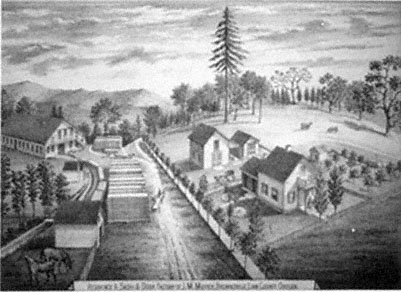
Figure 4.
John M. Moyer's sash and door factory, 1878. Moyer purchased this sash and
door factory in Brownsville in 1863. Note the millrace leading into the factory
along the left side of the picture.
Source: Illustrated Historical Atlas Map of Marion and Linn Counties, Oregon .
Located well into the forested foothills of the Cascade Mountains, Crawfordsville depended principally on the lumber industry, which fed primarily a local market. Small water-powered sash-frame mills such as Richard Finley's, P. V. Crawford's, and Timothy Rigg's existed on the upper Calapooia and Brush Creek as early as the 1850s. By the 1870s larger mills had made their appearance. David Allingham's forty horsepower steam mill, the largest, had a capital investment of $6,300. It conducted business six months of the year and employed six men over sixteen years of age. McDowell and Company's thirty-five horsepower, water-driven mill had a capital investment of $3,000 and operated year-round with a work force of eight and total lumber production value of $13,200.[38]
Allen, Robinson and Company, a large lumber firm located on the Willamette River in Albany, logged on the upper Calapooia above Crawfordsville for a more extensive market. Allen, Robinson owned a controlling interest in the Calapooia Boom Company. In 1876 the state legislature granted this company exclusive rights to "improve" about
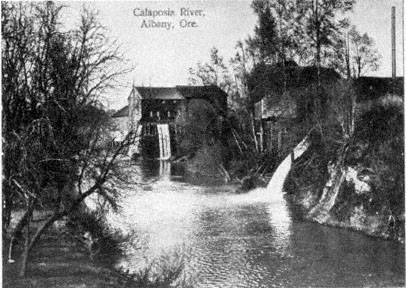
Figure 5.
Mills on the lower Calapooia River, 1895. The Calapooia River was both a means of
transporting logs to Albany and a source to power the lumber mills. Courtesy of Print
Collection, A9415, Special Collections, Knight Library, University of Oregon, Eugene
(negative number CN 924).
forty miles of the Calapooia River from Crawfordsville to the Willamette in order to float logs to the Allen, Robinson mill. Once this work was completed, loggers felled timber into the Calapooia and Brush Creek above Crawfordsville for several months of the year, then waited for the winter rains to float the logs the forty-plus miles to the mills in Albany. Figure 5 shows some of the mills on the lower Calapooia in Albany.[39]
Log drives on the Calapooia, which began in 1878, commonly occurred in fall and winter. One newspaper account reported that the Allen, Robinson loggers felled up to five million feet of timber into the upper Calapooia River and Brush Creek in anticipation of autumn rains. On 12 December an Albany newspaper reported, "On Thursday of last week they were running so fast and thick at Crawfordsville that men could cross the river on them, and we are informed that on last Monday the entire drive had passed there." From her farm on the Calapooia some twenty-five miles below the timber belt, Sarah Cornett
noted in her diary in January 1885, "Jo and George went over to Mr. Farwells then up to the dam to see the logs come over the rest of us staid at home." Two days later she casually remarked, "The logs went by to day."[40]
Although a number of firms—essentially small mills save for Allen, Robinson—exploited the forest of the upper Calapooia, the amount of timber taken remained limited during this period. Because of the inaccessibility of the steep and rugged valley of the upper Calapooia, loggers took only trees along the banks of the river. Because of unreliability of the Calapooia itself as a highway for logs to Albany, a fifteen-year cessation of log drives on the river began in about 1890.[41] Not until well into the twentieth century did increasing regional and national demand and technological improvement allow for the extensive logging of Calapooia forests.
The cutting of forests along the banks of the Calapooia, while limited, and the "improvement" of the stream for drives between 1876 and 1890 did have environmental consequences. Logging increased erosion and runoff. In improving the river, Allen, Robinson eliminated sloughs and minor courses, removed trees and debris, tore out drifts, and confined floating, stationary logs to the stream's banks (known in the trade as booming) in order not to obstruct the central channel. This work, coupled with the loss of riparian forest from local logging, altered the nature of the Calapooia. On the one hand, floods still occurred and perhaps increased in ferocity, but on the other hand, humans forced the river into a narrower channel, actively and continually separating it from its flood plain. On its flood plain, in its sloughs, and among its forested banks, the river had prehistorically deposited large amounts of sediment. In addition, the original riparian forests traditionally reduced erosion. In their absence, and with the river unable to unload much of its organic material, the Calapooia naturally increased in turbidity as well as nutrients, increasing algae and decreasing stream clarity, and thereby decreasing fish populations. Before stream improvement, the higher water table added to marshlands, home to a multitude of aquatic animals and fowl. Now, during log drives on both the Calapooia and Brush Creek, logs blocked the migration of some fish and scoured the riverbed, reducing fish habitat and destroying aquatic plant communities. The floating logs also shed bark, which sank to the bottom and destroyed fish spawning grounds. Decomposing bark removed needed oxygen from the water, and log rafts blocked sunlight from plants on the riverbed.[42]
As a thriving community, Crawfordsville depended for prosperity on the early logging industry, but locals also exploited other forest products, such as cascara bark or chittim, which was used in laxatives. In the 1880s and 1890s, cascara bark collecting became a prosperous cottage industry, and residents removed tons from the forest, in the process killing large numbers of cascara trees. One east Linn County inhabitant, Joseph Stein, shipped sixty-eight tons of chittim in June 1890. Fannie Adams Cooper remembered that her husband collected bark and "packed it out of the woods on his back." She would "scrape off the moss and spread it to dry," and her husband would then "put it in a big deep box and chop it with a spade and sack it." In town, the Coopers exchanged the bark for groceries, shoes, and other necessities. Cooper recalled that it "took a lot of bark at 2 cents a pound to buy things."[43]
In addition to the exploitation of forest products, Crawfordsville residents also had other commercial interests. The same individuals who gave impetus to the town, Richard Finley and P. V. Crawford, worked together in 1858–59 to establish a new and larger gristmill and town out on the plains of the Willamette. Finley's original mill on the upper Calapooia had primarily served the local economy of the Calapooia and the southern Willamette Valley. A typical order in 1856, revealing the limited nature of his operations, was the milling of four bushels of wheat for three dollars. As more settlers moved into other areas of the southern Willamette, other millers constructed flour mills. In 1860 the census taker counted four flour mills in Linn County. One of the larger of these, the Magnolia Flour Mill, was constructed in Albany on the Calapooia where it flows into the Willamette River (figure 6). Finley's mill, well up the Calapooia and now distant from the population and thriving trade centers, began losing business.[44]
To recapture his lost market, as well as take advantage of the growing population in the Willamette Valley, Finley formed a partnership with Crawford and Alexander Brandon to begin a new mill, the Boston Mills, several miles downriver on the plains of the Willamette. Finley acquired land from Americus Savage and water rights from Robert Elder, enabling him to construct a dam across the Calapooia for milling purposes. He cut and hewed the timbers for the mill near Crawfordsville and hauled them to the new town site, some twelve miles away. Eventually a carding mill came to the area. Although the mill burned down a couple of years after its completion, its owners rebuilt it. Near the mills, Richard Finley laid out the town of Boston, which included a central
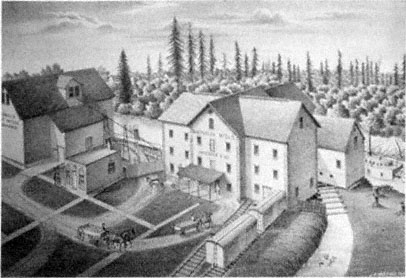
Figure 6.
Magnolia Flour Mill, 1878. The Magnolia Flour Mill, built near the confluence of the
Calapooia and Willamette rivers at Albany, drew much of the business away from
Richard C. Finley's small flour mill on the upper Calapooia. Note the steamboat on the
Calapooia at the right edge of the picture. Because of the small size of the Calapooia,
steamboats never ascended above its mouth.
Source: Illustrated Historical Atlas Map of Marion and Linn Counties, Oregon .
town square surrounded by several blocks divided into building lots. Although the community remained small, it did have a store, blacksmith, and the carding and flouring mills, and it also became an important stage stop.[45]
The town of Boston had a very short life, however, and its history reflects the general pattern of events in latter nineteenth-century Calapooia and Willamette Valleys. In short, although Boston's beginnings were closely tied to happenings in the Calapooia foothills, its demise was determined by events occurring on the plains of the Willamette. On 8 December 1870, less than a decade after Finley laid out Boston, Ben Holladay's Oregon and California Railroad, coming from the north, reached Albany, the seat of Linn County. In June 1871 it extended onto the central portions of the county's prairie west of the Calapooia Valley and just one and one-half miles west of Boston. Now off the main transportation route, Boston withered away while its popu-
lation moved west to meet the railroad. Because of the railroad—in the middle of open farmlands—the town of Shedd sprang up, as did a neighboring village, Halsey, five miles south.[46]
Four years after its founding, Shedd had two general stores, a blacksmith, shoemaker, hotel, two warehouses, and one church. Halsey had a population of 250 and a long list of commercial establishments including four general merchandisers, two blacksmiths, a telegrapher, a sash and door factory, a hotel, and five warehouses. Although neither town even existed in 1870, 306 people lived in Halsey and 55 in Shedd in 1880, ten years later, Shedd had a population of 355.[47] Located in the center of Linn County's vast agricultural district on the plains of the Willamette, both towns became shipping centers for the county's wheat and other produce.
The Oregon and California Railroad never reached Brownsville, but local promoters there finally acquired a connection to the Oregon Railway Company's narrow-gauge line on 28 December 1880. During the preceding nine years, between the time the Oregon and California came to the valley and Brownsville received a railroad connection, commercial interests in Brownsville had difficulty accepting the phenomenal growth of their two new competitors, Halsey and Shedd. Brownsville residents argued that there was no natural reason for Shedd's and Halsey's existence: "What has made the town of Halsey? Has she any real, natural advantages? . . . Is the land around there any better, or more productive? We say not a bit." In promotional articles and editorials week after week, the Brownsville Advertiser demanded that the railroad come to its hamlet. The Advertiser constantly threw disgruntled barbs at growing communities like Halsey whose very existence seemed artificial. And just as constantly they promoted the natural resources and situation of Brownsville:
The large section of country covered with heavy timber above us, would resound with the lumber-man's axe . . . ; town property would be increased; more people would come in with capital; more houses would be built; more goods would be sold; . . . this town would grow up into a great manufacturing center, situated as we are with almost unlimited water power, and an endless supply of timber of the finest quality, within easy reach, and good farming land on every side, who can say what the future of Brownsville would be, with Rail Road and river connection in Albany?[48]
In this example of the idea of community building, the theme of utility is fully pronounced. At the same time, the relationship between
utility and landscape changed through the long process of estrangement of the Calapooians from the natural landscape. No longer did they see landscape itself as the sole provider of resources; instead, these resources could be made profitable only through the acquisition of more and better technology, in this case the railroad. In other words, the citizens of Brownsville realized that they could not place the future of their community solely in the landscape, either its primitive or pastoral prospects. Rather, having witnessed the rapid development of Halsey and Shedd, they came to believe that it was really mechanization that would allow them to progress. Asking themselves, "Why all this difference?" between Halsey and Shedd and their own town, they summed up the answer in their response, "The railroad is the reason!"[49] Though the Calapooians did not forget the primitive and pastoral beauty of the land, their narrowing and intensifying focus on mechanization, profit, and better access to outside markets—which was also seriously affecting the environment—would ultimately have severe consequences for their psychological relationship to the land.
With the establishment and growth of towns on the banks of the Calapooia, not only industry but also personal occupations grew and diversified. The first census of the Calapooia Valley in 1850 listed 219 people. Out of the 39 people who gave an occupation, 32 described themselves as farmers. In 1860, 915 people lived in the valley; 114 worked as farmers or farm laborers, while day laborers accounted for 37 and stockraisers and herders 14. Most significant was the appearance of 19 other occupations accounting for some 50 people, including 2 sawyers, 5 blacksmiths, 3 cobblers, and 4 schoolteachers, as well as merchants, grocery clerks, and physicians. The 1870 and 1880 censuses reported more new occupations: engineers, photographers, coopers, wagon makers, justices of the peace, telegraphers, gardeners, and woolen-mill workers.[50]
Population growth related directly to the diversification of occupation, nascent industries, the establishment of towns, the improvement of transportation, and the extension of agriculture. (Table 7 shows the increase in population in the Calapooia area and comparison figures for Linn County and the Willamette Valley.) The economic historian James Tattersall has pointed out that population grew in Oregon during the 1850s because of both the California gold strikes and the Donation Land Law. Population growth slowed down during the 1860s, as immigrants chose more often to go to California than to Oregon, but it
| ||||||||||||||||||||||||||||||||||||||||||||||||||||||||||||||||||||||
continued to grow because of more gold strikes in the Pacific Northwest. Population growth picked up in the 1870s because of the extension of transportation and the entry of northwestern agricultural and forest products into world markets. Population continued to grow, but again at a slower pace, through the end of the century.[51]
While following the general population trends for Oregon and the Willamette Valley, Linn County and the Calapooia differed in rates and reasons for growth. For instance, in the 1850s the growth rate of the Linn County and Calapooia population was greater than that of the Willamette as a whole. Since Linn County and the Calapooia are near the southern end of the valley, where initial settlement occurred later, more land was open for settlement and a greater proportion of immigrants could be absorbed during the years of the Donation Land Law (1850–55). Population growth slowed greatly in the 1860s as land supplies diminished and as the county still remained somewhat cut off from markets during this period—again in part because of the Donation Land Law, as discussed above. Furthermore, the general population of Oregon expanded, thanks partly to the lumber industry; the expansion was greatest in the northern valley at the confluence of the Willamette and Columbia rivers. But Linn County, located in the southern valley and lacking adequate means of lumber transport, could not take advan-
tage of the wider regional timber trade during these years. By 1880 the population of Linn County and the Calapooia again burgeoned with the coming of the railroad, and it kept climbing through the end of the century.
Calapooia residents founded early towns, with the exception of Union Point (significantly, it failed within seven years), on the principle of utility derived from the landscape. The examples of Brownsville's flour mill and the town's demand for a railroad connection demonstrate how human changes in the natural landscape could increase the utilitarian potential of the landscape. The example of Crawfordsville shows how the extraction of timber and the use of the Calapooia as a log highway could limit the ability of the environment to rejuvenate what settlers had first recognized as most valuable—in this case, fertile soils. The rise and fall of Boston discloses a pattern first of the plains becoming more important than the foothills, and then the location of the railroad becoming more important than anything else. The growth of Shedd and Halsey demonstrates the importance of the proliferation of technology during the nineteenth century.
The founding of communities; the establishment of manufacturing and industry; the rise of logging; the increase in agricultural production; the building of roads, steamboats, and railways; the imposition of the cadastral survey and land claiming laws that forced adherence to it; and the growth of the population—all of these reveal how in the later nineteenth century the Calapooia settlement and the environment increasingly became integrated into a world that stretched far beyond the walls of the valley. Accompanying the economic integration of the Calapooia into the region, nation, and world was a change in the residents' attitudes to and psychological relationship with the environment. The settlers had once considered the landscape to be in some ways separate from humans and in many ways something on which humans depended; over time, though, the landscape increasingly became just the object of utilitarian desires and economic demand. Throughout this process, however, the environment was also an actor, and it responded in ways that proved costly to its inhabitants.