
Exercitium Super Pater Noster
Two editions of this blockbook are preserved. They each contain a series of ten woodcuts interpreting the Lord's Prayer, with explanatory texts. The first edition is chiro-xylographic with Flemish text written beneath the woodcuts, but the banderoles in the pictures are in Latin. The unique copy, lacking, however, leaves 1 and 9, is in the Bibliothèque Nationale in Paris (fig. IV-3). The style of the miniatures has been related to that of Robert Campin of Tournai (the Master of Flémalle). According to Delen, the costumes are typical of the early years of the fifteenth century.
Of the second edition, two copies exist, one at the Bibliothèque, Université de l'Etat à Mons, which has the Latin text above the image and the Flemish translation below (fig. IV-4). In the other copy, that of the Bibliothèque Nationale in Paris, the text beneath the image has been cut off, presumably by someone with a strong prejudice against the vernacular. In this edition, evidently produced some years after the first, the woodcut pictures are much more elaborate.[7] While the compositions are based on the first set of blocks, the costumes and the diagonal parallel lines of shading indicate a later date. The text is cut in the wood within rectangles and banderoles.
Between these blocks and those of the Spirituale pomerium there is a strong similarity of artistic style which suggests that both books may have been produced by one artist or atelier chosen by the author, who was presumably responsible for both texts (see figs. IV-3, 4, 5, and the text on the Spirituale pomerium ).[8] Evidence points to the origin of the two Exercitium editions in the communities of the Devotio moderna at either Sept-Fontaines or Groenendael (near Brussels), or both. This is adduced from the Flemish text, the character of the work that indicates its usage by preaching clerics, and the attribution of its authorship to Hendrik van den Bogaerde (1382–1469). After ten years as Prior of Sept-Fontaines, Bogaerde was named Prior of Groenendael in 1431. A catalogue listing his writings, which has been preserved, includes both an Exercitium super Pater Noster and the Spirituale pomerium .[9] Possibly under his direction, the first edition may have been produced at Sept-Fontaines and the second at Groenendael. The first set of blocks may have been lost or considered unsuitable for the new text in both Latin and Flemish. Each of these communities was a center of book production, with an impressive library of manuscripts.
[7] Louis Lebeer, "Le Dessin, la gravure, le livre xylographique et typographique," in Bruxelles au XV siècle (Brussels, 1953), pp. 203–205, states that the woodcuts of this edition were executed from drawings by Vrancke van der Stockt. See also Flanders in the Fifteenth Century: Art and Civilization , catalogue edited by E. P. Richardson (Detroit Institute of Arts, 1960), pp. 222–223.
[8] Lebeer, Spirituale Pomerium (Brussels, 1938), p. 15.
[9] For a discussion of the relationship of these two blockbooks see Delen, op. cit. , pp. 52–56.
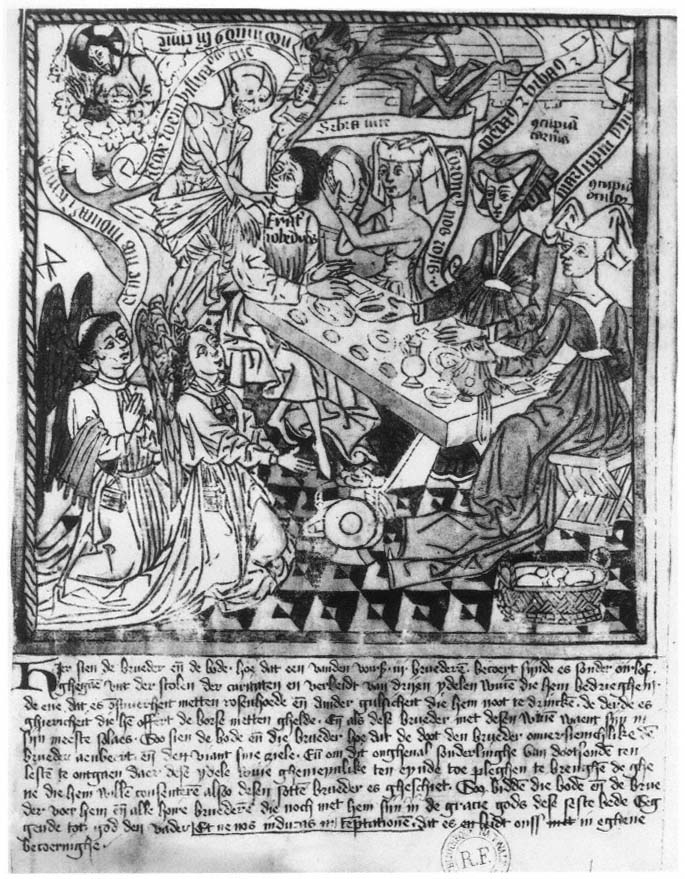
IV-3.
Chiro-xylographic first edition.
Exercitium super Pater Noster .
Bibliothèque Nationale, Paris, Xyl. 31.
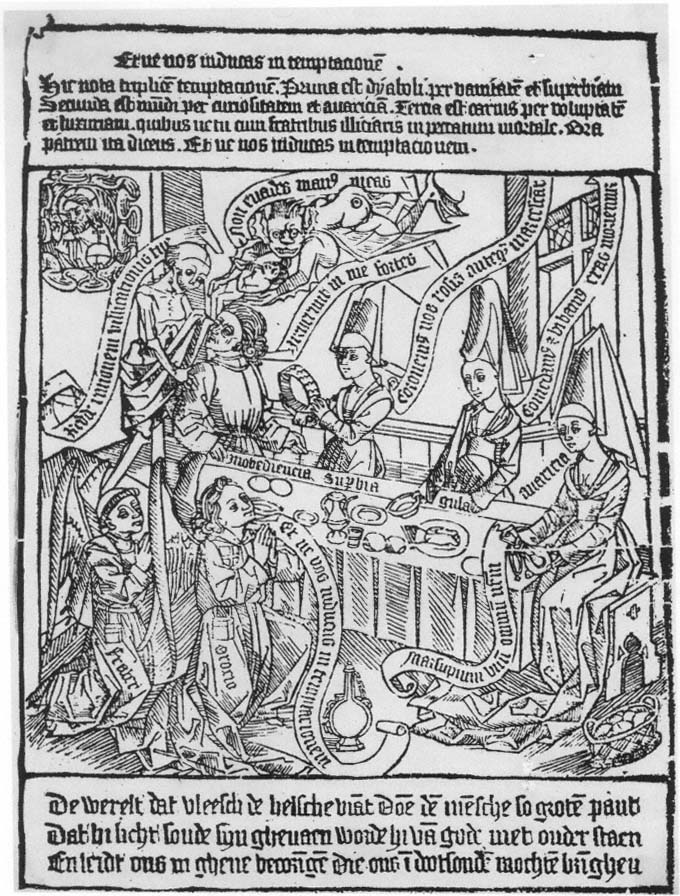
IV-4.
Xylographic second edition.
Exercitium super Pater Noster .
Université de l'Etat à Mons,
Bibliothèque, Fonds anciens 1797-B*.
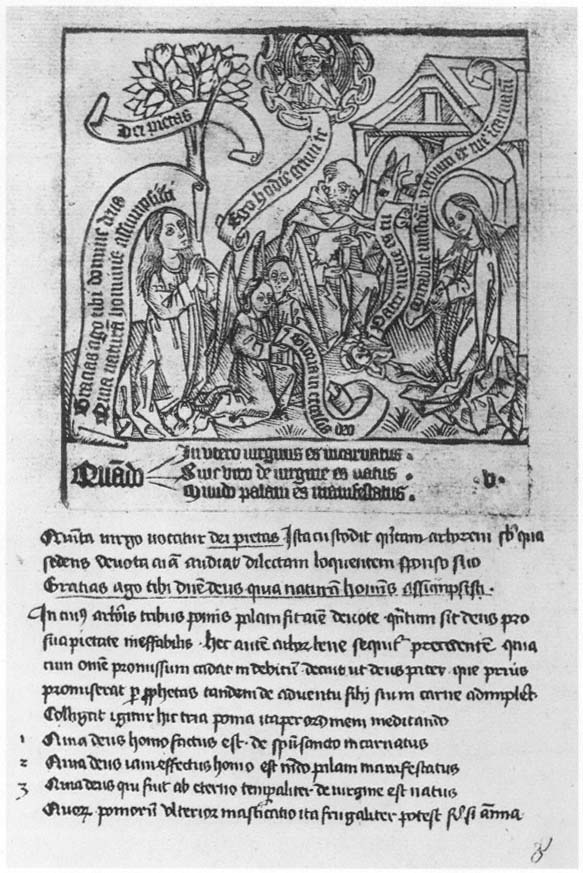
IV-5.
The Nativity.
Spirituale pomerium blockbook.
Bibliothèque Royale, Brussels, Ms. 12070.