
Major Anthropological Theories and Their Empirical Testing
At this juncture, it is necessary to review the anthropological theories that form the basis for the interpretation of the collected data. In figure 6.13, use is made of six explanatory variables measuring respectively the degree of subsistence dependence on agriculture and female labor inputs, the format of lineage organization, the presence of forms of diverging devolution of property through women, the degree of political complexity, the extent of social stratification, and female literacy. These factors are considered to influence male and female ages at marriage, either directly (paths A and C) or indirectly through the incidence of polygyny and its corollary, the age gap between spouses (paths B, D, G, and H).
Although anthropologists documented the existence and practice of polygyny in early research (see, for example, Radcliffe-Brown and Forde, 1950), little attempt was made to explain its occurrence. Inasmuch as structural functionalist anthropology drew elegant, holistic pictures of discrete societies, it tended not to engage in extensive comparative approaches. Only with the advent of the Murdock Ethnographic Atlas and demographic measurements did this become a real possibility.
It was an economist, Ester Boserup (1970), who first attempted a comparative overview of the relationship of social features such as nuptiality to organizational and economic variables. Boserup's thesis is straightforward:
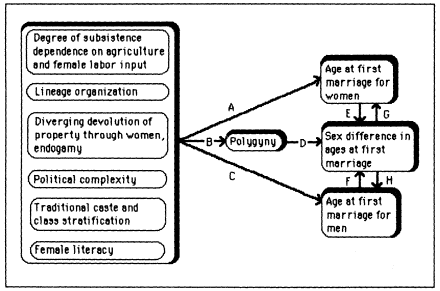
Figure 6.13.
Variables Involved in Statistical Analyses of Ethnic Marriage Regimes
farming systems can be divided into male and female systems. In areas of low population density, such as sub-Saharan Africa, Boserup postulated that shifting cultivation using the hoe and female labor, would be practiced. Any other female economic contribution, such as trading in West Africa, would be added to the productive value of women. Women's high economic value would therefore be reflected in high levels of polygyny, fast remarriage for widows (appropriation of female labor in gerontocratically structured societies), and bridewealth. The alternative is a system where men do the agricultural work with more advanced technology (irrigation, plough) and the women's reduced contribution would be reflected in monogamy, less remarriage, and dowry. In sum, Boserup viewed marital practice as being a function of the relative contribution of the sexes in agricultural production, and the operationalization of her thesis would essentially occur via paths B and D in figure 6.13.
As shown in chapter 1, Goody (1976) put Boserup's thesis to the test and found that, in general, it held well when run against Murdock's ethnographic information. In fact, Goody's own thesis is similar and goes one step further. For Goody, the transmission of property becomes the deciding factor in the social and economic system. In low-technology hoe agriculture, land is corporately owned and widely available, and its transmission is not a grave issue since all lineage members have access to it. Marriage payments in such a
system, that is, bridewealth, are not so much concerned with the transmission of property, but with the transmission of the productive and reproductive value of women. In systems with more advanced plough agriculture, property, states, castes, and other forms of social stratification based on wealth are predicted. The system evolves away from the principle of circulation of resources towards concentration of wealth. In order to protect these interests, marriage tends to become endogamous. This is also an answer to the practice of bilateral inheritance. A father who wishes to protect his daughter's status with a dowry, but keep the family property intact, may solve the problem with caste or lineage endogamy. In-marriage implies strong parental control with respect to partner choice and avoidance of premarital conceptions or births. In many instances that are not characterized by neolocal residence, this leads to the marrying off of women at young ages. Goody's mechanism operates essentially via path A in figure 6.13.
Similarly, Goody's thesis divides the world essentially into two: those societies with diverging devolution of property through bilateral inheritance, dowry, monogamy, plough agriculture, complex polity, and social stratification, versus those with unilineal descent groups, bridewealth, polygyny, shifting cultivation with hoe technology, and high female labor inputs in agriculture. In this fashion, he also incorporates Boserup's dichotomy.
The testing of Goody's and Boserup's thesis with a sub-Saharan rather than a worldwide sample faces the problem of increased homogeneity with respect to the social organization variables. Bridewealth, for instance, constitutes by far the most common form of marriage prestation (86 percent of entries in our data file), irrespective of the form of lineage organization. The practice of dowry is virtually absent, and the remaining 14 percent of societies without bridewealth are distributed over the categories of no exchange, token exchange only, gift exchange, bride-service, or sister exchange. Inheritance for women is rare and occurs in 20 percent of the entries. Tolerance of or preference for endogamous forms of cousin marriage is more common (mostly of the bilateral, trilateral, or quadrilateral types) with 46 percent of entries, but the combination with inheritance for women results in few societies that manifestly counteract diverging devolution of property through endogamy. In fact, this combination is found in twenty-nine societies only, or seventeen percent of the entries. Hence, the few that have inheritance for women generally tolerate endogamous marriage, but those who tolerate cousin marriage do not necessarily practice inheritance for women. Of the twenty-nine societies with both diverging devolution of property and endogamy, twenty-one are thoroughly Islamized, which presumably explains the origin of this non-African combination. None of the remaining eight societies are patrilineal and hence they are exceptional in more than one respect.
As Comaroff (1980) pointed out, what is the use of the Boserup-Goody
generalized distinction, when so much of Africa falls in a single category? Hence, additional explanatory variables have to be found with more discriminating power for this continent. Goody (1973) himself, in an earlier critique of Boserup, stressed that female involvement in agricultural production itself would not suffice to explain marriage patterns. As Comaroff underlines, the problem with assigning "value" to women according to their productive potential begs the question of what kinds of female and male activities are regarded as valuable. There may be a crucial distinction between the actual economic contribution of the sexes with respect to the production of means of subsistence and the socially perceived contribution. For example, in many African societies, which rely predominantly on agriculture, animal husbandry is also practiced, and in these the socially perceived value of female agricultural work is often lower relative to the inflated value ascribed to the male involvement in cattle raising and trading. This relationship is typical to East Africa, where cattle raising is common and women seldom engage in trading activities.
The relevant distribution characteristics in the data file are as follows: the modal category for reliance on agriculture is comprised of between 50 and 69 percent dependence on this sector and contains 61 percent of the entries. Of these, half the number of entries have scores indicative of greater female than male labor involvement in agriculture. The modal category for animal husbandry is 6–25 percent reliance with 55 percent of entries. Hence, the combination of a dominant farming sector with an additional cattle raising one is not rare and the same probably holds true for the social devaluation of women's economic contribution.
To sum up, the Murdock variables relating to the degree of subsistence reliance by sector and to the female work input in agriculture do not constitute an optimal measurement of the dimension of the perceived value of women. This is most clearly visible in the fact that the variable of female versus male farming does not discriminate between East and West Africa, whereas the social value of women's work and the social position of women are known to be weaker in East Africa. The reliance on animal husbandry versus agriculture may be a better proxy than the direct female work input in agriculture used by Boserup, because of the prestige associated with cattle owning accruing to men only. The hypothesis to be tested is then that increased reliance on farming and decreased importance of animal husbandry leads to greater perceived productive value of women and to more polygyny and larger age gaps between the spouses (paths B, D in figure 6.13).
Another essential element that should be included in the explanatory framework is the relationship between lineage organization and polygyny. One might predict that matrilineal societies would be less polygynous because of problems with household formation. Matrilineal societies that have matrilocal or uxorilocal residence of spouses impede polygyny since the hus-
band would have to marry sisters. In the present data file, 18 percent of societies are matrilineal, of which two thirds have matri- or uxorilocal residence. As a consequence, one can indeed expect that societies with matrilineal descent systems would be less polygynous, have smaller age gaps between the spouses, and have either later marriage for women and/or earlier marriage for men (effect through paths B, D, G, and H in figure 6.13).
The effects shown in figure 6.13 were statistically tested and measured as follows. Two sets of tables were prepared, respectively excluding and including polygyny as a predictor. In the first set the direct effects A, B, and C in figure 6.13 proved of interest, whereas the results of the second set also take the existence of D, G, and H into account. Each set is composed of three tables. The first table in each set (that is, tables 6.9 and 6.12) gives the results of an analysis of variance and permits a comparison of the proportions of variance of each of the four dependent variables (proportions single women 15–19, proportions single men 20–24, SMAM difference inferred from these proportions, proportion married women 15+ in polygynous unions) accounted for by the independent variables listed in figure 6.13. The year of observation has been added to the set of predictors merely as a control for differential data quality over time. The five social organization variables are discrete (factors), whereas female literacy and the year of observation are continuous (covariates). In the second set of tables, the incidence of polygyny is added as a covariate. The second table in each set (that is, tables 6.10 and 6.13) contains the results of a Multiple Classification Analysis (MCA) corresponding with the analyses of variance. In all these analyses missing values have been deleted in a listwise fashion, which means that a missing value for any of the variables results in the deletion of the case from the file. Listwise deletion produces a substantial loss of cases and sample sizes are reduced from 170 to 107–121 depending on the dependent variable. The third table in each set (that is, tables 6.11 and 6.14) shows the unstandardized regression coefficients from a dummy regression analysis. As no interaction terms are considered, the column with "adjusted deviations" in the MCA tables and the regression coefficients should reveal, each in its own way, a similar picture. However, the dummy regression procedure used here is based on pairwise deletion of missing values, meaning that a case is only omitted from a bivariate relationship as a result of a missing value. The procedure minimizes the loss of cases, but bivariate relations are rarely computed on the basis of identical samples. These two different treatments of missing values serve to check whether results display sufficient robustness against the selection bias produced by missing data. Finally, one should be reminded of the fact that the nested design and its weighting procedure are used throughout these analyses (see earlier discussion).
The first set of tables which exclude polygyny as a predictor are now considered (tables 6.9 through 6. 11). The independent variables provide the
| |||||||||||||||||||||||||||||||||||||||||||||||||||||||||||||||||||||||||||||||||||||
| |||||||||||||||||||||||||||||||||||||||||||||||||||||||||||||||||||||||||||||||||||||||||||||||||||||||||||||||||||||||||||||||||||||||||||||||||||||||||||||||||||||||||||||||||||||||||||||||||||||||||||||||||||||||||||||||||||||||||||||||||||||||

| |||||||||||||||||||||||||||||||||||||||||||||||||||||||||||||||||||||||||||||||||||||||||||||||||||||||||||||||||||||||||||||||||||||||||||||||||||||||||||||||||||||||||||||||||||||||||||||||||||||||||||||||||||||||||||||
| ||||||||||||||||||||||||||||||||||||||||||||||||||||||||||||||||||||||||||||||||||||||||||||||||||||||||||||||||||||||||||||||||||||||||||||||||||||||||||||||||||||||||||||||||||||
| ||||||||||||||||||||||||||||||||||||||||||||||||||||||||||||||||||||||||||||||||||||||||||||||||||||||||||||
| ||||||||||||||||||||||||||||||||||||||||||||||||||||||||||||||||||||||||
best prediction in the instance of ethnic variation in proportions single women 15–19 (R2 = 0.46). Much of this is attributable to the positive effect of female literacy, which accounts for 28 percent of the variance in proportions single. Ethnic variation in female ages at first marriage is consequently essentially related to the modernizing effect of higher female literacy in this cross-section. This is entirely in line with all the earlier findings (see chapters 2 and 3). The other significant, but much smaller, proportions of the explained variance stem from diverging devolution coupled with endogamy (6 percent) and political complexity (6 percent). Table 6.10 with the corresponding MCA results shows the magnitude and the direction of the effects. As expected, the few societies with both inheritance for women and tolerance and/or preference for endogamy have substantially lower proportions of single women 15–19. Not adjusting for the other variables, their mean proportion is 0.57 – 0.12 = 0.45 as opposed to 0.57 + 0.02 = 0.59 in societies without diverging devolution of property through bilateral inheritance. The original discrepancy of 14 percentage points is reduced to 8 percentage points if the other variables (including literacy) are controlled for, but the difference nevertheless remains significant. Since very much the same result is obtained in table 6.11, this finding does not stem from the specific treatment of missing values. Hence, Goody's variables of property transmission and control over young women identify the pattern of particularly early marriage for girls in societies that are mostly profoundly Islamized and perform exactly according to the theory. The effect of political complexity stems from later marriage in societies that have paramount chiefs or states. This is also in line with a similar (although nonsignificant) effect of enhanced stratification.
A quarter of the variance of polygyny is accounted for by the set of predictors used here. The effect of female literacy is much smaller (0.04) than in the instance of female age at first marriage (0.28), but the effects of subsistence dependence on cattle or agriculture and of lineage organization emerge more clearly (0.10), as would be expected from the theoretical propositions. The reduced effect of female literacy contrasts with the finding in chapter 2 where female schooling levels played a far more prominent role. Admittedly, literacy and schooling level are not identical variables, but the main source of the reduction in the explanatory power of literacy is the extension of the present sample to most of sub-Saharan Africa in contrast to the predominantly West-African sample used in chapters 2 and 3. However, as can be seen from the dummy regression results reported in table 6.11, polygyny and literacy are still negatively related. The magnitude of the coefficient (–0.132) indicates that a 10-percentage-point shift in female literacy produces on average a diminution of the percentage of married women in polygynous unions of 1.3 points. Considering that the respective means for polygyny and literacy are 36 and 45 percent, and the respective standard deviations are 14 and 30 percent, this cross-sectional slope indicates that polygyny would on average
| ||||||||||||||||||||||||||||||||||||||||||||||||||||||||||||||||||||||||||||||||||||||||||||||||||||||||||||||||||||||||||||||||||||||||||||||||||||||||||||||||||||||||||||||||||||||||||||||||||||||||||||||||||
| ||||||||||||||||||||||||||||||||||||||||||||||||||||||||||||||||||||||||||||||||||||||||||||||||||||||||||||||||||||||||||||||||||
| ||||||||||||||||||||||||||||||||||||||||||||||||||||||||||||||||||||||||||||||||||||||||||||||||||||||||||||||||||||||||||||||||||||||||||||||||||||||||||
| ||||||||||||||||||||||||||||||||||||||||||||||||||||||||||||||||||||||
still occur at the 31 percent level in societies with 80 percent female literacy and at the 29 percent level in instances of complete female literacy. Hence, the sign of the slope is in line with Goode's expectation, but its size points in the direction of the robustness of the institution, as hypothesized by van de Walle and Kekovole (1984). This discussion on the relationship between literacy and polygyny cannot be complete without the warning that cross-sectional results are no substitutes for trends over time, notwithstanding the controls for traditional social organization variables.
The effect of the variable measuring the importance of cattle raising versus agriculture produces, as indicated, a major effect: it accounts for 10 percent of the variance in polygyny, and the differences between the extreme categories (pastoral versus sole dependence on agriculture) amounts to an average of 18 percentage points more polygyny for the agricultural societies in the MCA analysis (table 6.10) and to 21 percentage points in the dummy regression analysis (table 6.11). Polygyny increases also monotonically with the growth of agriculture. This is clearly "within-Africa" evidence supportive of Boserup's thesis that increased activity in low-technology swidden agriculture enhances the productive value of women and fosters polygyny. The contrast with cattle raising societies, where women are perceived as "uneconomic" and polygyny is lower, accounts partially for the contrast in the incidence of polygyny between West and East Africa (cf. maps 6.5, 6.6, and 6.7).
The two organizational features that tend to reduce polygyny and which statistically curb the polygyny enhancing effect of greater involvement in low-technology agriculture are matrilineal kinship organization and aspects associated with the emergence of social stratification. The lineage factor explains 13 percent of the variance of polygyny (table 6.9), which is as much as agriculture (0.10) and much more than female literacy (0.004). The entire effect of lineage is due to the category of matrilinearity as shown by the MCA and dummy regression results (tables 6.10 and 6. 11). The order of magnitude of the effect is equally important: matrilinearity produces on average a 13-percentage-point diminution in polygyny when compared to patrilineal descent systems. This is confirmed by the dummy variable regression with a shift of 11 percentage points. This corresponds almost to a full standard deviation shift toward the lower end of the polygyny distribution. The finding is in accordance with the theoretical proposition that matrilineal systems would have an additional problem with polygynous household formation as a result of their tendency toward matrilocal or uxorilocal residence. The result also suggests that matrilineal descent should be added to the Boserup-Goody list of explanatory variables, especially when dealing with low-technology farming societies.
The three variables that are connected with the emergence of social stratification in function of wealth or descent (that is, diverging devolution and endogamy, political complexity, and class or caste stratification) also have a
negative effect on polygyny, but the magnitudes are smaller. The finding is again in line with Goody's view that monogamy becomes the rule in more complex societies with bilateral transmission of property and a concern for endogamy and homogamy. There are several reasons accounting for this negative relationship:
1. A simple gerontocratic structure is most propitious for polygyny as this practice involves the appropriation of female productive and reproductive functions by older men. Deviations from such gerontocratic organization generally imply complications for the maintenance of high levels of polygyny.
2. A stratification system based on wealth and descent leads to the fragmentation of the marriage market and imposes problems in the recruitment of suitable brides.
3. If hypergamy is desirable, plural marriages increase the chances of hypogamy. If the top stratum is highly polygynous, more single men of this stratum may be inclined to take a bride from the next lower stratum rather than remain single for a longer time. This in turn creates a deficiency of available brides in the second stratum and in the presence of polygyny, more men of the second stratum may again have to resort to hypogamy. Each man who succeeds in recruiting a bride from a higher class or caste is effectively imposing a match with a woman of a lower stratum on someone else. This externality arising from a deviation from perfect homogamy is contained by monogamy and exacerbated by polygyny.
There are, however, several societies in the sample which have a dual caste system combined with high levels of polygyny. One of these, the sedentary Fulani or Peul, has been thoroughly studied by G. Pison (1982, 1986). Typical of Goody's "Asian" pattern is that the Fulani (Pison studies the Bandé subgroup located in Senegal) have a theoretical preference for endogamous patrilateral parallel cousin marriage, and caste homogamy. Typical of the "African" system is the existence of bridewealth rather than dowry and the presence of all the demographic prerequisites for the maintenance of high polygyny. The Bandé Fulani are in other words replicating the African system within the boundaries of each caste by preventing younger men from marrying earlier with women of a lower caste. As a result, the mean age at first marriage for men is 26 years, or 11 years later than for women. Only if such excessive differential ages at first marriage are tolerated can the polygynous system be sustained in combination with homogamy. Also, if the need for exogamy arises, foreigners are preferred to hypogamy. The example of the Bandé shows that this "Asian" form of endogamy is grafted uncomfortably on the African system.
To sum up, the findings of tables 6.10 and 6.11 support the general
tendency towards the dichotomy suggested by Goody, but the orders of magnitude of the effects of diverging devolution and class/caste stratification and the Bandé Fulani example clearly show that a synthesis of the two contrasting systems can be made. In other words, Goody's dichotomy stems essentially from a geographical contrast between the Eurasian and sub-Saharan types, but these should not be taken as being completely mutually exclusive. If the demographic prerequisites of polygyny are strongly enforced in conjunction with strict homogamy, and if tensions within the stratified marriage circles can be solved by recruitment from outside rather than by hypogamy, the maintenance of highly polygynous nuptiality regimes within the various strata is a possibility. The main feature of such a system is an exaggerated age difference between the spouses. Finally, several ethnic groups in Senegal, such as the Wolof and Tukulor, have a similar combination of caste stratification and high polygyny, and this may partially account for the particularly large SMAM differences found in this region when compared to those of the Ivory Coast, Togo, Benin, Nigeria, and Cameroon (see map 6.4).
The MCA and dummy regression results for the age difference at first marriage (SMAM difference) are consistent with those for polygyny. As expected, the SMAM difference is reduced in pastoral societies and matrilineal ones, given their lower incidence of polygyny, and enhanced in caste- or class-stratified societies. Diverging devolution through bilateral inheritance combined with endogamy further increases the SMAM difference. Controlling for literacy and year of observation, the average SMAM difference for patrilineal societies with a medium-level involvement in agriculture and with diverging devolution and caste stratification is of the order of 6.61 – 0.06 + 0.09 + 0.43 + 0.28 = 7.47 years according to the MCA results. That for a pastoral society without stratification or diverging devolution is 4.83 years. This difference of more than 2.5 years is appreciable given that the standard deviation of the SMAM difference is only 1.5 years. The corresponding difference between these two types of societies produced by the dummy variable regression and pairwise rather than listwise deletion of missing values is considerably less, namely 0.82 years, or half a standard deviation. Equally noteworthy and consistent is the negative effect of female literacy on the SMAM difference.
The age at first marriage for men remains inadequately explained: the analysis of variance (table 6.9) indicates that none of the social organization variables, individually or taken together, are significant. The dummy variable regression results only suggest a positive effect of class and caste stratification. This, at least, is consistent with the mechanisms described above concerning the organization of polygyny in stratified societies on the basis of enhanced age gaps between the spouses.
The second set of tables reports findings of similar analyses but includes
polygyny among the independent variables. On the whole, the results presented in the first set of regressions are not systematically altered. The increase in R2 resulting from the introduction of polygyny on the independent variable side is modest (compare tables 6.9 and 6.12) and roughly the same variables prove to be significant. The MCA results in table 6.13 compared to those of table 6.10 show a slightly attenuated effect of pastoralism versus agriculture and of lineage organization, and a slightly enhanced effect of diverging devolution and social stratification on the three age-at-marriage variables. The same holds for the dummy regression results with pairwise deletion of missing data (tables 6.11 and 6.14). This outcome seems logical: the arguments advanced for explaining contrasts in the ages at first marriage and the SMAM difference between pastoral and agricultural societies and between matrilineal and patrilineal ones hinges on the relatively large difference in the functionality and incidence of polygyny. A control for the difference in the incidence of polygyny must therefore reduce the effects of these social organization variables. The situation with respect to diverging devolution and stratification is different: societies with these characteristics have on average less polygyny than those without them, but are nevertheless characterized by enhanced age gaps between the spouses. This illustrates once more the particular situation of those sub-Saharan societies who have maintained polygyny while adopting a caste stratification and bilateral inheritance.
The next question pertains to the patterning of the residuals of the dummy variable regressions presented in tables 6.14 and 6.11. More specifically, it is interesting to inspect forms of geographical autocorrelation in these residuals. To investigate this, the residuals of individual ethnic groups were averaged by ethnic cluster using the weighted design. The residuals by cluster were subsequently divided over two broad geographical regions (West + Central versus East + South) and four categories for their direction and size. The frequencies are reported in table 6.15. Geographical autocorrelation emerges most clearly for polygyny, proportions single males 20–24, and the SMAM difference. It is least marked for proportions single females 15–19. In all instances there is a tendency for residuals to be skewed in the positive direction for West and Central ethnic clusters and in the negative direction for East and South. Hence, despite controls for major social organization variables and female literacy, West and Central groups still tend to exhibit more polygyny than expected on the basis of the variables in the regression, higher proportions single for both sexes, and larger age gaps between the spouses. For East and South, there is still an unexplained tendency toward less polygyny, earlier marriage for males and females, and a smaller SMAM difference. For proportions single women 15–19, the underlying autocorrelation pattern can be specified further: of the eight ethnic clusters with considerably smaller proportions single than predicted, that is, with particu-
| |||||||||||||||||||||||||||||||||||||||||||||||||||||||||||||||||||||||||||||||||||||
| |||||||||||||||||||||||||||||||||||||||||||||||||||||||||||||||||||||||||||||||||||||
larly early marriage for women, three are not Islamized (Maasai, Bemba-Lamba, Cameroon Highlands). The others are Islamized and clustered in the western Sahel (Hausa, Bornu, Chari-Logone groups, Mandara hill groups, sedentary Fulani). There is no detectable effect of Islam in the patterning of the residuals of the remaining variables. The overall outcome is that the geographical contrast in female ages at first marriage can be adequately accounted for by the variables in the regression and Islamization, but that the West and Central versus East and South contrast persists with respect to polygyny, SMAM difference, and male age at first marriage. Either existing variables with some East-West differentiation have not been adequately measured, or new variables that similarly follow an East-West division need to be incorporated. Likely candidates are more precise measures of female economic value and social status, such as the strength of women's organizations and the customary involvement of women in trading activities (see chapter 1).