
8
Heaps
Industry has ravished it; drunken storm troops have passed this way; there are signs of atrocities everywhere; the earth has been left gaping and bleeding; and what were once bright fields have been rummaged and raped into these dreadful patches of waste ground.
J. B. Priestley, "The Black Country," English Journey, 1934
On a summer tour of England's manufacturing district in 1835, Sir George Head made his way north from Halifax on the Bradford Road to Wibsey Low Moor. The moor, he found, had become a cauldron of industry. Arriving there, he said, was like entering a volcano's crater: a broken landscape heaped with cinders and calcined shale from the ironstone mines. What impressed him was that each one of the "four ancient elements," earth, air, fire, and water, had, in this one locality, been subdued and made subservient "by human power and intelligence." It was, he wrote, "a noble sight to stand here and see the devastating elements in such radiant glory, yet at the same time under perfect subjection." There was so much energy in the scene, he tells us, so much drama: "Here, the ore dug from the bowels of the earth; there, the steam-blast rushing through the furnaces; together with various contrivances for the economy of water, and application of its power to the machinery—all these sights and sounds are sufficient to raise, even in the apathetic mind, the sentiment of veneration."[1]
The bowels of the earth laid open for viewers to admire, to be stirred with feelings of admiration and profound respect? No sense of shock or outrage? We recollect that his account appeared at a time when a num-
ber of poets, novelists, and social commentators were expressing with great force the dismay they felt on encountering such images, sounds, and smells of industrial blight. There is that unforgettable scene in Charles Dickens's The Old Curiosity Shop when Little Nell and her grandfather walk through a nightmare landscape "where nothing green could live but on the surface of the stagnant pools, which here and there lay idly sweltering by the black roadside."[2]
One possibility is that Head was simply a champion of free enterprise in its most unrestrained, early Victorian manifestation. He almost certainly subscribed to the rationalizations commonly offered by defenders of mining and heavy industry and their methods: that the iron and coal lying under the surface only became valuable when extracted from the ground; that employment of the workers who did the extracting and smelting depended on an economy that was growing as a result of their labors; that an expanding population needed to consume more energy and iron or risk decline; that it was responsible behavior, inside a free market economy, to pursue self-interest and maximize profits; that market mechanisms, when allowed to run freely, not only encouraged innovation but also eventually rewarded the thrifty and punished the wasteful. Moreover, the rate of technological progress was bound to keep accelerating. Consequently, human ingenuity could be counted on to find new ways to reprocess waste and rehabilitate the land. What appeared at the moment to be ugly, noxious heaps could, in time, turn out to be valuable after all.
He might also have made the case that such views were widely shared by the communities most directly exposed to those heaps. Given the gift of a bit of hindsight, he could have offered supporting evidence. Victorian entrepreneurs were seldom subjected to pressure from public opinion unless, like the early alkali manufacturers, their pollution constituted a hazard to the health of a region or unless their effluents threatened salmon fishing and other privileged pastimes.[3] Individuals did occasionally come under organized attack. There was fierce resistance in the 1860s and after when manor lords claimed the right to dig gravel or clay from a common. But one must search hard to find instances where such pressure was applied against those who dumped mine, quarry, and furnace waste in or near mining and manufacturing towns.
Were Head in need of further rationalizations, he might also have pointed out that efforts to interfere with the right to litter received little overt support from those who chose or were forced to live with blight. So long as carts were tipping their loads, mining and quarrying families
could be assured that they were reprieved from the doom that inevitably awaited their communities. Many who grew up in mining and smelting towns no doubt associated the heaps and tips that surrounded them with home and its comforts. It was possible to regard tailing mounds as interesting and familiar features of the local landscape. If spontaneous combustion set the shale on fire at night, the effect could be dramatic, even beautiful.
One can imagine John Thornton, Elizabeth Gaskell's principled, intelligent, hard-headed Manchester mill owner making these points and Head nodding in agreement.[4] But then we come to another passage in the description of Wibsey Low Moor that suggests there might be something more to be discovered about Sir George's understanding of nature and his way of relating to it. After his panegyric about man's conquest of the elements, he added that it was "awful to reflect, that science will never, probably, wholly avert those catastrophes which, either by combustion or explosion, in the melancholy reverse of fortune, serve to remind man of his finitude of his wisdom, and occasionally obtrude the fortunes of the victim on the victor."
Sir George was an experienced soldier and world traveler. So was his younger brother, Sir Francis Bond ("Galloping") Head, at one time a mining engineer in South America and in 1835 Lieutenant Governor of Upper Canada. Both brothers gained reputations for their abilities to describe working environments at home and abroad in graphic detail. They were enthusiastically optimistic about the direction the march of progress was leading. Yet when George Head saw what had happened to that Lancashire moor, he was fascinated but also aware that nature had been victimized and that the result was catastrophic.
Head recognized that his generation was saddling posterity with frightful environmental problems. Apologist though he was, he felt the need to remind readers that one day, in this place, Prometheus would be compelled to return the fire he stole from the gods and leave behind a once-pastoral scene now transformed into a rubbish heap of calcined shale, a reminder that man had once governed the elements there but did so no longer. Before that happened, nature, the victim, would from time to time recover her strength sufficiently to strike back and teach her masters lessons in humility. What Head invites us to venerate is not just human ability to control the elements but also nature's patient endurance, her tenacity, her capacity for revenge, her final victory. In his eyes tortured nature was as much a sacred text as was nature in full health and vigor.
A more secular age finds this juncture of optimism and fatalism, this
way of understanding, difficult to grasp. We know that feelings and attitudes cannot be left out of the attempt to explain why toxic heaps were allowed to accumulate and why so little was done to put these ugly and dangerous leavings to some use. But we usually find it difficult to connect these emotions and rationalizations directly to behavior. Therefore we search for structural explanations to help guide and buttress our inquiry—in this case, into the reasons why a moralistic age failed to control its litterers and clean up the messes it left behind.
A look, for example, at the scale and organization of mining enterprises provides some valuable clues. We see how precariously most entrepreneurs carried on their businesses. Especially where the seams of ore, limestone, or coal were close to the surface, any risk taker able to save or borrow several thousand pounds, possibly much less, could lease or buy the mineral rights of a property and then contract out the task of exposing the seam and setting miners to work. The contractor, or "butty," might supply some of the capital: tools, blasting powder, horses, and wagons. He would hire and pay laborers (often at his own pub) and send an overseer (called a "doggie") to supervise their work. His object was to keep the cost of production below the agreed-upon price. Since there could be no margin for miscalculation or adverse market fluctuation, the butty might frequently find himself delivering coal, stone, or iron ore to someone other than the original lessee, or the butty who made the contract might not be the butty making the delivery.[5] Under these circumstances, it would have been, if judged by conventional wisdom, unreasonable to expect leaseholder or butty to be concerned about the looks of the environment or interested in spending money experimenting with recycling waste, waste that some other entrepreneur might have left behind.
Although fly-by-night operations were common throughout the century in the extractive industries, as the century progressed they tended to be overlaid with somewhat larger and more heavily capitalized enterprises. Presumably, these enterprises could afford to think ahead and spend money on waste management and reclamation. Occasionally this did happen. The most obvious example is the use found for basic slag, the product of blast furnaces. Sometime in the 1880s, soil chemists discovered that this material contained ammonia and phosphorus and recognized that if ground up, it would make an excellent fertilizer, more effective than lime in sweetening the acid soils of rain-soaked Britain. As we have noticed earlier, farmers discovered that treatment with slag encouraged dormant "leguminous herbage" to sprout and eventually to choke out weeds, especially on pastures where stiff clays became water-
logged in winter and parched in summer. Industries appeared to supply a growing demand. In the 1890s several factories that ground slag and sold it to fertilizer retailers and glass and cement manufacturers opened in Middlesborough and Wednesbury.[6] The hill farms of Wales still depend on slag for fertilizing permanent pastures.[7]
Science and industry came together in this case. But it was an exception. Compared to much of the Continent, bridges between industry and scientific laboratories were few in number and poorly signposted. Unless stimulated by protest or threat of regulating legislation, businessmen's interest in recycling waste lagged behind developments in the relevant science and technology. It should also be kept in mind that few mid-Victorian firms had accounting systems sophisticated enough to alert managers to the total costs of waste.
Cost of transport was, on the other hand, well known. As ways were discovered in the latter part of the Victorian era to use mine and furnace wastes, proximity to water or rail transport became crucial. These factors determined whether utilization would pay. Since cinders and furnace slag were heavy and had low unit values, they could only be profitably shipped to places conveniently served by water or easily reached by railways. The same could be said for coal spoil heaps. As in the case of the Cheshire flashes, waste left over from coal mining, although likely to be highly acidic, could be used for relatively safe fill. It could also make firm railway beds. But demand for this material was much smaller than was demand for blast furnace slag. Location was the determinant. Particularly in the Welsh valleys, where mine shafts were dug into hillsides, tips would be grouped nearby. That meant rubble would often be piled up on remote and dangerously unstable sites and allowed to remain there after the mine closed.[8]
Where the lifeblood of communities was supplied by collieries, smelters, and stone, clay, and slate quarries, residents would be slow to complain. If reclamation projects were begun, they were usually undertaken by individual landlords and their agents or the occasional mine or quarry owner. Where outside pressure was a factor in these experiments; it would most likely have come from a sector or sectors of the community and not from the whole. That meant that reclamation usually had to wait until the mines, quarries, and blast furnaces shut down and ceased to add fresh waste to the heaps. Only when these mounds had became relatively stable could they be cleared away or planted.
Until the middle years of the twentieth century, no laws required that reclamation be carried out; contractual agreements to do so were usually
settled with cash payments. Thus it is not difficult to understand why mining and quarrying companies did so poor a job of cleaning up after themselves. There was usually little or no material reward for being environmentally responsible, and there were few deterrents to irresponsibility. So most large and small extractive and metal refining industries simply piled tips higher or shot slag into ravines or the sea. Peter Simmonds, editor of The Journal of Applied Science , estimated that in 1876 it cost about a half million pounds a year to dispose of six million tons of the "metallic encumbrances of the smelting works."[9]
It follows that the circumstances of the mining and metal smelting and processing industries are as crucial to understanding the history of reclamation and pollution control as are the development of agencies for promoting these causes. During the final quarter of the nineteenth century, concern about the effect of these industries on the environment coincided with concern about their long-term future. Testimony before investigatory committees suggests that few employers acted on the premise that cleaner and safer surroundings would increase the productivity of labor and make their industries more competitive. Structural factors stood in the way of such reasoning. As we have seen, the subcontracting system removed many owners from management. A resident of South Stafford-shire remarked in 1843 that more work could be extracted from the men by butties than the owners "would like to extract themselves."[10]
Up to this point, we have focused the discussion mainly on people to whom the land was leased, those who dug mines and built smelters, or on workers and middlemen who did the digging, shoveling, and hauling. Those who owned the land leased it to mining companies, advanced capital for mining enterprises, and occasionally took over some of the active direction of operations also shared in the responsibility for turning the fields, pastures, and wooded areas of the South Staffordshire, Glamorgan, County Durham, Lancashire, Nottinghamshire, and Northumbrian countryside into industrial dust heaps. For the most part, landlords as a class were despoilers, not reclaimers. If there were valuable deposits of sand, stone, gravel, slate, salt, or ore underneath their properties or if enclosure settlements had given them some pretext for claiming control of mineral rights over former wastelands and commons, men of property were usually more than ready to convert parts of the landscape they owned into money. No doubt, many of them took pride in the mounds, cavities, and chimneys that pocked or littered portions of their estates. They might look on these indications of industry as visual testimony to the progressive, improving spirit of their class.
It may seem inconsistent that a great landlord should wish an estate to express his or her good taste, importance, wealth, and paternalistic concern for local values and at the same time wish to associate that estate with the spirit of industrial development. Such an apparent confusion of symbolic landscape meanings did often trouble Victorian squires and aristocrats but seldom to the extent that they refused to grant lucrative leases to resource exploiters.
It did not escape the notice of contemporaries that professed paternalists so often showed a crass disregard for the traditional values of rural society. Reflection on Adam Smith's dictum, "Wherever there is great property, there is great inequality," could dampen appreciation of the refined proportions and textures of an elegantly contrived vista. Not long ago a contributor to a gathering of scholars spoke of the "evil selfishness of generations of landowning gentry . . . those who ruined Nottinghamshire and County Durham (not to mention enslaving their inhabitants)."[11] It is well to bear this judgment in mind when admiring the view from the porch of a great country house as it sweeps from the shrubbery to the park to the farmers' fields and the village, half hidden, by bosky groves. The view back from the cottage doorstep to the forbidden park and plantation may not always have conveyed the same gentle message.
But it can be productive to think about these matters in less categorical terms. Individual landlords could be at the same time ruthless exploiters and imaginative reclaimers of the lands they controlled. Until the beginning of the twentieth century, it was almost invariably a landowner who began a reclamation project. The earl of Dudley, for example, was the most vigorous and by far the largest resource exploiter in South Staffordshire. His entrepreneurship did much to produce one of the century's worst areas of dereliction.[12] Yet it was that same earl of Dudley who, about the time of Waterloo, carried out experiments on the site of one of his limestone quarries to find out which grasses and trees might best heal surface wounds.[13] Shortly before 1914 a visitor remarked that Dudley's plantation, then a century old, could be mistaken for a "virgin" forest. Apparently the visitor did find incongruous in so peaceful a setting the "crash of hammers and shriek of railway whistles."[14]
A more systematic experiment with techniques for returning despoiled land to productive use occurred on the duke of Buccleuch's Boughton estate in Northamptonshire in the early years of this century. In much of the East Midlands and especially in the area around Kettering, ironstone lay only a few feet below the surface. By the 1850s contractors were strip-
mining large patches along the route of the London and North West Railway. For the most part, workmen used picks, hammers, shovels, and wide-tined forks; but by the end of the century the steam-powered "face shovel" was removing the overburden. This machine traveled along the working face and dumped the spoil in parallel ridges, leaving behind it debris mounds, resembling giant washboards. At Boughton, however, the ore was so close to the surface that most of the excavating could be done by hand and horse labor and the waste shoveled into carts and dumped. This meant that the ridges in this "hill-and-dale" configuration would contain a mixture of top soil, heavy clay from farther down, and rubble from the lower ironstone seam.[15] Thus when the lease was up and the duke again took possession in 1909, the land offered considerably better opportunities for reclamation than would have been the case had machines done most of the stripping.
Other landowners of the region had attempted to plant trees on similar sites, with mixed success. What was unusual about the duke's project was his determination to make the Boughton plantation into a laboratory where experts could experiment with suiting tree species to the different chemical properties of the rubble mixtures and with finding the most efficient and cost-effective fertilizers. After lowering some of the hills and partially filling some of the dales, workmen fenced the site to keep out rabbits. After that they put in the shoots, having made sure that plenty of soil from the bedding flats remained on the roots. Results exceeded expectations. Alder did well on heavy boulder clay; sycamore, ash, beech, and European larch flourished on the limestone and ironstone rubble.[16]
As the years went by, those involved in the project were gratified to note that most tree varieties grew better on this reclaimed land than they had done in the period before the site was disturbed. Hand strip-mining had left enough nutrient in the soil for the shoots to take hold and had broken up the layer of clay that had formerly caused mature trees to be shallow-rooted. Thus at Boughton exploiters had thoroughly ravaged an ecosystem, and a landowner had created a new one of considerable beauty and integrity. René Dubos once pointed out that disturbed biotic communities sometimes "undergo adaptive changes of a creative nature that transcend the mere correction of the damage"[17] : the Boughton ironstone fields, it would seem, were cases in point.
Both the duke of Buccleuch and Lord Dudley were model restorers, but few great landlords followed their lead. Most nineteenth century reclamations were undertaken by individual landlords whose object was beautification rather than utility and carried out in a hit-or-miss fashion
and with little attention to cost. A General Carolyn, for example, was determined to build an estate on what had been the site of Crinnis copper mine at Tregrehan, near St. Austell Bay, on the south coast of Cornwall. Fumes and leaching from piles of copper ore waste had created a barren surface. Next to the old shafts were the ruins of smelter buildings and chimneys. Since copper slag is, along with zinc, especially toxic to vegetation, there seemed to be no point in treating it with fertilizer. So Carolyn leveled the ground, had the slag carted away, and then imported uncontaminated soil. Only then could he plant trees and establish a garden, one of particular beauty and eventually a showplace of the region.[18] Owners of derelict sites who needed to keep careful watch on profit-and-loss columns might admire such efforts, but they would hardly be inclined to emulate them.
A similar desire to cover up unsightly heaps caused Lady Frances Osborne to plant on colliery slag near her Northumberland home. In 1887 at a nearby mine, the agent for the owner, the Greenwich Hospital in Chelsea, turned a particularly dismal mound into a tree-clad hill. About the same time, another local experimenter managed to get Scotch pine established on shingly refuse. In Cumberland, experimenters working on the leavings of a colliery abandoned in 1897 were initially discouraged by the high proportion of toxic pyrite in the caked surface but discovered that if they started the process of disintegration with rape and grass and then planted larch, Scotch pine, and birch in holes filled with fertile soil, they could overcome even this inhospitable environment.[19]
But these labors seem to have been carried on in a near vacuum. Isolated reclamation projects failed to generate institutions capable of sustaining this kind of research and publicizing the results. Therefore there was no repository of information readily available to landowners, smelting companies, municipal authorities, or mine and quarry developers.
However, by the 1890s there were signs, that some collieries and corporate landholders were becoming interested in finding ways to make reclamation pay. A few of them turned for advice to those professional foresters and soil scientists who had begun to gain footholds at several universities in the 1880s. William Schlich and William Rogers Fisher of the Forestry School at Oxford were closely involved as consultants in the Boughton experiments and received regular reports from the estate agent on how the seedlings were faring.[20] Several books and a few articles also described experiments and made specific recommendations.[21] Their authors assured prospective reclaimers that they could be confident of success when planting on coal wastes, especially if some of the sulfur had
first been burned out, providing they finely tuned the needs of each plant variety to the properties of the site.
According to these specialists, experimenters must proceed empirically when looking for the best fit between host material and plant species, since every tip would have a slightly different chemistry, depending on age, the composition of the material, and the degree of compactness. Where a coal shale heap had a high content of pyrites and was loosely packed and receptive to water infiltration, harmful acidic residues could be expected. Disturbing that tip might speed up oxidation. Those about to begin a reclamation project were advised to neutralize this acidic condition with applications of lime and the planting of black and white alder. Experts pointed out that these remarkably undemanding trees gradually built up a layer of humus and thus prepared the ground for other, less hardy, species. In addition, their matted root formation was effective in keeping the subsurface moist.[22] If a tip had a relatively low degree of acidity, particularly on heaps that had been burned, reasonably good results could be expected from Scotch pine, birch, willow, and poplar. Such guidelines as these were doubtless useful to those already determined to experiment. What was lacking, however, were organizations formed to bring the message of reclamation to the unconverted.
Except for the Lower Swansea Valley in South Wales, nowhere was dereliction more concentrated than in the Black Country of South Staffordshire and North Worcester. Inside this fifty-three-square-mile region were more than 30,000 acres of pit banks—slag, shale, and coal waste—resting, for the most part, on heavy boulder clay.[23] Travelers through the Black Country were invariably inspired to vivid rhetoric by the sight of smoldering slag heaps. There, industry had created not just an "artificially made desert,"[24] but a wasteland "where everything is black with the blackness of coal dust," and "where birds, sun, and civilisation are alike absent, and where barbarism unmitigated maintains its improvident pomp."[25]
Quarrying and subsidence had spotted the surface with thousands of slimy green "swags"—sunken pools. To James Nasmyth, the early Victorian machine tool maker, the whole area looked as if it had "been turned inside out, its entrails strewn about, nearly its entire surface covered with cinder heaps and mounds."[26] According to a Birmingham newspaper, a tallow chandler named Thomas Holland suddenly disappeared early one morning in December 1903, while walking down St. John Street in Northwood. He had been swallowed up by an old pit bank beneath the pavement.[27] This accident was unusual only in that it resulted in loss
of life. According to Thomas Tancred, who prepared a detailed report on mining conditions in South Staffordshire in 1842, it was "a matter of everyday occurrence for houses to fall down" as the ground sunk beneath them. He cited the testimony of a lay rector in Wednesbury that "twenty or thirty houses in the centre of town were thrown down by the mining the other day."
The whole country, wrote Tancred, "might be compared to a vast rabbit warren." Mixed in indiscriminately with workers' cottages were blazing furnaces, fumes from coking mounds, and calcinating ironstone, forges, pit banks, engine chimneys and, in odd corners, patches of corn and grass, all "intermingled with heaps of the refuse of mines and slag from the blast furnaces."[28] By the time wrought iron manufacturing had reached its peak (about 1870), smoke from some 2,000 puddling furnaces had erased even these last traces of an agrarian past.
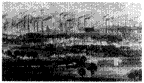
Elihu Burritt, a New Englander, spent several years in mid-Victorian Birmingham, acting as his country's consul. In 1868 he published his impressions of several tours through the region. The title of his book, Walks in the Black Country and Its Green Borderland , indicates the theme: the stimulating contrast between what Burritt considered to be the most charming and the most shocking features of the English landscape. At the center of the composition appeared "a section of Titanic industry, kept in murky perspiration." It was "black by day and red by night," a "sierra negra, " yet the whole burning panorama was "beautifully framed by a Green Borderland."[29] (See Figure 8.) He invited his readers to board a train with him and experience the sudden transition from nature "scourged with cat-o'-nine-tails of red-hot wire, and marred and scarred and fretted, and smoked to death" to nature "in the various dresses she has worn from her birth":
. . . in an English Autumn you have all the colours on an equal footing, and no one has an absorbing place or power in the landscape. . . . You see a green in the middle of November which the grass or grain fields never show in spring. For nothing in May or June can equal the green of a field of Swede turnips, or the vivid hue of mangel-wurzel . . . when alternated with the bright stubble of recently harvested wheat and barley-fields, and fields of lake-coloured soil harrowed and smoothed to a garden's surface for the harvest of another year. . . .
In America, noted Burritt, one did not encounter such sudden contrasts between kinds of landscape and between the costumes nature wore at each of her seasons. Root crops were not a feature of the American autumn countryside. The rural spaces of his homeland were seldom sharply

Figure 8.
Manchester from Kersall Moor (1857). This study in contrasts suggests two things:
that most areas of pollution and industrial detritus were concentrated and closely
ringed with greenery and that city dwellers were within walking distance of the countryside.
(Illustrated London News 31, 1857)
defined; whereas in England, he noted, hedges, "like gilded frames, enclose these various fields" to "give to the whole vista an aspect which no other season or country can equal."[30] Burritt's perception that contrast and variety gave the Midland countryside its particular character and interest did not lead him to call for the preservation of those "ranges of blue-black hills, looking like huge barrows, which have been windlassed up from unknown depths."[31] He looked forward confidently, he said, to the day when this ugly waste would find an agricultural use. But the idea that so black a country might itself be made green again apparently never crossed his mind.
That suggestion first appeared in the Birmingham Daily Mail during the summer of 1884, in a leading article entitled "Beautifying the Black Country." It began by admitting that "the idea of conferring beauty of any kind on such a hopeless agglomeration of the unbeautiful will doubtless seem not a little laughable." But the writer thought that the time had come to consider the possibility seriously: in recent years many mines had ceased to pile up sterile ash mounds, and many foundry chimneys
had ceased to cloak the blue sky with a "reeking canopy of black and grey smoke." Readers were asked to consider that wherever individuals and groups had tried to plant shrubs and flowers on burned over heaps, they had discovered how ready nature was to "repay any care bestowed upon her." Let the skeptics take heart from those hopeful signs, the article concluded, and let the region's leaders rise to the challenge of restoring "one of the Malebolgic districts of the Inferno" to the delightful Eden it once had been.[32]
One reader, Frederick Hackwood, responded enthusiastically to this exhortation. He appealed to the local government of his hometown, Wednesbury, for help in converting twenty-two acres of ugly pit mound into "a smiling pleasure ground for the people."[33] A crowded public meeting at the town hall gave its endorsement in 1884, and Brunswick Park was the result.[34] It proved so popular that the district council of nearby Tipton decided to follow suit and other Black Country towns began to experiment with planting trees along streets.[35]
Encouraged by this response, Hackwood then tried to generate local support for legislation aimed at encouraging colliery owners and municipalities to cultivate wastelands in mining districts. In an article written in 1886 for the Midland Advertiser , he attacked the "gross carelessness of colliery managers and the callous indifference of coal-owners." The manager, he wrote, is bent on "ripping open the bowels of the earth in the readiest and cheapest manner possible." The owner is content to pocket whatever compensation he might receive for permitting exploiters to ravage the surface of his mining properties, only to spend it where "his fastidious taste had led him to take up his residence—in most instances in some paradise of a park, or amidst the luxuriance of nature's verdant beauties."[36]
Philip Stanhope, Liberal M.P. for Wednesbury, brought Hackwood's views to the attention of Charles Bradlaugh, best remembered for his successful struggle to sit in Parliament as a professed atheist and for his collaboration with Annie Besant in disseminating information about family planning. In 1886, soon after winning the battle to take his seat as member for Northampton, Bradlaugh brought in a private member's bill to make failure to cultivate usable land a misdemeanor, a move that succeeded in embarrassing and infuriating the landed classes. This was, of course, his main purpose, although he must have been aware that a group of Liberal land reformers, including Scottish M.P.s from places where anti-deer park sentiments were running high, could be counted on for support.
Having caused a satisfactory stir, Bradlaugh withdrew his bill. But the following year he tried again. The second proposal was to empower local councils to condemn cultivatable wastelands and divide them into allotments for distribution to small farmers. On this occasion, Hack-wood and Stanhope persuaded Bradlaugh to accept an amendment giving local authorities the right to condemn and acquire thousands of derelict acres in South Staffordshire and to permit authorities to raise rates and use that revenue to assist small landholders in leveling heaps, filling holes, and restoring the soil. The hope was that councillors would be attracted by an opportunity to use town sewage in so positive a way. Bradlaugh's argument was that property values would rise as soil fertility increased, and consequently, costs would eventually be offset by increased income from rates. He made the point that at modest or no expense and with far-ranging benefits, waste itself could be the means for reclaiming wastelands.[37]
Few were persuaded: Men of property were not attracted by talk about extending powers to condemn land, even sterile, derelict land. So this second try also failed, although ninety-seven members actually voted for it. Criticisms in the House and outside tended to concentrate on the absurdity of suggesting that ratepayers be asked, especially given the depressed condition of agriculture, to subsidize crackpot schemes for making profitless land marginally productive.[38] Nevertheless, these two bids for attention were symptoms of a perceptible quickening of interest in the possibility of restoring derelict areas.
This development had much to do with growing concern about the depletion of resources, especially in areas like the Black Country where foundries were beginning to import coal, ironstone, and limestone as early as the 1860s.[39] Also in the background was a sense of anxiety about the nation's economic future and a corresponding interest in improving efficiency and eliminating all kinds of unnecessary waste. The later 1880s was also the time when influential people in government, in universities, and, to a limited extent, in industry and agriculture became aware of the progress being made on the Continent with techniques for enlisting the aid of governments and the public in restoration projects.
The Danish Heleselskab , or Heath Society, provided a particularly interesting model. Founded in 1866, this organization came about through the efforts of an army engineer named Enrico Dalgas who had helped to prepare a fortified line across Schleswig shortly before the Prussian army swept through it in 1863. Dalgas came to the conclusion that what his nation required to compensate for its humiliation in war was a cause
around which all factions could rally: a state-sponsored project to make Jutland's heath productive by cultivating it and planting it with trees. When the government failed to respond, he joined with a lawyer and amateur natural scientist, Georg Morville, and a wealthy landowner, Ferdinand Mourier-Petersen, to rally support and put pressure on officialdom.[40] The society recognized from the start that success depended on demonstrating that the Jutland plain was not hopelessly infertile. Members enlisted in its cause some of the leading figures in the earth sciences, literature, the fine arts, and the fields of educational and religious reform. So aided, the Heath Society and its cause of reclamation became a major focus of patriotic feeling and prospered to the extent that it could undertake a series of drainage, irrigation, and afforestation projects and encourage other local groups to do likewise.[41]
The success of the Heath Society came to the attention of a Tory M.P. for Birmingham, Herbert Stone, who had been trained in forestry and had become interested in experiments in growing pit props on coal spoil mounds carried on in the Forest of Dean and abroad. He discussed with geographers and scientists at the University of Birmingham the possibility of using similar methods to reclaim the most derelict parts of the Black Country. The most prominent of these experts was Sir Oliver Lodge, a physicist of international reputation. As a result, an organization called the Midland Reafforesting Association came into being in 1903.[42]
This group of some ninety academics and concerned citizens recognized that the first hurdle to be overcome was the widespread skepticism about the possibility of renewing so ravaged a landscape. Unlike the Danish movement, the English association had no soaring ambitions, no expectations for a nationwide reclamation of derelict land. What attracted them about the Heath Society was its method: its emphasis on education aimed at convincing people that reclamation was an act of patriotism, of social responsibility. They also approved of the Heath Society's decision to manage restoration projects directly as well as its decision to combine on each of these projects woodland, arable land, and pasture. They determined to adopt its tactics for avoiding excessive red tape, its strategy of incremental rather than large-scale planning, and its emphasis on community involvement.[43] But unlike the Heath Society, the Midland Association would start small. Rather than announce that they intended to make the industrial desert bloom, association members bought four and a half acres of spill banks at Travellers' Rest Mound in the heart of the Black Country and set to work, determined that the name should once again fit the place. If reclamation could succeed in so
blasted and dehumanized a scene as this, presumably it could succeed anywhere.
Since the primary aim was to overcome the legend that nothing would ever grow again in the Black County, the society bought or supervised on contract the planting of small tracts of land that were covered with coal-measure shale rather than with potentially toxic heavy metal tailings. On shale some degree of success could virtually be assured. The trees grew reasonably well, and a few donations allowed for some modest expansion. By the outbreak of the First World War, the association owned or managed sixteen plots, sixty-three acres in total.
There seems to have been little attempt to conduct scientific experiments in soil science and botany. Using the familiar trial-and-error procedure, association agents discovered anew which species of grass or tree did best on the various kinds of wastes, depending on elevation and mound configuration. They carried out tests to see how acid the material was, how much potash and phosphorous should be added and in what form, which plants best withstood a smoky atmosphere, and which were the most effective at building up nitrogen and covering the ground with humus. They confirmed what others had noted about the virtues of black alder, poplar, willow, wych-elm, birch, ash, and sycamore and tried out ways of keeping rabbits and human trespassers away from the young trees and grasses by fencing and planting thorn-bearing bushes along borders.[44] In 1914 the association won a medal at an agricultural show for an exhibit of articles made from their pit bank plantations: handles for small tools, electric switches, and kitchen utensils.[45]
Considering that the first priority was to overcome pessimism and apathy, the association was probably right to be content with such small successes and to begin by planting on furnace slag and burned-out coal waste where they knew trees would grow. A greater challenge was finding ways to reclaim ground contaminated by waste materials from copper, lead, and zinc mines, materials that were far more toxic to vegetation than coal waste. Trees would survive on highly toxic ground only if quantities of fertilizer were added. Since it was unlikely that the sale of such things as tool handles would repay the cost of growing willow or alder on these sites, association members hoped that municipal authorities would recognize that improving the appearance of their towns would be sufficient recompense. If they felt themselves to be too poor to afford expenditure on beauty, they could, at least, contribute reconstituted town sewage.
Like many other reform-minded citizens, association members as-
sumed that local governments would respond if shown that reclamation had direct local benefits. From the 1880s cities had been increasingly active in acquiring and managing gas and water supplies, urban transportation facilities, parks, and sporting grounds. Decades earlier, the larger cities had begun to develop water catchment areas to meet rapidly expanding needs. One of the points the association had been trying to make was that reforestation of derelict areas would greatly improve the capacity of watershed areas to absorb and retain water. The difficulty was that local authorities in the area were too hard-pressed to take interest in making investments in such long-term benefits. Except for a few words of encouragement and several joint projects in tree planting along city streets, they failed to get behind the idea of Black Country reclamation. Even those branches of local government with the most to gain, the municipal water authorities, proved to be indifferent.[46]
More encouraging was the response from some of the Black Country school boards. When a new school opened in 1909 on Doulton Road in Rowley Regis, a few miles from Dudley, the educational committee of the district council approved a suggestion made by the Midland Association that students be encouraged to plant whatever space was not needed for playing grounds. Mr. Teague, the headmaster, with the blessings of the association, decided to make the occasion of the planting part of an Arbor Day festival.
This idea of devoting a day to the celebration of the tree had originated with Julius Sterling Morton, head of the Board of Agriculture of Nebraska. Energetically promoted by Morton, the Nebraska legislature made the event an official holiday in 1885, and other American states soon followed. The idea also caught on in Sweden, in France, where children planted two million trees in 1910, and here and there in England.[47] As its contribution to the 1897 Diamond Jubilee celebrations, the village of Eynsford in Kent decided to have children plant a school ground hillside with an arrangement of maple, yew, sycamore, oak, negundo, birch, elm, weigela, ivy, sumac, and elder to make an acrostic for the text from Proverbs , "My son, be wise." This deeply Victorian rite attracted considerable attention, and Arbor Day became an Eynsford event, villagers digging holes, gaily dressed children planting the seedlings, the village band playing.[48]
At Rowley's Arbor Day, teachers, students, and members of the council planted 500 trees in the school's barren surroundings on mounds of fired shale mixed with slack. Attached to each seedling was a label with its planter's name. A "progressive" educator, Teague incorporated into
his curriculum what students observed in this and a nearby small plantation. Children were shown why it was best to grow alder on gray shale, birch on the burned-out shale, and black Italian poplar on the lower slopes of the mounds. As the young grove developed, it became the school's laboratory for geology, botany, and chemistry lessons. Boys and girls learned how to measure rainfall, wind direction and force, and degrees of frost. In what seems like a modern ecology assignment, they were taught how to observe changes in the environment and how these changes affected the relationships between fungi, insect, bird, and small animal populations. Somehow Teague even managed to work in hygiene lessons. As a result of this experience, he proudly reported, there had been a noticeable improvement in the manners of the children. They seem, he said, in better health and less drawn to town amusements like the cinematograph. Furthermore, they had developed a civic sense through participating actively in their own reclamation project.[49] Although he does not say so directly, Teague's object was clearly to teach children who had grown up in a blighted environment respect for nature and nature's healing powers.
At least one other teacher in the Black Country responded to the association's encouragement and initiated a similar program. Mr. Evans of Wright's Lane Council School in the Staffordshire town of Old Hill had his pupils plant and study a grove of 100 trees on the edges of the playground. He, too, reported improvement, both physical and moral. He found it impressive that there had been no act of vandalism even though most of the children came from families of a "rough class." Drawing from these examples of the association's successes, Augustine Henry, a professor of forestry at the Royal College of Science at Dublin, came to this ambitious conclusion: "To get the scholars and the teachers into the open air, and in touch with farming, gardening, and forestry, will be the great step towards the hygiene of the Social Organism."[50] He did not go on to speak about how such lessons might also improve the hygiene of the earth itself. For him, good stewardship was valuable because it made practitioners into good people and good citizens.
Measured by its effect on the Black Country landscape, however, the association was a failure. Whatever impetus there was just before the First World War dwindled in the aftermath and the economic troubles that followed. Because of this discontinuity, many of the lessons learned during the experiments of the earlier period had to be repeated—from experimenting with varieties of grasses and their capacity to withstand toxic materials to involving schoolchildren in planting mounds and hill-
sides. The economic troubles of the 1920s, the depression of the 1930s, another war, concentrated attention on attempts to increase employment by fashioning metal instead of making it. Black Country smelter workers became skilled at "bashing" metal. Since the end of the 1970s that new kind of industry, too, has declined, and another phase of dereliction has set in. This time, however, it is generally recognized that reclamation must be large-scale and government-supported and not carried on bit by bit by voluntary organizations more or less in isolation.[51]
An era of reclamation can be said to have begun when central and local governments begin cooperating with university-organized planners, engineers, and scientist in restoring and rehabilitating blighted regions and when scholarly journals, technical publications, books aimed at the general public, and the documentary media begin to pay attention. That happened in Britain two decades after the end of the Second World War. The tragedy of Aberfan in October 1965, so movingly reported by the television camera, touched and shocked the nation as few disasters have done before or since. Occurring at a time when fears about the possibility of nuclear catastrophe and the effects of air and chemical pollution were creating a culture of protest, this event acted as a catalyst. Specialized treatises on techniques for reclaiming spoiled or seriously disturbed land began to appear. An aroused public demanded regulatory legislation, and Parliament responded by requiring mining and quarrying companies to submit comprehensive reclamation plans when applying for permission to begin digging and blasting.
It was in this climate, so different from what the Midland Reafforesting Association had to work within, that the first of the large-scale renewal programs, the Lower Swansea Valley Project, began to submit its reports.[52] Eight hundred of the valley's 1,175 acres were completely derelict, half of this area covered ten to ninety feet deep by coal shale, furnace ash, and the mixed leavings from extracting copper, arsenic, zinc, silver, lead, cobalt, and iron.[53] Those who issued progress reports described in detail the initial sense of hopelessness that suffused the valley. Wreckage was everywhere: ruined works, vegetation "blasted" away, rills and deep gullies scooped out by erosion, acid soils, bare slag heaps, coal tips, rubbish dumps, seven thousand tons of clay and furnace waste, toxic seepage, atmospheric pollution. The place was an industrial Gehenna: "the most extensive contiguous area of industrial dereliction found anywhere in the United Kingdom."[54] It is doubtful that even those able to appreciate the "lunar beauty of industrial dereliction" could have responded positively to this cluttered wasteland.[55] As John Barr
wrote in 1969, "nowhere in Derelict Britain is there a more dismaying example of man creating wealth while impoverishing his environment."[56]
One explanation is that wealth was created in the Lower Swansea Valley by smelting copper—an activity that left highly toxic residues on the surface of the land. When John Vivian arrived in 1810 to build the first of the large-scale copper smelting works at Hafod in the valley, nine smaller smelters already lined the river Twae. Other large companies followed. By the peak years in the late 1860s and early 1870s, over half of all copper ores imported into the United Kingdom and an even higher proportion of partly refined imported copper was coming into this small triangle of land.[57] Two hundred furnaces on some 1,200 acres of former floodplain filled the valley night and day with acid smoke. Charles Frederick Cliffe, who visited Swansea in 1846, said that what appeared to be "a dense thunder cloud" was visible "at a distance of 40 to 50 miles."[58] The sight and the smell, he wrote, formed "no bad representation of the infernal regions":
Large groups of odd chimneys and rickety flues emit sulphureous arsenic smoke, or pure flame; a dense canopy overhangs the scene for several miles, rendered more horrible by a peculiar lurid glare. The day-light effect is not much more cheering. All vegetation is blasted in the valley and adjoining hills, and immense swellings in the joints of horses and cattle occasionally attest to the pernicious nature of the vapour.[59]
What seemed like hell to owners of those horses and cattle represented prosperity or at least jobs to residents of Swansea and the valley. Supposedly, the whole community rejoiced when the courts rejected an action brought against Vivian in 1833 by a group of farmers whose fields had become desert. According to a highly biased press report, the news of the court's decision "diffused the greatest joy throughout this town and neighbourhood, which has been manifested by the ringing of bells and firing of cannon throughout the day."[60]
Nevertheless, objection to toxic smoke continued. Increased use of copper ore containing concentrations of arsenic pyrites sent white clouds of stinging oxide over the valley. Complaints were sent to the Noxious Vapours Commission, then hearing testimony about pollution created by the alkali industry. Commissioners sympathized but, noting that no technology existed for neutralizing sulfurous fumes and arsenic gases, recommended that copper smelting be exempted from legal penalties.
Landlords, who had been suing and petitioning for thirty years, were less passive. They organized themselves and continued to agitate. Henry
Hussey Vivian, heir to the family business, tried to respond by raising the height of his chimneys, but only succeeded in poisoning a wider area.[61] At the suggestion of Sir Humphry Davy and Michael Faraday, he tried, unsuccessfully, to recover some of the valuable sulfur by passing smoke through a water filter. Eventually, Vivian did find a way to control the amount of air needed to bring about combustion in the copper and zinc ores and to make sulfuric acid out of some of the effluent, but this improvement had no significant effect on the quality of the atmosphere.[62] As for the natural habitat, the damage had already been done. All vegetation had long since disappeared, even the weeds from the churchyards. In the wet climate of the valley, sheet and gully erosion had left behind a surface of hard, sterile boulder clay.[63]
On this desolate scene, changes in the color of waste heaps recorded changes in the history of metal refining. Copper waste produced tips that were at first orange-colored and later, black. Superimposed on these heaps were layers of gray. Shades modulated as the smelting industry gradually shifted from copper processing to zinc refining and then to lead, arsenic, tin-plate, and steel manufacturing. A poisonous environment became more so. Relief came only in the aftermath of the First World War, when all but a few of these industries closed down. The air improved, but the Victorian and Edwardian legacy of barrenness and grime remained behind, seven to ten million tons of it. Dereliction in the Glamorgan Valley, because of the higher toxicity of its residues, seemed more durable than elsewhere, even in the Black Country.[64] Therefore pessimism about the chances of bringing this place back to some kind of life seemed well-founded. Robin Huws Jones, the inspiration behind the Lower Swansea Valley Project of the 1960s, knew that overcoming this sense of hopelessness should be his first priority.[65]
Thus it is surprising to find that as early as 1912 the Swansea City Council received a proposal for reclaiming the banks of the Twae. The originator was the borough surveyor, George Bell. His plan, bearing the sumptuous title Floreat Swansea , proposed to clear one part of the valley for an industrial park, expecting that secondary industry would then be encouraged to replace the nearly extinct nineteenth century dinosaurs.[66] Recognizing that prospective developers could not be attracted to such a forbidding site, Bell proposed that the borough undertake to fill the holes and cart away the heaps. He envisioned a "garden suburb" for the eastern side of the valley that would be integrated into metropolitan Swansea by means of new roads and a tramline. He proposed a comprehensive remaking of the whole region. In its statement of objectives,
its analysis of the obstacles to be overcome, and its recommendations, this plan was nearly as imaginative as the one finally implemented in the 1960s and 1970s. But Bell's rationale was strictly utilitarian. In his view the purpose of reclamation should be new development in the form of housing, high-technology industry, and recreational facilities. He recognized that land so completely despoiled could never be returned to its preindustrial condition.[67]
Bell's plan was shelved; Robin Huws Jones's plan, similar in conception, succeeded. Two world wars were fought during the half-century interval and helped to bring about important changes in how governments understood their responsibilities toward society, the economy, and the natural environment. After 1945, technological advances led to public anxiety about the planet's future health. Prosperity stimulated interest in recreational resources. The science of ecology became more sophisticated. University specialists gained experience in conducting group research. As a result, the Lower Swansea Valley Project of the 1960s had available to it a new configuration of forces willing to promote large-scale reclamation and to support it once under way.
The local authorities who received Bell's plan in 1912 could not have relied on meticulous research information from an interdisciplinary team of university botanists, biologists, geologists, soil scientists, ecologists, and social scientists. They could not have anticipated timely donations from private foundations interested in promoting environmental causes. They could not have been confident of assistance in the form of money or advice from central government agencies or of support from local industries and businesses. They could not have expected to receive publicity from scientific and technical journals specifically devoted to the subject of reclamation or from national media that recognized that news about the state of the environment attracted viewers and readers. Therefore those who write about the history of reclamation are right to concentrate most of their attention on the 1960s and afterward—so long as they recognize that the subject has a longer history than many suppose.
It is tempting to read in that history confirmation of Sir George Head's optimism about the widening out of knowledge and the eventual redeployment of new technology to clear away the noxious heaps an older technology helped to produce. But prudence cautions against so Whiggish a view. As we have seen, discoveries made were interrupted by wars and had to be rediscovered. Public support at all levels, acknowledged to be crucial to success in the Lower Swansea Valley and elsewhere,[68] still ebbs and flows with the shifting tide of events, the economy, and the
political climate. Then there is the condition of the land. Modern research shows that damage caused by toxic seepage from heavy metal tips, although not theoretically irreversible, is far greater and more long-lasting than Edwardian reclaimers seemed to have been aware.[69] Meanwhile, drums full of nuclear waste steadily accumulate.
That some Victorians and more Edwardians looked for ways to clear away their detritus does not mean that they had found a way of reconciling the development of heavy industry and the inevitable pollution it entails with the basic need for a livable environment. They were not even well started on that path. In that area they had created no balances, no harmonies. Largely isolated and small-scale reclamation efforts did little to balance the effects of dereliction. But at least these efforts demonstrate that by no means all Victorians or Edwardians were indifferent to the wounds they inflicted on the surface of their land, not all shared Head's reasonably good conscience about leaving so many of those wounds unhealed. Many people of the time saw what was before their eyes and described what they saw with passionate indignation and in vivid detail: the ugliness, clutter, banality, and dereliction that were left in the wake when, what Marsh termed "the motive power of elastic vapours" was firmly connected to the gears of change.