
Pang Lok Sam (see fig. 3)
Pang Lok Sam begins his family history with his great-grandfather Sing Fu and his great-grandmother (surnamed Ho), who lived as farmers in Longhua, Baoan. His grandfather and grandmother (surnamed Cheung) ran a business, and his father and mother (surnamed Wong) worked in the Longhua market.[2] Pang Lok Sam's parents learned of Christianity, and in 1879 they were baptized nearby in the Langkou church. Pang Lok Sam was born in 1875 and baptized when he was four years old. When he was eight, his father died and his mother began to work as a housekeeper for Basel missionaries. He went on to mission-run schools: primary school in Lilang, secondary school in Wuhua, and then Lilang Seminary, from which he graduated in 1896 and took up missionary work. In 1899 he married Tsui Dou Leung from Zhankeng, Wuhua, with whom he had twelve children. After working two years at the Zhankeng church, Pang Lok Sam was transferred to a church in Zijin. In 1901 his youngest brother died. His mother was heartbroken, and to console her he applied to the mission for a transfer to Baoan to be closer to her. He was transferred to Tai Po and later Sha Tau Kok in the New Territories. In 1905 he began to preach in Shung Him Tong but also continued to work in Tai Po, Nam Wa Po, and Sha Tau Kok.
Pang played an active role in the development of the village and in New Territories politics and was involved in the founding of the Heung Yee Kuk. He was personal friends with Sir Cecil Clementi during the latter's years as district officer and later his governorship. Pang was awarded the Coronation Medal (Ingrams 1952:170), and was also one of the originators of the plan for establishing the Luen Wo market in Fanling. Before the market was
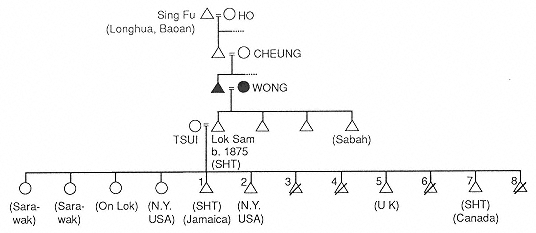
Figure 3.
Pang Genealogy.
established, people from Fanling did their marketing in Sheung Shui at Shek Wu Hui. But the fees collected from vegetable hawkers were spent on social welfare projects in the Sheung Shui area and did not benefit the people of Fanling. The Luen Wo market was completed in the early 1950s and is run primarily by the Punti Pang of Fanling. Pang died in 1947 and did not live to see the market fully developed.
It was because of Pang that the family of Tsui Yan Sau decided to settle in Shung Him Tong. Pang's wife was the sister of Yan Sau, making Tsui and Pang brothers-in-law. Tsui was a direct descendant of the first Basel mission convert in Wuhua.