
A Butcher's Store and Plein Air Portraits
The extensive iconographic range of Corinth's works from the 1890s is a constant source of frustration to anyone seeking to bring order to the painter's varied output. Indeed, in 1897 he achieved a new level of competence in subjects that had claimed his attention previously: the light-filled interior and the portrait in the open air. In the butcher's store interior (Fig. 71), painted in the small town of Schäftlarn in the Isar Valley, he subordinated the visceral conception of the slaughterhouse scene from 1892 (see Plate 6) to a more controlled structural logic in keeping with the less aggressive character of the subject. The vaults of the setting divide the pictorial field vertically into equal halves; the resulting equilibrium is subtly modified by the scaffolding of the meat racks. The simple ground, painted in relatively unified shades of red and green, provides an effective foil for the multicolored cuts of meat displayed on the counter and suspended from hooks above it. They derive their gleaming texture from the fatty gloss of the paint itself, applied in deft strokes of red and pink shot through with specks of white and purple. Unlike the butcher's store interior that Max Liebermann painted in 1877 in the Dutch town of Dordrecht (Kunstmuseum, Bern), Corinth's painting has an expressive anecdotal content that ultimately allies it to the small slaughterhouse scene of 1892. The butcher's apprentice provokes the viewer's sensibilities by presenting a large dish piled high with pieces of freshly cut meat, his expression of smug self-satisfaction a mocking reminder of the grisly process just completed.
In the portrait of Berta Heck (Fig. 72), the sister of Max Halbe's wife, Corinth achieved a similar unity of structural logic and expressive content. The motif of the young woman seated in a boat, with a male companion just visible behind her, recalls similar paintings by the French Impressionists, in particular Manet's Boating (1874; Metropolitan Museum of Art), although it is impossible to say whether Corinth at this point actually knew these pictures. Having set up his canvas at the back of the boat, he apparently executed the painting from start to finish out of doors. But in contrast to the psychologically neutral approach of painters like Manet and Monet, Corinth was clearly unwilling to sacrifice the facial features of the model to the evanescent, form-dissolving effects of light. The brushstrokes, applied broadly to the lake and the distant shoreline and rapidly in the blouse and hat, become more differentiated in the young woman's face, making it both the structural and psychological focus of the composition. Averting her gaze, Berta Heck is absorbed in her innermost thoughts. The simple pictorial structure, dominated by three broad horizontal bands that divide the background, reinforces the picture's
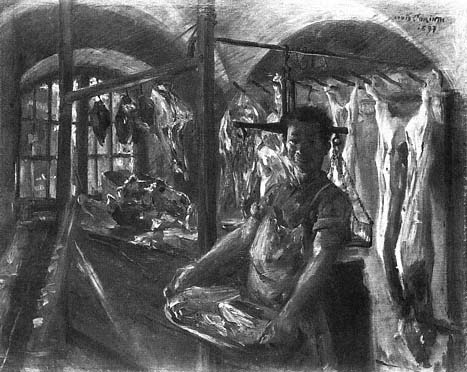
Figure 71
Lovis Corinth, Butcher's Store at Schäftlarn , 1897. Oil on canvas, 69 × 87 cm, B.-C. 147.
Kunsthalle Bremen.
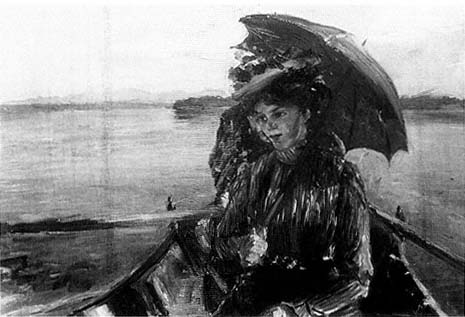
Figure 72
Lovis Corinth, Berta Heck in a Boat , 1897. Oil on canvas, 57 × 84 cm,
B.-C. 140. Dr. Karl Schmidt, Cologne.
Photo: Marburg/Art Resource, New York.
mood of quiet reverie. This sentiment is the result not only of considerable artistic growth but presumably also of a harmony between painter and model that prompted Corinth's empathy, allowing him to rise above a mere description of the sitter.
In a similar way only considerable mutual trust can have made possible a portrait such as the one Corinth painted of Bertha Heck's sister, Luise Halbe, the following year (Fig. 73). Corinth actually painted two portraits of Max Halbe's wife at this time. The other, a life-size three-quarter-length portrait showing her standing in a garden (B.-C. 161), is more formal in conception, underscores her fashionable appearance, and, as a result, remains psychologically detached. The small panel in Munich, by comparison, is an unassuming and personal work, whose closely circumscribed pictorial field emphasizes the woman's open gaze. The extreme close-up view virtually forces the observer to share in the intimate dialogue between painter and model. Painted in August 1898 in the village of Ammerland, on the eastern shore of the Starnberger See where Max Halbe and his family were spending the summer, the picture is a plein air portrait by implication only, for its sunny air is entirely a
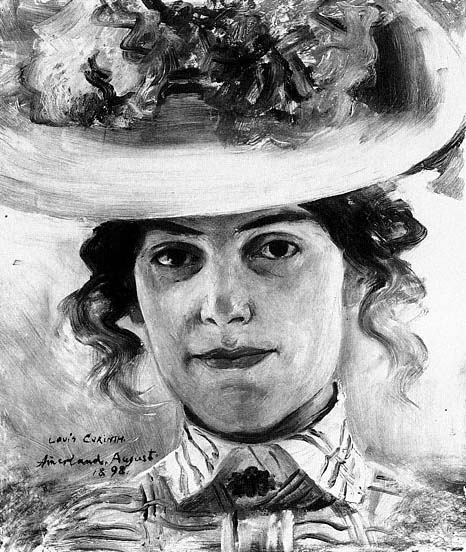
Figure 73
Lovis Corinth, Portrait of Luise Halbe in a Straw Hat , 1898. Oil on wood, 35 × 30 cm,
B.-C. 160. Städtische Galerie im Lenbachhaus, Munich (G 13.004).
function of the three primaries red, yellow, and blue. As in the portrait of Berta Heck, the brushstrokes have been applied freely only on the periphery of the composition while the face itself is carefully modeled.
Corinth's charming plein air group portrait (see Plate 10), painted in August 1899 in Bernried on the Starnberger See, also originated in the congenial company of Max Halbe's family. Facing the viewer, the playwright sits in a garden, his wife to his left and Berta Heck to his right. The bearded fellow wearing the traditional Bavarian suit and hat is the Viennese writer of comedies Carl Rössler. Like the portrait of Benno Becker and the double portrait of Langhammer and Brand (see Plate 5, Fig. 37), the painting has the character of a genre scene. Max Halbe, with a touch of amusement, looks up from the newspaper as his wife offers Carl Rössler a peach. Berta Heck, about to sip from her cup, smiles at the tempting offer. According to Halbe, the painting was completed in the course of a few morning hours;[93] and there is no reason to doubt that this is so, even though Corinth inscribed the canvas with the dates August 28–31, 1899. Perhaps the inscription refers to the duration of the painter's visit, Rössler's, or both. It is also possible that the picture was painted in several brief morning sittings on the dates inscribed. As in the plein air portraits of Berta Heck and Luise Halbe, the vigorous brushstrokes serve a tightly controlled modeling only in the faces. Despite the seeming spontaneity of the overall execution, it is evident that the composition was carefully planned and nuanced so as to emphasize Corinth's hosts. The women are related on a diagonal axis that intersects a corresponding one for the men, and these structural lines are reinforced by the shades of white that link Luise Halbe and Berta Heck and the darker tones of the men's clothing. Max Halbe and his wife have been given special prominence, he by his frontal position next to the tree trunk that divides the composition in the center and she by her placement in the right foreground and by her action, which provokes the gestures and glances of the other three. Indeed, Luise Halbe is the psychological center of the composition, and the painting itself is a testimony to her charm and the unpretentious hospitality that made the Halbes' home so appealing.