
Algeria and Tunisia under French Rule
Because Algeria was France's first and most important Muslim colony, its presentation to the world was a major concern, and French officials experimented with various possibilities. In 1867 Algeria was represented in the French exhibit as a "trophy," "a new territory reconquered by civilization after twelve centuries of barbarian rule." Inside the Galerie des Machines the Algerian display, modestly demarcated by palm trees, showed raw materials (Fig. 83). To display Arabs and their civilization, a douar, or Arabian village, was set up in the southwestern part of the park, near the Porte de la Grenelle. A group of camels sat in the center of a circle of tents while their caretakers, brought to Paris "to give an idea of the true Arab type," dozed inside.[72]
This modest exhibit contrasted with the next one in Paris in both scale and architectural ambition. The Algerian palace in 1878 was a massive mosquelike building, 40 by so meters (Figs. 84–85), its exterior dominated by four towers, its plain white walls unfenestrated. The interior, however, was more of a caravansary, where the products of two thousand exhibitors were displayed.[73]
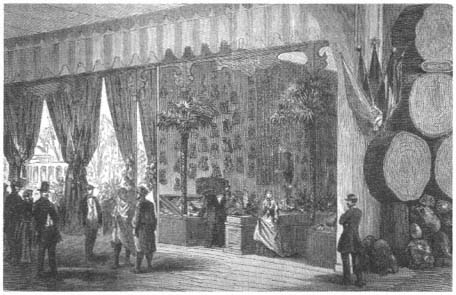
Figure 83.
Algerian displays of raw materials, Paris, 1867 ( L'Exposition aniverselle de
1867 illustrée ).
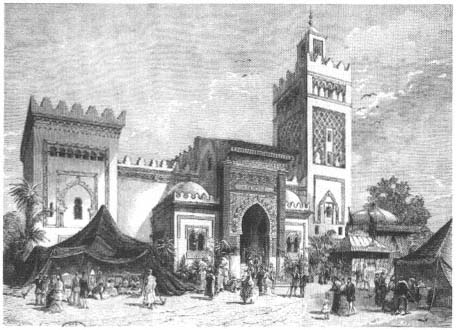
Figure 84.
Algerian palace, Paris, 1878 (Bibliothèque Nationale, Département des
Estampes et de la Photographie).
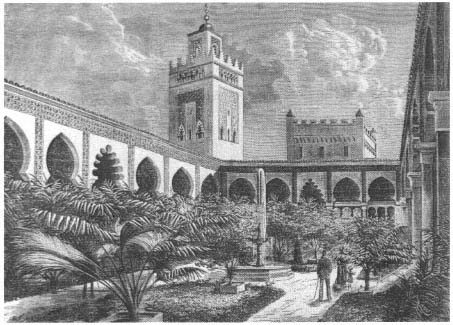
Figure 85.
Courtyard of the Algerian palace, 1878 ( L'llustration, 10 August 1878).
Daylight came in through the central courtyard, planted with palms and roses and containing a fountain. Components of the structure had their origins in monuments in the city of Tlemcen: the 30-meter-high minaret replicated that of the fourteenth-century Mosque of al-Mansur, and the portal came from the Mosque of Sidi Bou-Madina; the ribbed dome of the vestibule imitated the mihrab dome of the Great Mosque of Tlemcen. The most important space in the building was the rotunda-shaped Salon du Maréchal, the reception hall of the French marshal; it was on axis with the main entrance and was lighted dramatically by spherical stained glass windows.[74] With its allusion to the appropriation of local architecture by the colonial power, this room served as a political symbol.
The idea of architectural fragments so dominated the Algerian display that the portal of the al-Kebir mosque in Algiers was erected as a freestanding structure near the exposition palace (Fig. 86).[75] Out of its context the portal served as an archway, but because of its seemingly random placement, it was also a picturesque "found object."
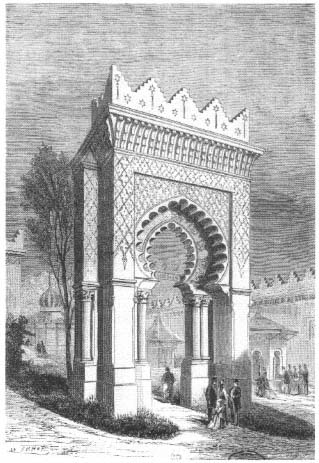
Figure 86.
The porta of al-Kebir mosque, Paris, 1878 (Bibliothèque
Nationale, Département des Estampes et de la Photographie).
Like the 1878 palace, the main Algerian pavilion at the 1889 Paris fair, designed by Albert Ballu and Emile Marquette (Fig. 87), was an introverted structure with courtyards, plain exterior facades with arched portals and porticoes, and a square minaret (not visible in the illustration) modeled after that of the Mosque of Sidi'Abd al-Rahman, which was topped with a French flag. A dome, also inspired by the Mosque of Sidi'Abd al-Rahman, covered the central space.[76] The interior decoration displayed a "capricious geometry"; one journalist argued that it was the "product of a dry imagination, a cold, me-
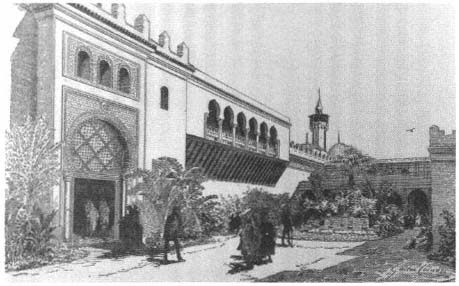
Figure 87.
Courtyard of the Algerian palace, Paris, 1889 (Monod, L'Exposition
universelle de 1889, vol. 2).
thodical barbarity without exuberance," because "the Arab never had a feel for plasticity; his genius was only in mathematics and colors."[77] Although this viewpoint adopts the rationalist theories of Islamic architecture rather than earlier theories of Islamic architecture as a sensuous fantasy, it still presents Islamic architecture in a negative light, denying that the Muslim artist and architect had any creative flexibility. Ironically, the exposition pavilions were considered Islamic architecture, despite their French authorship, at the same time that the neo-Arabian buildings erected in the colonies were considered French.
As noted in the previous chapter, Algeria in 1900 occupied the "place of honor" in the Trocadéro Park. Albert Ballu, the architect of the Algerian palace, had given this imposing structure an unadorned exterior to reflect the "Muslims' contempt of worldly things" (see Fig. 52).[78] The walls were a "luminous white," with bands of tiles on the upper levels and a crenellated roofline. The facade on the Seine was the structure's most elaborate, with its monumental stairway leading to an arched portico. A minaret 28 meters high, a replica of that of the Mosque of Sidi Bou-Madina in Tlemcen, rose on one side of the stairway. The central dome of the palace was inspired by the Mosque of the Fishery in Algiers.[79]
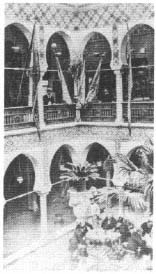
Figure 88.
Courtyard of the Algerian
palace, Paris, 1900 (L'Exposition
de Paris, vol. 3).
The palace basement was filled with antiquities and choice wines for tasting (Fig. 88).[80] On the ground floor, a large courtyard, a reproduction of the courtyard in the Bardo Palace in Algiers, "recalled the interior courts of Moorish houses in Granada and of Muslim harems, where solitude and freshness invite one to dream." In the middle, however, where tradition called for a fountain, there was a large, glassed-in model of the ruins of Timgad. In the galleries of the next floor, reached via the grand staircase outside, were exhibit of fabrics, guarded by "Turks and sipahis" (indigenous soldiers in the French army); a collection of engravings and cartoons from the time of the French conquest ("very curious and amusing historical documents"); a mineralogical exposition, complete with geological maps; and an exhibit of Algerian artists and French Orientalist painters.[81]
French colonizers presented the Algerian palace as a "didactic and demonstrative" exposition. Because the "attractions" were reserved for the section on the other side of the avenue bisecting the park, the palace lacked the picturesqueness Europeans were accustomed to by now. Although some visitors expressed disappointment, others noted with satisfaction that for once an Oriental exposition avoided being messy and commercial.[82]
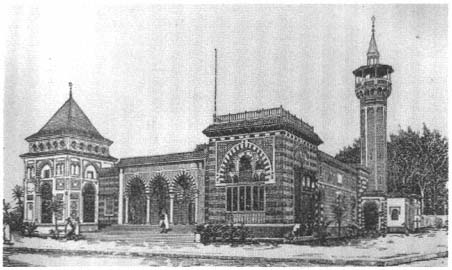
Figure 89.
Tunisian palace, Paris, 1889 (Monod, L'Exposition universelle de 1889, vol. 2).
Tunisia, which became a French colony in 1882, was summarized in 1889 by an elaborate and ambitious pavilion (Fig. 89). Following what could now be called a tradition in colonial representations, the young architect Henri-Jules Saladin incorporated architectural motifs from various monuments of Tunis into the facades of this "sober and elegant" building. A portal came from the Sulaymaniyya Madrasa and a facade from the Great Mosque of Kairawan, the dome and the minaret recalled the Sidi ben-Arous, verandas and musharabiyya s evoked the old houses of Tunis, and the tiled courtyard with a fountain in the middle was a feature of many Tunisian buildings. Tiles with floral motifs in blue and yellow, inspired by the tiles of the Bardo Palace, covered the walls. The building featured agricultural products and archaeological objects as well as schoolbooks that recorded "the progress achieved" under French rule.[83]
In the crowded Tunisian quarter of the Universal Exposition in Paris in 1900, again designed by Henri-Jules Saladin, there were two replicas of mosques. The first, a copy of the Mosque of Sidi-Maklouf in Kef, actually served as a mosque where Muslims could go for their daily prayers.[84] The second, a copy of the seventeenth-century Mosque of Sidi-Mahres in Tunis, then abandoned and in
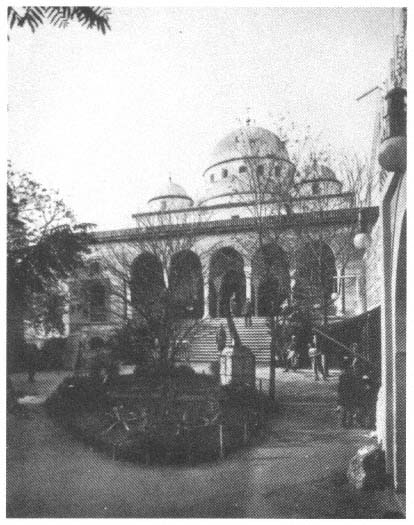
Figure 90.
Tunisian palace, Paris, 1900 (Exposition universelle internationale
de 1900, Paris, 1979).
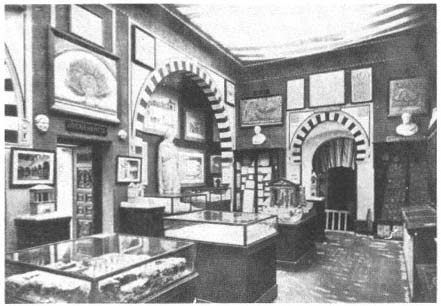
Figure 91.
Interior of the Tunisian palace, the archaeological section, Paris, 1900
(L'Exposition de Paris, vol. 3).
ruins, was transformed into an exhibition hall to display the agricultural, industrial, and commercial products of the regency (Figs. 90–91).[85] One room was reserved for documents pertaining to colonization, another for representative artwork from Tunisia's rich history.[86] Observers agreed enthusiastically that this white-domed "mosque" lacked only the light of the Tunisian sun to be real. To lend "authenticity," the moldings (geometric interlacings) were made in Tunisia by local artisans and shipped to Paris. The resident general of the colony, René Millet, joked that this replica—this "jewel"—lacked only the cow that had turned it into a stable back in Tunis.[87] Once again underscoring the building's authenticity, a French journalist sympathized, tongue-in-cheek, with the native who did not understand why he was not allowed to pray in this "mosque."[88]
The architecture of the Algerian and Tunisian colonies of France projected an image of Islam correlating with that of the noncolonial presentations. Yet the indigenous character of the pavilions played a different role in the colonial context, aggrandizing the image of France by making it more varied and complex. The greater the spectrum of differences in colonized cultures, the stronger was the impression of the colonizer's power and the vastness of his
domain. One French observer asked: "Are we not a grand Muslim nation, given our vast African colonies?"[89] In effect, the Islamic colonies were only a small part of the much larger French empire, which included West Africa, the Congo, Madagascar, Indo-China, and islands in the Caribbean. Pluralism suggested the empire's universality.