
6
The first sales in Villaverde were concluded in September 1799,[49] and the last of which I have a record took place in May 1806.[50] Within this period 221 of the 1,354 arable plots were sold and 9 out of 101 meadows: 19 percent of the land according to its value. Two houses were also sold.[51] Between the making of the catastro and the disentail the proper-
[49] AHPS, Contaduría, libro 850, f. 404r.
[50] Ibid., libro 856, f. 152r.
[51] Most of the properties can be identified in the catastro, but because this document does not give accurate names of all the religious institutions that owned land in Villaverde, some can only be identified on the basis of size, quality, and number of plots involved andby a process of elimination. Three plots sold do not appear to have been recorded in the catastro at all, but their value can be calculated from their size and quality. The Villaverde sales are in the following sources: ibid., libro 850, ff. 400v, 404r; libro 851, ff. 154r, 162v, 165r, 181v–191r; libro 852, ff. 123r–125r, 131r–137r; libro 853, ff. 112v–117r; libro 854, ff. 57v–58v; libro 856, f. 152r–v. Sales recorded in Madrid not entered in Contaduría are C1291, C12681, C15981. C19980, C31845, C31872. Vecinos of Villaverde bought some lands outside the town: AHPS, Contaduría, libro 851, ff. 94r–95v, 223r, 253r, 285v; libro 853, f. 102v; libro 855, f. 32r; libro 856, ff. 94r, 97r.
ties of four laymen (31 plots, 1 meadow, and 1 house) had been transferred to religious endowments and were among those disentailed.[52] In two cases these properties were purchased by vecinos of the same town as the 1752 owner, so that there was no net change of type of owner.
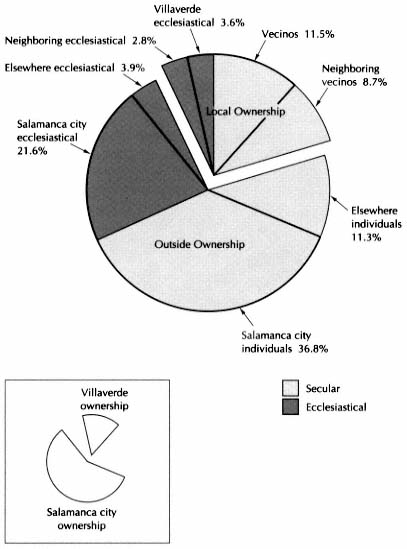
The situation after the disentail in 1808 is compared to that of 1752 in Table 8.29 and Figures 8.2 and 8.6. The change in ownership of land was not so extensive as in La Mata, where 42 percent of all land changed hands. The main cause of the difference was that ecclesiastical endowments owned less land in Villaverde, for they also lost massively here, 38 percent of their land being sold. The parish church and its funds were most affected, losing 53 percent of their property. In absolute terms, however, the religious institutions of Salamanca suffered most: their share of the town property fell from 33 to 22 percent.
A more significant difference between the two towns was in the buyers. La Mata's vecinos bought 55 percent of the property sold, Villaverde's only 16 percent. Vecinos of towns near La Mata bought 8.5 percent, vecinos of towns near Villaverde only 2.3. Nearby vecinos had made two bequests of land in Villaverde to religious foundations since 1752, and this land was now bought by residents of Salamanca, with the result that the share belonging to nearby vecinos declined by a fifth. Disentail did help the vecinos of Villaverde redress their position vis-à-vis their neighbors, extending to ownership a process that had been going on in rentals for several decades. In the sales Villaverde farmers acquired twenty-two plots and a meadow outside the término, while nearby vecinos bought only seven plots in Villaverde. The gain was modest, and on the whole the disentail hurt the town economy slightly. By contrast in La Mata the value of land in local hands almost doubled.
The massive buyers in Villaverde were residents of Salamanca, who
[52] Twenty-two plots owned in 1752 by the priest of Gomecello, Villaverde, maest. ecles., ff. 213–20; sold, AHPS, Contaduría, libro 851, ff. 154r–158r; two plots owned in 1752 by a vecino of Salamanca, Villaverde, maest. segl., ff. 217–31; sold, Contaduría, libro 851, f. 186v; four plots, one meadow, one house owned 1752 by a sister and brother in Pedrosillo el Ralo, Villaverde, maest. segl., ff. 275–79, 283–87; sold, Contaduría, libro 850, f. 404r; and three plots probably owned in 1752 by a vecino of Espino de la Orbada, Villaverde, maest. segl., f. 323, sold, Contaduría, libro 853, f. 115v.
| ||||||||||||||||||||||||||||||||||||||||||||||||||||||||||||||||||||||||||||||||||||||||||||||||||||||||||||||||||||||||||||||||||||||||||||||||||||||||||
bought 64 percent of the property sold and raised their share of the village's land from 25 to 37 percent. Residents of other distant places also increased their share. Among these individuals was don Francisco Alonso y Moral of Salamanca, one of the largest buyers in the province. He made five purchases totaling sixty-three plots and four meadows, 4.7 percent of the property in the town, as well as a house. Don Lorenzo Piñuela, a priest and prebendary of the Salamanca cathedral, in two purchases acquired forty-two plots, while don Cosme de Trespalacios, an advocate of Madrid, bought thirty-six plots and a meadow. Together these three gentlemen acquired two-thirds of the land sold in the town. We shall meet them again in Chapter 20, when we consider the persons who obtained most from the disentail.
Thirty-two people bought land in Villaverde. Table 8.30 gives their identity and the percent of the land in the town that each bought. The list shows a clear pattern. Residents of Salamanca and Madrid dominate the top quarter; they are seven of the top eight buyers. Vecinos of Villaverde make up most of the next quarter. Those in the bottom half of the
| ||||||||||||||||||||||||||||||||||||||||||||||||||||||||||||||||||||||||
| ||||||||||||||||||||||||||||||||||||||||||||||||||||||||||||||||||||||||||||||||
list, people who mostly bought only one or two plots, had scattered residences, two certainly and two probably in Salamanca, one in Valladolid, and eight in nearby towns.
Chance did not dictate this pattern. On the whole, lands were purchased by residents of the place in which the religious institution that owned them was located. Twenty-seven of the 28 plots and all 3 meadows that the vecinos of Villaverde bought belonged to the funds of their church. Residents of Salamanca bought most of the holdings of Salamanca institutions, all but 34 of their 148 plots (29 of the other 34 went to Trespalacios, a vecino of Madrid who soon was to move to Salamanca). Vecinos of Villaverde would have found it difficult to bid for most of these properties, for they formed parts of endowments that consisted of plots scattered over various towns and, sold in blocks, were beyond the means of any local farmer. One may recall, however, that two buyers of La Mata were able in at least one case to bid on and buy those plots that lay within their town and neighboring Narros of a large endowment that spanned other towns. Vecinos of Villaverde did not achieve any such success. And when the large property of a confraternity of Villaverde, 25 plots and 2 meadows, went on sale, Alonso y Moral stepped in to acquire it.[53] He had to pay more than the assessed value in hard currency to get it, seventeen thousand reales, which he would not have done unless forced to by competing bidders. One suspects that the vecinos made a concerted effort to get these lands but failed before his wealth. In comparable circumstances, the vecinos of La Mata obtained the vast property in their término of the General Hospital of Salamanca.
Nine vecinos bought land in the town, two of them and five others bought land outside. Among these fourteen were four women. What can we tell about them? Our main source of information is the tithe book; except for two of the women, all their names appear in it at sometime or other. They were seven labradores, two labradoras, two senareros, and a priest. That is, nine of the fourteen were already full-time farmers.
The largest purchaser was the priest, don Alonso González. The parish supported two clergymen, the curate and the beneficio simple servidero, holder of a capellanía without specific duties. The census of 1786 identifies don Alonso as the latter person. In 1752 the holder of this capellanía had not been resident, but don Alonso's name appears on the tithe register as a senarero from 1774 to 1797. He bought one plot in
[53] AHPS, Contaduría, libro 853, ff. 112v–114r.
1800 for 7,700 reales, which had belonged to the benefice he held;[54] the same year he headed a group of six buyers who purchased two plots in Villaverde and ten plots, one meadow, and two vineyards in nearby towns.[55] These properties had formed the endowment of another capellanía of Villaverde, which don Alonso may also have held. The purchase seems to have been a family affair: besides don Alonso there were three other Gonzálezes, Antonio and Manuel, labradores of Villaverde, and Josepha. The two other buyers were María and Isabel Albarez, sisters perhaps, the last a vecina of Negrilla. They paid 30,620 reales, a respectable sum. We do not know the source of this capital or how much each person's share was. Don Alonso had the income of his benefice; Antonio and Manuel were small labradores. Antonio disappeared after 1802, and Manuel died after the harvest of 1804. The priest was evidently the driving force of the group. He was no longer farming, probably because of his age, and so he rented his newly purchased fields.
Several of the other labradores who bought lands were among the upper third of the farmers, and it is easy to explain their resources. Manuel Romo Borrego, who spent about 3,900 reales for three plots and a meadow as his share of a purchase made in 1801 by three vecinos (one of whom, Manuel González, has already been mentioned), was an elderly and distinguished member of the community.[56] We first find his name simply as Manuel Romo in 1766, when he shared a lease for the lands of the monastery of Discalced Franciscan Nuns of Salamanca in Villaverde and six surrounding towns.[57] His name is regularly in the tithe book from its inception in 1773, and in 1786 he signed the census return as one of the two alcaldes of the town. He was second tither in 1798–99, with an annual net income from harvest in excess of 150 EFW. At 1800 prices (43 reales for a fanega of wheat in Salamanca) he could have had much more money put away than he spent on his purchase. Manuel Romo Martín, a tither since 1786 (his appearance was the cause of the other Manuel Romo adding his matronymic surname Borrego), was the third of the men making the joint purchase in 1801. He bought four plots for about 2,800 reales. In addition he and Gerónimo Romo together purchased two plots in Pajares, the next town to the north, paying 5,170 reales.[58] Manuel Romo's net income from harvest of 135 EFW would have permitted him to save the total of these
[54] Ibid., libro 851, f. 162v.
[55] Ibid., ff. 94r, 182v, 223r, 253r, 385v.
[56] Ibid., libro 852., ff. 133r–134v.
[57] AHN, Clero, libro 10854, ff. 111–21.
[58] AHPS, Contaduría, libro 856, f. 97r.
purchases by himself in five years. Since Gerónimo Romo appears to have been the heir of Manuel Romo Borrego (on the latter's death, he took over his lease to the lands of the Franciscan nuns), he could easily have paid whatever his share was. The labradora Juana Encinas was the widow of Juan Rodrigo, who died in 1798.[59] Rodrigo had been on the tithe register since its inception, and in 1786 he signed the census as the second alcalde. Before his death he had risen to be third tither, just below the other alcalde. When his widow first appeared on the tithe lists in 1798–99, she was sixth, having given up some of his leases. Her net income from harvest averaged about 135 EFW. In 1803 she bought four plots for 5,409 reales;[60] she would not have had trouble financing the purchase.
Where the others got their money is less clear. Josef Carvayo, fourth largest buyer among those of Villaverde, was thirteenth in the ranking of harvests for the years 1798–99 with an annual net income from harvest of about 120 EFW. In 1801 he bought six plots in Villaverde for 12,100 reales.[61] Perhaps he saved forty fanegas of wheat a year, at current prices over an eighth of his purchase, but since prices had risen recently, his purchase represented a minimum of nine or ten years' savings, or less if he paid in vales reales (the contaduría records do not specify the form of currency). He had been on the tithe rolls since 1791, but one suspects that he had an inheritance or other income. Mariana Martín, the other labradora, bought five plots in Pajares in 1806, paying 5,000 reales.[62] She first appeared in the tithe rolls in 1804; in 1807–8 she was sixteenth tither, putting her at the top of the group that netted about 100 EFW in 1795. It would have been hard for her to save the price of her fields; she was probably a widow with inherited wealth. The origin of the capital of Francisco Laso, the last of the labradores who bought land, is the most difficult to understand if it came only from farming. He appeared on the tithe rolls in 1798 almost at the bottom of the labradores. In 1803 he bought six fields lying outside the town, four of them in La Cañada and La Cañadilla, paying the relatively modest sum of 2,620 reales.[63] Farming could hardly have provided his savings; did he engage in other activities? We do not know.
I have classed the other two local purchasers as senareros, although
[59] She took over his lease to the lands of the monastery Nuestra Señora del Jesús in 1799 (AHN, Clero, libro 10668, f. 217r–v).
[60] AHPM, C31872.
[61] AHPS, Contaduría, libro 852, f. 132v.
[62] Ibid., libro 856, f. 94r.
[63] Ibid., libro 855, ff. 32r, 32v.
the identity of one is in doubt. This is Manuel Martín, who paid 6,250 reales in hard currency for a large plot in 1803.[64] His name appears only once in the tithe book. in 1801 as a senarero. Was this unlikely person the buyer, or did the notary in Madrid corrupt the name of Manuel Romo Martín the labrador, who could easily have added this to his other acquisitions? There is no doubt about the identity of the second senarero, Cayetano Prieto. He first paid tithes in 1800. In 1802 he bought five plots and two meadows in two separate purchases, paying altogether 3,500 reales. Furthermore he paid this in hard currency at more than the minimum price; he had beaten out other bidders.[65] His case is particularly interesting. Listed as a senarero until 1806, he appeared as a labrador in 1807 and 1808. In 1798–99 his harvest was about 38 EFW; in 1807 it was 145 and in 1808, 117. Yet the plots he bought produced only 10.5 fanegas per year in 1752, so that most of his harvests in 1807–8 came from rented lands. Whatever his profession before the disentail, he seized the opportunity to buy land and went on to become a labrador.
Prieto's case reveals the economic mobility induced by the sales, not as striking in Villaverde as in La Mata but clear in some cases. Manuel Romo Martín had the ninth harvest in 1798–99; by 1807–8 he was sixth. Josef Carvayo was even more successful: number thirteen in 1798–99, he rose to number two in 1801–2 and was still there in 1807–8. One recalls that his resources are not clear; it is clear that he had great individual drive. At a lower level, Francisco Laso, among the poorest labradores in 1798–99, after his purchase in 1803 rose to be tenth by 1807–8. Two purchasers did not advance, but in both cases their age can account for their declining harvests. The widow Juana Encinas, number six in 1798–99, fell to number twelve in 1807–8. Since her late husband was already farming in 1773, she was probably getting too old to administer all her leases and passed on some to others. The alcalde Manuel Romo Borrego was number two in 1798–99, dropped to number seven in 1801–2, and died after the harvest of 1803. He had been farming since at least 1766; age and infirmity may have forced him to restrict his activities.
In none of these cases do the lands purchased alone account for the change in status. Josef Carvayo's six plots produced 13.5 fanegas of wheat in 1752, his gross harvests went from about 245 EFW in 1798 to almost 700 in 1807–8. His is only the most striking case. As in La Mata, the purchase of lands evidently made a farmer a more attractive
[64] AHPM, C31845.
[65] Ibid., C19978, C19979; AHPS, Contaduría, libro 853, ff. 114v–115r.
tenant, and he could extend his leases at the expense of his more passive neighbors. Here, as in La Mata, disentail reversed the trend toward flattening out the income curve of labradores. In 1798–99 the top tither on the rolls (second after the casa excusada) paid 4.3 percent of the tithes collected; in 1807–8, 6.0 percent. The top five tithers listed in 1798–99 paid 20 percent of the tithes; in 1807–8, 26 percent.
Most of the purchasers were in the top half of the labradores, those with excess income, but they were scattered through this group. Only three of the top ten in 1798–99 bought land. They included number two and the widow of number three but not the head of the casa excusada nor the cuarto dezmero.[66] The well-to-do of the town benefited as a group but not all the richest individuals, only those who leavened their resources with personal ambition.
Religious institutions and endowments had owned 48 percent of the land; their share was reduced to 32 percent. In La Mata the transformation favored the town. In Villaverde this was not the case; after disentail the land controlled by the town, its church and residents, including land outside the término, had declined slightly. The formula established earlier indicates that the rent paid by the vecinos to nonresident owners increased about twenty fanegas of wheat per year as a result of the sales. The amount is small, hardly affecting the town economy, but it is symptomatic of the fact that desamortización did not help Villaverde. The wealthy citizens of Salamanca, by acquiring more than the churches of the city lost, raised the city's share of Villaverde slightly. Villaverde remained as much an economic dependency of Salamanca as before, despite the gains it had made in the second half of the eighteenth century.
At first sight, the failure of Villaverde to do better comes as a surprise when one considers the success of La Mata. At this time their populations were about the same, but the vecinos of Villaverde spent only about 74,000 reales on disentailed land, those of La Mata 251,000. La Mata's major success, the purchase by sixteen vecinos of the properties of the General Hospital of Salamanca, for which they paid 174,000 reales, was led by a man addressed as don who was a newcomer to the town. This man may have brought a major share of this capital with him. Nevertheless, one would have to credit the other vecinos with providing at least 150,000 of the 251,000 spent, twice the amount of those of Villaverde.
The vecinos of Villaverde could not compete with the buyers of Sala-
[66] The casa excusada and cuarto dezmero are identified in the tithe roll of 1804; they were Manuel Escudero and Antonio García. Neither was a buyer.
manca for large blocks of properties scattered across a number of towns, but they let escape lands in their own town that were easily within their reach: eleven plots and four meadows bought in 1800 by a resident of Salamanca for only 9,285 reales, two small plots of first quality land that went to another buyer in Salamanca in 1801 for 800 reales, and the only properties of the General Hospital in Villaverde, seven plots, bought by a vecino of Salamanca in 1806 for only 8,150 reales.[67]
Since the middle of the century, the vecinos had improved their economy substantially. When disentail began, their estimated per capita income of 17.5 EFW was not far below that of La Mata, 20 EFW. Yet they did not take advantage of the royal decree as the vecinos of La Mata did. A number of reasons have come to light for their differing responses. Villaverde had only recently recovered from what appears to have been a long, drawn-out depressed economy. According to the data, at midcentury it had a lower yield-seed ratio, higher rents, and heavier royal taxes than La Mata; a large sector of its population engaged in declining crafts; and its arrieros followed less remunerative routes. Its physical aspect as well, with abandoned houses and an elegant old church, indicates a more prosperous past when artisans were thriving, more productive land justified higher rents, and the crown compounded its taxes at a corresponding level. Times had gotten worse, but the burdens of rents and taxes were fixed by tradition. La Mata had a more modest past, witness its taxes and its church, not completed until 1791. Since before the catastro it had experienced a heady growth, which led to its seizure of the opportunity of disentail.
The story of the two towns since the catastro was almost reversed, with Villaverde improving its economy and La Mata struggling to stay where it was, and this may be the major factor in the difference in their responses. With rapid population growth induced by the town's prosperity, La Mata's farmers had declined relative to the population of the town as a whole. For a while in the 1780s the despoblado of Narros offered them a way to keep their marginal productivity from falling, but when it became a separate town in 1789, they lost this resource. The town was still prosperous; the families had savings accumulated over recent generations; and the labradores with large harvests had immediate means to pay for purchases, as did the arrieros, whose position had not declined. Disentail offered them a possible way out of their straits, and one that looked especially attractive at a time of high grain prices. The pressure of circumstances encouraged them to unite against the
[67] AHPS, Contaduría, libro 851, f. 181v; libro 852, f. 123r; libro 856, f. 152r–v.
world represented by their landlords in Salamanca, as they did in buying the lands of the General Hospital.
It would be hard to argue that the labradores of Villaverde were less enterprising than those of La Mata, for the remarkable expansion of their harvests, in part at the expense of neighboring towns, shows that as a group they had plenty of drive. Rather, one can say that for Villaverde the disentail came at a less opportune moment. Prosperity had come more recently, and the cause of it, the expansion of farming into the two despoblados anexos of the town, was still working. Families probably had fewer savings, and labradores could see less advantage in buying land when they could rent virgin soil relatively cheaply next door. In economic terms, the opportunity costs of investing in disentailed land were higher for the farmers of Villaverde, and so they let slip out of their grasp some easy acquisitions.