
The Growth of Paris in the Late Nineteenth Century
The transformation of Bobigny was part of the general development of a suburban belt around Paris after 1860. Paris had suburbs well before the late nineteenth century (the Latin Quarter was originally one); but in this period its suburban area increased to cover most of the Department of the Seine. In the process the city of Paris itself was transformed (Map 2). Suburbanization was merely the most visible redivision of urban functions that population growth and economic change produced, in their increasing capitalist imprint on the metropolitan area. The patterns of production and consumption, of work and leisure that developed in the suburbs differed in many ways from those of Paris; in effect the suburbs were a new urban form.
In the first half of the nineteenth century Paris grew at an impressive rate, from a population of 546,856 in 1801 to one of 1,174,346 by 1846. The population's increase in the second half of the century was even more spectacular. By 1901 the population had increased to nearly two and one-quarter times that in 1851 (Table 1).[20] In the most dramatic period of population increase, from 1851 to 1856, Paris grew by over 20 percent, adding a quarter of a million inhabitants.
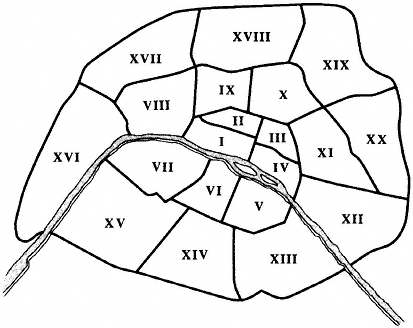
Map 2.
Paris after 1860. From Norma Evenson, Paris: A Century
of Change, 1878–1978 (New Haven, 1979), p. 363.
TABLE 1 | ||
Year | Population | Percentage |
1851 | 1,227,064 | 100 |
1861 | 1,696,141 | 138 |
1872 | 1,851,792 | 151 |
1881 | 2,269,023 | 185 |
1891 | 2,477,957 | 202 |
1901 | 2,714,068 | 221 |
SOURCE : Louis Chevalier, Laboring Classes and Dangerous Classes (Princeton, 1973), p. 182. | ||
As was the case from 1800 to 1850, the growth of Paris in the late nineteenth century derived from immigration, not natural increase. The excess of births over deaths in Paris was even lower than in the first part of the century; at no point did it exceed 1 percent from 1860 to 1900. More than ever before in its history, the population of Paris was failing to reproduce itself and turned to the provinces to renew its ranks.[21]
Although immigration dominated in peopling the city throughout the nineteenth century, immigrants who came after 1850 differed in many ways from those who had preceded them. They no longer came mostly from northeastern France but came increasingly from all over the country. The number of immigrants from Lorraine (incorporated into Germany in 1871) declined, whereas from Brittany and the massif Central the number rose. Thus a much larger percentage of the new Parisians came from poor, less developed areas. The Great Depression of the 1870s to the 1890s brought hardship to many French peasants and forced those living a marginal existence off the land altogether; the development and expansion of the national railways ensured that many of the dispossessed eventually made their way to Paris.[22]
The greater percentage of immigrants from impoverished regions may explain why the new immigrants were more homogeneously working class than the old; no longer could it be said that migration to Paris was "a conquest and not a defeat."[23] In addition, more of these workers were unskilled, in contrast to the skilled workers and artisans that the city had traditionally attracted. The annexation of the inner suburbs in 1860 had already added a working-class population of 350,000 to Paris; the new immigration further increased the proletarian character of the city's population.[24]
This proletarian shift arose from changes in the Parisian economy of the late nineteenth century. The wave of immigrants in the early 1800s had been prompted by an expansion of the traditional artisanal industries of Paris. The growth of the city itself increased the need for workers, especially in the construction industry. The high point of this expansion came in the 1850s and 1860s, when the renovations of Paris directed by Baron Haussmann produced an unparalleled boom in both construction and immigration.
Yet after 1860 modern large-scale industries began to assume a larger role in the economy of the Paris area. More traditional sectors like textiles declined, whereas newer sectors like the metallurgical industries employed an increasing share of Parisian workers. By the turn of the century the metropolitan area was home to a large and
prospering heavy industrial sector organized along more modern lines of production. Even though most industries were located in the suburbs of Paris, by 1896 the city itself had well over two thousand factories employing more than twenty workers, of which over two hundred utilized a work force greater than one hundred. By 1900 Paris had definitely entered the industrial age.[25]
The rise of a modern industrial sector in Paris depended not on any natural resources or advantages the region possessed, but rather on the city's position as the national capital and largest urban area in France. Of crucial importance was its place as the national center of railroad freight traffic. Major merchandise railway stations created at La Chapelle, Saint-Ouen, and elsewhere in Paris and its adjacent suburbs in this period facilitated the shipment of raw industrial materials to the city's factories. Developing freight railways and a system of ports gave Parisian manufacturers increased access to national and international markets, so that the rise of Paris as an industrial center in the late nineteenth century was linked to the development of an integrated national market.[26]
This period's increasingly complex industrial organization and more sophisticated investment banking made access to credit markets a factor in the success or failure of a given firm. Since Paris was the country's financial center, it gave an advantage to French industrialists who located their operations there. And in this cyclical process, the presence of a large and diverse working-class labor force in Paris, attracted by the capital's broad range of employment opportunities, provided a further incentive for businessmen to establish factories in the area. The high quality of this labor force, no longer dominated by trained and highly specialized artisans but still skilled, was an additional attraction. After 1860, through its economic power and geographic distribution, industrial capitalism had a large part in shaping the landscape of the Paris area and contributed significantly to the rise of suburbia.[27]
In analyzing the rise of a suburban belt around Paris in the late nineteenth and the early twentieth century, we must examine the changing living conditions that faced workers in Paris. The city's increasing inaccessibility to the working class in the late nineteenth century was a key factor in developing the suburbs of the Department of the Seine.
We have touched on Baron Haussmann's renovation of Paris after 1860 and the changes it caused in the social fabric of the City.[28] The impact on the Parisian popular classes was twofold. First, by demol-
ishing many ancient slums in the Ile de la Cité and the central Right Bank, Haussmann's reforms drove many workers out of central Paris into the outer districts (especially the nineteenth, twentieth, and thirteenth arrondissements) annexed to the city in 1860. (The new social configuration emerged in the failure of the communards to hold the city center during the last bloody days of the Paris Commune of 1871, when they retreated to make a final stand on the city's eastern periphery.) By depopulating the center, Haussmann's reforms sharply increased Parisians' residential segregation, for as the working class moved to the northern and eastern edges of the city, middle-class and wealthy inhabitants moved into newer quarters in the western part of Paris, especially the sixteenth arrondissement. The Parisian working class was more spatially marginalized and isolated from its neighbors; before long the majority of this class would be forced out of the city altogether.[29]
Concomitant with the greater concentration of Parisian workers in the outer districts of the north and east was their intensified overcrowding. The Parisian population increased most in the outer districts. From 1861 to 1896 the population from the eleventh arrondissement through the twentieth grew by 103 percent, whereas that of the first arrondissement through the tenth grew by only 7.1 percent. These areas had been sparsely populated suburbs fifty years earlier and were thus poorly equipped to house large numbers of newcomers. In many cases people moved into former single-family houses, subdividing them into small individual housing units. Attics, basements, and even stables were converted into apartments. Many working people, both individuals and families, lived in furnished single rooms known as garnis, notorious at the time for their unsanitary condition. Some of the poorest Parisians even resorted to building their own shacks on open land at the edges of the city; these squatters' settlements were merely the most dramatic example of the dire shortage of moderately priced housing in Paris during the late nineteenth century. The 1896 census revealed that 14.9 percent of the city's population lived in overcrowded housing; the percentages for the thirteenth, nineteenth, and twentieth arrondissements were 64.2, 65.5, and 66.0 percent respectively.[30]
Haussmann's renovations of Paris helped create this overcrowding, but they cannot explain it. Of greater immediate importance were the patterns of housing construction in Paris during this period. The housing industry was active in the late nineteenth century, with the construction of new dwellings reaching a peak in the years 1875
through 1884; most houses were built in the outer districts, which had the greatest vacant space. Yet it was the wealthier arrondissements of the western end of Paris that benefited, not the more proletarian ones to the east. From 1878 to 1889 the amount of available housing in the sixteenth district rose by 62.7 percent, while its population increased by 47.2 percent; by contrast, the thirteenth district experienced a 41.6 percent increase in population but only a 29 percent rise in available housing stock. Moreover, much of the housing in the poorer arrondissements was built for middle-class residents. While new buildings in more prosperous neighborhoods stood vacant for lack of tenants (at least of tenants able to pay the high rents), those Parisians who most desperately needed good housing were least able to find it.[31]
There were several reasons for the failure of the Parisian construction industry to build sufficient low-cost housing in this period. To a much greater extent than before, housing in Paris was built by large companies that purchased extensive tracts of land for speculation rather than immediate construction. Speculation made it imperative to realize the greatest possible profits, and such profits did not come from building for working-class occupants. Much more lucrative was renting to members of the large new middle class, employed in branches of the tertiary sector like banking and commerce, whose incomes were both higher and more stable.
Government policies also discouraged the construction of low-cost housing. Municipal charges on owners of buildings adjoining public thoroughfares were steep and increased with each road improvement: these costs were passed on to tenants, and those with little to spend on rent could not afford them. Also, taxes on inexpensive buildings were proportionately heavier than on costly ones. Yet the essential problem lay elsewhere: the Paris construction industry in the late nineteenth century was composed of private entrepreneurs who built housing for monetary reward, not to fulfill a social need. Since there were plenty of middle- and upper-income people to build housing for, it is easy to see why the construction industry neglected the housing needs of the Parisian working class.[32]
Only major government intervention into the housing industry could have made a difference in this period. Yet neither city nor national government took significant action to deal with this crucial problem. Throughout the period many public officials expressed concern over the poor condition of working-class housing, seeing it as conducive to the spread of disease, moral degeneracy, and political instability.[33] Yet
these officials, holding fast to the tenets of economic liberalism, rejected state intervention in the housing market as illegitimate and as a first step on the road to collectivism.[34]
The sharp increase in population of the 1880s and the decrease in construction after 1884 did lead the Paris city council to consider a number of proposals to deal with the housing crisis, such as municipal guarantees for bank loans on low-cost housing and tax exemptions to builders of inexpensive rental units. The prevalent belief in the efficiency of the free market, however, prevented all such ideas from winning approval; a proposal by socialist city councillor Jules Joffrin for the construction of municipal housing was voted down in 1884 by a margin of four to one. Advocates of housing reform limited themselves to encouraging the efforts of private charitable societies. Yet these organizations contributed little to resolve the problem, either because construction was too unprofitable to attract outside investment or because the rental units that were built were too expensive for most working-class tenants.[35] The same logic that ruled the private construction industry effectively circumscribed philanthropic efforts for working-class housing.
The major example of government intervention to deal with the housing crisis came in 1894. Widespread public concern over the problem had led to the foundation of the Société française des habitations à bon marché (HBM) in 1889. A private organization, the society viewed its role as advisory, to encourage the construction of low-cost housing by private individuals, companies, and charitable organizations. Five years later the national government voted to subsidize the work of the society by offering fiscal exemptions and low-interest loans to builders of inexpensive housing units that met certain government specifications. Yet because local and departmental governments, charged by the national government with implementing the law, took few steps to do so, the society accomplished little in this period. Between 1895 and 1902 it built only 1,360 HBM dwellings in all of France.[36] Clearly, Parisian workers in the late nineteenth century frantically searching for affordable housing of decent quality could expect assistance from neither the Paris city council nor the national government.
One consequence of the insufficient low-priced housing in Paris was a rise in rents. Most workers in this period could not afford to pay rents of more than 300 to 350 francs a year. Yet because of the patterns in housing construction, the percentage of rental units available at such
prices was in decline. In 1880, 67.6 percent of housing units in the city rented for less than 300 francs; this percentage dropped to 47.6 percent by 1900. The absolute number of such units fell by 69,093 from 1880 to 1889, whereas the total number of rental units rose by 104,836. Parisian workers were forced to spend more of their meager earnings on housing: the proportion of an average working-class budget devoted to rent rose from 13.5 percent in 1862 to 18 percent in 1900. The shortage of low-cost housing and the resultant overcrowding of the working class in Paris also had serious implications for public health. The inadequate sunlight and air that characterized many modest dwellings undermined the health of their occupants, as did the rudimentary sewage and trash collection in poor neighborhoods; the crowded living conditions of the poor and working class facilitated the spread of contagious diseases. Consequently, in poor neighborhoods more than in wealthy ones mortality rates were high, especially for infants: from 1893 to 1897 the rate was 25 percent in the thirteenth arrondissement, 11 percent in the eighth.[37]
It is true that this gap cannot be attributed to housing alone; the poor quality and quantity of food consumed, among other factors, also had their effect. Yet if we look at death rates from tuberculosis, a disease closely related to housing conditions, we see an even more drastic gap. From 1896 to 1900 the rate of death from tuberculosis was close to five times as high in the poor twentieth district as in the wealthy eighth. The housing crisis was thus a factor in the inequality before death that separated Parisians in this period.[38]
It must not be thought that Parisian workers accepted their situation with equanimity. Hatred of the landlord was a common theme of the period, as reflected in popular songs referring to the landlord as "M. Vautour" (Mr. Vulture) and suggesting that he be hanged from the nearest lamppost:
If you want to be happy
In the name of God,
Hang your landlord![39]
Political groupings that appealed to a working-class clientele played up the poor living conditions of the Parisian working class. Yet the political dominance of capitalism and the government's determination to preserve housing as a free-market activity forestalled any solution to the crisis of working-class housing conditions. In spite of a slight easing of these conditions after the 1880s, any real solution seemed to be as far
away as ever.[40] Bertillon and DuMesnil studied the housing problem in the poorer areas of Paris near the end of the century, noting the persistence of overcrowding and poor sanitary conditions.[41] By 1900 the basic question—Where is one to live?—still had no answer for the workers of Paris.
Within the context of this question we must now shift our focus from the city of Paris to the Paris suburbs in the late nineteenth century. In the rise of the suburbs we will find a partial answer to this question.