
II. Spirit Possession in the Sambirano
5. The World of the Spirits
Tromba possession is the quintessence of Sakalava religious experience. Throughout Madagascar, ancestors and other spirits are an important aspect of everyday life, yet no form of possession is more widespread than tromba (see Estrade 1985). For the Sakalava, the spirit world is inhabited by royal and common ancestors, lost souls, nature spirits, and malicious, evil spirits. Tromba, as the spirits of dead Sakalava royalty, are the most significant and influential in terms of daily interactions that occur between the living and the dead. As Huntington has observed, the “royal ancestors belong, in one sense, to everyone” and are regarded as “the ‘national ancestors’ ” of the Sakalava (Huntington and Metcalf 1979: 95).
Tromba as an institution provides keys for understanding Sakalava notions of the world, offering explanations and solutions for misfortune. It is also an important part of any major celebration. Tromba spirits affect the lives of both Sakalava royalty and commoner, and they are active in public and private spheres. These spirits appear in such diverse contexts as royal events, healing rituals, after the birth of a child, and during domestic disputes. Furthermore, a tromba ceremony may be viewed as an encapsulation of Sakalava experience in time and space. Tromba spirits enable Sakalava to record and interpret historical experience. They also offer ways to understand how Sakalava perceive the local geography of their ancestral land and the nature of their responses to economic development. For these reasons, one can not fully understand what it means to be Sakalava without understanding tromba.
In the past, tromba possession was a purely Sakalava institution, tying the living to the dead, and commoner to royalty. Although tromba in Ambanja continues to be a marker of Sakalava identity and tera-tany status, it has undergone radical transformations during this century. Accompanying the increased immigration of non-Sakalava to this region, there has been an explosion in the incidence of possession within the last thirty years, involving the incorporation of new tromba and other spirits and the participation of peoples of diverse ethnic backgrounds. When Malagasy speak of Ambanja, they often remark that there is a lot (misy tromba maro) or, perhaps, too much tromba (laotra ny tromba!). Today the incidence of possession in Ambanja is high when compared to other regions of Madagascar as well as neighboring areas of Sakalava territory.
Discussions of the causes of spirit possession are best argued when rooted in the internal logic of the culture in which they are found (cf. Boddy 1988: 12, who in turn cites Crapanzano 1977a: 11). The interpretation becomes flawed and misleading if it draws exclusively from Western conceptualizations of the body and mind as distinct categories, a notion that only distorts indigenous notions of possession (see also Scheper-Hughes and Lock 1987). The purpose of this chapter is to give the reader a general impression of what possession looks like and to provide an overview of the Sakalava spiritual world.
| • | • | • |
The Dynamics of Tromba in Daily Life
Tromba are perhaps the most well-known—and best documented—of the spirits of Madagascar. The term tromba is sometimes used in Madagascar in a general sense to refer to any form of possession. In the strictest sense of the term, tromba are the spirits of dead Sakalava royalty (ampanjaka) whose lineages are based throughout western Madagascar.[1] The recent proliferation of spirits in Ambanja is rendering this definition of tromba increasingly problematic. Today, tromba continues to play an important part in preserving records of these royal genealogies, providing a shorthand account of the succession of royalty (most often rulers). In recent years it has also become a more flexible category so that it now includes a wide assortment of other spirits. They, like their mediums, are in a sense “strangers” to these lineages, since not all are important rulers from the past.
Tromba in Royal Contexts
In the Sambirano one finds many types of tromba and other spirits. From a precolonial point of view, the key figures of the Bemazava spirit world are those that only appear in mediums on the island of Nosy Faly, in the village that guards the royal tombs (zomba, mahabo). These are the oldest and most powerful of the Bemazava ancestors, and they are often referred to as the tromba maventibe, or the “greatest tromba.” Each of these spirits possesses only one medium, who is referred to as a saha (“valley” or “canal”). Saha live full-time at Nosy Faly (there were four living there in 1987), and their sole purpose is to serve the living royalty. Periodically, members of the royal family come to pay tribute to or consult their ancestors (cf. Baré 1980, especially chap. 6). Since it is forbidden for rulers to approach the royal tombs when they are alive, their personal counselors regularly visit the island to seek advice on issues that affect the well-being of Bemazava royalty and, more generally, tera-tany who inhabit the kingdom.[2]
Two assumptions are central to Sakalava tromba: that all spirits were royalty when they were alive, and that any member of the royal lineage may become a tromba spirit after death (this usually takes about twenty years). When a great royal tromba possesses a medium, it takes her to the tombs: in other words, she will travel to and arrive at the tombs in trance. The royal guardians (ngahy), who reside at the tombs, will test the tromba spirit to make sure it is the ancestor it claims to be. I have heard two accounts from living royalty who have been summoned to the tombs to help administer and witness an examination of a tromba. In both cases the spirit passed, since it was able to pick out personal possessions from a pile of paraphernalia presented to it by the ngahy, and it described the appearance and location of an item that was in a private area of a witness’s house.
The recent proliferation of lesser spirits outside of Nosy Faly make it necessary to distinguish between different types of tromba spirits. Kent (1968) and other authors (cf. Lombard 1973 and Baré 1980) use the term dady to refer to the royal cult of ancestors and tromba to refer to other Sakalava possessing spirits. Perhaps these definitions were true in the past in Ambanja, and they are used elsewhere in Madagascar (see Lombard [1988] on the southern Sakalava of Menabe). In Ambanja, however, the medium serves as the point of reference and the means for distinguishing between these spirits. Royalty and commoner alike draw distinctions between the great tromba of Nosy Faly and other spirits who appear in town by saying that only a medium who has passed an exam (and who usually then takes up residence at the royal tombs) may be referred to as a saha. When speaking of other mediums one simply says that she “has a tromba” (misy tromba, lit. “there is a tromba”). Today the term dady, which means “grandparent,” is a generational term used to refer to the tromba spirits of the greatest age and stature. The founding ancestor of the Bemazava, Andriantompoeniarivo, for example, is affectionately referred to as dadilahy (“grandfather”) by living royalty. This spirit’s saha, in turn, is referred to as dadibe (meaning “big-” or “great-grandmother”). This is because a medium is structurally defined as the spouse of her spirit (see chapter 7).
Unfortunately, it is cumbersome to refer to the medium’s status in order to distinguish between these two types of possession. For this reason I will use the spirit’s audience (and its function) as the point of reference when comparing these two forms. Thus royal tromba are the most important of the Bemazava ancestral spirits that appear only at Nosy Faly, and popular tromba are those that possess mediums in town. Since the town of Ambanja is the focus of this study, the reader should assume that I am speaking of the popular spiritual realm unless spirits are referred to specifically as “royal tromba.”
The Popularization of Tromba
The term “popularization,” as I am using it here, has several meanings. First, it refers to the shift in emphasis from royal tombs to the community of commoners. As in the past, royal spirits are central to the lives of royalty. Yet today Sakalava of common descent possess little understanding of the old order. Only elders have any knowledge of the roles and duties their own grandparents had in relation to living and dead royalty. For most Sakalava in contemporary Ambanja, the royal tromba and their saha seem distant and only occasionally touch their lives, since they are far away on the smaller island. Instead, it is the popular tromba spirits of Ambanja which are important for commoners. The respect that commoners express for royalty is manifested in ceremonies that occur in town, involving spirits of much smaller stature than those that can be found at the royal tombs. Second, accompanying this shift from the tombs to town is the dramatic increase in the incidence of tromba possession over the last few decades. Older informants living in Ambanja report that in the 1940s and 1950s there was only a handful of mediums operating in town, possessed by the stately spirits of old royalty. These mediums assisted commoners, primarily as healers. Today tromba possession is widespread; my data collected throughout 1987 reveal that roughly 50 percent of all women are possessed. Today, tromba possession touches the lives of nearly all of this town’s inhabitants, since almost everyone either knows a medium personally, has consulted a tromba spirit, or has friends or kin who have done so. A third characteristic of popularization is that it involves widespread participation of non-Sakalava female migrants in what was previously an almost exclusively Sakalava domain (the ramifications of this proliferation—generally speaking and in reference to migrants—will be discussed in greater detail in subsequent chapters, especially chapter 7).
Fourth, popularization marks an increase in the number and types of spirits that are now identified as tromba spirits. Although the majority of these new popular tromba spirits are Sakalava, tera-tany often say that Tsimihety and other groups are responsible for bringing them from the south to Ambanja. In addition, recent trends reflect the incorporation of obscure royalty and, potentially, non-royalty into the world of tromba. Many of the spirits that now appear in Ambanja are not members of the Bemazava lineage but are distant kin, coming primarily from the region near Mahajanga. The vast majority of these spirits are obscure members of the Zafin’i’mena royal lineages. Although these spirits usually can be located in the royal genealogies, they are considered to be royalty of low status, for many of them died young without having ruled or accomplished much in their lifetimes. Finally, these new tromba spirits also reflect the nature of contemporary town life in Ambanja. Whereas the stories of the greatest royal tromba are well-known and cherished, few mediums in Ambanja know the details of the lives of popular spirits. The spirits active in town are not the staid and powerful royalty of the past, instead, they are cowboys, boxers, soccer players, and prostitutes. Their life stories often echo the experiences of people who live in the urban environment of Ambanja. They have been in automobile accidents, they like to drink and dance, they frequent boxing (morengy) matches, and several have died at the hands of their lovers or rivals.
The popularization of tromba is now beginning to reveal a shift away from royal status through the incorporation of a few non-royal spirits. The most important of these are spirits who are not direct descendants of royalty, but who are affines who appear to have achieved royal status over time and through association with other tromba spirits. Others are commoners who have retained their lower status after death. For example, a number of informants hoped that friends or kin who had died in a recent ferryboat accident would one day become tromba so that they could talk to them, and there is already a young woman in Ambanja who is possessed by her twin sister who died in this accident. I also know of a spirit whose dog, named Markos, has become a tromba, and these two accompany each other at ceremonies.
Another recent trend involves the incorporation of Christian personalities into the tromba world. In Diégo, the Virgin Mary (Masina Marie) occasionally appears in mediums. In 1988 John the Baptist (St. Jean) arrived in a medium in the middle of a Catholic service. This spirit stood and began to evangelize in the style of a Protestant pastor, infuriating the officiating priest. From a Sakalava point of view, these spirits are confounding, as they defy all rules of tromba. As one of my assistants wrote recently, “I do not consider St. Jean to be a tromba; he is really just some type of njarinintsy” (an evil spirit; see below). These examples are important, since they reveal that tromba is not a static institution but is dynamic and evolving.
The Organizing Principles of Tromba
There are several organizing principles inherent to tromba possession which are significant in both royal and popular contexts. First, tromba spirits (like all northern Sakalava royalty) are divided into two major descent groups: the Zafin’i’mena (“Grandchildren of Gold”) and Zafin’i’fotsy (“Grandchildren of Silver”). (These are abbreviated versions of Zafinbolamena and Zafinbolafotsy [see Lombard 1988]). Gold (vola mena, or “red money”) and silver (vola fotsy, or “white money”) are symbols of Sakalava royalty, and these metals are represented by the colors red and white during tromba ceremonies and other rituals. Thus, Zafin’i’mena tromba spirits dress in red and Zafin’i’fotsy dress in white.
Each descent group can be further broken down into a collection of lineages. Each of these corresponds to a different Sakalava dynasty that has its own royal tomb. Tromba genealogies serve as truncated versions of these lineages. Within each lineage, tromba spirits can be divided into three generational groups: the oldest are the Grandparents (dadilahy; grandmothers: dady), of whom the tromba maventibe (“very big” or “biggest tromba”) are the most powerful (and the ones that are generally only found at the royal tombs). Beneath the Grandparents are the “Children” (zanaka) and “Grandchildren” (zafy).
Since each spirit is tied to a specific royal tomb, it is also important to locate it within the context of Sakalava sacred geography. In this context, the tanindrazan̂a or ancestral land provides a way to refer to types of tromba spirits. Among the Zafin’i’mena, for example, there are baka atsimo (lit. “coming from the south”) who are from the region of Mahajanga.[3] Similarly, there is a category of Zafin’i’fotsy tromba which is referred to as the baka andrano (lit. “coming from the water”). These are the spirits of Sakalava royalty who, in the eighteenth century, chose to commit suicide by drowning to escape serving under their Merina conquerors (cf. Feeley-Harnik 1988: 73). It is the baka atsimo and baka andrano who appear most frequently at the ceremonies in town.
Finally, since tromba were at one time living persons, their deeds and personal histories are also important, and these are often reflected in their names. It is fady to utter the given names of Sakalava royalty after they have died. As noted earlier, after death, a royal person is given a new praise name (fitahina). If he or she becomes a tromba spirit, this is the name the spirit will adopt. For example, the former Bemazava ruler was Tsiaraso II; his tromba name is Andriamandefitriarivo, which means literally, “the ruler who is tolerant of many.” Today, many Sakalava only observe this name taboo in a loose sense. During interviews with informants I found that many would shyly refer to the most recent rulers by their living names when they would trace the royal lineages, and use the tromba names when referring to the same persons specifically in reference to spirit genealogies. Because tromba names are long, many of the better known spirits have nicknames: thus Ndramiverinarivo (“the king to whom many return”), a very well-known tromba spirit, is often referred to as either “Ndramivery” or “Zaman’i’Bao” (“Bao’s Uncle”).
These genealogical, generational, and geographical categories comprise the essential operational principles of tromba possession. Their importance is evident in several contexts. If one wishes to invoke a spirit, one must cite its genealogy in descending order, calling first upon the ancestors on high, the Zanahary. The tromba spirit must then be located within its general descent group—the Zafin’i’mena or Zafin’i’fotsy—by calling on the more important tromba spirits of this lineage, the Grandparents. One then descends through the tromba’s specific lineage, and only then does one address the spirit. The spirit should be able to identify itself when it arrives, stating its genealogy (cf. Ottino 1965) by naming its classificatory Grandparent(s) and Parent(s). It should also be able to tell the story of its death. Finally, during a ceremony the order in which spirits arrive and depart reflects these descent groups and the hierarchy of the three generations. In essence, a tromba ceremony is a dramatization of the genealogical system.
| • | • | • |
The Possession Experience
Tromba possession permeates much of everyday life in Ambanja. Large-scale ceremonies that involve a gathering of mediums (and their spirits), kin and neighbors, musicians, and clients occur frequently in this town. This is especially true during the dry months from May through September,[4] because at this time it is easiest to travel. Children are out of school on vacation, and since it overlaps with the coffee season, many adults have the cash needed to host ceremonies. Throughout the course of the year in 1987 I attended a total of nine ceremonies and knew of two dozen more; a third of all of these ceremonies occurred within earshot of my house.
Tromba ceremonies are lively dramas where the spirits of dead royalty come to life and interact with the living (cf. Firth 1967 and Lambek 1988a on possession as performance; see also V. Turner 1987, especially pp. 33–71). This they do by possessing mediums, the majority of whom are female. Tromba spirits may be aggressive and, at times, physically threatening, playful, or flirtatious. Their characteristics vary according to their age and unique personality. Tromba, unlike other Sakalava spirits (as well as many others found cross-culturally), have elaborate histories and highly developed personalities, and each spirit has its own style of dress, behavior, and body of fady, making it easy for the trained observer to identify the spirit once the medium has entered trance. Because of these attributes, when tromba spirits possess their mediums, one often forgets that they are not actual living persons. Since the majority of mediums are female, while spirits tend to be male, the most striking aspect of tromba possession is that one watches a female medium transform into a male spirit.
The issue of gender is integral to understanding the nature of tromba possession in Ambanja. Spirits may possess men, but this is unusual: where 96 percent (94 out of 98) of the tromba mediums I encountered were women. The reasons given for this by the living (and by the spirits as well) is that women are more susceptible to possession because they are “weak” (malemy) and it is difficult for them to resist the advances of spirits, in contrast to men who are “strong” (hery). In addition, since most spirits are male, they are attracted to women. Marriage provides the idiom for expressing the relationship between male spirits and female mediums, who are said to be each others’ spouses (vady). As will be described in further detail in chapter 7, tromba mediumship correlates with adult female status, marked by marriage and first pregnancy (which may or may not be carried to full term; see figure 7.1 and Appendix A).
Although the majority of participants at tromba ceremonies are female, tromba possession is not exclusively a female domain. The majority of mediums and observers at ceremonies are teenage girls and adult women, while the musicians and spirit interpreters (rangahy) are men. This division of duties along gender lines replicates what occurs at the royal tombs, where the saha for the most powerful royal tromba are female, and male tomb guardians (ngahy) who serve as the spirits’ interpreters when living royalty wish to consult them. (The significance of gender and the role of the rangahy will be discussed in more detail in chapter 7.)
Should a person show signs of tromba possession, she must accept it, for if she resists the spirit, it may cause her great physical harm. Most often possession is precipitated by an onslaught of chronic symptoms, including headaches, dizziness, persistent stomach pains, or a sore neck, back, or limbs. Typically, the victim has consulted a wide array of healers, including staff at the local hospital and indigenous healers, including tromba mediums, herbalist-healers (moasy), and diviners (mpisikidy). Eventually it is suggested to her that perhaps it is a tromba that is making her ill, the spirit being angry because she is resisting possession. The victim is then instructed to visit an established tromba medium in order to have the diagnosis confirmed. If it is indeed a tromba, she is expected to undergo an elaborate series of ceremonies in order to permanently install the spirit within her.
Once established, a tromba spirit remains active in the medium throughout her lifetime, and although it may become dormant once the medium has reached old age, the spirit departs only after she is dead. The spirit does not constantly reside within her. Instead, the spirit lives in the royal tomb, which it leaves temporarily in order to possess a medium; she in turn serves as a temporary “house” (trano) for the spirit whenever she goes into trance. When the spirit enters the medium’s body (or head, since it is often said “to sit” [mipetraka] here), her own spirit departs and remains absent throughout possession. After the possession experience has ended she does not remember what came to pass, so that a third party is required to serve as a witness or interpreter (rangahy) for her.[5]
One medium may have several tromba spirits, and often the older the medium the greater her spirit repertoire, since she collects increasingly powerful (and older) spirits as she herself ages. A medium can only be possessed by one spirit at a given point in time. Although the greatest royal tromba have only one saha each, the majority of tromba spirits are active in many mediums, and each can only be present in one medium at a time. In the past, when a medium became old or died, one of her daughters would usually inherit her spirits. (Lambek 1988b provides an excellent description from Mayotte of how children inherit their parents’ spirits.) Over the course of my fieldwork I knew of only one medium who had inherited her mother’s spirits. Instead I found that in Ambanja tromba possession often affects clusters of women who are friends or who are structurally related through kinship. Often these women are possessed by the same spirits. Special bonds defined through fictive kinship are established between mediums who share the same spirits or whose spirits are members of the same genealogies. Tromba possession affects a medium’s life in many other ways: in addition to being an important part of her personal experience, tromba spirits often become integral members of her household. As a vessel for them she may also become a respected healer in the community.
Tromba ceremonies are entertaining and suspenseful events. Spirits love music, and it is the lively sound of an accordion or stringed valiha[6] which generally alerts passersby to the fact that a ceremony is taking place inside someone’s home. The tunes of these instruments are complemented by faray, wooden rattles made of bamboo which are shaken and thumped on the floor to produce sophisticated poly-rhythms. These ceremonies are held for specific purposes: for a woman who is thought to have a new spirit; for the established spirits of a medium in order to introduce them to a new family member (such as a new child); or to show them a new house where the medium (and thus, the spirits, too) have moved. For these ceremonies the sponsor must spend much money for food, drinks, and payments for other mediums, their spirits, and for hired musicians (an accordionist or valiha player). These are often large-scale social events, sometimes attended by as many as twenty mediums (and their spirits), as well as kin, neighbors, and other friends. Tromba ceremonies generally begin in the daytime and run throughout the night and into the next day. The time when a tromba ceremony is held is chosen with care so as to fall within auspicious, complementary phases of the solar day and the lunar calendar.
Angeline’s Tromba Ceremony
Angeline is twenty and was born of Sakalava parents who live in a village thirty kilometers from Ambanja. She has been married to Jean (age twenty-nine) for two years. They met four years ago at the junior high school where she was a student and he was teaching French as part of his national service (required before continuing on to university). Jean is also from Ambanja and is the son of a Sakalava mother and Tsimehety father. His parents live in town, but are divorced. When Angeline and Jean informed their parents that they wished to marry, Angeline’s parents said she had to wait until she had finished her studies at junior high school; a year later Jean left for eighteen months to attend university in another province. During this time Angeline became very sick, possessed temporarily by an evil njarinintsy spirit, but she was eventually cured. She later finished her studies but had to repeat the final year. She did not pass the exam that would have enabled her to continue on to high school. Jean later decided to discontinue his studies at the university, and he returned to Ambanja to marry Angeline. He now works as a shift supervisor at a local enterprise. Since their marriage Jean and Angeline have lived in a small, neat two-room house made of traveler’s palm which was built on land that belongs to Jean’s maternal grandmother.[7]
Eight months after they were married, Angeline became ill again: she was weak, lost her appetite, and suffered from chronic stomachaches, dizziness, and periodic headaches. During this time she also became pregnant, but miscarried in the middle of her third month. Jean’s mother came and cared for her, cooking meals for Angeline and Jean. Being a tromba medium herself, she suspected that perhaps Angeline’s suffering was caused by a tromba spirit. It was not simply the chronic symptoms that led her to think that this might be true. She also suspected that, perhaps, it had been a tromba spirit that had given Angeline a njarinintsy because she was resisting possession. Jean’s mother finally decided to approach Angeline in private to see if she could learn more.
When she asked Angeline about her past experiences with possession, Angeline told her mother-in-law in a low voice that she had, in fact, been diagnosed as having a tromba. At first, when she had attacks of njarinintsy, friends and kin had told her parents that she needed to go to a tromba medium or other healer to have the spirit driven from her. Her parents are devout Catholics and did not believe in njarinintsy. When the doctor at the local hospital failed to cure her, however, they became very distressed and finally decided to do as others had suggested. A tromba medium was eventually able to drive out the njarinintsy, but suspected that Angeline also suffered from tromba possession. The medium said Angeline appeared to be possessed by a young baka atsimo tromba of the Zafin’i’mena descent group. Angeline’s parents had never arranged for the appropriate ceremonies, refusing on religious grounds to let their daughter become a tromba medium. They also feared that Jean would no longer wish to marry their daughter if he knew that she had a tromba spirit.
Angeline and her mother-in-law decided to approach Jean and explain the circumstances to him. He agreed to host a tromba ceremony (romba ny tromba). This ceremony is called mampiboaka ny tromba (“to make the tromba come out”), since it is at this time that the spirit makes its debut. When I later asked Jean what his reaction was when he heard the news he said, “I was surprised, but not upset—you see, I grew up with tromba, since my mother has several spirits. Although tromba spirits can be demanding, they are there to help the members of their households.” The greatest problem was finding the money to pay for the ceremony: it cost 95,000 fmg, the bulk of which Jean saved, with additional assistance from his mother and his maternal grandmother (Angeline did not work). The ceremony was postponed on three different occasions because royalty from different lineages had died throughout the course of that year, thus, “the doors [to the royal tombs] were closed” (nifody ny varavaran̂a), making it taboo to hold tromba ceremonies for several months. The tomb door was finally “opened” (nibian̂a ny varavaran̂a) in September, and the ceremony was scheduled to begin around 9:00 a.m. on a Saturday, when the phase of the moon was nearly full. Jean’s mother and maternal grandmother helped with the arrangements, and although Angeline’s mother did not attend, her mother’s sister, with whom Angeline had lived while a student in Ambanja, was an observer at the ceremony. Jean was also an important observer throughout the ceremony, since he would be introduced to his wife’s spirits. An implicit understanding was that he was there to begin to learn the role of rangahy or medium’s assistant.
By 9:15 a.m. two men arrive, one bearing an accordion. These musicians have been hired to play music that will entice the spirits to come. They will take turns playing and will split the 5,000 fmg Jean will pay them. Five mediums have also been invited to attend; Jean will pay between 750 and 2,000 fmg for each spirit that has been invited to officiate at the ceremony, the amount being determined by the spirit’s stature (see figure 5.1). The first of the mediums to arrive at the house is Dady Soa, a woman in her early sixties. She is possessed by a powerful spirit named Ndramarofaly, and it is this spirit that will officiate at the ceremony. Dady Soa is accompanied by a man named Anton, who will serve as the rangahy or interpreter for her spirit. He, like Dady Soa, will be paid 2,000 fmg. No one knows Dady Soa personally, but she has been recommended to Jean’s mother by several friends as an accomplished medium. Within half an hour four other mediums arrive. These include two women in their forties: one named Mona, who is a cousin of Jean’s mother, and Alice, Mona’s friend. The other two are Marie and Jeanette, who were Angeline’s schoolmates and who are now her neighbors. All five mediums carry small baskets that hold the costumes for their respective spirits.
The mediums sit down in the house and face the eastern wall. This direction is associated with the ancestors and the location of the royal tombs.[8] Dady Soa occupies the northeast corner. Anton, her rangahy, is seated slightly behind her and to her left, and the other mediums are to her right. In front of the mediums is a short-legged table that Jean’s mother has set up to serve as an altar for the spirits. On this she has placed items needed to summon the spirits: an incense burner in which a piece of resin now burns, issuing a sweet aroma into the air; a plate holding water and crumbled kaolin (tany malandy); a small cup with more kaolin that has been crumbled and mixed with water to make a paste; several bottles that are painted with designs of white kaolin and which hold a mixture of burnt honey and water (SAK: barisa generally refers to the container; the contents is tô mainty/joby; HP: toaka mainty);[9] and an assortment of goods that will be given to the spirits to “eat” (mihinana) or consume. These include a small vial of honey, a small bottle of local rum, three one-liter bottles of beer and two others of soda pop, and two packets of cigarettes. Other similar supplies rest on the floor in a basket, waiting to be added to the table when needed. The mediums have already bathed before coming to the house, but Jean’s mother has placed a pitcher of water beneath the table for periodic hand washing and drinking during the cermony.
The house soon fills with other people. The two musicians sit to oneside, while Angeline, Jean, and Jean’s mother approach the front and sit next to the rangahy along the north wall. Friends and neighbors have also begun to assemble in the room. The majority are teenage girls and adult women, several of whom hold babies on their laps. Out of respect for the ancestors all present are barefoot, have their heads uncovered, and wear lambahoany, a body wrap that is an essential element of Sakalava dress. A dozen children crowd in the doorway and crane their necks inside the windows to watch the ceremony just inside.
When all are seated, the rangahy and mediums consult with Jean’s mother to review the reasons for why the ceremony has been arranged. Dady Soa, Mona, and Alice untie their knots of hair so that their long plaits hang down to their shoulders. This is a gesture they make in deference to the royal spirits that will soon arrive. They then assume a cross-legged position and, while facing east, they hold their palms up in deference to the ancestors; several members of the audience do this as well. The rangahy says the invocation (sadrana), asking the ancestors for their assistance. He first addresses the Zanahary, or Gods on High, and then those spirits who have been requested to attend this ceremony. As he does this, Jean’s mother hands him two 100-fmg coins made of nickel, which serve as an offering of “silver” (vola fotsy) for the spirits. The rangahy places these in the plate that is filled with water and kaolin. A musican then begins to play a lively tune on the accordion.
The atmosphere in the room is not calm, nor are the members of the audience austere. This is a time for excitement and rejoicing, for if the spirits are pleased, Angeline’s spirit will make its debut in her. When the musicians begin to play, one woman begins to sing and three others soon join her, while two additional women each pick up a rattle (faray) and beat out the rhythms of the tune. The time between the prayer and the arrival of any spirit is always one of great anticipation, for no one is ever sure how long the wait will be or if the spirit will come at all.
The first medium to go into trance is Dady Soa, and this she does with ease. She trembles slightly and then, abruptly, she stands. She is now possessed and has become the male spirit NDRAMAROFALY.[10] Jean’s mother jumps up to help this spirit, who draws his clothes from Dady Soa’s basket and begins to dress. As Jean’s mother holds up a cloth between Ndramarofaly and the spectators, the spirit drops Dady Soa’s waist wrap and puts on an old peasant-style white shirt and two tattered and faded pieces of red cloth, one of which he wraps around his waist, draping the other over his shoulders. He then sits down andwashes his hands. Then the rangahy hands him a wooden baton (mapingo) that is tipped with silver. Jean and his mother speak to the spirit with the assistance of the rangahy, who repeats what each party says. In this way the spirit learns why he has been summoned. Throughout this Angeline is silent. The spirit takes the plate of water and blesses Angeline by pouring a bit onto her head, and then pours some more into his palm, which he wipes on her face.
Tromba spirits are arranged hierarchically in relation to one another, according to their positions in the royal genealogies. The order in which they arrive at Angeline’s ceremony reflects these positions: the Grandparents (dady; dadilahy), who are the oldest and most powerful spirits arrive first, followed in turn by younger generations, the Children (zanaka) and Grandchildren (zafy). Thus, Ndramarofaly, who is the most powerful spirit to attend this ceremony, must arrive before other mediums can enter trance. Now Mona and Alice begin to draw on their bodies with kaolin paste. These markings designate which spirits will arrive in them. Alice also ties a white cloth around her chest. Within a few minutes both of these mediums show signs of possession. First their bodies shake violently, then Mona begins to shake only her head, and then she falls on her belly, with her hands behind her back. Alice, meanwhile, begins to hiss, holding one trembling arm outstretched before her. She, too, falls on the ground, and then they each draw a white cloth over their bodies and heads. Two other young women come to their aid, helping them to rise and dress and shielding them with draped cloths. They emerge as two brothers, RAOVOAY (“Crocodile Man”) and RALEVA, who are both young affines of Ndramarofaly. These are the spirits of royalty who served under the colonial administration and their clothes reflect a European flair: in addition to a small baton and a red-print lambahoany waist wrap, each wears a white, four-pocketed shirt and a fedora.
Upon arriving these spirits must greet their elder, and so they approach Ndramarofaly and put their heads on his lap. He then blesses them by placing his hand on their heads. While Grandparents like Ndramarofaly remain calm and somewhat detached throughout tromba ceremonies, younger spirits interact with the living. Typically, a Child or Grandchild will light up a cigarette and then greet members of the audience with a special tromba handshake; this is just what Raovoay and Raleva do.
Again, the spirits confer. All wait and watch Angeline, who now sitscalmly behind the spirits. She has recently untied her long, braided tresses and they now hang down onto her shoulders and back. She sits cross-legged and has a lambahoany draped over her shoulders. The music continues, people chat, and children come in and out of the room. Still, nothing happens.
An hour later one of the two youngest mediums, Marie, starts to go into trance. Grunting, she violently spins her head from side to side, so that her tresses fly. A young woman runs to grab her: first she smears white kaolin along Marie’s jawbone, and then she wraps a towel firmly under her chin and up over her head. All know by now that this is the spirit of MAMPIARY, the cowherd and the son of Raleva, who is trying to make his entrance. When this spirit died he broke his jaw, and so when he arrives the medium’s head must be supported so that she will not be injured in a similar way. The young woman holds Marie, who is kneeling and whose body begins to jerk while her head moves up and down. Meanwhile Jeanette has drawn lines of white kaolin on the backs of her fingers, hands, and up her arms, and she now begins to box the air. When members of the audience realize she is aiming for one wall, they laugh and nervously jump away, while Jean’s mother quickly smears kaolin on the wall. Just as she withdraws, Jeanette strikes the wall with her fists and falls—she is possessed by the boxer, BE ONDRY (“Big Fist”), who is the brother-in-law of Mampiary (see plate 4). Marie and Jeanette, possessed by their respective spirits, each stand and dress. Their clothes are similiar to those of Raovoay and Raleva: they, too, wear lambahoany, although Marie’s is green and Jeanette’s is orange, and they wear boater or panama hats. Once dressed, they greet the other spirits and then turn to the audience and playfully shake each person’s hand. Mampiary also jingles a collection of bottle caps that he has in one of his pockets. Although in appearance these two Grandchildren resemble the Children who are their elders, they are playful and reckless in their actions. These two spirits speak in high voices, and throughout the ceremony they will drink, smoke, and dance with members of the audience. When clowning Grandchildren are present, it is the dead who are the life of the party.
These five spirits will play important roles during Angeline’s ceremony, having been summoned because her spirit is believed to be a member of their lineage (again, see figure 5.1). These spirits appear frequently in Ambanja, each possessing mediums of ages that correspond to those present at Angeline’s ceremony. Throughout this ceremony other spirits will arrive and depart in these and other mediums, so that any medium may undergo a series of transformations, changing personae as different spirits arrive and depart in her body. Since tromba spirits are powerful healers, passersby may also drop in and request their services. Most of these clients are adults who bring small children by for treatment. Periodically there are breaks in the ceremony; at these times the musicians pause to rest or to eat with members of Angeline’s household. Anyone else who is present will be invited to join them. Sometimes mediums leave trance so that they can eat, but more often they refrain, remaining possessed throughout the ceremony.
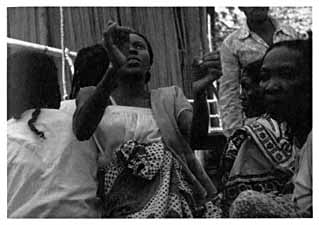
4. Medium entering trance. The medium is making two fists, which indicates she is about to be possessed by one of the boxer spirits, Djao Kondry or Be Ondry.
Once these five spirits have assembled, all attention is again focused on Angeline in anticipation of her spirit’s arrival. Occasionally she shows signs of possession, shaking and moaning, but she only collapses, exhausted, on the floor. These moments are tense and exciting. The musicians, anticipating the spirit’s arrival, play faster, and the beat of the rattles grows harder and louder. Women also begin to ululate or sing loudly, hoping to excite the spirit and encourage it to arrive. Each time, too, the younger spirits run quickly to Angeline’s aid, holding her up, consoling her, and asking her spirit to be kind to her and arrive smoothly and quickly. This continues throughout the afternoon and into the night, but still her spirit does not arrive. When she shows signs of fatigue following fits of partial possession, the spirits have her drink from the plate of water, or they wipe her face and arms with kaolin paste: both have healing properties because they are cool (manintsy) and because they are sacred, being associated with the spirits. The spirits and a number of observers begin to suspect that Angeline may be possessed by Mampiary since, at one point, when Marie was temporarily possessed by another spirit, Angeline waved her head up and down when showing signs of possession. Mampiary is instructed by Ndramarofaly to leave Marie, who then becomes possessed by another spirit, MAMPIAMIN̂Y (“Limpness”), Mampiary’s brother. His style of dress is slightly different: he wears a purple cloth that is similar to Ndramarofaly’s and a shirt and hat like that of the Children. Also, unlike Mampiary, he is quiet, sitting limply on the ground at the front of the room. By this time Angeline is exhausted and she retires for an hour to the bedroom next door.
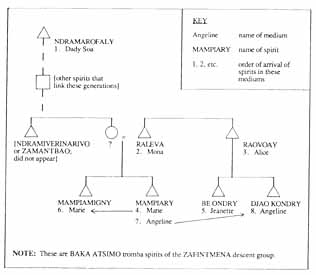
5.1. Spirits and Mediums Present at Angeline’s Ceremony.
Around dawn Angeline’s spirit finally arrives. This is the moment of the day that is, in J. Mack’s words, “the most auspicious time in the Malagasy calendar” (1989). Since the spirit is making its debut in Angeline, it is important that it be identified, stating its name and position in one of many genealogies. In this way its relationship to other spirits and to Angeline can be determined. Possessed, Angeline is brought to the front of the room to consult with Ndramarofaly and the other tromba. After much discussion, her spirit finally utters its name: it is, indeed, MAMPIARY. A series of additional conferences are then held, involving Ndramarofaly, the rangahy, and members of Angeline’s household.
The arrival of the long-awaited spirit is the climax of the ceremony. The neophyte may remain possessed for less than an hour, her spirit quickly departing, or her spirit may stay and enjoy the celebration, clowning with other spirits and members of the audience. In Angeline’s case, it leaves quickly, but soon she shows signs of being possessed by yet another spirit. She assumes a boxing position, and at this time others prepare her in the same way as was done for Jeanette. Angeline suddenly hits the wall with her fists, collapses, and then sits up. The spirits and her kin confer and determine that Angeline is possessed by a second spirit, DJAO KONDRY (“The Guy Who Boxes”), the brother of Be Ondry.
After this second spirit departs from Angeline, the ceremony is nearly completed. The spirits that remain must depart in an order that mirrors their arrival, the youngest leaving first, the most powerful departing last. Angeline’s ceremony lasts for another hour because Be Ondry refuses to leave until Jean has bought him yet another bottle of beer. Since it is early in the morning, Jean has to wait for a nearby store to open before he can send a child to purchase a bottle for the spirit. Be Ondry guzzles this down, and then he is cajoled into leaving by the other, more powerful spirits. He finally agrees to leave so that other spirits may follow. Each spirit leaves in a style similar to the way it arrived. As the younger and more active spirits depart, unpossessed members of the audience run to catch each medium, massaging her arms and back with quick slaps and jerks in order to relieve her somewhat of the pain and stiffness she will feel afterward. All mediums are in a daze when they reenter their own bodies and they ask for a summary of what happened, since they do not recall what came to pass. Although they are tired, they do not feel the effects of any alcohol they consumed.
This ceremony will be followed by another equally expensive ceremony called manondro ny lamba (“to give the clothes”), when the spirits will be presented with their appropriate attire and they will be given items they like to eat. For Mampiary and Djao Kondry these goods are beer and cigarettes. They also will be properly introduced to Jean, since he is a member of Angeline’s household, and they will be paraded seven times around the courtyard of the house. Anytime that a major change occurs in Angeline’s life—if she bears a child, or if she moves to another residence, for example—she must hold a ceremony to officially inform her spirits of this. Since these ceremonies are expensive, mediums are often forced to postpone them for a year or more until they can assemble the necessary capital or gain the assistance of kin to help pay for the ceremony. Postponement is dangerous, however, and causes the medium much anxiety, since her spirit may become angry with her and decide to harm her or others close to her. Throughout her life she may accumulate several other spirits, and generally the stature and power of these new spirits increase as she herself ages. If she wishes, she may participate in similar ceremonies held for other neophytes.
In addition to the large-scale ceremonies such as the one described above, many established mediums work alone at home, holding private sessions, by appointment, with clients. These ceremonies are more austere than the larger, public ceremonies, and they are always held in a quiet and dark room. They are attended by the client, the medium and her assistant or rangahy (who is usually her husband, although it may be a woman who is a friend or a relative), and, perhaps, an assortment of other observers such as friends or kin of the medium or client. In addition to prearranged ceremonies, tromba spirits occasionally arrive suddenly and unannounced. This almost always occurs when the spirit has been angered, either by the medium or by someone who is close to her.
| • | • | • |
Other Members of the Spirit World
The spirit world of Ambanja is complex and varied. Tromba are by far the most important spirits. It is they who appear most frequently in mediums and who are most significant in terms of daily interactions between the living and the dead. As the spirits of Sakalava royalty, structurally they are also of prime importance. Although tromba dominate the spirit world, they can not be understood fully unless explored in relation to other spirits.
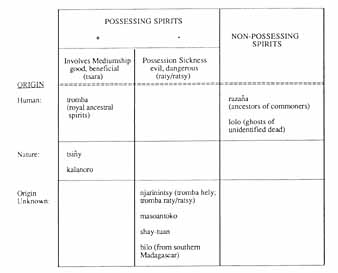
5.2. Spirits of Ambanja.
In Ambanja, spirits are categorized in a number of different ways (see figure 5.2). They may be grouped according to their origins and by human or nonhuman qualities. In addition to the tromba, who are royal, historical figures, there are also the ancestors of commoners (razan̂a), ghosts of the lost dead (lolo), nature spirits (tsin̂y and kalanoro), and a variety of lesser, amorphous, evil spirits (njarinintsy, masoantoko, shay-tuan, bilo). Although all spirits are potentially dangerous, spirits generally are grouped by Sakalava as being either good (tsara) or bad (raty, ratsy).
Mediumship also provides a means by which to group spirits. Just as tromba spirits require mediums, so do the nature spirits tsin̂y and kalanoro. All spirits are potentially dangerous, especially when angered, but spirits that work through professional mediums are regarded as being, in general, benevolent. In Sakalava cosmology, the Zanahary, or Gods on High, are distant and vaguely conceived creator spirits or dieties to whom the living do not give much thought. Ancestral spirits especially serve as intermediaries between the living and the Zanahary. (In Malagasy Christian theology, the Zanahary have been replaced by the Christian God, Andriamanitra, or “the King of Heaven”; sometimes Catholic mediums will address this God instead when they invoke tromba spirits.) Although nature spirits that require mediums are feared, they, like tromba, are respected as authority figures and as specialists in times of crisis. They are also revered as knowledgeable healers.
Finally, positions and meanings assigned to spirits within the Malagasy cosmos are further manipulated, restructured, and redefined through the doctrines of Christianity and Islam. In these contexts, all spirits are considered to be evil and are referred to as devils or jinn (devoly, jiny). Values collide in the realm defined by the spirit world, as devotees of Christianity and Islam (as well as urban intellegentsia and foreigners) struggle to make sense of the pervasiveness of Malagasy customs (fomba-gasy) in light of their own beliefs based on alternative moral and ideological systems (this will be elaborated in chapter 10).
Other Spirits of Human Origin: Razan̂a and Lolo
Like royalty, Sakalava commoners have their own personal ancestors (SAK: razan̂a; HP: razana; the latter term is used throughout Madagascar for ancestors), but, in contrast to tromba spirits, razan̂a do not possess mediums (cf. Rason 1968).[11] Instead, they communicate with the living either through dreams or through a third party, such as a tromba medium, whose spirit, in turn, serves as an intermediary and interpreter.[12] These spirits interact with the living when they are angry or troubled and must be appeased when necessary. An angry razan̂a may also be identified by a healer as the cause for an individual’s sickness or misfortune. They sometimes disturb the living because their bodies have been lost or forgotten. For example, an ancestral spirit may be angry because it has long been dead and its burying place forgotten, or because it was never placed in the family tomb. Reasons for this may vary. Perhaps the person died while traveling, or the body was never recovered, or the body was intentionally neglected, left to rot somewhere in the woods because of a major trespass committed in life.[13] The healer, most often a tromba medium, will then instruct living kin how to placate the troubled spirit, explaining where to find the remains, or what other actions the ancestor wishes its kin to take. Personal ancestors are also honored annually on the Day of the Dead (Fety ny Maty), since many Sakalava in Ambanja are Catholic.[14]
Lolo (pronounced “lu-lu”) is a term used throughout Madagascar for ghosts. These are, in essence, orphaned spirits with no structural ties to anyone. They are similar to razan̂afa, the difference being one of perspective. Razan̂afa are one’s own lost ancestors; lolo, on the other hand, may be seen as the lost ancestors of strangers: they bear no structural affinity to those whom they disturb.[15] Lolo are the ghosts of people who have died in tragic or violent ways, whose bodies were never recovered and placed in a tomb. Lolo haunt the scenes of past accidents, such as regions of the sea where people have drowned or under bridges where there have been automobile accidents. These are jealous and vicious spirits that cause their victims to die in ways similar to their own deaths. For example, the sea near the east coast town of Toamasina is very rough, and it is said that many lolo dwell there. Similarly, people crossing the channel between Nosy Be and the main island often fear that the ghosts of those who drowned in boating accidents will cause them to meet similar fate.
The theme of lost bodies is a common one in Madagascar. As Bloch (1971) has shown, it is in the tomb that Malagasy invest the greatest amount of money and sentiment, for it is the tomb that defines where home is, tying the individual to past, present, and future kin. A lost body is very frightening, and Malagasy tell elaborate tales of trying to recover and transport the body of a loved one who has died far from home, either in a remote part of Madagascar or abroad. During the course of my interviews with an old Sakalava man he told me I should move out of my house because there were lolo living there, since it was built, along with the neighboring Lutheran church, on top of an old Sakalava cemetery. One of my assistants and I later challenged him on the truth of this story (topographical records revealed that a cemetery had in fact existed near the church, but not on its grounds). He later retracted his statement and agreed that it was unnecessary for me to move. I believe that his statement had much to do with my needing to clarify for him my relationship with the Lutheran church, which was not particularly popular with the Sakalava.
Nature Spirits that Require Mediums: Tsin̂y and Kalanoro
In addition to tromba, there are two categories of nature spirits that also possess mediums. These are the tsin̂y and kalanoro. A tsin̂y is a nature spirit associated with a specific location where it is said to live, such as a sacred tamarind tree (madiro) or a rock. Tsin̂y, when they possess their mediums, wear clothes that are similar in appearance to Zafin’i’fotsy tromba. In addition to being periodically possessed by their spirits, tsin̂y mediums also serve as the exclusive guardians or caretakers of the spirits and their habitats, so that a tsin̂y medium is said “to have a tsin̂y” (misy tsin̂y, lit., “there is a tsin̂y”). This issue of guardianship is important. Since a tsin̂y’s dwelling is sacred, people may wish to leave offerings for the spirit without actually consulting with it directly. In order to do this, however, one must acquire permission from the spirit’s guardian. The location of a tsin̂y is easy to recognize, since it generally has a fence built around it for protection, and pieces of white cloth, left as offerings, will be draped on a pole or, if it is a tree, a branch. Unlike tromba, tsin̂y possession is not widespread in Ambanja. Tsin̂y locales and mediums are few and are located in small villages throughout the countryside.
Kalanoro are by far the most mysterious, frightening, and bizarre (hafahafa) of the Malagasy spirits, having a quality that Kane (1988) aptly describes as “surreal” in speaking of the duende spirits of Panama. Kalanoro are found throughout Madagascar, and in other regions of the island they go by such names as kotoky and vazimba.[16] Kalanoro are rarely seen, because they live deep in the forest. They are short and some informants say they have long fingernails and red eyes. Their hair is long and possesses magical qualities. I know of one moasy (herbalist), for example, who derived his power from a small packet of magical substances which included kalanoro hair. The most striking aspect of kalanoro is that their feet point backward, so that if one wishes to track a kalanoro, it is important to remember to follow the footprints in the direction they appear to be coming from, rather than where they seem to be going. Kalanoro eat raw food and may leave evidence of a meal—such as the cracked shells of a crayfish on a rock in the middle of a river.
As is true of tsin̂y, kalanoro mediums are said to have or keep these spirits and act as their guardians. Unlike tromba and tsin̂y possession ceremonies, however, the client is not permitted to view a kalanoro when it possesses a medium. Instead, during the consultation, the medium sits behind a white curtain in a darkened room. There are only a few kalanoro mediums working in the Sambirano Valley, and they, like those with tsin̂y, live out in the bush. Although I was never able to consult a kalanoro, I was told by informants who had done so that when the kalanoro arrives it can be heard walking and banging on the ceiling and walls of the house and that its speech is quick, choppy, and high pitched, so that it is difficult to understand. It is taboo to have a dog present during a kalanoro seance, because dogs can see them. Malagasy are generally wary of kalanoro because of their strange qualities. The few informants I knew who had consulted kalanoro did so either out of curiosity or as a last resort after the efforts of numerous tromba mediums and other healers had failed.
Although tsin̂y and kalanoro are similar to tromba spirits in that they operate through mediums and work as healers, they differ in a number of ways. First, kalanoro and tsin̂y are associated with nature, and so many of their clients seek their assistance because of a trespass they have committed against such a spirit by violating a sacred locale. Second, the mediums for these nature spirits serve as their guardians and, thus, each spirit is only associated with one person, whereas a tromba spirit may possess many mediums. Third, they are much rarer. Over the course of a year, I met only three tsin̂y mediums, and I was never able to locate a kalanoro. Because of this, their services are usually more expensive than those of tromba mediums, which accounts in part for why they are a last resort for clients. Fourth, although the majority of tromba spirits possess women, kalanoro guardians are men and women. Tsin̂y possession, on the other hand, appears to be more common among men: of the three tsin̂y mediums I encountered during one year, only two of these were male. Finally, whereas tromba possession occurs in the context of large-scale ceremonies, tsin̂y and kalanoro work in the privacy of the guardian’s home.
Evil Spirits
Njarinintsy, Masoantoko, Shay-tuan
All spirits that operate through mediums—tromba, tsin̂y, and kalanoro—become permanent fixtures in their mediums’ lives. There are also evil (raty, ratsy) possessing spirits—njarinintsy, masoantoko, and shay-tuan—which are harmful and are often regarded as a special form of possession sickness. These spirits are said to be recent arrivals to the Sambirano region.
Of these malevolent spirits, njarinintsy are the best known and claim the greatest number of victims. For this reason njarinintsy will be the focus of subsequent discussions of possession by evil spirits (see especially chapter 9). Njarinintsy possession is a relatively new phenomenon in Ambanja, occuring only within the last fifteen years. Most informants say that they first heard of njarinintsy in the 1970s, and Sakalava argue that it was brought by Tsimihety migrants. Cases of njarinintsy are reported from other areas of the north as early as the 1960s and informants describe these as clowning spirits. In more recent years, however, njarinintsy have become increasingly violent. Njarinintsy possession is viewed as a grave illness with symptoms that include shaking and chills (this is reflected in the spirit’s name, which is derived from manintsy, which means “coldness”);[17] uncontrollable screaming and crying; loss of memory; and mental confusion. As with tromba possession, the majority of njarinintsy victims are female. They experience temporary fits of possession or madness when they wander the streets aimlessly and may even, in extreme cases, attack people. If an individual is in a possessed state she does not recognize anyone, nor will she remember what happened once the fit has ended.
Sakalava often speak of njarinintsy in reference to tromba. Njarinintsy may be viewed as structurally akin to tromba, for it is sometimes said that they are the “children of tromba” (tsaiky ny tromba, zanaka ny tromba). They are also referred to as tromba hely (“little tromba”) or tromba raty/ratsy (“bad tromba”). Informants insist, however, that njarinitsy are not a type of tromba for, unlike tromba, njarinintsy are malicious and extremely dangerous, and must not be allowed to inhabit the living. In many ways these spirits are defined in opposition to tromba—they are everything that tromba are not.[18]
Masoantoko and shay-tuan are very similar to njarinintsy, and so I will describe them only briefly. A masoantoko (lit. “group of eyes” [?] from maso, “eye,” and antoko, “group”[?]) disturbs its victim while she sleeps, giving her terrible nightmares. Informants opinions on shay-tuan differ, particularly in reference to their origin. Some informants say they are Chinese spirits, referring to the local spelling of the name, but others say they are Muslim. More likely they were brought to Madagascar by slaves or Swahili traders from East Africa (compare with the Arabic term shetwan, for “devil”; setoan in Feeley-Harnik, 1991b: 95; also sheitani spirits of East Africa, see Giles 1987; Gray 1969; Koritschoner 1936). According to one informant, shay-tuan smell bad (maimbo). Odors can be important in distinguishing different categories of spirits from one another. Tromba, for example, can be enticed into arriving in a medium by burning sweet smelling resin or other types of incense. Shay-tuan (and lolo, see above), however, can be driven from a room by burning the same type of incense or a piece of cloth. For this reason adults often burn one of these substances in a room before children enter it to sleep at night.
Bilo
A final form of possession sickness found in Ambanja is bilo. Bilo does not occur with great frequency in Ambanja, being an affliction primarily of peoples who have come from the south, such as the Betsileo and Antandroy. The symptoms associated with bilo are much like njarinintsy in that its victims may become violent and temporarily crazed. Some bilo spirits are animals, such as snakes, and they cause their victims to crawl on their bellies while they are possessed.[19]
Responses to Possession Sickness
The responses to possession involving evil spirits—njarinintsy, masoantoko, shay-tuan, and bilo—reflect the gravity of the situation and the necessity for collective action. In Malagasy communities, individual illness is a time when kin and close friends congregate to care for, watch over, and socialize with the afflicted. This is especially evident in cases involving spirit possession. Tromba, tsin̂y, and kalanoro require that the individual go through a series of ceremonies to instate the spirit permanently within her; in contrast, an evil spirit must be driven from its victim. If it is not, she may become increasingly ill and may even go mad or die. When an evil spirit strikes, the assembled group provides not only a united front against the spirit, but also helps to give the victim strength to resist possession. The presence of kin ensures that the afflicted will be taken to a healer. Furthermore, she has witnesses to the entire process. This is, I believe, essential: regardless of the type of possession, the possessed is never aware of what happens when she is in trance, and so part of the healing process involves the recounting of events to the victim (see Lambek 1980 for a similar discussion from Mayotte).
Possession sickness involving evil spirits most often affects adolescent girls between the ages of thirteen and seventeen, and many tromba mediums and other healers specialize in exorcising these spirits. Malicious spirits generally do not possess their victims through a will of their own but have been sent by an adversary, who has used magical substances or bad medicine (fanafody raty/ratsy) to harm someone. The victims of evil spirits are those who have come into contact with fanafody that was meant for them or, in some cases, through accidental contact with fanafody that was meant for someone else. As the case of Angeline shows, they may precede tromba possession, the evil spirit having been sent by a tromba to harm a woman who is resisting mediumship. In these cases, once the evil spirit is exorcised, the tromba then makes its debut.
Although njarinintsy possession is a grave illness, if a cure has been successful, long afterward kin and friends will tell lively, comical stories of the problems encountered in trying to restrain the possessed and keep her calm during transportation in an oxcart or taxi and, finally, what came to pass with the healer. Njarinintsy are, in general, uncooperative and demanding spirits. The role of the healer is to strike a bargain with the spirit, making arrangements to give gifts to it or later to leave certain goods in strategic locations—by a sacred tree, for example—so that the spirit will be content and will leave the victim. This process is not always successful. It may take several visits to a number of different healers before the spirit agrees to leave. The process is further complicated by the fact that njarinintsy do not always appear alone, for they are said to prefer working in groups of seven. Thus, even if one spirit is driven away, there may be others that remain inside the victim. Once the spirit or spirits have departed, the individual is cured. A failure to cure is a grave matter, for the person will continue to have fits, and it is said that she may be driven mad or even die from the harm caused by the presence of the spirit. If indigenous healers fail to coax an evil spirit from its victim, her kin might then go to a Protestant or Muslim exorcist.
Most Christians and Muslims in Ambanja state that they are opposed to possession. According to Christian doctrine, all spirits are considered to be devils (devoly). Although the Catholic church in Ambanja is fairly tolerant of possession activities, Protestant churches in Ambanja (and in other regions of Madagascar as well) are actively involved in exorcism activities. The FJKM, Lutheran, and a number of other churches have a long tradition of specialists called fifohazana (HP, from the verb mifoha, meaning “to wake” or “to arise”) or mpiandry (“shepherds”) who exorcise tromba and other spirits through the power they derive from the Holy Spirit. Under Islam, all spirits are similarly regarded as being jinn (SAK: jiny), and, like the Protestant churches, a number of Muslim sects in Ambanja also have specialists who are able to exorcise them. Tolerance of possession varies from one Muslim sect to another, and attitudes toward possession often depend on how troubled the victim is. Rarely do kin seek help from Protestant exorcists and only in extreme cases. (This alternative form of therapy will be explored in chapter 10.)
Thus, tromba and other forms of possession now form a vital part of daily life in Ambanja. The social, demographic, economic, and political forces outlined in Part 1 have led to the popularization of tromba. As the chapters that follow will show, tromba provides Sakalava with a means to reflect upon their shared experiences and to document, reshape, and constantly redefine relationships with peoples of diverse origins. In turn, since tromba possession continues to be viewed as a Sakalava institution, it enables tera-tany to regulate the participation (and thus incorporation) of outsiders. For vahiny, it provides them, too, with a powerful vehicle to express their own experiences within the context of migration, and with a means of integration into the local community. In these ways, possession in Ambanja is an important aspect of both collective and individual identity.
Notes
1. Authors generally refer to tromba as being the spirits of Sakalava princes. This is, however, misleading, since both male and female members of royal lineages may become tromba. Throughout the province of Diégo (Antsiranana) there are a number of well-known female tromba: for example, the royal Bemazava lineage has several female spirits. The term prince is misleading as well, because it implies not only the absence of princesses, but also of kings and queens. For these reasons I prefer to use the term royalty when referring to rulers and other members of their lineages.
2. Tsiaraso III, who is the present Bemazava king, does on occasion visit Nosy Faly.
3. Atsimo is the name of the tomb in Mahajanga province in which these royalty are entombed (Ramamonjisoa, personal communication). Some informants also say that the name is derived from tsimo, which means “wind.” The term refers to the idea that tromba are out in the air when they are neither in the tomb nor in a medium.
4. In Ambanja, early June is often a time of much tromba. Following this, however, are “taboo months” (fanjava fady) for certain categories of spirits: mid-June to mid-July is fady for Bemihisatra spirits, and the period from mid-July to mid-August is fady for the Bemazava. These taboo months are associated with times when royal work (fanampoan̂a) is being performed at their respective tombs. Since this period is associated with death and danger, it is said that the tomb “door is closed” (mifody ny varavaran̂a) so that the royal spirits may not leave and possess the living. Similarly, tromba possession is also forbidden during any month when a member of the royal family has died. The month when the door is once again open (mibian̂a) is August (Volambita). Finally, if there is an eclipse, no tromba possession may occur during that month.
5. In this study, I wish to distinguish between spirit possession and trance, the former referring to the experience as it is socially defined and constructed, the latter describing the physiological changes felt by the medium. In other words, possession refers to Sakalava perceptions of the spirit, as it takes control of the medium’s body, and trance refers to the medium’s altered state of consciousness. I am not certain if all of the mediums I observed actually entered trance (Sakalava stress that there is “fake” tromba: tromba mavandy or “tromba who lie”), but since trance is assumed by Sakalava to be part of the medium’s experience I, too, will assume that the majority experienced this altered state of consciousness.
6. A valiha is a type of zither made from a large piece of bamboo. It is held vertically in the lap and the strings are plucked with the fingers and thumbs. It is unusual to find a valiha player at a ceremony in Ambanja, since today there are very few musicians in the area who know how to play this instrument.
7. Students in Ambanja and other coastal areas lag behind highland children in their schooling; it is not unusual for junior high school students to be in their late teens and for high school students to graduate when they are in their early twenties. In addition, Angeline’s experience with njarinintsy possession typifies that of many adolescent schoolgirls. These topics will be discussed in chapter 9.
8. According to compass direction, the closest royal tombs are at Nosy Faly and lie north of Ambanja. The spirits who appear at Angeline’s ceremony all come from tombs in the south (boka atsimo), near Mahajanga.
9. As Feeley-Harnik explains, this is a form of mead used at royal celebrations and to cleanse filth associated with death or wrongdoing (1991b: 594).
10. Spirits’ names appear in capital letters to designate when they arrive.
11. Tromba, of course, as royal ancestors, are also razan̂a. To avoid confusion, I will use the term razan̂a only when referring to the ancestors of commoners.
12. Lambek (1981: 70ff) refers to this as the “communication triad” of possession, which involves the sender (host or medium), the receiver (spirit), and the intermediary (others with whom the spirit converses).
13. One informant stated that in the past individuals with leprosy could not be placed in the family tomb. I am not sure if this was true, since the disease does not appear to be stigmatized today.
14. Non-Sakalava Protestants, too, honor their dead at this time but, as I heard a Lutheran pastor stress during a sermon, they were not to leave goods such as honey or rum at the gravesites to feed the dead, since this is a pagan Malagasy custom (fomba-gasy). They could, however, leave flowers or candles to honor them.
15. Feeley-Harnik describes lolo as spirits who have not achieved ancestor status (1991b: 405); see also Lombard’s discussion (1988: 117ff). Astuti (1991) reports that among the Vezo lolo means “tomb” and it is thus equated with known ancestors.
16. For the Highland Merina, vazimba are the spirits of the little people who are said to be the island’s original inhabitants. See also Lombard (1988: 17) on the southern Sakalava of Menabe.
17. The term njarinintsy is often capitalized; since there is not one but a multitude of njarinintsy spirits I have decided not to capitalize this term in the text (compare, however, Sharp 1990). Feeley-Harnik translates Njarinintsy as “Mother Cold” while my informants in Ambanja defined it as “The Fellow/The One who is Cold.”
18. Among my informants, however, a few were skeptical about this structural affinity to tromba; these tended to be members of the Bemazava royal lineage. They stated that more recent tromba spirits, such as Mampiary, Be Ondry, and Djao Kondry are not tromba spirits but simply njarinintsy who have taken names and who are trying to achieve royal status. According to Feeley-Harnik (1991a: 88), “be hondry,” like njarinintsy and “masantoko,” is an evil spirit (lolo) who possesses in order to kill.
19. Heurtebize (1977) has described this form of possession among the Antandroy. He reports that a decade ago Antandroy sometimes returned from the north with a new form of possession, called doany, which means “tomb,” but by 1987 doany possession was rare (Heurtebize, personal communication). See also Lombard’s description of bilo among the southern Sakalava of Menabe (1988: 17). Finally, for an intriguing discussion of bilo and economic change among the Masikoro see Fieloux and Lombard (1989).
6. Sacred Knowledge and Local Power: Tromba and the Sambirano Economy
In the Sambirano, power, authority, and independence hinge on access to and control over land. At first glance it may appear as though it is outsiders (first, French and, more recently, highland Malagasy) who exert the greatest control in the valley, since throughout this century they have been the managers of the plantations and now the enterprises. In this region, much local power lies, however, with those most familar with and integrated into its institutions: these are the Sakalava tera-tany. Managers rarely occupy their positions for more than a few years and so their influence is limited. Sakalava maintain long-term control over important social, economic, and political arenas since they outnumber other groups; occupy the majority of elected positions; own the greatest number of private landholdings; and define the thrust of local culture. The final factor is significant because shifts in national policy in the early 1970s have underscored the necessity of showing respect for local custom, and so today outsiders find they must maintain a delicate balance with the Sakalava tera-tany if they are to accomplish their goals.
This chapter will explore the manner in which Sakalava collectively view and interpret local power and, in turn, how they maintain their influence in the valley. As will become clear, the power of tera-tany hinges on their ability to resist capitalist relations and to undermine or manipulate the future development of the region by the state. In order to fully comprehend this process, it must be explored from a multitude of angles. First, social cohesiveness is an essential element: among the Sakalava this is defined through the ancestors, the concept of a shared historical past, and the occupation of a common territory, their tanindrazan̂a (cf. Keyes 1981). For the Sakalava, like other Malagasy, these domains of time and space are sacred. Since these contexts are defined by the actions of royal ancestors, tromba spirits are an essential element of local custom and identity.
Second, as the studies of such authors as Comaroff (1985), Nash (1979), and Taussig (1980a, 1987) show, ritual may be rich in symbolism that reveals an indigenous awareness of the disruptive and alienating nature of development. The symbolism associated with tromba serves to record, reorder, and critique collective experiences that occur under drastic economic development. In essence, tromba possession rituals operate as a form of ethnohistory, providing an arena in which to retell and reflect upon relations with non-Sakalava.
Third, and perhaps most significant, tromba possession goes beyond critique: it also empowers the Sakalava of the Sambirano. Apter (1992) has argued that, in the context of Yoruba religion, ritual knowledge and power may be intrinsically linked and may ultimately challenge the political order on a national level (cf. Lan 1985). Tromba spirits (through their mediums), embody sanctioned ritual authority, occupying pivotal positions that affect power relations in the Sambirano and the subsequent development of the landscape of the tanindrazan̂a. Such authority affects not only individual experience but also directs collective reponses to the state. Through popular tromba, individual mediums may manipulate their actions in the context of labor relations, while the saha of Nosy Faly control the actions of outsiders and monitor economic changes that disrupt the order of the local sacred geography as a whole.
| • | • | • |
Tromba as Ethnohistory
The preservation of historical knowledge is an important task among the Sakalava, and often this takes the form of written histories (tantara) where stories of royal succession and deeds are preserved (see, for example, Feeley-Harnik 1991b: 22). An essential element of written aswell as oral Sakalava history involves recording royal—and thus tromba—genealogies. There are several authorities to whom this duty of preserving such knowledge is allocated. Many communities (in Sakalava territory and other areas of Madagascar as well) have an elder (usually male) who is designated as the official local historian.[1] In Ambanja this position is held by a man in his seventies who is a counselor to the king; often when I sought information on the history of the Sambirano Valley I was referred to him. The role of historical authority has also become bureaucratized. School-teachers are respected as historical authorities because of the knowledge they acquire through their studies. Because of the nature of their work, they are regarded as very articulate. In Ambanja there is a second elderly man (he is in his sixties) who is a self-appointed historian. He was raised in the Sambirano, served in the colonial administration, and later worked as a school administrator in Diégo. He is often referred to as a “living encyclopedia” (Monsieur l’encyclopédie vivante) by his friends and by professors at the provincial university, and occasionally he is invited to give presentations at conferences at the Académie Malgache in Antananarivo. Although these two men will speak freely of the French conquest, the development of the Sambirano, and the influx of non-Sakalava into the town, the details on more sacred subjects are the prerogative of royalty, special royal advisers or counselors, the tomb guardians, and the tromba spirits themselves.
Royalty, their advisers, and the tomb guardians may be knowledgeable, yet they often defer to the tromba, for it is these spirits who are regarded as the true authorities and as the guardians of sacred knowledge. Only tromba spirits will speak in detail of the deeds of past rulers or on matters related to spirit possession over time. Part of the logic here is that they, after all, can provide firsthand knowledge, since they were eyewitnesses to these events. This knowledge is regarded as sacred (masina) and should not be treated lightly or spoken of freely. Since one gains access to the tromba through the mediums, it is women who have the greatest access to, and who thus, in essence, serve, as the gatekeepers to this sacred knowledge. Furthermore, since it is women who predominate at tromba ceremonies, it is they who are able to recall the names of royalty and recite their genealogies with the greatest accuracy.
Dead Men Do Tell Tales: Possession as Collective Memory
Historical knowledge is conveyed in direct and indirect ways. When a spirit arrives, it is expected to be able to identify itself by name; recite part of its geneaology (the name of its father and grandfather, for example); locate itself geographically by stating the location of its tomb; and tell the story of its death. This is especially important when a spirit makes its debut, but it occurs in other contexts as well. For example, one may ask questions of or interview a spirit in detail regarding its past or that of other tromba spirits. This is done not only by inquisitive anthropologists, but also by Sakalava, who may seek to locate another spirit in the genealogy or to test to see if it is a real or a “fake spirit” (tromba mavandy).
Historical knowledge is embedded in the operational principles of tromba (see the previous chapter). As should be clear from Angeline’s ceremony, tromba ceremonies are a form of pageantry, where history is dramatized and displayed through the dress, mannerisms, dialects, and actions of the tromba. Sakalava history is both embedded and embodied in tromba, conveyed not only through the words and behavior of the spirits, but also on the body of the medium. While she is possessed, the medium’s body carries evidence of the spirit’s history. The color and style of the clothes she wears indicate the spirit’s point of origin and its place in the genealogical hierarchy (see plates 5 and 6). She may also put marks on her body that reflect the injuries the spirit sustained at the time of death: white kaolin on her cheeks to indicate the broken jaw of Mampiary or skeletal marks on her hands which are the sign of the boxers Be Ondry and Djao Kondry.

5. A Grandchild spirit. The medium’s dress and the marks on her chin signify that she is possessed by the spirit Mampiary, who broke his jaw falling from an ox cart. The marks left on her arms and hands are remnants of an earlier possession by the boxer spirit Djao Kondry.
As one watches a tromba ceremony, it becomes evident that generations of royalty are collapsed into three generational categories of spirits—Grandparents, Children, and Grandchildren.[2] These correspond to three major epochs of Sakalava history: precolonial (prior to 1896), colonial (1896–1960), and postcolonial (1960 to the present) (see figure 6.1). This is reflected in their dress, personal stories, and their behavior. The Grandparents are the oldest of the spirits, both in terms of their age when they died and historical depth of time. Their clothing also reflects that they are of an older era. Typically spirits of Ndramarofaly’s stature wear clothes that are reminiscent of the styles of a century ago: red waist and shoulder wraps called lamba mena (or “red cloths”)[3] and a white, simply-cut (peasant style) pullover shirt. The predominance of the colors red or white is generally an indication that the spirit belongs to the Zafin’i’mena (“Grandchildren of red [metal, i.e., gold]”) or Zafin’i’fotsy (“Grandchildren of white [metal, or silver]”) royal lineages. In one hand they hold a long wooden staff tipped with silver (mapingo), which is an emblem of royal authority and power (see also the description in Feeley-Harnik 1991b: 92). Their clothes may be very old. No one may destroy the clothes of a tromba and no one, save a special class of royal attendants (the Sambarivo), may wear them as everyday dress. When a medium dies, her family is expected to take her tromba clothes to the living ruler, who will then take care of them or redistribute them to mediums who have the same spirits. A medium who has inherited her mother’s spirits will also inherit the spirit’s clothes. In the context of royal tromba possession, saha wear the clothes that rulers wore during their lifetimes. These are kept by the tomb guardians when they are not being used.
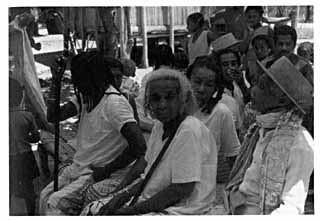
6. Tromba ceremony (romba ny tromba) involving older mediums (including one who is male). These mediums are possessed by older and staid Grandparents. They sit on a raised, open-air platform that can be found in villages throughout the Sambirano. In contrast, mediums in the town of Ambanja prefer to hold ceremonies inside private homes.
As one moves to the next generational group of spirits, to Children such as Raleva and Raovoay, the style of dress changes to one reminiscent of the colonial era. Many Sakalava royalty received an education and were trained by the French to be civil servants in the colonial adminstration. In Ambanja, many of these spirits continue to wear the sacred color red, but instead of donning the traditional red cloth (lamba mena), they prefer a factory printed waist cloth (lambahoany) that bears a red design printed on a white background. Today the lambahoany is considered to be the traditional dress of the Sakalava, although the living may not wear a red one since this color is reserved for tromba. Instead of wearing the old peasant cut shirt of the Grandparents, this generation of spirits prefers the quatre-poche, a white, four-pocketed short-sleeved shirt. In addition, the shoulder cloth has been replaced with a terrycloth towel.[4] Other paraphernalia include a fedora or boater hat (the black band of the latter being decorated with stars, moons, and other tromba symbols reminiscent of Islamic influence), and in their hands they often carry a silver-tipped staff, but generally it is shorter than that of the Grandparents.
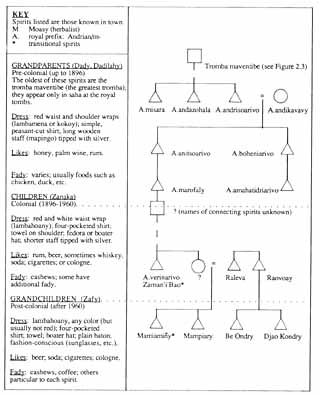
6.1. Partial Genealogy of the Zafin‘i’mena, Baka Atsimo Tromba Spirits.
Finally, Grandchildren, such as Mampiary and the boxers Djao Kondry and Be Ondry, exhibit a style similar to that of the parents, except that they have abandoned the royal color of red. Their waist wraps are generally blue, green, or purple on white. Their accoutrements are similar to those of the colonial spirits in that they hold a small, plain baton and wear Panama hats. Their style of dress has more flair, however, and when they possess mediums in town they are by far the most fashion conscious of the spirits. Their clothes may be color coordinated, so that a blue lambahoany will be accompanied by a blue shirt and towel, and some even sport sunglasses.
Since tromba were at one time living (and supposedly well-known) persons, each spirit also has a personal story. These are lively, dramatic tales that record the more important events of the Sakalava past. As Estrade (1977: 217) states, these stories operate as a form of mémoire collective (cf. Rosaldo 1980). The stories of tromba are often very detailed and reflect the nature of life during the period in which the tromba spirits were alive and ruled. These stories may be part of their their individual or categorical names as well. As stated earlier, Sakalava royalty change their names at the time of death, so that the name they used when alive can no longer be uttered. The new praise name or “tromba name” often reflects great deeds they performed during their lifetimes. Other spirits take names that reflect the manner or circumstances under which they died. Thus, since many of the Grandparents reigned or were well-known royalty, their names provide a shorthand for their deeds.
The life stories of the Children and the Grandchildren are not as well known, since these spirits never ruled. The stories of their deaths are usually more developed, and reflect the nature of the lives of those born in the present century. The stories of the Grandchildren are by far the most involved and spectacular and reflect the experiences of town life in the Sambirano. Behavior also marks the status and the associated historical period, for while Grandparents are staid and aloof, like old rulers, Children and Grandchildren are more accessible to the living and more understanding of their daily affairs, since they have had similar experiences themselves.
What follows are descriptions of a number of popular Zafin’i’mena spirits that appeared at Angeline’s ceremony and which correspond with the chart in figure 6.1 Nearly all are baka atsimo spirits who are entombed to the south near Mahajanga. I have also included a description of a few Zafin’i’fotsy spirits, since they appear frequently at ceremonies in Ambanja. These versions of spirits’ stories are drawn from descriptions provided by informants living in the Sambirano. They do not necessarily correspond with versions from other regions of Madagascar and so for contrast I have occasionally included information from Estrade, who has carefully catalogued Sakalava tromba spirits elsewhere in Madagascar.
Grandparents
Ndramarofaly (full name: Andriamarofalinarivo;[5] in Ambanja, this name is translated to mean “the King who is always happy” [faly, happy]). Most mediums in Ambanja are unfamiliar with this spirit’s story but state that they believe he died by hanging. This spirit is considered to be one of the most important of the Grandparents, and he often officiates at cermonies in Ambanja. (Spirits listed above this point in the Zafin’i’mena genealogy appear only rarely in mediums in town.) Like an old king, he is very quiet and calm when he is present. An important fady for this spirit is the guinea hen. He likes to consume honey (a food that is given as an offering to ancestors throughout Madagascar), palm wine (trembo), and rum. (According to Estrade [1977: 207] his name means “the King who has many taboos,” faly being an older version of fady, as with Nosy Faly. Estrade reports that this name is ironic, referring to Ndramarofaly having defied the fady imposed by a sorceror. While lost in a forest, he went mad and hanged himself from a cashew tree; as his body putrified, it was surrounded by guinea hens. Another fady is a perfume called sakona, which is made from the cashew.)
Ndramandenta (full name: Andriamandentarivo, “the King who slit the throats of many”). He is a spirit that many find frightening because when he arrives he is usually very angry. Still, as a Grandparent, he is a powerful healer, and so clients occasionally ask for his advice. This spirit died by having his throat slit, and so when he arrives he coughs up blood, making mediums reluctant to call him up. Ndramandenta likes to drink palm wine and he eats honey. (According to Estrade [1977: 212] he was a mighty warrior who was stoned to death. Estrade also reports that this spirit likes to consume blood.)
Kotofanjava,Kotomena, and Kotovazaha are representative of the baka andrano (“coming from the water”) spirits of the Zafin’i’fotsy descent group. These spirits are from Analalava, which lies to the south of Ambanja near the mouth of the Loza River. They and an assortment of other spirits of the same generation chose to commit suicide by drowning rather than become the subjects of their Merina conquerors in the late eighteenth and early nineteenth centuries (cf. Feeley-Harnik 1988: 73). (Estrade [1977: 211], in his description of these spirits, stresses the severity of this action, saying drowning is an unusual form of suicide for Malagasy.) It is fady for Merina to approach these spirits. Since Zafin’i’fotsy spirits usually appear at ceremonies in Ambanja, people of Merina descent may not participate. Other fady include shark and an assortment of other fish that feasted on their corpses; chicken is also fady for some. (Estrade [1977: 211] only lists firearms as their taboo.) These spirits like rum.
Zaman’i’Bao (“Bao’s Uncle”) or Ndramiverinarivo (full name: Andriamiverinarivo, “the King to whom many return”) was among the first of the popular spirits to possess mediums in any great number in the Sambirano. Zaman’i’Bao’s story is colorful and reflects the changes and experiences associated with colonial rule. Several informants say that Zaman’i’Bao died as a young man when he was enrolled as a student in the Merina city of Antananarivo. Two versions of his death were told frequently by informants: that he choked on a mixture of alcohol and cashews, or that his drink had been poisoned by a Merina rival. One informant, however, told a slightly different version: “Zaman’i’Bao was the chef de canton in an area near Mahajanga. There was an old woman who hated him because he was a Christian, and so she decided to poison his drink, toaka mahabibo [which is made from cashews]. When he drank the poison, it made him cough and spit up a lot of blood.” When this spirit arrives in a medium he coughs uncontrollably; to signify possession (and to protect herself from harm) a medium marks her chest with kaolin before going into trance. As the latter informant said, “It is dangerous for a medium to be possessed by this spirit very often; if so, she will die young.” Unlike other Grandparents, an important fady is cashews. Zaman’i’Bao likes rum, as well as drinks of foreign origin, such as beer and imported whiskey.
(Estrade [1977: 219] provides a more detailed account of the circumstances of his death: Zaman’i’Bao was enrolled in the Ecole le Myre de Villers in Antananarivo, and he died either as a result of Merina witchcraft or after he drank from a glass that was infected with bacille de Koch. [This seems unlikely, however, since this is the bacterium that causes conjunctivitis, and it is not fatal.] He went home drunk and got in bed with his wife, who pushed him away. He then took a double dose of an alcoholic drink called betsa-betsa and died. His wife mourned terribly because she believed that she was responsible. She went to the royal tomb of Betioka [Ambato-Boeni], crying and saying that she was to blame for her husband’s death. But Zaman’i’Bao then rose from his tomb to comfort her. Today he consoles Sakalava women.)
Children
Raleva is perhaps one of the most “popular” of the spirits active in Ambanja today—he is well known to all mediums and inevitably appears at any tromba ceremony. Few of the mediums I interviewed were familiar with the details of his life, although several said that he served in the colonial administration, having been schooled as a child by the French. In his dress and actions he mimics a colonial officer.
One medium for this spirit told his story as follows: “Raleva worked for Zaman’i’Bao as his secretary, and he was married to Zaman’i’Bao’s sister.…The two men were inseparable: they worked together and inhabited the same house. When Raleva heard that Zaman’i’Bao had been killed, he was so distraught that he committed suicide. This he did by climbing up in a tree, and then he jumped, landing on his head. As he fell, he hit some branches and broke his forearm and neck. This is why a medium puts kaolin [tany malandy] on her arm and neck before she summons the spirit.” This medium then added: “It is true that Raleva was not royalty by birth, but shortly after the deaths of these two men, a young girl in Mahajanga became possessed by Zaman’i’Bao, and through her the spirit said, ‘Raleva is to be respected just as I am…because we were close in life and thus it should be so with our tromba [spirits].’ ” The medium asserted that Raleva had died only within the last decade or so and that his niece, who was about seventy years old and who lived in Mahajanga, had toured the north several years ago, visiting mediums and testing them while in trance to make sure they were in fact possessed by Raleva. (This is the only example I have of tests being administered for popular tromba.) The most important fady for Raleva is cashews, although individual mediums sometimes list others that the spirit has designated for them throughout their lives. Although Tuesday is a taboo day for all baka atsimo spirits (in reference to activities that occur back at the tomb), Thursday is also taboo for Raleva, since he died on this day. He likes to smoke cigarettes, and although he will drink rum and palm wine, he prefers drinks of foreign origin, especially beer and whiskey; sometimes he will also drink soda pop. He enjoys wearing French cologne.
Raovoay (“Crocodile Man”). As with Raleva, mediums are unfamiliar with the details of Raovoay’s life, and they know only a bit about the circumstances of his death. Raovoay was eaten by a crocodile (voay) while trying to cross a river, and for this reason a medium’s motions imitate this animal when this spirit arrives and departs. Raovoay’s fady and preferences are the same as Raleva’s.
Grandchildren
Today, Mampiary is usually the first spirit that young women of the Sambirano acquire. Mampiary was a cowherd or “cowboy” (koboy) who died in an automobile accident when he was young. This happened when he was intoxicated and driving across a bridge in an oxcart filled with coffee. A car (which some say was gray, the color of most bush taxis in Madagascar) ran into him. When he fell from the cart, he broke his jaw and died. These circumstances account for his fady, which are oxcarts, coffee, and gray automobiles. Just as for his “Fathers” Raleva and Raovoay, cashews are fady. In addition, as mentioned in the description of Angeline’s ceremony, one must take special care to make sure the medium does not injure her jaw when the Mampiary arrives. He likes beer, soda pop, and cigarettes.
Djao Kondry and Be Ondry were both young men who loved to box at morengy matches. Morengy occur frequently throughout the dry months (May to August), and this is a popular sport among young Sakalava and Tsimihety men. These matches usually take place on Sunday afternoons and attract contenders as well as young women who wish to watch. It is a time of romance, when sweethearts meet and court each other and when rivals fight one another. The boxing is carefully supervised so that opponents pull back from one another following each successful contact; the match ends after one opponent has successfully touched the other three times. The one who wins then seeks a new challenger from the circle of spectators, and whoever is willing to accept the challenge steps into the ring. Although most matches last no longer than a minute, after the official morengy is over rivals stay and fight each other in less structured settings. It is at these times that boxers may be seriously injured. Both Djao Kondry and Be Ondry died at morengy matches, killed by rivals. Their preferences and fady are the same as Mampiary’s. A medium for either of these spirits is also forbidden from making a fist when she is out of trance. A few mediums say that they can not eat other foods, such as certain types of hot peppers.
Mampiamin̂y This spirit’s name means “to make limp” or “limpness,” and when he possesses a medium he sits quietly and slumped over. He is not nearly as well known (or as active) in Ambanja as his brother or the two boxer spirits. He, like them, worked for the colonial administration, but the story of his death is not clear. One medium said she thought that maybe he died with Mampiary, riding in the same ox cart. His dress is not as stylish at that of the other Grandchildren. Instead, Mampiamin̂y, as with an assortment of other Zafin’i’mena spirits, wears a purple waist wrap (soboya) like that used by the Grandfathers, along with a white, four-pocketed shirt and fedora hat. Like Zaman’i’Bao, he appears to be a transitional spirit, since, in addition to coffee and cashews, his taboos include a kind of duck (drakidraky), milk, and french bread.[6]
As cross-cultural studies of possession reveal, spirit possession provides a powerful idiom for preserving collective and historically based memory. This is illustrated, for example, in Brown’s (1991) study of a Haitian vodou priestess living in Brooklyn, New York. Embedded in the the dress, tastes, and tales of vodou spirits are generations of knowledge shared by displaced peoples. These include the experiences not only of those who choose to migrate from Haiti to the United States, but also of slaves taken involuntarily to the Caribbean from Africa. Giles has also argued that possession among kiSwahili speakers of the East African coast reflects indigenous notions of peoples of diverse origins whom they have encountered over time. Spirits incorporated into Swahili possession cults include Somali, Arab, Maasai, and even Malagasy and “hard-drinking European Catholic priests” (1987: 249).
Similiar themes are embedded in Sakalava possession. At present, tromba stories comprise a special genre that reflects different epochs of Sakalava history. Through these stories and associated dress and behavior Sakalava both learn about their past and interpret it. The tromba stories recorded above, for example, reflect local perceptions of historical experience that are specific to the Bemazava, since they do not necessarily correspond with those collected elsewhere by Estrade and others. For the Bemazava-Sakalava, Grandparents are powerful and influential rulers from the Sakalava past. Their greatest concerns are with the ancestors and with an old order that existed prior to French conquest. Informants are generally reluctant to tell the stories of these powerful tromba spirits, fearing their wrath, and it is their behavior that is the most important marker of their status: they are staid and serious, and they generally do not speak directly with the living, but through an interpreter. When these tromba spirits arrive, they speak of major events and relationships with other non-Sakalava. These include disputes over royal succession and subsequent relocation; battles with the Merina in the eighteenth and nineteenth centuries; the arrival of the French in the 1890s; and the 1947 uprising. Each time these spirits arrive, they (and their mediums) reconstruct the past and critique collective precolonial and early colonial experience.
Spirits for Common Folk: Zaman’i’bao, Raleva, Mampiary, Djao Kondry, and Be Ondry
As one moves to the more recent generations there is a sudden shift in emphasis in both the genealogical system and in the behavior of the spirits. The first of these is Zaman’i’Bao, who occupies a pivotal position. Zaman’i’Bao is the first of the popular spirits, one who, by the middle of the present century, became well known among commoners as a powerful healer. Like the Grandparents, this spirit is associated with the precolonial era (as is evident in the way he dresses) and he has a royal name, Ndramverinarivo. He is more closely associated with the Children, however, since he does not appear in the saha of Nosy Faly but in mediums in town. Whereas the stories of Grandparents focus on the deeds these royalty performed in life, that of Zaman’i’Bao and other Children and Grandchildren focus on the nature of their deaths.
It is the spirits who follow Zaman’i’Bao whose actions and concerns parallel those of townspeople of the recent past and of today. The first of these are Zaman’i’Bao’s brothers-in-law, Raleva and Raovoay. It is very difficult to date the arrival of these popular tromba spirits, but it seems that these Children appeared in Ambanja in the late 1950s or early 1960s. Shortly after Independence in 1960 they were followed by Mampiary the cowherd (who is the child of Raleva), and the boxers Be Ondry and Djao Kondry (two brothers and the children of Raovoay). These three spirits are considered by Sakalava to be royalty (ampanjaka), although Raleva and Raovoay and his sons are affines to the royal family. In essence, they are honorary royalty.
What becomes clear is that the most recent shifts in forms of spirit possession, involving the Grandchildren, closely parallel the experiences of the town’s youth. As mentioned earlier, older—and especially royal—Sakalava are skeptical of these spirits, describing them as fakes (tromba mavandy), stating that they are not royal ancestral dead at all but only njarinintsy, or arguing that they are not Sakalava but were brought by Tsimihety migrants (see Deschamps 1959 for information on the migrations of the Tsimihety up to this time). Nevertheless, this category of spirits defines the most widespread of the popular forms of tromba possession in the Sambirano. In essence, the older spirits no longer fulfill the needs or expectations of the younger people of the town, who make up the majority of the population.[7] Older forms of tromba harken back to a time that is not part of the collective memory of the young. Even though Grandfather and Children spirits continue to oversee tromba ceremonies, and it is from them that spiritual power and knowledge are derived, nevertheless, the active participants at these gatherings and at healing consultations are most often the Grandchildren.
Grandchildren spirits are young, reckless playboys who have died as a consequence of their behavior. When they interact with the living at ceremonies, their actions are similar to those who enjoy the town’s nightlife. Sometimes spirits such as Mampiary even wander into discos and bars and demand something to drink or attempt to dance with women there, behaving as young men sometimes do when they are drunk. Although they are royalty (ampanjaka), their experiences parallel those of contemporary folk living in an urban world, where there are fast automobiles, cash crops, and rowdy boxing matches. It is these spirits that proliferate in Ambanja, and mediums report that they receive the greatest amount of requests from clients to consult with them: since these spirits grew up in the late colonial and postcolonial eras, they have a firsthand understanding of their clients’ problems. Issues such as love and romance, work, and physical injury are important domains for them, these problems being typical of life in town and the surrounding plantation economy (see chapter 8).
Thus tromba provides an encapsulation of Sakalava perceptions of their collective experience. It is a form of ethnohistory, where the dress, actions, and stories of each generation of spirits reflect the nature of life in three epochs of time—precolonial, colonial, and postcolonial. In more recent years, tromba possession has involved the participation of increasing numbers of non-Sakalava. Tera-tany and vahiny both are now involved in the construction of local history, especially through the Grandchildren, who are most active in mediums today.
| • | • | • |
Tromba, Wage Labor, and Economic Independence
This historical order associated with tromba does not simply provide a means to record or reflect on past experience. It is also a major force that affects daily individual and collective action of both tera-tany and vahiny. The taboos associated with each spirit may influence the economic activities of individual mediums. On a grander scale, the royal tromba of Nosy Faly today monitor any additional economic developments that affect the local ancestral land.
Tromba and Their Fady
Just as dress serves as a marker of precolonial, colonial, and postcolonial epochs, the various fady associated with spirits reflect changes in the local economy which accompanied the introduction of foreign produce. These fady record these changes. They may also affect the daily activities of their mediums. In the Sambirano and neighboring areas, as one moves down through the Zafin’i’mena genealogies, it is plantation cash crops that slowly have been incorporated into the system of fady. This process reflects changes in the economy of the Sambirano over time and attempts by local Sakalava to resist and control the effects of these economic changes on their collective and individual lives.
The fady associated with the Grandparent spirits are the least restrictive. Many of these spirits impose none on their mediums, save for limitations associated with certain days of the week when the medium may not go into trance. (These taboo days affect all spirits and correspond to activities that take place on a regular basis at the tombs.) These spirits usually prefer to be fed certain items that existed prior to the French conquest: honey, palm wine, and, sometimes, rum. Honey and rum are regarded as appropriate foods for ancestors throughout Madagascar.[8]
It is among the Children that one begins to see the acceleration of preferences and aversions for foreign goods. Bloch (1971: 8–9; 32ff) has noted that the Merina often express a certain ambivalence toward foreign goods and customs, which they contrast to things Malagasy (thus there are fomba vazaha, or foreign customs, and fomba-gasy, or Malagasy ones). Similar distinctions are made in Ambanja: there are Malagasy chickens and ducks that are distinguished from foreign breeds, for example. In the case of produce and animals, often the latter category connotes better quality, yet the ambiguity remains (Bloch mentions this as well).
In the context of tromba, a distinction is also made between foreign imported goods and cash crops that are of foreign origin. Although Children and Grandchildren enjoy (and demand) foreign cigarettes, rum, beer, soda pop, and sometimes even whiskey (which is very expensive), certain cash crops are taboo. For the Children an important fady is cashews (mahabibo) and for the Grandchildren, cashews and coffee (kafé). In the context of tromba there exists both a recording of the introduction of foreign goods and a subtle critique of them.
Working in the Sambirano
In order to understand the significance of these fady, it is necessary to return our attention to the economy of the Sambirano. In the warehouses of the major enterprises, women are employed to sort and clean three main crops: cashews, coffee, and cocoa. Of these cash crops, two are major fady for the majority of tromba spirits active in Ambanja. Although cashews grew wild throughout the west coast prior to the colonial era, it was during the period of French occupation that cashews became a major cash crop. This is especially true around the area of Mahajanga, which is often referred to as the “capital of tromba” by the northern Sakalava, since it is near there where many of the Zafin’i’mena spirits are entombed. Mahajanga is also referred to affectionately as “Mahabibo,” for it is a city of cashews. Similarly, indigenous coffee grew in Madagascar, but it was in the 1940s when new domestic strains were introduced and when much of the countryside was transformed into coffee plantations where the crop was grown for export.[9]
It is not coincidental that residents of Ambanja are referred to as the “possessors of the soil” or tera-tany. Although in part this is a general reference to the Sambirano being the ancestral land of the Bemazava-Sakalava, it is also the Bemazava who are identified as those who originally used the land prior to the arrival of the French, other foreign nationals, and Malagasy migrants. Today, in the Sambirano, it is the enterprises that occupy much of their territory. Private plots are scarce and highly valued, for several reasons. Here, the soil is very fertile and farming is profitable. Also, personal economic freedom is associated with land ownership. If one has even a small plot of land on which to grow rice and other subsistence crops, one may not have to work as a wage laborer. This is the most important distinction made between tera-tany and vahiny, since many of the former own land, while the latter are landless proletarians who hope one day to acquire arable plots.
In the Sambirano the enterprises are the largest employers of unskilled labor. There are significant benefits associated with this work. Salaries at several enterprises are relatively high: in mid-1987 a full-time laborer could earn 30,000 fmg per month. Although this is barely enough to feed a small family, laborers who are single can live fairly comfortably on this salary. Enterprises provide women who have no other employable skills with a ready means for economic independence. Two of my informants, for example, who were having marital troubles, were able to move out of their husbands’ houses and rent one of their own with money they saved from their salaries. In addition, health care is free or available on a sliding scale for laborers and members of their households. Still, cash and health care are not as highly valued as economic independence.
Throughout this century, Malagasy have resisted wage and contract (corvée) labor. As Feeley-Harnik notes, by World War II Madagascar had more labor laws than any other French colony. French colonial officers “noted that Malagasy had ‘a veritable fear’ of labor contracts. By signing them, they felt ‘a little like prisoners’ ” (1984: 8; she in turn is quoting Thompson and Adloff 1965: 449). Among the Sakalava, wage labor means losing control over one’s time and becoming entwined in unequal social relations. According to the Sakalava “morality of exchange” (Parry and Bloch 1989) the reciprocal exchange of goods and services is coveted, but payments made in cash are generally not desired and are often refused.[10]
Most laborers hope eventually to find other employment, since enterprise work is difficult and time consuming. Many newly arrived migrants begin by working at an enterprise and then, as soon as they have accumulated enough capital, they start a small business of their own. Antandroy, for example, travel south to Befandriana and Antsohihy where they buy rice and then resell it in Ambanja, while others go north to purchase cattle. These they then take back through Ambanja and then on the ferry to Nosy Be, where sugar cane plantations monopolize lands that could otherwise be used for grazing. Here the cattle are slaughtered for sale in the market, where much meat is needed to satisfy the demands of the local tourist trade (see the case of Guardian in chapter 4).
Although most enterprises have one worker village on their grounds, the majority of laborers’ homes are in town or are scattered throughout the rural areas of the Sambirano. Laborers begin their workday around 6:00 a.m., when they catch a transport (usually a large flatbed lorry or dump truck) for the hour-long ride to the company warehouses. Women (who may be accompanied by children) sit in shaded areas and sort and bag produce (again, see plate 3), while men load these bags and other heavy items onto trucks bound for the port. Men, women, and sometimes children work in the fields, cutting branches, clearing underbrush, and harvesting produce. While most women’s salaries are determined by the number of bags they fill (these are weighed at the end of each day), men are paid slightly more and receive a flat salary. Since the enterprises are far from most laborers’ homes, the majority carry their lunches in small baskets. A typical meal consists of leftover rice with, perhaps, a little broth sprinkled over it. Laborers are allowed thirty minutes to an hour for lunch, but women often prefer to eat quickly or skip lunch altogether so they can bag more than the minimum quota or finish early and rest at the end of the day. The workday is scheduled to end around 3:00 p.m., but delays occur frequently, since trucks may be needed for other purposes. As a result, laborers may not reach their homes until 5:00 or 6:00 p.m., if not later.
One of the greatest complaints expressed by laborers concerns the time requirements of their work. Since they usually work six days a week, they feel they live only to work, sleep, and work again (miasa, matory, miasa koa koa). Each day they return home late and exhausted, unable to perform other necessary tasks. They have no time to visit with kin and neighbors or keep house. For this reason women and single men usually rise as early as 3:00 or 4:00 a.m. to clean their homes and shop before catching the transport to work. They are unable to attend the Thursday market, where one finds the greatest selection of items and the lowest prices and where townspeople can look forward to visiting friends and kin who live in the rural areas. Sunday is their day off, but on this day hardly anything is available in the two markets in town. Enterprise work is especially hard on single women with children, since they must also rely on kin for help with childcare. If a woman has no kin living nearby, she must bring her children to work with her. Children who are sick usually accompany their mothers to work so that they can be cared for there. The degree to which this is tolerated varies from one enterprise to another; in some cases a woman may risk losing her job if she pays too much attention to her children.
As discussed in chapter 2, land in the Sambirano is associated with economic freedom. This feeling is especially strong among the Sakalava. As one Sakalava engineer said, “I have planted coffee on my father’s land so that in another five years, when the plants are mature, I can quit this horrible job and control my own life, my time.” As the story of Botabe’s homestead (chapter 4) illustrates, both tera-tany and vahiny are freed from such constraints of capitalist labor by nonenterprise work and through the acquisition of land on which to grow rice and house kin. Laborers and supervisors alike often speak of a desire to purchase a bit of land one day so that they will not have to rely on the enterprises for their livelihood. The preoccupation with land is reflected in the activities of the local county court, where approximately 70 percent of all cases involve land disputes. Although employers refer to the Sakalava as lazy (kamo) because of their reluctance to work as laborers, the Sakalava regard their resistance to wage labor as their strength. It is partially a result of colonial policies that many Sakalava have been able to avoid working for the enterprises. Sakalava were alienated of the richest farmland, and those who remained in the valley and lived on indigenous reserves continued to farm and graze animals. Other non-Sakalava worked as laborers. Following the Socialist Revolution, land reform laws have favored tera-tany. Sakalava have also maintained land rights without purchasing their plots since, by law, whoever puts the land to good use is the rightful owner.
Tromba as a Critique of Capitalist Production and Relations
Feeley-Harnik, in a discussion of Sakalava royal work, argues that Sakalava taboos served to exempt individuals from labor requirements imposed by the French during the colonial era (1984: 11). In the Sambirano, the fady associated with tromba operate in a similar fashion. Tromba possession enables a medium—who may be Sakalava or non-Sakalava—to manipulate her economic relations to her advantage.
Spirits like Raleva and Raovoay, as well as Mampiary and his classificatory brothers Be Ondry and Djao Kondry, are extremely active in mediums in the Sambirano, which means that many mediums have coffee or cashew taboos. Because of this, a medium with one of these spirits must avoid these agricultural products. If she does not, her spirit may become angry and make her very sick. Mediums often shift their economic activities as a result of new restrictions imposed on them by their tromba spirits. I encountered several mediums who had these fady and had continued to work at the enterprises, but they had to make sure to sort only cocoa and avoid coffee and cashews. Generally this is not a problem if one works at an enterprise where, on a daily basis, a choice is possible. Coworkers, foremen, and employers are often aware of and respectful of tromba fady. As the case of Berthine, below, shows, a more common scenario is that a woman quits her job when she learns that she is possessed by a spirit with a coffee or cashew taboo.
Berthine’s Past Experiences as an Enterprise Laborer
Berthine is about forty years old. She has been single for ten years, ever since her husband left for Diégo with his mistress. She lives with three of her four children (the other child lives with her sister). Her oldest child is now twenty, and he works as a laborer at one of the enterprises to support the household. Berthine is severely crippled as a result of an automobile accident fifteen years ago; she can move only if carried or if she drags herself on the ground. As a result, she is not much of a housekeeper. Her house is in shambles and leans to one side, and both the interior and the surrounding yard are dusty and messy, atypical for homes in this town. Berthine was born of Betsileo parents near Fianarantsoa, but they moved often when she was a child, since her father was a gendarme. They came to Ambanja in 1951 and she has stayed here ever since. Both of her parents are dead.
Like her son, Berthine once worked for one of the enterprises. As she explained, “Eleven years ago my husband persuaded me to get a job to help support the household; this was just one year after our youngest child was born. But I had no skills, and so I went to a neighbor, who worked at one of the enterprises, and I asked her to help me find a job.…I was hired to sort and bag produce with women and other girls who were about my age.…Oh, the work there was very hard! You sit and work from early morning into the late afternoon.…I sorted coffee and cashews, and I worked there for about six months.…It was around this time that I started to feel sick: I was dizzy, and I had terrible headaches that would not go away. Eventually I went to a medium, who told me I had a tromba…when the tromba arrived we knew it was Mampiary [for whom cashews and coffee are taboo].…My husband was furious, but he and my sister helped me instate the tromba.…We held a small ceremony with three mediums six months later.” I asked her if this has affected her life in any way since and she said, laughing, “It causes no problems, except that we must never bring coffee into the house!”
Berthine’s story is typical: pressures at home (and, specifically, from her husband) forced her out into the labor market. She, like many other mediums I encountered, reports that subsequently she had been forced to quit her job at the enterprises because of the sudden arrival of a spirit whose fady prohibit its medium from coming into contact with cash crops. When mediums quit their jobs they then turn to other means of support. This includes selling goods such as charcoal, vegetables, or palm fiber (for house construction) from their yards; finding work at a business in town; or seeking financial support from kin or a lover. Even though these activities are generally not as lucrative as enterprise work, they enable a woman to remain economically independent, stay close to home, and control how she spends her waking hours. Reminiscent of spirits in Malay factories (see Ong 1987), tromba provides a medium with a means by which to articulate her sentiments regarding wage labor in symbolic ways and through the words (and fady) of her spirits. But whereas in Ong’s example outbursts of group possession provide only temporary relief from the drudgery of the shop floor, tromba possession has long-term effects that permanently liberate the medium from the demands of wage labor.
The requirements of tromba fady are not rigid, but can be altered or manipulated by mediums when necessary. In the case of Angeline (chapter 5), for example, problems arose after it became clear that she was possessed by Mampiary and Djao Kondry. Her example illustrates the flexibility of these taboos, revealing that distinctions can be made beween wage labor and favors to kin. From a Sakalava point of view, it is not the cash crops alone which present problems but the nature of labor relations that endow these items with harmful properties.
Angeline’s Problems with Coffee
After it was clear that Angeline was possessed by two tromba spirits that had coffee taboos (Mampiary and Djao Kondry), her in-laws were faced with a significant problem. Although Angeline had never worked as a wage laborer, her affines expected her to work in their fields, since Jean’s mother had looked after Angeline when she was first married and, later, whenever Angeline had been sick. Jean’s mother grows coffee in her fields; since Angeline’s spirits forbade her from coming into contact with this crop, she could no longer help with the care of the fields and with the harvest each year. Angeline’s labor is valuable to her kin, and so she and Jean’s mother finally decided to ask Angeline’s spirits for a dispensation. They did this by holding a private ceremony in Angeline’s house. Jean’s mother called up each spirit in turn and asked if it would be possible to exempt Angeline from this taboo. As members of her household, her spirits wished only the best for Angeline and her kin, and so each spirit gave Angeline permission to work in her mother-in-law’s fields, but they forbade her from ever working at the enterprises. As Jean put it later, Angeline may handle raw coffee berries, but processed coffee is strictly taboo (informant’s emphasis).
These taboos are a creative local response to an awareness of exploitation associated with capitalist relations, as revealed by data from other regions of Madgascar. For example, Feeley-Harnik reports that coffee and cashew taboos may perhaps be spreading south to the Analalava region. In the 1970s these fady were not associated with tromba there, yet by 1989 informants told her a story of a medium of Mampiary who died after falling asleep against a bag of coffee. Although this is not a plantation region, coffee has become a more popular drink in recent years and is associated with European customs (fomba vazaha) (written personal communication, 1991). The flexibility associated with possession in Madagascar allowed Angeline and her kin to redefine the relevance of her spirits to work activities (cf. Fieloux and Lombard 1989). Her spirit’s coffee fady saved her from wage labor relations and simultaneously allowed her to assist her in-laws through principles defined by kin-based reciprocity.
| • | • | • |
Tromba and Collective Power in the Sambirano
In the precolonial era, tromba was central to social and political control in Sakalava society (Ottino 1965). Today this role remains evident in the actions of the royal tromba spirits of Nosy Faly. In the past, their advice could affect the lives of all subjects, although today it is generally limited to the private matters of royalty. In this aspect tromba spirits have become marginalized because of the displacement of power from royalty to the state. Within the last fifteen years, however, the power of royal tromba has been extended in new ways, so that these spirits affect the activities of both tera-tany and vahiny. As a result of recent developments in government policies, tromba spirits have entered the arena of economic development of the Sambirano.
Malagasization and Economic Development
Throughout the colonial period, spirit possession and other rituals associated with honoring Sakalava royalty were suspect and were often suppressed by local French authorities. The level of surveillance increased dramatically following the 1947 revolt, which began on the east coast and quickly spread throughout the island. In response, tromba mediums in the Sambirano essentially went underground, holding tromba ceremonies in private and hidden places.[11] As Feeley-Harnik reports, the Analalava region shared similar experiences: the French required that the Bemihisatra-Sakalava acquire their permission for all forms of royal rituals. As a result, secret tromba meetings were held. In some cases, however, French officials appear to have looked the other way, as long as such ceremonies did not interfere with the power of French authority. Since women were not perceived as a political threat by the French, “that contributed to the indecision of French officials and thus their inconsistent and ultimately inconsequential efforts at suppression”; therefore tromba possession appears to have spread, rather than declined in this area (1991a: 112, n. 27).
In contrast to the colonial period and the first fifteen years following Independence, malagasization marks a new, dramatic shift at the state level, beginning in the 1970s. Malagasization has been incorporated into the national policies of President Ratsiraka’s administration, mandating the rejection of many French-derived practices (fomba-vazaha) and the promotion of Malagasy customs (fomba-gasy). Its effects are widespread. They include a shift from French to Malagasy as the language for teaching in the schools (see chapter 9) and the nationalization of privately owned plantations. By government edict, respect must also be shown for local customs (fomba-gasy, fombandrazana).
The attitudes that accompany malagasization vary radically from that of colonial officials and those who served in the early post-Independence years. Bemazava attribute outbreaks of njarinintsy possession in local schools (which began in the 1970s) to the earlier actions of the French, since they built these and other buildings with total disregard for Sakalava tombs and other sacred locales. The construction of these buildings disrupted and displaced spirits, who have subsequently become angry and have caused harm to the living. The more recent emphasis on malagasization is reflected in the increase in tromba. Mediums in Ambanja report that around 1972, following the Revolution, tromba possession became a sanctioned activity, so that it was no longer necessary to be discrete about holding ceremonies. Ceremonies started to occur with greater frequency and spirits began to appear in public settings such as bars and in the street.
Royal tromba has also been affected by malagasization. The tromba spirits of Nosy Faly are respected as the guardians of sacred space by both tera-tany and vahiny. Since the mid-1970s, the role of the royal tromba has become increasingly important in the Sambirano. Whenever the local terrain is disrupted or changed, respect must be shown for local customs and for the geography—and thus the spiritual order—of the local ancestral land. In the Sambirano, deferring to the tromba spirits of Nosy Faly has become an aspect of local protocol. A new coffee factory, for example, bears evidence of a joro, a ceremony that is held to honor the ancestors and give thanks for their blessing and assistance. Cow skulls are mounted on the fence surrounding the factory, a sign that zebu were sacrificed, and in the courtyard there is a plaque at the foot of the flagpole which commemorates the date of the joro. Today this sight is a common one throughout Madagascar. Two examples illustrate recent participation of royal spirits in the Sambirano’s economic order in post-Revolutionary times.
The Fishery in Nosy Be
Seafood is an important export commodity for northern Madagascar, and in the early 1970s a fishery was built on the island of Nosy Be to harvest and process local sea products. In 1973 it started to fish near Nosy Be for giant prawns (makamba). The allocation of fishing rights became an important issue since the richest waters surround Nosy Faly. Fishery management consisted of French nationals, Merina, and Betsileo. They knew that if their fishing boats were seen near the island it would cause an uproar among the Sakalava. For this reason they decided to hire someone who was Sakalava who could help them approach the Bemazava royalty and gain access to the waters. The man they hired is a member of the northern Bemihisatra royal family (which is based in Nosy Be) and is knowledgeable in both financial and royal affairs.
Gaining initial and continued access to the waters involved complicated negotiations and private conferences with both living and dead royalty. This emissary first approached the Bemazava king and his advisers, who eventually gave him permission to visit Nosy Faly. There, in the village of the royal tombs, he had to confer with the tomb guardians who, in turn, helped him gain access to the saha and thus the tromba spirits themselves.
The standing agreement reached between the fishery and the royal tromba spirits requires that at the opening of each season the emissary visit Nosy Faly and acquire permission to fish in the local waters during that season. If the fishing season is a successful one, the fishery must then host a joro and rebiky (a royal dance) in honor of the royal ancestors. This contract is similar to that made by any client who consults with a tromba spirit in town: one makes a request (for medicine, to be cured, and so forth) and then promises to return to thank and repay the tromba spirit with goods or money if the tromba’s actions were effective. The first ceremonies were held in 1975, and every year since they have done the same. Each time the fishery hosts a joro or rebiky, both living and dead royalty preside.
The New High School
The population of Ambanja has been increasing steadily and so in the early 1980s the town decided to build a high school. Up to this time, it was necessary for all students in the county to go to Diégo to continue their studies beyond junior high. The naming of the new school became a major political issue in Ambanja, where tensions between insiders and outsiders surfaced. Two factions emerged: Sakalava (especially royalty) wanted to name the school after Tsiaraso I, a former Bemazava ruler. Non-Sakalava preferred to use the name of a Sakalava national hero who was instrumental in the 1947 uprising against the French. When the vote was taken at a public meeting, Sakalava royalty made sure that it was well attended by their supporters so that they carried the vote.
After the decision was made, the present king, Tsiaraso III, went to Nosy Faly[12] and requested permission of the tromba of Tsiaraso I (Andriamandilatrarivo) to use his name. Naming the school after Tsia-raso I is significant because, as stated earlier, the name that a royal person has in life may not be uttered after his or her death. To put the name Andriamandilatrarivo on the front of the school, however, would be an even greater breach of tradition, since it is a sacred name. Tsiaraso I served as an appropriate compromise, because today there are many people who disregard royal rules regarding name taboos.
Today the school is an imposing structure on the edge of town, occupying lands acquired from one of the enterprises. It is a source of civic pride: in 1987, the Independence Day celebrations on June 26 (the most important holiday in Madagascar) were held on its grounds. A lengthy parade, which included nearly everyone in town—schoolchildren, workers, different elements of the national party, and local clubs—filed past a grandstand of local dignitaries who watched from the shade of the school’s veranda. The school opened its doors to students in the fall of 1987. Its name and the manner in which it was constructed underscore that it is a focus of collective identity among Sakalava.
Bemazava Spiritual Authority and Economic Development
As Comaroff has asserted in her work Body of Power, Spirit of Resistance (1985), it is a mistake to view traditionalism as an archaic response to change or as an oblique form of protest. In Madagascar, shifts in national policy in the early 1970s have stressed the importance of showing respect for local customs. As a result, the authority of the Bemazava tromba has been revitalized, and these spirits have entered the arena of economic development. Whenever the local terrain is disrupted or changed, respect must be shown for local customs, the geography, and the spiritual order of the Bemazava kingdom.
The authority invested in tromba spirits is very similar to that of spirits among the Shona during the struggle for independence in Zimbabwe, as described by Lan in Guns and Rain (1985). In this context, spirit mediumship was not an oblique form of control, but a vital force during a time of great change. As in the Bemazava example, Shona spirit mediums serve as vessels for royal ancestral spirits, who are the guardians of local, sacred ground. Spilled blood can pollute the land and harm its inhabitants, and thus Shona mediums imposed restrictions on and served as advisers and ritual specialists for ZANU (Zimbabwe African National Union) guerillas, teaching them about the terrain and monitoring their access to the land and its people. Following Mugabe’s victory, Shona mediums were recognized as heros of the revolution. I do not maintain that tromba mediums are revolutionary leaders; nevertheless, Lan’s example is useful, since it underscores the potential power of traditionalism as an agent of control in social change, rather than simply viewing it as a vestigial and archaic cultural form (this will be explored in chapter 9).
The purpose of malagasization has been to assert Malagasy customs over those of foreign origin, but in the Bemazava kingdom it has led to the assertion of local custom over all others. Following malagasization, the government has become self-conscious about how its actions may affect Malagasy people as a national body. In the Sambirano, the French built their structures with total disregard for sacred locales, placing buildings on top of tombs and moving villagers to other areas. Bemazava hold the French responsible for outbreaks of possession by evil spirits which have occurred within the past decade: they argue that displaced ancestral spirits are angry and so they now harm the living. If the present government of Madagascar were to disregard the sacredness of Bemazava land, its actions would parallel those of the former French colonial government.
This example from Madagascar illustrates the dynamic of traditionalism in a contemporary African state. On the one hand, it is an important aspect of nationalist policies. On the other, it provides particular groups with a means to assert their authority over that of the dominant political body (see also Apter 1992). In the northwest, Sakalava tromba spirits (and their mediums) impede development, since negotiations take time, money, and a lot of patience. Ong (1987), in her study of possession in Malaysian factories, illustrates that possession may slow capitalist production or bring it to a temporary halt. The actions of the tromba, however, are more influential than the spirits (and the possessed) in Ong’s example. They are sanctioned by the state and they are accepted by Malagasy, who, throughout the island, embrace a belief in and a respect for ancestors. Malagasization assures that Bemazava may exercise authority over Merina and other migrants; ultimately, it elevates local authority over that of the state. As the terms tera-tany (“children of the soil/land”) and tompontany (“masters/owners of the soil/land”) imply, it is the tromba of the Sambirano who are, essentially, the true landlords of sacred space who manage and control the means of production in the context of state capitalism. Since managers of state businesses rarely occupy their positions for more than a few years, the extent of their influence is limited. Today, these outsiders must maintain a delicate balance with the tromba spirits if they are to proceed smoothly in their pursuit for profit in Bemazava territory.
Notes
1. For an example from the Betsileo see Kus (1984).
2. The oldest category (Grandparents) reveals the greatest amount of “collapsing” of generations. In other words, the names of some spirits have been forgotten. Still, I wish to stress here that the genealogy in figure 6.1 spans two centuries of Sakalava history (this should be clearer through a comparison with figure 2.3). Others are much deeper than this one.
3. In other regions of Madagascar (especially the highlands) lambamena is the term used for a burial shroud. Other names for cloths that are worn by tromba mediums during possession are kokoy (these are generally white cotton cloths with striped borders; they are similar to the kikoi of coastal Kenya) and the purple striped, cotton soboya (from Arabic, sobaiha[?]). Originally the latter were made of handwoven silk and were imported by Comorean and Arab merchants from Arabia. Kokoy were also handwoven, although I am not sure if they were imported or made locally. Now they are produced by factories in Madagascar. For a more detailed discussion of Sakalava textiles see Feeley-Harnik (1991a).
4. I was never able to learn why these tromba spirits have towels. Terrycloth is a coveted imported item and I assume that it is associated with European customs of bathing because these tromba wash their hands fairly frequently and they use the towel for drying. One informant, with whom I traveled, gave me a long lecture on how Europeans are unclean, because they do not bathe as often as Sakalava, and told me that when a person bathes the upper body alone this is called a douche vazaha (“European shower”).
5. Andrian/m- and Ndran/m- are variants of the same prefix, which signifies royal descent.
6. Spirits that dress like Mampiamin̂y appear to be more common to the south in, for example, the Analalava region (see Feeley-Harnik’s description, 1991a: 110, n. 16) and Mahajanga (as she in turn reports the account in Estrade 1977: 59).
7. According to the 1986 census, the total population of Ambanja was 26,288 (25,945 nationals, who are almost exclusively Malagasy, and 343 foreigners or étrangers). The population by age group (male and female) was as follows:
0–5 years: 5,182 6–17 years: 11,682 18–59 years: 8,307 60 and up: 774
8. Sugar plantations were established in Nosy Be in the eighteenth century; sugar was also one of the first cash crops planted in the Sambirano (see chapter 2). Rum would have been available to the Sakalava earlier than this, since it was already being distilled on other islands of the Indian Ocean. Rum may also have been produced locally from other vegetable sources.
9. The third crop of importance here is cocoa. Interestingly, it is not recognized as a taboo for any tromba. I often joked with informants that it was only a matter of time before it, like coffee and cashews, became an important fady, a suggestion that most mediums found to be ridiculous.
10. For other discussions of the symbolic meanings associated with money cross-culturally, see, for example, Shipton (1989) and Taussig (1980a, especially chap. 7).
11. For example, in the town of Ambanja, tromba ceremonies are generally held inside people’s houses. Passersby become aware of tromba because they can hear the music, but they cannot see the mediums. This is quite different from the countryside, where open-air, shaded platforms are built in the center of villages to serve as the sites for tromba cermonies. Perhaps this practice occurred because villagers rarely fell under the scrutiny of colonial officials whereas townsfolk had to be wary of their watchful eye. (The mediums who appear in plate 6 are sitting on such a platform.) See also the platform (“meeting house” or fatsina) that appears in Feeley-Harnik (1991b: plate 29, p. 336).
12. This action on his part is highly unusual (and fady) for a Sakalava king. Rulers should only “visit” royal tombs after they have died. Tsiaraso I’s actions may perhaps be attributed to the fact that he is Catholic and is also somewhat uncomfortable in general about being an ambanjakabe.
7. Spirit Mediumship and Social Identity
Since tromba is a vital aspect of Sakalava culture, participation in tromba possession confirms tera-tany status. Strictly speaking, tera-tany and Sakalava are synonymous, yet the recent participation of migrants in tromba possession necessitates a looser definition. For those who have only recently arrived in Ambanja, tromba is an exclusive and unfamiliar institution but, over time, virtually any outsider may participate. The manner and rate in which they become involved in tromba is determined by their social networks, length of stay, economic constraints, compatibility with Sakalava, and desire to be integrated into the tera-tany community. Tromba creates a sense of belonging, a social cohesiveness that is unmatched by other local institutions. Sakalava structural principles that are associated with tromba possession favor women over men. As this chapter will show, participation in tromba may alter a woman’s life in profound ways. First, as a medium, she may experience shiftsin her identity. This process is facilitated by a special form of fictive kinship which has especially profound ramifications for non-Sakalava. In turn, a shift in her social relations occurs, affecting those who know her in the privacy of her home as well as the public sphere, where she strengthens her personal networks with other mediums and, if she works as a healer, with clients. In essence, tromba enables a medium to redefine her social status and gain access to local power structures.
| • | • | • |
Selfhood and Personhood in the Context of Possession
Tromba possession affects identity on multiple levels. As a medium moves in and out of trance, she experiences shifts in her identity on three different levels: the first is what Mauss (1987: 2) referred to as the idea of moi or “self,” that is, her private (and psychological) sense of who she is as an individual operating in the world. The second is her “person” (personne; again, see Mauss 1987: 2ff), or what I will refer to as her social persona: how she is perceived by others within her social milieu.[1] For example, as a medium a woman elevates her social status when she becomes a healer. She also shifts from being a commoner to a royal personality. The third shift is one that is experienced by mediums who are migrants. They experience a shift in their ethnic identity, that is, their cultural persona. A complex fictive kinship system associated with tromba enables a medium to make these shifts in her social and cultural personae.
Shifting Selves
A medium, because she is a vessel or “house” (trano) for spirits, has multiple selves: her personal (unpossessed) self and each of her spirit’s selves. Thus, a medium with two spirits has, essentially, three selves. Gender is also an important elements of selfhood. As a medium she is female; when possessed, she is usually male. The boundaries between these different states of selfhood are clearly demarcated for the observer as a woman goes in and out of trance, yet these multiple selves blend into one another and carry over into her daily (unpossessed) life.
As the last chapter illustrated, spirit possession provides fertile ground on which to record and interpret collective experience. In turn a dynamic may also develop between collective and personal histories. As Brown deftly illustrates in her study Mama Lola (1991), in the context of Haitian vodou there are multiple layers of history recorded, shaped by Haitian history, generations of mediums within a given kindred, and the personalities of the spirits that possess them. As we learn through the unraveling of the personal and family history of her key informant, Alourdes, different spirits (who are African and Haitian, male and female, and so forth) are, for example, more appropriate for particular time periods, settings, and temperaments of mediums. In this way, not only is possession subjectively experienced, but history, as well, is interpreted from a subjective point of view by a medium, through her spirits. This process in turn has a profound effect on the medium’s sense of selfhood.
This overlapping of histories is also central to tromba possession. A tromba medium, as well as others around her, perceives herself as a composite or a gestalt of interlocking and overlapping selves. This is evident in the way that tromba mediums and their spirits recounted their personal histories during my interviews with them. I found that the events in mediums’ personal lives were often reflected in their versions of their spirit’s personal histories. At times, tromba stories provided a more appropriate arena for articulating a medium’s personal problems. For example, in interviews with a medium named Mariamo, I had great difficulty in collecting any details on her life. After numerous attempts one afternoon proved futile, I asked her to call up her spirits so that I might interview them. Two appeared: the first was a prostitute spirit named Mbotimahasaky, whom I quickly learned had had serious conflicts with her father, brother, and lover, and she had killed her first and only baby as a result of neglect. The second spirit was a soccer player named Djaomarengy. After these two spirits had departed, her assistant (rangahy) and I retold the spirits’ stories to Mariamo, who then explained that she herself had worked as a prostitute for sixteen years in Mahajanga. Previous to this event she had sometimes alluded to her inability to have children, but it was only during (and then after) these interviews with the spirit Mbotimahasaky that Mariamo was able to articulate the great sadness she felt about her barrenness. As I later learned, the antics of the spirit Djaomarengy usually paralleled events in the life of Mariamo’s lover, who was an avid soccer player. As this story illustrates, there is a richness in narrative form here that may allow for a deeper level of introspection than is generally possible in daily social discourse among Malagasy. In essence, mediums may in fact experience a deeper or more integrated sense of self than do non-mediums (cf. Obeyesekere 1981).[2]
The Social Persona, or Mediumship and Personhood
For Mariamo, this overlapping of selves is one that carries over into her everyday life, and which affects her social persona (person) or how she is viewed by others in her social world. Mariamo perceives herself as being composed of all of these personalities, and others do as well: she is both male and female, royal and commoner. This is especially true since she works as a healer. Even in her unpossessed state she experiences this shift, because she is respected and feared by others who are aware of her association with ancestral spirits. Possession also affects how a medium is defined structurally in relation to others. As will be made clear below, her personal relationships with kin and friends are temporarily altered as she shifts in and out of trance yet, by virtue of her being a medium, they are permanently altered as well.
Gender, Age, and Possession
Historically, the majority of mediums for tromba spirits have been adult women. At Nosy Faly, for example, saha are usually women in their forties or older, while men play complementary roles as interpreters for the spirits. In general, a Sakalava ritual cannot be performed if the two are not present and represented.[3] This is evident, for example, during activities that take place at the royal tombs on Nosy Faly. There are both male and female tomb guardians (male: ngahy; female: marovavy or ambimanan̂y), each with their specified duties. When living royalty come to pay tribute to their ancestors, both male and female guardians must participate in order for the spirits to be invoked. Similarly, when the greatest of the royal tromba spirits are consulted, both the female saha and the male ngahy must participate.
Thus, in the precolonial context, possession in Sakalava culture was not evidence of marginal status (cf. Giles 1987 on possession on the East African coast). Instead, it was a central institution associated with adult female status. Similarly, in Ambanja today, tromba possession continues to be almost exclusively a female experience. Tromba spirits may possess men, but this is unusual. Only four (of a total of ninety-eight) of the mediums I encountered throughout the course of my fieldwork were male. In addition, different categories and generations of spirits are associated with different ages and statuses. Possession sickness, involving njarinintsy and other malicious spirits, occurs most often during adolescence, their crises coinciding with troubled or failed love affairs and pregnancy outside of marriage (see chapter 9). Tromba mediumship, however, is associated with culturally sanctioned adult female status: out of eighteen female tromba mediums I interviewed in detail, nearly all had been married (by ceremony or common law) at least once before the onset of tromba, and thirteen had had at least one pregnancy that may or may not have been carried to full term at the time of having a tromba spirit instated (see figure 7.1 and Appendix A).[4] Marriage itself is the idiom that is used to describe tromba possession: a medium and her spirit are defined as each other’s spouse (vady). As will be explained below, this concept of marriage has significant implications for household dynamics. It also provides a framework for a medium to expand her social networks.
The age of onset for tromba possession is typically between eighteen and thirty years, although I did encounter two cases involving girls under fourteen years of age.[5] In addition, different categories of tromba spirits make their debuts at different stages in a medium’s career, so that mediums accumulate more powerful spirits over time. Grandchildren spirits frequently arrive in women who are seventeen to twenty-two, Children arrive most often in women twenty to thirty-two, and Grandparents are almost exclusively seen for the first time in mediums who are thirty-two to forty years of age (again, see figure 7.1).
Boddy’s (1988, 1989) work on zar possession among women in northern Sudan provides clues for understanding gender as a factor in possession experience. She argues that zar is related to concepts of female identity and selfhood and that possession occurs in response to women’s attempts to cope with circumcision and the overwhelming demands associated with adult status: in the Sudan, female “selfhood is…culturally overdetermined” (1988: 16). Even when women have been properly socialized and circumcised, they may still fail to be fertile. As Boddy explains, “When a woman’s fertility mandate is impaired—for whatever reason—her self-image, social position, and ultimately general health are threatened”; it is zar spirits that are “held responsible for procreative mishap” (1989: 186, 188). Within this context it is married and childless women who are most likely to become possessed by zar spirits.
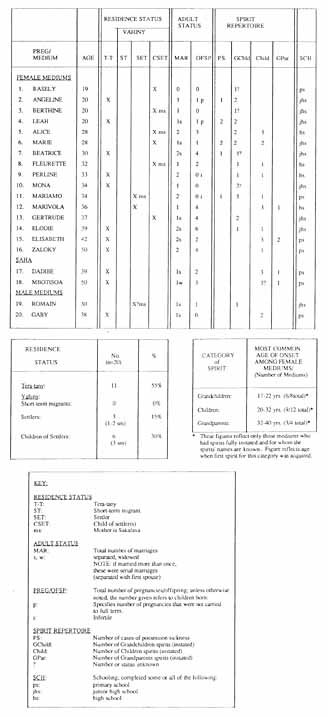
7.1. Table of Mediums. Note: See Appendix A for more details and for descriptions of women who have experienced only possession sickness.
Tromba in Ambanja is likewise associated with female status, but in this case it serves as a confirmation that female status has been achieved. As a woman takes on the role of tromba medium, her identity is transformed in terms of the way it is perceived subjectively and collectively. While in a state of trance, her personality and behavior change in ways that are only limited by the boundaries of her spirit repertoire. Her spirit(s) also impose(s) a new order on her daily life through the complicated categories of taboos that are part of each spirit’s identity and history. Furthermore, as a powerful and respected healer, a medium imposes order on the lives of others: her family, her friends, and her clients are all within her sphere of influence. If she is possessed by a very powerful spirit, then she may affect the actions of living royalty as well. Finally, she joins a special collective of mediums who share the same spirits or who have other spirits from the same genealogies. As will be described below, these women, as spouses to their respective spirits, are redefined in relation to one another as sisters, mothers, and co-wives. Power is inherent to the tromba world, and social integration is also an essential characteristic.
The Cultural Persona: Changing Ethnic Identity
Since it is ancestors that are pivotal in defining Sakalava (and, more generally, Malagasy) identity, it is exclusively through tromba that outsiders may be structurally recognized as Sakalava. Through this process they also gain access to local ancestral power. The significance of tromba in the context of migration is evident in the types of people who experience possession. In the past, tromba possession was exclusively a Sakalava experience; in recent years, non-Sakalava mediums have become involved. They are either settlers or the children of settlers. For these reasons it is not surprising that half of the mediums interviewed during 1987 were themselves migrants, participating in what is viewed as a Sakalava institution. The involvement of migrants in tromba possessionhas occurred through an unusual set of kinship principles that are activated by the spirits. The reasons for this have much to do with local notions of social identity and status and Sakalava conceptions of gender and adulthood.
Migrants as Mediums
Although tromba possession is regarded as a Sakalava institution in Ambanja, the recent proliferation of possession in this town has occurred in part as a result of the active participation of vahiny. As noted earlier, Bemazava royalty especially bemoan the popularity of new and less important Grandchildren spirits, saying that Tsimihety migrants are to blame for bringing them to Ambanja. Nearly all tromba spirits continue to be members of Sakalava royal lineages, either by birth or honorary incorporation (as with Raleva, Raovoay, and their offspring), but tromba mediums are peoples of diverse origins. They include, for example, many Tsimihety, as well as Antakarana, Betsileo, Antaimoro, and métisse. Only Merina are denied the possibility of ever participating, regardless of their personal networks. This is because Merina are taboo to many spirits (they are “fady Merina”). As a result, members of the most powerful ethnic group on a national scale remain among the most peripheral locally in Ambanja. They can never fully participate in tromba, and they are never welcome as members of the Sakalava tera-tany community.
Although I estimate that approximately half of mediums participating in tromba today are of migrant status, they are not short-term (temporary) migrants but settlers or the children of settlers (see figure 7.1 and Appendix A). Drawing again from the sample of twenty mediums (male and female) whom I interviewed in detail, eleven were tera-tany (born locally of a Sakalava mother and father) and nine were vahiny. These vahiny can be broken down into two subgroups: three were settlers (two of whom had Sakalava mothers), and six were the children or grandchildren of migrants (three of whom had Sakalava mothers). All nine were born in the Sambirano. I encountered no short-term (temporary) migrants who had become tromba mediums.
Possession as a means for social integration in Madagascar has been described elsewhere by other authors. Althabe (1969), in his study of possession among the Betsimisaraka of the east coast, has argued that in an area where exogamous virilocal settlement was the rule, possession served as a means to incorporate women into local lineages. Mediumship guaranteed a woman’s participation in her husband’s ancestral lineage, providing her with a way to be involved in local decisions that affected her and her affines. In Ambanja, this incorporating nature of possession has taken one further step. Through tromba, outsiders are incorporated into local Sakalava culture and society. Unlike Althabe’s example, they are not simply affines who are, in a sense, strangers, but more distant non-Sakalava migrants and neighbors. The reason why tromba is so successful in integrating non-kin migrant women is that it operates on kinship-based principles.
| • | • | • |
Turning Outsiders into Insiders: Mediums’ Social Networks and Personal Relationships
Tromba ceremonies are major social events that involve a large group of people and may span several days. As is often true cross-culturally, mediums who participate at these ceremonies are generally part of a network of women who, on a regular basis, attend the same ceremonies. Similarly, zar ceremonies in the Sudan may be a daily social event where women gather to gossip and drink coffee (Kenyon 1991: chap. 6). Giles, writing from the perspective of Mombasa, Kenya, states that possession activities provide cult members with a “close-knit group or ‘family’ for support in a heterogeneous and complex social setting, especially in urban areas” (1987: 248). In Ambanja, tromba networks are composed of women who might be kin, neighbors, or coworkers or who were friends at school when they were young. Socializing among these women extends beyond the spatial and temporal confines of the ceremony. It is in the ceremonial context, however, that these ties are underscored and strengthened.
Active participation in large tromba ceremonies helps to create special bonds between mediums. One network of women I followed throughout 1987 will serve as an example. It was composed of six women: one Antakarana, two Sakalava, two Tsimihety, and one Antaimoro. Five of these six women were mediums. All six participated regularly in ceremonies sponsored by royalty living in town (for example, to celebrate the birth of a child, a child’s first hair cutting, or the circumcision of a son). Four of these women had known each other since childhood, having gone to school together. Two had befriended the remaining two (the Antakarana and one of the Tsimihety women) while they were working at a tapioca factory, which is now defunct. (Today they all work in town.)
During the past decade, these six women have helped each other find housing so that now they all live in the same neighborhood, an area where rents are cheap and where several royal households are located. As dwellings have become vacant, they have alerted each other that a new house is for rent, and now they are clustered as two sets of next-door neighbors, four on one side of the street facing the other two. These women visit each other daily, sitting on the porch or in the yard of one of their houses, chatting, braiding each other’s hair, or preparing food for their evening meals. Two of the six women are single, and all six assist one another in times of need: they watch each other’s children; take turns going to the market; and they keep an eye on each other’s possessions should one of them leave town. The Antakarana woman’s sister had left a son under her care. Near the end of my fieldwork the boy died of diphtheria, and her five friends came to mourn his death and accompany her to the cemetery as if they were kin.
To understand the significance of these ties, one must analyze the structural implications of tromba. It is not simply friendship that binds these six women. In Ambanja, being friends (drakô, an intimate term used between women; or kamarady, from French camarade) is not enough to bind individuals. Among Malagasy, friends do favors for one another, but only kin (SAK: havan̂ana; HP: havana) are obligated to help each other in times of need. As Keenan says of the Vakinankaratra of the high plateaux, “The ties that bind descendants are thought to be the strongest of any interpersonal relationship” (1974: 61). In small villages, neighbors are usually kin (see Bloch 1971), but in Ambanja one generally has no kinship ties to those who live nearby. Among these six women it is participation in tromba ceremonies which cements these ties.
Involvement in tromba in Ambanja is simultaneously evidence of an individual’s integration into the local community and a means to achieve this end. In this community, it is not simply affines who are incorporated but, more importantly, people of diverse ethnic (and thus ancestral and geographical) origins. In order to instate a spirit in a medium, a woman must have either kin or close friends who can help pay for and sponsor the ceremony. She, or others she knows, must also have contacts within a network of mediums who will agree to participate in and run the ceremony for her. Migrants who have been in town for only a short period of time have not had time to develop such networks; those who plan to return home soon are not interested in developing them. Tromba serves as a mechanism that regulates the pace of integration. The personal qualities and sown status of the migrant determine whether she may become a medium. Whereas Angeline’s cermony (chapter 5) provides an example of successful possession, the case of Basely illustrates that if networks are weak, a tromba spirit cannot be instated in a potential medium.
Basely and the Angry, Unrequited Spirit
Basely is nineteen and was born of Tsimihety parents. She moved to Ambanja with her parents and her older brother when she was ten. Basely shares a house in Ambanja with her father, but she spends much of her time there alone. Her mother died when she was twelve, and her brother died a few years ago. Her father, who is both an alcoholic and unemployed, is rarely home, preferring to live instead with a string of lovers in town who support and feed him (and eventually throw him out). Basely reports that her father is cruel to her—he often beats her when he is home, and he never provides her with food to eat or money with which to support herself.
Four months ago Perline hired Basely as a part-time house servant. Perline is thirty-three, Sakalava, and married. She was born in the Sambirano and she owns the land on which she and other members of her household live. Although she has no children of her own, she cares for her present husband’s two children by a former marriage. Perline’s day is very busy: she runs a small grocery store with the help of her husband, and she is an accomplished tromba medium with a large clientele. For two years her younger sister lived with them and helped Perline with household chores, but six months ago her sister went to live in Ambilobe with a lover. Perline found it difficult to see to her housework while running two businesses. Since one of her sisters was, at one time, married to Basely’s brother (who is now dead), Perline decided to hire Basely to wash dishes, carry water, and do the laundry.
Perline pays Basely a minimal salary and feeds her two meals a day. When Basely is in the yard, just out of earshot, Perline often speaks to me of Basely. As she said on one occasion: “I feel so sorry for Basely…she is a little crazy (adaladala)—she is not quite right in the head.…This is because Basely has had a tromba for almost a year and a half now, but she has no one—no friends or living relatives—who will help her raise the money for the spirit so it can be established within her.…Her tromba makes her feel weak and dizzy because it is angry with her.…Oh, it is terrible—back at her house she lives like a dog,[6] eating scraps when she can find them!” Before Perline had decided to pay part of Basely’s salary in the form of meals, Basely used to come by between work hours and beg for food to eat. Now Perline feels she is helping Basely while saving herself some money in the bargain. Perline is worried that if a ceremony is not held soon, Basely will suffer even more than she does already.
Basely’s situation illustrates the necessity of having a supportive network of either kin or a strong social network of friends (something that most tera-tany, settlers, and the children of migrants have). Basely has neither. Since Perline does not consider Basely to be close kin, she is unwilling to help pay for Basely’s ceremony.
Tromba as Fictive Kinship: Spiritual Polyandry and Polygyny
Perhaps a generation ago, the bonds between these women might have been legitimized by a form of fictive kinship called fatidra or “blood brother/sisterhood” (Tegnaeus 1952), yet it appears that this practice no longer operates in Ambanja. I met several Malagasy in Ambanja who had heard of fatidra but I was unable to find anyone, male or female, who had a blood brother or sister.[7] Through tromba spirits, women establish bonds through a complicated fictive kinship system, characterized by inverted and shifting perspectives. Kinship serves as an idiom for defining relationships that a medium has with the spirits and other mediums, and those that exist between her kin and her spirits.
The most important defining principle is marriage. Lambek, in his analysis of possession in the Mayotte, compares trumba initiation ceremonies to weddings since, structurally, the two are quite similar (1981: 141). He also draws a comparison between a spirit and a groom (1981: 143). In Ambanja this relationship is a reality, for a medium’s spirit is her “spouse” (vady) (figure 7.2). An important structural component of tromba is symbolic polyandry (cf. Karp 1987 on polyandry and spirit possession in Kenya). If a tromba medium is possessed by numerous male spirits, all of these spirits are her husbands. If she has a living husband, when she is not possessed, he, too, is her spouse. When she is possessed, she becomes the tromba, and this spirit and the living husband regard each other as “friends” (kamarady) or as “brothers” (miralahy).[8] The ranking of spouses is also important. If a female medium has more than one spirit, these are ranked according to their relative location in the spirit’s genealogical hierarchy. All spirits, in turn, are regarded as being superior in rank to the living husband. Thus, when a female medium is possessed, she becomes the dominant male in her household, and she may appeal to her tromba spirit for assistance in ways that a living spouse should help her. When I asked Mbotisoa, who is widowed and who is a saha at Nosy Faly, if she ever thought of remarrying, she replied, “I have no need for a [living] husband! My tromba [spouse] takes very good care of me.” Mbotisoa is simultaneously a widow, a woman married to a spirit husband, and the embodiment of that spirit husband. She had freed herself from what she perceives to be the constraints of marriage.[9]
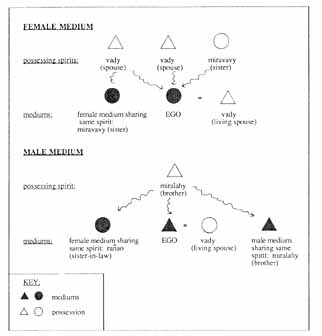
7.2. Mediumship and Kinship Bonds (terms used when medium is out of trance).
Other relationships defined by marriage are also at work here. Poly-gyny was often practiced by Sakalava royalty in the past, since having several wives was a sign of power and prestige. Since one spirit may possess many mediums, structurally all of these mediums are co-wives. When they are together at a tromba ceremony they will sometimes refer to each other as “sisters” (miravavy). If a woman has a female tromba spirit, it, too, is regarded as her “sister.” Men, too, can be mediums, yet they are only possessed by male spirits who are defined as their “brothers” (singular: rahalahy; plural: miralahy) (figure 7.2).
Going In and Out of Trance: Male Versus Female Identities and Their Associated Kinship Ties
This concept of having shifting male and female selves is also structurally embedded in the complex kinship system that is associated with tromba possession. Accompanying tromba marriage are other principles thataffect not only the medium but her living kin as well, and these principles follow general rules of Sakalava kinship, where terms of address change according to the sex of the speaker. In order to examine the relationships of a female medium, the two parts of figure 4.4 (chapter 4) are needed. First, it must be noted that while in everyday practice Sakalava utilize “town” kin terms that are influenced by french vocabulary, in the context of tromba one relies on older, “village” terminology. This is done out of respect for the ways of the past (taloha), since tromba spirits are ancestors. Also, charts for female and male egos are relevant. The terms for the female ego operate when a female medium is not possessed and is addressing her own living kin and the kin of her spirit (spouse). The chart for the male ego becomes relevant when the medium is possessed by a a male spirit. At this time, she is a male spirit who uses this set of terms when he speaks of or to his “wife” (the medium’s displaced self) and his own spiritual kin. This restructuring of relationships between the living and the dead is also relevant to all of the medium’s living kin. I have heard one medium (when out of trance) address another woman as “older sister” (zoky) (figure 4.4, female ego), and then, as soon as she enters trance, refer to her as “sister-in-law” (ran̂ao) since, as a tromba spirit, he (the tromba, that is) is married to the medium who is that woman’s sister (figure 4.4, male ego).[10]
Since spirits have genealogies of their own, mediums are also integrated into a spiritual kinship order. If a medium is possessed at a ceremony, then it is likely that she is surrounded by tromba spirits who are related to her own possessing spirit. When she is possessed, she becomes that spirit, and so she addresses all other related spirits by their proper kinship terms—they are the spirit’s “children,” “parents,” “grandchildren,” “nephews,” “brothers,” and so forth (see again figure 4.4, male ego). Mediums for different spirits are related to one another as affines, so that if one woman is a medium for Raleva, for example, and another for Be Ondry, they address each other as “father” (baba) and “son” (zazakely, zanaka, zanakalahy). Finally, if a medium is not possessed and is in the presence of spirits who are related to her own, she will address these spirits as relatives of her tromba “husband” (figure 4.4, female ego). As should be clear by now, the terms of address shift constantly, depending on whether the medium (and others around her) are in or out of trance.
As a result, unrelated women become kin to one another through a kinship system that involves constantly shifting perspectives. As the above examples illustrate, women involved in tromba are quite comfortable with this notion of shifting selves. Since the majority of mediumsare female, it is women who experience the richness of this experience, which ultimately can deepen her social networks in this community. As a migrant, a female medium becomes established as a member of the tera-tany. This occurs in a number of ways. She becomes Sakalava, since through possession she is transformed into a Sakalava ruler or member of the royal lineage. She embodies the Sakalava past and becomes active in the construction of Sakalava notions of their historical experiences. Ultimately, her actions may be significant within the context of local power. In addition, through fictive kinship, she is incorporated into a network of established mediums who are not only her friends, but who are defined, for example, as her “sisters,” “co-wives,” and “mothers,” bonds that carry with them the obligations of kinship. Through tromba possession a medium joins an “old girls” network that enables her to strengthen and extend her local social ties. Finally, as a healer, she may become a central figure in the community, assisting both tera-tany and vahiny in times of personal crisis. Since tromba is simultaneously the epitome of Sakalava experience, yet one that is associated primarily with female status, it is far more difficult for vahiny men to become integrated as insiders than it is for women.
Tromba in the Home
Tromba possession also affects a medium’s relationships in her household. Among the most significant are those with her husband and children. If the medium and her living spouse have children, then they are also regarded as being the “children” (either direct or classificatory) of the spirit. As one tromba spirit said of his medium’s family, “her husband is my brother, and so his children are my children.” The children, in turn, address the spirit as “father” (papa, baba, or sometimes dada). When Perline (see above), for example, speaks to her children of her youngest spirit, Raleva, she says, “and, so, how is your father’s friend?” (kamarady, or zalahy, the latter being an intimate term of address used between men, similar to drakô, which is used by women). When she and all other members of her household speak of her most powerful spirit, they refer to him as “Grandfather” (Dadabe or Dadilahy).
Spirits become integral members of their mediums’ households, as the following case illustrates.
Alice and Her Merina Husband: Tromba and Marriage
Alice is a medium who is twenty-eight years old. Although she is the child of a Betsileo (settler) father, she considers herself to be tera-tany and Sakalava, since she was born and raised in the Sambirano by a Sakalava mother. She is possessed by five spirits (claiming that three of these arrived when she was six years old) and she works full-time as a medium. Alice met her present (second, by common law) husband, Gaby, four years ago. For the past three years they have lived together in a house she owns.
Both report that they are happy in their marriage. This was not always so, however. Alice had assumed that both of Gaby’s parents were Betsileo, but soon after they started to live together she learned that although his mother was Betsileo, Gaby’s father was Merina. This caused serious problems for Alice, since it was taboo for at least one of her spirits (Kotofanjava) to be near anyone of Merina descent. As Alice said: “After I learned this, I had many restless nights and I would wake up very tired in the morning. I thought that my tromba was responsible for this, but I was too afraid to consult the spirit to ask what to do.…Then, one night, in the middle of dinner, I collapsed.…I don’t remember what happened, but Gaby later told me that Kotofanjava suddenly arrived, without warning.…Gaby said I dropped my spoon and fell over. Then I stood up, and he realized I was possessed.”
Gaby later added: “The spirit sat up abruptly and started to yell at me, saying that as a Merina living in the house, I was making it dirty. I was so scared! You know, Kotofanjava does not like filth [tsy tiany maloto]. He wanted to know why Alice had allowed me, a Merina, to enter her house and live there with her. The spirit was very angry, saying I shouldn’t have assumed I was welcome here.…I asked what I should do.…I said I cared about Alice and I was happy living with her as her husband.…The spirit said he would like to think about it, and that I must make a request to speak to him a second time. Alice fell to the ground again and then she sat up and she asked me what had happened. It was then that I told her the story that I’ve just told you.”
They decided that the best thing to do was to call up the spirit later that month, when the moon was in an auspicious phase. This they did one morning and the spirit stated its terms: Gaby must host a ceremony in order to formally introduce himself to each of Alice’s spirits, and at this time he was to pay a fine of 2,000 fmg to each. This would serve as recompense for his transgression. Gaby agreed to the terms. Although it took more than eighteen months for him to assemble the necessary funds, he did eventually host a ceremony at which time each of the five spirits arrived, greeted him, and, after being paid the fines, gave him their blessing.
Gaby has since become involved in helping Alice with her work as a medium. In addition to working at a restaurant in town, during his days off he also serves as her rangahy. Alice’s spirits know him well and trust him; they often commend him for his skilled work as interpreter. He now brings new clients to Alice, since customers at the restaurant sometimes ask him if he knows of a competent tromba medium in town. When Alice is tired following possession, Gaby cooks their evening meals and washes the dishes afterward. On some days he also goes to the market for her if she needs to get ready to receive clients in the morning.
Tromba spirits are expected to watch over and take care of a mediumand her kin. If the medium is married, ideally her spirit and living spouse regard each other as friends or brothers. As the story of Alice and Gaby illustrates, a husband may become familiar with tromba possession through his wife’s activities as a medium. Also, he may become integrated into the local community through her, since, as a medium, she has a network of friends and clients whom she knows through her possession activities. If the couple has children, a woman’s spirit is regarded as a second father who helps raise them along with the living husband.[11] In this household, tromba strengthened the bond between spouses.
Mediums and Their Rangahy
Although men are not very active in tromba as mediums, they often serve as the rangahy or assistant to one, especially if the medium is his spouse. This relationship illustrates another form of the complementarity of male and female that is so common in Sakalava ritual. Gaby is now indispensable as Alice’s rangahy. The story of Angeline in chapter 5 illustrates how a new husband may begin to learn this role through example, watching another skilled rangahy perform the associated duties as spirits are instated in his spouse.
If a medium works as a healer, it is essential that she have a rangahy, an assistant who helps her as she goes in and out of trance and who can interpret the wishes of the spirit for her clients. Also, since a medium does not remember what came to pass while she is in trance, the rangahy serves as her witness, recounting the events for her (cf. Lambek 1981: xiiff, 70ff; 1988a). Generally the rangahy is not a medium, but is someone who is, nevertheless, very familiar with possession. He or she may be someone who attends ceremonies on a fairly regular basis, for example. The rangahy must also be someone the medium can trust, since it is the rangahy who prevents the medium from hurting herself while she is in trance and who tells her what happens during interactions with clients.
It is also the rangahy who serves as the go-between for the medium and her clients, helping to make appointments. If a medium wishes to work full-time as a healer, she needs help to ensure that her household duties are done (cleaning, cooking, fetching water, going to market, and so forth). It is the rangahy who often performs these duties for her. Since this requires much work on the part of the rangahy, the rangahy is most often the spouse, other kin (for example, a sister-in-law), or a close friend. These are individuals who are tied to the medium in reciprocal relationships that carry with them the obligation to assist one another.
The case of Marie presents an unusual example, since her rangahy, Monique, was a schoolmate and a former client. This case illustrates the closeness of the bond that develops between a medium and her rangahy when the rangahy is not already her kin.
Monique and Her Medium Friend, Marie
Monique is Marie’s closest friend. These two women seem inseparable, for I rarely see one without the other. Monique and Marie met when they were schoolmates in junior high school.
Monique is Tsimihety and came to the Sambirano with her parents when she was seven (she is now twenty-one). She had been an excellent student when she attended grammar school in the village where she lived. Six years ago (when she was thirteen), her schoolteacher convinced her parents to let her continue on to junior high school in Ambanja. Since she had no kin in town, the schoolteacher accompanied her parents there and helped them find lodging for Monique. They found a small, two-room house made of traveler’s palm. This Monique shared with three other schoolgirls. Her mother tried to visit her at least once each month, coming to town for the Thursday market and bringing Monique rice and other food to eat. Although Monique did well her first two years, in her third year, when she had just turned fifteen, she started to go out with a man from Diégo who delivered the mail each week to Ambanja. She began to fail in her studies. Things got worse when, near the end of the school term, she became pregnant and her lover abandoned her for an older woman who worked at the post office. She failed her studies and was told she would have to repeat the year.
When Monique went back to her parent’s village over the school break, she became very ill, possessed by a njarinintsy spirit. In the middle of the night she would wake up and cry, then run out into the street and wander aimlessly for hours. Her mother, father, and older sister cared for her and took her to four different tromba mediums, but none were able to cure her. She continued to be troubled by fits of possession, when she would scream and cry. Her parents were very worried but they were also angry with Mo-nique because she had become involved in the town nightlife, and this had caused her to do poorly in school (and become pregnant at a young age).
Monique had heard of a classmate who had been cured of njarinintsy by the spirit Mampiary, and so two months later she decided to go to Ambanja on market day and see if she could find her friend, Marie, whom she knew was a medium for this tromba spirit. After two consultations, Mampiary (while possessing Marie) successfully drove out Monique’s njarinintsy spirit, and Marie and Monique have remained good friends ever since. A neighbor of Marie’s also directed Monique to an older woman who gave her herbal remedies to make her abort.
Monique did not go back to school that year, nor did she return to her parents’ village. Instead, she moved to Ambanja with her sister, who supports herself by selling bread in the market. Marie is now Monique’s closest friend, and they are together every day. In the morning Monique helps her sister make and sell bread, and by noon she returns to Marie’s house. Monique is Marie’s rangahy: she assists Marie at ceremonies, helps clients make appointments to consult with Marie’s spirits, and she also runs errands for Marie (such as going to market and fetching water) when Marie must work elsewhere or when she is in trance. Friends and neighbors say they are lovers, but I was unable to confirm this with Marie or Monique.
As chapter 9 will illustrate, adolescence is a time of great turmoil for young girls in Ambanja, who are confronted with the expectations associated with womanhood, particularly in terms of fertility and sexuality. Marie cured Monique; Marie, in turn, has gained a much needed rangahy. Whereas the rangahy is generally a spouse, in cases where the spouse is uncooperative or nonexistent, close kin (often female) fill in. In the case of Marie, a classmate and former client is now her closest friend, her rangahy, caretaker, and perhaps her lover.[12]
| • | • | • |
Miasa Ny Tromba: Mediumship as Work
Tromba spirits do not simply affect the personal lives of mediums; these spirits also play essential roles in defining a medium’s place as a healer in the community. In addition, being a medium elevates a woman’s status in the community; and provides a means whereby she may support herself financially. As described in chapter 6, through possession a medium can opt out of working as a wage laborer at one of the enterprises. This is facilitated by the fact that mediumship today is regarded as a legitimate and profitable profession. Mediums possess a special and particular kind of knowledge, which enables them to assist both tera-tany and vahiny.
The professionalism associated with mediumship has developed within the second half of this century. It is often said in Madagascar that spirit mediums can grow rich by working as healers, and that the most famous amass small fortunes serving important government officials. None of the mediums I interviewed made much money, although those who had a large clientele earned enough in a month to pay their rents and to cover almost all food expenses. Comparatively speaking, this is still less than they would make working six days per week at an enterprise sorting cocoa, where a female worker’s monthly salary might reach a maximum of 30,000 fmg. Yet many women prefer towork as healers because this liberates them from capitalist labor relations.
Time and Possession: The Tromba Calendar and Client Consultations
Working as a healer is not required but is a matter of personal choice for a tromba medium. The range and frequency of healing activities vary widely from one medium to another. Some occasionally assist kin or close friends, while others build a large clientele so that they might see half a dozen or more clients during the course of a week. Other mediums prefer to participate only in large ceremonies; at these times their spirits may be asked for advice by participants or passersby.
Although a medium has much to gain as a healer—prestige, fame, and, potentially, an income—not all mediums work as healers. This is because possession is exhausting and time consuming, and so a successful medium is one who plans ahead. After a medium leaves trance she often feels weak and stiff, especially in her arms, back, and neck, and she is usually disoriented for the rest of the day. Since spiritual consultations may take an hour, if not longer, a medium who regularly receives clients at home needs help in attending to her other duties. One medium I knew always made sure she had lunch prepared early in the morning before she would receive clients. If her children returned from school for the midday meal and found her in trance, the oldest daughter (who was fourteen years old) would cook the rice, and her father, who would be busy as the rangahy, would occasionally shout orders to her and the other children from the consultation room. The children would eat, clean up, nap, and return to school while the medium, her husband, and sometimes the client, would eat much later when the consultation was over.
There are auspicious and inauspicious times for possession, determined by the lunar calendar and the solar day. The period between the new or ascending moon (fanjava tondroen̂y, “mounting moon”) and full moon (fanjava bory, “round moon”) is the best time to perform a tromba ceremony. This period is associated with life, vitality, growth, and well-being. The period marked by a descending moon (fanjava maty, “dead moon”) and no moon (fanjava fady, “taboo moon”) is a time of death and danger. This is when, for example, royal funerals are held. No spirits may be called up in a medium (and thus, out of their tombs) during these lunar phases. To do so would be dangerous, since it might bring harm or death (see figure 7.3).
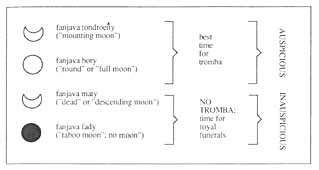
7.3. Tromba Lunar Phases.
Taboo phases also coincide with certain months (the word fanjava means both “moon” and “month”). As noted in chapter 5, tromba is taboo when the royal Sakalava tombs are cleaned. These periods are mid-June to mid-July for Bemihisatra spirits, and mid-July to mid-August for the Bemazava, and they are referred to as fanjava fady (“taboo month[s]”) or sokave. In August there is much tromba in Ambanja following the lifting of the bans. This time also corresponds with the end of the coffee harvest season, when women’s and men’s pockets are full of cash, enabling them to host long overdue (and very expensive) ceremonies.
To a lesser extent, similar meanings are assigned to the positions of the sun in the sky. Morning is associated with well-being, growth, and life, whereas the afternoon, when the sun is descending, is less auspicious. As illustrated by Angeline’s ceremony in chapter 5, large-scale ceremonies generally begin in the morning and proceed through the night and into the next morning. It is just after dawn that a new spirit often arrives in the neophyte. All spirits also have taboo days associated with them which coincide with activities that occur on a regular basis back at the tombs: Tuesday and Thursday are among the most common for spirits active in the Sambirano. In addition, a medium may not go into trance if she is menstruating.
Determining when to hold a tromba consultation is fairly complicated, since overlapping yet distinct systems of lunar and solar time affect possession. As a result, a general rule of tromba possession is that a client must make an appointment to consult with a given spirit. This time is determined in part by when it is convenient for the medium and, more specifically, by phases of the moon and sun. Solar time is more flexible than lunar: sometimes a consultation occurs in the afternoon. In part this is because, by Sakalava notions of time, a new day does not begin at dawn, but around 2:00 p.m., when the sun is descending (for example, Friday begins on Thursday afternoon). Some mediums are willing to hold sessions with clients in the afternoon in order to allow for the constraints imposed by the workday. Thus, they might schedule consultations late in the day since people in Ambanja prefer to go to market in the morning and mediums or their clients may work at the enterprises until 3:00 or 4:00 p.m. The best time to hold a ceremony is in the morning, before 10:00 a.m., and at a time in the month when the moon is new.
Marie and Mampiary: Problems at Work and Spiritual Intervention
As described in chapter 6, tromba possession offers mediums, who work at the enterprises, a way to opt out of wage labor, because of the cash crop fady associated with certain spirits. As a result, tromba mediumship as a profession stands in opposition to wage labor. Mediums say they do not provide services to clients for money since it is their duty or obligation to assist the living when they wish to contact the royal dead. Nevertheless, the income derived from these consultations enables a medium to survive in a world dominated by a cash economy. Again, Marie provides an appropriate example:
Marie, who lives near my house, is twenty-eight and has four spirits, the first one having arrived when she was seventeen. Her parents are both Tsimihety settlers from south of the Sambirano; she herself was born in Ambanja. She was married when she was younger, but she now lives alone. Marie has an eleven-year-old daughter who lives with Marie’s mother in a village in the countryside. Two years ago Marie started to work at a local enterprise, where she sorted cocoa (since one of her spirits has coffee and cashew taboos).
One evening I woke up around 10:00 p.m. and heard someone crying and wailing. I thought it was coming from Marie’s house, since I could see some people inside—maybe one or two—who appeared to be tending to someone. The crying was like that of a njarinintsy…later I thought I heard the person wandering about in the street at night, again crying and wailing.
A few days later one of my assistants and I went to talk to Marie to interview her about her experiences at work. She told us that she had suddenly quit her job at the enterprise. We learned that the other night I had indeed heard her crying and that that was the night she had quit her job. When we asked her why, she told us the following: “There was a young man there who was very interested in me, but I didn’t like him. I tried to ignore him and brush him off whenever he made passes at me, but instead of leaving me alone, he continued to bother me even more…treating me like a prostitute [makarely].…[On the last day of work] I was sitting on the ground beside a truck, sorting cocoa. He came over, sat down on the truck, and put his foot on my head!” When my assistant asked why he had done this, Marie said “Because I would not accept his advances!…I don’t remember what happened, because I passed out [manjary torana]…I was told later that I was taken back to my house in a company car. When I got back to Ambanja and woke up I went straight to Monique’s house. She then went to find my mother in her village.” Marie then explained that the reason why she fainted was that her spirit Mampiary was angry. “He did not like having my head touched by something dirty [tsy tiany maloto, “he hates filth”].…Mampiary also gave me a njarinintsy because he was mad…at the man and…because Mampiary did not want me to work at the enterprise any longer.…My mother and Monique helped me to call up the spirit [nikaiky ny tromba]: Mampiary said they were to have me bathe and oil my body.” Then Monique added, “Before we could do this, Marie ran from the house and went wandering in the forest nearby…that’s where you’ll find the cocoa fields of [the enterprise where Marie worked].”
I then asked Marie to describe her sentiments toward Mampiary after all this happened. She said: “He was not my enemy but my friend because he helped me…he made the man’s foot swell up for a week, and he lost his job! Ha!…I’d like to go back to work, but Mampiary will not let me.…If I want to go back to work I must first make a formal request [hataka] to him.”
This story illustrates the role of the tromba spirit as guardian and protector of Marie, since it is the spirit who intervenes during this crisis. It also stresses the significance of problems associated with work, as well as those that may arise in interactions between men and women. These themes, of work and romance are major concerns for many mediums’ clients and they will be reiterated in the discussion on mediums and their clientele in chapter 8.
During this episode, the man’s actions were an affront to both Marie and her spirit. In placing his foot on her head, he violated strict rules of etiquette. In Madagascar, only individuals of higher status (elders or royalty) may raise their heads above those of other adults. If someone needs to walk through a seated crowd, they always bend over, and as they walk between others they put their hand before them and say aza fady (“excuse me,” lit. “don’t [commit a] taboo” or “pardon my taboo”). For Malagasy, the head is sacred, and so no one ever touches the head of another without first asking if they may do so. Tromba possession is among the few situations where the head may be touched by others: as illustrated in Angeline’s ceremony, lesser spirits place their heads in the laps of Grandparent spirits to honor them and to acquire their blessing.[13] When sleeping in a crowded room, Malagasy generally form a circle with their feet in the middle, so that one’s head does not come into contact with another person’s dirty feet. When the man touched Marie’s head with his foot, his action was also an affront to her spirit, since spirits reside in the heads of their mediums (cf. Feeley-Harnik 1988: 76).
Following this incident, the man was fired from his job. Marie did not return to work at the enterprise.
In August, a month after Marie left her job, she started to work full-time as a medium. She lived in my neighborhood, and when I would pass by her house I often saw clients coming and going from there. Most often she was possessed by Mampiary who, although he is not a very powerful spirit, was well known by the people of Ambanja. At these times Mampiary would call out to me if he saw me in the street and would ask me to come watch him work. Marie held consultations with clients as often as four days a week, when the moon was in auspicious phases, and her friend Monique as always there to assist.
Within two months Marie had assembled a large clientele. During the auspicious times of the month she was able to make as much as 8,000 fmg per week. When I left the field two months later, she was still working as a healer. Her clients included equal proportions of women and men, tera-tany and vahiny, and people she knew as well as strangers. She made additional money by helping friends in her neighborhood who needed to organize large-scale possession ceremonies (romba ny tromba) to appease their own angry spirits. She was, for example, one of the mediums who appeared at Angeline’s ceremony. Marie hosted some of these ceremonies for neophytes in her own house, making arrangements for musicians and inviting other mediums to participate. Marie was usually paid 1,000 to 2,000 fmg for each of her spirits that arrived at a ceremony; generally at least two of her four spirits participated.
Although Marie was able to support herself financially as a medium, describing this activity as work (asa) is problematic, since it it runs contrary to how mediums perceive their actions and, more generally, to Sakalava conceptions of work. When a tromba medium is consulting with clients, one says “miasa izy” (“she is working”), but this is not in reference to the money she might earn. Instead, it bears the same meaning as when she is washing clothes: she is busy or occupied. Tromba mediumship, according to Sakalava concepts of work, is not regarded as a form of wage labor. Furthermore, a medium does not have free access to the goods and cash that are given to her spirit(s).[14]
A medium can make use of the funds paid by clients only through prior agreement with her spirit(s), since payments are made to the tromba spirits and not directly to her. This is because a client comes to consult a spirit, and not the medium, who is simply the vehicle for communication. Payments are made to spirits in several ways. A client is expected to bring gifts of money or food to the spirit to encourage it to arrive and to ensure it will be pleased and will then cooperate. During the invocation, the client initiates the consultation with a payment of one or two silver-colored (nickel) 50- or 100-fmg pieces (vola fotsy)[15] which they place in the plate filled with water and crumbled kaolin. Once the spirit has arrived, the client offers goods for consumption which are appropriate for that spirit, such as soda pop, rum, beer, or cigarettes. These items are for the spirit, and the medium must consume all during trance. If for some reason she does not, they are put aside and used during another ceremony (this happens most often with cigarettes). Even if the actual consultation is brief, the spirit is expected to stay until it has consumed these items. Thus, none of these goods remain for use by the medium or her family after the ceremony is over.
Consultations often require one or more follow-up visits. The client may be instructed, for instance, to find or purchase certain herbs and then return to the medium’s home for further instructions. I have watched spirits write up lists for this purpose which are similar to doctor’s prescriptions. The final payment is made only if the cure is successful. The spirit will usually state its terms beforehand: if the cure is effective the client must pay, perhaps, 500 fmg, a piece of cloth, or a bottle of beer (charges are usually levied on a sliding scale). Again, none of the money or goods can be used by the medium or other members of her household. Only the spirit can wear the cloth, and the money should be used to buy, for example, a new hat for the spirit or to pay for a future ceremony. Mediums keep these funds separate from general household funds, often on a shelf or table in the east or northeast corner of the house, this being a sacred spot that is designated as the storage place for tromba’s items (trano ny tromba, lit. “the tromba’s house”).
There is, however, a certain amount of flexibility here. Mediums do borrow from the tromba’s till, but only after asking permission from the spirit. As in the case involving Angeline and her coffee fady, the spirit may be summoned and asked by the rangahy if it would make an exception. In this way, the rangahy may ask if funds from the spirit’s till can be spent on something needed by the household. I am unsure how often individual mediums actually pay back these loans. Although Malagasy frequently borrow money from one another, they do not necessarily pay back the full amount. Instead, by remaining in debt, a reciprocal relationship is initiated, where the original giver is then free to make a future request of the original borrower.[16] To ask for repayment of a debt shows total disregard for this form of etiquette. This is expressed by the saying tsy manao trosa (lit. “[I/we] don’t do [give] credit”), which implies that if one demands reimbursement it redefines the relationship between these two friends as an unequal one more akin to that between a merchant and client. As among the living, a spirit does not ask for a full repayment of the debt, but requests, instead, another favor. For example, it may ask to have a ceremony given in its honor. In this way the medium can actually sustain herself on clients’ payments, although she does not consider this money to be a salary nor are her activities a form of wage labor. Tromba is work (asa) in the precolonial sense: when a medium is receiving clients, one says asa ny tromba (“the tromba spirit is working”). This a medium does out of duty, since she performs this work to help the living gain access to the royal ancestors.
Feeding the Spirits: Medium-Client Relationships
Within the context of tromba healing ceremonies, there are several shifting relationships between the medium and rangahy, the medium and her spirit, and the client and medium/spirit. In the context of healing sessions, the key relationship is between the client and spirit, whereas that between client and medium is secondary. A medium who works most of the month as a healer will become well known in her neighborhood. A client’s choice to go to a specific medium may be based on practical or sentimental reasons: the medium lives nearby, or perhaps she is a friend or relative. Others seek her out because she is possessed by a spirit that has helped them (or someone else they know) in the past. A client may also wish to speak with a powerful spirit, and so he or she seeks out a medium who is possessed by a Grandparent. Marie’s clients include friends and neighbors, although the majority are strangers (both tera-tany and vahiny) who seek the advice of a particular spirit—in her case, usually Mampiary.
The relationship between healer (medium or spirit) and client is complex. On the surface, it is based on an unbalanced form of reciprocity in which the medium provides services in exchange for money or gifts that are given to her spirit. To gain access to the spirit, the client must have the cooperation of the medium. For example, an adult with sore eyes or a child who cries too much can be treated in a single, brief consultation. The client (or, in the case of a child, another adult) explains the problem to the medium and then again to the spirit. The spirit then uses its powers to heal: perhaps it will draw circles of white kaolin around the first client’s eyes, accompanying this with an incantation requesting assistance from more powerful ancestral spirits. For the child, it might prepare an herbal remedy to sooth a stomachache or sore gums. If the cures work, each client is expected to return later to make a small payment—a bottle of beer or perhaps 200 fmg. Although mediums help clients with physical ailments, more often clients suffer from complicated economic and social problems associated with work and success, or love and romance.
In a sense, the simpler the problem, the less involved the relationship between the medium-spirit and client. With serious problems, relationships may develop over time that are more symbiotic (or even, in extreme cases, parasitic). This is expressed by the proverb “Tromban’ny teta, vola miboaka” (lit. “It’s tromba that’s in the head, it’s money that comes out”). This saying was popular in 1987, when it appeared on a printed lambahoany cloth that many women in Ambanja purchased. The message conveyed by this proverb is that if one wants service, one must pay for it first. Merchants in local boutiques use it to mean “don’t touch the merchandise unless you plan to pay for it.” For them, it is synonymous with the expression mentioned earlier: “We don’t give credit” (tsy manao trosa). The proverb is also a reference to the greedy and demanding nature of tromba spirits—if you seek the advice of a tromba spirit, you may have to pay dearly for it. The extent to which this is true is determined by the nature of the client’s problem, the type of cure the tromba spirit dispenses, and the personality of the medium. Although mediums do not consider their activities as healers to be a form of wage labor, the spirit-client relationship is an unequal one, since spirits are demanding and greedy.[17]
There is much folklore surrounding the centrality of tromba in the lives of the intelligentsia, with stories recounting how the most famous tromba mediums have been flown from northern Madagascar to Antananarivo to treat the urban elite. Malagasy often express great fear (SAK: mavozobe; HP: mitaotrabe) of tromba spirits because of their consuming and unpredictable nature. There are several reasons to be wary of tromba spirits. First, people who commune too often with the spirits run the risk of becoming possessed themselves. Second, tromba spirits can be reckless and they are easily angered, and so they may physically injure observers. Third, they can be very demanding of their clients, consuming an individual’s wealth in exchange for spiritual advice and assistance. As Feeley-Harnik has noted, praise songs about Sakalava royalty speak of their voracious greed and how they desire to encompass and consume all that they see (1982: 30ff). Similarly, one must feed spirits if one seeks their cooperation. The tromba, as royal spirits, may, in turn, devour the fortunes of desperate clients. I have met individuals who have paid as much as 50,000 to 100,000 fmg to a series of healers as they sought treatments for what seemed to be incurable ailments.
Although I would not describe the majority of mediums I encountered as greedy, I did find it to be an appropriate description for the few who dealt in harmful or bad medicine (fanafody raty). This type of fanafody is used for self-advancement, generally at the expense of others or, more directly, to harm an adversary (this will be discussed in detail in the following chapter). Because of the nature of their work, these mediums are very cautious in forming relationships. Whereas many of Marie’s clients are strangers, Marivola, who professes in private that she specializes in bad medicine, screens her clients very carefully. She and other members of her household are very careful in their daily interactions with non-kin.
Marivola’s Bad Medicine
Marivola, who is thirty-six years old, is married and has four children. She is Arab-métisse (her father is an Arab from Yemen, and her mother, who is now dead, was Tsimihety). Marivola is a housewife, and her husband is a bookkeeper at one of the local enterprises. Marivola has four spirits; three of these she inherited from her mother.
Although Marivola possesses a number of valuable skills (she finished two years of high school and speaks French fluently) she prefers not to work. Occasionally, however, as a medium, she holds private healing sessions in her home. She does not have a steady flow of clients. She only assists individuals whom she knows well and whom she trusts. As a result, during certain months there is a flurry of tromba activity in her house, whereas other months may pass when she rarely goes into trance. The amount of activity depends upon the problems that arise in her own household and upon the demands from her limited clientele.
Marivola is very cautious about divulging any information about her work as a tromba medium, more so than most mediums I have met, because she is among the few who are willing to provide clients with bad medicine (fanafody raty). To speak of these things would mean giving away secrets. It might also bring on the wrath of her spirits, since this knowledge is sacred. She and her husband are very suspicious of non-kin, certain that out of fear or jealousy of Marivola’s powers, they will try to harm them or their children with their own bad medicine. Marivola and her husband make a point of buying food and other goods from strangers or non-Malagasy. They prefer to go to the outskirts of town even for everyday items rather than going to the grocery run by their next-door neighbors and risk being harmed by them.
Marivola uses kinship to define close relations with clients; these are the only friends she trusted. When I knew her in 1987, she only received two women as clients on a regular basis, both of whom she defined as being “like sisters” (mira piravavy). The first was a woman who suffered from chronic headaches whom she helped because, as Marivola put it: “I have known her a long time, and, besides, she is Tsimihety, and so I feel I should help her, because we are like family” (mira havana). The second was a friend named Fatima.
The story of Fatima’s relationship with Marivola will be covered in the following chapter. As will become clear, Fatima paid dearly for Marivola’s services. In contrast to Marivola, the profile provided of Marie, above, is more typical for a medium. Marie’s clients learn of her through word of mouth, and many are strangers. If Marie does not treat certain clients, it is not so much because she is suspicious of them or because she has no sentimental ties to them, but because of the limitations of the skills of her spirits. Marivola, on the other hand, is very cautious. She rarely even permits any visitors to enter her house. Instead, they must stay on the front porch or visit her in her backyard. If they appear at mealtime they are rarely greeted with “karibo, karibo sakafo,” (“come in, come in and eat”), as is standard practice in Ambanja. Her cautiousness (which I often felt verged on the paranoid) is a result of the nature of her trade: since she harms others, others might try to harm her. Or, put another way, since she is preoccupied with doing ill to others, she assumes that all people are potentially her adversaries. Because trust is a major concern for Marivola and her husband, strangers are especially dangerous.
Regardless of the nature of their trades, however, for mediums such as Marie and Marivola possession transforms identity and enhances power by granting greater authority over their activities at home, at work, and in the community at large. The idioms of marriage and kinship associated with tromba facilitate the incorporation of women more readily than men. These structural principles help to create special bonds between mediums, turning friends into fictive kin. If a medium is a migrant, her ethnic identity changes, since she will be recognized by her fellow mediums as being Sakalava. As a medium for tromba spirits in the popular realm, she plays an important role in the local community, assisting vahiny and tera-tany clients in their efforts to cope with and control the events in their lives. As Part 3 will show, problems vary for tera-tany and vahiny, adults and children, and even for mediums of different statuses. It is tromba mediums and other practitioners who assist clients in making sense of the crises they encounter in their lives.
Notes
1. Self and person are generally overlapping or may even be indistinguishable since the concept of an individually, psychologically conceived self is not universal cross-culturally. In the context of tromba possession, however, they are in some ways distinguished by private and public realms. For a medium, selfhood is a private or personal experience, and it is in this sense that I use the term, as Mauss did.
2. A detailed discussion of this process extends beyond the scope of this present study. Suffice it to say here that the level of self-reflection that occurs, for example, in the context of Western schools of psychiatry and psychology is not something that characterizes Malagasy culture (see Sharp, in press). If we assume that language shapes in part the way we perceive the world, the Malagasy language is structured in such a way so that the speaker will avoid drawing attention to himself or herself. For example, a common Malagasy sentence structure is the passive voice, where the first-person pronoun often drops out completely. Thus, individuals who speak at too great a length about their problems are perceived as egotistical and rude (for a discussion of this among Vakinankaratra see Keenan 1974).
3. Ideally, these should be zanakan’ vavy and zanakan’ lahy, or “children of women” and “children of men” (for a detailed discussions of the significance of these categories in royal rituals see Feeley-Harnik 1991b). This complementarity of male and female in ritual contexts is something Malagasy share with Melanesian peoples (Betsy Traube, personal communication).
4. Two of the nineteen women surveyed were infertile. I am also unsure if three others had been pregnant prior to becoming a medium. One of the two men interviewed was married prior to possession. Figure 7.1, which provides information on total number of marriages, also reveals that mediums, throughout the course of their possession histories are similar to a significant number of adults in the general population, since they have been engaged in more than one union in their lifetimes.
5. Although a few mediums I encountered had acquired their spirits in adolescence, I know of only three cases of children possessed by tromba. Elisabeth first showed signs of possession around age six, and by age seven her parents had hosted a ceremony to have a Child spirit instated in her. I also saw a young girl (about age eight) become possessed by Mampiary during the course of a royal Antakarana ceremony. Finally, Alice claimed that that she first showed signs of possession by three tromba spirits around age six, although no spirits were instated until much later (again, see Appendix A). These three cases are unusual, and the authenticity of such stories are questioned by Sakalava: when one of my assistants heard that Alice claimed to have become a medium at such an early age, she said: “ma!mavandy izy é!” (“what! oh—she’s lying!”).
6. To compare a human being to a dog is probably the most derogatory statement that one can make about another person in Madagascar. In this context, Perline uses it to stress how dire Basely’s situation is.
7. Most often, the reasons given for not performing fatidra in Ambanja were either that the ceremony was too expensive or that the informant did not know how to do it. It is still common practice, however, elsewhere in Madagascar. Huntington, for example, has a Bara blood-brother (1973 and personal communication). Descriptions from Sakalava territory can be found in Lombard (1988: 84), who describes in detail the materials needed for the ceremony, and Feeley-Harnik (1991: 271ff).
8. Miralahy (“brothers”) and miravavy (“sisters”) are terms of reference. Terms of address used by siblings are zoky (for an older sibling) and zandry (for a younger sibling) (see chapter 4).
9. In Haitian vodou, mediums (female or male) may choose to marry a spirit. In doing so, she or he must save one day out of the week for the spirit spouse: on such days the medium may not date or have sexual intercourse. In return, the spirit is a benevolent guide and caretaker in ways that parallel those of a loving spouse (Brown 1991: 248, 306ff). In the Sudan, a medium may be a bride of zar, where medium and spirit have sexual relations (I. M. Lewis 1991: 3). Crapanzano also describes the Moroccan Tuhami’s relationship with the she-demon ’A’isha Qandisha as a sexual one (1983). Tromba possession in Ambanja is not described as a sexual relationship, however.
10. I encountered no married men with spirits. I assume that a man’s wife would address her husband’s spirit as “brother-in-law” (ran̂ao), since a man’s spirit is his brother.
11. Lambek (1988b) also provides an account of this, describing its psychological significance for the children of mediums in Mayotte. In Alice’s household the process is very much the same.
12. If they are lovers, potentially this relationship would set up interesting structural parallels with male rangahy, since Marie might be conceived of as Monique’s spouse in the context of tromba. I do not have enough data on this at this time, and to date I have not seen references to other similar relationships in the literature on tromba.
13. As will become clear in chapter 10, Protestant exorcists, seeking to undermine the authority of tromba spirits, will place their hands or the Bible on medium’s heads.
14. Similarly, Lambek (1981: 9) reports for Malagasy speakers in Mayotte that “asa conveys a sense of seriousness and responsibility, an activity carried out in the context of long-range goals and of a moral system.” It is used to refer to a large class of activities and performances, of which possession is one.
15. This is not a lot of money. In 1987, 50 fmg would buy five small bananas, and 100 fmg would buy a papaya or one cup of rice.
16. In Haitian vodou spirits also make loans. A client may prefer this, even at usurous rates that exceed credit card interest charges, because of the value of the reciprocal bond (see the example in Brown 1991: 63ff). Kenyon (1991: chap. 6) also reports that zar leaders in the Sudan have begun to provide economic support to those in need.
17. There are different interpretations of this from elsewhere in Madagascar. Estrade has also recorded this proverb, translating it as “Teta’s royal spirit, money appears.” He states the expression is used to describe government officials who accept bribes; those who give such bribes are like the spirit Teta’s victims who have been fooled by a fake tromba (Estrade 1977: 307; also reported in Feeley-Harnik 1991a: 111–112, n. 23). Raison-Jourde (1983: 58) and Chazan-Gillic (1983: 472) report that among the southern Sakalava tromba antety and tromba andrano are two opposing categories of spirits, the latter being “tromba of the earth” as opposed to those of the water.