
Ideological Building Blocks: Scientific Utility, Professional Gain, and National Security
In another pattern originating in World War II, military planners during the Cold War years consistently joined the lofty purposes of scientific advance to more immediate national security needs. Their notion of scientific advance, however, was a decidedly self-inter-
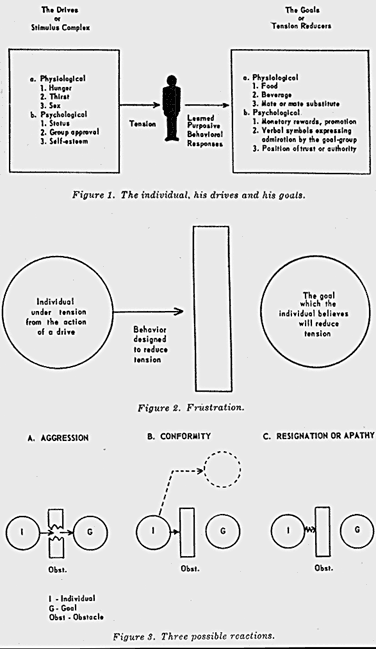
Figure 14. Diagram of the individual's drives and reactions, from
U.S. Army 1962 Field Manual on Psychological Operations.
ested one in which psychologists and others subordinated scientific goals to the DOD mission. In 1953 Don Price, the deputy chairman of the DOD Research and Development Board, tried to raise awareness among researchers about their properly submissive Cold War role, a role he felt they were foolishly resisting:
[The military] stands firmly on its cardinal principle: it does not make research contracts for the purpose of supporting science, but only "in order to get results that will strengthen the national defense. . . ." American scientists are still struggling to reconcile their eighteenth-century devotion to science as a system of objective and dispassionate search for knowledge and as a means for furthering the welfare of mankind in general, with the twentieth-century necessity, of using science as a means for strengthening the military power of the United States.[24]
As long as psychology could demonstrate its utility to "strengthening the military power of the United States," many military patrons were more than willing to champion it, and their record of solid support for military psychology during the Cold War years was impressive.
Psychology's conquest of the military, however, was far from complete. In spite of the experts' best efforts, some key policy-makers persisted in the old-fashioned belief that psychological knowledge was nothing but a mystified and expensive version of common sense, really a shameful waste of taxpayers' money. Others were even more hostile. Hyman Rickover, for example, the architect of the nuclear navy, "anticipate[d] with horror the day when the Navy is induced to place psychiatrists on board our nuclear submarines."[25] He believed that psychological experts had actually caused problems during World War II and decreased the efficiency of the military during the Cold War years. The "gauche and amateurish" antics of military psychologists, Rickover reflected in 1968, were not merely annoying diversions. They had actually been straightforward threats to national security for almost three decades. According to him, psychology's silly concerns distracted soldiers from the important business at hand—beating the enemy—which had very little to do with either "morale" or "adjustment."
Rickover was not alone in feeling that military research ought to be limited to a narrow definition of winning wars and not used "to determine various important human characteristics on the basis of the contents of wastepaper baskets."[26] Especially during the McCarthy years, active political suspicion was heaped onto the charge that behavioral expertise was stupid and irrelevant.[27] Worse, it might even be un-American. U.S. social and psychological experts, along with their foun-
dation patrons, came under regular attack in Congress for leftist political sympathies and alleged plans "to weaken or discredit the capitalist system in the United States and to favor Marxist socialism."[28]
The constricted Cold War climate at home was likely an important factor in popularizing the new term, "behavioral science," which promised to exude hard-headed objectivity in the face of accusations that the human sciences were soft on socialism.[29] Some psychologists, Gordon Allport among them, were unhappy with the "behavioral science" label, but not too unhappy. In an address at Wellesley College, Allport mused, "Personally, I am not entirely happy with it since the science we seek is a science of feeling, of thought, of dreams and of silence, quite as much as of behavior. But philanthropic foundations seem to like the name behavioral science, and we shall raise no objection to it lest Cinderella miss her chance to ride in a golden coach provided by the Foundation. Up to now these sciences have been riding in a Ford model T."[30]
Suspicions about social science's socialistic inclinations never disappeared entirely, but as time went on, other concerns superseded them.[31] After the Soviet launch of Sputnik in 1957, many dedicated anti-Communists like Richard Nixon worried more about the competitive edge of U.S. social scientists than about their alleged political sub-versiveness. The military—along with the rest of U.S. society—came to associate psychology with sophisticated cultural and scientific understanding, a capacity that seemed not at all trivial, and certainly not optional, in a dangerous world. In January 1964 the Department of Defense reported to Congress that behavioral scientists were involved in all aspects of policy formulation, implementation, and evaluation.[32] No fuss greeted this routine announcement, and no controversial attention was paid to military behavioral science until Project Camelot came to light the next year.
The most virulent critics and the most enthusiastic proponents of military psychological expertise all based their arguments on the rhetoric of national security, a fixture of the era. While psychologists were the first to admit, to one another at least, that they actually knew appallingly little about their areas of supposed competence, they made promises to the military as a way of killing two birds with one stone: demonstrating psychology's social responsibility and advancing their own professional interests.[33] The establishment of the ONR, the National Security Act of 1947 (which reorganized all the military and national security agencies of the federal government), the Korean War, and
other important developments in the wake of World War II added up to a "a dream come true" for psychological experts.[34]
If this sounds opportunistic, it was. There is no doubt that psychological experts massaged the system when they could, packaging their research plans in terms they knew would appeal to the military. Much of the debate about basic versus applied research had this quality; the distinction itself was partially created by the unprecedented sums of money available from government agencies in the period after World War II. Differences had always existed, in theory at least, between "applied" research geared toward smoothing the operations of the state and "basic" research prompted by purely scientific concerns. In practice, psychological experts worked on the assumption that their military customers always preferred the latter to the former. As one of them said, "Basic research is what I want to do, whatever that is, and whenever the mood strikes me. . . . Applied research [is] what someone else wants me to do, with some practical purpose in mind."[35] Some, undoubtedly, responded to the political economy of the research market by expediently translating their basic scientific concerns into a language filled with practical applications, thus garnering financial support under false pretenses. Many, perhaps most postwar psychological experts, however, did not have to lie, or even misrepresent their goals to military funders. They believed that defense-related work could simultaneously advance scientific knowledge and state efficiency.
Such multifaceted ambitions deepened with the Cold War because superpower hostilities created openings for projects like Camelot. If its genesis in international crisis was unfortunate, Camelot nevertheless symbolized how tantalizing the prospects were of a permanent social and psychological experiment on a very grand scale. Opportunities to study and manipulate the basic components of human motivation and behavior, and consequently to take a real shot at long-term psychological policy making, came frequently during the Cold War. The planet was still psychology's laboratory.
Most psychologists, on the other hand, were hardly crude opportunists. They were sincere in their convictions that psychology was crucial to national security and that psychologists were obligated to serve their government, perspectives deeply rooted in the World War II experience. They were certain that advancing their techniques of tension prediction and reduction could help the United States move toward an enlightened and peace-prone foreign policy rather than one crafted out of the war-prone cobwebs of intuition.
Cold war was, above all, a psychological phenomenon, just as total world war had been. While cold war presented the U.S. military with new challenges—unconventional styles of warfare against a new cast of confusing enemies—nothing could have offered clearer evidence of the World War II maxim that war was fundamentally a battle for hearts and minds. Third World upheavals were nothing if not contests for the feelings and will of people. What could have vindicated more comprehensively everything the World War II experts had said about the chaos of public opinion and morale and the need for expert management of ideology and propaganda? Military might, on its own, was simply not up to the task of winning the Cold War because victory would not go to the side with the most guns. No one was more intimately acquainted with the drift of military thinking than President Eisenhower, who proclaimed in 1954 that "the world, once divided by oceans and mountain ranges, is now split by hostile concepts of man's character and nature. . . . Two world camps . . .lie farther apart in motivation and conduct than the poles in space."[36] The Cold War was a "war for the minds of men," Eisenhower concluded.[37]
The World War II worldview was the most decisive factor shaping psychology's Cold War history, and the link between the two emerged in part from the sustained vision of a rigorous and predictive behavioral science, which lasted from 1945 well into the 1960s. The World War II sources were tangible as well as abstract. A number of individuals whose formative professional experiences had been in World War II went on to lay the plans that inspired the ill-fated Project Camelot. Charles Bray, for example, was chair of the Applied Psychology Panel of the National Defense Research Committee during World War II, which had mobilized some two hundred psychologists in twenty research projects geared to streamlining military operations and increasing proficiency. His leadership of the Smithsonian Institution's Research Group in Psychology and the Social Sciences, during the late 1950s and early 1960s, was especially important in laying the groundwork for projects like Camelot. Many other psychological experts with World War II experience involved themselves in military psychology well into the 1960s, often in important planning and advisory capacities. These included Leonard Carmichael, Leonard Doob, Frank Geldard, Daniel Lerner, Morris Janowitz, S. Smith Stevens, Samuel Stouffer, Theodore Vallance, Dael Wolfe, and others.
The most significant organizational innovation during the Cold War years was the establishment of military contract research organizations,
which proliferated between 1945 and the early 1960s. Funded almost exclusively by the military, but nominally affiliated with "multiversities" and located on campuses, these new organizations (called Federal Contract Research Centers, or FCRCs) handled massive volumes of psychological and other types of scientific work for the DOD.[38] According to the NSF, the numbers of professionals of all types employed by FCRCs tripled between 1954 and 1965 and their budgets increased by 500 percent.[39]
Stationed in a kind of "twilight zone" between the clear public functions of government bureaucracies and the supposedly private concerns of universities, these FCRCs literally transferred much DOD data gathering to organizations outside of the state, furthering the mixture of military and nonmilitary, public and private, that was so characteristic of Cold War research.[40] The most famous of these hybrid organizations is undoubtedly the RAND Corporation, founded with air force aid in 1946. Another was the Special Operations Research Office (SORO), the sponsor of Project Camelot.[41]