
The Dedication Frontispiece of MS C :
General Features and the Upper Register
Perhaps the subtleties of the nonverbal, visual comments of Figure 7 proved too elusive for the patron and other concerned readers. In any case, the dedication frontispiece of C (Fig. 10 and Pl. 1) underwent substantial revision. Setting the tone for the increased didacticism, substantial inscriptions added to the miniature attempt to clarify the meaning of the scenes, now reduced from four to two. Figure 10 also establishes another precedent followed in the other nine illustrations of the C cycle. Instead of the quadrilobe frames and columnar format of most of the A illustrations, those in C occupy the full width of the text block. Frequently, but not always, they occur at the top of the folio. The C illustrations thus become more prominent, since they function as frontispieces to each book of the text. The less elaborate and expensive character of C resulted in the substitution of grisaille forms for the brilliantly colored figures of A . Yet with added touches of gold and colored washes, these grisaille figures stand out strongly against their colored backgrounds. Highly refined, the elaborate geometric or swirling patterns are executed in peach or blue tones and outlined in gold, black, and other colors. The peach tones of the background of the upper register in Plate 1 contrast sharply with the deep blues of the lower zone. Although the miniatures of C have simple, two-banded frames, they are usually tied to the marginal borders by foliage motifs, which in turn often connect with the large initial below the illustrations. In Figure 10 the dragon drollery of the right margin reinforces the links between the miniature and the decorative structure of the folio.
Whereas the extraordinary inscriptions of the upper register of Figure 10 indicate that the scribe, Raoulet d'Orléans, must have had an important role in executing the miniature, Nicole Oresme undoubtedly chose the texts. Two elaborate and delicately delineated scrolls accompany the scene of the king receiving a
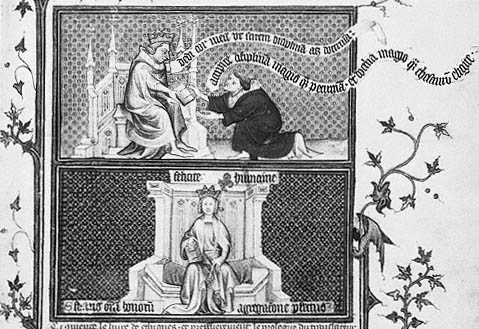
Figure 10
Above: Charles V Receives the Book from Nicole Oresme; below: Félicité humaine. Les
éthiques d'Aristote, MS C.
book from the translator. The book, held by each man and containing the present translation, is the focus of the verbal messages. One scroll unfurls at the level of Charles V's chin; the other curves around Oresme's head. The inscriptions are written in heavy black ink, a departure from the usual brown used elsewhere in the manuscript. Also unusual is the extension of the scrolls beyond the frame of the miniature into the right margin; in fact, the inscription around Oresme touches the very edge of the folio. With the exception of the phrases surrounding the personification in the lower register, the use of Latin for these messages is unique in this translation and signals the exceptional weight and authority associated with words in Latin. Not surprisingly, the inscriptions are taken from familiar scriptural passages. The scroll next to Charles V reads: "Dedi cor meum ut scirem disciplinam atque doctrinam," or "I devoted myself to learning discipline and doctrine."[25] The scroll around Oresme, derived from Proverbs 8:10, advises: "Accipite disciplinam quam pecuniam, et doctrinam magis quam thesaurum eligite," or "Choose learning rather than money and choose instruction more valuable than treasure." Couched in biblical language, the inscriptions invest the secular and pagan texts with religious sanction. Also, the messages on the scrolls make explicit
the theme of education, which in the frontispiece of MS A (Fig. 7) remains more allusive. Furthermore, the elimination of Charles V's family from the dedication scene concentrates attention on the king's motives in educating himself.
As the words spoken by each man separately, the inscriptions also point to the relationship between Charles V and Oresme. The message on the scroll next to the king indicates that by his specific commission of the Aristotle translations he fulfills his obligations as a wise ruler.[26] In doing so, he heeds Oresme's strong admonition, which confirms the translator's position as moral and intellectual adviser to the king. Indeed, the much shorter inscription and humbler tone of Charles V's declaration contrasts with the lengthy quotation Oresme selected for himself. Also conveying the translator's standing is his choice of a quotation, used here to address the king, that habitually employs the imperative mood of the verb.
The composition likewise emphasizes the prominent role Oresme assumes by the authority of the inscriptions. While the dedication scene is another example of the intimate type, certain aspects of the miniature show a greater formality than the analogous illustrations of A (Figs. 6 and 7). For example, in Figure 10 the king's frail form is enclosed in an intricate thronelike structure.[27] In addition, the king looks down at the book as much as he regards the translator. Depicted in profile, Charles V does not, as in Figures 6 and 7, directly establish eye contact with Oresme. Also missing are the warm smiles of both parties. Despite his distance from the king, Oresme, whose head is represented in a fuller, three-quarter view, tilts his head upward to glance at the king. Although only the translator's hand advances into Charles V's sphere, his kneeling form dominates the picture space. Just as his portrait is more amply and naturalistically rendered than the conventional, doll-like image of the king, Oresme appears as the more solidly represented figure. And while Charles V is confined within the throne, Oresme's bulky form, placed on a separate stagelike strip, spreads out laterally. The deep blue of his robe overwhelms the gentle grisaille tones of his patron's figure. Oresme's is the only figure in the C cycle whose costume is painted.[28] Even the additions to the translator's prologue of C of his name and title, "Je Nicole Oresme doyen de l'eglise nostre dame de Rouen" (I, Nicole Oresme, dean of the church [cathedral] of Our Lady of Rouen), suggest the expansion of Oresme's role in the translation enterprise. In A no title is included, and his name, "maistre Nichole Oresme," appears in the opening rubrics but not in the prologue text. The presentation miniature of C , dated 1376, shows the evolution in visual form of Oresme's relationship with the king. From the early, intimate presentation scene accompanying his first French translation for his patron, Ptolemy's Quadripartitum (Fig. 3), to the dedication portrait of C , Oresme assigns himself an increasingly dominant role.