
Extracting a Symbol from the Narrative
In what has been called the main "symbolic image" of the Narmer Palette (Schäfer 1957), the rebus in the reverse top right zone (Fig. 45) is not divided from the picture of the ruler smiting his enemy by a register line like those separating the pictorial zones elsewhere on the palette. It would seem, therefore, that whereas the late prehistoric narrative image calls for considering the reverse top and the reverse middle zones as distinct passages of pictorial narrative text, the pictorial symbol of the narrative also contained on the palette dictates that they should not be so distinguished.
In the symbolic image, in which reverse top and reverse middle zones are not separated, the depiction explicitly shows that Falcon lifts the enemy's face to gaze directly at the face of the ruler Narmer. Unlike the fleeing enemy on the Battlefield Palette (Fig. 33, obverse, third zone), who looks behind him to see and acknowledge the victorious lion-ruler facing away from him, here Narmer's enemy, subdued by Falcon, faces the master who takes possession of him. Just below, however, is a less compliant enemy (labeled as "harpoon" or coming from harpoon territory"), grasped by Narmer himself; although his body faces away from Narmer, the ruler twists his head completely around. The ruler must be grasping the enemy's topknot, for his clenched fist reaches into
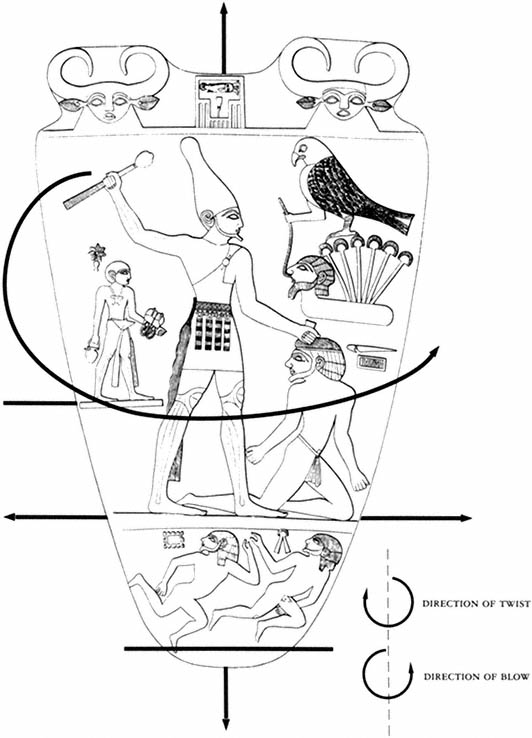
Fig. 45.
Symbolic image on the Narmer Palette, reverse.
From Wildung 1981.
the enemy's hair. A small rectangular form protrudes slightly over or "behind" Narmer's fist, but as it is not placed immediately "behind" Narmer's thumb resting over his curled fingers it cannot actually represent the enemy's hair. It appears to be an object Narmer is wearing on the back of his hand or wrist, perhaps the cylindrical roll seal belonging to the case (?, possibly a square box with a lid) suspended by a strap around the neck of his sandal bearer, standing behind him to the left. (The sign or image on Narmer's seal is apparently depicted in the upper left corner in the obverse top zone of the palette, at the very beginning of the pictorial text. The scene of smiting an enemy is replicated, in later images like the Libyan or Booty Palette [Fig. 53] and many canonical representations of figures adopting the "smiting" pose [for example, Smith 1949: 169–71, 245–48; see Davis 1989: 80–82], as a metaphor for taking possession of, surveying, or enumerating properties—an act literally accomplished in ancient Egyptian and ancient Near Eastern societies by impressing a seal.)
Narmer stands fixed to a solid ground line drawn below the group from side to side of the palette. Since the mace points up, rather than down, and considering the way Narmer's arm, wrist, and hand are rendered, the blow will swing in the moment of smiting forcefully to the side of the enemy's head, caving it in or knocking it off; presumably the ten decapitated enemies in the obverse top zone are the aftermath of such a blow. Narmer's decisive blow, then, must arc through a wild, unrepresented space—an ellipsis in the image's specification of "place"—from the point of view of figures ranged along the depicted ground line. As with the preceding late prehistoric images, the ruler's deadly force enters the world from outside, where it cannot be seen. In this case his force comes directly from the place—like the cosmetic saucer on the obverse—where the real viewers of the palette must be standing, invited to view the narrative image as followers of the ruler, and where the ruler himself must be standing behind them, for his blow will, in the full unfolding of the narrative, take the viewers too. In the depiction the doomed enemy seems about to slump on the ground line. When the blow falls his broken body will collapse forward along the ground line or at right angles to it, in any case "falling off " the ground line and "out of" the picture into an unrepresented place. But, again,
in the full unfolding of the narrative image, all the places "in back of," "beside," and "in front of" the palette have been mastered by the ruler in the counterclockwise direction of his blow.
In addition to the rebus and the figure of Narmer smiting the enemy, the symbolic image on the reverse contains a third element. Behind the ruler and placed on his own small ground line, Narmer's personal servant waits on the sidelines to perform his services. The viewer has already met him in the introduction to the narrative image (obverse top zone), where he follows "behind" Narmer. In both passages he carries the ruler's sandals (apparently bound to his wrist), a water jug or oil container, a small wooden case for holding the ruler's seal(?) strapped around his neck, and slung around his waist a bowl with two long hanging flaps of cloth, possibly for washing.[3] Above his head two "hiero-glyphs"—a "royal" rosette, a flower from a lileacious plant, and an object that could contain sandals (Vandier 1952: 597) or might be the bulb of the plant—apparently give his title (see also Schott 1950: 22).
While the sandal bearer in the obverse top zone has a relatively straightforward place in the highly detailed description of the enemies' execution, matters are by no means as clear on the reverse of the palette. The sandal bearer appears to be part of the reverse middle passage of depiction; he seems to accompany the ruler just before the moment of his decisive blow. And yet, since he has his own ground line placed in the left portion of the composition, he could also belong to the reverse top zone, facing and complementing the rebus. According to this view the passage of pictorial text above the principal ground line on the reverse (middle and top zones) presents a "close-up" but also more "hieroglyphic" view of the scene depicted on the obverse top—that is, the ruler, accompanied by his personal servant and other companions (represented by Falcon), executing his enemies.
Why, then, should the sandal bearer be the only one of the ruler's retainers, of the several depicted in the introduction to the narrative image, to stand near the ruler just before the decisive blow? Although on the obverse top he has an obvious, if limited, place in the narrative image by filling out the ekphrasis at the beginning of the sTory, why should he be included in the text that symbolizes the narrative as a whole? Why, in the symbolic image, does he occupy the
place walking beside or behind the ruler—the place the viewer occupies in the beginning of the narrative and by its end discovers as being struck by the ruler's blow? Finally, if we treat the entire reverse side of the palette as part of the symbolic image, can it be significant that the fleeing enemies below the ground line look over their shoulders not only at the ruler but also at the sandal bearer (no other such glances across register lines appearing on the Narmer Palette, though common between zones in earlier replications)? Are we looking simply at the compositional and iconographic ambiguity necessarily inherent in a passage of text that functions simultaneously as part of a narrative image and as a symbol of the narrative whole?—or are we looking at the maker's, or the viewer's, difficulty in extracting a symbolic whole out of a narrative image?
If the symbolic image on the reverse of the palette extracts from the entire narrative the same metaphor for the sandal bearer as for the group of ruler and enemy, then the sandal bearer's position as "coming up behind" spatially might be interpreted as his continuous, universal temporal place. Like the ruler smiting his enemy, he too must be before, after, and throughout the story of the blow—with the difference that throughout he is masked from the sight of the enemy, for Narmer stands between the sandal bearer and the falling enemy.
The pictorial text places the sandal bearer directly below the ruler's raised arm clenching its mace. After the blow falls, then, he could move "forward" to assume the ruler's place. Thus he can be regarded as the ruler's heir-apparent.[4] With the heir-apparent on the left ("future" or "after") side of the blow, the two enemies depicted below Narmer's ground line (reverse bottom zone) are correlatively placed to the ruler's right (the "past" side of the blow), looking back in the very direction the blow will be coming toward them (Fig. 44). Like the ruler's heir-apparent, they could be said to have a place in the symbol in both the "before" and the "after" stages of the blow. Before the blow—in the forward direction of the narrative image—they flee the ruler's deadly wrath, are pursued, and are destroyed (Figs. 40, 43). After the blow—and in the message of the narrative image extracted by its symbol—they acknowledge Narmer's successor. Their apparent change of heart is indicated in the pictorial text by a gesture somewhat like the raised hand of the fleeing enemy on the Battlefield Palette earlier in the chain of replications (Fig. 33): while the left enemy raises
his left hand and looks back over his right shoulder, the right enemy reverses direction, raising his right hand and looking back over his left shoulder. In either case, the pictorial text depicts them as able to see fully only what is behind them—the power and danger of the ruler, whom they can observe by twisting their heads back even further to their left (resulting in death by decapitation) or completely around to their right (that is, changing their point of view).