
A Review
The literature on self-esteem and self-concept is enormous. Few topics in the social sciences and education have sustained interest for so long among both popular and scholarly audiences, or promoted such vast amounts of research and almost unending speculation. However, amid this flood of findings and material, at least one important regularity emerges, one we have already mentioned. A large number of studies over the past seventy-five years have demonstrated a positive association between self-esteem variables and academic achievement. (For
comprehensive reviews, see Purkey 1970; Walberg and Uguroglu 1980; Wylie 1979.) As a group, these studies have sampled students of widely different ages and learning characteristics—from the gifted to the retarded—and have also employed many different measures of self-esteem, as well as a variety of achievement indices, including grade point average, standard achievement test scores, and even performance on teacher-made tests. Thus the generality of this finding is not in dispute. But most of these studies are correlational, and as such are of little more than circumstantial value in making a case for causation or for the direction of any causal relationship.
Apart from their lack of conclusiveness about causation, the most disquieting feature of these studies is the generally low magnitude of association found between self-esteem and achievement. For instance, Hansford and Hattie (1982) reported in their review of twenty studies, representing some forty-eight thousand subjects, that the average correlation between measures of achievement and indices of self-description was. 16. If we assume a causal interpretation of this statistic, only 4 percent of the variation in school achievement is accounted for by variation in self-concept. Likewise, a review by West, Fish, and Stevens (1980) of some three hundred studies revealed correlations ranging between. 11 and. 50, with the average being. 18. Finally, Sandige (1976) added a measure of self-esteem to a multiple-prediction of school achievement that already included factors such as social class and intelligence. The self-esteem measure accounted for only an additional 3 percent of the explained variation in academic performance. This means that most of the variation in achievement we observe in classrooms—97 percent of it, according to Sandige's study—can be explained by influences other than those traditionally associated with the notion of self-concept.
These findings present us with a dilemma. If feelings of self-esteem are so important to achievement, then why is the demonstrated relationship between self-esteem and academic performance so uniformly low? On the face of this evidence alone, would we be better advised to concentrate our limited educational resources on potentially more effective and immediate ways to offset educational failure, such as teaching improved study habits or increasing the amount of time students spend on a task?
The situation is scarcely improved when we consider the research that has attempted to demonstrate experimentally that changes in self-concept lead to improved performance. Here, as we have seen, investigators manipulate levels of self-esteem, on the assumption that
these changes will induce students to perform differently (Aronson and Mettee 1968; Silverman 1964; Stotland and Zander 1958; Webster and Sobieszek 1974). Unfortunately, the results of these studies tend to be somewhat contradictory and the effects of the manipulation are typically short-lived (Steele 1975).
Another source of evidence about the role of self-esteem comes from the appraisal of special compensatory education programs aimed at creating changes in self-concept in order to enhance academic performance. These programs include Head Start for preschoolers, Follow Through in the primary grades, and Upward Bound for high school students. (For a review, see Scheirer and Kraut 1979.) The basic rationale behind many of these programs is that high self-esteem is a necessary condition for achievement (Gray and Klaus 1970). Put in terms of path analysis, self-concept is treated as a mediator that is positioned between instructional variables, on the one hand, and achievement outcomes, on the other, implying that for changes in instruction to influence achievement they must first change the student's self-concept. This reasoning is implicit in what have been identified as student-centered models of achievement (Covington 1985b).
Student-Centered View
A schematic of the student-centered model is presented in Figure 3. 1 (Model A). The arrows imply causality and indicate the presumed direction of causal influence. Some of the relevant studies attempt to encourage environments of trust in the classroom (e.g., Reckless and Dinitz 1972); others provide instructional options that allow students a choice of workload (Jacoby and Covington 1973). Still other researchers have introduced curricula that permit nongraded academic experiences (Lawson 1974). These attempts to encourage learning through self-change have been generally disappointing. Some studies show little or no change in measured self-concept as a result of intervention, even though indices of academic achievement increased (e.g., Grant 1973; Lawson 1974; Stallings and Kaskowitz 1974). In other instances, although changes in measures of self-regard occurred, no parallel changes in achievement were observed (Hunt and Hardt 1969; Logsdon and Ewert 1973). Neither outcome is consistent with the assumption that positive self-regard is a necessary and sufficient precondition for productivity in the schools.
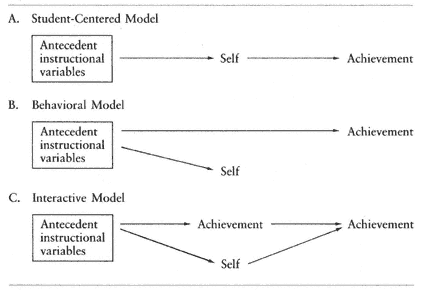
Figure 3.1.
Casual Models of School Achivment
Behavioral View
A second, rival view of the role of self in the achievement process follows from a behavioral perspective. According to this tradition, the concept of self—like notions of motivation, emotion, and other "internal," subjective states—is of little value in understanding the dynamics of learning and performance. Behaviorists neither deny the reality of a subjective inner life nor reject the existence of emotions associated with success (pride) and failure (shame). But they do doubt that such general and diffused states of arousal could in themselves guide and direct human behavior in subtle ways.
Rather, they argue, it is the "external" features of instruction that control those actions traditionally associated with concepts such as motivation and self-esteem. These "motivated" behaviors include choice of learning task and intensity of study effort. According to many behaviorists, the main controlling factor is the schedule of reinforcements that teachers set up, in the form of grades, praise, and other rewards. Although psychologists still debate a number of subtle theoretical issues associated with such concepts as reward and reinforcement, it is nonetheless abundantly clear that on a practical, everyday level we tend to do those things that are rewarding and to avoid what is punishing or
threatening. Other things being equal, students will typically do whatever they must to attain the highest grade possible. Indeed, many observational studies suggest that the teacher's grading policy controls almost everything about the student's academic work, including choice of task, intensity of effort, and duration of involvement in the task (Carter and Doyle 1982; King 1980). This is precisely why grading practices have come under such intense and increasing criticism in recent years. For many students, grades have become more important than learning itself.
For good or ill, grading policies control the quality and amount of student achievement to a remarkable degree, and so do a host of other instructional factors, including the amount of time spent studying, the quality of study (Rohwer 1984), and the quality and timing of feedback concerning performance. With respect to feedback, numerous demonstrations support the claim that a fundamental component of effective instruction is the degree to which learners have a clear picture of what is expected of them, as well as clear information about their progress toward these goals. (A review can be found in Doyle 1983.) For instance, students who do not receive information about how well or how poorly they are doing may subsequently perform less well than if they have been given consistently negative feedback (Butler and Nisan 1986).
From this perspective, it is unnecessary to introduce concepts such as "self" to explain the difference between good, poor, and mediocre performers in school. The essence of the behavioral model is that if and when positive changes in self-concept occur, they are most likely the result of successful performance rather than its cause, and that in turn such changes will exert little influence on the quality of future performance. In effect, the notion of self is simply an unnecessary explanatory complication. This view is depicted in Figure 3.1 (Model B). Interestingly, we would find it difficult to refute this rather stark proposition using the literature generated from the student-centered model.
Interactive View
The interactive model combines elements of both the behavioral and the student-centered views. It is portrayed in Figure 3.1 (Model C). Moving from left to right, we see that an increase in academic skills—say, learning to diagram sentences—triggers gains simultaneously both in self-esteem (as in the student-centered model) and in achievement (as in the behavioral model) and that enhanced self-esteem in turn favors
further academic improvements. In short, by improving the student's scholastic skills we initiate a recursive, upward cycle of emotionally driven successes—hence the term interactive .
But can we ever expect to demonstrate such complex pathways empirically, especially in light of previous failures under the far simpler student-centered model? The answer is yes, albeit a cautious affirmation. But what has changed? The interactive model itself is not a recent introduction; actually, in one form or another, it has long been implicated in arguments favoring the view that self-esteem affects achievement. What has changed, however, is the greater precision with which this model is now being evaluated and the increased number of variables being considered by researchers. Above all, we are now beginning to conceptualize the notion of self in new ways. A novel, unifying view of self as applied to educational achievement is rapidly emerging, born out of recent advances in attribution theory, research on fear-of-failure dynamics, and self-defensive motivation. We now turn to these developments.