
Theories of Mind
More effort needs to be spent explicating the nature of a scientific theory of mind. I prefer to do that at a specific level, not at the level of science in general. Still, something general needs to be said, if only because so much has been written and mused about the nature of science as it might pertain to humans and their societies and cultures, or whether in fact it could pertain at all. Again, the focus here is not to straighten out the notion of science per se. Rather, I want to be sure the notion of science that I use is clear.
By a theory of mind , I mean just what I would in talking about any scientific theory. I mean it in the same sense as in the theory of plate tectonics in geology, the theory of orgain chemistry, the astronomical
theory of the planetary orbits, the theory of the atom, and on and on. These examples are themselves not quite the same, but they all contain a solid common kernel. Society, in the body of the attending scientists, attempts to organize its knowledge of some body of phenomena. Its goal is to use the knowledge for prediction, explanation, design, control, or whatever. Theory is the symbolic organization of this knowledge.
Sciences all grow to look alike in many ways—the natural and biological sciences very much so, as well as bits and parts of the human sciences. They all develop bodies of solid fact and regularities and surround them with an explicit, if somewhat conventional, apparatus of evidential support. They all develop theories, which tend to mathematical and formal symbolic form. These theories tend to be mechanistic. That is, they posit a system or collection of mechanisms, whose operation and interaction produce the regularities. The theories of all the sciences all fit, more or less well, into a single theoretical fabric that is a stitched-together coherent picture of a single universe. An article of faith for a long time, this has become increasingly evident with the amazing emergence of biology to match in power and elegance the older physical sciences—and to be one with them in a seamless scientific web.
Some aspects of the sciences reflect the nature of the world, others the nature of the enterprise itself. That scientific theories are cast in terms of underlying mechanisms seems to reflect the nature of the world. Theories could be different and sometimes are. That theories have a formal and calculational character reflects the scientific enterprise. This quality makes the knowledge that is the science derivable from the theory and not from the theorist. To use a scientific theory requires both knowledge and skill, especially the latter. Hence, not everybody can take a theory and produce its results (or even reproduce them). But the results, when produced, are the results of the theory, not of the theorist—a matter of no small import, since humans themselves have (or contain, depending on your metaphor) bodies of knowledge. Humans can predict, explain, design, and control, all without benefit of science, much less theory. Perhaps what best characterizes science methodologically is its ability to get these activities into external symbolic artifacts, available to all who are "skilled in the art."
If science stayed outside the house of man, there would be nothing to consider in contrasting metaphors and theories of mind. But, of course, a scientific psychology does exist, and it is recognizably a family member of the science kin group. The contrast requires more than just a scientific psychology, however. The computer must underlie both the metaphor of mind (which it avowedly does) and the theory of mind. If this were not the case, the contrast would still amount only to the proverbial one hand clapping.
But the cognitive revolution has occurred (Gardner 1985). It is thirty years old. It has come to dominate individual psychology. New scientific upstarts now rail against it instead of against behaviorism. And this revolution has been dominated by the computer—or more correctly, by the abstract notions of computation and information processing that have emerged as the theoretical counterpart to the technological advance. Even the phiosophers say so (Dennett 1988, Fodor 1983). The acceptance has moved to the creation of an umbrella interdiscipline called cognitive science. In some quarters, we can actually hear the clapping. There is indeed a contrast to consider.
Unified Theories of Cognition
My William James Lectures give some indication of what it might mean for there to be a theory of mind, in the sense we have been discussing.
Psychology has arrived at the possibility of unified theories of cognition—theories that gain their power by having a single system of mechanisms that operate together to produce the full range of human cognition.
I did not say they are here yet, but I argued they are within reach and that we should strive to attain them. Nor did I claim there was a single such unified theory. Indeed, in my lectures I argued that in our current state of knowledge, there would be several theories. I did claim that enough was known to attempt unified theories and that they had immense benefits for cognitive science—bringing into one theoretical structure the constraints from the great store of empirical regularities that cognitive psychology has amassed, along with what we now understand about the mechanisms of cognition.
The lectures were built around the presentation of an exemplar unified theory, embodied in a system called Soar, developed by John Laird of the University of Michigan, Paul Rosenbloom of the Information Sciences Institute at the University of Southern California, and me (Laird, Newell, and Rosenbloom 1987). Soar provides an appreciation of what is required of a unified theory, what its yield might be, and how ready the field is to develop them. Soar is only an exemplar; there are others as well (Anderson 1983).
Figure 9.1 presents the elements of the theory of human cognition embodied in Soar. So far, I have taken care to say theory embodied in Soar . As we shall see, Soar is a specific kind of system—an architecture or machine organization.[1] We usually take a theory of some domain, here a theory of the mind, as being the assertions about the nature of that domain—here assertions about how the mind is structured, how it operates, how it is situated, and so on. So Soar, as a system, cannot literally be a theory. But the theory asserts that the central structure in mind is the
1. Controller-Perception-Cognition-Motor 2. Knowledge and Goals 3. Representation, Computation, Symbols 4. An Architecture plus Content 5. Recognition Memory (about 10 ms) 6. Decision Cycles—Automatic (about 100 ms) 7. Problem Spaces and Operators (about 1 sec.) 8. Impasses and Subgoals 9. Chunking (about 10 sec.) 10. Intended Rationality (100 sec. and up) | 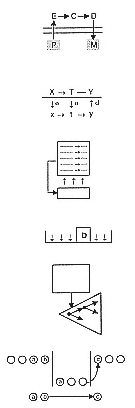 |
Fig. 9.1
Soar a unified treory of cognition.
cognitive architecture, that humans have one nad that its nature determines the nature of mind. The theory then specifies a lot about that architecture. Soar is a system that embodies these particular specifics. Because the architecture is so central and determines so much about the mind, it is convenient to slip language a bit and identify Soar with the theory of cognition it embodies.
Figure 9.1 enumerates the main mechanisms in Soar. The top four items are shared by all comprehensive cognitive-science theories of human cognition. Soar operates as a controller of the human organism, hence it is a complete system with perception, cognition, and motor components. This already takes mind in essentially functional terms—as the system that arose to control the gross movements of a manmmal in a mammalian world. Soar is goal oriented with knowledge of the world, which it uses to attain its goal. That knowledge is represented by a symbol system, which means that computation is used to encode repre-
sentations, extract their implications for action, and decode specific desired actions. Thus, Soar is an architecture—a structure that makes possible a hardware-software distinction. Most of the knowledge in such a system is embodied in the content that the architecture makes meaningful and accessible.
The rest of the items describe Soar from the bottom up, temporally speaking. Soar comprises a large recognition memory . This is realized by an Ops5-like production system (Brownston et al. 1985). A production system consists of a set of productions, each consisting of a set of conditions and a set of actions. At each moment, the conditions of all productions are matched against the elements of a temporary working memory , and those productions that are satisfied then execute, putting new elements into working memory. Human long-term memory comprises many productions, in the millions perhaps. A cycle of production execution also occurs very rapidly, around 10 milliseconds (ms).[2] Although in artificial intelligence (AI) and cognitive science, productions are usually taken to correspond to operators (deliberately deployed actions), in Soar they correspond to an associational memory. Thus, production actions behave like a memory retrieval: they only enter new elements into working memory and cannot modify or delete what is there. Also, there is no conflict resolution (of the kind familiar from Ops5); instead, each production executes independently, just like an isolated memory access and retrieval.
The nexe level of organization, which occurs within about 100 ms, consists of the decision cycle . This comprises a sequence of retrievals from long-term memory (i.e., a sequence of production firings) which assemble from memory what is immediately accessible and relevant to the current decision context. This sequence ultimately terminates when no more knowledge is forthcoming (in practice, it quiesces quickly). Then a decision procedure makes a choice of the next step to be taken. This changes the decision context, so that the cycle can repeat to make the next decision. At the 100 ms level, cognitive life is an endless sequence of assembling the available knowledge and using it to make the next deliberate choice.
The decisions taken at the 100 ms level implement search in problem spaces , which comprise the next level of organization, at the 1 second (sec.) level. Soar organizes all its goal-oriented activity in problem spaces, from the most problematical to the most routine. It performs a task by creating a space within which the attainment of the task can be defined as reaching some state and where the moves in the space are the operations that are appropriate to performing the task. The problem then becomes which operators to apply and in what order to reach a desired state. The search in the problem space is governed by the knowledge in the recogni-
tion memory. If Soar has the appropriate knowledge and if it can be brought to bear when needed, then Soar can put one operator in front of another, so step its way directly to task attainment. If the memory contains little relevant knowledge or it cannot be accessed, then Soar must search the problem space, leading to the combinatorial explosion familiar to AI research.
Given that the problem-space organization is built into the architecture, the decisions to be made at any point are always the same—what problem space to work in; what state to use (if more than one is available); and what operator to apply to this state to get a new state, on the way to a desired state. Making these choices is the continual business of the decision cycle. Operators must actually be applied, of course; life is not all decision making. But applying operators is merely another task, which occurs by going into another problem space to accomplish the implementation. The recursion bottoms out when an operator becomes simple enough to be accomplished within a single decision cycle, by a few memory retrievals.
The decision procedure that actually makes the choice at each point is a simple, uniform process that can only use whatever knowledge has accumulated via the repeated memory searches. Some of this knowledge is in the form of preferences about what to choose—that one operator is preferred to another, that a state is acceptable, that another state is to be rejected. The decision procedure takes whatever preferences are available and extracts from them the decision. It adds no knowledge of its own.
There is no magic in the decision cycle. It can extract from the memory only what knowledge is there, and it may not even get it all. And the decision procedure cna select only from the options thereby produced and by using the preferences thereby obtained. Sometimes this is sufficient, and Soar proceeds to move through its given space. Sometimes—often, as it turns out—the knowledge is insufficient or conflicting. Then the architecture is unable to continue: it arrives at an impasse . This is like a standard computer trying to divide by zero. Except that, instead of aborting, the architecture sets up a subgoal to resolve the impasse. For example, if several operators have been proposed but there is insufficient information to select one, then a tie impasse occurs, and Soar sets up a subgoal to obtain the knowledge to resolve the tie, so it can then continue.
Impasses are the dynamo of Soar; they drive all its problem solving. Soar simply attempts to execute its top-level operators. If this can be done, Soar has attained what it wanted. Failures imply impasses. Resolving these impasses, which occurs in other problem spaces, can lead to other impasses, hence to subproblem spaces, and so on. The entire
subgoal hierarchy is generated by Soar itself, in response to its inability to attain its objectives. The different types of impasses generate the full variety of goal-driven behavior familiar in AI systems—operator implementation, operator instantiation, operator selection, precondition satisfaction, state rejection, and so on.
In addition to problem solving, Soar learns continuously from its experiences. The mechanism is called chunking . Every time Soar encounters and resolves an impasse, it creates a new production (a chuck) to capture and retain that experience. If the situation ever recurs, the chunk will fire, making available the information that was missing on the first occasion. Thus, Soar will not encounter an impasse on a second pass.
The little diagram at the right of chunking in figure 9.1 sketches how this happens. The view is looking down on working memory, with time running from left to right. Each little circle is a data element that encodes some information about the task. Starting at the left, Soar is chugging along, with productions putting in new elements and the decision procedure determining which next steps to take. At the left vertical line, an impasse occurs. The architecture adds some elements to record the impasse, hence setting a new context, and then behavior continues. Finally, Soar produces an element that resolves the impasse (the element c at the right vertical line). Behavior then continues in the original context, because operationally resolving an impasse just is behavior continuing. The chunk is built at this point, with an action corresponding to the element that resolved the impasse and with conditions corresponding to the elements prior to the impasse that led to the resolution (the elements a and b). This captures the result of the problem solving to resolve the impasse and does so in a way that permits it to be evoked again to avoid that particular impasse.
Chunking operates as an automatic mechanism that continually caches all of Soar's goal-oriented experience, without detailed interpretation or analysis. As described, it appears to be simply a practice mechanism, a way to avoid redoing the problem solving to resolve prior impasses, thus speeding up Soar's performance. However, the conditions of the productions reflect only a few of the elements in working memory at the time of the impasse. Thus, chunks abstract from the situation of occurrence and can apply in different situations, as long as the specific conditions apply. This provides a form of transfer of learning. Although far from obvious, this mechanism in fact generates a wide variety of learning (Steier et al. 1987), enough to conjecture that chunking might be the only learning mechanism Soar needs.
Chunks get built in response to solving problems (i.e., resolving impasses). Hence, they correspond to activities at about the the 1 sec. level and
above. The chunk itself, of course, is a production, which is an entity down at the memory-access level at about 10 ms.
The higher organization of cognitive activity arises from top-level operators not being implementable immediately with the information at hand. They must be implemented in subspaces with their own operators, which themselves may require further subspaces. Each descent into another layer of subspaces means that the top-level operators take longer to complete, that is, are higher level. Thus, the time scale of organized cognitive activity climbs above what can be called the region of cognitive mechanism and toward the region of intendedly rational behavior. Here, enough time is available for the system to do substantial problem solving and use more and more of its knowledge. The organization of cognition becomes increasingly dictated by the nature of the task and the knowledge available, rather than by the structure of the architecture.
This rapid-fire tour through the mechanisms of Soar serves primarily to box its compass, to see the mechanisms that are involved. It is an architecture that spans an extremely wide range of psychological functions. Some limits of the range should be noted. Perception and motor behavior currently exist in the theory only in nascent form. Perhaps as important, the impasse-driven means-ends structure that builds up in a given situation is ephemeral. Long-term stable organization of behavior could hardly be held in place by the momentary piled-up impasse subgoal hierarchy. Soar does not yet incorporate a theory of what happens as the hours grow, disparate activities punctuate one another, and sleep intervenes to let the world of cognition start afresh each morning. All these aspects must eventually be within the scope of a unified theory of cognition. Soar's failure to include them shows it to be like any scientific theory, always in a state of becoming.
Our description of Soar contains a strong emphasis on temporal level . Soar models behavior from about 10 ms on up to about 1,000 sec. (30 min.). Soar, as a theory of human cognition, is tied strongly to the world of real time. Figure 9.2 provides a useful view of the time scale of human action. The characteristic time taken by processes fractionates our world into realms of distinct character. Neural systems take times of the order of 100 microseconds (µsec) to 10 ms to produce significant effects. Cognitive systems take times of the order of 100 ms to 10 sec. to produce significant effects. Beyond that, in the minutes to hours range, is something labeled the rational band. And up above that stretch time scales that are primarily social and historical, left blank because theories of unified cognition are initially situated in the lower bands, focused on the architecture.
These banks correspond to realms of scientific law. The neural band is within the realm of physical law, as we have come to understand it in
| ||||||||||||||||||||||||||||||||||||||||||||||||||||||||
Fig. 9.2.
Time scale of human action
natural science. And it is physical law on down, although with a twist as it enters the realm of the very small and quantum indeterminacy. But the cognitive band, which is the structuring into a cognitive architecture, is the realm of what can be called representational law. By appropriate computational structuring, internal happenings represent external happenings. The computations obey physical laws; they are physical systems after all. But they also obey the laws of what they represent. From the internal tokens that represent two numbers, an addition algorithm fashions another internal token for a sum of the two numbers. To discover an addition algorithm is precisely to discover a tiny physical system that, while doing its physical thing, also produces situations that obey the laws of addition (given further encoding and decoding processes).
As computations operate in the service of the system's goals, the sys-
tem itself begins to behave as a function of the environment to attain its goals. This is the realm of reason. No rigid laws hold here, because goaloriented computation is precisely a device to circumvent whatever is in the way of goal attainment. In Aristotelian terms, this is the realm of final causes, whereas the neural band is the realm of efficient causes, and there was nothing in the Aristotelian scheme that corresponded to computation, which is the apparatus for moving between the two. A key point in this is that it takes time to move away from the mechanics (the architecture0 and up into rational behavior. And, indeed, it never fully happens, so that a longer but better term would be intendedly rational band .
With the picture of figure 9.2, one can see that a unified theory of cognition is primarily a theory of the cognitive band. it provides a frame within which to consider the other great determiners of human behavior—the structures of the task environments people work in and the knowledge people have accumulated through their social worlds—but it does not determine this. Rather, it describes how these determiners can be possible and what limits their expression.
Fragments of the Theory
Let me provide a few quick illustrations of the theory. These will be like strobe-light exposures—a fragment here, a flash there. Still, I hope they can bring home two critical points. First, Soar is a theory, in the same mold as theories in the other sciences, a collection of mechanisms that combine togethet to predict and explain empirical phenomena. The predictions come from the theory, not the theorist. Second, as a unified theory of cognition, Soar has a wide scope, both in types of behavior covered and in terms of time scale. Though never as great as wishes would have it, Soar can still stand for the possibility that unified theories of cognition might be in the offing. Let us begin with immediate reactive behavior, which occurs at a time scale of about 1 sec., and work up the time scale of human action.
Stimulus-Response Compatibility
Stimulus-response compatibility is a phenomenon known to everyone, though perhaps not by that name. Anyone who has arrived at an elevator to find the Up button located physically below the Down button would recognize the phenomena. The Up button should map into the direction of travel—up on top. This human sense of should , in fact translates into longer times to hit the button and greater chances to hit the wrong button. Stimulus-response compatibility effects are everywhere. Figure 9.3 shows another example, perhaps less obvious. A person at a computer editor wants to delete some word. The editor uses abbrevations, in this case dropping the vowels to get dlt . Thus, the
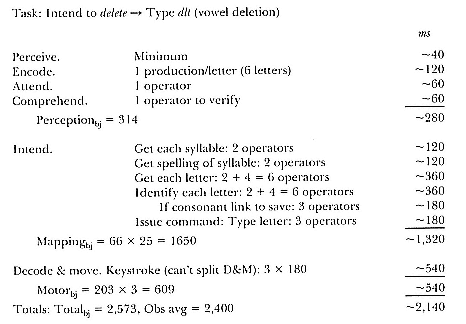
Fig. 9.3.
SRC example: Recall command abbreviation
person needs to get from delete to dlt to command the editor appropriately. Stimulus-response compatibility occurs here. On the more compatible side, the designer of the editor might have chosen delete itself, although it would have required more typing. On the less compatible side, the designer might have chosen gro , thinking of get rid of .
Figure 9.3. shows an accountinf of how Soar would predict the time it takes a person to type dlt . First is the processing that acquires the word and obtains its internal symbol: perceive the sensory stimulus (in the experimental situation, the word was presented on a computer display); encode it (automatically) to obtain its internal symbol; attend to the new input; and comprehend it to be the task word. Second is the cognitive processing that develops the intended answer: getting each syllable; extracting each letter; determining if it is consonant; and, if so, creating the command to the motor system that constitutes the internal intention. Third is the motor processing: decode the command, and move the finger to hit the key (successively d, l , and t ). The entire response is predicted to take about 2.1 sec. (2,140 ms), whereas it actually took 2.4 sec.
Soar is operating here as a detailed chronometric model of what the human does in responding immediately in a speeded situation. This does not fit the usufl view of an AI-like system, which is usually focused on higher-level activities. But a theory of cognition must cover the full tem-
poral range of human activity. In particular, if the theory of the architecture is right, then it must apply at this level of immediate behavior.
These operators and productions are occurring within the architectural frame indicated in figure 9.1. But Soar is not an origional theory here. Lots of psychological research has been done on such immediate-response tasks, both theoretical and experimental. It has been a hallmark of modern cognitive psychology. In this case, the experimental work goes back many years (Fitts and Seeger 1953), and there is an extant theory, developed primarily by Bonnie John (1987), which makes predictions of stimulus-response compatibility. What is being demonstrated is that Soar incorporates the essential characteristics of this theory to produce roughly the same results (the numbers subscripted with bj are the predictions from John's theory).
Acquiring a task
Figure 9.4 shows a sequence of situations. At the top is a variant of a well-known experiment in psycholinguistics from the early 1970s (Clark and Chase 1972). In the top panel, a person faces a display, a warning light turns on, then a sentence appears in the lefthand panel and a picture of a vertical pair of symbols in the right-hand panel. The person is to read the sentence, then examine the picture and say whether the sentence is true or not. This is another immediate-response chronometric experiment, not too different in some ways from the stimulus-response compatibility experiment above. In this case, one can reliably predict how long it takes to do this task, depending on whether the sentence is in affirmative or negative mode, uses above or below , and is actually true or false. This experiment, along with many others, has shed light on how humans comprehend language (Clark and Clark 1977).
Our interest in this example does not rest with the experiment itself but with the next panel down in the figure. This is a set of trial-specific instructions for doing the task. A cognitive theory should not only predict the performance in the experiment but also how the person reads the instructions and becomes organized to do the task. The second panel gives the procedure for doing the task. Actually, there were two variants of the experiment, the one show, and one where 4 reads "Examine the picture" and 5 reads "Then read the sentence." These are not the only instructions needed for doing the task. The bottom who panels indicate increasingly wider contexts within which a person does this task. These panels, written in simple language, are an overly homogeneous and systematic way of indicating these layers of context. In an actual experiment, the person would gather part of this information by observation, part by the gestures and behavior of the experimenter, and part by interaction directly with the experimental apparatus.
The experiment occurs 1. Light turns on. 2. Display shows. | 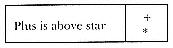 |
3. Subject roads, exzmines, and press a button. Prior trial-specific instructions 4. "Read the sentnece." 5. "Then examine the picture." 6. {Press the T-button if the sentence is true of the picture." 7. "Push the F-button if the sentnece is false of the picture." 8. "Then the task is done." Prior general instructions 9. "at some moment the light will come on." 10. "After the light comes on, a display will occur." 11. 'The left side of the display shows a sentence." 12. "The right side of the display shows a picture." Introduction 13. "Hello." 14. "This morning we will run an experiment." 15. "Here is the experimental apparatus." 16. . . . | |
Fig. 9.4.
Acquiring a task
Soar does both the top two panels (but not the buttom two). Focusing on the second panel, as the interesting one for our purposes, Soar takes in each simple sentence and comprehends it. This comprehension results in a data structure in the working memory. Soar then remembers these specifications for how to behave by chunking them away, that is, by performing a task whose objective is to be able to recall this information, in the context of being asked to perform the actual task. On recalling the instructions at performance time, Soar performs the task initially by following the recalled instructions interpretively, essentially by following them as rules. Doing this leads to building additional chunks (since Soar builds chunks to capture all its experiences). On subsequent occasions, these chunks fire and perform the taks without reference to the explicitly expressed rule. Soar has now internalized this task and performs it directly thereafter.
The point is that Soar combines performance and task acquisition in a single theory, as required of a unified theory of cognition. It shows one advantage of having unified theories. The theory of the performance
task is not simply stipulated by the theorist (as Clark and Chase had to do) but flows, in part, from the theory of how the task instructions organize the person to do that performance.
Problem Solving
Let us move up the time scale. Figure 9.5 shows a little arithmetical puzzle called cryptarithmetic. The words DONALD, GERALD, and ROBERT represent three 6-digit numbers. Each letter is to be replaced by a distinct digit (e.g., D and T must each be a digit, say D = 5 and T = 0, but they cannot be the same digit). This replacement must lead to a correct sum, that is, DONALD + GERALD = ROBERT. The figure shows the behavior of a subject solving the puzzle (Newell and Simon 1972). Humans canb e given cryptarithmetic tasks and protocols obtained from transcripts of their verbalizations while they work. The subject proceeds by searching in a problem space; the figure shows the search explicitly, starting in the initial state (the upper left dot). Each short horizontal segment is an operator application, yielding a new state. When the search line ends at the right of a horizontal line, the subject has stopped searching deeper and returns to some prior state already generated (as inicated by the vertical line, so that all vertically connected dots represent the same state on successive returns). The subject often reapplies an earlier operator, as indicated by the double lines, so the same path is retrod repeatedly.
It takes the subject about 2,000 sec. (30 min.) to traverse the 238 states of this search, averaging some 7 sec. per state. Although a puzzle, it is still genuinely free cognitive behavior, constrained only by the demands of the task. This particular data is from 1960, being part of the analysis of problem solving by Herb Simon and me (Newell and Simon 1972). A unified theory of cognition should explain such cognitive behavior, and Soar has been organized to do so, providing detailed simulations of two stretches, lines 1–4 and 8–12. Figure 9.6 shows the more complex behavior fragment (lines 8–12), where the subject has trouble with column 5 of the sum (E + O = O) and thus goes over the material several times, a behavior pattern called progressive deepening . These two stretches are far from the whole protocol, but they still amount to some 200 sec. worth.
The reason for reaching back to old data is the same as with the stimulus-response compatibility and the sentence-comprehension cases. Initially, the most important element in a proposed unified theory of cognition is coverage—taht it can explain what existing theories can do. One attempts to go further, of course. In the sentence case, it is getting the theory to cover the acquisition of the task by instruction. In the cryptarithmetic case, it is attaining completness and detail.
Development
Finally, consider an attempt to understand how the development of cognitive functions might occur. This territory has been
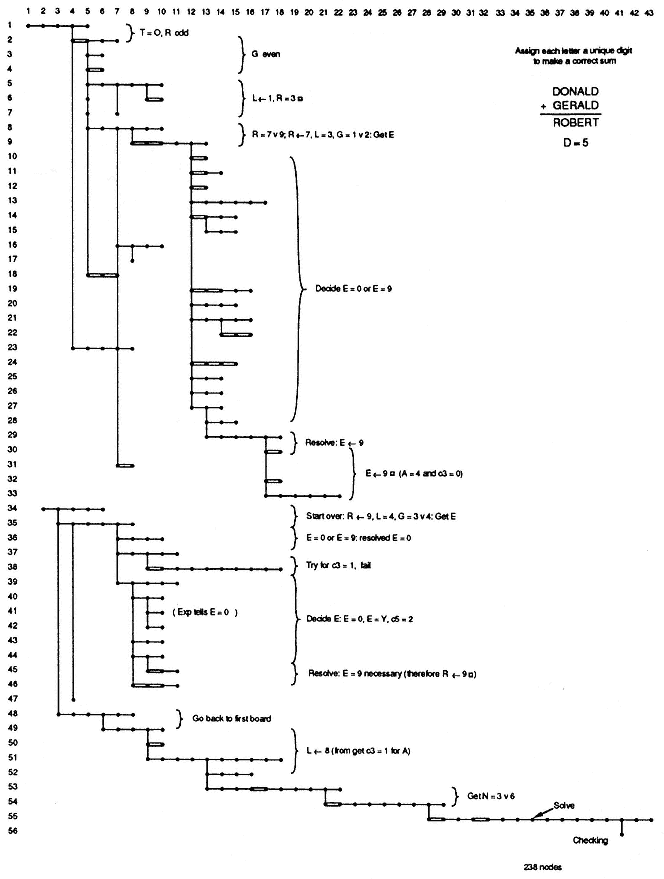
Fig. 9.5.
Behaviro of a person on the cryptarithmetic task
mapped out by Piaget, who gave us an elaborate, but imperfect and incomplete, theoretical story of stages of development, with general processes of assimilation and accommodation, oscillating through repeated equilibrations. Piaget also mapped the territory by means of a large and varied collection of tasks that seem to capture the varying capabilities of
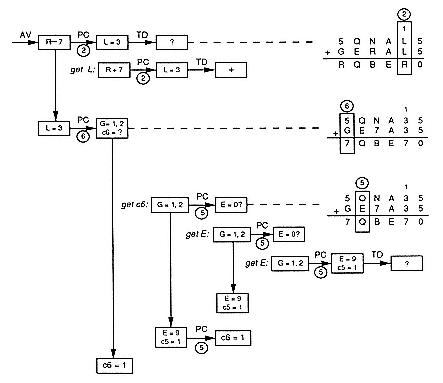
Fig. 9.6.
Soar simulation of the cryptrithmetic task
children as they grow up. Some are widely known, such as the conservation tasks, but there are many others as well.
This exploration with Soar uses the Piagetian task of predicting whether a simple balance beam (like a seesaw with weights at various distances on each side) will balance, titl right, or tilt left with various placements of weights. As they grow up, children show striking differences in their ability to predict, only taking total weight into account (around 5 years), to considering both weights and distance, providing they are separable, to (sometimes) effectively computing the torque (by late adolescence). Developmental psychologists have good information-processing models of each of these stages (Siegler 1976), models that are consonant with cognitive architectures such as Soar. What is still missing—here and throughout developmental psychology—is what the transition mechanisms could be (Sternberg 1984). That, of course, is the crux of the developmental process. It will finally settle, for instance, whether there really are stages or whether cognitive growth is effectively continuous.
Soar provides a possible transition mechanism. It learns to move
through the first two transitions: from level 1 (just weights) to level 2 (weights and distance if the weights are the same) to level 3 (weights, and distance if they do not conflict). It does not learn the final transition to level 4 (computing torques).[3] Soar predicts how the vbeam will tilt by encoding the balance beam into a description, then using that description to compare the two sides, and finally linking these comparisons to the three possible movements (balance, tilt-left, tilt-right). Soar has to learn both new encodings and new comparings to accomplish the transitions, and it does both through chunking. Figure 9.7 provides a high-level view of the transition from level 1 to level 2. It shows the diffrent problem spaces involved and only indicates schematically the behavior within problem spaces. My purpose, however, is not to show these learnings in detail. In fact, both types of learning are substantially less rich than needed to account for the sorts of explorations and tribulations that children go through.
The above provides the context for noting a critical aspect of this effort to explore development with Soar. Soar must learn new knowledge and skill in the face of existing learned knowledge and skill, which is now wrong. In this developmental sequence, the child has stable ways of predicting the balance beam; they are just wrong. Development implies replacing these wrong ways with correct ways (and doing so repeatedly). That seems obvious enough, except that Soar does not forget its old ways. Chunking is a process that adds recognitional capability, not one that deletes or modifies existing capability. Furthermore, the essence of the decision cycle is to remain open to whatever memory cn provide. Soar, as a theory of human cognition, predicts that humans face this problem, too, and there is good reason and some evidence on this score. Humans do not simply forget and destroy their past, even when proved wrong.
The solution within Soar is to create cascades of problem spaces. If an existing problem space becomes contaminated with bad learning, a new clean space is created to be used in its stead. That is, whenever the old space is to be used, the new one is chosen instead. Of course, when first created, this new space is empty. Any attempt to use it leads to impasses. These impasses are resolved by going back into the old space, which is still around, since nothing ever gets destroyed. This old space contains the knowledge necessary to resolve the impasse. Of course, it also has in it the bad learning. But this aspect can be rejected, even though it cannot be made to go away. The knowledge for this must come from a higher context, which ultimately derives from experimental feedback. Once an impasse has been resolved by appropriate problem solving in the old space, chunks are automatically formed (as always). These chunks transfer this knowledge into the new space. Thus, on subsequent occurrences
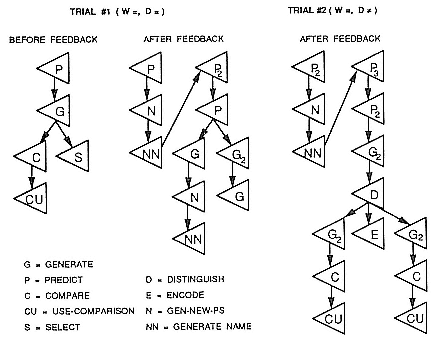
Fig. 9.7.
Problem spaces used in learning about the balance beam
of using the new space, it will not have to return to the old space. It may do so for some other aspect, but then that too is transferred into the new space. Gradually, with continued experience, the new space is built up and the old space entered less and less often. But it always remains, because Soar never knows all the information that was encoded in the old space, nor could it evaluate its quality in the abstract. Only in the context of an appropriate task does such knowledge emerge.
The Scope of Soar
Soar addresses a significant range of other phenomena that surround central cognition. Figure 9.8 provides a summary list. Heading the list is the demonstration that Soar accounts for the ability to be intelligent. One of the reasons AI is closely related to cognitive psychology is that functionality is so important. A theory of cognition must explain how humans can be intelligent. But there seems no way to demonstrate this without constructing something that exhibits intelligent behavior according to the theory. Soar demonstrates this by being a state-of-the-art AI system (Laird, Newell, and Rosenbloom 1987).
Soar exhibits the qualitative shape of human cognition in many global
1. The ability to exhibit intelligence 2. Global properties of cognitive behavior 3. Immediate-response behavior 4. Simple discrete motor-perceptual skills 5. Acquisition of cognitive skills 6. Recognition and recall of verbal material 7. Short-term memory 8. Logical reasoning 9. Problem solving 10. Instructions and self-organization for tasks 11. Natural language comprehension 12. Developmental transitions |
Fig. 9.8.
Cognitive aspects addressed by Soar
ways. For instance, it is serial in the midst of parallel activity and it is interrupt driven. Next, Soar provides a theory of immediate responses, those that take only about 1 sec. Stimuls-response compatibility was an example. Soar also provides a theory fo simple discrete motor-perceptual skills, namely, transcription typing. In general, however, Soar is still defincient in its coverage of perceptual and motor behavior, with typing as close as we have gotten to these critical aspects.
Soar provides a plausible theory of acquisition of cognitive skills through practice. It also offers the main elements of a theory of recognition and recall of verbal material—the classical learning domain of stimuls/response psychology. Soar also provides some aspects of a theory of short-term memory, including a notion on how the plethora of different short-term memories (whose existence has been revealed experimentally) might arise. It provides a theory of logical reasoning, of problem solving, and of how instructions are converted into the self-organization for doing new immediate-response tasks. In addition, it implies a specific but still undeveloped theory of natural language comprehension. Finally, it has demonstrated an idea for a transiton mechanism in developmental psychology.
Figure 9.8 presents the range of things that one candidate for a unified theory of cognition has addressed. it has done this with varying degrees of success, depth, and coverage. No claim is made for its superiority over existing cognitive theories. Indeed, Soar contains mechanisms that make it a variant of existing successful theories. The issue is not to demonstrate nvoelty but to show that a single unified theory can cover all these phenomena—that it is one architecture that does all of these tasks and does them in fair accord with human behavior on the same tasks. Finally, to come back to our main point, Soar is a genuine theory. It is not just a broad framework or a simulation language that provides a medium
to express specific microtheories. One does calculations and simulations with Soar and reasons from the structure of the architecture to behavior. Above all, Soar is not a metaphor for mind.