
4. Empire
Gaze, Discipline, Rule
The Problem
In the last chapter, I noted that the inhabitants of the eastern coastal region eventually came to identify with and participate in the institutions of the Ottoman Empire. But if these rural peoples were inclined to align themselves with the imperial system, this does not mean that the ruling institution itself would have permitted, let alone encouraged, such an accommodation. Indeed, the very idea of a rural people becoming ottomanist in orientation contradicts the prevailing historiography of the Ottoman Empire. Most commentaries have emphasized an unbridgeable divide between its ruling (askeri) class of state officials and its ordinary subjects (reaya), both Muslim and Christian. How then could a population of gardeners residing in remote mountain hamlets find themselves a place in the imperial system?
To answer this question, I first review how the Ottomans incorporated the eastern coastal region soon after the conquest of Constantinople, at a time when they were perfecting the classical ruling institution. This done, I analyze the architecture and ceremony of the governmental complexes that they built in the new imperial capital. This analysis features a double objective: to lay bare the distinctive configuration of sovereign power in the imperial system, and to expose channels of popular identification and participation that would lead into it.
Ottoman Centralism and Exclusivity
From the early sixteenth century, western European observers began to perceive the Ottoman Empire as a remarkable example of the centralism and exclusivity of sovereign power. What they noticed were the features of a new imperial system that Mehmet II had developed following his conquest of Constantinople in 1453.[1] Niccolò Machiavelli's comparison of the French and Ottoman governments in The Prince (1515) exemplifies the contemporary assessment:
The passage points to a stereotype of Ottoman government that had come to prevail in Christian Europe. The sultan ruled through a body of officials having the legal status of household slaves. Recruited from the children of Christian families and trained from adolescence within the confines of the sultan's palace, they had no independent social identities or loyalties.[3] At the same time, these slave officials (kul) were unchallenged by any system of estates. There was no aristocracy composed of lords who ruled their own peoples and territories, and no bourgeoisie composed of merchants or bankers who had been granted the privilege of governing their own towns and cities. The "Grand Turk," as the sultan was sometimes styled in Christian Europe, seemed to enjoy a measure of sovereign power unmatched by any other monarch in early modern Europe.The entire monarchy of the Turk is governed by one lord, the others are his servants; and, dividing his kingdom into sanjaks [sub-provinces], he sends there different administrators, and shifts and changes them as he chooses. But the King of France is placed in the midst of an ancient body of lords, acknowledged by their own subjects, and beloved by them; they have their own prerogatives, nor can the king take these away except at his peril. Therefore, he who considers both of these states will recognize great difficulties in seizing the state of the Turk, but, once it is conquered, great ease in holding it. The causes of the difficulties in seizing the kingdom of the Turk are that the usurper cannot be called in by the princes of the kingdom, nor can he hope to be assisted in his designs by the revolt of those whom the lord has around him. This arises from the reasons given above; for his ministers, being all slaves and bondmen, can only be corrupted with great difficulty, and one can expect little advantage from them when they have been corrupted, as they cannot carry the people with them, for the reasons assigned.[2]
Machiavelli's analysis reduced the ruling institution to a simple and static formula, thereby concealing both its complexity and instability. Still, his formula directs our attention to a distinctive feature of a new governmental system that gained ground during the early classical period. As the Ottomans launched a world imperial project during the later fifteenth century, they reinforced the centralism and exclusivity of the ruling institution. The recruitment and training of "slave" children to serve as high state officials was just one of the measures they adopted. By means of a range of policies, the Ottomans came to rely on a special class of military, administrative, and judicial officials who lacked affiliation with the governed. This raises the question of how the Ottomans incorporated a region whose peoples had such a large stake in market and state participation.
Mehmet II had annexed the Greek Empire of Trebizond (1461) just as he was beginning to devise and apply the new imperial system. Süleyman I had later reorganized the province (paşalıık) of Trabzon as a new administrative entity (1519) at the high point of classical institutions. So the substantial Christian population of the coastal region had become subjects just as the Ottomans were perfecting the centralism and exclusivity of the ruling institution. Higher state officials were more than ever composed of slave officials, and other entry points into the ranks of officialdom were regulated more than ever. Thus the shock of conquest was compounded by the shock of subjection. The old rural societies of the coastal region and the new imperial system were exactly mismatched. The inhabitants of the province of Trabzon had become part of a governmental system based on principles that stood in direct opposition to compelling local interests.
As we saw in the last chapter, the mismatch was transitory rather than permanent. As the domains of the ruling institution reached their maximum limits, the conduct of warfare was shifting away from the use of cavalry toward the use of infantry with firearms.[4] Under these circumstances, the Ottomans came to require larger numbers of men with a wider range of skills, even before the close of the classical period. They therefore took steps to widen the circle of participation in imperial military and religious institutions during the seventeenth century, in effect compromising the principles of centralism and exclusivity. As they did so, problems of imperial competition at the military frontier were joined by problems of internal instability in the core Ottoman provinces. Provincial governors had begun to defy the central government, asserting themselves by collecting illegal taxes and maintaining their own private armies. In response, the palace widened the privileges and prerogatives of provincial elites at the district level in hopes of curbing the powers of provincial governors.[5] As a result, principles of centralism and exclusivity were compromised still further. By the beginning of the eighteenth century, the distribution of sovereign power had moved outward and downward into the imperial system, weakening both central and provincial government. Higher state officials found themselves unable to rule save with the acquiescence and assistance of provincial elites.[6] The post-classical period was thereby characterized by a progressive decentralization of sovereign power.
All the core Ottoman provinces were affected by the changes I have just summarized, but the province of Trabzon is an especially revealing example of the phases of decentralization. By the close of the seventeenth century, many of the districts where the population had been almost entirely Christian at the moment of Ottoman incorporation had become almost entirely Muslim. Furthermore, large numbers of the men among these new Muslim populations had associated themselves with local branches of imperial military and religious institutions. By the close of the eighteenth century, local participation in imperial military and religious institutions had resulted in an entirely new relationship of state and society. Provincial elites at the head of armed followings asserted their prerogatives in the imperial system, sometimes defying, even threatening, higher state officials, both those in Trabzon as well as in Istanbul.
The instance of the eastern coastal region therefore poses questions of general significance for the understanding of the ottomanization of provincial society in other parts of Asia Minor and the Balkans. How did a population composed of different ethnic groups attached to different religions come to participate in imperial military and religious institutions? And in doing so, how did this diverse and mixed population become state-oriented, official Muslims, given that the imperial regime was based on radical principles of centralism and exclusivity?
Ottoman Incorporation of Trabzon
In his account of the ruling institution during the classical period, İİnalcıık explains how the palace, the seat of centralized government, organized and supervised the core Ottoman provinces in Asia Minor and the Balkans.[7] A hierarchy of military officers was appointed to govern a hierarchy of administrative units. There was a governor of each province (beylerbeyi), a few sub-governors of its several sub-provinces (sancakbeyi), and a large number of subordinate officers (sipahi) assigned to groups of villages (tıımar) in the sub-districts of each sub-province.[8] The palace appointed the governors to their positions for a limited term, rotating them from province to province. The palace also approved the governor's appointments of subordinate officers, also for a limited term, rotating their assignments from time to time.[9] The powers of this hierarchy of military officers was further subject to certain checks and balances. The chief treasury official (hazine kethüdasıı) was responsible for seeing that the fiscal affairs of the province were in order. The chief court official (kadıı) issued judgments in accordance with administrative and religious law. The provincial governor could dismiss both these officials, but only upon notification of the palace.
As we have seen, the military, treasury, and judicial officials were members of a special class without ties to the lands and peoples they governed. Only some members of this special class would actually have been trained in the institutions of the imperial capital, but of those who were not from Istanbul, only some would have been born and raised in the eastern coastal region. So the military, treasury, and judicial officials of the province of Trabzon had no multistranded ties with either the lands or the peoples for whom they were responsible. In this regard, they were unlike the lords and vassals of western Europe during the Middle Ages. They generally lacked castles or estates in the provinces to which they were posted, just as they lacked supporters among their inhabitants.
Furthermore, official procedures insured that the military governors would remain loyal and obedient servants of the central government rather than set down roots and build a following among the populations they governed. The sipahi, who were assigned to the countryside as a kind of country police force, best exemplify how this was accomplished. They came into direct contact with villagers on a routine basis in the course of collecting taxes, apprehending fugitives, imposing forced labor, and carrying out court decisions. They were therefore in a good position to build a base of local support, by favoring or disfavoring the villagers for whom they were responsible. But to counter this very possibility, the sipahi were subject to all kinds of controls.
The provincial governor could renew or revoke their appointment to a tıımar, as well as allow or disallow their relatives to succeed them as asipahi. So both their assignment in the countryside and their tenure as subordinate military officers were entirely dependent on higher state officials rather than local preference or election. Normally, they were rotated from district to district during the course of their service, so that they usually found themselves among peoples with whom they had no previous social contacts. They also had limited opportunity to develop social contacts since they were obliged to report for military campaigns, during which they were replaced by deputies for extended periods.[10] Treasury and judicial officials also subjected them to periodic inspections and were in a position to bring charges against them for malfeasance. Complaints could be lodged against them by townsmen and villagers and could result in dismissal if confirmed.[11]
In other words, all kinds of precautions had been adopted to prevent lower state officials from doing exactly what some would do during the period of decentralization. Policies of appointment, rotation, and inspection prevented the sipahi from setting down family lines and building local followings. It was as though the Ottomans had designed the institutions of the classical period in anticipation of the post-classical period that followed it. As we shall see, this would not have been a coincidence. Those who were responsible for inventing and implementing the imperial project would have taken care to neutralize a decentralizing potential that was inherent within its logic.
Four Ottoman registers attest to the thoroughness and efficiency with which the classical system of provincial government was put into practice in the province of Trabzon. Taken once every generation during the first century of incorporation, the registers tabulate the different classes of tıımar assignments, list the names of the sipahi appointed to them, and establish the tax obligations of each household head.[12] Although the same structure of government would have been operating in other parts of Asia Minor and the Balkans, the province of Trabzon was in certain respects unusual. Initially, as confirmed by the registers, the Ottomans appointed sipahi who had taken part in the conquest. Some of these individuals came from the western coastal region (the province of Canıık), which had been Islamized and Turkicized for many years.[13] More than a few came from still further away, from other parts of Asia Minor, or even the Balkans.[14] Thus, thesipahi in most of the coastal valleys of Trabzon would have been even more distant from their charges than was the case in some other provinces. The villagers among whom they resided were a newly subjected Byzantine population composed mostly of Orthodox Christians. The sipahi and the villagers therefore observed different customs, spoke different languages, and belonged to different religions.[15]
Accordingly, the rural societies of the sixteenth-century province of Trabzon faced a bureaucratic hierarchy whose officials were part of interpersonal networks closed to ordinary townsmen and villagers.[16] The townsmen and villagers found themselves subject to strangers who represented a foreign fiscal and legal administration. Appointments to military, administrative, and judicial positions were limited to insiders rather than open to outsiders. The entry of ordinary townsmen or villagers into the official class was unlikely. State regulations made it difficult for villagers to leave or neglect their farms. Even conversion from Christianity to Islam may have been discouraged, since every new Muslim household, no longer obliged to pay a tax (haraç) imposed on Christian households, would have had a negative effect on treasury receipts. The policies and institutions of the classical period were therefore incompatible with the peculiar character of the eastern coastal region as described in the preceding chapter.
And yet, as we shall see, the foundation had been laid for the "imperialization" of the rural societies in the province of Trabzon. The Ottomans had incorporated the inhabitants of the eastern littoral as a Christian population subordinated by imperial institutions. But the latter would eventually discover channels into the military and religious establishments that ruled them. In doing so, the inhabitants of the eastern littoral would evolve into a Muslim population participating in imperial institutions. To some degree, this transformation came about as local elites of the eastern coastal valleys took advantage of the breakdown of bureaucratic centralism during the period of decentralization. But this was not the most important process that led to the emergence of ottomanized rural societies in the province of Trabzon.
As we shall soon see more clearly, the official class of the ruling institution subscribed to a discipline of social thinking and practice that instilled qualities of individual behavior and disposition. Reinforced by bureaucratic policies and procedures, the exercise of sovereign power through interpersonal association bound the official class together even as it divided them from ordinary townsmen and villagers. But once individuals of the subject population were in a position to adopt this same "imperial tactic," they would be able to assert their prerogatives within the imperial system, even at the expense of higher state officials. The dissemination of the exercise of sovereign power through interpersonal association, its spread from insiders to outsiders, was then a cause of the period of decentralization. The breakdown and corruption of bureaucratic centralism can be seen as the corollary rather than the cause of this dissemination. To understand the emergence of ottomanized provincial societies in the eastern coastal region, it is therefore necessary to clarify the social thinking and practice of the official class.
The Palace Complex: A Device of Sovereign Association
Soon after the conquest of Constantinople, Mehmet II initiated the construction of great monumental centers on prominent hilltop locations within the city. By the end of his reign (1451–81), a palace complex and a mosque complex, by virtue of their immensity, the numbers of their personnel, and the extravagance of their budgets, had completely transformed the city from a Byzantine into an Ottoman capital.[17] Each of the two sites had a dual purpose, both organizational and representational.[18] They were centers for implementing a new ruling institution based on radical measures of centralized government, and at the same time, they were also theaters for displaying this ruling institution in splendor and grandeur. The palace complex and the mosque complex were therefore instruments of edification as well as of government, and as such, designed to confound and enthrall, if not intimidate and terrify.
Two hundred years or so after the time of Mehmet II, as the imperial system slipped into a period of decentralization, the counterparts of these great imperial complexes began to appear in many parts of the eastern coastal region. Aghas residing in government mansions and hodjas teaching in mosque academies were in effect rural versions of the great monumental sites of Istanbul. However, these rural replicas of imperial models mimicked their originals more perfectly at the level of interpersonal association than at the level of ceremony and architecture. Neither the aghas nor the hodjas intended to emulate the courts, domes, ceremony, and protocol of the palace and mosque complex. Rather, they drew upon the ethical underpinnings of the imperial project: the exercise of sovereign power through a discipline of interpersonal association.[19]
Since the great monumental centers were designed as much for "showing" as for "ruling," their ceremony and architecture can be deciphered to expose these ethical underpinnings. I shall consider each of the two centers in turn, but devoting more attention to the palace than the mosque complex. The relationship of power and religion during the classical imperial period justifies this treatment. As we shall see, the foundation of the imperial project, sovereign power through interpersonal association, required that the palace hold Islam captive.
The Palace Machine
By its placement and appearance, the palace complex is contrived to manifest sovereignty and invincibility, but by a peculiar logic. Two striking architectural features, clearly visible from afar, suggest a coordination of seeing with ruling. The residential quarters of the sovereign are set on a promontory overlooking two continents, Europe to the west and Asia to the east. This vantage point is set behind and above a high fortress wall that surrounds the entire palace complex.[20] So the sight of the sovereign is represented by an overlook from within an interior. And the association of a personal gaze with a ruling power, already implicit in its elevated perspective, is explicitly represented by a high fortress wall adorned with watch towers and gun emplacements.
The physical structure of the palace complex announces the relationship of gaze and rule not once or twice, but over and over again. Apertures, gratings, and windows are repeatedly coordinated with balconies, overlooks, and towers. Each instance of the relationship symbolizes the sovereign situated within an interior space overlooking an external space occupied by subjects. All these instances of an elevated oversight articulate the personal presence of the unobserved sovereign as the foundation of a world ruling institution.
But exactly how is gaze translated into rule? What is the quality of vision as cause and how is it related to the quality of power as effect? Does the relationship of gaze and rule perhaps have some kinship with the panopticon, as invented by Jeremy Bentham and analyzed by Michel Foucault?[21] Or should we not anticipate that the articulation of peculiar elements—eye, interior, oversight, rule, exterior—points to a specific language of authority and obedience? The verses of an Ottoman poet, cited in Necipoğlu's definitive study of the architecture and ceremony of the palace, seem to have been composed as an answer to this very question. Cafer Çelebi said:
What is each window, but an eye opening to the whole world, to watch ceremonies and spectacles? What is each tower, but from head to foot a tongue to praise and eulogize the just shah?[22]
The verses of the poet refer to the basic elements of the overall placement and appearance of the palace complex: A personal presence, symbolized by windowed interiors set in tower overlooks, bespeaks of sovereign power. But now the poet composes these elements to articulate a somewhat strange message.
According to the conceit, the palace complex works like a machine that mediates between the eye of its resident and the imperium beyond its walls. Its overlooking windows (set in towers) are telescopes that expose the whole world to his sight. Its elevated towers (pierced by windows) are megaphones that speak to the whole world of his rule. So by this combination of mechanisms, seeing is most certainly linked with ruling. The structures that expose the world to the person of the sovereign are also the structures that represent the person of the sovereign to the world as legitimate ruler. Moreover, the verses also point to the specific qualities of seeing and ruling. The windows are an eye that brings the world into view, but not as a landscape of fields, waterways, mountains, and lakes. The world appears in the form of the subjects of an imperium, engaged in ceremonies and spectacles, and so not engaged, by contrary example, in commerce and warfare. The sovereign therefore sees, or rather oversees, normative performances. The windows, as instruments of the palace machine, bring a kind of world into view, a world of propriety and sociability, pleasing in form and delightful to experience. So the sight of the sovereign, as mediated by the palace machine, has worked to compose the world it brings into view by sponsoring and supporting normative performances. The palace machine is both organizational and representational. Cafer spoke both brilliantly and succinctly as he put the spirit and logic of the palace complex into a score of words.
By the anachronistic terms "telescopes" and "megaphones," I have emphasized how the poet images the palace as an instrument of sovereignty. On the other hand, Cafer's tropes are more anthropomorphic than mechanical. He likens the palace windows to an eye and the palace towers to a tongue. Since these figures clearly do not refer to the sovereign himself, the poet is suggesting that the palace is an instrument of sovereignty that works through anthropomorphic rather than technical media, such as the scripts and documents of a centralized bureaucracy. As we shall see, the palace was indeed an instrument for extending and amplifying the personal presence of the sovereign by means of loyal and obedient officials who were something more than a centralized bureaucracy. This feature of the palace is indicated by another coordinated repetition of structures and functions, one that determined the overall layout of the palace complex (see fig. 7).[23]
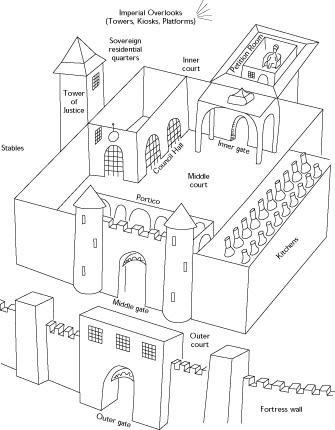
Figure 7. Schematic of Mehmet II's palace complex.
A succession of three gates, leading to three courts, organized the grounds of the palace complex. The outer gate led to the outer court, from which the middle gate led to the middle court, from which the inner gate led to the inner court. This arrangement defined a series of thresholds leading to interiors, each standing in relationship to one another as "further out" or "further in" by reference to the person of the sovereign. At the same time, each instance of a threshold and interior was also associated with apertures and overlooks representing the personal presence of the sovereign, seeing but unseen, hearing but unheard. In this respect, the successive interiors defined by the gates and courts had the status of assembly spaces that were correlated with the increasing nearness, and hence intensity, of sovereign oversight. As the visitor to the palace complex moved through them, he experienced the progressive loss of his own will and purpose as he became more and more subject to ceremony and protocol. In this way, the visitor experienced his approach to the sovereign as an approach to a locus of normative regulations that otherwise radiated outward.[24] The series of thresholds and interiors therefore indicated the personal presence of the sovereign as a focal point of a world imperium. So an architecture of windows and towers was coordinated with an architecture of gates and courts.
An Omnipresent Personal Oversight
Following the lead of Cafer, let us begin with the Tower of Justice (köşk-i 'adl), a structure he may have had in mind when he composed his verses.[25] The base of the Tower of Justice was situated in the residential quarters of the sovereign located beyond the north corner of the middle court. The upper section of the Tower of Justice, fitted with a latticed window, rose above the rooftops of the other buildings so that it could be seen from afar. The sovereign was therefore able to mount the Tower of Justice and view the two continents of his imperium from the seclusion of his residential quarters. By its architectural prominence, this symbol of sovereign oversight, only one example of many, dominated the entire palace complex.
A Council Hall (divan) was situated before the Tower of Justice in the forward section of the middle court (see fig. 7).[26] Here, the highest officials of the ruling institution deliberated state affairs, reached administrative decisions, received petitions from subjects, and heard law cases.[27] At the base of the Tower of Justice, a little room was equipped with a curtained window that opened out into the upper wall of the Council Hall.[28] The sovereign could access the little room from the seclusion of his residential quarters and sit behind the curtained window. For all those present in the Council Hall, he was then always present, even when absent. Before the curtained window itself, hanging from the domed ceiling of the meeting room, a gilded globe represented the earth.[29] Round about the meeting room, large grilled openings at the entrances symbolized the availability of justice to all subjects.[30]
The window above, which overlooked two continents, was therefore punctuated by another window below, which overlooked the dispensation of justice by state officials. In the early years of his reign, and continuing for sometime thereafter but ever more rarely, Mehmet II had joined state officials in the Council Hall and participated himself in their deliberations. This practice, which was abandoned as the palace complex reached completion, points to the derivative and evolutionary character of the ruling institution. Once upon a time, it would seem, the sovereign had been more directly and routinely involved in the day-to-day matters of administration and adjudication. At a certain moment of dynastic history, one could presume, the device of the windowed overlook had begun to substitute for the personal presence of the sovereign.
The sovereign had ruled by his personal presence in accordance with a kind of justice that was interpersonal in character rather than abstract and technical. With the extension of his domains, however, the sovereign came to rely on his officials as stand-ins for his personal presence so that their eyes, tongues, heads, and feet were his representatives. And then with the further extension of his domains, his officials multiplied, so that they numbered in the thousands rather than the hundreds. The windowed overlook had then been adopted as a device for extending the personal presence of the sultan. Thus, the ruling institution retained its character as an interpersonal association even as it evolved into a world system. This had come about by a resort to an architectural instrument that preserved a founding principle but enabled its imperial amplification.
This "just so story" suggests that the Council Hall had first been fitted with a curtained window, and then a Tower of Justice with a latticed window had been added to the Council Hall. The windowed overlook would have been first adopted as a device for supervising the ruling institution and then only later become a symbol of the ruling institution to be seen from afar.
A Spectacle of Interpersonal Association
In fact, the Tower of Justice also served as an internal device of the ruling institution as well as its external symbol. Its latticed window had been specifically constructed to provide a view of the core mediating segment of the palace complex, the middle court. From the seclusion of his residential quarters, the sovereign was able to mount the Tower of Justice, position himself before this latticed window, and observe an extraordinary scene of "ceremonies and spectacles" consisting of "praises and eulogies." Down below in the middle court, he could observe thousands of loyal officials who had assembled to show themselves to their sovereign, greeting and honoring him as they did so. In all probability, Cafer had these occasions in mind when he composed his verses describing the palace. He had sought to capture the wonder of a novel architectural structure by which personal oversight of normative performances had been translated into a world imperium.
In the early years of his reign, before the palace complex was completely finished, Mehmet II had not always mounted the Tower of Justice to view the assemblies down below. He had regularly joined his officials and troops in the middle court, appearing before them and hosting a meal.[31] Necipoğlu, relying on the description of a Genoese merchant, gives the following account of these gatherings, which occurred early each day at the break of dawn:
The derivative and evolutionary character of the palace complex has once again come into view. Once upon a time, the sovereign had been more routinely present at the assembly of his officials, not only as they dispensed justice, but also as they congregated as a sovereign association. The windowed overlooks of the palace complex therefore appear as architectural replacements of the once-present sovereign.On these occasions the courtyard was filled with eight thousand officials wearing "vests of brocade and silk of every color and type." The sultan appeared in glory under a magnificent portico (lobia) in front of the gate that led to the residential court. The ceremony lasted for a quarter of an hour, during which time servants offered food to the sultan on a gold tray and to those assembled on silver and copper trays, according to their rank. At the end of this banquet, at which not a word was spoken, the courtiers loudly acclaimed their ruler, extolling, praising, and glorifying his name. . . . Ambassadors were made to watch this ceremony of imperial glorification, after which they were conducted . . . to the sultan's seat. After bowing and kissing his hand, they were made to sit . . . until he rose to return to his private quarters. As soon as he stood he was again loudly acclaimed by the soldiers; then he sat and rose a second time to hear another acclamation, before entering his private apartment. After the soldiers left, the dignitaries of the [Council Hall] ate. Only then did [they] listen to the cases presented, which they subsequently reported to the sultan inside the private courtyard.[32]
At a certain moment, it would seem, Mehmet II had chosen to absent himself from his officials, substituting his participation in a sovereign association with the device of a windowed overlook. The intention of carrying out such a replacement can therefore be more or less precisely dated to Mehmet II's decision to build a new palace. It did not immediately follow the conquest of the Byzantine capital.[33] Mehmet II had first built another palace complex in Istanbul, later to be known as the "old palace" (eski saray). It was only after he had decided to launch an imperial project some years later that he undertook to build what would become formally known as the New Imperial Palace (sarây-ıı cedîd-i 'âmire).
The Dynastic Court Tradition
Given its derivative and evolutionary character, the New Imperial Palace can be best understood in terms of its place in the history of the Ottoman dynasty. I shall here tell a second "just so story."
Osman, founder of the Ottoman dynasty, had been a chieftain of a Turcoman tribe of pastoral nomads in northwestern Anatolia. But during the course of his reign (1280–1324), he had also become a leader with followers in the marchlands between the Byzantines and the Seljuks.[34] As such, he was the principal figure of a warrior association composed of individuals who came from many places and spoke many languages. This warrior association eventually came to represent a ruling institution legitimized by the extension of the lands of Islam at the expense of the lands of Christianity. So Osman was something other than a chieftain, and his associates were something other than tribesmen. But still, during this early period, they had participated in communal banquets more or less in accordance with the steppe traditions of the Turcomans.[35]
As successive Ottoman dynasts had fitfully risen in power and stature, these communal banquets continued as part of the dynastic court tradition. However, they gradually lost their tribal character and acquired a more Islamic character. The banquets therefore shifted from an occasion that reinforced tribal customs and habits to an occasion that celebrated the ruling institution as a normative association underwritten by the sacred law of Islam.[36] These banquets were then not mere expressions of royal hospitality and sociability that supplemented the otherwise separate business of implementing policy and applying justice. On these occasions, the leader appeared as the personal guarantor of an interpersonal association underwritten by the sacred law of Islam. So the banquets of the dynastic court tradition became at the same time disciplinary exercises and legitimacy performances.[37] The leader and his follower composed a ruling institution of Islam legitimized by the extension of the lands of Islam.
Accordingly, the holding of formal banquets prepared in the royal kitchens eventually determined the design of the grounds and buildings of royal palaces, just as they had also determined the layout of the royal tents during military campaigns. So long before the time of Mehmet II, the Ottoman dynast and Ottoman officials had joined in formal banquets in order to enact the normative performances of an interpersonal association. And long before Mehmet II, such occasions had featured ceremony and protocol for the purpose of impressing, if not astonishing, subjects, participants, and competitors.[38] The palace complexes that preceded the New Imperial Palace were then likewise governmental residences that provided for a theater of state. They had also included assembly grounds, massive kitchens, and large staffs for this very purpose.
At this point, let us return to the middle court to consider what became of these formal banquets as the New Imperial Palace reached completion.
An Uncanny Discipline
During the later years of his reign, as the palace and mosque complexes were reaching completion, Mehmet II adopted new state regulations (kanunname) that decisively transformed his state system into an imperial system.[39] Afterwards, he entered the middle court to appear before the personnel of the ruling institution only twice each year, on the occasion of the two major Islamic festivals. Otherwise, he never again joined his officials to host them with food prepared in his royal kitchens. And yet the dynastic court tradition of the formal banquet still continued, but in a new "disarticulated" form.
After the adoption of the new state regulations the sovereign was still the focal point of the ruling institution, but the sovereign himself was more than ever inaccessible, even invisible. He retreated to his residential quarters within the palace, distancing himself even from the members of the official class. Meanwhile, the representatives of his ruling institution became more than ever a centralized and exclusive official class. The highest state officials were more and more often of "slave" status, individuals who had been separated from their families to be raised and trained within the palace. Correspondingly, the dynastic court tradition changed in character to reflect the logic and sense of the new imperial project. The loyal and obedient officials now presented themselves before a sovereign who had come to resemble a divinity, seeing but unseen, hearing but unheard. Four times each week, thousands of officials came to the middle court to manifest the ruling institution as a normative interpersonal association through a display of ceremony and protocol.[40] Necipoğlu summarizes the intent of these so-called "Victory Councils" (galebe divanıı) in the following terms:
A fragment of the old dynastic court tradition, a warrior leader hosting warrior followers, had been elevated to the level of an imperial project. But in the quote, which tells us a great deal, Necipoğlu has also uncharacteristically slipped past the most important point, which her study otherwise fully documents.Ceremonial [of the middle court] served to create a visual diagram of this hierarchically organized military state that was immediately graspable at a glance. This diagram accentuated the omnipotence of the sultan together with the transformation of the centralized state into a bureaucracy and a great army at the personal service of the sultan.
The perpetuation of ceremonial communicated a message of timeless order and stability, bestowing permanence and legitimacy on an arbitrary social construct. Its power lay in constant repetition, enacted in an eery silence, as if time had been temporarily suspended by an endless recurrence. It froze time in an eternal present and created the illusion of an order transcending mere human experience. [Italics mine][41]
The imaginary potential of the displays in the middle court did not arise from the suspension of time through constant repetition. The witnesses of the ceremonies of the middle court, both insiders and outsiders, had an experience of repetition, but in the register of the uncanny, rather than the eternal.[42] The imperial theater of the middle court had distilled an interpersonal association, rooted in the dynastic court tradition, into its disciplinary essence. The ceremonial rested on an arbitrary social construct, but only in the sense that it revealed thousands and thousands of individuals whose being had seemingly been seized and compelled by such a construction. It was this conscious display of the unconscious that had lain behind the poet's image of the place complex in terms of body parts, eye (çeşm), head (ser), foot (kadem), and tongue (dil).[43] The display of a sovereign association had acquired the quality of an "order transcending human experience." The movements of its participants seemed governed by divine ordinances, by their reduction to figures of loyalty and obedience. Such an imperial theater would not have been effective had it been arbitrarily staged and performed by casting directors and professional actors. Its power to seize and compel its witness relied on effects that could have only been induced by radical procedures of recruitment and training.
One did not have to "know" the meaning of the imperial theater in order to be impressed. Both foreign observers and official participants were struck by its representations. Fresne-Canaye, who witnessed one of the Victory Councils in the company of the French ambassador in 1573, noted its disciplinary essence, even as he could not conclude whether the sight was pleasurable, frightening, monastic, natural, civilized, or savage. The Frenchmen had first passed through the outer gate into the outer court where they dismounted from their horses. They then passed through the threshold of the middle gate to enter into the open square of the middle court. Fresne-Canaye describes what they then saw:
The Frenchmen were then taken to the Council Hall in the forward section of the middle court where they were "courteously received" by the grand vizier and governors. Following this reception, they were then taken elsewhere in the middle court, where they were provided a generous dinner laid out under a portico. As they dined, they observed the officials and troops assembled in the middle court:At the right hand was seated the Agha of the Janissaries [a high officer of the central army], very near the gate, and next to him some of the highest grandees of the court. The Ambassador saluted them with his head and they got up from their seats and bowed to him. And at a given moment all the Janissaries and other soldiers who had been standing upright and without weapons along the wall of that court did the same, in such a way that seeing so many turbans incline together was like observing a vast field of ripe corn moving gently under the light puff of Zephyr.[44]
This representative of a country distant from the Ottoman Empire was both enchanted and frightened, but the nearer neighbors of the Ottomans came away with less ambivalent impressions. When the Safavid prince visited the palace complex in 1591, for example, his attendants were "exhausted" and "weakened" by what they saw in the middle court.[46]We looked with great pleasure and even greater admiration at this frightful number of Janissaries and other soldiers standing all along the walls of this court, with hands joined in front in the manner of monks, in such silence that it seemed we were not looking at men but statues. And they remained immobile in that way more than seven hours, without talking or moving. Certainly it is almost impossible tocomprehend this discipline and this obedience when one has not seen it. . . . After leaving this court, we mounted our horses where we had dismounted upon arrival [in the outer court]. . . . Standing near the wall beyond the path we saw pass all these thousands of Janissaries and other soldiers who in the court had resembled a palisade of statues, now transformed not into men but into famished wild beasts or unchained dogs.[45]
According to the witnesses of this imperial theater, the crowds of officials did not behave as crowds at all. By the gravity of their movements and the silence they imposed on themselves, they took on the appearance of an exalted assembly under the governance of divine ordinances. The personal oversight of the sovereign was coupled with the enactment of a discipline of interpersonal association. The result was the manifestation of the ethical underpinnings of the ruling institution in the form of a body of loyal and obedient servants.
The Palace as Panopticon
The palace machine does indeed recall the panopticon of Bentham and Foucault. The guarantor of the discipline enacted by loyal and obedient servants was not himself present in the middle court, but positioned instead in the Tower of Justice up above. From behind its latticed window, the sovereign observed the middle court down below. And so by the device of the Tower of Justice, the sovereign retained his officials under his surveillance, even though he might not even be present. The windowed overlook was then a device of omnipresent inspection and regulation serving to inculcate self-control in each servant. But in this regard, there is something odd about the Tower of Justice, Council Hall, and middle court, at least by the measure of the nineteenth-century western European panopticon.
There is no compartmentalization of those subjected to surveillance, one of the most distinctive features of the panopticon.[47] On the contrary, regulation and inspection are invariably linked with assemblies and associations. The windowed overlook of the palace machine is therefore a device for internalizing a discipline that takes the form of an interpersonal ethic rather than a personal conscience. The eye of the sovereign up above is reinforced by others down below. Sovereign oversight therefore has no need of jails, workhouses, or barracks, because it is supported by the eyes and tongues of others. Sovereign oversight therefore takes the form of support and sponsorship of places of normative association, such as salons, coffeehouse, and mosques, rather than cells, exercise yards, and parade grounds.
The Tower of Justice, Council Hall, and middle court are not the panopticon of Bentham and Foucault because they refer oversight to "ethics" rather than "conscience." They are devices for instilling a discipline of interpersonal association, rather than a discipline of self-control by self-oversight. This is why apertures and overlooks indicate a person located within an interior, rather than a point of technical observation occupied by an anonymous warden. This is why the micro-forms of palace architecture are personalized, referring specifically to the location of the sovereign even in his absence. And this is why the personal presence of the sovereign can be projected through, and so has his counterpart in, the personal presence of others. And this is why the palace, insofar as it is imaged as machine, never escapes anthropomorphization. The windowed overlooks are insistently linked with the sovereign, precisely because he is not a machine, but a person who can be represented by the eyes, tongues, heads, and feet of others.
Disarticulation, Distribution, and Rearticulation
The architecture and ceremony of the palace complex would appear to have reduced the old dynastic court tradition to a disciplinary tactic of loyalty and obedience. The sovereign has left the banquet to become a figure of omnipresent surveillance. The servings of food have been removed, leaving nothing other than ceremony and protocol. The fellowship of the assembly has been transformed into a setting of individuals who have taken on the appearance of lifeless, marble statues. A windowed overlook is all that remained of the warrior leader who once hosted his warrior followers. But in fact, the totality of the old dynastic court tradition had remained in place in the palace complex. Mehmet II had not at all forsaken the old dynastic court tradition in the course of building his palace complex and launching his imperial project. He had rather disarticulated, distributed, and rearticulated it. The architecture and ceremony that supplemented the middle court illustrates this operation.
As we have seen, the layout of the palace complex consisted of a series of thresholds and interiors signaling an approach to the personal presence of the sovereign, but also by a reverse movement, the projection of the personal presence of the sovereign into world at large as an imperium. Tracing this double movement, we discover how the core mediating segment of the palace complex transformed the formal banquets of the old dynastic court tradition into a world empire. I shall start with the innermost approach and then conclude with its outermost projection.
The Inner Gate and Petition Room
When granted audiences with the sovereign, high officials and foreign ambassadors proceeded to the inner gate in order to enter the inner court. As they did so, they moved from the outer palace (birûn), a place that was subject to devices of sovereign oversight, to the inner palace (enderûn), a place that was subject to actual sovereign oversight. The difference appears in the official title of the inner gate: the Gate of Felicity (bâb üs-saâde). The approach to the sovereign is likened to an experience of happiness and delight. In this respect, an element of the scene of the warrior leader hosting his warrior followers—bountiful hospitality and engaging sociality—had been distilled into a figure of the pleasures of paradise.[48]
But paradoxically, having become an almost god in an almost cosmic setting, the sovereign was now unfit to engage in any form of reciprocity even as he remained a symbol of hospitality and sociability. In the inner court, his servants, forbidden to speak out or to reveal themselves, communicated in signs and hid behind columns. His personal assistants, eunuchs, mutes, and dwarfs, featured physical disabilities. His personal companions—youths who were not men, men without social origins, mothers who could not be wives, wives who could not be mothers—featured status debilitations.[49] The sovereign, as the fount and origin of an imperial normativeness, could not himself partake in horizontal social engagements, at least by the representations of official ceremony and protocols. The personal presence of a world ruler reduced every other being in his immediate environment to something less than fully human. No one "whole in being" was to be found close or near to him. The principle of sovereign oversight had in effect blasted away the imperial family. From the standpoint of ceremony and protocol, the sultan could not be a father, a son, a husband, a brother, a lover, a companion, or a friend. He could only be an ascendant or a descendant. The crossing from outer to inner palace was not a matter of entering a familial space and time, or a communal space and time. It was architecturally and ceremonially marked in order to symbolize the personal presence of the sovereign (see fig. 7).
As the visiting official or ambassador passed through the inner gate, he stood before the Petition Room (‘‘arz odasıı), where he would soon encounter the sovereign, but he was already under surveillance. The wall of the petition room was pierced by a large iron grating so that the threshold of the inner gate was exposed to the gaze of the sovereign. The visitor had therefore already come within the view of the sovereign sitting on his throne.[50] The visitor was then brought into the Petition Room, where he was presented to the sovereign in a manner that varied with imperial fashions and policies. The occasion might involve an exchange between the visitor and the sovereign, a ritual greeting and welcoming, but this was not the usual formality. More commonly, it was an exchange without exchange, submission without recognition, supplication without acknowledgment, or sentence without trial. The official or ambassador entered a room whose walls and carpets were encrusted with gold and jewels, in accordance with a solemn ritual, conducted in "the very silence of death itself."[51] The sovereign sat upon his throne, unflinching and immobile.[52] The ambassador, with eunuchs gripping both his hands, was then taken down to the knees of the sovereign to kiss his robes at his feet.[53] The official, standing before the sitting sovereign, might hear a clap of the hands, whereupon mutes might suddenly appear to carry out his execution outside the Petition Room before the grating.[54]
And yet the personal presence of the sovereign, in whose vicinity no man could compose his own will and purpose, had to be the foundation of a sovereign association that could be projected as a world rule. This was precisely the role of the palace machine, a monster of heads, feet, eyes, and tongues constituting the person of the sovereign as a world imperium. By reversing direction, in order to move from Petition Room to the middle court, we can follow the path whereby personal presence was projected as world imperium.
The Petition Room is topped by a low roof in the imperial style, which extended beyond the walls of the structure itself. As in the instance of the coupling of an interior with an overlook, this feature of the roof symbolizes the projection of the sovereign's oversight of an interpersonal association into the world at large. The roof both covers an interior and extends beyond the limits of this interior. The symbolism is explicitly articulated by a feature of the overhanging roof that draws the Petition Room into a relationship with the middle court. On that side of the Petition Room facing the inner gate, the roof does not come to an end but penetrates the boundary wall in which the inner gate is placed. On the other side of the boundary wall, this same section of the overhanging roof reappears as a portico extending over and before the inner gate itself. Here, under a cupola set in the forward part of the projected roof, the sultan would sit on a throne to witness the ceremonies in the middle court on the occasion of the two annual Islamic festivals.[55] Otherwise, the throne and cupola served as symbols of the sovereign on the occasions of the Victory Councils four times each week.
So the inner gate represented an approach to an interior overlook (room and grating) even as it also represented the projection of an interior overlook (court and cupola). The micro-forms of palace architecture—the room and grating and the cupola and court—had disarticulated the old dynastic court tradition, then rearticulated it to link a sovereign, who was absent rather than present, with a sovereign association. However, the palace machine has not yet completed its operations. The placing of the inner gate before the Petition Room has its counterpart and complement in the placing of the middle gate before the middle court.
The Middle Gate and Middle Court
More than any other architectural boundary within the palace complex, the middle gate represented a transition from outside to inside. As such, it revealed what was composed on the inside (an interpersonal association) and how this composition appeared on the outside (the sovereign power of a world ruler).[56]
The visitor arrived in the outer court crowded with the attendants and horses of all the officials and ambassadors who were to enter the middle gate and take part in the ceremonies of the middle court.[57] Approaching the middle gate, he was presented with what appeared to be a medieval stronghold (see fig. 7). The entrance was flanked by two stone towers topped by parapets and surmounted by a crenellated wall that joined the flanking towers together. The threshold itself was staffed by military officers and soldiers of the central army and festooned with banners, weapons, and armor commemorating imperial victories.
The external facade of the middle gate therefore represented the fortress of a ruler, and, in so doing, repeated the statement made by the watchtowers and gun emplacements of the high stone wall that surrounded the entire palace complex.[58] This restatement asserts the linkage between military force and victory on the outside with the discipline of interpersonal association on the inside. Accordingly, the threshold itself articulated the relationship force and ethics. It was the site of a court where two military judges (kazasker) tried military officers accused of malfeasance.[59]
In effect, the external facade of the middle gate is a remainder of the old dynastic court tradition of a warrior leader hosting his warrior followers. Now, however, all the symbolism of military capacities and formations has been exiled from the middle court by the logic of a disarticulation, distribution, and rearticulation. So passing through the threshold of the middle gate into the interior of the middle court, the visitor would discover the ethical "substance" behind the military "facade." The official name of this entrance, the Gate of Greeting (bâb-üs-selâm), contrasted with the official name of the Gate of Felicity behind it. The warrior leader hosting his warrior followers had been broken into pieces, consisting of military force and power (middle gate), ethical discipline (middle court), and hospitality (inner gate).
After the visiting official or ambassador passed through the middle gate, he was received under a "stately portico with ten marble columns attached to the gate's inner facade."[60] Before the portico itself, he saw a garden "paradise of peacocks and gazelles, cypress trees and other trees."[61] The visitor had left behind the crowds of attendants and horses in the outer court. He had also left behind the representations of the military force and power of the ruling institution. He now found himself welcomed by an assembly of officials whose dress and movement were regulated by ceremony and protocol. The inner gate represented the personal presence of the sovereign as the guarantor of a discipline of interpersonal association. The middle gate represented the discipline of interpersonal association as an instrument of sovereign power in the world at large. The relationship of inner, middle, and outer courts was then a relationship of gaze, discipline, and rule.
The Never-Ending Banquet
And yet there would still seem to be one missing piece of the old dynastic tradition in the middle court. Mehmet II had seemingly suppressed the banquet itself, when the sovereign hosted his officials to food and drink. But this is not the case. The banquet had not disappeared at all, but it had rather become routine and perpetual.
I have already noted that the Tower of Justice rose prominently above the other buildings within the outer fortress wall. Similarly, twenty paired chimneys of the Imperial Kitchens had been designed as prominent marks on the skyline.[62] To the left of inner gate, the Imperial Kitchens comprised the transverse border of the middle court. Here thousands of "graded" meals were prepared each day in "graded" kitchens, for the sovereign, the staff of the inner palace, high officials of the ruling institution, and, finally, military officers and regiments.[63]
With the building of the palace complex, the warrior leader hosting warrior followers had become a master leader hosting slave followers, while the banquet had become an everyday routine but no less charged as a symbol of loyalty and obedience. On campaign, military regiments were brought to shame by the loss of their cooking pots to the enemy, not the loss of their flags and banners.[64] And similarly, military officers and troops expressed their displeasure with the sovereign by overturning the soup cauldrons where their meals were regularly prepared.[65]
The elements of the dynastic court tradition had remained in place, as a warrior leader of warrior followers became the early modern sultan of a world empire. The symbol of personal presence (window), a normative oversight (tower), an interpersonal association (kitchens), and invincible sovereignty (fortress wall) were all the tropes of palace architecture as seen from afar. Each consisted of a disarticulated micro-form of a warrior leader hosting warrior followers. The elements were enduring because they represented something more deeply rooted in thought and practice than ceremony and protocol.[66]
We are now ready to accompany the sovereign on those occasions when he ventured from his residence in the company of his personnel. Where did they go and for what purpose?
The Mosque Complex: A Device of Official Islam
So far as I have been able to determine, the ceremonies of the middle court did not include an occasion in which the sovereign appeared as a military commander leading a military formation.[67] Contrary to what one might expect—given the origins of the dynastic court tradition in an association of warrior leader and warrior followers—the Victory Councils represented the ruling institution as triumphant and invincible by virtue of its ethical underpinnings, rather than military organization or technology. However, the sovereign did routinely lead a procession of officials from the palace complex in parade formation. On such occasions, he came to the middle court where his attendants had brought his horse from the Imperial Stables opposite the Imperial Kitchens (see fig. 7). He mounted and rode through the middle gate in the company of officials and attendants on foot. In the outer court, he then joined a larger formation, which included both horsemen and footmen, and exited through the outer gate. They were on their way to perform the Friday prayers (namaz kıılmak) in a great mosque of the imperial capital.[68]
Having arrived at their destination, sovereign and officials would perform their ablutions, preparing their minds and bodies for the religious observance. This done, they would enter the great mosque and assemble themselves in ordered ranks, the sovereign occupying a separate elevated compartment. Having oriented themselves in the direction of Mecca, the constituents of the ruling institution then performed the prayers, enacting a discipline of mind and body, in accordance with required formulas of speech and gesture. The staging and performance of a normative association before the sovereign, unseen and unheard, was therefore punctuated by the staging and performance of a normative association before divinity, unseen and unheard.[69]
Is it far-fetched to draw a parallel between sultan/palace and divinity/mosque? Is this merely a kind of free association of a ruling discipline with a religious discipline? Not according to western European observers of these ceremonies and protocol. Fresne-Canaye had noticed the parallel in his account of his visit to the Petition Room. As he waited his turn, he had observed high officials groom themselves before making their appearance before the sovereign: "And I saw the pashas . . . standing up straight and combing their beards with their hands: because they consider it meritorious to appear well groomed before God as they perform their prayers, and also in the presence of their emperor."[70]
And he had noticed the parallel again precisely on the occasion of the sovereign's procession to Beyazit Mosque in order to perform the Friday prayers:
With the passage of the Great Lord, there was everywhere an extraordinary silence. One could say that his very look had the power to transform men, like Medusa, into marble or into mute fish; because they have the conviction that their lord is the shadow of the breath of God on earth, having learned nothing from their youth in the palace save obedience and respect for their emperor. And by that unique discipline, they are always going to increase their power, to the shame of all Christians.[71]
The impressions of foreign visitors are of course notoriously unreliable. However, Fresne-Canaye appears to be well informed. High Ottoman officials had not explained their thoughts and feelings to him, as his citations imply. Nonetheless, the ghost of Mehmet II could have been his "literal" informant, his calligraphers having left his "personal signature" all over the palace complex.
Two gilded inscriptions appear over the portal of the outer gate leading to the outer court. Necipoğlu is once again our guide to their significance. The lower of these is a foundation inscription that brings to mind once again the poet's verses. The solidity of the palace complex as an architectural structure is said to be the guarantee of social order and calm. Here, however, this accomplishment is attributed to a sultan who is both a substitute for and a favorite of divinity:
The sovereign does more than acknowledge Islam. The palace is more than linked with Islam. The sovereign and his palace are a paragon of divine will and favor. When you approach the sovereign by entering the palace complex, it is as though you have crossed into the circle of divinity.By the help of God, and by His approval, the foundations of this auspicious Castle were laid, and its parts were joined together solidly for strengthening peace and tranquility, by the command of the Sultan of the two Continents, and the Emperor of the two seas, the Shadow of God in this world and the next, the Favorite of God on the Two Horizons [East and West], . . . may God make eternal his empire, and exalt his residence above the most lucid stars of the firmament, in the blessed month of Ramadan of the year 1478/883. [72]
The upper inscription tells us just this. It is a Koranic quote that likens the threshold to the Gates of Paradise and the interior to the Garden of Eden:[73]
The inscription marks the portal of the outer gate, which is set in a surrounding fortress well. It stands over another inscription, which draws a relationship between the material structure of the palace complex and the eternal endurance of a world empire. Nonetheless, the material structure, that is to say, palace architecture, is but the frame or setting for an interpersonal association. You know you are crossing into the circle of sovereign power, the very shadow of divinity, when you encounter within these precincts the peace and security of a brotherly association and affection.But the God fearing shall be amidst gardens and fountains: "Enter you them, in peace and security!" We shall strip away all rancour that is in their breasts; as brothers they shall be upon couches set face to face; no fatigue there shall smite them, neither shall they ever be driven out from there. [Italics mine][74]
The palace was then explicitly analogous to the mosque. The throng of officials in the middle court assumed the quality of angels compelled by divine ordinances. The setting in which they were assembled seemed as though it was a landscape from paradise.
The sovereign himself was represented as the epiphany of a divinity. The architecture and ceremony of the Tower of Justice, Council Hall, and middle court were directly associated with, if not embedded in, the legal tradition of Sunni Islam. In the middle court itself, the ceremony and protocol of a sovereign association, its disciplined gestures and movements, were the counterpart of other disciplined gestures and movements, the ablutions and prayers. The sovereign and his palace were then affiliated with, even dependent upon, Islam. The former manifested and celebrated the ethical underpinnings of a world empire. The model for a discipline of interpersonal association was Islamic. The basis of the loyalty and obedience of the official class was Islamic. The legitimacy of such a world empire before all potential competitors within and outside the Ottoman Empire was based on its status as a paragon of Islamic authority and obedience.[75] Or is this exactly the way to express the relationship of power and religion? Did Islam have a claim on the palace? Or did the palace have a claim on Islam?
Mehmet II had built a mosque complex at a distance from the palace complex nearer the center of the capital city. As in other mosque complexes that would be built by his successors, its principal architectural feature was a great mosque. By its size and aspect, this mosque complex rivaled the Hagia Sophia, the still-existing basilica of the Byzantine emperors (but now a mosque memorializing the Ottoman conquest). Many observers have claimed that all the great mosques of the classical period seemed imitative and derivative, and, consequently, less effective as sacred buildings than the Byzantine "original." But as Aptullah Kuran has insightfully pointed out, the Ottomans had transformed Byzantine tradition, even as they drew from it, arriving at a distinctive and original architectural statement by means of a structure that is only at first sight similar to the Hagia Sophia.[76] What follows is my own elaboration of his conclusions.
From the outside, the great mosques of the classical period have a squat, frog-like aspect such that they appear to be among the most inelegant, if not unattractive, examples of mosque architecture in the Islamic world. But their ponderous arches and segmented domes are the price to be paid to achieve a specific representational objective. From the inside, the great mosques consist of an immense, virtually unobstructed interior space sheltered by a high dome.[77] The transparency and homogeneity of the interior represent a universal time and space for the assembly of Muslims who came from different lands, speak different languages, and live by different customs. The high dome that floats magically above this interior space confirms the role of sovereign power as the sponsor of this assembly.
The palace complex was therefore legitimized by a mosque complex. The sovereign was fit to govern all lands and peoples because his ruling institution represented a standard of ethical thinking and practice of cosmic import, valid for all times and places. However, such a reading of the great mosque is slightly askew, more in tune with popular contemporary interpretations of the classical Ottoman mosques in the Turkish Republic than with the intentions of Mehmet II.[78]
Perhaps Mehmet II built his mosque complex in acknowledgment of the one and true world religion. Perhaps the vast domed interior of its great mosque could be seen as a place of worship for all the faithful of his imperial domains. But even if these points are conceded, and they are far from obvious, the sovereign also built the great mosque complex to stake a claim on Islam, to subject it and so command it.
The sovereign in his palace was entangled with a specific dimension of Islam, not the totality of this religious tradition. The ruling institution had a direct interest in the sacred law of Islam, which is a piece of Islam, and, however important, not all of it. And more exactly, the ruling institution had a direct interest in the legalistic and juridical side of the sacred law of Islam, which is a piece of the law, and, however important, certainly not all of it.
The Ottomans had invented and constructed mosque complexes (imaret, külliye) long before Mehmet II conquered the Byzantine capital. They were the means by which an Islamic dynasty had supported and propagated Islam among lands and peoples with Christian rather than Muslim majorities. They included schools, academies, dormitories, hospitals, kitchens, baths, shops, and warehouses situated in the immediate vicinity of the great mosque.[79] They served as "urban renewal projects" designed to created Muslim cores of what had been Christian towns and cities.
However, Mehmet II had set about to build a different kind of mosque complex just as he set about to build a different kind of palace complex. Now, the buildings and institutions of the mosque complex, together with their accompanying positions, salaries, meals, housing, and endowments, would become, more than ever before, the resources and instruments of a religious officialdom representing an official Islam. By this intention, the mosque complexes of the classical period served to support, hence to elevate, the learned class of Sunni Islam, but at the same time served to define the membership and formalize the activities of the learned class of Sunni Islam.
The judges of the imperial courts, drawn from the learned class, represented the first tier of officials of the religious establishment. The professors of the imperial academies, drawn from the learned class, represented the second tier of the religious establishment. The ladder of salaried appointments that led to the highest professorships was topped by another ladder of appointments that led to the highest judgeships. This meant that the representatives of the state legal system had precedence over the representatives of the broader religious tradition. And this meant the broader representatives of the religious tradition were themselves oriented to the state legal system. So the judicial hierarchy was positioned over the academic hierarchy. The courts of the religious establishment placed an emphasis on that very part of the religious tradition that could best serve as the basis for the imperial legal system. And accordingly, the academies also placed an emphasis on that side of the sacred law of Islam that was most compatible and consistent with its role in the imperial legal system.
The gigantic domed interior was therefore the symbol of a centralized and exclusive religious officialdom, not the symbol of a single humanity united by a single true revelation. Accordingly, the gigantic domed interior was a place where the sovereign and his officials regularly assembled to subject themselves to Islam during the Friday prayers. But it was also routinely a site for the display of a religious establishment by which the sovereign had subjected Islam. Judges and professors, joined by attendants and students, regularly assembled in the interior beneath the dome, displaying themselves as the representatives of an official Islam. The assemblies of religious officials that appeared beneath the dome of the great mosque were then the counterpart of the assemblies of military officials that appeared in the middle court. The performance of authority and obedience in the mosque complex served as the foundation of the performance of authority and obedience in the palace complex. But by this logic, the palace had to hold Islam captive. If an Islamic discipline of interpersonal association was the basis of sovereign power, then the launching of an imperial project required that the palace complex had to command and control the mosque complex. The ruling institution of the classical period was subjected to Islam, but it was also the case that Islam was subjected to the ruling institution.
State System and State Society
Machiavelli had both understood and misunderstood the ruling institution of the new Ottoman Empire. The ministers of the Ottoman sultan, "being all slaves and bondsmen," were loyal and obedient servants of their master, but lacking any roots among the subject population, they could not "carry the people with them." Such a figure, that of a slave official, points to the exercise of sovereign power through an interpersonal association, but mis-identifies an "ethic" as a "status." The actual Ottoman slave official (kul), a product of specific measures of recruitment and training, took his place in a centralized bureaucracy. All the personnel of this centralized bureaucracy, whether kul or not kul, were set apart from ordinary townsmen and villagers as an official class. The ethical underpinnings of this centralized bureaucracy, which constituted a tactic of sovereign power through interpersonal association, were otherwise fully transmissible, from inside to outside the imperial system. They could be the basis for training and recruiting segments of the subject population when the imperial system was in need of manpower and resources. And accordingly, they could also be appropriated and adapted by segments of the subject population determined to colonize the periphery of the imperial system. The classical imperial period therefore harbored a potential for dissemination that entirely escaped the attention of Machiavelli, as well as other western Europeans, right down to the twentieth century.
As we have seen from the outset of this chapter, the palace organized provincial government by relying on principles of bureaucratic centralism, that is to say, lower officials reporting to higher officials, ruling officials reviewed by judicial officials, and so on. However, it is now evident that these same principles of bureaucratic centralism were the rationalized and legalized expression of an imperial tactic: the exercise of sovereign power through a discipline of interpersonal association. The governors (beylerbeyi), the sub-governors (sancakbeyi), and their subordinate officers (sipahi) were the eyes, tongues, heads, and feet of the palace machine. In effect, they represented the body parts of the personal presence of the sovereign, the governors by reference to the sub-governors, the sub-governors by reference to the subordinate officers, and the subordinate officers by reference to ordinary townsmen and villagers. So each member of the official class was both ruler and ruled.
But this means that identification with and participation in the imperial system were not limited to the official class as such. Each governor, sub-governor, and subordinate officer was after all always more than a singular, isolated individual. He was a father of children, a master of a household, a relative among relatives, a friend among friends, a partner among partners, and a patron among clients. That is to say, each took his place in a world of nonofficial as well as official associations. So each was the representative of a discipline of interpersonal association as father, master, relative, friend, partner, and patron. And given that each was the subject of a discipline of interpersonal association, insofar as they were members of the official class, would it not also follow that adherence to such a discipline would also shape the ethics of families, households, patronage, kinship, partnership, and patronage? The state machine, a tiered hierarchy of bureaucratic centralism, was then conjoined with a state society, a tiered hierarchy of interpersonal associations. And moreover, the associational dimension of the regime always exceeded its official dimension. And by this fact, the associational dimension of the regime always exerted a constant pressure on its official dimension. Whenever the system of imperial regulations allowed some leeway, who would be favored and who would be disfavored? It would not be possible to answer this question without a thorough understanding of the system of interpersonal associations. And this being the case, to what extent could one be sure that the system of imperial regulations was not itself bent or warped, even corrupted and subverted, by the system of interpersonal associations? This very problem explains the precision and elaboration of the imperial system of regulations. It was built as a kind of dike against networks and connections that suffused the official class. And it was a dike that always leaked.
The problem of decentralization was then in place before, during, and after the classical period. The slave official had been conceived to contain and control such a tendency. The children of a subject population who became slave officials were outsiders to existing official circles of interpersonal association (theoretically if not in practice).[80] They were therefore recruited and trained in the Imperial College of the palace, married to women trained in the Imperial Harem, and then posted to governorships and sub-governorships. In this manner, the palace machine seeded the further reaches of the imperial system with creatures of its making, with individuals embedded in and compromised by official circles of interpersonal association. The eyes, tongues, heads, and feet of these individuals could therefore be relied upon to reconstitute the personal presence of the sovereign sitting in his tower, looking from a window, viewing the two continents of a world empire.
The palace machine was designed to hold in check the forces of decentralization that could only accumulate with the expansion and extension of the ruling institution. But the palace machine accomplished something far more general and enduring than what Machiavelli had estimated. By the work of Mehmet II, the exercise of sovereign power through a discipline of interpersonal association had been more perfectly and elegantly expressed as world rule based on a cosmic law. There was then, in principle, no limit to the number of individuals who might participate in the state society of the imperial system, only a limit to the efficiency and effectiveness of its bureaucratic centralism.
The Period of Decentralization in the Province of Trabzon
As the central government grew weaker during the eighteenth century, provincial elites in the core Ottoman provinces assumed the status of sovereigns ruling extensive domains, passing their wealth and property, as well as their official titles and appointments, to their descendants.[81] The provincial elites lived in spacious mansions with many servants, including both male and female slaves. Their residences, often sited on promontories or hilltops, took the form of semi-fortified mansions (konak), which were like government buildings with receiving rooms, accounting offices, and prisons. They carried out all kinds of government functions, collecting duties and taxes, apprehending fugitives and enforcing court orders, assembling irregular troops, requisitioning military supplies, and maintaining roads and bridges by corvée labor. For this purpose, they maintained a certain number of administrative staff, and they moved about with retinues of armed supporters.
Since they were sometimes able to place tens of thousands of troops in the field, the provincial elites were in a position to resist, and even defeat, the central armies of the imperial system.[82] The Ottomans, that is, the state officials representing the palace in Istanbul, were therefore obliged to work with or against them, sometimes granting them titles and appointing them to offices, sometimes declaring them rebels and sending troops against them. The provincial elites were then both inside and outside the official class. As sovereigns of their domains, the provincial elites sometimes defied the central government, but they sometimes implemented imperial regulations and contributed troops to imperial campaigns. In most of the core Ottoman provinces, both higher and lower state officials were unable to carry out the most elementary governmental functions without their assistance. Accordingly, the Ottomans styled them in different ways at different times, for example, as "lords" (derebey) or as "usurpers" (mütegallibe), in accordance with an intent to accept or to question their legitimacy.[83] In many places, the provincial elites had risen to prominence by amassing vast farming estates worked by large peasant populations. They had done so in many cases by manipulating the tax-farming system, which had replaced the older system of military appointments and assignments. Acquiring the right to collect and forward tax-receipts, an individual could gain control over large tracts of land as well as large numbers of villagers who inhabited them.[84]
The local elites of the eastern coastal districts were of a different sort. Unlike their counterparts elsewhere, they did not own estates worked by peasants. Instead, they were able to assert themselves as sovereign powers—against their competitors or even against state officials—by their ability to mobilize large numbers of armed followers. But here, the foundation of their sovereignty, that is, large numbers of armed followers, has to be distinguished from the quality of their sovereignty. They were not gang leaders or warlords. Some of them appeared as such at least some of the time, and state officials and foreign consuls described them as such when they gave them trouble rather than assistance. They were also not exactly leaders of military formations, although they certainly manifested themselves in this form from time to time. More exactly, the local elites in their great mansions had a close kinship with the sultan in his palace. They were the principal figures of ruling associations based on a discipline of social thinking and practice. But unlike the sultan, their ruling associations were not closely linked with ceremony and protocol. The local elites in their great mansions were at the center of circles of interpersonal association. These circles were not formally constituted as corporate groups but rather as social networks. They were composed of agnates, affines, servants, friends, partners, and allies. They included a significant fraction of the rural population, even all of the rural population of Muslims, in theory if not in practice. In this respect, the makeup of these circles of interpersonal association directly reflected the largely Muslim makeup of rural society.
The local elites of the province of Trabzon were, much like the sultan in Istanbul, the overseers of circles of interpersonal associations. They maintained salons (oda) in their mansions where they received guests and visitors, and they sponsored coffeehouses (kahve) patronized by large numbers of partners and allies.[85] At the same time, they were wary of any signs of ambition or rivalry among their relatives or followers. They did not allow anyone within their domains to build new houses, to add rooms to existing houses, to open coffeehouses, or even to build mosques without their permission. Each of these steps could be a first move toward building local support and influence.
Since the sovereign power of local elites, no less than that of the sultan, was linked with a discipline of interpersonal association, they aligned themselves with a kind of Islam much like official Islam. Local elites arranged for the building of mosques in the market centers subject to their control.[86] They struck partnerships with representatives of the religious professors and students, even to the point of subsidizing them. With the assistance of these representatives, they took the liberty of intervening in the affairs of their followers, arranging marriages and settling disputes in the name of the sacred law of Islam. At the same time, they did not tolerate religious teachers and students asserting themselves as independent authorities in towns or villages.
When their collective interests were threatened by a provincial governor, the local elites of Trabzon joined in coastal coalitions that were able to raise thousands of men in arms and move them both by land and sea. But they were not generally interested in bringing down the sultan or the Empire. They were themselves the creatures of the imperial system. Having adapted and appropriated the imperial tactic of sovereign power, they had a stake in imperial legitimacy, that is, in official Islam. When they rose in revolt, they did so in order to defend or to extend their privileges and prerogatives within the imperial system. As a consequence, they could be partisans of the sultan and Empire, responding to call-outs for imperial campaigns, even as they also raised men in arms in order to force state officials to grant them titles and offices.
When French and British consuls arrived in the town of Trabzon during the first decades of the nineteenth century, they had no understanding of how the local elites of the coastal valleys had grown within the imperial system. Seeing that they were able to defy and threaten the governor of the province of Trabzon, the consuls concluded that the local elites were part of a "feudal system," an alternative political system entirely distinct from the central government.
Fontanier was among those consuls who so described the local elites; however, he eventually came to understand them in ways that directly belied his prejudices.[87] On two occasions, he inadvertently contradicted himself. The local elites were not the principals of a feudal system exactly like that of thirteenth-century Europe. He noticed instead that they bore an eerie resemblance to the sovereign in his palace.
In the first of the two passages, Fontanier was not describing the local elites but rather belittling the Ottomans. Momentarily "off-guard," he asserts that the sultan, the provincial governor, the district sub-governor, and the agha are all similar to one another:
Having forgotten the reversion from republic to monarchy in France, Fontanier condemns the Ottoman Empire because of a confusion of the official with the familial. At every level of political authority, sultan, pasha, bey, and agha, the family is applied to the state. However, in making this point, he recognizes that the ministers in question are not really members of a family at all, but rather "relatives" or "friends," and by analogy with the palace, one might add, "servants" or "slaves." So Fontanier has actually pointed to a specific tactic of linking sovereign power with interpersonal association. Furthermore, he has noted that this specific tactic was characteristic of every level of political authority, not just the sultan, but also the pasha, the bey, and the agha. That is, it was a feature of both officialdom and nonofficialdom.As we are ordinarily inclined to make judgments by analogy, we might guess that the Ottoman Empire is run by ministers with specifically defined abilities who are able to take the department assigned to them in whatever direction they might wish [as was supposedly the case in the existing monarchy in France]. This would be a serious misperception, because a ministry is nothing but the organization of each family applied to the state. Thus, the agha of a village, the bey of a district, and the pasha of a province all have their house set up exactly like that of the sultan, so that they are surrounded by officers who fulfill the functions analogous to those of the ministers. Just like the Great Lord, they have their own steward, judge, treasurer, etc., whom they choose from among their relatives or their friends. It's just the same in the case of the Imperial Divan itself. Accordingly, it is clear that the ministers are merely domestic servants without any particular standing in their own right whose power depends solely on the favor of their master. [Italics mine][88]
In the second of the two passages, buried in a later chapter of his second book on the Ottoman Empire, Fontanier again qualifies his earlier expressed opinion that the aghas of the eastern coastal region represented a feudal system. The passage occurs once again at a moment when he is "off-guard" as he considers the specific character of the local elites in the district of Sürmene.[89] Once again, he contradicts himself as he draws an invidious comparison; for he now judges the imperial system to be even lower in stature and quality than the feudal system of western Europe:
Here Fontanier recognizes that the agha is "nothing more than the chief of a community," but the phrase substitutes for an omission in his analysis. He never writes about the vertical and horizontal solidarities in which the local elites were positioned. He does not take the trouble to point out that the community in question was not ethnic or tribal in character. But he understood nonetheless that the community in question was a kind of "society" constituting a sort of "republic." He even understood that the community in question was a protean one that could rise to the level of "civilization" if it were favored by "geographical, political, and commercial circumstances." Here, he could have pointed directly to the sultan in his palace. The failure in his analysis arises from a blindness. He is unable to recognize a distinctive imperial tactic: sovereign power through interpersonal association.The mode of administration [in Sürmene] was more or less the same as in Anatolia. The inhabitants put themselves under the protection of those whom they supposed to be wealthier or more powerful. This would have been a feudalism completely like that which once existed in Europe, if such a patronage were to accord positive rights, and if children were able to inherit power from their fathers. But far from that, the lord who is called a "derebey" [valley lord] is nothing more than the chief of a community. He can do whatever he likes when it comes to tormenting foreigners or pillaging neighbors, but his power over those he administrates is very limited. The democratic element is that on which the society rests; such that the society is nothing more than a collection of little republics. These are more or less advanced in civilization in accord with whether they have been more or less favored by geographic, political, or commercial circumstances. [Italics mine][90]
By the eighteenth century, the ethical underpinnings of the ruling institution had been disseminated among the populations of the core Ottoman provinces. The local elites of the eighteenth-century province of Trabzon were far removed from the ceremony and protocol of the classical period. And yet key features of the imperial tactic displayed by the middle gate, Tower of Justice, Council Hall, middle court, inner gate, and Petition Room reappeared among them. But it was not only the local elites who had assimilated the ethical underpinnings of the imperial system. Unlike elsewhere in the core Ottoman provinces, the rise of the local elites of Trabzon had been contingent on the assimilation of the imperial system by the provincial population, hence the ottomanization of the rural societies of the eastern coastal districts. So a classical imperial system—which Machiavelli had appreciated as a remarkable example of exclusivity and centralism—had resulted in the formation of "a collection of little republics . . . more or less advanced in civilization," as Fontanier was to put it.
Notes
1. İİnalcıık (1973, 29) regards Mehmet II as the true founder of the Ottoman Empire.
2. Machiavelli (1992), in manuscript from 1505, in print from 1515.
3. The slave official that appears in western European commentary can be considered a rhetorical figure. He is a person whose being was reduced to absolute obedience by separation from his place and family of origin. Ottoman officials of slave status (kul), however, might parade their ethnic origins, dressing as Circassians or Bosnians, forming factions with those of the same ethnicity in the palace and speaking among themselves in their mother languages (Kunt 1974). Despite these complications, the rhetorical figure of the slave official does accurately indicate the strategy of Ottoman recruitment and training.
4. Barkey (1994) points out that the Ottomans regularly adjusted the size of their armies by either expanding or contracting military appointments and prerogatives. Even during the classical period, the high point of imperial centralism and exclusivity, they added military officials and formations when they required them, then shed them once they no longer needed them. The increasing numbers of soldiers and preachers were at least in part the intended result of state policies.
5. İİnalcıık 1977.
6. Ibid.; Nagata 1976; Özkaya 1977; Sakaoğlu 1984; and Veinstein 1975. These authors are not in agreement on the timing of the period of decentralization, setting its beginning variously between the middle of the seventeenth and the middle of the eighteenth century.
7. ıınalcıık 1973, 103-18.
8. Only a fraction of these military officers would have been raised and trained in the palace.
9. For a more detailed summary of this complex system, see Barkey (1994, chap. 3).
10. Barkey (1994, chap. 4) describes the position of the tıımar holder in relationship to his charges during the classical period.
11. Bilgin (1990, 240–46) has examined fifteenth- and sixteenth-century tıımar lists for Trabzon. These lists include the name of sipahi to whom a tıımar was assigned, the reason it was granted, and, more exceptionally, the reason it was revoked. Bilgin gives some examples of complaints against sipahi that led to revocation of their appointments, such as 1) taking a wife without proper registration of marriage, 2) killing a man, 3) getting drunk and drawing a weapon on another sipahi, 4) insulting the sultan, and 5) a complaint lodged by an ordinary individual (reaya).
12. The dates were 1486/892, 1515/921, 1554/961, and 1583/991. Three of the registers are discussed in more detail in the next chapter.
13. Bryer (1975, 132–33) notes that Çepni beys were given tıımar in Trabzon after its incorporation.
14. Of 207 tıımar holders in Trabzon, as listed in a document dating from 1486, Bilgin (n.d. a) believes 20 were of Albanian origin. Elsewhere, citing Beldiceanu, Bilgin (1990, 136, 145) points to evidence of tıımar holders of Albanian, Bosnian, Serbian, and Hungarian background.
15. The villagers would have largely been Lazi-, Greek-, and Armenian-speakers who were Christians.
16. The rural societies of the coastal region had taken part in the military and religious institutions of the Greek Empire of Trebizond (Bryer 1975). The defense system of the latter had extended into the upper and outlying coastal valleys, requiring the support of the local residents, Greeks and non-Greeks, Christians and Muslims. Orthodox churches, monasteries, and endowments were also dispersed through the coastal valleys, and their staffs and tenants were drawn from a cross-section of the population.
17. The Ottoman mosque complex and the palace complex were designed to "fashion" both a Muslim state personnel and Muslim state subjects where there had been few or none before. In this respect, they were without precedent among other Islamic dynasties (ıınalcıık 1973; Necipoğlu 1991).
18. Necipoğlu 1991, 21.
19. I use the term "ethical" advisedly to emphasize the interpersonal character of the ceremony, a quality that linked it with Islam. This is not to say that court ritual was essentially Islamic, even if the Ottomans might wish to claim it was so.
20. The wall was not built to serve a military purpose, its watch towers and gun emplacements being of symbolic rather than practical significance (Necipoğlu 1991).
21. Bentham's panopticon (1787) consists of a central point of observation surrounded by, but invisible to, a circle of isolated cells. The individuals in each of the cells have no contact with their neighbors but are exposed to surveillance by the central point of observation. Foucault (1975) explains the panopticon as an architectural arrangement designed to instill an individualized discipline of behavior. As such, it was a model that could be used for the construction of prisons, barracks, schools, factories, or hospitals.
22. Necipoğlu 1991, 85. The verse is from Cafer Çelebi's "Heves-Name": "Nedür her câm bir çeşm-i cihan-bîn / Temaşa itmeğe tertib ü âyîn. Nedür her küngüre ser-tâ kadem dil / K'ider medh ü senâ-yi şâh-ıı âdil" (Levend 1958, 72–73). Necipoğlu's translation appears to me to be an excellent rendering. A more literal, hence inelegant, translation would be, "What is every window but an eye on the world / for observing ordered ceremonies. What is every tower but from head to foot a tongue / for fulsome praise of the just shah."
23. The figure illustrates the ethical underpinnings of architecture and ceremony and is not otherwise an accurate representation of the layout of the palace complex.
24. The Ottoman sultans were represented at the portal of each gate by inscriptions, military guards, and victory banners. Pierce (1993) mentions the symbolism of inside and outside in the palace, as well as its incompatibility with contemporary concepts of public and private. Lewis (1988), cited by Pierce, observes that the language of power in Islamic societies, as opposed to the courts of western Europe, turns on spatial separations that are horizontal rather than vertical.
25. Necipoğlu (1991, 52, 54) confirms that the middle court was in existence early in the reign of Mehmet II. She also notes that its layout was identical to the administrative enclaves of the tent palaces of the Ottoman sultans (ibid., 53–54). Necipoğlu (1991, 84–85) concludes that the Tower of Justice was probably an early feature of Mehmet II's palace complex. She cites Cafer Çelebi's verses as evidence of this possibility and notes that royal buildings built before the New Imperial Palace featured similar structures.
26. The Council Hall and public treasury were located a short distance from the Tower of Justice during the reign of Mehmet II. They were moved to the base of the tower early in the reign of Süleyman I, sometime between 1525 and 1529 (ibid., 23, 79–80). For simplification, I am anachronistically referring to the latter arrangement, which Necipoğlu views as a refinement of the architecture and ceremony of the middle court.
27. Necipoğlu 1991, 56–58. In the time of Mehmet II, "Any male or female subject of the sultan, Muslim or non-Muslim, could petition the high court of justice to have his case heard and decided" (ibid., 76).
28. Such an aperture, or window, was part of the old Council Hall of Mehmet II, as well as of the new Council Hall of Süleyman I (ibid., 79, 83).
29. Ibid., 59, 62 (fig. 41), 63 (fig. 42), 80, 86.
30. Ibid., 80.
31. Observers report that Mehmet II regularly appeared before his soldiers to assure them that "he was still alive and that they were not threatened by a usurper" (ibid., 18). Such an explanation would be relevant to any dynast who removed himself from his officials and soldiers. Otherwise, it does not explain the elaborate symbolism devoted to the personal presence of the sovereign in the palace complex.
32. Iacopo de Campis Promontorio, a Genoese merchant who served in the Ottoman court from 1430 to 1475, described the ceremony as it was held in 1475 (ibid., xii-xiii, 18–19). This was before the adoption of a new codification (kanunname) of court ceremony and protocol.
33. By this observation, I do not mean that the device of a windowed overlook was absent from earlier dynastic structures, whether buildings or tents. I mean to say that the windowed overlook became a fundamental principle of the ruling institution during the time of Mehmet II.
34. Kafadar (1995) examines the policies and followings of the early Ottoman dynasts.
35. See, for example, the depiction of more or less Islamized pastoral nomadic chiefs and tribes in The Book of Dede Korkut (Lewis 1974). The Dede Korkut stories have their origins among the thirteenth- to fourteenth-century Oghuz peoples of northeastern Anatolia. Meeker (1992) analyzes these stories as ethical representations of self and society.
36. Ibid.
37. Necipoğlu (1991, 19) refers to the commentaries of Aşııkpaşazade and Mihailovic, contemporary observers of the classical period who were of the opinion that the Ottoman sultan had personally appeared at communal banquets from the time of Osman, founder of the dynasty.
38. Ibid., 69.
39. Ibid., 19.
40. Ibid., 61.
41. Ibid., 68.
42. Freud 1958 [1919].
43. During the earlier classical period, the sovereign might also observe executions of delinquent officials in the middle court below. In doing so, he opened the lattice to signal his presence while the condemned entreated his forgiveness (Necipoğlu 1991, 59).
44. Necipoğlu 1991, 64–65, Necipoğlu's translation. The original account is in Italian. I have consulted the French edition (Fresne-Canaye 1980 [1897], 62, 64).
45. Ibid., 65.
46. Ibid., 68.
47. Foucault 1975.
48. Cf. Necipoğlu 1991, 90.
49. Cf. Pierce 1993, 39-45.
50. Necipoğlu 1991, 98.
51. Ibid., 90, 102 (quoting Miller).
52. Fresne-Canaye described the appearance of the sovereign as he was presented to him. "He did not look at us in the face, but with a troubled eye, mean and alarming, he held his head turned toward the fireplace, as though not really aware of those who came before him so humbly" (1980 [1897], 70).
53. See the plates representing the visits of European ambassadors in Necipoğlu (1991, 103–5). Fresne-Canaye described his ambassador being presented to the sovereign: "When the Ambassador had arrived at the door of the [Petition Room] where the Grand Turk awaited him, two aghas, superbly attired, took him by his two hands, and as soon as he had kissed the garment of the emperor, he was taken to a corner of the room" (1980 [1897], 68-69).
54. Necipoğlu 1991, 107–8. Fresne-Canaye writes, "All around the [Petition Room] there were hidden I don't know how many mutes, among whom are found the most faithful and proven executors of the atrocious orders of this tyrant" (1980 [1897], 70).
55. On the occasion of the religious holidays food was served from the kitchens, but apparently not while the sovereign appeared in the middle court. Uzunçarşıılıı (1984, 209) describes the celebration of religious holidays in the middle court during the early seventeenth century.
56. Cf. Necipoğlu 1991, 50.
57. Ibid. Before the completion of the surrounding wall, the palace complex consisted only of two gates and two courts.
58. Ibid., 32, 50–51. The exterior of the middle gate, as a segment of a fortress wall, could be regarded as a synecdoche of the surrounding fortress within which it was situated, making it a symbol of a symbol of sovereign power.
59. The two towers flanking the middle gate included a prison for those on trial. The court martials were held regularly following the ceremonies in the middle court (ibid., 76; Uzunçarşıılıı 1984, 21).
60. Necipoğlu 1991, 53.
61. Goodwin 1971, 132-3.
62. Necipoğlu (1991, 72) affirms the importance of the chimneys as visible architectural symbols. Both the Tower of Justice and Imperial Kitchens had been built by Mehmet II but were later either remodeled or replaced several times, during the classical period itself and also afterwards. But despite successive changes, they remained prominent architectural features of the palace complex. For early representations of the Imperial Kitchens, see ibid., 70–73, 84–86, plates 30a–b, 31a–c, and 32a-b.
63. Ibid., 71-72.
64. My reference for this is late. Ferrières-Sauveboeuf (1790, 220) noted that the worst thing that could happen to a unit of the janissaries was to suffer the dishonor of losing their cauldrons. They therefore assigned two "batteries of the kitchen" to prevent such a disaster.
65. Necipoğlu 1991, 72.
66. Indeed, the ethical underpinnings of the old dynastic court tradition are still to be found in the Turkish Republic, having been once again disarticulated and rearticulated. Meeker (1997) analyzes Atatürk's tomb and the Kocatepe Mosque as national monuments.
67. Returning military expeditions did sometimes enter the outer gate and parade in the outer court (Necipoğlu 1991, plates 33a-q).
68. Ibid., 24 (fig. 12). Fresne-Canaye (1980 [1897], 128) observed, "In this company and order, [Selim II] went off to the mosque of Sultan Beyazit, where an immense crowd had gathered, and he remained there a little more than an hour, then returned with the same people by the same procession."
69. One of my readers has criticized the use of the word "performance" in this paragraph as indicating that the ceremonies of the court and mosque were but superficial rituals, lacking in psychological depth. It is not my intention to suggest that this is so. I translate namaz kıılmak as "perform the ablutions and prayers." I assume that these rituals are part of a range of rigorous disciplines that served to forge thought and behavior. For analysis of the discipline of religious belief and practice in terms of its power to create a psychological reality among contemporary believers in Cairo, see Mahmood (forthcoming). The example also serves to point out that discipline of religious belief and practice in the Islamic tradition can be used for various ends.
70. Fresne-Canaye 1980, 69.
71. Ibid., 127.
72. Necipoğlu 1991, 34, 36.
73. Necipoğlu 1991, 36. The Koranic citation is 15: 45-48.
74. Arberry's (1955) translation.
75. Unlike their Seljuk predecessors, the "countrified" Ottomans lacked a distinguished genealogical heritage. They therefore placed a special emphasis on sultanic sponsorship and support of the learned class of Islam, and, more specifically, ruling in conformity with the sacred law of Sunni Islam (Zilfi 1988, 23–24, 27-28).
76. Kuran 1968.
77. Ibid., 198.
78. See Meeker (1997) on the nationalist features of contemporary mosques built in the classical Ottoman style.
79. See ıınalcıık (1973, chap. 15), for an account of the role of the mosque complex in the formation of Muslim towns and cities. See Ergin (1939) for an account of the activities that took place in the mosque complex. See Ayverdi (1973, 356–406) for an account of the buildings and endowments of Mehmet II's mosque complex.
80. Kunt 1974.
81. ıınalcıık 1977, 31; Sakaoğlu 1984, 10; Özkaya 1977, 67, 99; and Veinstein 1975, 1991. The local elites varied in their sociological character. This has led to disagreements among historians about the causes that brought them to prominence, the exact periods when they were dominant, and their most important social and political characteristics. Cf. Gould 1976; Nagata 1976; Skiotis 1971; and Uzunçarsıılıı 1975.
82. Akarlıı 1988; Özkaya 1977, 8, 24–27, 67–68, 98, 111; Sakaoğlu 1984, 10; and Veinstein 1975, 1991.
83. According to Sakaoğlu (1984, 5), the term "valley lord" (derebey) is a corruption of the phrase "recognized lord" (derre bey).
84. Akarlıı (1988) discusses the rise of provincial magnates through the accumulation of agricultural lands. Sakaoğlu (1984, 10) remarks that Ottoman officials referred to them as simple landowners (çiftlik ağasıı), but they had in fact become provincial lords and rulers. See, however, Veinstein (1991) on the question of the extent to which the rise of local elites in the eighteenth century was linked with the control of land.
85. See Fontanier (1829, 13, 22) for coffeehouses in Sürmene and in Trabzon; Brant (1836) for comments on coffeehouses in the markets at Sürmene, Rize, Atine, Hopa, and Batum; Guarracino (1845) for coffeehouses from Batum to Artvin; Koch (1846, 3) for comments on a coffeehouse at Sürmene that was similar to those in Istanbul; and Decourdemanche (1874, 358, 360) for coffeehouses as places for travelers to stay and places for association. Also see Umur (1956, No. 89 1859/1275), which shows that the estate of Memiş Agha Muradoğlu of Of included a coffeehouse.
86. This claim is certainly true for the major mosques in the district of Of. I am assuming that the pattern holds for all the province of Trabzon.
87. Fontanier 1829, 17–18, cited in chap. 1.
88. Fontanier 1834, 39.
89. In this chapter, Fontanier is recounting the revolt against the government in the district of Sürmene in 1832.
90. Fontanier 1834, 321.