
INTRODUCTION
Joseph W. Esherick and Mary Backus Rankin
The revered Chinese philosopher Mencius wrote: "There are pursuits proper to great men and pursuits proper to lesser men.... Therefore it is said, 'Some labor with their hands, and some labor with their minds. Those who labor with their minds govern others. Those who labor with their hands are governed by others. Those who are governed provide food for others. Those who govern are provided with food by others.' This is universally regarded as just.[1] Few people would now openly subscribe to such explicitly elitist views. Until the nineteenth century, however, all complex civilizations accepted the notion that society was hierarchically ordered, that wealth and status would be unequally distributed, that certain people were properly qualified to rule, and that men and women owed deference to their social "betters." It was taken for granted that a society should have an elite. The only questions involved what type of elite it should be. What determined membership in the elite? How open was the elite? How unified was the elite? Did a single elite monopolize wealth, status, and power? Or did merchants, for example, have more wealth, aristocrats more status, and state functionaries more power?
When Western scholars interested in comparative sociology began to ask such questions about China, they readily associated elite status with office holding and the central bureaucratic state. From a European perspective the autocratic power of China's imperial bureaucracy was overwhelming: here was an enormous land of some four hundred million people ruled over by a bureaucracy of imperially appointed officials who qualified for office through state-sponsored examinations open to all, without regard for wealth or family pedigree.[2] This view of an all-powerful state readily associated elite status with state service. Thus Max Weber began his essay on the Chinese elite with the judgment that "for twelve centuries social rank in China has been determined more by qualification for office than by wealth."[3] In a similar
vein, the eminent sinologist Etienne Balazs wrote of "the uninterrupted continuity of a ruling class of scholar-officials."[4]
The analytical purposes of the sociologist Weber and the sinologist Balazs were virtually identical. Both sought to compare China to Western Europe and to understand why China—with its enormous achievements in imperial governance, in Confucian philosophy, in the high culture of painting and poetry, and in such crafts as silk weaving and porcelain—had failed to break through into capitalist production and industrial modernization. This was a central concern of Weber's life work. He asked the same question of India, and like so many others he came up with the answer of caste. In China he focused instead on what he considered a unique, unified Chinese elite, the literati, and the Confucian culture they embodied. Both Weber and Balazs stressed the weakness of competing elites in China. The absence of a hereditary landed aristocracy or clerical hierarchy was one obvious contrast to Europe, but Weber and Balazs were particularly concerned with explaining the weakness of the bourgeoisie. Chinese cities, they both argued, were administrative centers dominated by imperial bureaucrats and Confucian scholar-officials, not self-governing communities of self-confident, world-transforming capitalist entrepreneurs.[5] As a result, the Chinese scholar-official elite ruled uncontested and essentially unchanged for centuries on end.
Although such scholars as Weber and Balazs assumed that there was an essentially homogeneous Chinese elite, this was not simply a political elite of bureaucrats. It also included a vast number of former officials and potential officials—all those who had passed the examinations and in the process assimilated the ethics and assumptions, the manners and mores of Confucian culture. Out of office, in their native counties, these men would be treated with all the deference due their learning, their potential influence with the bureaucracy, and their (or their families') usually substantial wealth in land. They were the local elite. During the nineteenth century, English diplomatic and missionary writers on China had introduced the term, "the Chinese gentry," to describe this social group, which they considered similar to the nonaristocratic/noncommoner rural landowning class in England. Despite this analogy, Europeans in general found the gentry of China stubbornly conservative, ignorant of the wider world, and fiercely proud. Most of the West's difficulties in opening China to commerce and Christianity were ascribed to the resistance of the gentry class.
When the first Western-trained Chinese social scientists looked at China's traditional elite, they used the same term and shared many of the negative views. To these Chinese nationalists, the gentry, with their commitment to the humanistic education of Confucianism and their disdain for technical knowledge or professional training, were responsible for China's backwardness. In the words of the London-trained anthropologist Fei Hsiao-tung, the gentry
monopolized authority based on the wisdom of the past, spent time on literature, and tried to express themselves through art.... IT]he vested interests had no wish to improve production but thought only of consolidating privilege. Their main task was the perpetuation of established norms in order to set up a guide for conventional behavior. A man who sees the world only through human relations is inclined to be conservative, because in human relations the end is always mutual adjustment.[6]
Thus, before systematic study of Chinese society began in the mid-twentieth century, there was already a substantial consensus on the nature of the Chinese elite. The conclusions of sociologists and sinologists, of Western China hands and Chinese nationalists were remarkably similar: China had a single, culturally homogeneous elite called literati, scholar-officials or gentry. This elite was closely tied to the imperial state, which conferred elite status through the examination system (status which, by the late imperial period, could be passed on to heirs only in limited ways and only by the highest officials) and specified the Confucian curriculum that socialized the aspirants for examination degrees. This elite was remarkably enduring, so that one scholar even described the entire period from 206 B.C. (the founding of the Han dynasty) to 1948 (the year before the founding of the People's Republic) as one of "gentry society."[7] The gentry's divorce from manual labor and technical knowledge, their humanistic resistance to professional training, their conservative commitment to Confucian values, and their stubbornly successful defense of their privileged position in society made them a significant barrier to technical modernization and economic development in China.
Studies of the Local Elite
As Western states grew stronger in the twentieth century and the weakness of the Chinese imperial state was brutally demonstrated by the assaults of Western imperialism, scholars began to doubt the power of "Oriental despotism." The lowest level of bureaucratic administration in China was the county, numbering about 1,436 at the end of the eighteenth century.[8] This meant that on average, each county magistrate was responsible for governing almost three hundred thousand people. By contrast, there were about three thousand persons per administrator under the ancien régime in France.[9] In addition, because the "law of avoidance" prevented Chinese officials from serving in their own province, the county magistrate was always an outsider, typically serving three years or less. Clearly, China's thinly spread and weakly rooted state apparatus had a limited ability to penetrate local society, and much of the governance fell to local elites operating outside the formal bureaucracy.[10] Considerable scholarly attention was devoted to dissecting the anatomy of these local elites.
Gentry Studies . The earliest systematic studies of Chinese local elites were done by a generation of Chinese scholars working in American universities who defined Chinese elites as gentry and continued the Weberian mission of distinguishing them from Western elites. Their concern was the late imperial period—the Ming ( 1368-1644) and the Qing ( 1644-1911) dynasties—and they focused on the gentry's relationship to the bureaucratic state: their recruitment through the civil service examinations and their service to the state in local governance. Ch'ü T'ung-tsu stressed the gentry's role as intermediaries between the bureaucracy and the people, a role guaranteed by their legally protected access to local officials whose Confucian culture and training they shared. Ch'ü explicitly treated the gentry as "the local elite."[11] Chang Chung-li described the social position of the gentry: their fiscal and legal privileges (favorable land tax rates and immunity from corporal punishment) and their functions in education, public works, local defense, tax collection, and cultural leadership. He also addressed the question of stratification within the gentry and provided an extremely useful estimate of the size of the gentry class in the mid-Qing period.
Chang divided the gentry into upper and lower strata. At the top were about eighty thousand active and retired civil and military officials, including all who had passed the highest, metropolitan, level of the examination system and earned the jinshi degree (about two thousand five hundred in number for the more prestigious civil degree). About eighteen thousand men (combining civil and military) held the provincial juren degree, but failed to pass the jinshi or go on to official roles. The lowest level of the upper gentry were the gongsheng degree holders, about twenty-seven thousand in number. The total size of the upper gentry, which included all those qualified for regular appointment to office, was thus about 125,000 people at any given time. The lower gentry had qualified to take the examinations that would allow access to higher gentry status and official position but were not yet eligible for regular appointment. There were two main groups of lower gentry: 555,000 shengyuan who had passed exams at the county and prefectural level (of whom 460,000 were civil shengyuan and the rest military), and 310,000 jiansheng , virtually all of whom had purchased the degree. The total size of the degree-holding gentry class was thus about one million individuals, who, with their immediate families, represented about 1.3 percent of the Chinese population.[12]
Ho Ping-ti noted the strongly hierarchical organization of Chinese society and focused on the question of social mobility into the elite. He hypothesized that substantial mobility into the elite mitigated the inherent injustice of the hierarchical order and thus helped explain the persistent dominance of the gentry class. By analyzing the backgrounds of jinshi degree holders, he concluded that the gentry were quite open to new blood, and he stressed "the overwhelming power of the bureaucracy and the ability of the state
... to regulate the major channels of social mobility."[13] Robert Marsh similarly concluded in his detailed study of 572 Qing officials that there was significant circulation in and out of the bureaucracy, although this movement involved only a tiny fraction of the Chinese populace.[14]
In all these works, the Chinese elite was perceived as equivalent to the gentry class, defined by the single criterion of their examination degrees. Chang's second book, The Income of the Chinese Gentry , revealed significant occupational diversity within the gentry and underlined the importance of commercial wealth. Nonetheless, by defining elites as holders of state-conferred degrees, all these works stressed elite-state relations more than the role of elites in local society. More important, the uniformity of state-conferred degrees suggested a uniformity of local elites all across China. Little attention was paid to possible variations in elite types—and especially to the possibility that degree-holding gentry might be quite unimportant in some areas. Finally, the fundamentally sociological approach of these works lent a disturbingly static cast to their analysis. Defining eliteness by unchanging imperial degrees, titles, and offices suggested that however much quantitative rates of mobility might change, the basic nature of the Chinese elite remained the same. We remained trapped in Balazs's "uninterrupted continuity of a ruling class of scholar-officials."
The State and Local Society . The contribution of these early gentry studies was enormous, especially in distinguishing certain features of the Chinese elite. But by stressing the close ties between gentry and the bureaucratic state, they overlooked the obvious tensions. Japanese scholars have also identified local elites with the gentry but have been much less concerned with links to the central state and more intent on elucidating local socioeconomic foundations of elite power; the implications of this perspective are evident in their discussions of "gentry landholding." In the Ming dynasty, the gentry were exempt from onerous corvée labor requirements. As a result, many peasants commended their land to gentry families to escape the corvée, not only substantially increasing gentry landholding but also significantly decreasing imperial tax revenues. The widespread use of bond servants by elite families also gave them a coterie of personal dependents to bolster their domination of local society. According to an official report included in a Ming statute of 1479, "When moving about ["powerful magnates" who are honorary officials] ride in sedan chairs or on horses and take along a group of three to five bondservant companions (puban ) who follow them on their rounds. Relying on their power and wealth they conspire to occupy the landed property of small peasants (xiaomin ), forcefully drag away cows and horses and make the children of free people into bondservants (nu )."[15] Clearly such behavior conflicted with the interests of the bureaucratic state.
To some extent, excessive self-aggrandizement by the Ming gentry was
responsible for both the fall of the dynasty to peasant rebellions and the Manchu invasion which led to founding the Qing dynasty in 1644. Under the Qing, the commutation of corvée labor duties to tax payments in silver and the elimination of most gentry tax privileges significantly reduced the structural conflict between state and gentry interests. In a widely influential formulation, Shigeta Atsushi saw this new Qing arrangement, not as "gentry landlordism" built on privileged status and personal dependency relations between master and bond servant, but as "gentry rule." Although Shigeta noted that the Qing state supported landlords' rent collection to guarantee state revenues from the land tax, he did not focus on the landlord-tenant dyad. All scholars agreed that the disappearance of most forms of personal dependence in the seventeenth and the eighteenth century made this dyad much less important. His notion of gentry rule was designed to encompass a much broader sociopolitical domination of local society, including influence over small peasants who owned their own land. Such peasant freeholders might still rely on local gentry for access to the local magistrate or for paternalistic relief in times of emergency. However, they no longer personally depended on an individual gentry "master" but instead socially depended on a preeminent gentry elite. [16]
Japanese scholarship has also been particularly important in elucidating local sources of gentry power as opposed to state-conferred status. Landholding, control of irrigation networks, local relief efforts, and other community activities all tended to serve gentry domination of local society. Several scholars pointed to the appearance of the term xiangshen (country gentry) in the sixteenth century and a growing gentry concern for their position in local society.[17] This scholarship suggested a secular trend toward the localization of elite power parallel to the "localist strategy" of lineage formation, militia organizing, and localized marriage alliances that Robert Hymes sees elites pursuing as early as the Southern Song ( 1127-1279).[18]
It is also clear that most of these phenomena could be understood as a cyclical process of elite-state competition for control of local society. As the Southern Song state weakened under nomadic pressure from the north, members of the local elite gained more opportunity to maneuver for local power and had less incentive to orient themselves toward a failing central state. The early Ming government severely restricted the prerogatives of the local gentry and strengthened the power of the bureaucratic state, but gradually the gentry expanded their landholdings and their privileges until the state was so weakened that it fell to peasant rebellion and Manchu invasion. With the early Qing state, the pendulum again swung in the direction of strong central governmental power.
Much literature on modern China—from the mid-nineteenth-century rebellions against the Qing through the Republican period ( 1911- 1949)—also highlights declining central bureaucratic control over local society, with
rural elites filling the power vacuum created when the imperial state weakened. This elite ascendancy is particularly evident in Philip Kuhn's study of gentry militia formation against the Taiping and other rebellions of the mid-nineteenth century. Local militarization led to "the supremacy of 'gentry managers'" as they assumed ever greater responsibility for local security, tax collection, and public works. The abolition of the examination system in 1905 and the collapse of the imperial system in 1911 did not end gentry rule in China: "China's rural elite survived into the twentieth century and indeed in some respects solidified its position in rural society.[19]
There is a strong tendency for this literature to view state-elite competition as a zero-sum game. The autocratic state seeks full fiscal and coercive power over rural society, while local elites—sometimes representing community interests, sometimes pursuing their own gain—seek to check the state's intrusion. Frederic Wakeman suggested a "dynamic oscillation" between integration into the imperial system and autonomy from it, a dialectic in which local elites and state functionaries checked each other's corruption to favor overall order.[20] Studies of merchant brokerage and taxfarming have also suggested more complex interaction of state and elite power: the state assigned powers over local taxes and markets to merchants in order to increase its own revenues, but these powers expanded in the nineteenth and the twentieth centuries with the advance of commercialization and the devolution of state power.[21] Nonetheless, most of this literature sees order as the product of state control. When elites organize it is a symptom of crisis, conflict, or the disintegration of established order.[22] In one volume of studies in this vein, a Middle Eastern specialist dared to ask:
Would China look different if it were studied as the outcome of individual choices and actions rather than from the perspective of a total system? What would China look like from an approach which emphasized the differences between localities and provinces ... ? Could informal or illegal phenomena, which seem to "deviate" from the Confucian conception of society and from the systematic ordering of Chinese society, be considered substantial realities in their own right rather than variant aspects of the Chinese system? Instead of seeing Chinese institutions as given forms for the organization of Chinese society, could they be interpreted as the outcomes of the informal dynamics of Chinese social life?[23]
In many respects, the present volume attempts to consider these questions, but its studies also build on several earlier analyses of the extrabureaucratic dynamics of local society.
Approaches from Local History . By shifting focus from state control or state certification of elite status to the activities of elites in local society, we develop more diverse pictures of local elites rather different from the scholar-gentry norm. Early twentieth-century field studies showed clear consensus among
local residents about whom they considered the local gentry. However, many of these "gentry" possessed none of the normal academic qualifications for that status. One study in a Yunnanese county in Southwest China found several so-called gentry who had risen through corrupt dealings as military officers and one family whose members had killed an opium dealer for his cash, fled for a time, and later returned to establish themselves as respectable merchants and landlords.[24] A similar diversity of late imperial elite types emerged from local history research of the 1960s and 1970s.
Three studies stand out in this literature. Hilary Beattie's study of Tong-cheng county, Anhui, directly challenged Chang Chung-li and Ho Ping-ti's focus on degree holders and suggested instead the importance of land and lineage. She explicitly sought to uncover the "long-term strategy" whereby certain families maintained elite status over long periods—a conclusion that clearly conflicted with Ho Ping-ti's stress on elite mobility. The strategy she identified was "a joint programme of systematic land investment coupled with education,"[25] in which lineage charitable estates were key, in both preserving the integrity of accumulated land and providing education in lineage schools.
Because education for the examinations was still central to Beattie's elite strategy, her local elite remained relatively close to the conventional mold. Johanna Meskill's Chinese Pioneer Family expanded the Chinese elite to include the very different figure of the local strongman. In the frontier society of eighteenth- and early nineteenth-century Taiwan, the local-elite family Meskill studied perpetuated its local dominance for more than a century through its military power and control of irrigation works. Only toward the end of the nineteenth century did the family show signs of gentrification, with the assumption of a cultured literati life-style.[26]
If Meskill's study, and the earlier Yunnan field work, taught us that frontier areas of China might differ significantly from the "gentry society" norm and that elite society might change significantly over time, Keith Schoppa's study of twentieth-century elites in Zhejiang showed that elites could vary significantly within a single province. Schoppa builds his model on a modified version of the core-periphery analysis used by G. William Skinner and demonstrates systematic variation in elite activities across space. Schoppa finds a more diverse, functionally specialized, commercialized, and politically organized elite in the prosperous lowland provincial core; a greater role of new military elites in the intermediate zones; and considerable continuity of entrenched oligarchies with generalized functions in the more isolated, hilly periphery.[27]
Schoppa's work is particularly important for us in treating the modern transformation of the local elite. Together with Mary Rankin's study of Zhejiang in the late Qing,[28] his book provides a comprehensive picture of elite
organizing from the Taiping Rebellion of the mid-nineteenth century to the accession of the Nationalist government in 1997. By viewing the process from a local perspective, Rankin and Schoppa see not a disintegration of state power but elite activism, social mobilization, and political development at the local level. In their work, it is clear that this local elite activity is much broader, less defensive, and more enduring than the militia organizing stressed by Kuhn. Rankin and Schoppa stress the diversity of the local elite and the fusion of merchant and gentry groups, especially in the commercialized provincial core. Contrary to many twentieth-century images of a conservative gentry elite, both scholars demonstrate the elite's readiness to adopt new associational forms—chambers of commerce, educational associations, and a host of other professional associations and special interest organizations—following the removal of the long-standing Qing prohibitions on private association during the first decade of the twentieth century.
Recent research by historians in China reinforces this picture of a changing elite defined by wealth and local activity as well as degrees. Scholars in China have rarely focused on elites as such, although materials they have collected inform the studies in this volume, but their work on "capitalist sprouts" in Ming and Qing China has greatly illuminated the process of socioeconomic change since the sixteenth century. They document a striking expansion of commerce, development of interregional and foreign trade, and the rise of both household and factory handicraft production that changed social relations from the Ming onward.[29] The merchants leading this commercial expansion joined the gentry by buying land and cultivating literati life-styles, rather than remaining a distinct class. In doing so, they added commercial wealth to the resources available to elites, changed elite strategies for mobility and status maintenance, and opened arenas of activity outside the state-sanctioned paths of degree acquisition, office holding, and Confucian scholarship. The great merchant patrons of art and scholarship in the eighteenth century were only the most visible symbols of pervasive changes in the character of elites within the framework of gentry society and the late imperial polity.[30]
Questions and Concepts
The growing body of local history work has revealed that Chinese local elites were much more diverse, flexible, and changeable than earlier notions of gentry society suggested. Nonetheless, Chinese society remained profoundly hierarchical, and elite families (and the state) paid minute attention to rank, the marks of status, and culturally embedded relations of superior and inferior. People clearly knew who was higher and lower on the social scale.[31] The question of how then to identify, describe, and analyze the dominant
individuals and families in local arenas was pursued at the Conference on Local Elites and Patterns of Dominance held in 1987 at Banff, Canada, and is further examined in this volume of articles from the conference.
This central question suggests several corollaries. What strategies and resources did local elites rely upon in their rise to local prominence, and by what strategies and resources did they maintain their status? How important, in particular, was the state as either a source of wealth and status in office and examination degrees or a potentially decisive actor in local political processes? What were the critical arenas of local elite activity, and how were these arenas related to each other? How long could elite families maintain their prominence; that is, how much continuity was there in the local elite? How different were local elites in different areas of China? What aspects of the local environment help to explain regional variations in elite types? How did the nature of local elites, and the strategies and resources on which they relied, change over time? What process effected these changes, and what were the crucial watersheds? In particular, how did twentieth-century elites differ from late imperial elites? The last question is of central importance for understanding the relationship of elites to processes of political and economic development.
To answer these questions, we have supplemented the familiar Weberian and Marxian analytical categories with the concepts used by anthropologists studying the practices of individuals within specific social structures. We define local elites as any individuals or families that exercised dominance within a local arena, thus deliberately avoiding a definition in terms of one or more of the Weberian categories of wealth, status, and power.[32] Useful as the Weberian categories are—and we will use them repeatedly in this volume—they often suggest an association of merchants or industrialists with wealth, aristocrats or gentry with status, and governmental officials with power. If used to define an elite, not just to characterize elite types, these categories tend to ossify social reality. One easily loses sight of changing determinants of elite status and the complex interaction of wealth, status, and power. Similarly, without denying the existence of classes in Chinese society, we avoid defining an elite in terms of class. If "class" means simply a shared relationship to the means of production, it becomes too narrow and static a category to encompass the economic diversity of Chinese elites; if it means the conscious articulation of that shared relationship, it refers to a historical stage that had not yet arrived in China.[33] Patterns of dominance not only call attention to an underlying coerciveness upholding the social position of elites, but they also allow us to focus on the dynamic and processual aspects of elite power and on the dialectical relationship of elites to subordinate actors in local society.
Local elites act within local arenas; and in this volume we take "local" to mean county (xian ) level or lower. As we shall see, to maintain their position,
local elites often seek influence at higher levels of the administrative hierarchy or rely on external social connections and economic resources, but they focus their activity and purpose on the local arena. An arena is the environment, the stage, the surrounding social space, often the locale in which elites and other societal actors are involved. Arenas may be either geographical (village, county, nation) or functional (military, educational, political); and the concept of an arena includes the repertory of values, meanings, and resources of its constituent actors.[34]
Because the available resources and social environments of local arenas differ markedly across China, we would expect corresponding differences among local elites. Thus analyzing the characteristics of arenas both helps explain the observed diversity of Chinese local elites and calls attention to different social environments in China, rather than to the bureaucratically imposed uniformity through administrative divisions or examination degrees. When we recognize the higher level of commercialization in some arenas or the disturbed conditions producing local militarization in other places or times, we can better understand the different environments and resources available to elites in different areas of China and different periods of Chinese history, which naturally produce different types of elite. Therefore, we should neither anticipate that all county elites will be basically similar just because they operate in the same administrative subdivision nor expect that all holders of the lower shengyuan degree will act in the same way because they have the same formal rank. Only by careful attention to the social environment within which elites operate can we fully appreciate and understand the diversity of Chinese local elites.
To maintain their dominance, elites must control certain resources: material (land, commercial wealth, military power); social (networks of influence, kin groups, associations); personal (technical expertise, leadership abilities, religious or magical powers); or symbolic (status, honor, particular lifestyles, and all the cultural exchanges that inform Pierre Bourdieu's fruitful concept of "symbolic capital").[35] Elites, or would-be elites, use their resources in strategies designed to enhance or maintain their positions. The focus on strategies calls attention to the dynamic processes of creating and maintaining elite power. Human agents, active creators of their own history, pursue practices and strategies that, through repetition and over time, produce, maintain, and amend cultural structures. These structures in turn shape and constrain the social environment for subsequent activity in an arena.[36]
This dialectical interaction of strategy and structure provides a more dynamic picture of elite action than can be derived from structural analysis alone. Thus we can see how elites pursue strategies of lineage formation to protect family resources from division through partible inheritance; and how these lineages in turn become structures shaping the arenas in which elites
contend. In a more modern context, elites advance their political objectives by forming associations, which then become resources in a new structure of political contention. The intersection of resource, strategy, and structure provides a convenient conceptual map for charting the rise, persistence, transformation, or decline of local elites.
The choice of terms to describe the actors in this volume is also influenced by the complexity of resources and strategies. We use "elite" because it can encompass all people—gentry, merchants, militarists, community leaders—at the top of local social structures and because the diverse resources of elite families often place them in more than one functional category. Gentry are thus only one, although a particularly important, type of elite in late imperial Chinese society. Going a step further, we have broadened the criteria defining gentry to include culture, life-styles, networks, and local reputation as well as degree holding. Gentry were the keepers of a particular set of cultural symbols that denoted refinement. These sociocultural attributes, associated with the literati image, conferred more distinctive status than the resources of land and wealth possessed by a still wider variety of elites.
This broader definition is intended neither to divorce the gentry from examination degrees nor to expand the term to be synonymous with "influential persons"—as it was indeed often used during the Republic. It would be hard to describe a family that failed to produce degree holders over long periods as gentry. Cultural expertise, symbolic display, patronage, and social alliances could, however, keep a family within the ranks of the local gentry during generations when it did not succeed in the examinations. Degrees might also function as cultural symbols buttressing claims to prominence within local social arenas as well as certificates of success in state-controlled examinations. Cultural mastery thus overlapped, but did not duplicate, the skills required for examination success. In both local and wider arenas the ability to write poetry was, for instance, a mark of elite refinement that was not directly oriented toward acquiring an official degree. Cultural display and symbols also helped set lower limits to the gentry category by distinguishing gentry, with or without degrees, from others, such as village community leaders, who lacked the same cultural credentials. Although a cultural definition of gentry is necessarily less precise than characterizations solely in terms of degree holding, it seems to reflect social dynamics more accurately by suggesting that gentry, like other elites, were defined not only by the state but also by themselves in relation to others in both their local arenas and the larger polity.
We have used "merchant" to include premodern industrialists and bankers as well as traders—and the merchants who appear in these pages are part of the local elite because of their wealth, often buttressed by resources commonly associated with the gentry, such as degrees (purchased or regular), landholding, cultural symbols, and community involvements. Given the
frequent overlap between merchant and gentry resources and strategies, late imperial merchants do not generally fit the model of the European bourgeoisie, which originated as a legally, occupationally and socially distinct estate. Chinese bourgeoisie, in a loose sense more akin to "modern businessmen and professionals," enter our picture in the twentieth century after the introduction of Western-style industry, business, and specialized professions, but even then they also relied on some resources and strategies akin to those of the late imperial gentry. The changing circumstances behind such theoretical considerations are recorded in this volume's articles.
Local Elites in Historical Context
The articles in this volume span the period from the fourteenth to the twentieth century, from the founding of the Ming dynasty to the onset of the Communist revolution. Arranged in roughly chronological order, the articles provide perspectives on the evolution of the Chinese elite in late imperial and modern times. Most of the detailed research focuses on the nineteenth and twentieth centuries: a period of continuous and sometimes wrenching social, economic, and political change.
We begin with three chapters on late imperial elites. This long period, from the fourteenth century to the early twentieth, includes the last two Chinese dynasties, the Ming and the Qing. At this time the techniques of centralized bureaucratic governance and the Confucian examination system that qualified men for office reached their highest level of sophistication. Degree-holding gentry were also the prototypical elites, especially in such stable and prosperous core areas as the Lower Yangzi. Timothy Brook opens the volume with a chapter on the Ming-Qing upper gentry of Ningbo. In a striking analysis of cultural hegemony at work, he argues that not only the examination degrees but also the cultural repertoires and associational networks of elite families allowed them to perpetuate their status over many generations, allowing one to speak of an "aristogenic elite."
William Rowe similarly argues for the very long continuity of elite families in Hanyang. Located along the middle reaches of the Yangzi River in the heart of China, the Hanyang region was sparsely populated at the beginning of the Ming. Rowe finds the Yuan-Ming transition a crucial period of elite formation, but in striking contrast to the Ningbo elite studied by Brook, these Hanyang families included remarkably few degree holders; instead, they perpetuated their position through occupational diversification, including substantial reliance on commerce, and an astute use of corporate lineages to marshal aggregate kinship resources and preserve elite status.
Continuing up the Yangzi, Madeleine Zelin's paper describes the operations of salt merchant families in Sichuan in the late Qing. The western province of Sichuan had been turned once again into a frontier region by the
devastating rebellions during the seventeenth-century transition from Ming to Qing. Far from the political center, the elites of the town she studied owed their position to profits from salt wells, not governmental degrees. They adapted the lineage hall, most often associated with gentry strategies, to create commercial corporations to manage and preserve their family business interests. The elites in both Zelin's and Rowe's articles indicate the growing importance of mercantile activity, as national and regional trading networks expanded amid the general commercialization of late imperial Chinese society.
Late imperial China was far from stagnant before the mid-nineteenth century. Commercialization and indigenous industrialization were slowly changing the local elites. The series of late-eighteenth- and nineteenth-century rebellions, especially the monumental Taiping Rebellion of the 1850s and 1860s, destroyed some families, opened opportunities for others, and weakened state control over elite society. Following the forceful opening of China by the Opium War of 1839-1842, commercialization accelerated, industry and transport began to be mechanized, and powerful weapons and revolutionary ideas arrived from the West. The Qing state endorsed a full-fledged program of reform only after the disastrous failure of the antiforeign Boxer Uprising in 1900. The examination system was abolished in 1905, and diplomas from Western-style schools replaced the degrees that had formally certified gentry status. Chambers of commerce, industrial promotion bureaus, educational associations, and new voluntary associations provided the elite with opportunities to institutionalize local political power. After 1909, local and national assemblies were elected from limited constituencies. Thus local elites began to acquire formal political positions, and when the "law of avoidance" disappeared with the dynasty, men could hold administrative posts in their own localities. In the end, the late Qing reforms only accelerated demands for political change. When revolution broke out in 1911, it quickly gained the support of local and provincial elites. New republican forms replaced the imperial system in 1912, but central state power was not effectively reestablished. The ensuing "warlord period" was marked by political competition and warfare, and social changes accelerated without central direction.
Elite continuity and change across the watershed of the 1911 Revolution have long been critical issues in modern Chinese history. The next three chapters treat this transition from late imperial to Republican elites. Lynda Bell introduces the elite economic interests represented by the silk industrialists of Wuxi county, in the heart of the Lower Yangzi's Jiangnan core. These "hybrid types" emerged from the late imperial Lower Yangzi society in which elites were at once highly successful in examinations, much engaged in commerce, and increasingly involved in managing local affairs. However, when introducing new technology and managing a modern business depen-
dent on foreign markets, the American-educated leader of Wuxi industry engaged in "bourgeois practice" similar to that of his Western counterparts. Industrial modernization also produced more powerful patterns of economic dominance over peasant households, dominance that differed from both the weaker controls exercised by earlier Jiangnan landlords and the European pattern of peasant migration to the cities during the early stages of industrialization.
Keith Schoppa's inquiry into local-elite politics in the Lower Yangzi carries issues of intra-elite conflcit and domination over peasants across the divide of the 1911 Revolution. His study of a water control dispute illustrates the elites' use of patronage, their manipulation of old cultural symbols, and their appropriation of the new discourse and institutions of representation. The article also underlines the effects of geographical location and overlapping arenas on local societies and the relative power of elites within them.
One unmistakable change in republican China was the prominence of military elites throughout the country. The first general steps in this direction occurred when local militia were formed to combat the Taiping and other rebellions from 1850 to the early 1870s—a process Philip Kuhn discusses in terms of the militarization of Chinese elites.[37] The late Qing promotion of military modernization to resist imperialism and the collapse of central state authority accelerated militarization in the early Republic. Edward McCord studies militia-warlord elites in the peripheral southwest where military power was more important than it ever became in the Lower Yangzi. Even there, McCord finds that military resources were paramount in maintaining dominance only in times of disorder; when the sociopolitical context was more stable, the family he studied developed its cultural and civil resources through education and examination degrees. Members also cultivated contacts in higher political arenas, a strategy that served them well when local elites moved into administrative posts in the confused years of the early Republic.
Each of these chapters shows us local elites aggressively responding to opportunities for association and reform in economic, political or military arenas. From the late Qing through the 1920s local elites were actively pressing for and profiting from the process of change. The founding of the Nanjing government by Chiang Kai-shek and the Nationalist (Guomindang) Party in 1927 ushered in a decade of centralized state-building that often left local elites, who lacked the legitimacy of previous county leaders, on the defensive. Lenore Barkan examines the changing character of elite-state relations in Rugao County on the northern edge of the Lower Yangzi core. There she finds a shift from prestigious, classically educated, community-oriented re-formist leaders in the early twentieth century to more specialized, less prestigious men, who in the late 1920S were squeezed between the forces of the assertive Nationalist government in Nanjing (1928-1937) and dissenting
activists challenging the local establishment in the name of the masses. The fragmentation of elite leadership and the stalemate between state and local power partially explain the demise, in the 1930s, of the earlier, expansive elite initiatives.
David Strand carries us further into the problem of elites caught between state power and lower levels of society in his study of local leaders in the national capital of Beijing during the warlord years. Strand contrasts long-established elite strategies to protect their local authority through vertical networks, patronage, and mediation with their simultaneous use of the associations of an emergent civil society. These associations not only provided new resources to challenge state administrative authority, but, as Strand further shows, the "counterelite" students, party activists, and labor organizers also used associations against the local establishment. New arenas of social conflict emerged, and elites were pushed into repressive acts when they could no longer mediate ideologically charged disputes. Central state power and mass politics constrained elites from above and below, but the two remained separate until later joined by the Communist revolution.
The communists, of course, rose to victory from village bases, and village elites would become targets of land reform struggles. The articles by Rubie Watson and Prasenjit Duara underline the striking differences between these elites in the contrasting social environments of South and North China. Watson studies a village in the New Territories of Hong Kong that illustrates common characteristics of the southeast coast: commercialization, high tenancy and landless rates among the peasantry, strong lineages, and the ownership of half or more of the land by corporate ancestral estates. The privileged position of village elites, resting on resources such as land, was solidified by their interlocking roles as merchants, patrons, brokers, and managers of lineage estates. Here we see corporate lineage used in another way as a political resource for local domination.
Duara asks how elites of villages on the North China plain established authority in a more fluid and less stratified society with few tenants and no elaborate corporate lineages. He finds that cultural prestige, or "face," was acquired by those middlemen who successfully brokered and guaranteed the many contracts required for loans, leases, and land sales under customary law. As community patrons, they dominated villagers who needed their outside connections and protection. When economic decline, warfare, and state intrusion undermined the community-oriented brokers in the 1930s, they were replaced, if at all, by more professional and often more predatory brokers who hastened the impoverishment and disintegration of village communities.
These issues of dominance and political change converge in Stephen Aver-ill's chapter on the peripheral hill country of Jiangxi province where Mao Zedong established the Central Soviet in the 1920s. Averill builds on a de-
tailed survey by Mao to provide a picture of economic stratification within the local elite, from the county's great families to the pettiest rural landlords. He finds a fluid society in which the elite exercised "commanding collective dominance" but individual families were "remarkably insecure." The first Communists, children of insecure downwardly mobile elites, were exposed to new ideologies in schools at higher urban levels—an example of how overlapping arenas now both produced counterelites and reinforced existing elite dominance. Hill-country schools became an arena through which these disaffected youths could enter the power structure. Communists reached out toward the peasantry through gangs and secret societies, but the early revolutionary movement tended to "expand and fracture in accordance with patterns of political interaction typical of hill-country elites."
Regional Variations in Chinese Local Elites
In addition to describing historical changes in local elites, the chapters in this volume illustrate regional variations in the course of treating elites in six of G. William Skinner's original eight macroregions (maps 1.1 and 1.2).[38] Contrasts have often been drawn between the ecologies and social organization of the Lower Yangzi, the southeastern coastal provinces, and the North China plain. However, geographical context is so important to understanding local elites in China that it is worth both summarizing characteristics of elites in these three major regions here and commenting briefly on the less studied elites of the Middle and Upper Yangzi regions and peripheral and frontier zones.[39]
The Lower Yangzi Elite . In late imperial times, the Lower Yangzi and its Jiangnan core was not only the wealthiest and most commercially developed region of China but also the most successful in producing degree-holding gentry.[40] Since the Ming the Jiangnan elite had also amassed substantial landholdings, with one seventeenth-century estimate asserting (probably with some exaggeration) that nine-tenths of the people were landless tenants.[41] By Qing times, the substantially urbanized gentry were living the leisured life of absentee landlords in administrative centers or the many small towns that lined the canals. Their scholarly and cultural activities set the standard for much of the nation, and our images of gentry society and literati culture are based on the Lower Yangzi region.[42] Jiangnan was also the most secure and least militarized area of China, and its cultural prominence reflected that fact.
The wealth and official status of the Lower Yangzi, especially the Jiang-nan, gentry gave them exceptional power, which the imperial state seemed to struggle endlessly to control. This gentry influence was enhanced by considerable social and cultural cohesiveness. Complex networks based upon
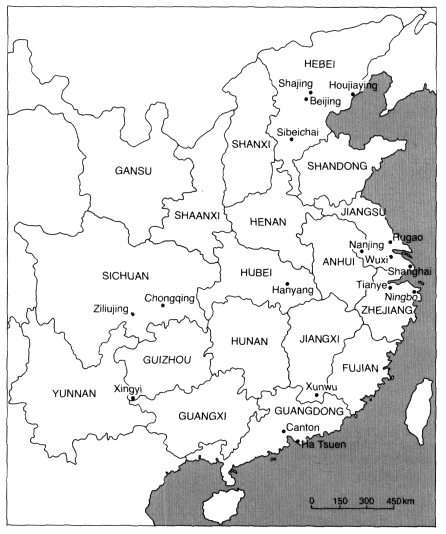
Map I. 1.
Provinces of China, Showing Locations of Studies in this Volume
SOURCE: G. William Skinner, The City in Late Imperial China (Stanford, 1977).
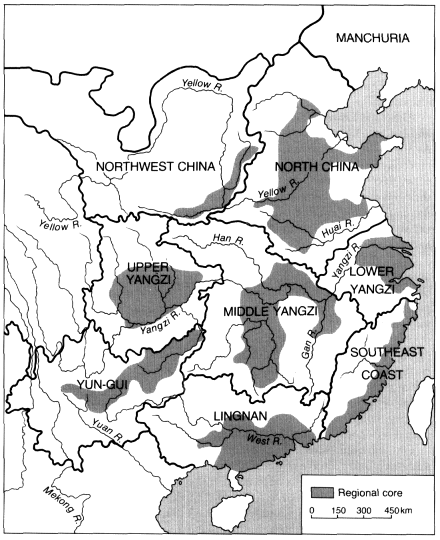
Map I.2.
Physiographic Macroregions of China
SOURCE: G. William Skinner, The City in Late Imperial China (Stanford, 1977).
such practices and institutions as marriage alliances, philanthropic activities, academies, and poetry clubs, tied the Jiangnan gentry together and set them off in ways that promoted their cultural hegemony. Lower Yangzi elite families organized lineages and established charitable estates; but lineage lands were usually limited, and lineages less defensive and boundary-conscious than in the southeast. Networks linking the gentry generally outweighed kinship units dividing them.[43]
Although Lower Yangzi elites epitomized the gentry as degree holders and cultural leaders, they also exemplified the gentry's involvement in trade. As the most commercialized region of China, the Lower Yangzi provided more mercantile resources for elites to draw upon. Because there were too many degree holders to be employed in government service, some supported themselves as teachers, scholars, and managers, but others turned to trade. As foreign trade and the rise of Shanghai as China's leading commercial city expanded opportunities in the nineteenth and twentieth century, merchants and gentry were virtually fused.[44]
With such various resources to draw upon, Lower Yangzi elites were among those least dependent on the central state even though they had the closest connections with high officials. Their autonomy grew after the Tai-ping Rebellion when the numerous bureaus and agencies through which elites took charge of repairing the destruction permitted a qualitative new expansion of civil power, and the concentration of lijin (likin) taxes in the Yangzi valley (as in the southeast) provided more funds for local elite projects and greater tax-farming opportunities than in most of northern and western China.[45] When treaty ports like Shanghai provided partial havens for political organizing, elites were well prepared to translate their autonomy into political activity, culminating in elite participation in the 1911 Revolution and continued autonomy during the Republic.[46]
On the other hand, village elites with considerable land, managerial authority, and coercive power in their localities were relatively rare in Jiang-nan, although they might be found elsewhere in the Lower Yangzi. After the Jiangnan landlords moved to towns and cities, there was less of a truly rural, community-oriented elite and few rural militia. Instead, absentee landlords acted in the villages through their agents and rent-collection bursaries supported by county governments.[47] In the southeast, rural landlords more closely tied to their local communities were more of a counterweight to county-level elites.[48]
Local Elites in the Southeast . Strong lineage organization was the most distinctive characteristic of rural society in the southeastern provinces of Guangdong, Fujian, and Taiwan, largely related to the frontier quality of these societies in the Ming and early Qing. Land had to be developed, and communities had to be defended; however, the scale of predation was small
enough for an armed community to defend itself Massive nomadic attacks and rebellions destroyed villages and scattered families in northern and western China, but the more manageable threats to rural society in the southeast reinforced the effect of hilly topography in producing cohesive and exclusive rural settlements. Complex lineage organization came later, influenced by Confucian norms and the officially sanctioned form of the ancestral estate, but it took its unique strength from the defensive need for community solidarity.[49]
Through lineage corporate property a foundation for the power of a characteristic local managerial elite was tied to kin-group constituencies. In many other ways, southeastern elites behaved much like those of the Lower Yangzi: turning to commercial ventures, following degree-holding strategies if they could move beyond the village level, and forming associations with other elites in the county seat or market towns. Foreign trade, developing from the sixteenth century onward, had more impact before the mid-nineteenth century than on any other region except Northwest China; in Fujian, it gave rise to absentee landlordism very similar to that produced by commercialization in Jiangnan.[50]
If such patterns were similar to the Lower Yangzi, the ways in which rural elites in the southeast exploited commercial resources reflected important differences as well. One of the most common methods was to exercise monopoly control and collect fees over local markets, ferries, or docks.[51] Clearly such exclusive arrangements would produce more territorial competition among elites than the commercial investments common in Jiangnan. Gentry associations frequently became "alliances" of kinship groups, rather than expressions of shared cuture and social interests.[52] Thus in the southeast, the vertical, kin-based structure of lineages seems stronger than horizontal gentry networks.
North China Elites . The unirrigated regions of North China—growing wheat, soy, corn, sorghum, and millet—were much poorer and more vulnerable to natural disasters than the rice-growing areas of the Yangzi and the southeast. Landlordism was generally undeveloped in North China, where landlords owned only about 10 percent of the land in Shandong and Hebei. When local elites did develop substantial landholdings, they tended to be in more commercially developed areas, along the southern Shandong portion of the Grand Canal or the northern littoral of the Shandong hills. There, by the nineteenth century, we see a fusion of landed and commercial wealth similar to the Lower Yangzi and southeastern patterns,[53] but in the vast regions without convenient water transport, and hence little commerce, local elites seem to have preserved more of the traditional Confucian disdain for mercantile activity.[54]
Scholars working on the North China plain have been impressed by the
weakness of the degree-holding gentry elite in predominantly rural counties. In the last half of the nineteenth century, the fifty-three counties of western Shandong produced only 413 holders of the provincial juren degree. Thus the average county, with a population of about 250,000 people, had probably five living juren . Rural counties had even fewer, and most of these men probably did not stay in places with such limited cultural and commercial resources.[55] Although there were many degree holders in North China, they were likely to concentrate in a few major cities, notably Beijing and the provincial capitals, in contrast to the wide dispersal of gentry in the towns of the Lower Yangzi.
Several consequences derive from the weakness of county-level gentry on the North China plain. First, village elites were more likely to deal directly with the local magistrate's yamen than to work through gentry intermediaries as in Jiangnan. Some of the most important rural leaders in this area were either village brokers or subbureaucratic functionaries such as lizhang or xiangbao whose task was to communicate between village and county yamen on fiscal, legal, or other public matters.[56] Second, the power of the county government was greater than in Jiangnan or the southeast. North China elites had neither a strong economic base in land and commerce nor powerful networks to confront the imperial state. As a result, the state loomed larger in the north, and access to officials was, in itself, considered a mark of elite status. Thus one village informant in twentieth-century Shandong described the "village gentry" as those "who know the county magistrate."[57] Third, the weakness of a strong degree-holding elite in precisely those poor areas especially prone to disorder weakened the checks on the nongentry village strongmen/militia leaders/bandits who emerged as governmental power declined in the late-nineteenth and twentieth centuries.
Elites in the Middle and Upper Yangzi . We know much less about Yangzi valley elites above the delta, and the chapters by Rowe and Zelin in this volume represent some of the first detailed English-language studies of the subject. Structurally, Middle Yangzi elites looked like slightly less developed versions of their Lower Yangzi counterparts; the Upper Yangzi elites of Sichuan were perhaps even one step less developed—less urbanized, less uniformly commercialized, less culturally refined, and less successful in the examinations. The Middle Yangzi differed from North China in its stronger gentry and more widespread and complex patterns of landlordism, but we do not find the same development of large corporate estates as in the southeast. There were fewer degree holders compared to Jiangnan, and local elites retained more contacts with rural communities, continuing their considerable involvement in agriculture and water control and successfully rallying peasants into militia against the Taipings.[58] However, like the Lower Yangzi elite, the elite of both the Middle and Upper Yangzi relied increasingly on mercantile wealth as well as land.
There is a likely explanation for these patterns: the rebellions at the end of the Yuan and the Ming dynasties had a particularly devastating impact on the Middle and especially the Upper Yangzi, which reverted to frontier status at the end of the Ming. These areas went through several phases of economic development during the Qing. At the beginning of the dynasty immigrants were resettling and reclaiming the land, but by its end the core cities of the Middle Yangzi were starting to rival the Lower Yangzi as centers of modern development. Considering this later timetable of development, it may be best to conceive of these elites as an earlier stage of a single Yangzi valley prototype.
Local Elites in Peripheral Zones . The regional elites that we have been describing are mostly the elites of regional cores. We must not, however, neglect the distinctions between elites in core and peripheral zones. Certain common characteristics of peripheral elites, not limited to any one region, deserve further comment.
Most obviously, peripheries tended to be more violent and disorderly. Elites were more likely to command militia units, and their coercive resources were generally greater than those of elites in the cores. Government officials, important figures in the county seat, might have virtually no leverage in the countryside. Merchants, too, often entered rural areas as unpopular outsiders controlling long-distance trade. They were vital to the local economy but were not integrated into rural society. The multiple waves of immigration and the transfer of some mercantile capital into landholding could result in complicated, multilayered tenancy systems and the development of large-scale defensive organizations like lineages.
Second, the county seat and the district magistrate appear more important to the urban-oriented segment of elite society. Both the hilly topography and the focus of trade on the export of hill products, like tea and lumber, to the economic cores discouraged the growth of numerous linked marketing centers. Indeed the county city was also likely to be the local economic center. Elites congregating there included few upper-degree holders. Without the upper degrees and connections that gave core-zone gentry access to higher bureaucratic arenas, it was more difficult to circumvent the authority of county magistrates even though local men did acquire lucrative fiscal posts in the twentieth century.[59]
Third, the evidence regarding elite continuity is particularly contradictory. The instability of the Jiangxi periphery encouraged fluid elite structures with considerable downward mobility. On the other hand, there is contrary evidence for enduring local oligarchies in the Zhejiang periphery where some elite families remained locally prominent for centuries.[60] The key variable may be the degree of social strife in an area, with more settled peripheries like Zhejiang's able to support long-entrenched elites; but the question deserves further investigation.
Frontier Elites . On the edge of Chinese society frontiers, still less socially and economically integrated with the cores, were largely beyond the reach of state power.[61] Frontier elites had to establish their positions as leaders of settlements in rough, sparsely settled societies and lead their followers against indigenous non-Han natives and competing immigrant settlers. Leaders of minority peoples had to defend against the intruders as well as other minority groups. Hence military power was the most common resource of frontier elites—shared by strongmen on Taiwan, militia leaders in Guizhou, and Muslim elites in the ethnically divided, strife-riven northwest. In this respect, frontier elites were similar to those on the periphery; but because the power of the state was still weaker, elites relied more on their own local resources, whether material like landholdings or spiritual like the inherited charisma of the Muslim menhuan elites described in Jonathan Lipman's paper at the Banff Conference.
Frontiers developed through several stages in the Qing, starting with Han immigration in the seventeenth and eighteenth century, followed by mounting conflict with the indigenous populace, growing external commercial contacts, and increasing governmental efforts to pacify and control these societies in the late eighteenth and nineteenth centuries. The northwest also experienced rebellion and government suppression in the nineteenth century, although it did not follow quite the same pattern and timetable. As a result, a process of gentrification seems to have overtaken elites on widely separated frontiers toward the end of the nineteenth century. Despite its political and military weaknesses, the Qing state in its final years was proving unusually effective on the frontier and was serving as a catalyst for cultural integration. It is ironic that just as the Confucian consensus that had long sustained the cultural hegemony of the gentry was breaking down along China's coastal core, frontier elites began to gentrify.
The diversity of Chinese local elites illustrated by the eleven studies in this volume makes it clear that the image of a static and monolithic gentry society cannot encompass the range of elites in China. It is not enough, however, just to say that Chinese local elites were diverse. In the concluding essay we will return to factors behind this diversity. What environmental factors determined the nature of local elites and the basis of their local dominance? What resources did they rely upon? What strategies did they pursue? What structures did they build to maintain and bolster their power? What new attributes did they acquire during the period studied in this volume? Were there common characteristics amidst diversity? Answering such questions within the different historical and geographical contexts in which elites acted is a necessary prelude to addressing the broader comparison of Chinese and Western elites that dominated earlier studies of the Chinese gentry.