
Tunisia and Morocco in the Pre-Protectorate Period
In 1867 Tunisia's and Morocco's displays in Paris seemed to some observers a deliberate escape from the economic and political upheavals the two countries were experiencing. Agricultural, industrial, and commercial spheres were omitted: instead, there were palaces with exuberant interiors and furniture, royal costumes, and armor—simply "everything that glitters, shines, and adorns.[63] Others noted the artistic value of the Tunisian and Moroccan pavilions. Alfred Norman claimed that they
were important not only for their size, but also for their tastefulness, their picturesque effect, and especially the brand new and charming sensation that they
arouse in us. . . . [Here was] a particular type of dwelling, where art was not excluded . . . from everyday activities.[64]
The purpose of the Tunisian pavilion was similar to that of the Egyptian selamlik and the Ottoman Pavillon du Bosphore: on his visits to the exposition, the Tunisian bey rested in the "grand palace" on the Champ de Mars (Figs. 81–82; see also Fig. 26). A duplicate of the Bardo Palace in Tunis, it was designed by the French architect Alfred Chapon. Six statues of lions framed the escaliers d'honneur, which led to a colonnaded porch and, inside, a vestibule. To the right of the vestibule was the domed "throne room" in the "purest Moorish style." The hall of the guards and the hall of the prime minister Mustafa Khaznadar were to the left. The prime minister's hall provided access to the bey's chambre d'honneur, also called Bayt al-Basha. Here, in a section separated by musharabiyya s, the Bey could hold private conferences.
At the core of the building was the patio, which gave access to the bey's private quarters—a vast room decorated in "unheard-of luxury and taste" that once again evoked The Thousand and One Nights . Brilliantly colored tiles sent from Tunisia added to the effect created by beautiful carpets and embroideries; gold-painted elements unified the space. The dazzling effects were greatest in the gilded dome. On a wall was a line from the Qur'an—"Happy is the land governed by the sadiq " (that is, "the just, the rightful")—that made a graceful pun on the name of the current bey, Muhammad al-Sadiq. On one side of the room, a stairway, hidden by a curtain, led to the harem, accessible only to the bey.
In the palace was a museum filled with Roman and Phoenician antiquities from Carthage, along with a huge café and a barbershop, accessible from the main street, that embodied two elements of Tunisian public life the exposition organizers saw as typical. The basement housed the stable.[65]
In 1878 the Tunisian pavilion was a more modest structure near the Algerian Palace. A square building with plain facades and a central courtyard with the inevitable fountain, it followed, on a much simpler level, the precedent of the 1867 palace, though its exterior was described as "grim and sad," like "all Turkish, Arabic, Moorish, and Persian buildings."[66] Inside, however, the
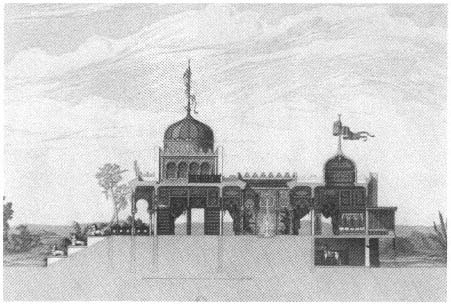
Figure 81.
Tunisian Palace of the Bey, section, Paris, 1867 (Normand L'Architecture
des nations étrangres ).
"multicolored Moorish design" was lively; ceilings were covered with rich mosaics, and the effect was altogether cheerful and picturesque.[67]
Stables and bedouin tents also played their part—in both the Tunisian displays (see Fig. 26) and the Moroccan. In 1867 in Paris, Morocco was represented by a large imperial tent and two smaller tents for guards next to the Tunisian section.[68] Nearby was a modest stable whose most striking feature was a fountain in white marble, decorated with bright tiles.[69] The pyramid-shaped tent made of camel hair reappeared in Paris in 1878, again as part of the "Oriental park." Inside, as in 1867, the tent was lined with couches covered with thick carpets; bric-a-brac, from large wooden wedding trunks to narghiles, completed the decor.[70] But now there were additions to the Moroccan compound: shops and a main pavilion, called the Moroccan villa. The villa consisted of four rooms, richly decorated and organized around a courtyard.[71] In 1889 and 1900, Morocco's pavilions, again with courtyards, had simple facades highlighted by detailed portals and square towers modeled after minarets.
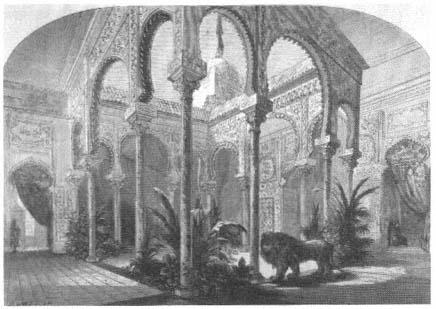
Figure 82.
Courtyard of the Tunisian palace, Paris, 1867 ( L'Exposition universelle de
1867 illustrée ).