
Chapter Two—
The Great Mexican Oil Boom
They were like the proverbial locusts. Once the news spread that the wells Potrero del Llano No. 4 and Juan Casiano No. 7 came in, the oilmen, drillers, lease-takers, and fortune seekers swarmed into Mexico. They came singly and in groups. They arrived at Tampico by boat and on the train. Encouraged by strong demand for petroleum products and prolific discoveries of oil, they continued developing Mexican production for a decade, searching the monte (tropical rain forests of the Veracruz lowlands) for oil leases and drilling wells. These foreigners worked right through the Revolution. By the end of the decade, more than 155 separate companies and 345 individual entrepreneurs and partnerships were operating in Mexico. For many, this was just another oil boom. These men had previously participated in the Ohio, Illinois, Kansas, and East Texas oil strikes. Their work had been speculative, sometimes wasteful, and occasionally rewarding in individual wealth. Then they would move on to other oil booms in Oklahoma and West Texas. When the swarm of opportunists departed, the big companies — and the Mexican oil workers — would inherit what was left.
One thing was certain: foreigners were making the oil boom as if they were operating in the United States. They operated in Spanish only when it was necessary to notarize an oil lease or hire domestic labor. Most of the time, they interpreted Mexican property laws as if they were carbon copies of U.S. statutes. They resisted Mexican interpretations and resented any meddling in their business affairs. At a time
when the federal and state authorities in the United States were tightening the regulation of business and busting the trusts, the expatriot American oilmen viewed Mexico as the new frontier of deregulation. Mexican officials could not do much about it. Perhaps the Díaz regime might have been able to staunch the breakneck speed with which the foreigners were constructing the oil industry during the great Mexican oil boom. But Díaz and his clique had been swept away by a hurricane that would not abate for ten years.
During the Revolution, those with a tenuous hold on federal power desperately needed the tax revenues provided by oil exports. All other sectors of the economy lay prostrate. Those who fought for political power, and there were many, sought to deny the federal authorities control of the oil fields. The result was a buildup of government resentment toward the freewheeling, powerful foreign interests, threats of drastic action against the oil companies, but little governmental influence on how the nation's oil business was being conducted. A booming foreign market and anemic domestic consumption of Mexican oil production gave many advantages to the foreign oilmen. They proceeded to create an Anglo-American capitalist haven out of the Huasteca.
In the popular mind, the scramble for oil leases involved cutthroat tactics, lawlessness, duping of naïve landholders by greedy foreigners, assassination of Mexican notaries, and company thugs known as guardias blancas.[1] To a degree, the era of exploration and oil boom in Mexico did have its distinctively "Wild West" character. It was a capitalistic, free-market free-for-all. But much has been exaggerated. Mainly, the foreign oilmen can be accused of attempting to Americanize a portion of Mexico. The great Mexican oil boom almost overwhelmed a country distracted by revolution. Almost.
Contracts in Very Poor Condition
One of the principal reasons contributing to the creation of an unregulated Anglo-American business world was the growth of international demand for oil and the decline of domestic Mexican demand in the second decade of the twentieth century. Heretofore used principally for illumination, crude petroleum was gaining additional versatility and demand. Oil's use in fueling railways, ships, and industries gained momentum, and oilmen pioneered the conversion of rail-
way locomotives to fuel oil, substituting for wood and coal. This conversion occurred as early as 1889 in Russia. In the 1890s, Doheny introduced petroleum to the locomotives of California.
Railway men in Mexico too converted their locomotives to fuel oils, dispensed in 10,000-gallon tanks along the rail lines, effecting savings and improving performance. With oil, the railways saved approximately 40 percent on their fuel bills. Doheny estimated that three and one-half barrels of oil, costing $2.60, accomplished the work of one ton of coal, which cost between $3.45 and $4.00.[2] Fuel oil weighed less and was more efficient. Mexico's locomotives consumed only sixty-two pounds of domestic fuel oil per kilometer compared to ninety-one pounds of imported and domestic coal. Fuel oil performed better over flat terrain. On the 189-mile Tehuantepec railway, stretching from the Atlantic port of Puerto México to the Pacific terminal of Salina Cruz, oil fuel improved the speed of the locomotive by 16 percent over coal.
Other sectors of the Mexican economy were also in the process of increasing their usage of domestically produced petroleum. El Aguila produced inexpensive fuel oil with a low flash point of 80 degrees Fahrenheit through preliminary distillation at its "topping" plants. It sold the oil for use in sugar mills, electrical light and power stations, breweries, steel works, cement works, and brick factories. Moreover, the Mexican government refitted its coastal vessels with boilers that burned petroleum.[3] However, Mexican fuel oil gained greater usage outside of the country in the second decade of the twentieth century.
Owing to its abundance and low price between 1911 and the First World War, Mexican petroleum lent itself to expanded uses in the United States and throughout Latin America. Railways and dredgers used in building the Panama Canal were equipped with oil-burning boilers. Once the interoceanic canal was opened to shipping in 1915, Doheny's tankers delivered petroleum to the Chilean nitrate and copper industries.[4] In England and the United States, industries adapted fuel oil to annealing furnaces, making nuts, and distilling zinc. Even biscuits came to be baked in petroleum-fueled ovens. The manufacturers of oil burners and furnaces multiplied, and at the end of the war, apartment buildings and homes converted their heating systems from coal to oil. Business was brisk. "We have been literally swamped with requests for our [oil-burning] installations in buildings here," reported the president of the Petroleum Heat and Power Company of New York. "Our ability to meet this demand depends upon an uninterrupted Oil supply from Mexico."[5] Markets for asphalt, for which
heavy Mexican crude petroleum was particularly appropriate, also expanded. United States refineries increased their production of Mexican asphalt from 114,000 tons in 1914 to more than 674,000 tons in 1919. In the same year, Mexican crude yielded more asphalt than did domestic American crude oil. Great Britain and Europe had few asphalt roads before World War I. But following the war, Shell's refineries in the Netherlands produced bitumen from Mexico's heavy crude oils for that purpose.[6]
The second decade of the twentieth century was one in which the world's fighting ships began to be converted from coal to fuel oil. As First Lord of the Admiralty, young Winston Churchill laid plans to provide twelve super Dreadnoughts, twelve cruisers, and forty destroyers of the British navy with oil-burning equipment. However, the British Admiralty used little Mexican oil. Its sulfur content was too high, its flash point too low, and it smoked excessively. In January of 1914, the Admiralty attempted to purchase some two hundred thousand tons per year of Mexican fuel oil. Cowdray used his very best oil to fulfill this contract, but it was not good enough. British warships ran mostly on the lighter, sulfur-free, American fuel oil.[7] Doheny too suffered from the British Admiralty's exclusion of Mexican oil. He once told a Senate hearing on the matter that he believed there existed a conspiracy between Shell and the Russian companies (before the Bolshevik Revolution) to provide for the British navy. "I went over there [to England] two years ago, at the solicitation of English capitalists, to talk about selling oil from Mexico," Doheny testified. "I found that their specifications were very ingeniously contrived by people who were selling oil from other places. The arrangement was such as to exclude Mexican oil." Doheny also harbored hostility toward the U.S. Department of the Navy for not buying Mexican fuel oil.[8] But the product was just not good enough.
Not only were navies of Europe and the United States converting their ships to fuel oil but so too were the merchant marine and well-known steamship lines. Overseas transport and passenger firms like White Star Line and Cunard Company completed the conversion before the war. Many smaller steamship lines put off converting from coal to oil-burning engines during the time of high oil prices — during World War I — but began conversion again when prices began to decline in 1919.[9] In any case, fuel oil was rapidly replacing coal.
That Mexican oil did not serve the needs of British warships did not bode ill for exports. After the war broke out in August 1914, Mexican
oil poured into U.S. markets. It formed the oil stocks for industrial usage and replaced the finer U.S. fuels being diverted to American and British warships. The New York office of Anglo-Mexican negotiated a number of sales contracts with the larger American companies such as The Texas Company, Standard Oil of New Jersey, and Gulf, which were selling their U.S. production to the British Admiralty.[10] Attempting to produce a nonodorous kerosene, chemists of El Aguila in 1920 had tried various methods of removing the sulfur from the oil. They ran the crude through lead salts and heated the product in order to decompose the sulfuretted hydrogen. It was no use. "The remaining kerosene still contained sulphur," they reported. The same was true of the fuel oil. The United States provided a total of 85.2 percent of British petroleum supplies in 1917; Mexico contributed a mere 6.3 percent.[11]
Given the expansion of markets, exports of Mexican production to the United States and other foreign destinations increased dramatically throughout the second decade of the twentieth century. Mexico provided the United States market with a mere 1 percent of its petroleum in 1911. But by 1919, Mexican oil satisfied 14 percent of a vastly expanded American consumption of petroleum products. Mexico's petroleum was shipped to refineries on the Gulf Coast and in the North Atlantic states. By the end of the decade, well over 80 percent of Mexican crude oil headed for U.S. ports. The remaining 20 percent or less of exported Mexican petroleum was destined for Latin America and Great Britain.[12]
Mexican production expanded up to 1916 because of the flush production of its major wells — only half of the story of the great Mexican oil boom. Price trends made up the other half. The heavier weight and location of Mexican production made it a part of the Gulf Coast market, where it competed and mixed with Texas, Louisiana, and (later) Oklahoma crude oils. It was priced consistently lower than the lighter Appalachian crude of Pennsylvania. The heavier Mexican crude oils were classed similarly to the heavy California crude oils. The former served Atlantic Coast markets and the latter served Pacific Coast demand. Between the discovery of Spindletop in 1901 and Potrero del Llano in 1910, oil prices in the gulf hovered around forty cents and seventy cents per barrel. Those prices rose above one dollar per barrel during the First World War, as demand rose and U.S. exploration declined. By 1919, prices stood at nearly twice their prewar levels. (See graph 1.) High prices meant that Mexico, or more precisely the foreign oil companies there, reaped profits in greater ratio than their expanded
output. Domestically, prices for bunker fuel also rose.[13] Few oil-producing nations in the twentieth century ever again would benefit, as Mexico did from 1917 to 1920, from the simultaneous rise of production and prices.
For the most part, Mexican governments permitted the export-led oil development. During the Revolution, it was the only economic bright spot and contributed to scarce public revenues. Mexico's peculiar petroleum geology, however, imposed some of its own limits on how it yielded up its treasures. Never before had oilmen encountered oil deposits in limestone formations. The gulf plain of northern Veracruz averages a width of thirty miles inland from the coast. It is bounded on the west by terraces, valleys, and the irregular foothills of the Eastern Sierras. "Scattered over the plain are characteristic cone-shaped hills which seldom rise over one hundred feet," Ralph Arnold, a Stanford geologist, reported in 1911. "These hills are made up chiefly of basalt, and play a very important role in the oil accumulation of the region, most of the oil seepages occurring at or near their bases."[14]
The Tamasopo limestone, a stratum some 3,000 to 7,000 feet thick, held the principal petroleum deposits in its uppermost reaches. The limestone began anywhere between 1,000 to 2,500 feet below the surface. It was both porous and cavernous. Located well below sea level, the limestone formations permitted relatively free circulation of both oil and water. Usually, water underlies the oil because it is denser. The mixture remained under great pressure from gas and thus both the oil and the water were quite hot. The oil pouring forth from the well head, however, reached very high temperatures, up to 149 degrees F., not because it was that temperature underground but because of the heat created by the friction of being rapidly forced through the well casing by gas pressures. Wells pinched back, purposely slowing the rate of natural flow, sufficed to lower temperatures of the crude.[15] The thicker oil would have been difficult to force through the casing had not the gas pressure heated the oil, rendering it less viscous. Once on the surface, the heavier oil cooled to the consistency of cold honey. It had to be heated artificially in order to force it through pipelines and terminal lines.
Once the oil boom was on, the lease-takers and speculators arrived in number. The East Texas boom was about over and the Mexican border provided no barrier to the speculative oilmen. To them, a boom was the same anywhere. Or at least, they would attempt to make it so. Some, like Michael A. Spellacy, were veterans of the Alaska gold rush. Others might have participated in the brief Spanish-American War;
still others had experience in the U.S. oil booms of Texas and Kansas. Spellacy arrived in Mexico in 1908 as a driller. Then he enlisted his brokers and some American financial backers in securing leases near Tuxpan and Tampico. Aided by the changes in Mexican mining laws dating from the 1880s, these pioneer lessors made oil leases with the fee-simple private-property owners. As in the United States, no government concession was necessary to start drilling. They usually paid the landowner an up-front fee, an annual rental fee, and perhaps a percentage of future production. By law, no royalties were due the government. None were offered. Mexican attorneys and U.S. lawyers who knew Spanish (William Buckley is a good example) established themselves in Tampico and specialized in perfecting oil leases. These leases usually obligated the lessee to drill within a certain amount of time and offered the lessor or landowner an annual rental, say six pesos per hectare, and a royalty, say ten centavos per barrel of oil produced.[16]
Then, the lease-makers would sell their leases to a drilling or producing company for development. The mestizo and mulatto small-holders and squatters and the Spanish hacendados of the coastal plain north of Tuxpan willingly cooperated. They operated within the American private-property system. But the Indian villagers south of Tuxpan were very suspicious of these first lease-takers. They had deep memories of being exploited by Mexicans and believed the Americans equally nefarious. Besides, they operated under corporate, village ownership of land, not individual. Therefore, lease-takers who did succeed in making a number of oil leases with these villagers had to specify that all village residents, collectively, were to receive royalties of any oil production.[17] This was not the only Mexican wrinkle in an otherwise American fabric.
The peculiarly Mexican conditions of private-property ownership in the Huasteca also created some problems to the lease-takers. Possession of isolated land was often quite informal; family lineages and inheritance records were not well maintained; and legal marriages were not generally practiced among the humble folk of the rural Huasteca. The lease "pioneers" who passed through the monte looking for prospects had to go to Tuxpan and other towns to check the civil records for proper titles. This was called "perfecting the title." Still, the possibility of competing leases and lease jumping was quite real. As one not-so-broad-minded lease-taker from Oklahoma put it: "There is no title down there that is any good because there are so many illegitimate children."[18] El Aguila attorneys, when they acquired the Horcones
hacienda, discovered that numerous branches of the Suara family had divided up ownership of the property into 1,200 shares. Between 1912 and 1920, the company's lands department acquired 1,109 and 1/36 of the shares and were still pursuing the purchase of the 90 and 35/36 remaining shares from six family members. Their information on the remaining owners was as follows: "Refugia Sanchez is the concubine of Felicitos Suara and Maria Margarita, Sinforlana, and Adela are his sisters. The heirs of Cirila are minors (6) who live with Maria Margarita, their aunt and with Donato Marquez. These shares will be very difficult to procure. The remaining 5 5/9 shares are owned by Sara Carballo y Suara whose whereabouts are unknown."[19]
Mexican landowners did not take much time in learning that they could manipulate the leasing system to their advantage. All one needed was a Mexican attorney. Soon oilmen had to tighten up the legal clauses of the leases so as to reduce the opportunities of landowners to find them in default of the lease contract. "Lic. Rodríguez [of the El Aguila legal staff] stated he has had in mind for some time recommending that all of our subsoil contracts stipulate a period within which exploration work should be commenced, in order that the land owner could not allege the contract was null and void due to our not having undertaken any exploration work during a given period."[20] Of course, El Aguila was complaining that landowners were eager to find any breach in old leases so that they could make new leases at higher rentals and royalties. They were catching on to the American system of oil boom.
These leases were to give the oilmen trouble. The complicated leases and multiple claims served as a source of conflict which the government could resolve by imposing its own regulations. Some Mexicans were motivated to "jump" a lease held by a company whose wells had already proven the property. Thus, the claimant and his backers, whether Mexicans or Americans, could drill a risk-free well.[21] Huasteca, one of the earliest entrants into the oil-leasing business, ultimately had to revise its initial nonchalance toward its leases. A competitor described their problems:
[T]he Huasteca Company, who had formerly never taken any steps to perfect their subsoil contracts but had left them in their original state and expected everybody else to respect them no matter what their legal situation might be, had lately changed their tactics and started a campaign of curing the defects. [T]hey have considerably increased their activities in that direction, having taken new and larger quarters for their legal and lands departments and having
engaged a very capable young attorney from Mexico City, who is working together with their American lawyer. Some of their contracts are in very poor condition legally, but they are working energetically and apparently now fully realize that their old policy . . . will not be sufficient to protect their interests.[22]
As the oil boom got started, leasing of oil lands became more common than buying them outright. Land in the Huasteca had been relatively inexpensive before the Dos Bocas blowout. The first oil entrants like Percy Furber, Doheny, and the Pearson interests could buy large tracts of land. Once the oil boom got under way, land prices shot skyward. Consequently, the early comers like Huasteca and El Aguila owned most of the land held in fee-simple status in the oil zones, and the perhaps four hundred other companies and individuals who arrived later leased most of the remaining hectares held by the oil interests. In 1919, the total amount of leased and owned oil lands amounted to nearly 2.7 million hectares. Seventy-five percent of the prospective oil lands were leased. A latecomer like the Tal Vez Oil Company, a name that certainly expresses the speculative character of the industry, held rights to thirty thousand acres of oil land in 1919 but owned only five thousand acres outright.[23]
Companies that arrived late to a particular oil district, however, discovered the best prospects were gone and the remaining lands cost a great deal. This was the case when El Aguila attempted to expand into the northern zone. In 1917, its agent reported that the rental and commission charges on leases around Pánuco had skyrocketed after several big wells had come in. "Practically all the land in the area . . . has been leased," they reported, "and any acquisitions we make will have to be sub-leases or transfers, and hence will cost us more than if we had gone into the field years ago."[24] Lease prices rose and fell according to the success of drilling activity nearby. "The average rental paid by the companies amounts to $1.92 per hectare [1 hectare = 2.47 acres]," one report stated, "but the rentals paid by the different companies vary greatly. One company pays as much as $4,166 per hectare, three companies pay about $2,000 per hectare, and many pay from $500 to $1,000 per hectare, while other companies pay only a nominal rental or none at all."[25] Not more than 10 percent of all these properties would ever yield any oil at all. But this was how the lease-takers made money. They effected leases with landowners and sold them for a windfall to producers. Naturally, some leases never got bought. Others went for a fortune. It was the same in Mexico as it had been in East Texas and Ohio before that and western Pennsylvania before that.
Throwing Cable Over the Derrick
Naturally, the whole object of securing leases was to drill wells that produced oil. Drilling attracted a second classical character of the industry — the oil driller. As in the United States, drilling was accomplished on several legal bases. The large firms hired North American drillers, nearly all of whom had prior experience on a monthly salary. Usually these drillers were also given opportunities to share a percentage of the production. Many drillers served as wildcatters, working purely on the speculation that a property in which they had some financial interest, or for which they worked without a wage, would yield production. This could be very risky. Most wells — probably 75 percent — were dry holes. But wildcatters might also gain great individual wealth. Much of the drilling work in Mexico, like growing carrots, was seasonal. Rigging and equipment could be moved easily only during the dry season. From June to September, the rains prevented mules, horses, and the five- and ten-ton Caterpillar tractors from hauling the equipment over the muddy roads.[26] The Mexican oil boom occupied many drillers, all foreigners. Few Mexican workers ever participated in this aspect of the business. The technology was alien to them, known only to the American or European drillers, who were loath to transfer it to any Mexican.
The drilling crews in Mexico had come down from East Texas. These Texans, Oklahomans, and Midwesterners had learned their craft from the Pennsylvanians, who had taught the oil industry to others around Beaumont and Corsicana. They behaved very much as they had in East Texas, except in coping with the enormous gas pressures of the Tamasopo limestone. That required some innovations. W.M. Hudson, who in 1906 had come to Tampico with some farmers from Llano, recognized this element of danger in Mexico. He and a partner had bought the Santa Fe Ranch, which had twenty-one kilometers of frontage on the Pánuco River at Topila Estero. Having witnessed the Dos Bocas blowout from afar, Hudson knew that the gas pressure in the limestone formation was ferocious.
Shortly after Potrero del Llano had come in, Waters-Pierce agents from the refinery at Tampico came to lease Santa Fe, forty miles upriver. As owner, Hudson was to receive 20 percent of production. "We'll agree in this contract to drill as many as three wells," the Pierce agent told Hudson. "If it's oil, we'll punch the ground full of holes."
They drilled the wells with standard percussion tools, the rig having been hauled up the Pánuco River on a barge. At two thousand feet, the sudden release of gas in the well blew the drill stem out through the derrick. A shower of rocks then followed from the well casing. Within five minutes, the rocks destroyed the timbers 110 feet atop the derrick and oil began to flow out at a rate of 17,000 bd. The manager had a dam placed across a creek below the well, and the flow of crude collected in this makeshift earthen reservoir. Hudson later inspected the rocks that had been blown out through the well. They looked like "creek boulders," round and smooth but coated with asphalt. Almost all the rocks were larger than the diameter of the pipe out of which they had passed! Hudson and two partners made about $25,000 apiece in selling their well to Pierce.[27]
When Pierce took over Santa Fe, they brought in Clinton D. Martin. Martin had dropped out of college, where he had acquired little scientific education to begin with, and entered the oil business in 1901 in Kansas. In the next twelve years, Martin worked for a pipeline company and three different refining firms. Then he came to Mexico for the Compañía Mexicana de Combustibles, Waters-Pierce's new production company. As soon as Pierce took over the Santa Fe wells, however, they all went to salt water. Martin eventually drifted out of Mexico and returned home.[28]
El Aguila had obtained some of its early drillers from the European oil fields. E.J. Nicklos learned his trade as a teenager in Galicia, a part of the Austro-Hungarian empire, in the 1890s. His father had helped build a refinery. As a young student, Nicklos broke into the business by rolling barrels around the refinery's yard. In 1907, he was hired through the auspices of the Pearson's business office in London. His crew consisted of Canadian drillers and an English bookkeeper and carpenter. They used the Canadian pole-tooled derricks, which operated on the same principle as cable tools except that the drill was suspended on iron rods instead of cables. Little scientific knowledge was involved in site selection. Dr. Orchesky, a geologist with experience in Galicia, directed the crews to drill near the oil seepages. The Pearson group set Nicklos to drilling with two rigs in Chiapas. He gathered together an eighty-man Mexican crew to drag a forty-horsepower boiler through the rain forest, hacking away the foliage with machetes as they went. Guy wires held up the smokestacks. He struck oil at five hundred feet, but it was no gusher. About 120 bd flowed gently through the ten-inch casing and slowed considerably after several days. The creek into which
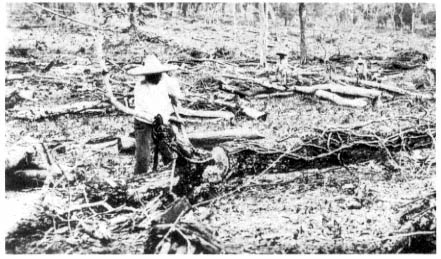
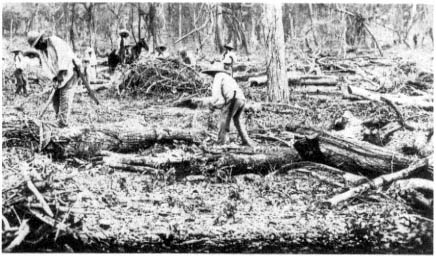
Fig. 6.
Preparation of an oil drilling site, c. 1913. Mexican workers clear the dense rain-forest
vegetation of the Golden Lane in preparation for well drilling. from the Eberstadt Photo
Collection, courtesy of the Barker Texas History Center at the University of Texas.
it flowed was dammed up, and the crude set afire so it would not seep into a nearby village. The Pearson group could not find enough crude in Chiapas to justify pipelines, storage tanks, and export terminals.
Nicklos later moved to Tampico, where he performed some drilling for the Shell Company of Corona, formed in 1912. "I got some [cable] tools together and started contracting," he reminisced. Corona gave Nicklos one-half interest in the wells that he brought in near Pánuco. There the gas pressure continued to present the drillers with problems and dangers. Nicklos recalls bringing in a well in 1920:
[A]s soon as you'd hit . . . the oil, why, the water would start coming out first and the oil was behind it. Well, as soon as the water started boiling over we'd start getting the tools out as quick as we could, but we never did get them out all the way. The last three or four hundred feet of the cable was thrown right back over the top of the derrick, then land, perhaps a hundred, two hundred feet away from the hole. But we had all of our steel and iron and everything covered up with big heavy logs or timber or planks and also the gate valves, so that if the tools did come and happen to hit then wouldn't set off a spark and . . . [start] a fire.[29]
In December of 1921, Nicklos pulled out of Mexico and deposited his considerable earnings in the Houston National Bank.[30]
These early drillers later learned to cope with the extraordinary gas pressure. During drilling, they set the heavy casings in concrete cellars with elaborate tubing configurations beneath the derrick floor. Thus, the drillers could pinch back the well almost immediately after the oil was struck.[31] When the well was flowing, the crews separated the gas from the crude oil. Huasteca's veteran geologist, Ezequiel Ordóñez, in 1932 estimated that the oil companies had vented or flared a total of one billion cubic feet of gas from the wells of Mexico during three decades of oil production. Very little gas was used beyond the energy needs of the isolated oil camps. A gas pipeline to Mexico City's urban population could have been five hundred kilometers long just to negotiate the passes of the Sierra Oriental. At one of Doheny's big wells, a tube was attached to the well head, separating the gas from the crude and shunting it to a nearby hilltop, where it was flared. The torch at this site burned continuously for ten years.[32]
Among the drillers and field personnel who worked for competing companies, there was great camaraderie. They lent each other fishing tools to get the drilling tools out of the wells. Another drilling contractor once lent Nicklos a boiler in Pánuco until another drilling rig could be shipped out from Tampico. The cooperation extended to the geologists as well. Everette DeGolyer, who had become the head geologist for El Aguila, collected extensive records of the activities of other com-
panies. He even had copies of their well logs and drilling records.[33] DeGolyer traded information with others. The fact that C. Willard Hayes and DeGolyer were employed by El Aguila did not prevent them from sharing their knowledge and experiences with geologists like Stanford University's Ralph Arnold and V.R. Garfías and others, like Mr. Cummings, who was employed by East Coast Oil.[34]
Some drillers attempted to wildcat on their own accounts. Although it remained speculative, drilling did have a certain logic. "Drilling, in practically every case, has shown that no commercially productive well has been drilled farther than 1/4 mile distant from some sort of surface evidence, such as seepages, asphalt deposits, or gas emanations," explained Arnold, "and in many instances negative results have been obtained much nearer than this to good surface indications."[35] Outside of these areas, drilling would be more or less hit or miss, usually miss. Drillers and geologists located wells by "walking or going over the country and noticing the general contour and the surface layout."[36] As yet, no one used sophisticated instruments to find oil.
The many wildcat drillers who failed did not leave a record of it. A few who did strike it rich wrote about it later. Mordelo L. Vincent told of his successful drilling at Tepetate in 1914. There he and a partner had discovered an important oil field, but the blowout had forced the casing back up through part of the derrick and a plume of oil and gas roared out. Vincent's inexperienced crew fought unsuccessfully for days to place a valve on the runaway well. Finally, an agent for Gulf Oil arrived. "I know the spot you are in," he told the partners, "and I know you can trade if you want to. Gulf Oil is prepared to give you one million smackers for this lease, plus 33 1/3 royalty, and we will move our experienced crews in here, plug this wild bastard, and drill another well right beside it." "Shake hands with a millionaire," replied Vincent.[37] Some of these oilmen, like Vincent and Nicklos, left Mexico wealthy and others, penniless. Yet, together they developed the Mexican oil industry during the great boom much as they and their peers had accomplished in Pennsylvania, Ohio, Illinois, California, Texas, and Oklahoma.
Along the coastal plain from Chiapas to the Pánuco River, these men set down more than seven hundred oil wells during the great Mexican oil boom. One-half of those wells produced crude petroleum in commercial quantities.[38] Despite the large number of producing wells, Mexico's major production was really taken from a small number of prolific wells. They had been drilled to depths of between 1,700 and 3,000 feet, at which point the men would stop if the well flowed to salt
water or nothing at all. The producing wells were allowed to flow of their own pressure, without pumping. In 1914, for example, most producing wells were yielding from 15 to 200 bd. Every company relied upon one or two great wells. El Aguila had Potrero del Llano No. 4, which ran 37,000 bd; and Alazán No. 4, yielding 17,000 bd. Huasteca had Juan Casiano No. 7, flowing at 12,000 bd.[39] Wildcat drillers working speculatively on their own accounts merely rounded out production. They were hoping to drill a well that could be sold to the bigger companies or to find that one "gusher," against all odds, that would make them a big company. It had been the same in U.S. oil booms.
A Few Hundred Meters Distant
The drill bits of innumerable rigs ultimately delineated three distinct zones of Mexico's oil fields. Each zone had definitive geographic boundaries, yielded distinctive crude oils, and presented different problems and possibilities of exploitation. At the northern extremity of the coastal oil region lay the so-called northern fields. Doheny's El Ebano in the state of San Luis Potosí had been the cornerstone of this zone. But between 1910 and 1920, other foreign interests challenged Huasteca's supremacy here and opened up production on both sides of the Pánuco River, centering on the town of Pánuco and the district of Topila. An independent firm named the East Coast Oil Company, apparently connected to the Southern Pacific Railroad, opened up production on the Pánuco River in 1911. Its crude oil was identical in density and asphaltic content to that of El Ebano. Soon, other companies started production in the northern zone, but problems of transport (the oil was too thick to pipe), quality (it was expensive to refine), and leases (the area had small producers) combined to retard the full development of the Pánuco-Topila fields.[40] Once shorn of its ties to Standard Oil, the Waters-Pierce interests moved upstream, as the saying goes. From its refinery at Tampico, it developed modest producing properties along the Pánuco River. The Royal Dutch/Shell established its new Mexican subsidiary, La Corona, in the producing fields near the town of Pánuco. The Texas Company of Mexico, Gulf, and eventually Standard Oil would also secure important leases in the northern fields. Only El Aguila among the large firms would have no presence at all in the north.
One characteristic of production tended to make the northern fields distinctive. The crude petroleum found here was very heavy and viscous, yielding abundant tars and asphalt but little kerosene and gasoline. At El Ebano, the oil averaged about 12 degrees Baumé, a standard measure of specific gravity. The lower the specific gravity, the thicker and heavier was the oil. Pánuco and Topila crude measured from 10 to 15 degrees Baumé. These heavier oils had to undergo a rudimentary refining called topping before being converted into fuel oil. In general, the wells flowed more slowly here. One also found few pipelines in the northern fields. Only the East Coast Oil Company and La Corona had pipelines, but they were not lengthy, the longest covering the twenty-four miles from the east coast wells to the Pánuco River. The oil had to be heated before it would flow properly. Two pumping stations were also needed to push it through the pipe. Most crude petroleum in the northern fields was transported to tank farms, refineries, and export terminals at Tampico aboard river barges. Five of the larger producing companies had Mississippi stern-wheelers to carry the barges down to Tampico. By 1914, three independent barge companies had also been established to carry the crude from Pánuco to Tampico.[41] Generally, the lower returns on oil exploration and refining rendered the northern fields somewhat less attractive than those oil lands near Tuxpan to the south. In the 1920s, however, the north would remain the foundation of the Mexican oil industry after the more prolific and productive wells in the south became exhausted.
Still, the northern fields west of Tampico shared one characteristic of the fields farther south — portions of the production came from leases on small-holdings. The valley of the Pánuco River had become an important agricultural zone before the oil boom. In the absence of Indian-village agriculture, the campesinos had divided up the land into modest family-sized holdings. In the areas of Pánuco and Topila especially, the lease-takers had made individual leases with the numerous landholders and then resold them to competing drilling and producing companies. Few big companies, therefore, held contiguous leases and none of the oil reservoirs were developed on the unitary system, at least during the oil boom. If one wildcatter successfully brought in a big well on his small lease, the discovery would set off a scramble to secure the small leaseholds next door. Competitors then drilled offset wells before the first rig could drain the entire reservoir. Along the river, many separate interests had competing wells in close proximity to each other. Agents of El Aguila acquired two leases in the Pánuco area in
1917. Both properties were less than ten hectares. "Across the river and only a few hundred meters distant [from our leasehold]," reported the agents, "is a six thousand barrel well, controlled by the Cia de Petroleo de `La Universal,' S.A., and close to that well the Penn-Mex. Fuel Co. are [sic ] now drilling."[42] The only thing that prevented the early exhaustion of the northern fields, many of which are still producing today, was the nearly intractable consistency of the crude here. The heavy oil simply refused to come out of the ground quickly and easily.
Only in the more arid cattle lands north of the river could the oilmen buy and lease land in large quantities. Thus, Doheny was able to purchase just two ranches to make up the large El Ebano field. Yet the larger haciendas like the San José de Rusias and others that lay in the southern part of the state of Tamaulipas were not as productive as the smaller holdings in the basin of the Pánuco River.
The southern fields, which came to be known as the Faja de Oro, the Golden Lane, lay west of Tuxpan and shared only a few similarities with the northern fields. Here one also found production on larger haciendas, although, as in the north, several farming districts in which offset drilling proliferated could be found within the Golden Lane. But the differences were much more important. The crude oil of the southern fields was lighter; impressive single- and double-looped pipelines stretched across the tropical landscape; few river barges plied the smaller Tuxpan River; exploration here was positively frenzied; and oil field exhaustion came sooner.
The firstcomers like Furber, Doheny, and Cowdray had already secured fee-simple title and leases on the larger properties when the oil boom began in 1911. At the southern extremity of the Faja de Oro, about forty miles southwest of Tuxpan, Furber owned the large property to which he gave his name, Furbero. He acquired additional large haciendas next door, most notably the property of Trapani, a factor that was to loom large beginning in the late 1920s. Its oil was the lightest and most valuable of the Faja de Oro, measuring 24 degrees Baumé. During the great Mexican oil boom, however, Furbero's wells were not very productive. Doheny, of course, had secured title to the Cerro Azul and Juan Casiano haciendas. The Pearson interests of Cowdray owned Potrero del Llano and had leases on several larger cattle haciendas, like Tierra Amarilla of the Peláez family. Of course, their companies, La Huasteca and El Aguila, were locked in a legal dispute over competing leases on the hacienda property of Cerro Viejo. Production continued anyway.
Still, there existed areas in which small-scale farming had predominated before the oil boom and where lease taking, well drilling, and production were much more competitive — even frenzied. Tanhuijo, Los Naranjos, Amatlán, Tepetate, and Chinampa were farming areas. Here the independent wildcatters, smaller producing companies, and late-arriving larger companies gained entry into the Mexican oil boom. The Texas Company, Gulf, and eventually Jersey Standard established important wells in this region. Lesser-known firms like the Penn-Mex also got their start here. Eventually many of the smaller firms either exhausted their wells or sold out to the bigger companies. Yet during the period of rising oil prices, from 1915 to 1920, these smaller interests engaged in a dash for leases. Oil strikes flashed across the landscape like lightning, gaining instant recognition and majesty, then fading quickly. Independent wildcatters and company drilling teams moved first to Chinampa, then to Los Naranjos. They produced oil prolifically, like the tropical rainstorm, from closely placed wells, leaving the ground exhausted, then moving on to the next site. The strike at Amatlán in 1919 and 1920 culminated the boom. There the big companies, even Jersey Standard, had encouraged their drilling crews to share in the flush production. They worked overtime. On the smaller holdings, each well owner felt pressured to empty the common reservoirs of crude oil before his competitor next door. Conservation was impossible. Exhaustion was inevitable, especially given the property of the oil here in the southern fields.
It was not called the Golden Lane for nothing. The oil of the southern fields was light, valuable, and flowed quickly. When it burst from the well at Dos Bocas, the oil had a temperature of 165 degrees F., compared to 105 degrees F. for El Ebano's heavier crude. The gas and water pressures in the southern fields were considerable. Engineers measured it at 285 pounds per square inch in the Casiano well and 850 pounds per square inch at Potrero del Llano. Its specific gravity measured 19 to 22 degrees Baumé, the oil yielding about 12 percent illuminants and 20 percent gasoline with the refining technology of the day. It also produced good lubricants. Topped off, that is, after a preliminary distillation, the crude could be used for fuel oil.[43] The latter was the growth product.
The lighter, more viscous crude of the southern fields also lent itself to being transported from well to refinery via pipeline. Huasteca had three major pipelines. The longest one, covering sixty-five miles, went from Juan Casiano to Tampico, and two smaller ones connected the
eight miles between Cerro Azul and Juan Casiano. El Aguila also had numerous eight-inch pipelines, two hundred miles of pipe in all, connecting Potrero del Llano east to the Tuxpan bar, Potrero north through Tanhuijo to Tampico, and Los Naranjos to Tuxpan. Mexican Gulf laid a sixty-two-mile, eight-inch pipeline from Tepetate to Tampico. The Cortez, the Texas Company, and Island Oil built smaller pipelines from the Tepetate-Chinampa oil fields to Port Lobos, a small oil terminal and topping complex at the southern end of the Tamiahua Lagoon.
Port Lobos and Tuxpan, however, did not develop into important oil refining complexes. Neither had good deep-water ports; nor did they have existing rail connections to the Mexican markets of the highlands. Port Lobos and Tuxpan had pipelines hoisted into floating loading hatches stretching two miles offshore, where steam tankers could load crude petroleum in bulk. The crude was then refined elsewhere. El Aguila sent Potrero crude to be refined at Minatitlán, while North American companies transported the crude to refineries on the Gulf and Atlantic coasts of the United States. The propensity of the Golden Lane crude to be transported on pipeline motivated the larger companies to continue the development of the oil region's major deep-water port, Tampico, as the principal Mexican refining center. Tampico surpassed Minatitlán as a refining town and Puerto México as Mexico's bustling oil terminal. In 1918, Tampico was exporting more than 5.3 million tons of petroleum; Tuxpan and Port Lobos, 2.6 million tons; and Puerto México, 149,600 tons of mostly reexported oil. Coastal barge and steam transportation served to transport equipment and personnel; few of the inland waterways of the Tamiahua Lagoon ever had as much traffic of oil barges as one found on the Pánuco River.[44] Oil moved exclusively in pipelines there.
The third zone of oil production was the Tehuantepec-Tabasco-Chiapas coastal lowlands, known merely as the isthmus. Isthmian crude was the highest quality of all (25 to 32 degrees Baumé), had a paraffin base, contained less sulfur, and yielded larger proportions of illuminating oil. Its deposits lay very close to the surface, sometimes at only 150 feet. El Aguila was the most active company to work here, and its leases and fee-simple properties were held in large haciendas, not on small-holdings, which were not found here in great numbers. The environment and petroleum would have been conducive to a large company's great success, and in fact, a large company, El Aguila, had been here since 1901. It built a refinery at Minatitlán and a railway and port
terminal at Puerto México. The only problem was, El Aguila never could drill a gusher on the isthmus. Those wells that did produce abundantly soon tapered off and sooner or later were capped. Their leased properties there might have been the oilman's dream. They were huge. El Aguila's option on the hacienda belonging to José Yves Limantour, then in a Parisian exile, covered ten thousand hectares. El Aguila might have developed this property over a long period of time, unmolested by offset wells of competitors. But it had no oil at all. "[T]he Limantour [property] has no desirability as a subsoil lease," reported El Aguila's agent.[45]
As export prices climbed to unprecedented heights, oil exploration proceeded not only in the three principal zones of production but elsewhere as well. Successes were hardly notable. Seven British capitalists had obtained the oil rights to more than one hundred thousand acres near Saltillo. Some U.S. interests were attempting to secure permits to drill on lands south of the Río Bravo (Rio Grande), on the opposite side of the border from some Texas oil fields. Farther west, on the Pacific Coast, Japanese, American, British, and Dutch agents were investigating oil-bearing lands near Ensenada and also in Sonora. Nothing worthy of drilling was found.[46] American prospectors were attracted to the southern parts of the Mexican Gulf Coast by El Aguila's abandonment of exploration there. An oil field explorer reported on oil seepages in the lowlands of Oaxaca, Chiapas, and Tabasco. "The San Andres — Tuxtla section is especially promising," he stated.[47] The explorer was wrong. American entrepreneurs were planning to bring drilling equipment to a site fifteen miles west of Hecelchakan, Campeche, where they had discovered evidence of petroleum and asphalt deposits. One drilling team also sank a well to three thousand feet near Progreso, Yucatán, before they abandoned it. On the opposite side of the isthmus, following the war, German entrepreneurs had returned to prospect for oil near Pochutla, Oaxaca.[48] Crude was not discovered in sufficient quantity, however.
During the great Mexican oil boom, the characteristics of the southern fields near Tuxpan encouraged foreign oilmen to develop them more rapidly than either the northern or the isthmian zones. The value of the product, the rapid rate of flow, and the ease of transport motivated a burgeoning rise in production of the oil fields of this zone. By 1921, more than three-quarters of Mexican production came from the southern fields, a fifth from the northern fields, and the remainder from the disappointingly impoverished fields of the isthmus (see tables 3 and
| |||||||||||||||||||||||||||||||||||||||||||||||||||||||||||||||||||||||||||||||||||||||||||||
4). El Aguila's ambitious refinery at Minatitlán processed more crude from Potrero than the nearby Tehuantepec fields, and its new terminal at Puerto México served almost exclusively to funnel in Potrero crude and funnel out the products refined from this crude.
| ||||||||||||||||||||||||||||||||||||||||||||||||||||||||||||||||||||||||||||||||||||||||||||||||||||||||||||||||||||||||
Wading in Oil up to the Knees
It is not known exactly how many different companies and oil interests came to operate in Mexico during the great oil boom, but they were numerous. Much depends upon what is counted: leaseholders, drilling and production, or exporting. One source mentioned
that 400 companies owned Mexican oil rights in 1916, 75 percent of which were American. A second source places the number of companies drilling wells in 1919 at 155. "Of the total investments in the oil industry of Mexico," the U.S. Department of Commerce reported in 1920, "97 percent is held by foreigners. . . . Of the total of 63,828,326 barrels produced in Mexico in 1918, the American interests produced 73 percent, British 21 percent, Holland 4 percent, and Spanish Mexican 2 percent."[49]
These companies came in all varieties, all shapes. Lord Cowdray's El Aguila company was not the only British oil interest in Mexico. In 1916, the Foreign Office compiled a list of twenty-three other companies, whose capitalizations ranged from £ 100 (for the Mexican Selected Oil Estates, Ltd.) to $1 million (for the Tuxpam Oil Company). Other lists abound with the names of individuals and small companies. By the end of the boom, most big U.S. companies had at least some representation in Mexico. The Texas Company, Sinclair, Gulf, and Standard Oil of New Jersey existed alongside the big producers like Huasteca and El Aguila, the host of small firms like the Cortez Oil Corporation and Lot Seventeen Oil Company, and individuals like Charles Rathbone and Mr. Carrie Yates.[50] Given the high prices during the First World War, small companies could get started by virtue of one or two good wells. The Port Lobos Petroleum Company (an oil transport company) and Cortez Oil Corporation (a producer) together owned one hundred thousand acres of leaseholds in 1916 but had only two wells. In 1917, The Texas Company was completing construction of its refinery at Tampico. The Gulf group of Pittsburgh began exploration in 1913. Mexico was to remain this company's only source of foreign crude supplies until it entered Venezuela in 1925.[51] Naturally, the competition among so many interests was bound to be keen. In 1912, The Texas Company had applied to Mexico's Chamber of Deputies for a pipeline concession to carry crude oil from Tampico to Texas refineries. Apparently, the Doheny interests fought the measure, successfully raising the specter of the Standard Oil trust, for whose benefit the pipeline was attributed.[52] The important companies in Mexico were not transporters nor refiners, but producers of oil.
Several medium-sized firms also began operations in Mexico by combining capital, experience, and contacts from numerous U.S. sources. The Penn-Mex Fuel Company is a fitting example. Its founders, J.C. Trees and M.L. Benedum, had once contributed critical financial support to Doheny but fell out with the owner of Mexican Pe-
troleum and Huasteca. They made a considerable profit when they sold their stock in "Mexican Pete" and decided to reenter Mexico on their own account. From Pittsburgh, they sent John Leonard and Eddie Gilmore, both Pennsylvanians with experience in the oil industry, to look over the Alamo Hacienda twenty miles west of Tuxpan. Wined and dined by the Núñez family, Leonard and Gilmore eventually secured options from them for their twenty-thousand-acre estate. Benedum traveled up the Tuxpan River and liked what he saw at Alamo. "You could see oil everywhere," he said later. "There were places where you could have waded in it up to your knees."[53] The partners of Benedum and Trees put up the $450,000 to exercise their options.
Back in Pittsburgh, Benedum and Trees organized a new corporation, the Penn-Mex Fuel Company, in 1913. They secured the backing of Pennsylvania oilmen and financiers and buyers in Jersey Standard. As soon as the Pennsylvania drillers brought in the oil at Alamo, the Penn-Mex became plagued by the same difficulty experienced by the other independent producers, Doheny and Cowdray: the need for capital. Penn-Mex constructed a pipeline to the Gulf Coast. They also built a railway, wharfs, warehouse, roads, and camps to support the entire operation. But the cost was beyond the means of Benedum and Trees. Just as the prices began to rise in 1916, therefore, Benedum and Trees sold out. They were never sure, but they suspected that the buyers had acted for the South Penn Company of Pennsylvania.[54] They were correct. But they also thought that the South Penn belonged to Standard Oil Company of New Jersey. That was wrong: it was then part of Socony, Standard Oil New York, but Jersey Standard would eventually absorb it.
Nonetheless, despite the rapid rise of Penn-Mex and other one- and two-well firms, the Doheny and Cowdray interests remained very much the leaders of the Mexican petroleum industry. Their success, of course, attracted many companies to challenge the near monopoly on oil production they had enjoyed in 1911. Other companies were drilling more oil wells in 1920 than were El Aguila and Huasteca.[55] Other companies also combined to wrest some 50 percent of production from the early arriving Doheny and Cowdray interests (see table 5). Yet, Huasteca and El Aguila were the largest and most important enterprises.
The flurry of activity sufficed to elevate Mexico, by war's end, to the second largest producer of petroleum in the world. It had surpassed Russia, whose oil production in the Baku had suffered from war, revolution, and Bolshevist expropriation. The United States remained the
| ||||||||||||||||||||||||||||||||||||||||||||||||||||||||||
premier oil producer, responsible for more than two-thirds of the world's production. In 1919, Mexico produced nearly 16 percent of the world's oil, a dramatic increase during the war years, according to these figures (in millions of barrels) on the world's leading producers:[56]
|
(Table continued on next page)
(Table continued from previous page)
|
The oil boom was one of the few growth industries during the Mexican Revolution. Tax collections on the production of Mexican petroleum, and after 1921 on its export as well, came to be the mainstay revenue producer of the fragile governments of revolutionary Mexico. Under the circumstances, the domestic authorities did not ignore the formation of a most American-like industry in Mexico, but there was little they could do about it. In the meanwhile, the oil boom fostered the growth of some large foreign interests.
A Great Flow of Gas
The combined properties of Edward L. Doheny, the Mexican Petroleum Company in the northern fields, and Huasteca in the southern fields came to form the largest single oil interest developed during the great Mexican oil boom. Doheny's men in 1901 had brought in the first Mexican production at El Ebano, and in September 1910, they drilled the fabulous Juan Casiano No. 7 in the Golden Lane, which became the mainstay of the Huasteca company for nine years following its discovery. It would eventually yield a total of between eighty and eighty-five million barrels of crude, one of the single most productive wells in the world — after Potrero del Llano No. 4.[57] Based upon Casiano's initial production of 100,000 bd, Huasteca completed the pipeline to Tampico, made important sales contracts, began construction of a refinery at Tampico, and expanded its tanker fleet. It even supported the first efforts of Doheny to create a refining and marketing network of his own along the Gulf and East coasts of the United States. In appreciation, Doheny named his private yacht the Casiano.
Nonetheless, Doheny's lease-takers and drillers were not idle during the frenzied period of Mexico's oil development. They continued to explore and keep up with the competition in both the northern and the southern fields. Doheny did not speculate as heavily in the smaller leaseholds of the Pánuco, Tepetate, and Alazán districts. As one of the
early arrivals, he relied on developing the larger haciendas that he had purchased or leased in the final days of the Porfiriato. By 1911, the Doheny companies had acquired more than six hundred thousand acres of land, 85 percent of which was held in fee simple. They already had under contract haciendas that would later serve as new oil fields, such as Juan Felipe, Cerro Viejo, Chapopote Núñez, Zacamixtle, and Chinampa. But its properties in the northern fields were showing signs of anemia.[58] Salt water was showing already at El Ebano. No Doheny drilling crew ever ventured into the isthmus, which was El Aguila's domain, nor into other areas of exploration. Doheny's exploration concentrated now on the southern fields for one reason: Casiano crude yielded higher profits than did El Ebano crude. Geologist Ralph Arnold calculated that the heavier crude, more expensive to bring up and transport, made a profit of only five cents per barrel when sold at Tampico, while the lighter and easier to transport Casiano crude made Doheny's companies a profit of forty-one cents per barrel. As his field manager stated, "Topping Casiano oil you would get about 13% gasoline; from Ebano or Panuco oil, you would get 3 or 4%."[59]
Although Doheny was inclined to belittle the contributions of geologists, they nonetheless had helped him to establish a working geological model of oil exploration. Doheny had hired Stanford geologist Ralph Arnold and the former West Virginia state geologist I.C. White. Moreover, the most renowned Mexican geologist of the period, Ezequiel Ordóñez, had been an employee of the Mexican Petroleum Company since 1903. Ordóñez was instrumental in distinguishing between the oil exudes that indicated large underground accumulations of oil and those seepages that indicated isolated dissipations.[60]
Doheny, Ordóñez, and other Huasteca employees developed a hypothesis. The size of the surface oil pool was not crucial, nor did a bubbling oil seepage indicate that a sizeable oil deposit lay directly beneath. They concluded instead that the oil had collected in the underground crevices and caverns formed by old volcanic explosions that forced basaltic plugs up through the sedimentary strata. Therefore, the exudes found in areas of contact between basaltic plugs and the limestone were the most important indicators of oil. This was the case when Doheny's crews, advised by Ordóñez, had brought in production at the base of the Cerro de la Pez at El Ebano in 1903. Such low-lying hills were also found at the Huasteca properties of El Chapopote, Juan Felipe, Cerro Viejo, and Cerro Azul. The drillers would sink the wells on the largest fracture radiating outward from the plug.[61] This was the geological
theory that brought drilling crews to the hacienda of Cerro Azul in 1916.
As Doheny's Casiano well had made his company one of Mexico's largest, the Cerro Azul discovery would catapult his organization into one of international importance. Doheny had acquired the property of Cerro Azul, known for its numerous oil pools, as early as 1906. Huasteca delayed the development of this solid prospect. After the Juan Casiano discovery, other necessities intervened: the pipeline, market contracts, storage facilities, and the refinery. In addition, work crews built a narrow-gauge railway from San Jerónimo, a small port on the Tamiahua waterways, to Cerro Azul and numerous roads in order to transport equipment to the property. The first two perforations at Cerro Azul were begun in 1914. The third well, completed in 1915, yielded a continuous but minor flow of oil. Crews then sank Cerro Azul No. 4 "in the middle of a small esplanade," Ordóñez explained, "partly surrounded by hills, that is to say, a situation similar to that of the Casiano wells."[62]
Like many of the wells of the Faja de Oro, Cerro Azul No. 4 had "drilled itself in." Once the cable tools had struck through to a pocket of gas, the rush of gas out through the well casing tended to deepen the well to the level of crude oil.[63] The first emission of gas on the night of 10 February 1916 blew out the drilling equipment. It destroyed the derrick in the classic fashion of Mexican gushers. After seven hours, the transparent gas turned to black crude oil. The well ran wild for nine days. By that time, the well was exploding at the rate of 260,000 barrels per day, throwing a jet of crude oil three hundred meters straight up. When they finally placed a valve over the well and shunted its crude into a pipeline, the well head maintained a pressure of 1,035 pounds per square inch.[64] Such wells as the Cerro Azul did not need to be pumped. On the first day, the well flowed unchecked at 152,000 bd and by the fifth day, it was flowing at 160,858 bd.
News of the Cerro Azul discovery spread rapidly among competing foreign oilmen. J.B. Body reported to Lord Cowdray that the gas noise could be heard at El Aguila's Naranjos camp nearby.[65] Cerro Azul No. 4 made oil history for being the most productive shallow well ever. Its depth was 1,792 feet, or 1,351 feet below sea level in the nearby Gulf of Mexico. Its total production to 1932 had been eighty million barrels.[66] Cerro Azul No. 4 elevated Doheny into the position of largest producer and exporter of oil during the great Mexican oil boom. His company now surpassed Cowdray's El Aguila by a large
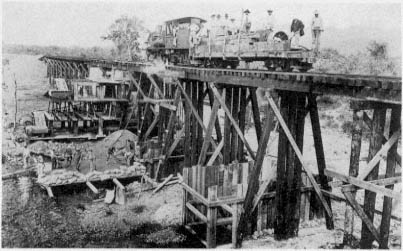
Fig. 7.
Bridge building near Cerro Azul. the Huasteca Petroleum Company
constructed a narrow-gauge railway to its new oil fields in the Golden Lane
in order to deliver equipment and supplies to its oil camps. Here, Mexican
laborers and their American supervisors complete the pilings of a railway trestle
over an arroyo. from the Eberstadt Photo Collection, courtesy of the Barker
Texas History Center at the University of Texas.
margin. But he also suffered the problems of flush production: how to transport the oil to market and how to sell it. To solve these problems, Doheny had to expand his operations outward from Mexico until he had created a multinational business enterprise.
The nightmare of every independent producer was to have discovered enormous quantities of crude petroleum with no means for transporting it to buyers — and then having no buyers. Doheny's discovery of Juan Casiano No. 7, followed within four years by Cerro Azul No. 4, placed Doheny in such a dilemma. He sold asphaltum and fuel oil in Mexico and also exported asphalt. But, being a Californian oilman, he had few outlets in the eastern United States. Nor, in September 1910, did he have the financial resources to rapidly develop the kind of infrastructure needed to transport the oil to tidewater and deliver it to refineries in the Gulf and Atlantic states. Therefore, his first phase of expansion entailed a simultaneous and desperate search for customers and capital necessary to build transport and storage. The second phase of expansion, commencing with the discovery of the Cerro Azul well,
propelled him into the development of his own refining and retail networks in the United States.
The first phase of expansion found Doheny quite successful in completing the pipeline from Juan Casiano to Tampico and in finding buyers. He secured the capital from a combination of independent Pennsylvania oil speculators and from a New York investment bank, William Salomon and Company. Apparently, the sum amounted to $12 million from Salomon.[67] The pipeline was completed in 1911. A terminal station and tank farm was constructed at Mata Redonda, on the southern bank of the Pánuco River opposite Tampico. Tank steamers anchored just three hundred feet from the nearest storage tank, one of thirty-five at the terminal's tank farm. The company owned twenty-two other large (55,000-barrel capacity) steel tanks elsewhere and numerous smaller storage facilities. On any one day in 1911, the company might have more than 2.5 million barrels of oil in storage, including earthen reservoirs. On the Pánuco River, Doheny operated three oil barges, a river steamer, and two steel freight barges. The latter would become increasingly important to deliver imported equipment from Tampico.[68] By 1917, nine tankers with a capacity of 60,450 tons were in the Pan American fleet, even though the United States had commandeered five and Great Britain one for wartime service. The English-made tankers (or "tank steamers," as they were sometimes called) were carrying crude oil from the Huasteca terminal at Tampico to U.S. ports from Texas to Massachusetts. His work gangs were also building the roads and rail lines through the Huasteca lowlands from Tuxpan to Tampico.[69] Although he borrowed capital to construct, quite rapidly, an impressive transportation infrastructure, Doheny still depended upon the big U.S. — based refining and marketing companies to buy his crude oil.
The Mexican market for petroleum came into crisis beginning in 1911. The fall of the Díaz government and the outbreak of revolutionary violence from Chihuahua to Morelos eroded Doheny's established markets for petroleum products. Mines shut down, railway tracks were breached, trains destroyed, and street paving stopped. Mexican Petroleum Company had had a contract with the Mexican Central Railway since 1905, since assumed by the National Railways, to buy 16,000 bd of fuel oil for a period of fifteen years. In order to compete on the domestic market with El Aguila, Waters-Pierce had stopped importing crude oil. It concluded a contract to take 2.5 million barrels of Huasteca's lightest crude oil from 1911 to 1915 for its Tampico refinery.[70]
Once the Revolution struck, the National Railways took less than half of what it had contracted to buy from Doheny. Even so, it was seldom able to pay cash for it. The Huerta government in 1914 and then Carranza in 1916 paid for fuel oil by giving Mexican Petroleum, and El Aguila too, certain tax credits instead of cash. The cessation of street paving motivated Doheny's men to carry on this business elsewhere. Harold Walker was in San Salvador in 1912 in order to make a bid for the paving of the streets of that Central American city.[71] None of these activities helped Doheny sell his new production.
For that, he turned to the large refining and marketing companies that dominated the U.S. oil market, especially Standard Oil of New Jersey. This must have involved some swallowing of pride for an independent oilman. Curiously, the new alliance between Doheny and Standard Oil now set Doheny against the interests of Jersey's former associate, Henry Clay Pierce. Early in 1911, E.L. Doheny had met with Jersey Standard's H.C. Folger, Jr., at 26 Broadway, New York. Standard Oil and Huasteca agreed to a five-year contract by which several of Jersey's refineries would purchase a total of two million barrels of oil per year from Mexico. Best of all, Jersey paid in advance, much to the relief of the Doheny organization.[72] For its part, Jersey Standard's move to deal directly with a producer of Mexican crude oil was its strategic reaction to the 1911 Supreme Court dissolution. In that decision, Standard Oil New Jersey, a refining and marketing giant, was separated from nearly all of its producing subsidiaries. Standard New York, Ohio, Indiana, and California were broken off, forming separate entities from Jersey. The Supreme Court also separated Standard from Waters-Pierce. Thereafter, Jersey Standard was free to develop refining and marketing in the Lower Mississippi Valley and Texas, previously part of the Waters-Pierce territory. Jersey was also free to move into Mexico.
Soon, tankers owned by Jersey Standard began delivering stocks of crude oil to the refineries of its new affiliate in Corsicana and Beaumont, the Magnolia Petroleum Company. What Mexican production Magnolia could not absorb, Magnolia sold off to other refineries and marketing companies from Texas to Missouri. Apparently, the contract enabled Doheny to draw on a $400,000 loan from the U.S. marketing company that Doheny used to develop his infrastructure in Mexico. The entrance of the Magnolia Company into the Texas market provided a very direct assault on the monopoly that Pierce had enjoyed in selling Standard Oil brands exclusively. Armed with inexpensive
Mexican crude oils acquired from the Huasteca Company, Magnolia's refineries began putting out Standard-brand gasolines, naphthas, and kerosenes at reduced prices. Magnolia's sales agents then began to undersell Pierce's products by as much as 20 percent. Pierce complained bitterly.[73] All this was, of course, of no concern to Doheny. He needed to sell a great deal of petroleum, and the Standard contract allowed him to do just that.
Rights of Citizenship and Accumulation
No sooner had Doheny settled into these arrangements than the Cerro Azul gusher brought additional marketing problems and strained all of Huasteca's new transportation facilities. From that moment onward, Doheny began to build his own refining and marketing facilities at ports along the coast from Louisiana to New England. This second phase of expansion lasted from 1916 to 1921. Doheny created a holding firm, the Pan American Petroleum and Transport Company, incorporated in Delaware. Pan Am came to hold the stock of the Mexican producing subsidiaries, Huasteca and Mexican Petroleum, as well as his California oil fields and the plethora of new facilities on the Gulf and Atlantic coasts of the United States. Pan Am established distribution depots in Portland, Maine, Boston, Providence, Fall River, New York, Baltimore, Norfolk, Jacksonville, Tampa, New Orleans, and Galveston. It built a 25,000-bd refinery at Destrehan, Louisiana. Abroad, the new Doheny interests established additional depots in the Canal Zone, Pará, Pernambuco, Bahia, Rio de Janeiro, Santos, Montevideo, and Buenos Aires. In Great Britain, Pan Am opened up distribution centers in Southampton, Liverpool, Avonmouth, South Shields, and Glasgow. Bunker and fuel oils continued to be the principal products sold at these points. The opening of the Panama Canal in 1914 permitted the Mexican oil, for the first time, to be sold on the west coast of South America. Doheny in 1917 was selling crude to Union Oil of California and to Chilean mining companies. Despite some problems with sea transport during the war, Pan Am came to own thirty-one tankers, amounting to 272,493 total tonnage, by 1921. It chartered many others. As the third decade of the twentieth century began, Doheny's companies had the capacity of selling some twenty million barrels of oil per year.[74] Moreover, it was attempting to wean
itself from dependence upon the large U.S. marketing firms like Jersey Standard.
The rapid expansion also created a need to expand Doheny's refining capacity. Beginning in September of 1916, Huasteca laid plans to convert its Tampico topping plant into a larger and more sophisticated refinery. While its capacity to produce fuel oil was expanded, stills and equipment to manufacture kerosene, gasoline, and lubricants were also installed. Within a month, Huasteca received the government permits. The contract stipulated that the company was to obey Mexican laws, permit government inspections, and provide certain services and benefits for refinery workers.[75] By the end of the decade, the Tampico refinery had the capacity to refine 140,000 bd.
Pan Am appeared to maintain a solid profitability during the great Mexican oil boom. Its sales — and dividends — mounted. By 1918, sales revenues rose to $17 million, and net profit to nearly $5 million. In 1920, its total assets were $103 million.[76] By any measure, Pan American Petroleum was becoming a successful multinational company.
The expansion of his oil enterprise motivated Doheny to promote his experienced employees and bring in new officials. His old partner from the Los Angeles oil rush, C.A. Canfield, remained as a vice-president but died in 1919. Herbert Wylie, who opened up production at El Ebano and in 1910 directed the Mexican operations from Tampico, moved to New York as general manager of Pan American Petroleum. Wylie had accomplished much in Mexico without ever having learned Spanish at all.[77] Harold Walker left his duties as manager of the paving operations in Mexico to assume the vice-presidency of Pan Am with responsibility for public relations. Walker soon became Doheny's political alter-ego.
New men soon rose within Doheny's Mexican operations. Capt. William H. Green in 1916 took over as general manager of Huasteca at Tampico and had charge of oil fields and refineries of both Mexican "Pete" and Huasteca. Green knew Spanish, having served with the U.S. Constabulary in the Philippines.[78] Weighing 250 pounds, Green was an imposing, dominating figure. He dealt with Mexican labor disputes and with local Mexican officials. José López Portillo y Weber, a young technician for the government petroleum office in Tampico in 1919 (and father of a future president), did not like Captain Green. He thought that Green, who could speak Spanish quite fluently, purposely maintained a strong English accent, because "he was convinced of the efficacy of humor to attract sympathy."[79] Green was also considered a
Yankee jingoist, believing the Americans were great and the Mexicans were lucky to be so close to such greatness.
In Mexico City, Hilarión Branch became the chief political trouble-shooter and public affairs official of the Doheny interests. Born to British citizenship in the Antilles, he lived for many years in Mexico, learning to speak Spanish grammatically and elegantly. He had polish where most American oilmen were somewhat coarse. Branch studied Mexican law and became an abogado. "He knew and understood us [Mexicans] very well," said López Portillo of Branch.[80] Branch's job was to deal with the diverse functionaries of the government. Mexican officials appreciated foreigners like Branch more than those like Green.
The whole of the Pan Am organization bore the imprint of Doheny. An optimistic and driven man, of rigid puritanical character, Edward L. Doheny did not easily accept criticism. It was rumored that his first wife, who died, was an alcoholic, and he suffered no one to drink or smoke in his presence. Together with his second wife, Estelle, Doheny became a great philanthropist and patron of the Catholic Church in Los Angeles. His Mexican geologist, Ezequiel Ordóñez, described the personal traits that led to executive success:
Two things were characteristic in the active business life of Doheny. The first was a slow and almost completely discussed resolution, but once taken, indeed, he had to carry it out promptly and decidedly. The second was that he was not a creator of great ideas. The primordial idea of a thing had to come from outside, from others, but once placed in his mind, he could develop and calculate its consequences with astonishing precision.[81]
Nevertheless, the successful, self-made American oilman in Mexico also had an Achilles' heel, a fatal flaw that was soon to mar his career and leave him a retired recluse who would die a vilified and embittered man. Doheny began to feel he was superior. Against those who opposed him, crossed him, or questioned him, Doheny could be a tireless fighter. "He could spend entire hours speaking about only one negotiation, trying always to dominate his listeners," observed Ordóñez. "Generally, he did not admit objections to his conversations and in the best epoch of his work, if someone dared contradict him, he would start to shout, pound his fists, his eyes irritated and his face reddened."[82] His arrogance and his growing profile during the war led him on a collision course in the political arena. What he saw as President Woodrow Wilson's bumbling responses to the Mexican Revolution and his wrongheaded domestic oil policies soon converted his political sympathies from the Democratic to the Republican party.
As the scion of an immigrant, working-class Irish family, Doheny had always been a Democrat. He gave money to Democratic candidates and to the Wilson campaign. But as a westerner and businessman, he came to resent the conservationist attitude of the East Coast Democratic establishment. He soon became an outspoken witness in Congressional hearings. In 1917, he appeared before the Senate Committee on Public Lands and clashed with the administration over its decision to withdraw the naval oil reserves at Elk Hills, California, and Teapot Dome, Nevada, from private exploitation. Doheny also objected to the U.S. Navy's refusal to burn high-sulfur Mexican bunker oil in its warships. Questioned about the excessive smoking of Mexican oil, Doheny retorted that various senators were intimating "that I lied about it."[83] Josephus Daniels, the secretary of the navy, spoke against exploiting U.S. naval oil reserves. "We would prefer to buy the oil, all that we can get, from foreign countries, if we can, and hold our own supply as long as possible," he told the Senate panel.[84] Doheny held a grudge upon which he would act later, becoming involved in the Teapot Dome scandals. Daniels later was to serve as U.S. ambassador and witness the Mexican oil expropriation. Needless to say, Daniels would not be known as a friend of American oilmen in Mexico.
The next year, 1918, Doheny returned to Capitol Hill to protest wartime policies of the U.S. Shipping Board. Pan American Oil representative, attorney Frederick R. Kellogg, claimed that the government had commandeered five Pan Am oil transports from the company's Tampico run. He asked for 100 percent compensation for the loss of the ships and not merely payment for the use of these ships. The argument stressed that Pan Am tankers were not carrying Huasteca's product to war but transporting the oil from competitors on the East Coast to France. The competition, not Pan Am, was therefore reaping the profits from the government's shipping policy.[85] Doheny's own testimony to the Senate committee seemed both condescending and whining. When war was declared, he said, he had offered all his ships and five million barrels of Mexican oil to President Wilson. Instead the government "commandeered" five of his vessels and paid him a charter fee amounting to $3.65 per ton for moving the petroleum of other companies. His companies could have been earning $16 per ton if those ships carried Mexican oil. Clearly, Doheny was forming the opinion that the Wilson administration was persecuting him. As the largest producer of oil in Mexico, if not the world, Doheny said he deserved better.
The world's greatest oilman continued this kind of political action during the remainder of the Wilson administration. Doheny commissioned a special panel of scholars to study Mexico and propose to the government a more appropriate U.S. policy toward the Mexican Revolution. The Doheny Research Foundation, featuring the investigative research of some fifteen prominent American academicians, may have been one of the first conservative think-tanks in U.S. politics. He also commissioned newspaper attacks against U.S. policies, and he supported one book, The Mexican Problem, by Clarence W. Barron. Among that book's profoundest convictions are the following:
The redemption of Mexico must be from the invasion of business, forcing upon the natives — the good people of Mexico — technical training, higher wages, bank accounts, financial independence, and the rights of citizenship and accumulation.[86]
The opinion reflected Doheny's ideas perfectly.
The Senate's investigation of U.S.-Mexican relations, however, was Doheny's most prominent public forum to express a policy alternative that was to be known as the "interventionist" lobby. Doheny's old friend from his prospecting days in New Mexico, now senator, Albert B. Fall, was an influential member of that committee. Moreover, Fall had become the Republican party's chief critic of the administration's Mexican policy. When the Senate began its hearings on Mexico in 1919, Doheny served as the first witness. Two giant wells in Mexico and a new marketing presence on the East Coast of the United States had taken Edward L. Doheny so far that he felt justified in influencing U.S. policy toward Mexico.
Selling the Surplus Oil
The second great oil producer in Mexico, El Aguila, shared several similarities and some differences with the combined Huasteca and Mexican Petroleum companies. During the last years of the Porfiriato, El Aguila had gained an early lead in production by combining political favoritism from the Porfirian regime with the early purchase and leasing of oil lands. After some frustrations exploring in the Isthmus of Tehuantepec, Sir Weetman Pearson's crews brought in the biggest Mexican oil well of all. Potrero del Llano No. 4 formed the
basis of all subsequent development. But unlike Doheny's companies, El Aguila did not bring in a second great oil well during the great Mexican oil boom; nor did it ever enter into production in the heavy crude of the northern fields. Thus, it was destined to lose its lead to Doheny's Huasteca in the 1910s.
As a major independent producer, El Aguila confronted the same problem as the Doheny group: it suffered from having insufficient marketing of its own. The Pearson group survived by selling large quantities of oil to refining and marketing companies in the United States and Great Britain and developing its own marketing apparatus in South America and England. Nonetheless, El Aguila never shook its market vulnerability. The reason: as a British company, El Aguila was much more inhibited by the ravages of war, because of capital shortages and transportation interruptions, than its American competitors. A closer relationship to a sympathetic British government did not assuage Lord Cowdray's feeling of vulnerability. In fact, the home government would not aid this British entrepreneur in Mexico. And so, in the end, El Aguila became the first of the large Mexican independent oil firms to merge with a giant international oil company.
Having acquired most of its oil properties before the rush of the lease-takers, El Aguila did not have to scramble for the marginal and risky oil prospects. It could have been quite expensive for El Aguila. Landowners and other lease-takers inflated their prices when dealing with the wealthy El Aguila. Much the same thing happened to El Aguila when it sought to construct pipelines. The property owners, whether Mexican or foreign, had to be given "substantial personal interests" to assign the rights-of-way. Many landowners would hold up the negotiations with El Aguila's Mexican lawyers in order to get more from the company. Mexican landowners were not stupid. They knew how to defend themselves and, according to the oilmen, to make "exorbitant claims."[87]
Often, El Aguila had to acquire additional oil lands in order to protect existing wells. In the midst of the lease-taking frenzy, geologist Everette DeGolyer purchased shares of the Horcones hacienda for El Aguila in order to protect the nearby Potrero wells. El Aguila also dealt in oil leases, subletting and selling its leases of doubtful prospects to other companies.[88] Keeping track of its oil leases and payments of royalties and rental fees occupied a team of company lawyers. The company in June 1912 inadvertently neglected to pay a certain Sánchez his monthly royalty on a lease in Tanhuijo. Sánchez immediately declared
the leasehold null and void because of El Aguila's breach of contract. Embarrassed attorneys rushed to confer with Sánchez, who refused at first to renew the lease to El Aguila, which already had two producing wells there and was drilling another. Sánchez was now free to sell the proven property to the highest bidder. Eventually, he signed a new lease with El Aguila — for a much larger royalty.[89] Mexican landowners were learning how to deal with the big companies.
As in the United States, lease and contract disputes in Mexico often embroiled the big companies in complicated litigations. El Aguila was no exception. The American independent oilman Ralph Culliman in 1912 assigned to El Aguila the lease for Lot 113, Amatlán. Immediately, El Aguila's acquired rights were set upon by what it called "parasitical speculators," who searched for imperfections in titles in order to sell contested rights to competing companies. Lots with clouded titles that yielded oil were especially attractive. Although El Aguila's lawyers had investigated the title with the Chinampa public notary when they purchased the lease, the company was later sued for royalties by a competing leaseholder. Although the Mexican Supreme Court eventually upheld El Aguila, the company in the meanwhile had to support a staff of Mexican attorneys to fight the suit.[90]
The greatest legal contest over a valuable leasehold concerned two big companies. Both El Aguila and Huasteca had acquired leases dating from 1909 for the same prolific property, the Cerro Viejo hacienda. Huasteca had moved its drilling crews onto the property first, in 1912. El Aguila's J.B. Body asked for an injunction against Huasteca. Yet, the legal department moved slowly. It took Licenciados Blas Rodríguez and Peláez five months to obtain a Supreme Court injunction against Huasteca. By that time, Doheny's company had brought in production on the estate and refused to leave.[91] Once the war broke out, the Foreign Office wanted to resolve the dispute amicably and offered to reconcile the two companies. In Washington, Sir Cecil Spring Rice, who shared an Irish heritage with Doheny, opened negotiations. Sir Cecil and Doheny got on famously, but the latter and his staff proved less forthcoming to El Aguila's representatives. El Aguila proposed to share production from Cerro Viejo on a fifty-fifty basis. But "[Doheny] was not willing to make any transaction with us," Body reported.[92]
When litigation over Cerro Viejo entered its eleventh year in 1917, Huasteca was taking approximately 60,000 bd from the seventeen-thousand-acre property. All things being equal, Doheny would have profited by prolonging the litigation. But all things were not equal. By
1918, regulatory pressure by the Mexican government of President Venustiano Carranza forced Doheny to make concessions with a business competitor in order to form a united front of foreign companies. Huasteca finally gave in. It created a new company, giving El Aguila a half share, in order to exploit Cerro Viejo production from that point onwards. But Huasteca kept everything it had gained since 1912.[93] Such leasing problems, hardly absent in U.S. oil development, added a measure of instability to Mexican oil development. Although theoretically falling within the jurisdiction of Mexican courts, such lease disputes nonetheless involved foreign diplomats. Their resolution was as apt to be hammered out in Washington, D.C., and London as in Mexico City.
In exploration and production, El Aguila lived off its early entrance into Mexico. The British company exploited some new fields but never discovered another well as significant as its Potrero No. 4, which had made El Aguila strong in the southern fields. In a way, the company became victimized by its early entrance too. El Aguila continued on a fruitless quest for production in the disappointing isthmian area and neglected, or nearly so, the northern fields. In 1913, the managers were shocked that its old rival, Waters-Pierce, had brought in a 50,000-bd well at Topila, on which they had commented unfavorably.[94] Instead, El Aguila expended much effort on the isthmus, where it remained the monopoly foreign concern and where it had (perhaps unwisely) completed its first refinery in 1906. DeGolyer and other geologists were working in 1916 to locate additional drilling rigs even though its old wells there were showing signs of decline. In the Faja de Oro, El Aguila accountants calculated that their net profits amounted to 6.4 million gold pesos, but in the isthmian fields, a mere 134,000 gold pesos.[95] The company finally decided to hold its isthmus properties without wasting more money on their development.
El Aguila remained the second largest producer in Mexico because of its work in the southern fields. The first order of business was to protect its most prolific well, Potrero No. 4. (By 1930, this one well had produced more than 115 million barrels of crude oil, more than several Texas oil fields combined.)[96] Recognizing the potential damage by fire, the managers first sought to make the great well fireproof. In 1914, lightning actually struck Potrero No. 4, setting the well head ablaze. Before workers could build up an earthen embankment around the fire and fill it with quenching water, the conflagration consumed a million barrels of crude oil and melted the valve casings. In reviving the well, El Aguila's crews encased the new well head in a mountain of concrete
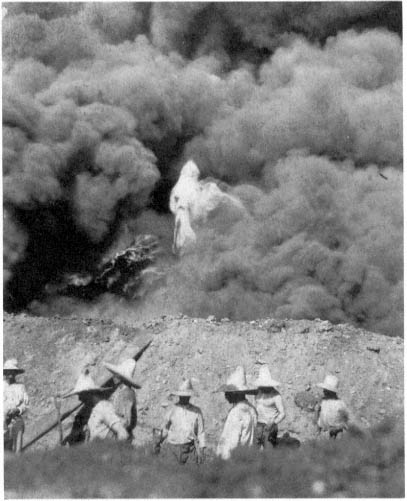
Fig. 8.
Putting out an oil fire. Workers construct an earthen wall around this minor
blowout — which still produced a thick, acrid smoke — in a flow line from one
of El Aguila's wells. Then the roaring torch was smothered by filling the temporary
reservoir with water and mud. Major well fires, like that of Potrero del Llano
No. 4 in 1914, were extinguished in the same fashion. Courtesy of the
DeGolyer Library of Southern Methodist University.
and pipes. The hollow cavity of the concrete mound was filled with water during thunderstorms. Thereafter, the men reduced the risk of fire to all the wells. They cleared and burned off the monte (tropical vegetation) around each well and earthen reservoirs, covered over the seep-
ages, and sunk flare pipes into fissures in the ground that leaked dangerous gases.[97]
Meanwhile, El Aguila spent its remaining energies holding off the competition in the southern fields. In 1912, the company had moved its oil rigs into Alazán, where they had brought in Alazán No. 4, flowing at 1,200 bd. They were also sinking numerous wells at the hacienda of Tierra Amarilla, belonging to the family of its attorney, Peláez, although production here never met expectations. By 1914, the company had expanded into the area of Amatlán and Naranjos, buying leases and studying the geology.[98] The major interest of competitors had shifted to Tepetate in 1917. Therefore, the British firm suspended its drilling activities at Naranjos to work on its Tepetate leases. The Vincent well at Tepetate had just come in at 12,000 bd, and The Texas Company immediately began drilling an offset well on a nearby lot, not more than one hundred meters away. "So many companies are drilling around us at Tepetate," said J.B. Body, "and we must take steps at the earliest possible moment to secure our share of this pool."[99]
When El Aguila opened up the first well in the Los Naranjos field, it could not pause even to congratulate itself. The field manager fully expected competitors like Mexican-Sinclair, Agwi, Mexican Gulf, International, and Union Oil Company to begin drilling on their small leaseholds. Consequently, El Aguila was motivated to open the well heads on small leaseholds in the Los Naranjos district and allow them to flow at maximum capacity. "I think Mr. DeGolyer's arguments in favour of our selling as much crude as we can get out, in excess of the requirements of our own Refineries, are entirely sound," reported the general field manager at Tampico. "As I see it the whole thing comes down to this: whether we shall take out this surplus oil, selling it as crude and making a good profit on it, or whether we shall let our competitors do so."[100] The answer was obvious to the capitalist businessman: produce as much as possible before it was too late.
Movement of drilling crews was not accomplished easily in the dense tropical rain forests of the Faja de Oro. One American driller described what it was like:
Of all the plain damned misery we had [moving to a new drilling site]! We moved everything; I don't mean we just picked us up a tent and a skillet and some little things like that and set out for a weekend camping trip; no sir! We packed every damned thing we'd need to drill a well — boilers, wrenches, picks and shovels, pipe, casing, rope, steel, timbers for the rig floor, tin for the boiler house and the belt house, everything — and packed 'em on burros. . . . We had a string of 'em several miles long. . . . There was more'n two thousand
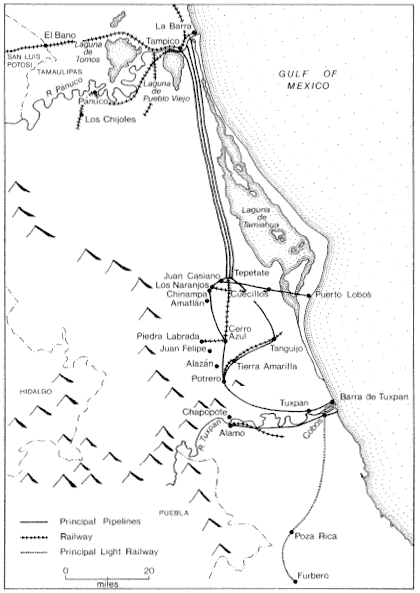
Map 2.
the Northern Veracruz Oil Zone, c. 1920
Mexicans — teamsters, roughnecks, roustabouts, hands for the picks and shovels, and some of them that was not supposed to work but just come along for the hell of it.[101]
Even at the height of the boom, there were harbingers of things to come. Drillers were always aware that in the prolific southern fields, where the sweetest crude and highest gas pressures were found, the oil reservoirs were located one thousand to two thousand feet below sea level. Many "dry holes" did not get their name because no liquids at all came up out of the well casing. Most wells yielded gas and salt water. Approximately one-half yielded commercial quantities of crude petroleum. Only a few wells, however, lasted more than one to two years. The best geologists, Everette DeGolyer for example, who knew the southern fields as well as anyone, understood that salt water underlay the petroleum deposits of the Potrero and other wells. "Mr. De" (as he came to be known) and his geologists would turn out scientific treatises on "A New Cretaceous Rudistid from the San Felipe Formation of Mexico" or "Notes on Lithology and Paleontology of the Sedimentary Formation of Eastern Mexico."[102] DeGolyer met regularly with paleontologists and geologists at academic meetings in the United States and reported on his Mexican work. The business managers of El Aguila, especially J.B. Body, were furious. They were afraid the geologists were giving away trade secrets; but Body gave in to these scientific inquiries when El Aguila's entire geology department threatened to resign en masse.[103] As early as 1916, DeGolyer warned of rising temperatures of the crude oil. High temperatures, he said, usually signified the approach of the underlying salt water. He suggested that production be pinched back at such wells, in order to preserve the underground oil reservoirs.[104]
In 1918, salt water invasion first began to appear in the previously productive wells at Alazán. El Aguila's men also perceived that the exhaustion of the wells at Tepetate had resulted from the competitive offsetting. Still, production here had been beyond expectations. However briefly the Alazán and Tepetate wells had flowed, they had nevertheless filled the earthen storage pools with more than 400,000 barrels of crude. The Potrero well had also created a giant lake with 2,500,000 barrels of crude before the pipelines had been connected. This reservoir would wait for a decade to be used.[105]
There was also another portent, this one fortuitous for El Aguila and for Mexico. Since 1908, the Pearson interests had been purchasing crude from the Oil Fields of Mexico properties of Percy N. Furber. In
June of 1914, Furber offered to sell his properties, and El Aguila acquired 51 percent of Oil Fields of Mexico stock. It was El Aguila's last effort at expansion before the war broke out.[106] Having acquired such a large oil property did not mean that El Aguila would strike out in a pell-mell effort to develop it. Its policy had always been to develop the smallest properties first. "Having been able to select from the pick of the petroleum lands before its competitors were in existence," its prospectus bragged in 1921, "the Mexican Eagle is reserving for later development the large zone where it is the sole owner."[107] And what a deal: the combined properties of the Oil Fields of Mexico had included the old Trapani hacienda, site of the future Poza Rica oil field.[108] The most immediate problem remained how to get rid of the oil already drawn from the ground. For this, the company with very large production needed to develop transportation, refining, and storage capacity.
No Discrimination Against Best Customers
Once the pipelines linked the Potrero field to Tampico in 1911, El Aguila thereafter worked to integrate the other wells of the southern fields into the system. Discoveries in new fields like Alazán, Naranjos, and Tepetate necessitated the laying of trunk lines feeding into the main pipeline. When Naranjos came in, crews rushed to connect it to the main pipeline with four "Prescott" pumps, a pumphouse, and a double eight-inch line running to Potrero, thirty-four kilometers away.[109] El Aguila's legal department acquired the rights-of-way from local landowners. Often, the pipeline would pass through a property owned by a rival company. Huasteca and El Aguila had a reciprocal agreement to allow the passage of each other's pipelines. But Huasteca officials always seemed to be "unavailable" when El Aguila wished to complete an auxiliary pipeline in a hurry. Finally, in 1913, El Aguila returned the petty vexation by obstructing the passage of a Huasteca pipeline through one of its properties.[110]
Like its rival, the Huasteca, the British company bought land at the river ports of Tampico and Tuxpan to build wooden and steel storage tanks and loading wharves. By 1914, the company had a total storage capacity in steel tankage of two million barrels. Such storage was essential, because the lighter and more valuable ends of the crude quickly
evaporated in open earthen storage, reducing the remainder to a mass of thick tar.[111] At Tuxpan, where it already had an offshore loading terminal of pipelines laid out into the surf, El Aguila constructed a new topping plant. The Tuxpan plant would never be a great success. Technical problems forced its shutdown in 1917, and inspections by the new Mexican Petroleum Office delayed repairs and alterations. Finally, the replacement furnace failed to heat the crude petroleum properly for primary distillation.[112]
El Aguila had greater refining advantages in the isthmus. The Pearson interests had already developed deep-water port facilities at Puerto México when they constructed the Tehuantepec Railway. The Minatitlán refinery, completed in 1906, had a daily capacity of 1,400 tons of crude. But even the Mexican oil it refined was imported, so to speak. It came not via pipeline from nearby isthmian oil fields but via tankers from Tuxpan, three hundred miles up the coast. The refined products had to be exported again through Puerto México even to Mexican markets. For these reasons, the management never invested much to improve the Minatitlán refinery during the great boom. General manager Body reported in 1916 that he "was disappointed to find that the Refinery Plant had not been kept up to the high state of maintenance that it had been formerly."[113] Once again, fire stalked the isthmian facilities. The Minatitlán refinery, which had suffered severe damage in the 1908 blaze, suffered a second major fire in 1916. The asphalt loading wharf and a barreling shed were destroyed. Five months later, a third fire broke out at the tank farm in nearby Puerto México.[114]
El Aguila's greatest manufacturing achievement was neither its maiden refinery at Minatitlán nor its ne'er-do-well topping plant at Tuxpan. The Tampico refinery, begun in 1912, was the greatest of all Mexican refineries. When it came on line in 1914, the Tampico refinery could run four thousand tons of crude per day. Built in Doña Cecilia, the industrial park between Tampico and the mouth of the Pánuco River, the Tampico refinery underwent nearly constant alteration and improvement. The facility manufactured a full range of products, such as lubricants, waxes, coke, and kerosene. The Tampico refinery was the pride of El Aguila. "The success of our Refineries should be such," Lord Cowdray ordered, "as will compare most favourably with any up to date Refinery controlled by the [Standard Oil] Co. or any other existing Refinery."[115] Still, the war interrupted refining developments too. Prices of imported machinery rose throughout the war, and finding technical personnel became difficult. The management constantly
sought draft exemptions to retain its best British personnel. The war with Germany also brought into question the continued status of Dr. Weinstein, the German-born refinery manager. Cowdray had to use his influence at the Foreign Office to get permission for Weinstein to stay on. Indeed, Weinstein did remain with the company to supervise in 1920 the expansion of the Tampico refinery, involving expenditures of several million pounds.[116] Indeed, the El Aguila refinery at Tampico, the biggest in Mexico, became the most advanced, state-of-the-art oil facility in all the land. It would also become the center of labor militancy.
Ultimately, El Aguila the great producer also had to develop its capacity to transport petroleum to foreign markets. It recognized that a sizeable fleet of its own steam tankers would increase profits and enable the producing company to sell at the best prices in New York and London. El Aguila in 1911 spun off a separate shipping company, the Eagle Oil Transport Company, Ltd., and purchased its first tanker, the nine-thousand-ton San Dunstano. Quickly, the transport firm ordered the construction of other, and larger, steam transports. The San Fraterno came on line in 1912.[117] It was 548 feet long and had a total dead weight capacity of 15,700 tons of oil stored in twelve holds. Steam heating coils were installed in the holds to facilitate discharge at the rate of 1,200 tons per hour. These tankers ran on their own cargoes. On sailings to Great Britain, they consumed 13 percent of their fuel oil cargo. Cowdray's organization calculated that each of its ships made profits of between £23 and £76 per day.[118] By 1914, the company had seven tankers in operation and more on order in British shipyards. Cowdray was hoping soon to have twenty tank steamers carrying Mexican oil to Europe and South America.
The war interrupted all plans. Shipyards cancelled Cowdray's orders in order to build warships for the Admiralty. In addition, the Admiralty took over four of the tankers of Eagle Oil Transport for wartime duty, for which the company received a rental fee.[119] Just as Doheny had complained of his sacrifices for America's war efforts, Cowdray also chafed under Britain's draconian wartime measures. His company's activities in Mexico suffered because the Admiralty did not assign the commandeered ships to move Mexican oil. Feeling unfairly treated, Cowdray made proposals to increase the sales of his Mexican oil to the Admiralty in return for the use of one of his tankers. No deal. British naval commanders did not like the smoke. The German submarine campaign in the North Atlantic also took its toll. The company re-
ported that all four commandeered El Aguila tankers had been torpedoed and sunk in 1917.[120] No American competitor in Mexico had suffered from the war as did El Aguila.
The battle for the Mexican market between El Aguila and Waters-Pierce did not end when the former began exporting. Pierce continued to plant news stories in Mexican newspapers about how cozy the Pearson group had been with the Díaz administration. Indeed, El Aguila still retained its directors from the Porfirian clique, Enrique Creel and Guillermo de Landa y Escandón. Lord Cowdray corresponded with José Yves Limantour, who had retired in Paris. The Pearson group in Mexico continued raiding the Pierce organization for personnel.[121] El Aguila still retained some advantages of low prices over Waters-Pierce's imported products. But now Waters-Pierce was buying domestic production from Huasteca and also got into production, especially in the northern fields. Its small refinery at Vera Cruz was running Mexican crude to the still.[122]
Be that as it may, El Aguila sought a formal market agreement with Waters-Pierce. Cowdray preferred a fifty-fifty market share on each item, except for fuel oil, which was El Aguila's strength. In this way, Cowdray hoped that the low prices might be lifted somewhat, in order to improve marketing profits. He knew that both companies were suffering from defaulted domestic accounts. During the Revolution, the Mexican economy had been so disrupted that rail lines and mining companies owed Waters-Pierce about one million pesos and Pearson, approximately six hundred thousand pesos. Many accounts were described as "absolutely bankrupt."[123] Finally, the two old enemies reached a satisfactory market agreement. The fight was over. The news articles condemning the Pearson interests stopped appearing, and prices were raised on gasoline.[124] El Aguila's problems, in any case, had shifted from domestic to international markets.
The tendency to raise prices in Mexico in concert with world price trends during the war was also tempered somewhat by the competition and by Mexican nationalism. Also, many El Aguila subagents had been guilty of selling El Aguila products at higher than scheduled prices, cutting down on sales. In 1914, price hikes engendered domestic protest, and the company became somewhat circumspect about raising domestic prices too high. "I am afraid it would be detrimental to our interests to increase the price of our products," general manager Body decided, even though they still remained below import costs.[125] Under the circumstances, the company was making its profits in foreign
markets now. In 1912, Cowdray reported that the new export trade was making approximately £2 million a year, while his domestic Mexican trade was garnering only £120,000.[126] The great oil boom had, quite suddenly, diminished the importance of the domestic market for the existence of the Mexican-based companies.
As it developed its refining and transporting capacities, El Aguila also had to build a world marketing organization. This was a paradoxical period in El Aguila's existence. The Mexican-based production company worked feverishly to make itself independent of the large marketing firms like Standard Oil Company of New Jersey. At the same time, however, it depended on Jersey Standard to buy its surplus crude oil. Cowdray himself had traveled to New York to arrange the sale of his crude oil to the big American companies. He negotiated secretly with Jersey Standard — and The Texas Company too — with a view to organizing his entire Mexican operations under one international company. In effect, he was offering to sell shares of his holdings to the Americans. After all, they had the markets — Cowdray only had oil. In 1911, Jersey's president, John Archbold, informed Cowdray that the company would soon be disassociating itself from Henry Clay Pierce and would be in a position then to deal with him.[127]
Ultimately, Jersey Standard declined purchase into El Aguila, but it did bail out the company by buying its crude. In 1912, Jersey concluded a five-year contract in which it promised to purchase a total of ten billion barrels of oil. To El Aguila, the contract was a lifesaver. Jersey Standard was not merely being magnanimous; it had been separated from its American production companies by the Supreme Court in 1911 and needed to find oil supplies to keep its marketing contracts filled. Using its own tankers, Jersey Standard obtained El Aguila's crude at preferential prices of fifteen cents to thirty cents (f.o.b. Tampico) for its refineries in Galveston, Sabine, Baton Rouge, New Orleans, Tampa, Baltimore, Philadelphia, and New York.[128] The price was well below Gulf Coast benchmark prices.
Yet El Aguila executives did not complain. Instead, they raised hosannahs. The agreement functioned well until 1914, when Standard Oil lost some of its shipping fleet to the government. After having taken 3.9 million barrels of El Aguila crude, Standard Oil technically had to breach the contract.[129] But during the war, Standard was still buying from El Aguila, albeit at higher prices, thirty-seven cents to forty cents per barrel, f.o.b. Tampico. Hoping to effect some wartime savings, Cowdray once suggested separating the highest quality crude
oil from its deliveries to Standard Oil at Tampico and Tuxpan. General Manager Body dissuaded him. "It is not considered that it would be good policy," Body wrote diplomatically, "to discriminate in such a way against our best customer." In the end, Cowdray had to concur. The Jersey Standard sales agreements had been crucial to the company's survival. "[I]f we had given the oil away," said Cowdray, "we could not have disposed of any greater quantities than we have sold [to Jersey Standard]."[130]
However, the Jersey Standard contracts came with a catch — or perhaps with an uneven exchange. El Aguila agreed not to develop a marketing organization in the United States, and Standard Oil accepted El Aguila's market encroachment in South America. These agreements were not at all contractual ("We have an unwritten understanding with regard to trade in South America," said Cowdray in 1912 after attending a New York banquet given in his honor by John D. Rockefeller, Jr.), but they were nonetheless effective.[131] Unlike the Doheny interests, which expanded into marketing in the United States, the business interests of Lord Cowdray expanded elsewhere. The Standard Oil contract had prevented El Aguila from direct participation in the more lucrative U.S. market.
Nevertheless, the British company moved briskly on developing its own marketing apparatus in the United Kingdom and South America. In 1911, it bought out the Bowrings Company and formed Anglo-Mexican Petroleum Products Company, Ltd., for marketing in the United Kingdom. El Aguila's strength remained in fuel oil, where the Mexican-based company provided half of the United Kingdom's needs. It had fuel oil installations at the English ports of Manchester, Hull, Avonmouth, and Thames Haven, and an inland distribution system of river barges, rail tank cars, and road wagons. Its outlets for "spirits" (gasoline) and lubricants in England and Wales (there were none in Scotland and Ireland) numbered 229. Anglo-Mexican was not a dominant source of these products. On the London market in 1913, Anglo-Mexican provided only 6 percent of the city's kerosene consumption, 1.2 percent of its lubricants, and 2 percent of its "motor spirits." Anglo-Mexican also had depots in Canada, Tampico, Veracruz, St. Thomas (West Indies), Pará, Rio de Janeiro, Santos, and Buenos Aires. Interoceanic and coastal vessels on the east coast of South America and river craft on the Amazon and Paraná river basins operated on Mexican fuel oil.[132] By the end of the war, El Aguila was a major supplier of fuel and bunker oils in the Atlantic world — except for the United States.
Despite the wartime disruption, El Aguila had emerged from the great Mexican oil boom as a great multinational oil enterprise. In 1915, Cowdray claimed a capital investment of £12 million and employment of three thousand to four thousand persons outside of Mexico. Its profits reached figures of 6 million gold pesos in 1915 and 10.3 million in 1916. At its height in 1921, El Aguila was producing nearly 38.3 million barrels of crude oil per year and making profits of nearly 82 million gold pesos.[133]
The Paradox of Rapid Expansion
Although his business was profitable and growing, Lord Cowdray felt continually preoccupied with pinching pennies and paying dividends to stockholders at the same time that he built an expensive, giant oil company quickly. Cowdray grew increasingly weary of the oil business. In 1916, he wrote to Body:
We have to be all the time remembering that the many demands that are being made for capital expenditure upon the Aguila Co. cannot take priority over the dividends that have to be paid. What with our dividend programme and our big capital expenditure programme it will, I know, take us all our time to provide the moneys they require. Of course, we cannot stand still but we have to keep the tightest grip possible on all expenditure.[134]
The wartime exigencies only made manifest his many financial vulnerabilities. Although production and profits had doubled during the war, his company's degree of business independence in terms of refining capacity, transportation, and marketing had not much advance. Cowdray perceived correctly that he could not compete effectively with the truly great international oil companies: Royal Dutch-Shell, any of the Standard Oil groups, The Texas Company, and Gulf. Its high profits surely would be in jeopardy when prices declined again.
Why? The reason was that El Aguila was imperfectly integrated. Its production far surpassed the firm's capacity to transport, refine, and sell it. In 1919, for example, the British company was producing about 100,000 bd but refining and topping only 28,000 bd. Its fleet could not carry very much of the crude oil that it sold abroad.[135] Other Mexican-based companies faced the same dilemma. Production had expanded so rapidly that the companies had not been able to construct
enough capacity to refine it all. In 1918, consequently, more than two-thirds of Mexican oil was exported in its crude state. About one-quarter was reduced by a process of primary distillation, called topping, so that it could be used for bunker and fuel oils. Only 6 percent of the Mexican production was distilled further for the lubricants, illuminants, and waxes and sold on the domestic Mexican market.
But El Aguila was worse off than the Doheny group, which also remained somewhat imperfectly integrated. The difference was that El Aguila suffered more from wartime interruption, and it had a tacit agreement with Jersey Standard not to enter the biggest market of all, the continental United States. The great Mexican oil boom had confronted Cowdray with the paradox of rapid expansion: as it grew, El Aguila became an ever-more-imbalanced oil firm. The choice for Cowdray was simple: either he had to purchase refining and marketing capacity to match his production or he had to sell his production company to a refiner and marketer. His decision was always clear. He wanted to sell out. But to whom?
One logical buyer was the Standard Oil Company of New Jersey. For six years, Cowdray and Jersey's executives carried on a coquettish, on-again, off-again courtship. It occurred to Jersey officials to purchase El Aguila and/or Huasteca as early as 1911. In September 1911, shortly after Cowdray paid a visit to New York in order to sell his crude oil, Arthur Corwin led a party of Jersey men to inspect Mexico. He recommended: (1) that a customs pipeline should not be built because it was not yet justified; (2) that Jersey should not enter Mexico to lease for development ("Based on the seepage showing, by far the richest seen in any oil fields, the cream of the territory has been taken," he wrote); and (3) that Jersey attempt to acquire "at a fair price" the Huasteca Company (preferred) or El Aguila, or both.[136] What constituted a fair price was subject to judgment. Neither Doheny nor Cowdray were willing to give away their Mexican properties. Standard Oil had also been quite leery of the political problems that El Aguila had been having with the Madero government. Jersey executives noted, "We have seen newspaper clippings to the effect that the Madero Government is going to try and if possible cancel some of the concessions granted to the Pearson interests."[137] Anyway, Jersey was not terribly motivated at the end of 1911. Standard Oil executives were busy reorganizing following the dissolution, and they bought crude from their own domestic suppliers and from Mexico too. So for the moment, Jersey Standard decided not to purchase any Mexican properties.
In the spring of 1913, Jersey Standard began to change its mind again. It asked to see all of the assets and balance sheets of El Aguila. Cowdray complied. Jersey President Archbold even traveled to London and discussed the purchase of El Aguila with Lord Cowdray. Then, Cowdray noticed that Archbold's ardor suddenly blew cold again. Archbold said that his legal department had advised against purchase of any new ventures until the dissolution matters were fully sorted out.[138] Perhaps Cowdray did not know, but Jersey Standard at that very moment was pursuing a second attractive British firm. And in 1913, it secretly bought the Peruvian oil properties of the London and Pacific, a mercantile group. Apparently, the matter was one of price. A Jersey inspection team had evaluated the Peruvian properties to be worth four times what they would have to pay for them under their option agreement.[139] Having successfully bought a Peruvian oil field, its first in Latin America, Standard Oil declined to enter the more expensive Mexican industry as a direct producer. Yet Jersey executives couched their objections in political terms, not economic. "[I]n view of existing conditions, political and legal," wrote Archbold to Cowdray, "we are not in position to pursue [the purchase of El Aguila] at this time."[140]
Once again, beginning in November 1916, Lord Cowdray and Jersey Standard resumed their transatlantic courtship. Lord Cowdray continued to think of selling El Aguila because it would relieve him of the endless — though fascinating — details of the business. He would have preferred to sell a majority of his shares to a knowledgeable oil enterprise, and Standard Oil New Jersey certainly qualified. Jersey Standard's new president, Walter Teagle, declared again that the asking price was too high by about 50 percent. The negotiations continued into 1917.[141] In the midst of wartime, when His Majesty's government was concerned about oil supplies, the Petroleum Rationing Committee decided not to allow British-controlled oil properties in Mexico to pass into U.S. hands. A final appeal was rejected by His Majesty's government in 1918. The Lords Commissioners of the British Treasury "do not feel able to give the instructions you suggest, to the Board of Trade to permit the transfer of your shares to an American citizen."[142] Pearson interests finally brought the affair with Standard Oil to an end. Neither oil firm was anxious to move against the displeasure of His Majesty's government. By that time, Jersey Standard had moved into Mexico by purchasing another, smaller British-controlled company, anyway. Although Cowdray was close to British political authorities, that proximity did not always give him the business freedom he may have desired. They prevented him from selling out to the Americans.
The Pearson interests were not averse to an all-British solution to its paradox of rapid growth. This had been one option that Cowdray had always pursued. In his quest for access to superior capital resources, he had conferred often with government officials about an amalgam with Anglo-Persian or the Burmah Company. He had also been negotiating, apparently fruitlessly, with Anglo-Persian officials for marketing the products of El Aguila in England and on the Continent.[143] Cowdray had also suggested the formation of an all-British "Imperial Oil Company," in which His Majesty's government was to purchase shares of El Aguila, providing capital for expansion. Cowdray was hopeful of government aid. After all, unlike Doheny and the U.S. government, Lord Cowdray remained on close terms with His Majesty's government. He was consulted about major decisions on Mexico and on petroleum matters, even if the government did not always heed his advice. For the best part of 1917, moreover, Lord Cowdray became minister of aircraft, receiving a new title of Viscount Cowdray of Cowdray in the process. He had a falling out with Prime Minister Lloyd George at the end of the year and resigned his government post.[144]
But the government was reluctant to form an Imperial Company. It worried about political conditions in Mexico during the Revolution, and it did not want to provoke the United States by violating its Monroe Doctrine.[145] With considerable pique and exasperation, Lord Cowdray lashed out at the government's opposition of a sale to Standard Oil and its simultaneous refusal to form a government-supported oil company. "We find it difficult to believe," he wrote diffidently in 1918, "that the Lords Commissioners [of the Treasury] intend to tie our hands, without providing us with a remedy."[146] Disappointed by his own government, Lord Cowdray had to find a different suitor altogether. Was El Aguila to be left standing eternally at the altar?
Deals Made in Foreign Fields
Inevitably, the large multinational oil companies such as Standard Oil New Jersey, Royal Dutch-Shell, The Texas Company, and Gulf became interested in the great Mexican oil boom. Why? One long-standing view holds that the modern world had become a battle-ground for the control of petroleum resources between Shell and Standard Oil. Each capitalist organization, so the argument goes, attempted to monopolize the world's oil resources — not for immediate
development to benefit the host countries but to be able eventually to strangle the world's consumers with high, monopoly prices. This view has had a particular appeal to Latin American intellectuals and politicians. It has justified the regulation of foreign interests and the state's nationalization of oil resources in the twentieth century.[147] However appealing, the viewpoint lacks a basis in fact. One might state more accurately that the big international oil companies had to expand into Latin American and world production or decline as competitive business entities.
In a world in which the oil business was booming, the development of independent firms actually eroded the market dominance of great companies like Standard Oil. Standard Oil exporting companies like the Waters-Pierce and West Indian Oil companies had dominated oil sales in Latin America since the 1880s; the opening up of production by independent companies in countries threatened to reduce Jersey Standard's sales through the process of import-substitution. Private British investors began developing the oil fields of Peru's northern coast in 1887. In the lucrative market of Argentina, a government water-drilling crew discovered oil in 1907.[148] And finally, the independent oil producers, E.L. Doheny and Sir Weetman Pearson, discovered oil in the Faja de Oro of Mexico in 1910. These discoveries threatened not merely to eliminate Standard's export markets in the specific countries of discovery but also to encroach upon markets shares in neighboring countries as well. By 1912, both Doheny and Lord Cowdray were establishing storage depots and arranging petroleum sales in Rio de Janeiro and Buenos Aires and in Europe and the United States as well.
Expansion into Mexico was more a question of survival than of domination. The biggest companies had to expand into foreign production or be excluded and absorbed by more aggressive competitors. The oil industry found economic advantages in vertical integration — controlling all assets of the business from production, transportation, refining, marketing, and sales. Vertical integration assured outlets for crude, for a steadier and more efficient planning of output over time. It made possible more efficient operation of expensive refineries as a result of a secure and managed flow of crude oil. It allowed a flexible adjustment to short-run changes in demand of different products in different areas and cushioned, as much as possible, disruptive price fluctuations that would raise costs to producers and consumers.[149] For this reason, neither of the two biggest international oil concerns of the twentieth
century, the Standard Oil Company of New Jersey and the Royal Dutch-Shell Company, could afford to ignore the great Mexican oil boom. They had to participate in it or be diminished by it. They chose to participate.
Jersey Standard, after all, faced a rather imbalanced integration in the 1910s too. Unlike Huasteca and El Aguila, Standard did not have enough production. The Supreme Court in 1911 had taken away its U.S. producing companies. Overseas, where it had always been, until the expansion of foreign production, a dominant supplier of export U.S. petroleum, Standard Oil faced aggressive competition. Thus, the second decade of the twentieth century marked a time of great transition in the company. It too expanded vigorously into foreign production.
Two men dominated this transition at the Jersey Standard corporate offices at 26 Broadway. Both had early foreign experience, one in production and the other in sales. Together, they fashioned a policy in which foreign sales would have been impossible without foreign production. Walter C. Teagle, an Ohio-bred oilman who had foreign experience in Britain and Canada, became president of Jersey Standard in 1916, representing a new postdissolution generation of Jersey executives. He was still a young man and although a part of the legal controversies that separated the Standard Oil companies in 1911, he was not inhibited by the experience.[150] Teagle's background in European sales, Canadian production and sales, and exporting disposed him toward foreign production as well.
He was not entirely alone. Everett J. Sadler also served as a catalyst directing the company toward foreign production. He had been manager of Standard's production company in Romania, where in 1917, he witnessed the German army's occupation of his company's assets. Returning to New York, he urged the company aggressively to pursue foreign production elsewhere. "I feel," he wrote, "the real source of power in the oil business is control of production, and it does not seem that our company is sufficiently fortified in this respect. Foreign production is almost exclusively in the hands of our competitors. In the last ten years many big deals have been made in foreign fields as in Japan, Persia, Russia, Galicia, Egypt, Mexico, Romania, Venezuela, Dutch Indies, etc."[151] Sadler suggested a long-term, comprehensive program for Jersey Standard. The firm should be at the forefront of collecting data about development work and transfers of oil properties throughout the world. He warned against depending on only a few localities.
"[P]olitical events, government monopolies, freight rates, or many other causes can shut particular sections out from competition."[152] Sadler became a persuasive proponent of overseas production in several Latin American areas.
Moreover, the company's foreign marketing expanded appreciably throughout the second decade of the twentieth century. In 1912, Latin American earnings amounted nearly to $1.5 million, 16.7 percent of Jersey's total overseas sales. By 1918, the total earnings had risen to more than $7.9 million, and Latin America constituted 43 percent of all Jersey's international sales. Its Latin American sales subsidiary, West Indian Oil Company, had marketing depots throughout the Caribbean Islands, the Dutch and British Guianas, Bolivia, Colombia, Ecuador, Venezuela, Chile, Panama, Guatemala, Argentina, Paraguay, and Uruguay.[153] Increased sales in Latin America dictated a more open policy at Jersey Standard concerning foreign production. Ultimately, Jersey Standard responded to Sadler's admonitions: they sent him to Mexico for additional foreign experience. When the foreign production department was created in 1919, Sadler was placed in charge. Sadler's clout within the company appreciated again the next year when he was made a member of Jersey Standard's board of directors. By this time, the operations of Standard's recently acquired properties in Peru (1913), Mexico (1917), and Colombia (1919) as well as the properties in Indonesia all came under Sadler's operational control. It was not long, however, until Sadler's organization was exploring and seeking concessions in additional countries, such as Argentina, Bolivia, Venezuela, and the Middle East. "[O]ur first efforts should be to obtain crude for our existing refineries," Sadler wrote, "and to supply our European and South American marketing organizations."[154] Latin America was the principal theater of Jersey's foreign activities in the 1910s and the 1920s. Mexico was the testing ground.
The enmity between Jersey and its erstwhile affiliate, Waters-Pierce, came to a climax in 1911. The Supreme Court dissolution of 1911 separated thirty-seven companies from the Standard Oil Company (New Jersey). It lost its major producing fields, pipelines, and refineries, except for the Bayonne, New Jersey, plant. Nonetheless, Jersey Standard remained the largest oil company in the world and retained most of its foreign-marketing apparatus. Most, that is, except for the Waters-Pierce Oil Company, Standard's link to the Mexican market. The Supreme Court dissolution also removed Henry Clay Pierce from the Standard orbit. What remains ironical about the dissolution of Stan-
dard Oil is that the petroleum industry worldwide had been expanding so rapidly that the Standard Oil group had been becoming less of a monopoly.[155] Every oil boom like the one in Mexico had created new rival oil companies and had reduced Standard Oil's market shares.
The new aggressive foreign policy of Teagle and Sadler, however, took time to coalesce. On the one hand, Jersey Standard's older executives, those like Bedford and Archbold, had grown cautious after long years of fighting domestic lawsuits. They were also apprehensive about the Mexican Revolution. On the other hand, it was convenient to arrange long-term contracts for the purchase of Mexican crude from independent producers, as the company did in 1911 and 1912 when prices were low. It was not that Standard Oil was asleep in Mexico, as one Jersey attorney put it, but the company was able to buy large amounts of oil cheaply. Under the circumstances, its geologists questioned the wisdom of developing production in Mexico in 1911 when you could buy someone else's oil at ten cents a barrel.[156]
In 1914, Jersey Standard established its first asset in Mexico, a small skimming plant on the south bank of the Pánuco River near Tampico. The plant separated Huasteca and El Aguila crude into fractions meeting the varying needs of Jersey's scattered refineries and those of other refiners.[157] Change was coming, however slowly. "Standard men [had] a way of saying that the Dissolution was one of the greatest things that ever happened to Standard," commented Burton Wilson, an American attorney for Jersey Standard in Mexico. "It was great because Standard had become [so] over-centralized . . . at 26 Broadway that the men in the outlying offices were afraid to take any initiative."[158]
Henry Clay Pierce did not want Jersey Standard to enter Mexico. But neither did very many Mexican-based companies. Pierce whipped up Mexican fears of the foreign trusts and monopolies whenever it appeared that Standard might buy El Aguila or Huasteca. In 1912, Shelburne Hopkins, a New York lawyer said to be in the employ of Henry Clay Pierce, accused Standard Oil of controlling Mexico's entire production of crude oil. "About four months ago," Hopkins told Congressional investigators,
that company purchased some 400 acres of land, surreptitiously at Tampico, and the Standard Oil Co. sent down its own men to go over the land and survey it and purchase it for the Magnolia Co., all the while denying that they had any interest in it. They were to erect, and will erect, on that land an immense refinery, and with that as a base and with the possible consolidation with the Aguila Oil Co. they will endeavor to monopolize the oil business in Mexico,
precisely as they did in this country until recently; all of which I think will be bitterly opposed by the Madero administration and the Federal Government of Mexico.[159]
One competitor, at least, appealed to extraeconomic stratagems to keep a rival out of the petroleum market.
Taking Advantage of Opportunities
Nevertheless, Jersey agents began to participate in the search for prospective oil lands and leases. So as not to attract attention or to force up prices, the agents always took out the leases in their own names. The first was James W. Flanagan. A flamboyant Texan of Irish descent, Flanagan claimed to have been a conductor on the Mexican Central Railroad and, later, to have fought with the rebels in the Cuban war for independence. He earned the title of captain in the Spanish-American War. Flanagan was an unusual Standard Oil man. He had no particular education nor experience in the oil business, and he was a Catholic in something of a white Anglo-Saxon Protestant organization. Good with languages and having a charming personality when the occasion called for it, Flanagan became the confidential employee of Walter Teagle. He was tapped for special and secret missions, often having to do with making political connections, as he did later in Peru and Colombia. His tie to Teagle and Standard was never to be admitted, seldom even to Standard's top men in the field. Flanagan was a man made for legend and intrigue.
Armed with introductions to important men of different revolutionary groups, Flanagan entered Mexico in June 1914. He arrived at a moment when the revolutionary turmoil of the highlands had just descended upon the tranquility of the oil zone. "It is impossible to convey to you in an intelligent manner the extreme chaotic conditions that exist in this country," he reported to Teagle.[160] The rebels were assessing forced loans and fines on the oilmen. The Americans had just occupied Veracruz, and some armed groups harbored hostility to the gringos. He reported that he had to talk himself out of one holdup. On a trip to Tuxpan, he said, he was "taking no arms whatever, believing that I had best take my chances talking than fighting through any difficulties."[161] Nonetheless, he persevered in a search for oil properties that took him, by foot and by dugout canoe, into the monte.
It may be that Flanagan was more flamboyant than effective, more flimflam and boastful than successful, at his work. He constantly wrote to his benefactor Teagle of his multiple difficulties. One American engineer pretended to offer Flanagan an "unbiased" professional opinion on a property that the engineer himself was secretly selling. The Cuban war veteran, however, did provide useful intelligence to Teagle, informing him of the problems of obtaining safe titles to properties in an area where the complexity of ownership was extreme. The Hacienda Moyutla near Tuxpan, for example, had been so hopelessly divided among heirs that proof of ownership was nearly impossible to establish.[162] And Flanagan waxed eloquently about the graft and corruption of Mexican politicians and public officials. But as far as the documents show, Teagle never authorized Flanagan to offer graft money nor did Teagle advance him any funds for that purpose.[163] In truth, Flanagan had very little to show after two years in the country. Teagle finally sent him on a mission to obtain an oil concession from the Peruvian government (in which he did not succeed) and brought in John Kee of the Carter Oil Company. Within a year, Kee had obtained thirty-three leases in such promising areas as Zacamixtle, Chinampa, and Amatlán.[164] So much less flamboyant than Flanagan, Kee nevertheless was a more fitting Standard Oil man: quiet, unassuming, low profile, but effective.
Yet up to 1917, Standard Oil for all practical purposes had not been a party to the enormous development of the Mexican oil industry. Besides a small topping plant and a few leases, Jersey had no production in Mexico at all. Not only were Huasteca and El Aguila expanding into Standard Oil markets in the United States and South America, but others of the fabled Seven Sisters (the seven largest oil companies of the world) already had operations in Mexico. Shell had established a production company in 1912, at the same time that it obtained the largest oil concessions in Venezuela. Mexican Gulf of the Mellon group and The Texas Company also entered Mexico, and Standard Oil Company of New York had just acquired the Penn-Mex concern through its South Penn subsidiary. "[A]ll of our principal competitors are more strongly entrenched in Mexico than we," said Sadler. "They were earlier in the field and bought their property under more advantageous conditions than will probably ever exist again. They are all in shape to make deliveries from the moment that steamers will be available for the purpose."[165] These big competitors were developing their own refineries and marketing organizations. The danger was that soon none of
the producers in Mexico would have to sell their crude petroleum to Jersey Standard. Then what?
Almost as a matter of self-defense, Jersey Standard finally relented and purchased a Mexican producing company. It was not Huasteca or El Aguila, properties found to be too expensive or politically inexpedient to acquire. Late in 1917, Jersey Standard bought the Compañía Petrolera de Transcontinental, a British company with American stockholders. For nearly $2.5 million, Jersey Standard acquired a Mexican charter, valuable leases, permits to construct pipelines and storage tanks, import tax-exemptions, one producing oil well in the northern fields, and no refinery.[166] Why late 1917 and not sooner? By that time, Teagle and Sadler were making their opinions known among Standard Oil executives. Now that the United States had entered the war, the British government was no longer adverse to allowing a small company, at least, to pass into the hands of an ally. Furthermore, the strategic importance of petroleum supplies during wartime had tempered the hostility of the U.S. government toward Standard Oil. Jersey thus decided to go ahead with a direct purchase of Transcontinental.
The architect of Jersey's new foreign production, E.J. Sadler himself, assumed the head of Transcontinental. His plans for the new Standard Oil subsidiary were ambitious. Sadler wanted Transcontinental to purchase new production and leases from other small firms that because of the war could borrow capital only at high rates of interest and had difficulty finding transport. "We will not fail," he hoped, "to take advantage of the opportunity which is now presented to equal and surpass the greater number of our competitors in Mexico." He planned for Transcontinental's delivering 100,000 bd of Mexican crude between the northern and southern fields.[167] Article 27 of the Mexican Constitution, which claimed national ownership (as opposed to private ownership) of all subsoil wealth, had gone into effect on 1 May 1917. Sadler did not indicate that it caused him the slightest concern when, shortly afterwards, he took up his new assignment in Mexico.
Sadler arrived at a time when world oil prices were rising to record heights. Transcontinental's expansion followed in short order. The first wells were exceptionally productive. One well in the Pánuco district was gauged at 76,000 barrels per day, and the first two producers in the southern fields reached a combined capacity of 60,000 bd.[168] Sadler was directing an extraordinary expenditure on transportation, refining, and terminal facilities. In 1920, Transcontinental acquired the La Barra refinery near Tampico. The number of employees in Mexico rose from
751 in 1918 to 3,313 in 1920. Jersey Standard raised its direct investment in Mexico from $730,000 to more than $5.2 million. By 1922, the dollar investment in Transcontinental amounted to $32.6 million. New leases had been acquired on the Isthmus of Tehuantepec and in northern Mexico.[169] As a parent company, Jersey Standard had the ability to draw earnings from many subsidiaries and lend large amounts of capital to designated companies. It had a great reservoir of its own investment capital. As of December 1912, Jersey's ledgers recorded loans of $110.8 million to affiliates.[170] The war did not much inhibit the growth of these internal capital transfers. At a time when Lord Cowdray and his British-owned El Aguila were strapped for capital, Standard Oil of New Jersey poured money into Mexico.
Like others, Transcontinental's managers also began to notice the exhaustion of its new oil wells, particularly those in the southern fields, as salt water rose to replace the crude oil in the hastily exploited oil pools of Zacamixtle. The decline of some wells began in 1919. By then, Transcontinental had only two wells in the southern zone; they produced abundantly but were beginning to flow to salt water. A plan was considered to decrease the rate of flow. Representatives of Transcontinental, El Aguila, and The Texas Company met late in 1920 to discuss a joint conservation program for the Amatlán, Zacamixtle, and Chinampa. In these fields, the wells were driven by hydrostatic pressure, and the keen competition multiplied the number of wells. The underlying salt water, consequently, rose in the wells faster than if the wells had been pinched back. Yet none of these oilmen understood exactly how much retardation of flow rates would have prolonged the wells. They did not agree on any conservation policy at all. In fact, the managers decided to drill even more wells to make up for dwindling production.[171] Dealing with the problem of salt-water encroachment was put off, although not exactly ignored, as long as total production continued rising during the great oil boom.
There was little doubt, however, that Jersey Standard had finally entered the Mexican oil industry, even though its long-expected entry had been delayed. The company did not exactly enter Mexico in order to capture all the country's oil production or to strengthen its command of the world's oil resources. Instead, Jersey Standard entered Mexico for the same reason that ultimately drove it to enter every major oil boom in the United States from 1859 to 1910. It expanded in order not to lose any more market shares than necessary to the new companies created by each new boom. When oil production went international in the
twentieth century, Jersey Standard too had to go international. If it did not enter Latin American production, Jersey stood to forfeit its lucrative markets there to upstarts like El Aguila and Huasteca. It was the same for other big companies.
Pulling Together Makes Strength
If Jersey Standard was becoming more directly involved in the great Mexican oil boom, was not its arch rival, Royal Dutch-Shell, close behind? In fact, the competition of the one tended to drive on the other, and together, Jersey and Shell were driven by the success of the Pearson and Doheny groups. Unlike the image presented by many observers at the time — and by some historians since — Shell and Jersey Standard were not engaging in some sort of death struggle to wrest control of world markets and oil supplies from each other. The Mexican oil boom created El Aguila and Huasteca, potential competitors. So, like Jersey Standard, the Royal Dutch-Shell had to get into Mexico.
The Royal Dutch had its beginning in oil production in the Dutch East Indies (today Indonesia). By the end of the nineteenth century, the Royal Dutch had built up markets in the Far East supplied by production and refining in Sumatra. Standard Oil once, in 1897, attempted to buy out the company, an offer the Dutch directors refused to take, and in 1907, the Royal Dutch combined with the British company Shell Oil Transport, widening its access to markets in Europe, Great Britain, and especially throughout the British Empire.[172] The Royal Dutch-Shell was not averse to using its special national privileges in a Dutch colony and did what it could to keep Standard Oil from developing in the Dutch East Indies. At least this was the view of Standard's executives; actually, Standard established production on the island of Sumatra despite the best efforts of the Royal Dutch.
Shell's interest in Latin America came through its imperial connection. As a half-British, half-Dutch company, it explored the possibility of producing oil amidst the numerous pitch lakes of the British island colony of Trinidad. Before World War I, Shell was selling petroleum products in many of the larger markets of Latin America. According to the "straight-line" theory of the president of the Royal Dutch-Shell, Sir Henri Deterding, the expanding company needed to find produc-
tion close to its new markets. As Sir Henri explained, "[Shell's] business has been built up primarily on the principle that each market must be supplied with products emanating from the fields which are most favorably situated geographically. . . . In order, however, to maintain our position in the world market it is not sufficient to be satisfied with the advantages already obtained. We must not be outstripped in this struggle to obtain new territory."[173]
Deterding directed his crews from Trinidad to Venezuela. Shell acquired options to several huge but quite neglected Venezuelan oil concessions. The Mexican oil boom having just begun, no Americans were interested in developing any more production — at least, not yet. So Shell had a free hand in Venezuela for a decade. By 1912, crews of American geologist Ralph Arnold had selected drilling sites, and the first small production for Shell came in 1916 in the Maracaibo Basin. Here it built a small refinery whose products soon undersold those imported into the country by Jersey's West Indian Oil Company. Shell finally brought in a gusher in 1922, and the Venezuelan oil boom was on.[174] By that time, the American oil industry had become quite interested in finally shifting its attention from Mexico to the great Venezuelan oil boom. A decade earlier, however, Mexico was the biggest name on the international oil map.
In the very same year that Shell sent geologists to Venezuela, 1912, it established its first subsidiary in Mexico. The Royal Dutch-Shell saw its Mexican — and to a lesser extent, its future Venezuelan — production as a method of getting into the domestic United States market. At the time, Shell was setting up marketing outlets in California for its Sumatra production. It could use Mexican and Venezuelan production for markets on the East Coast of the United States.[175] Having shunned an opportunity to purchase Furber's Oil Fields of Mexico, Shell rushed into the swarm of lease prospectors, obtaining an option on 150,000 acres in the northern fields. The N.V. Petroleum Maatshappij La Corona was formed in the Netherlands in December of 1912 in order to funnel five hundred thousand guilders into the Mexican enterprise. Seven wells were drilled on various properties in Topila. Only the fifth well, in January 1914, came in a gusher, initially producing 100,000 bd of the thicker crude of the northern fields.
La Corona would have preferred working on a larger, more secure oil field of its own. It acquired the 1.25-million-acre hacienda north of Tampico, San José de las Rusias, and purchased 820,000 acres of the El Cojo hacienda. Neither yielded much oil. La Corona had also
purchased land for a tank farm and oil terminal at El Rodeo on the southern bank of the Pánuco River, just four kilometers from the mouth of the river. Upriver, at Chijol, La Corona constructed a river terminal in order to dispatch its oil downriver by barge. By 1914, the Dutch colony in Tampico numbered nearly one hundred people, mostly employees of La Corona and workers from the Dutch colony of Curaçao.[176] Expansion was cut back during the war as a result of the parent company's lack of cash.
Like El Aguila, La Corona could not expand at the very moment that Jersey Standard's subsidiary, Transcontinental, was growing rapidly. La Corona suffered from the multiple transport, marketing, and capital problems then afflicting war-torn Europe. Although oil had been exported from the El Rodeo terminal before the war, La Corona's dependence on European tankers curtailed exports during the four years of the European war. At any rate, the heavy quality of the crude from the Pánuco area required much refining before it could be used for motor oil and fuel oil. La Corona had shut in its Pánuco No. 5 well, which lost much of its high flow rate as a result.[177] Production rose, but slowly, from 553,000 barrels in 1916 to 737,000 barrels in 1917, but only because La Corona was buying out smaller companies. The 20,000-bd refinery that La Corona planned had to await construction until after the war. Production rose following the war when its wildcat crews entered the southern fields as well, opening up Cacalilao in 1920. Thereafter, Corona's production rose from 4.2 million barrels in 1920 to 17.5 in 1922. By then, the encroachment of salt water was greatly reducing La Corona's potential.[178] This small firm would remain part of Shell's entree into Mexico, but La Corona could hardly be termed, by itself, a great success. It was not Shell's ticket into American and other Latin American markets.
Following the war, therefore, Deterding moved quickly to expand in Mexico in other ways. He negotiated to purchase El Aguila. Apparently, this suitor had approached Lord Cowdray as early as 1914, but Deterding rejected a purchase at the time because El Aguila lacked long-term sales contracts for its great production. In 1918, however, Shell wanted to create a larger "all British" oil concern in Mexico. Deterding had wanted to buy 51 percent of El Aguila's shares. Since the Royal Dutch-Shell was already half British, then El Aguila would have remained very much a British entity, thus overriding some of the concerns of the British government.[179] The two companies entered into formal contract in March of 1919. The Royal Dutch-Shell paid the
Pearson group a reported £10 million. By agreement, Shell's share actually was less than 50 percent but the Pearson group, contractually, turned over managerial control to Shell, permitting it a majority of members on the board of directors. Shell's managerial control would last for twenty-one years — until 1 January 1940.[180] In this way, Deterding was acting on another of his business maxims: "Pulling together makes strength." That is to say, large business enterprises succeed not when they engage in cutthroat competition and price wars but when they combine through alliance and partnership.[181]
Cowdray had wanted a market pooling agreement to be included in the sales contract. El Aguila would thereby gain access to Shell's worldwide markets for all its excess Mexican production, none of which thereafter would be in danger of going unsold. But Shell resisted. "I shall consider it my duty." Deterding wrote to Cowdray, "even if no Pooling Agreement is entered into, to safeguard the interests of the Mexican Eagle shareholders in every way."[182] Cowdray bought it. So did the British government, which had been advised of the negotiations and did not raise the same objections it had to a Standard Oil-El Aguila combination.
Lord Cowdray finally solved his paradox of rapid growth. The merger with Shell increased the refining and marketing capacity available to handle El Aguila's vast production, which he considered necessary for the continued and unimpeded growth of El Aguila. Also, by this time, he had become quite annoyed at the obstacles placed in his path by the British government. El Aguila now benefited from Shell's superior access to capital for expansion and to petroleum technology for future exploration. Shell also benefited. It jettisoned the small La Corona refinery at Tampico and expanded the El Aguila refinery into Mexico's largest. In 1920, the Shell-Mex Company was established in order to combine its own marketing organization with that of the Anglo-Mexican Company in England.[183] Moreover, in Mexico, Shell became the second largest producer, surpassing the growing Jersey Standard subsidiary, Transcontinental. This must have provided Deterding no end of satisfaction. In one fell swoop, Shell had obtained at least one-quarter of all Mexican production and one-half of the Mexican market.[184]
Production now proceeded at full tilt, in part because of the relaxation of wartime disruptions and the availability of capital. Rising prices spurred the entire process. Having sold for as little as 40 cents before the war, a barrel of Gulf Coast crude oil had climbed to $1.80
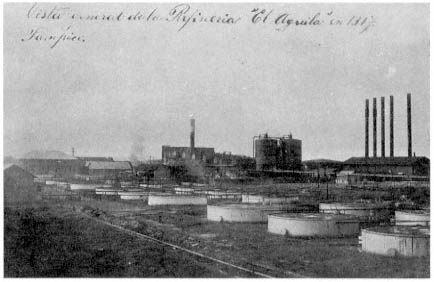
Fig. 9.
Panorama of the El Aguila refinery at Tampico, 1917. This was already Mexico's
largest refinery, and construction was still continuing. Nearly one thousand men
worked here. Courtesy of the Rama del Trabajo, Archivo General de la
Nación, Mexico City.
in 1918 and reached a peak of $2.50 in 1920 before falling again. (See graph 1.) El Aguila's production overcame its ceiling of less than seventeen million barrels per annum during the war years to reach nearly thirty-three million barrels in 1920 (see table 6). Remarkably, this advance in production came about just as the cornerstone well of the entire company, Potrero No. 4, was beginning to show signs of exhaustion. On 3 December 1918, company officials received word from the field managers that the well showed emulsion. Additional indications of hot salt water in the oil caused the well to be pinched back and finally shut in. Potrero No. 4 had yielded nearly 104.8 million barrels of crude oil in its nine years of existence. Some of its past production remained to be used. More than 9.8 million barrels of Potrero's crude remained stored in huge, open-air earthen reservoirs.[185]
As regards direction of the company, El Aguila's former officials, all of whom had been recruited over the years by Lord Cowdray, continued operating the company's business. J.B. Body would eventually leave the general managerial position in Mexico City and take up an office in Shell's London office, where he coordinated the Mexico activi-
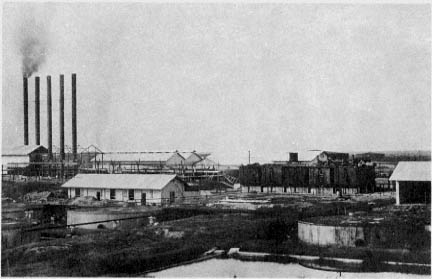
ties. T.J. Ryder remained in the New York office until he retired early in the 1920s. Two assistant managers in Mexico would eventually move into the direction of El Aguila's affairs in Mexico. J.A. Assheton replaced Body as general manager and A.E. Chambers acted as his deputy. Most supervisors of oil fields and refineries remained at their posts. The continuity of company policy was significant, as was the deference that Shell headquarters gave to this experienced team to run the oil operations in Mexico and deal with local labor and political conditions.
Salt-water intrusion, a signal of the impending exhaustion of the oil field, was not easily dismissed. Geologists, drillers, and their employers had been aware all along of the relationship between the salt water and the oil in the limestone reservoirs. Two wells that Pearson had drilled near the Dos Bocas blowout had produced little else but hot water. As early as 1911, numerous wells in the El Ebano field, Mexico's oldest, had begun to yield "large quantities of hot water with the oil." Several wells at the Hacienda Santa Fe, near Topila, which Pierce had acquired, had also gone to salt water as early as 1913.[186] Now that the truly prolific wells of the southern fields were flowing emulsion, Shell was confronted with having paid £10 million for declining oil fields. The company moved to reassure its stockholders. In its 1920 annual report, El Aguila said: "Particular emphasis is drawn by the directors to the fact
| ||||||||||||||||||||||||||||||||||||||||||||||||||||||||||||||||||||
that the appearance of salt water in some of the more heavily exploited fields need cause no anxiety to the shareholders, in view of the company's large reserve territories."[187] But the annual report was wrong. The great Mexican oil boom had already reached the beginning of decline.
What was the difference between the great Mexican oil boom, one may ask, and those oil booms that had preceded it in the United States? Just in terms of the economic structure of the industry, there were few. Lease-takers searched for prospective oil properties, dealing directly with landowners and local property records as they did in the United States. The entire industry was based on the private-property contract. Thanks to those mining laws changed by nineteenth-century Mexican liberals in 1888 and 1892, the oilmen acquired land by purchasing or leasing it directly from the landowner. The ranchero and hacendado's sale of the oil underneath their houses, fields, pastures, and forests did not come under the purview of the state at all. As in the United States, therefore, the oilmen's exploitation of the oil deposits could be brutal and wasteful in areas dominated by small property owners and many
companies. Their exploitation could be more conservationist in areas dominated by large landholdings and few oil companies. Offset campaigns were just as prominent a feature of the Los Angeles oil boom of the 1890s, where rigs were placed as close to each other as "holes in a salt shaker." Offset wells could also be found at Topila, Pánuco, Alazán, Amatlán, Zacamixtle, and Los Naranjos.
In the United States, the oil industry of the twentieth century was becoming ever more integrated into the world economy. This was even more true in Mexico. The major market for Mexico's oil was the United States and, secondarily, Latin America and Europe. When the world's price for petroleum rose and fell, so did the prices for Mexico's crude oil. Profits grew during times of strong demand. They slowed down during times of excess worldwide production. Each boom in the United States fostered the development of a large number of individual companies, a few of the fortunate first-comers usually emerging into significant business organizations. Some of these boom-created entities thrived and expanded their production, refining, and marketing outlets in order to survive the boom that created them; many competed with the existing multinational oil companies. The same was true in Mexico. Moreover, the tendency of a maturing oil boom had been to consolidate and integrate the larger companies through acquisition of complementary assets downstream and upstream. El Aguila and Huasteca were Mexican-based companies that best typified this economic behavior.
Finally, one is struck with the tendency of the entrenched great companies to move into an area of oil boom. In the United States, Standard Oil had had a long history of moving out of western Pennsylvania in order to follow the oil booms west, into Ohio, Indiana, Illinois, Iowa, Kansas, East Texas, Louisiana, Oklahoma, West Texas, and California. From its base in Sumatra, the Royal Dutch-Shell worked its way east toward California and west toward Europe and Venezuela in a global process of consolidating both markets and production. For those reasons, Jersey Standard and Shell inevitably felt a need to enter Mexico. They could no longer ignore the Mexican oil boom that was fostering such intense competition for market shares in the United States, Europe, and Latin America. Also, during World War I, the Americans had the advantage of being able to expand internationally, while British companies were set back.
What was different about the oil boom in Mexico? The oil was found in limestone, not oil sands, and produced a lot of gas. This was merely a matter of technological adaptation to oil drillers. But it
mattered not at all to the basically Anglo-American structure of the oil industry.
The important differences were cultural and political. This was Mexico, after all, not the United States. Neither the Mexican politicians nor the native work force were satisfied with the way in which the capitalistic industry was developing. No doubt, some Mexican landowners were reveling in their newfound wealth. But the Mexican state worried about its ability to control the industry as a source of tax revenue and as a threat to state power. Only the distraction of the Revolution and the strength of international demand prevented the Mexican state from intervening in the affairs of the oil companies. Furthermore, the workers wanted an economic institution that provided security and dignity to their lives. Mexican laborers would organize to resist those aspects of modern capitalism that threatened their culture and their security. Even as the foreign companies developed the Mexican oil industry according to strict capitalistic and market considerations, the politicians and the workers, each in their own way, were preparing to reclaim the Huasteca Veracruzana as their own.