
Six—
Words and Windows
Few Commonplace Ideas displeased Duchamp as much as the old French saying bête comme un peintre , "stupid as a painter." He denounced it in several interviews, speaking up instead for a view that made thinking, even metaphysical speculation, central to what artists did. The kinship he felt between art and intellect fed his hostility to what he called "retinal" painting, with its appeal to visuality as sensual experience; almost from the start his work had a verbal side, beginning with captions and dialogues in the cartoons he published while a student and continuing by way of the titles and literary references that gave an extra dimension to pictures like Paradise, Baptism, Dulcinea , and Once More to This Star . His fascination with puns helped to expand this literary bent toward a general preoccupation with the nature of language itself, and the notes for the Large Glass include proposals for constructing new languages appropriate to the mental world of relations between the bride and her bachelors; to these projects he added a series of works that used words rather than visual images as basic components.
Duchamp's desire to remake language tied him to numerous other modernist and avant-garde figures. Mallarmé developed a highly original and idiosyncratic style and syntax, employing veiled allusions, al-
tered meanings, prepositions exchanged for one another, suppressed verbs (especially the verb to be, which he regarded as without concrete content), subjects displaced to the end of sentences, circumlocutions, and archaic or invented words. These experiments were inspired by the conviction that a language cleansed of the confusions of ordinary experience, and restored to the purity of its own internal relations, could liberate the ideal forms of things. Although not a private language—its elements were still those of ordinary French, and readers willing to put in the necessary effort could penetrate most of its mysteries—Mallarmé's speech was puzzling enough to be one source of Rémy de Gourmont's equation of personal art with incomprehensibility; it was a language of interiority whose virtues inhered in the purity of its own structure, unblemished by the compromises imposed when words take on obligations to the objects of ordinary, shared experience.
Duchamp admired Mallarmé, but he seems to have been still more drawn to Jules Laforgue. Laforgue shared Mallarmé's conviction that existing language was corrupted by its interchanges with everyday reality, but he felt the effects more personally, as a wound to his own selfhood. To his mind, the individual who seeks to express what is unique about his or her own person necessarily finds the way blocked by linguistic conventions, caught up in verbal commonplaces that turn the search for authenticity into a helpless repetition of hollow and inappropriate gestures. The moments when one seeks to express the deepest and most personal feelings—love above all—are precisely the ones that call forth the most banal, used-up, impersonal phrases, those that fill popular songs and cheap novels. The person who becomes aware of his dependence on such expressions despairs of ever escaping the trite verbal leftovers of other lives and finding any authentic core of existence; the self that seeks its own wholeness finds itself divided among the various characters that the available modes of speech allow it to assume, much in the way that the energy of Duchamp's bachelors must be stuffed into one or another of the malic molds. Feeling that even the words of his own heart belonged to others, Laforgue came to look upon his attempts at self-expression with the same cold detachment with which one regards the mechanical speaking of some automaton; at times he seemed to regard silence as the only path to
authenticity. These ideas and feelings made him part of the tendency in literary modernism that turned writing inward on itself, away both from the romantic belief that creative activity expressed an essential and personal way of being and from the realist project of mirroring the external world.[1]
Because Duchamp—along with other vanguard figures—clearly shared many of these views, we need to look for a moment at some of the assumptions that lay behind them. Given that our language comes to us from others, that our most passionate sentiments have been expressed before, and that we often take on roles for which prior models exist, does it follow that persons can never achieve a selfhood that is properly and authentically their own? Not only does answering yes to this question deny genuine self-existence to all the great originals who have illuminated—and often disrupted—human history, it amounts to equating individuality with a pure, unalloyed independence that only a being alone in the world could acquire. In art and literature, the realms Laforgue cared most about, creative figures have always attained authentic individuality by starting off from cultural elements taken over from those around them; originality does not require starting from nothing, but giving new shape to what one finds in place in the present and inherits from the past.[2]
In some moods, at least, Laforgue understood this perfectly well. Although genuinely drawn to the kind of narcissistic purity much of his work invokes, he saw that the notion of such an existence was itself dependent on preexisting models and that to desire it was to choose one of the many alternative character types put on offer by the culture into which—as a man and as a writer—he had been born. He was fascinated by the stage figures of Pierrot and Hamlet, both of whom cultivate an unobtainable ideal of personal purity while self-consciously moving back and forth between the various roles that situations require them to assume. These were Laforgue's models, both in the strength of their inner conflicts and in the power of their ironic detachment. When he portrayed every admixture of otherness as a wound to personal authenticity, therefore, he knew that he was setting up an impossible ideal, deserving of the same skeptical treatment he meted out to those who thought they could express pure love and devotion in the
stock phrases of popular lyrics. Thus he undermined his critique of ordinary selfhood and returned his literary activity to the very world from which much of his writing seeks escape, the world where individuals share elements of their identity with others. All the same, the critique remained a central theme in his work, keeping alive a fantasy vision of narcissistic purity that his awareness of its unreality could never still.
In an interview with the art historian and curator William Seitz in 1963, Duchamp described his own philosophical—he preferred the term "metaphysical"—point of view as one that doubted everything. Truth and being itself were the main targets of this skepticism, and the reason people believed in ideas that correspond to nothing real was that language deceived them. Speaking about language seemed to ruffle Duchamp's usually calm demeanor, leading the interviewer to italicize some of what he said. "Words such as truth, art, veracity, or anything are stupid in themselves. Of course, it's difficult to formulate, so I insist that every word I am telling you now is stupid and wrong ." Puzzled, perhaps, Seitz asked: "Could it be otherwise? Can you conceive of finding words which would be appropriate?" To which Duchamp:
No. Because words are the tools of "to be"—of expression. They are completely built on the fact that you "are," and in order to express it you have built a little alphabet and you make your words from it. So it's a vicious circle. I mean it's completely idiotic. I mean the language is a great enemy, in the first place. The language and thinking in words are the great enemies of man, if man exists. And even if he doesn't exist....
At this point the interviewer changed the subject.[3]
Although some of what Duchamp was saying here remains obscure, his general drift seems dear enough. Language falsities the world by imposing certain predetermined categories on our attempts to comprehend and describe it; this falsification takes place not only in "big" words like "truth" and "art," but in every way of speaking about the world that makes us attribute being to the things we encounter in it.
What alternative there might be to the language that expresses being Duchamp did not say, but he seemed to imply that it would involve a more fluid and skeptical relationship to experience—one in which language would support our uncertainty about whether man exists or not, and whether we "are" or not. In an earlier interview Duchamp described his way of thinking about things with the upsetting analogy, "I want to grasp things with the mind the way the penis is grasped by the vagina."[4] Since under normal conditions the penis is grasped only very loosely by the vagina, in a way that allows it to slip back and forth, one thing to which this metaphor may have pointed was just the sort of unstable connection between concepts and things that the rejection of "to be" might set up.
When Duchamp told Seitz that he had no hope for replacing existing language with language that would be appropriate to his fluid and skeptical view of the world, he seems to have forgotten that he had once imagined ways to do just that. Among its notes for the Large Glass, the Green Box contains a project, probably dating from around 1914, for a language that "very probably is only suitable for the description of this picture." That language would be composed solely of "prime words," defined as "'divisible' only by themselves and by unity," that is, words that cannot be resolved into any other, simpler ones. To obtain such words Duchamp proposed to copy from a standard French dictionary (the Larousse) "all the so-called 'abstract' words, i.e. those which have no concrete reference." Having assembled such a vocabulary, the next step was to "compose a schematic sign designating each of these words," and these signs would be "thought of as the letters of the new alphabet." He then wrote that "A grouping of several signs will determine ...," but he left the sentence unfinished: as assemblages of elemental signs resembling letters, such groupings would correspond to words in languages like French or English, but as combinations of abstract concepts they would be more like phrases or sentences. Within the language there would be "ideal continuity," that is, "each grouping will be connected to the other groupings by a strict meaning ," and with this vocabulary one could express things that current languages, based on "concrete alphabetic forms," could not, namely, "some abstractions of substantives, of negatives, of relations of relations of subject to verb etc."[5]
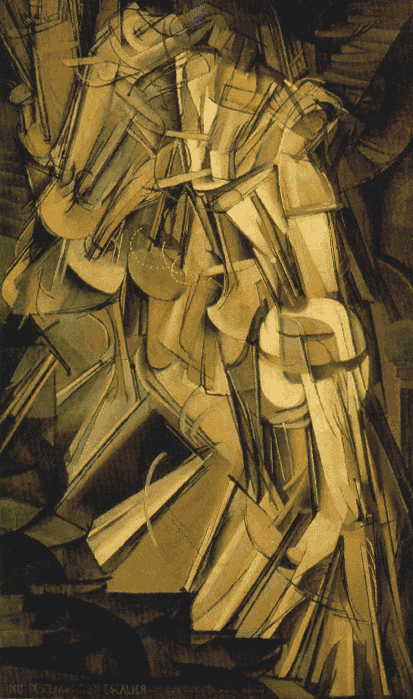
Plate 1. Duchamp, Nude Descending a Staircase , No. 2 (1912)
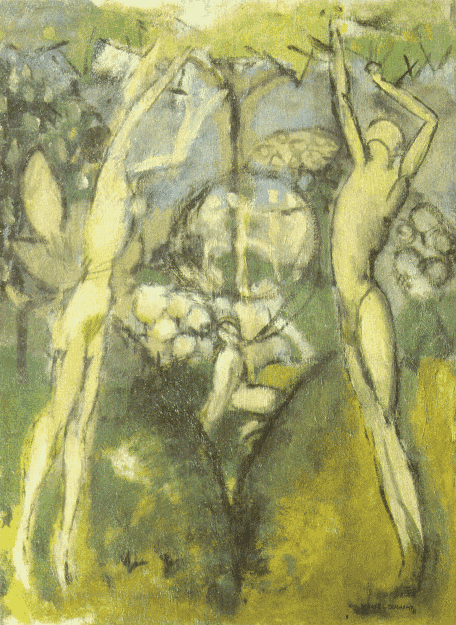
Plate 2. Duchamp, Young Man and Girl in Spring (1911)
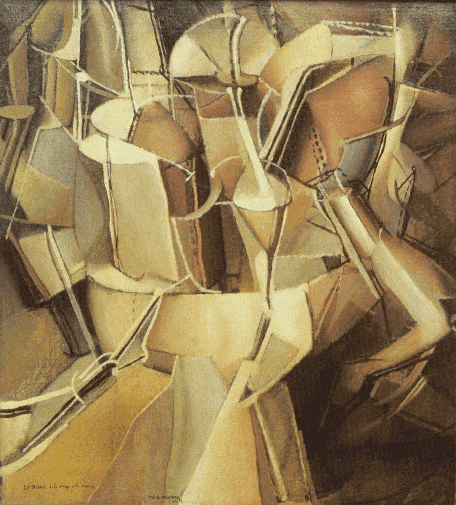
Plate 3. Duchamp, The Passage from Virgin to Bride (1912)
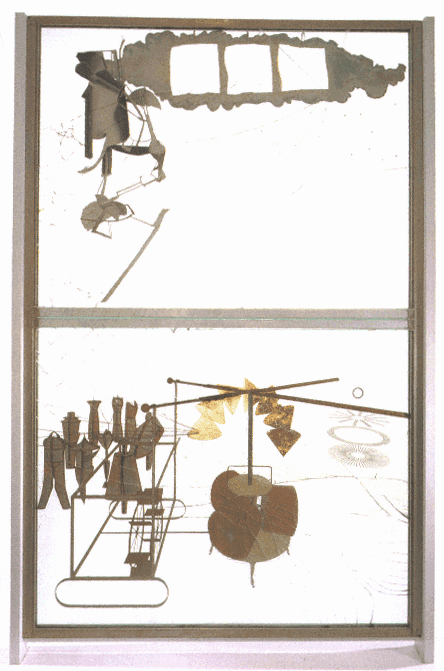
Plate 4. Duchamp, The Bride Stripped Bare by Her Bachelors, Even
(The Large Glass) (1915-23)
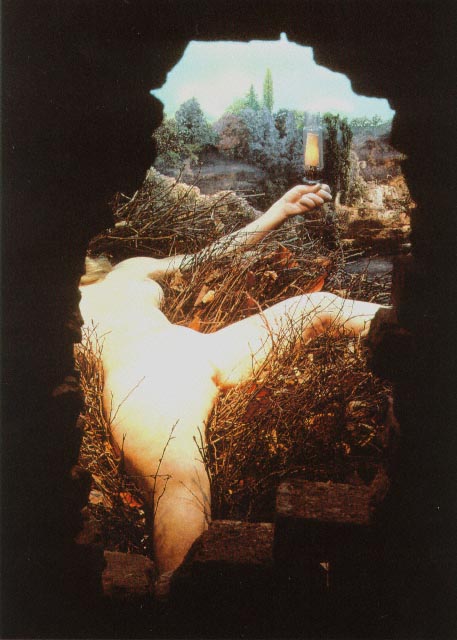
Plate 5. Duchamp, Given: 1. The Waterfall 2. The Illuminating Gas (1946-66),
Interior View
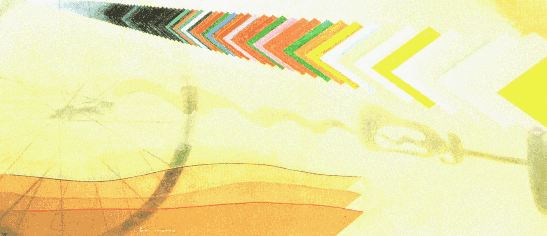
Plate 6. Duchamp, Tu m' (1918)
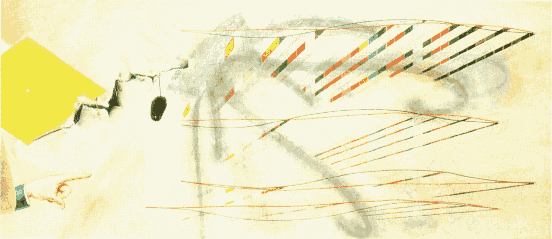
Obscure as much of this note remains, it is clear that what Duchamp had in mind was a language that would have reference not to concrete objects in the world—that is the point of its restriction to "prime words" that are purely abstract—but only to defined conceptual relationships; by combining these prime words, it could refer to other, still more abstract combinations of such relationships: virginity, bridehood, desire, and delay, for instance. It was an appropriate language for the Large Glass because, like the picture, it turned away from the traditional use of signs to represent concrete objects and experiences, instead calling up an immaterial fourth dimension beyond experience where only imagination could be at home.
The White Box , published in 1966, contains some closely related linguistic speculations. One proposed a dictionary "of a language in which each word would be translated into French (or other [languages]) by several words, when necessary by a whole sentence," much like the groupings of schematic signs proposed in the Green Box . Duchamp went on to specify that this would be "a language which one could translate in its elements into known languages but which would not reciprocally express the translation of French words (or other), or of French or other sentences"; its alphabet would be "a few elementary signs, like a dot, a line, a circle, etc." In other words, this would be a language whose basic elements were chosen in the same way Duchamp later said an artist could choose signs—"anything, a dot, a line, the most conventional or unconventional symbol"—to stand for what he wanted to say; these would correspond to the letters or ideographs of other languages, but the words and sentences formed out of them would have no equivalents in any other tongue. This, then, was the language of a sphere of experience to which it alone gave access, a hermetic world sealed off from contact with any other.[6]
A third proposal took the following form:
With films, taken close up, of parts of very large objects, obtain photographic records which no longer look like photographs of something. With these semi-microscopics constitute a dictionary of which each film would be the representation of a group of words in a sentence or separated so that this film would assume a new significance or rather that the concentration on this film of the sentences
or words chosen would give a form of meaning to this film and that, once learned, this relation between film and meaning translated into words would be "striking" and would serve as a basis for a kind of writing which no longer has an alphabet or words but signs (films) already freed from the "baby talk" of all ordinary languages.
—Find a means of filing these films so that one could refer to them as in a dictionary.[7]
Such a language would be a kind of hieroglyphic or pictographic script whose signs, enlarged pictures of tiny portions of objects, would convey the mysterious mixture of familiarity and strangeness that marks Duchamp's images of the virgin and the bride; each one would stand for some specific idea or thing (just as the bicycle wheel and the bottle rack did before they were designated as readymades) but—at least to begin with—only he would know what that reference was. Duchamp might write in such a language, but only those willing to learn it as he invented it (whether that was one use to which the "dictionary" could be put he did not say) would be able to "read" such writing; it was less a medium of communication than—to recall his later description of the Large Glass—"un amas d'idées," a private hoard of ideas.
These three languages, one eliminating reference to concrete objects in the world, one giving expression only to its own universe, inaccessible to other tongues, and one composed of symbols whose meaning Duchamp established by himself, all have in common the elimination of language's ordinary role as the medium through which human beings establish relations with one another, communicating their personal feelings and ideas, on the one hand, and their perceptions of the external world, on the other. Only the third is strictly a private language (although, like the symbolic universe of the Large Glass, accessible to others who are given enough information); the second, like some of Duchamp's pictures, offered the appearance of comprehensibility but without the possibility of achieving it; and the first was devised as a medium to express relations too abstract to be accessible by any existing language—a kind of algebra of the fourth dimension.
Duchamp pursued his experiments with remaking language in some works, made up of words rather than visual images, but titled and presented like pictures. He was not the first to treat words as pictographic elements; one predecessor was his onetime friend Guillaume Apollinaire, who produced a series of "calligrammes" before World War I, verbal pictures created by arranging the words of poems in patterns that seek to give a schematic impression of the objects they describe. But Duchamp's aim was the opposite of Apollinaire's: not to find an extra way to make language refer to the world outside it, but to subvert the process of linguistic representation and enclose language inside a space where it made no connection with external objects. He had already experimented with ways to break the link between language and the world in the inscriptions he gave to the first named readymades, In Advance of the Broken Arm for the snow shovel and Emergency in Favor of Twice for the unidentified object chosen at the same time. The operation he performed on language in these titles paralleled his treatment of the objects themselves, disrupting their ordinary relationship to the world by appropriating them for his private realm of symbols. In other inscriptions, notably that for With Hidden Noise (Fig. 43), where the unidentified object inside the ball of string stood for just this enclosure of the sign within a space cut off from things outside it, Duchamp raised the linguistic barrier higher by leaving letters out of the words; asked to reconstitute them, the reader discovered that the completed words made no more sense than the fragments.
In the verbal works themselves—one in English, one in French—Duchamp pursued the same involution on a more extended scale, by putting nouns or adjectives together with verbs or adverbs in combinations that short-circuited the link between signifier and signified. The first, called The , had the additional feature that it replaced the English definite article with a star every time it appeared, doubtless an act of revenge on the little word that gives native speakers of French so much trouble, while simultaneously obscuring the designation of concrete objects (Fig. 49). The second, in French, bore the title Rendezvous of Sunday, February 6, 1916 , and consisted of four postcards taped together so that the typewritten message begun on the first apparently continued through the other three (Fig. 50). Both consist of groupings
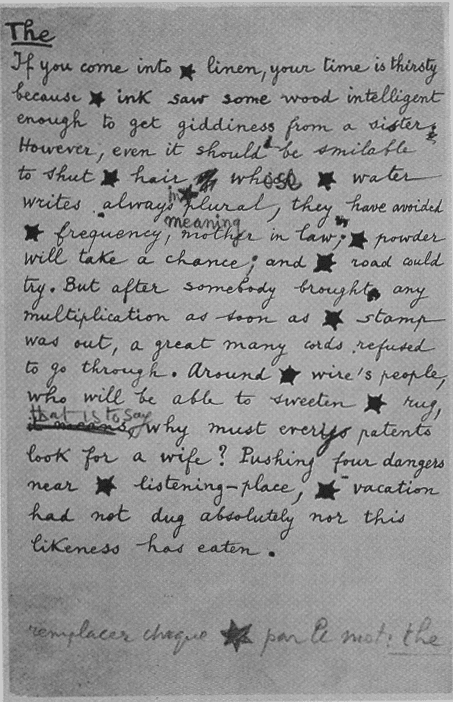
Figure 49.
Duchamp, The (1915)
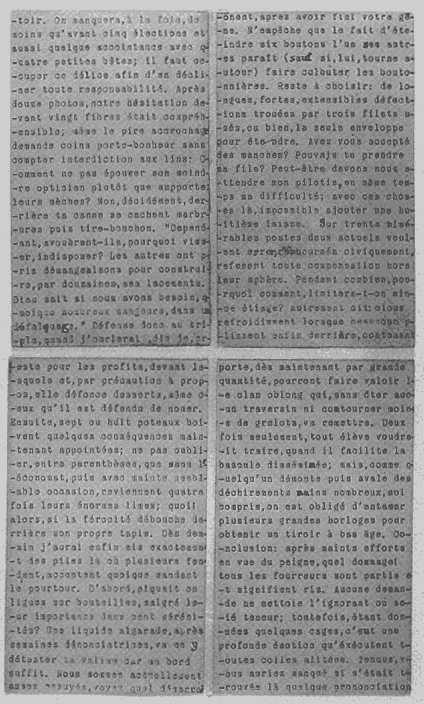
Figure 50.
Duchamp, Rendezvous of Sunday, February 6, 1916 (1916)
of words that have the form of ordinary sentences, but which constantly interrupt the production of meaning in which they seem at first to engage, so that the rendezvous of language and meaning never takes place. We can give the flavor of both the English and the French text by quoting the first and last sentence of The :
If you come into
linen, your time is thirsty becauseink saw some wood intelligent enough to get giddiness from a sister.... Pushing four dangers nearlistening-place,vacation had not dug absolutely nor this likeness has eaten.

Duchamp later explained that he composed Rendezvous by first writing ordinary sentences, then altering and substituting elements so as to cut off all the links between words and objects; the task was not easy, because meaning kept creeping back in, but he finally ended up with combinations that made the text "read without any echo of the physical world."[8]
Whether he quite succeeded in doing this may be a matter of disagreement, but by acknowledging it as his purpose Duchamp made clear the tie between these works and the linguistic experiments proposed in his various notes. Both aim to confine the production of language inside a space where either reference to objects or communication with others is blocked, aspirations for which he found an apt metaphor by designating as a readymade the black, opaque cover that created a protected enclosure for the Underwood typewriter on which he seems to have written Rendezvous (Fig. 51). Similar screens between language and objects are set up by the final même that casts the relations between the bride and the bachelors into its space beyond physical existence and by the title Tu m ', a gesture of communication that never completes the passage to meaning, leaving the relationship between the speaker and the person spoken to, which the phrase seems about to call up, hanging in midair. (To respond to this title in the way most writers about Duchamp do, by suggesting ways to complete it, misses its real point.)
Like these titles, the texts The and Rendezvous of Sunday, Febru-
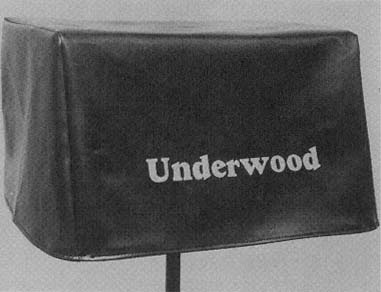
Figure 51.
Duchamp, Traveler's Folding Item (1916)
ary 16, 1916 , are jokes, of course, and funny ones, too, but the humor is akin to the hostility toward language Duchamp later expressed in his interview with William Seitz, and the texts are attempts to use language in ways that undermine the assumption that the world has a stable manner of "being" which he railed against in the interview. Unlike the readymades, these texts are not affronts to the special world of "art" whose hallowed precincts are breached by Fountain , but they have in common with readymades the purpose of subverting the procedures and practices that lead people to believe in the possibility of a fixed and stable relationship to experience; they speak of a world where expectations are constantly upset and where individuals would be unable to acquire definite habits or a consistent style. On one level, the assault against art was only a way to pursue these broader and more "metaphysical" goals.
Since the 1960s, similar goals have been furthered and developed by a movement in philosophy and literary criticism that sometimes seems to breathe Duchamp's spirit, the current of "deconstruction" identified especially with Jacques Derrida and Paul de Man. A central aim of
deconstructive criticism is to discover everywhere in the operations of language the subversion of stable meaning and fixed reference that Duchamp toiled to produce through his linguistic works and experiments. For the deconstructionists, the task of the critic is to show that language itself works to undermine stability, defeating our misguided efforts to make it the bearer of assigned meanings and thus give clarity and definition to experience. The best examples of deconstruction at work—often carried out in a region of irony where Duchamp would have felt very much at home—aim precisely to detach us from the expectation that texts put us in the presence of clear meanings, by showing how the relationship between verbal signs and the things or ideas they signify is constantly "deferred" by the resurgence of fluid and metaphorical relations between the signs themselves, the slippery "dissemination" of meaning along a chain of signifiers over which language-users seek vainly to gain control. Escape from the assumption that we live in a world of stable meanings brings liberation from the metaphysical treadmill of Western culture, which has for so long subjected people to the fruitless and punishing pursuit of "the true" and "the good."[9]
The closeness of all this to Duchamp's linguistic works and experiments can perhaps be best illustrated—certainly most amusingly—by a fictitious lecture on the futility of seeking definite interpretations for literary texts that the writer and critic David Lodge placed in the mouth of his character Morris Zapp, an American avatar of deconstruction, in his novel Small World . Reading a literary text, Zapp explains, is like watching a striptease, because both keep the object of desire just out of view and reach. As with the dance, the text makes us believe that we will finally arrive at the bare truth, the "real" meaning, but both hold our attention because they succeed in always keeping what we long for behind one more veil than we had expected. The text's constant promise and refusal to strip itself bare before us is what gives us pleasure in reading it: because it never allows itself to be possessed, we never cease to desire it. "Veil after veil, garment after garment, is removed, but it is the delay in the stripping that makes it exciting ... no sooner has one secret been revealed than we lose interest in it and crave another."[10] Morris Zapp's lecture is true to Derrida's love of irony, of playfulness
and especially word play, and the latter's writing, as one admirer puts it, "mimes the movement of desire rather than its fulfillment."[11]
Because the spirit of deconstruction resembles Duchamp's at so many points, it is not surprising that several critics have thought it the most appropriate way to respond to him, indeed the sole way to interpret him that remains true to his own temper.[12] Readers will understand that such is not the viewpoint of the book they now have in hand. Perhaps the project being pursued here, the attempt to give a clear account of the intentions and ideas behind Duchamp's various works and particularly of the deeper and common set of impulses linking his whole career together, is condemned from the start to just the sort of frustration Morris Zapp analyzed so tellingly in his lecture: of course there will be other readings, and still others, and indeed the striptease will never end. But perhaps Zapp forgets that the experience people seek in a striptease may not be reducible to any single, ultimate object of desire, and that those who attend to the dance get to see quite a lot all the same. Duchamp admitted that the attempt to squeeze meaning out of language in The and Rendezvous of Sunday, February 6, 1916 , cost him a great deal of effort, and Derrida and other deconstructive critics often expend as much or more, despite their claim that language, in its depths, is on their side. I admit that I believe that language can and often does describe the world outside itself and us clearly and stably enough for our purposes, despite the traps we need to learn to recognize and avoid to make it do so, and that human beings are indeed "beings," possessed of enough stability to invest their diverse and changing activities with meanings that are sufficiently coherent and interesting to justify our trying to say what they are. But the deeper reason for not joining in the deconstructionist attempt to make "delay" and "deferral" the principles of reading Duchamp's career or anyone else's is that there seems to me little reason to believe either that the verb "to be," or the commonsense notion that human beings inhabit a world stable enough to be named by our ordinary words and concepts, are as oppressive as Duchamp and Derrida believe them to be, or that subverting language could offer liberation of the sort they claim. Some of the grounds for this view have already been suggested, in connection
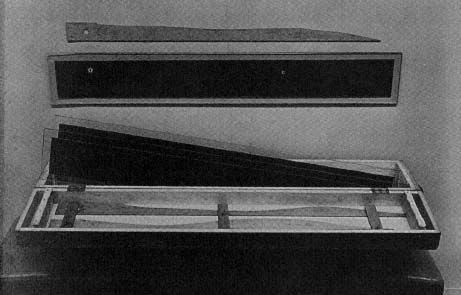
Figure 52.
Duchamp, Three Standard Stoppages (1913-14)
with Jules Laforgue's anxieties about the relations between speech and personal authenticity; others will appear later on. For now we need to return to the place Duchamp's experiments with language occupied in his work.
Understanding that place requires that we see the connections between Duchamp's linguistic projects and a number of works and objects from the 1910s and 1920s that are not usually associated with them. Several of these were also linked to his fascination with chance, the earliest being a project first proposed in a note of 1913 and carried out during the next year. Called Three Standard Stoppages , it consisted of a boxed assemblage containing three curved threads glued to painted canvas strips, together with three strips of wood, straight on one side and shaped to match the curves of the threads on the other (Fig. 52). Duchamp liked to refer to the result as "canned chance," and gave the following account of how he made it:
Each strip shows a curved line made of sewing thread, one meter long, after it had been dropped from a height of I meter, without
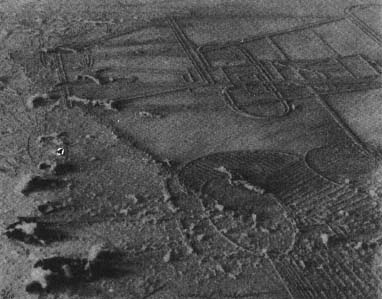
Figure 53.
Duchamp, Dust Breeding (1920; photograph by Man Ray)
controlling the distortion of the thread during the fall. The shape thus obtained was fixed onto the canvas by drops of varnish.... Three rulers ... reproduce the three different shapes obtained by the fall of the thread and can be used to trace those shapes with a pencil on paper.
This experiment was made in 1913 to imprison and preserve forms obtained through chance, through my chance. At the same time, the unit of length, one meter, was changed from a straight line to a curved line without actually losing its identity [as] the meter ...[13]
Duchamp similarly celebrated chance by having Man Ray photograph patterns of dust that settled on the Large Glass during several months in 1921 when it lay face down in his apartment, calling the result Dust Breeding (Élevage de poussière , Fig. 53). Later he worked part of this experiment into the Glass itself by varnishing over the dust adhering to the shapes of the malic molds, thus adding color to them. In 1924 he sold some friends shares to finance a system for playing roulette at Monte Carlo, issuing certificates with a picture of himself as a kind of
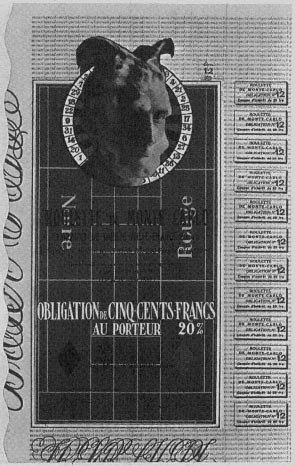
Figure 54.
Duchamp, Monte Carlo Bond (1924)
devil, with a beard made of shaving cream and his hair molded into horns atop his head (Fig. 54).
Although each of these appeals to chance had some features of its own, all were linked to the desire he described in one interview as wanting "to strain the laws of physics just a little." That formula was one of several acknowledgments Duchamp made of his sympathy with the ironic science Alfred Jarry invented around the turn of the century and christened "'pataphysics." Jarry's 'pataphysics was defined as the science of the particular rather than of the general, where exceptions ruled in place of laws. Duchamp injected Jarry's kind of science into the Large Glass when he described the glider as "emancipated horizon-
tally" from gravity, so that it could slide without friction, and attributed "oscillating density" to the brandy bottles whose fall imparted motion to the glider. The principles of 'pataphysics effect the revenge of individual spontaneity against the norms other sciences erect to restrain it, and Jarry was inspired to proclaim it because he was drawn at once to the symbolist cultivation of interiority and the anarchist revolt against external constraint. The result was an intensely radicalized individualism whose implications were well expressed in Rémy de Gourmont's declaration: "One individual is one world, a hundred individuals make a hundred worlds, each as legitimate as the others."[14]
The standard stoppages operate in just this spirit, depriving the meter, and by implication all standard units of measure, of the quality that makes them a way for different individuals to develop a common account of the world, namely, universal applicability. This task was accomplished once the number of alternative meters had been extended to three, because in Duchamp's mind three served as a kind of intimation of infinity: to do three stoppages was to imply that there could be an infinite number of others.[15] The parallel to his experiments in language was exact: both destabilize media that provide shared systems of interaction with the physical world, fragmenting them into an illimitable number of incommensurable ways to assess and order experience. He recognized this by proposing to use the standard stops as elements for the schematic language of "prime words" proposed in the Green Box , but the link is perhaps closer to the other imagined language, which would have allowed for the exchange of elements with others, but not for mutual translation of words or sentences. In this connection it is important to remember that Duchamp saw the stoppages as linked to him personally: they represented "chance ... my chance," the record of a personal moment of liberation from universal norms.
A somewhat similar, albeit less explicitly personal, escape from necessity was figured in what Duchamp called the Unhappy Readymade , a device he constructed at a distance by having his sister Suzanne and her husband Jean Crotti hang a geometry book from the balcony of their Paris apartment, passing a string along the inside of the spine so that the pages were open and exposed. The wind was to blow through the book, tearing out pages—hence problems or proofs—as it liked;
in this way the universal logic of three-dimensional geometry was to be disassembled piece by piece. It cannot have been an accident that Duchamp specified a geometry book for this work, because he conceived it in Buenos Aires in 1919, while he was using geometrical figures to stand for escape into the fourth dimension in the small glass, To Be Looked at ... for Almost an Hour . Like the stoppages, the Unhappy Readymade enlisted chance in the project of withdrawing from the world of predictable, shared experience.
Duchamp provided a different image of such withdrawal in another mysterious work, Fresh Widow , done in New York in 1920. It consists of a small model of a French window, constructed by a carpenter, but containing flat pieces of black leather in place of the eight panes of glass (Fig. 55). An ordinary window is a an object that establishes a permeable boundary through which people can experience the world, separating inside from outside in a way that permits both perception and psychological projection to pass through (consider Gustave Caillebotte's painting The Man at the Window , discussed above). By replacing the glass with opaque leather, Duchamp eliminated the transparency that allows this interchange to proceed, turning what had been a medium of interaction into a barrier that reminds us by its very obstruction of the communication it allowed before. This was precisely what he did with language in The and Rendezvous of Sunday, February 6, 1916 .
Like the bicycle wheel and the bottle rack, Fresh Widow was a visual pun on his own preoccupations—in this case, his interest in making media of communication opaque where they had once seemed transparent—and the visual pun fit together with the verbal one in the work's title: a recently widowed woman is a person who has been deprived of an important relationship that ties her to the external world, throwing her back into the darkened space of her own thoughts and feelings; a window whose panes no longer allow light or affect to pass through is an apt metaphor for her condition. Duchamp, however, did not consider that condition to be one of loss only; in the Large Glass the absence of physical contact between bride and bachelors is what guarantees the permanent independence of imagination from the
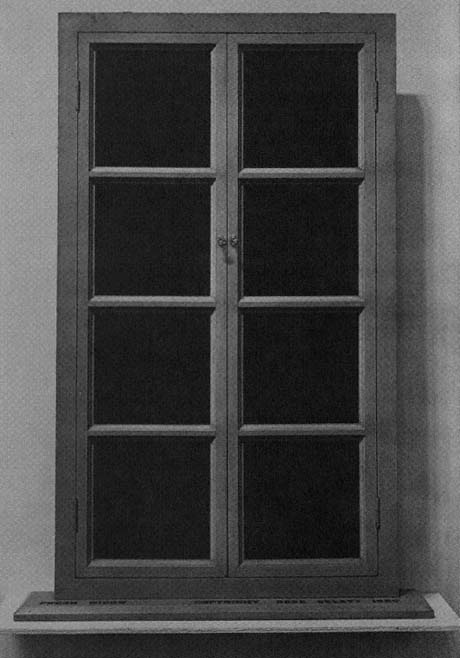
Figure 55.
Duchamp, Fresh Widow (1920)
narrow confines of material existence. Fresh Widow was a glass altered so that the disillusionment that, in the note on shop windows, followed breaking the pane had no chance to occur. The work was therefore fittingly signed with the name Rrose Sélavy, the partner who, as the eros that is life, never grants her lovers actual possession, keeping their desire fresh too. In this light, the proclaimed "freshness" of the widow derives from her inaccessibility to the new partner for which she is constantly "ready"; as long as she remains separated from the world by the opaque panes that symbolize her state, she exists as an instance of the condition where, to use again Walter Benjamin's phrase about Baudelaire, lovers are spared rather than denied fulfillment.
A similar play of ideas surrounds an apparently unrelated object, a glass ampoule Duchamp bought in Paris in 1919, asking a pharmacist to empty it of its original contents and reseal it, so that it contained 50 cc. of Paris air, hence the title Air de Paris (Fig. 56). (He gave it as a present to the Arensbergs.) This glass is transparent, but what it holds of interest is both within an interior space and invisible; we can continue to maintain it in the state that makes us desire it—that is, maintain the air in its Parisian purity—only as long as we do not yield to the temptation to experience it physically. The air in the ampoule thus occupies exactly the position of the objects described in the note on shop windows, making the work a miniature distillation of the complex play between imagination and perpetuated desire that occurs in the Large Glass.
Although most students of Duchamp's work prefer to regard these and other objects as meaningless and arbitrary gestures, significant only for what they contribute to the assault on the traditions of art, I think the themes that can be discerned in the ones we have just examined resound through a much larger range of his activities. When Katherine Dreier's sister Dorothea asked him to make something for her, he responded, in 1921, with what is probably the oddest of his constructions, which he inscribed Why Not Sneeze, Rose Sélavy? (spelling the name, for no known reason, with only one "r") (Fig. 57). It is a bird cage, filled with what look to be lumps of sugar but which are actually cubes of marble (a reminder that making the construction required considerable effort), so that the cage, when lifted, surprises the
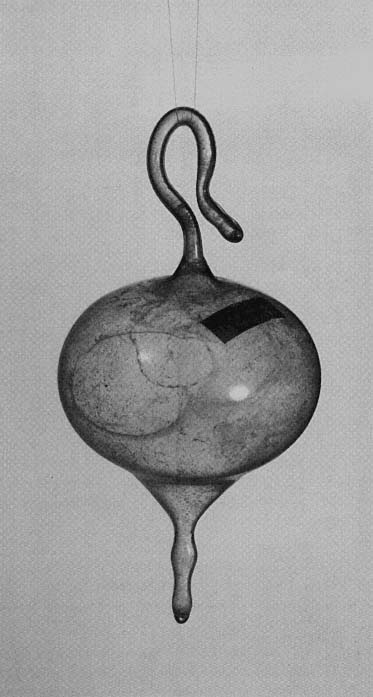
Figure 56.
Duchamp, Air de Paris (50cc. of Paris Air) (1919)
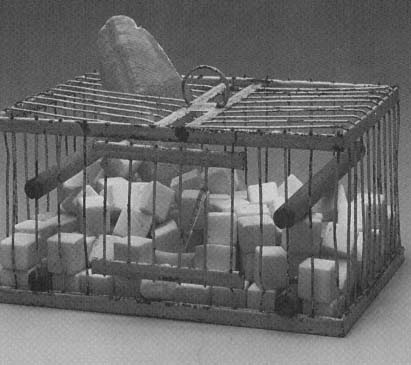
Figure 57.
Duchamp, Why Not Sneeze, Rose Sélavy? (1921)
handler with its weight. Inside there is also a cuttlefish bone and a thermometer.
What should restrain our impulse to conclude at once that this is a mere piece of silliness is that the title is an actual sentence, not a nonsensical phrase like In Advance of the Broken Arm . It refers clearly to something which is not happening: R[r]ose is not sneezing. Her state is graphically figured by the way the tide is attached to the bottom of the cage in paper-tape letters that place each word on a separate line instead of making them one continuous sentence; the result is to make us read each word independently in a way that suggests the jerky, stop-and-start rhythm we all know from feeling the approach of a sneeze that does not arrive.[16] What the title calls up, then, is a state of "delay," and in regard to an action that, because it begins in a feeling of stimulation or arousal, has often been likened to sexual climax; that it is éros,
c'est la vie herself who is not sneezing establishes the connection clearly enough.
What makes the object appropriate to the title is that it provides an image of confinement, a metaphor for the inner space from which the sneeze cannot escape. Were it to come it would provide release, the lightness and satisfaction we are made to expect by seeing the sugar cubes, but which the heaviness we experience by trying to lift them frustrates. The implied answer to the question is that R[r]ose prefers the state of permanent anticipation that is not sneezing to the release of tension the small explosion would bring: because eros is desire, delay is the only state in which it survives undiminished.
The other elements of Why Not Sneeze? are certainly playful, but they are not without meaning. Since the marble cubes surprise the cage's recipient by their weight, the thermometer warns those who believe in universal systems of measurement that they will seek to apply them where their categories are out of place, reiterating the 'pataphysical point of the standard stoppages. The cuttlefish bone is the sign of Duchamp's ironic presence: like the fish, he hides behind the liquid substances—ink or paint—he squirts at us (or perhaps at Dorothea Dreier, who may have hoped to catch him by commissioning a work).
The bird cage, the ampoule, and the window with blackened panes are all images of confinement, of impeded motion; the same theme sounds in some of Duchamp's other objects. One was a Sculpture for Traveling he constructed in 1918 and took with him to Buenos Aires. It consisted, as he later explained, of "pieces of rubber shower caps, which I cut up and glued together and which had no special shape. At the end of each piece there were strings that one attached to the four corners of the room. Then, when one came in the room, one couldn't walk around, because of the strings!"[17] That such a "sculpture" should be intended for taking on trips is understandable enough, given its lightness and portability. But as Duchamp explained, its real purpose was to interfere with walking, so that it was as much a sculpture against movement as for traveling. In its own way it imposed immobility on gestures expected to produce linear motion, just the result achieved by mounting the bicycle wheel on its stool and by setting the cyclist of To
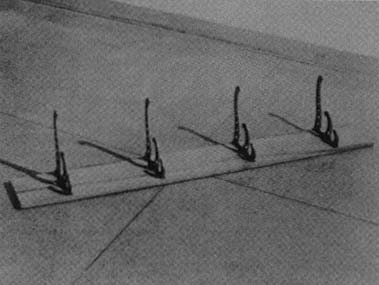
Figure 58.
Duchamp, Trap (1917)
Have the Apprentice in the Sun on a line between two staves on a sheet of music paper. The same theme received another expression in the clothing rack Duchamp nailed to the floor of his New York studio in 1917, calling it Trap (Trébuchet , Fig. 58; as a verb the French word means to stumble or trip). Not only did this object impede linear motion in the same way as the Sculpture for Traveling ; by echoing (like the hat rack included in Tu m' ) the phallic shapes of the bottle rack and declaring—since it stayed on the floor—that the soft, concave objects for which its hard, extended rods called out would never be attached to it, it merged the bicycle wheel's imagery of motion preserved and impeded with the bottle rack's symbolization of the forever absent feminine counterpart to masculine desire.
Traveling is the activity where one most often encounters such "delays," which may be the reason it appears in a number of Duchamp's objects. The typewriter cover was called Traveler's Folding Item (Pliant de voyage ), and the theme appears again in The Brawl at Austerlitz (La Bagarre d'Austerlitz ). This title collapsed the name of the well-known Paris railroad station, the Gare d'Austerlitz, with that of the battle where Napoleon defeated the Austrians. The play on words interfered
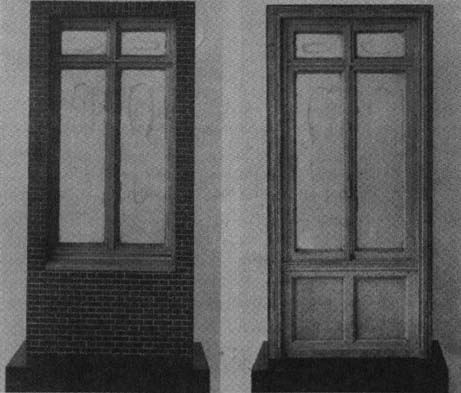
Figure 59.
Duchamp, The Brawl at Austerlitz (La Bagarre d'Austerlitz) (1921)
with the passage from sound to meaning much in the way that having a brawl at a railroad station might delay departure. The object itself was a window (Fig. 59), making a link to Fresh Widow that Duchamp seems to have thought about repeating in a kind of chain of related images, as he said in an interview: "I used the idea of the window to take a point of departure, as ... I used a brush, or I used a form, a specific form of expression, the way oil paint is, a very specific term, specific conception. See, in other words, I could have made twenty windows with a different idea in each one, the windows being called 'my windows' the way you say 'my etchings.'"[18] To have thought about windows in this way is to say that the question of passage—allowed and impeded—between interior and exterior spaces was one to which Duchamp returned over and over again. Every one of these objects calls
up the same blocked movement between inner and outer realms that Duchamp labored to establish in his linguistic experiments and works.
Duchamp pursued his fascination with language in a state that prevents it from referring to the external world in one final way, by inscribing some of his favorite puns in spiral patterns on rotating disks. The disks contained language, but when spun they reduced the words to a physical blur. Among the verbal groupings chosen were "Esquivons les ecchymoses des esquimaux aux mots exquis," "Bains de gros thé pour grains de beauté sans trop de bengué," "Avez-vous déjà mis la moëlle de l'épée dans le poêle de l'aimée?" and "L'aspirant habite javel et moi j'avais l'habite en spirale" (Fig. 60). All were puns that curved language back on itself, disrupting its contact with the world. In addition to the language disks, Duchamp during the 1920s made a variety of flat and half-spherical disks with various sorts of circular patterns, some of which he attached to a motor (Fig. 61). When spun, these disks produced a blurred pattern too, and one of them bore on its edge the inscription "Rrose Sélavy et moi esquivons les ecchymoses des esquimaux aux mots exquis," declaring that the two sorts of disks were closely related in his mind: the optical images disrupted the relations between vision and the world in the same way that the verbal ones made language opaque.
In 1926 he made (with two collaborators) a seven-minute film, Anemic Cinema (the title can almost be read backwards), in which eight verbal disks alternate with eight optical ones. The dizziness produced by both was heightened in the film by the rapidity with which the disks succeeded each other, and the pulsing, thrusting quality of the moving images was a reminder that this was the same condition Duchamp associated at once with erotic experience and with the fourth dimension in the notes for the Large Glass. In turning on themselves, all the disks returned to the themes of Duchamp's other work.
Admittedly, the readings just offered of Duchamp's various objects and constructions rely on a certain amount of intuition, even speculation, and it may be that some readers will find one or another of them doubtful or inconclusive. I do not mean to claim certainty for them all, but I would argue that, taken as a whole, they give strong support to
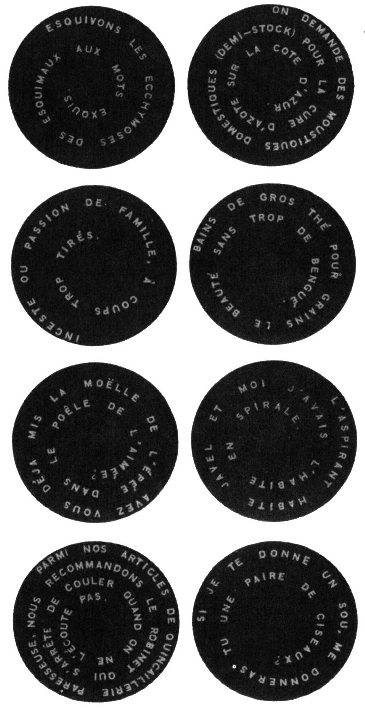
Figure 60.
Duchamp, Disks Inscribed with Puns (used in Anemic Cinema, 1926)
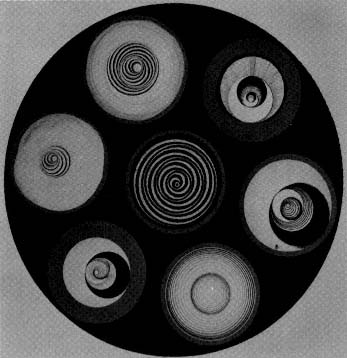
Figure 61.
Duchamp, Disks Bearing Spirals (1923)
the likelihood that Duchamp's objects were linked together in his mind by their common reference to a coherent and interconnected set of themes, the same issues of isolation, noncommunication, perpetuated desire, and liberated fantasy that we have seen evolving throughout his career and to which he gave fully developed expression in the exchanges between the bride and the bachelors. The apparently random and meaningless quality of these works has the same relation to the irony of the Large Glass that their inner thematic coherence has to its intricate play of conceptual relations. To have provided such a deeply linked body of work, its meaning veiled by irony and the appearance of random meaninglessness, was Duchamp's way to demonstrate how far he was from being bête comme un peintre .
In making these works, the perpetrator of Fountain was also continuing to chip away at the walls that enclosed art in a separate world of aes-
thetic purity, reclaiming that space as part of ordinary life. But why did he want to do this, and what should we take it all to mean? Two related answers have usually been given, both important, but neither, I think, quite appropriate to him. One speaks about reestablishing the tie between art and craftsmanship that had been severed by the romantic exaltation of the artist as some special kind of being; the other focuses on challenging the authority to define what is and is not art, which modern society vests in institutions like museums, galleries, critics, and exhibition committees.
Duchamp sometimes spoke in favor of considering artists to be ordinary people, involved like many others in the work of making things. He told Pierre Cabanne that he was suspicious of claims that attributed some unique power of creation to the artist.
He's a man like any other. It's his job to do certain things, but the businessman does certain things also, you understand? On the other hand, the word "art" interests me very much. If it comes from Sanskrit, as I've heard, it signifies "making." Now everyone makes something, and those who make things on a canvas, with a frame, they're called artists. Formerly, they were called craftsmen, a term I prefer. We're all craftsmen, in civilian or military or artistic life. When Rubens, or someone else, needed blue, he had to ask his guild for so many grams, and they discussed the question, to find out if he could have fifty, or sixty grams or more.[19]
It would follow from this that many more people are artists than ordinary use of the term suggests, just as a great many people once engaged in some kind of craft or handicraft. Adding in this way to the population of "artists" parallels expanding the range of objects that fall within the category of "art."
Yet Duchamp's participation in such a project was more limited than this avowal suggests. Other similar statements can be found in his writings and interviews, but they are easily outnumbered by attempts to identify art with ideas, metaphysical conceptions, the world of mind and imagination. He often decried ways of doing or valuing art that
emphasized sensual qualities, seeking escape from the "retinal" notions that made both realism and impressionism arts of visual experience and declaring his distance from the "olfactory" artists who found pleasure, as he did not, in the smell of paint. In 1960 he even gave a talk about why artists should have a college education (the event was part of Hofstra College's twenty-fifth anniversary celebration), arguing that they need to develop "the deeper faculties of the individual, the self-analysis and the knowledge of our spiritual heritage" through higher education.[20] Where craft-like images enter into his work—for instance, in the elements of the Large Glass produced by mechanical drawing—they are there to further the highly personal project of avoiding identification with a recognizable style, a goal they serve as much by the way they contrast with other, neighboring parts of the work as by any presumption of impersonality in the techniques themselves. A good illustration is the pointing hand in Tu m' : painted by a professional sign-painter, it works to heighten the overall sense of mystery conveyed by the picture, drawing attention to a world that has no communication with the ordinary realm from which the hand, like most of the other objects represented on the canvas (mostly by images of their shadows), comes.
When Duchamp expressed some sort of solidarity with craftsmanship, he echoed a venerable tradition that criticized art's separation from ordinary life, but without really sharing its goals. From the middle of the nineteenth century, artists and critics such as John Ruskin and William Morris in England, with their followers elsewhere, had bewailed the baneful effects of establishing art in a sphere of its own; for them such a division was part of the industrial reconfiguration of social life, consigning everyday experience to soulless ugliness. In their hands—especially in those of the socialist Morris—breaking down the barrier between art and craft meant putting pleasure back into work and beauty back into objects of use, restoring dignity to workers and raising them out of the subhuman condition imposed by the narrow and heartless regime of wage-labor. Duchamp may seem to be appealing to these projects when he calls the artist a "maker," but in fact he remained distant from them. Readymades were fit to serve the purposes he assigned to them just as they were, and his using them led to
no questioning of the conditions of modern industry, which he neither celebrated nor deplored.
In fact, as Kirk Varnedoe and Adam Gopnik have argued, modern industry and commerce had long been preparing, in their way, the conditions within which everyday objects were finding entry into the world of art. The rapid displacement of products from one setting to another undermined the assumption that certain kinds of things belonged only in certain contexts, and a whole variety of practices intended to attract buyers by emphasizing the aesthetic qualities of commodities had set up associations between industrial products and art. Shopfronts, department-store windows, fairs or expositions of furniture, automobiles, and electrical goods, and the whole range of advertising techniques developed since the middle of the nineteenth century were all occasions when claims for the aesthetic qualities of commercial objects were advanced, either explicitly or implicitly. The readymades played on these associations, partly in jest, but in part seriously too, extending the connections between display art and his own projects that Duchamp first recognized when he used the image of the shop window to meditate on the relations of desire and satisfaction that recurred in his work. The notion that art belonged to a realm "above" ordinary life owed much to traditional hierarchies once operative in society and culture, but which the upheavals of industrialization and democratization had already done much to weaken during the century before Duchamp's birth. The invention of readymades as a category of substitute art objects was, like many radical acts, an extension of changes already taking place, and its effectiveness lay partly in the way it drew conclusions from an existing situation that others had not thought to seize on, but whose force and appropriateness could be recognized once the deed was done.[21]
Similar considerations operate in regard to the way Duchamp's gestures worked to undermine the art world's structures of legitimation and authority. Fountain created a scandal, of course, just as Duchamp and his friends intended, but the proportions of the challenge contract when we remember that the exhibition to which it was submitted was set up to accept all comers; sending in the urinal was more a way of making the organizers face up to the full implications of their own
commitment to total artistic freedom than an attempt to champion innovation against tradition, and had the thing been widely seen it would probably have struck at least some viewers as an apt commentary on how far the exhibition's commitment to democracy had already stretched the limits of "art."
Neither Duchamp nor his coconspirators consistently denied the existence of genuine critical judgment or aesthetic standards. By 1917 his friend and patron Walter Arensberg was already embarked on building up a significant collection of modernist paintings, and he constantly relied on Duchamp for advice and judgment about what to purchase. Henri-Pierre Roché, with whom Duchamp began a lifelong friendship when the two met in New York in 1915, was by then operating as an agent and artistic adviser, counting among his contacts John Quinn, one of the most prominent American art dealers in the period before World War I and a major organizer of the Armory Show. In 1920 Duchamp would join with his friends Katherine Dreier and Man Ray to establish an organization they playfully named Société Anonyme, Inc. ("the corporation, incorporated"), dedicated to publicizing, exhibiting, and collecting modern art; over the years Duchamp served the group in many ways, eventually writing a series of savvy and generous catalogue entries about more than thirty artists in its collection. Throughout his life he would number collectors and curators among his friends, and at his death he left careful instructions about installing Given in the Philadelphia Museum, where Arensberg had arranged for most of his major works to be put on long-term display.[22]
The idea of the readymades, however, was only partly related to changes in the relationship between ordinary objects and art, or to an ongoing expansion of the category of what could be thought of as art. Duchamp's interest in everyday things had a much more personal side, one related to a comment he made to Pierre Cabanne: "I like living, breathing better than working.... Each second, each breath is a work which is inscribed nowhere, which is neither visual nor cerebral. It's a kind of constant euphoria."[23] Where did this euphoria arise? Duchamp pointed to the answer when he spoke in another interview about the pleasure he took in puns, saying he found them stimulating "both because of their actual sound and because of unexpected meanings at-
tached to the interrelationships of disparate words. For me this is an infinite field of joy, and it's always right at hand."[24] Duchamp treated objects in the same way he operated on words, making both of them peculiarly his by withdrawing them from ordinary use and fastening on features that could link them metaphorically to his own preoccupations. Ordinary objects, too, were right at hand, and dealing with them as he did made the world into an instrument for stimulating the organs of fantasy, just the relationship he pointed to when he said that he wanted to "grasp things with the mind the way the penis is grasped by the vagina"—a way that leaves logical reflection behind, that allows for constant slippage back and forth, and that produces a form of "knowledge" of which joy and euphoria are the accompaniments.
Duchamp's commerce with ordinary objects, and its meaning for modern culture, is illuminated by some observations made by Erich Heller in a classic, but no longer always remembered, essay. Heller examines the consequences for modern art of our culture's ever more complete loss of faith in the ancient cosmic assumption that human beings and the world they inhabit form part of a coherent spiritual whole, the belief that once allowed material objects in the world—the human body above all—to be regarded as vehicles of ideal meaning. In such a world, the world of Greek sculpture celebrated by writers such as J. J. Winckelmann and Friedrich Schiller, people could ascend to the heights of transcendence by following the lineaments of real life. But once that ladder collapsed, then the impulse to find meaning in the world was turned back on itself and forced to conduct its search for significance in the now-lonely spaces of the psyche, "in the pure inwardness of human subjectivity." This rise and fall has not taken place only once, and we might suggest that at least glimmers of the old faith returned in some of the forms Duchamp called "retinal," the realist and impressionist styles that found satisfaction in a renewed attempt to render directly the experience of a world that, in its wholeness, again promised to be (as Hegel would have said) "adequate to Spirit." Is this not why impressionist painting has become the classic art of modernity, why so many viewers continue to find satisfaction and nourishment in it?
Duchamp, however, found little sustenance in an art that rested on
such a relationship to the world. Heller describes the consequences of the loss of this relationship:
The classical artist did not have either to invent or carefully to choose the reality that was to receive the baptism of his spirit: it was there.... He moved in a world of, as Hegel puts it, "preconceived objectivities." ... But as the classical marriage between the true mind of the Spirit and the true mind of the sensuously real dissolved, the affairs of the spirit of art became ever more promiscuous and licentious; or, to speak more kindly of it, the artist became ever freer and more and more "creative." He found himself loose, and often at a loss, among the seemingly infinite potentialities of his choice. Anything, and ever more "anything," be it madonna or courtesan, saint or pagan, beast or thing, invited his fair attention, turning him into the Don Juan of the creative spirit
To find the reason for this promiscuity, Heller draws on T. S. Eliot, who named the symbols modern artists employ "objective correlatives," particularized equivalents for inner states, whose power over the imagination grows in response to the impossibility of finding life as a whole to be meaningful. Why do fragmentary and apparently random memories and images—for Eliot they were "the song of one bird, the leap of one fish ... the scent of one flower, an old woman on a German mountain path"—acquire the power to speak to us of things we cannot identify or express? Because they stand not just for particular moments of past life, but for the aspiration to experience transcendence as an instant of unbounded unity with the world, an aspiration that turns back on itself in feeling because it cannot find a resting place outside the self; such images "come to represent the depths of feeling into which we cannot peer." Quoting a line from Hofmannsthal, Heller reads it to say that "he who is without a home in external reality will entrust himself to any wave of inwardness to take him anywhere."[25]
Heller's formula calls up the paradoxical condition of the person who feels his homelessness as a matter of great comfort because it has taught him to experience the world as an endless series of opportunities for escape. Such a figure was Baudelaire, whose links to Duchamp we have
noted before; one of Baudelaire's most characteristic poetic refrains declared his departure to "anywhere out of this world." When Jules Laforgue celebrated Baudelaire at the turn of the century he emphasized the older writer's exemplary discovery of the poetic possibilities hidden in everyday objects and experiences, many of them long kept at bay by the border guards of literary and artistic life because they were said to inhabit the realms of evil and immorality. Baudelaire acknowledged that horrors lurked in these depths, but he also found some of his most exotic flowers there, objects and situations where it was sometimes possible to experience what he called in one prose poem "an infinity of pleasure in a single moment."[26] Duchamp took Baudelaire several steps further, creating an art whose language and materials receded into deeper recesses of privacy, finding joy in puns and tricks of language that turned objects into solvents of their own stability, and euphoria through inscribing the breath of his spirit in the "nowhere" that allowed the imagination to attach itself to objects on terms that were wholly its own.
Speaking to himself with radically simplified means of expression, Duchamp resembled a portrait of Mallarmé penned by the disabused symbolist poet Adolph Retté: "He dreams of a poem summed up in a strophe, of a strophe condensed in a line, of a line compressed in a word—that he would repeat to infinity and whose melody, appreciated only by himself, plunges him into inexpressible ecstasy."[27] In the face of all those who have seen in Duchamp the figure who cut whatever ties remained between the avant-garde and romanticism, severing art from its old matrix of personal feeling with the surgical knife of his irony, we must say that it is just the opposite: far from banishing inner experience, Duchamp's was an art of the most radical inwardness, turning the window of language into an opaque curtain behind which fantasy could shelter and accepting commerce with objects only to project the contents of his psyche onto them. Like Raymond Roussel, who built unheard-of worlds out of seemingly meaningless linguistic connections in order to illumine them with the penetrating—and highly eccentric—rays of his imagination, Duchamp was nowhere so personally present in his work as at those places from which all traces of personality seem to have been effaced.