
The Invisible Enemy
If PSC was an analytical construct designed to serve a political function, so too was Frankland's depiction of the probable morbid poison of water-borne diseases, the germ, able to increase its numbers rapidly, resistant to the elements, and wholly undetectable. Despite the early work of Pasteur, the experiments of Hallier and Thiersch in Germany, and the hypotheses of William Crookes, Lionel Smith Beale, and Robert Angus Smith on the cause of the cattle plague of 1865, in the late 1860s germ theories remained in about the same state of speculativeness as they had been when John Snow had published the second edition of his cholera pamphlet in 1855. What had changed was the background of expectation. The concept of specific diseases, each caused by a unique morbid poison, was more widely accepted: if no less speculative, germs were more plausible. During the 1866 cholera Frankland had considered the possibility that the exciting causes of cholera and similar diseases might be 'the germs
of organisms,'[22] and his superior, William Farr, who had already taken the step of positing and naming the particular cholera poison, had taken a similar view: what caused cholera was some extremely tiny particle 'at war with those that constitute man.'[23]
Neither felt a need to take a stand on whether the poison was obscure fermentation or belligerent cell; that is whether, from the modern viewpoint, the Liebig or the Pasteur model was the more accurate. There was no good way of choosing between these hypotheses, no consensus that the dichotomy was a real one, and in many respects it seemed not to matter. The Cattle Plague Commissioners had made it clear that the term 'germ' was to be used metaphorically, to represent a set of characteristics rather than an entity: 'the terms "germ," or "growth" are used because no better expressions can be found,' they wrote. 'They seem to imply an independent living existence of the poison, and on this point our knowledge is not yet sufficiently definite. Care must be taken that the terms used do not lead to erroneous conclusions.' Indeed, throughout the '60s and '70s the term 'germ' was an extraordinarily vague one; as J L W Thudichum pointed out as late as 1878, germs were eggs for some, seeds for others, 'shapeless ferments' for still others.[24]
The scheme of water analysis Frankland announced in the spring of 1867 could be justified alternatively in terms of germs or putrefying matter. Focusing on organic nitrogen made sense in terms of the zymotic theory since only nitrogenous organic molecules could acquire a dangerous form of putrefaction, but it also made sense in terms of a germ theory, since many felt that germs would require a congenial home of nitrogenous organic matter in which to 'vivify and develop' whilst in between human hosts.[25] In the next two years, however, Frankland did begin to recognize that living germs and putrefying matter differed in some important respects, and while for many years he would maintain that the identity of the agents of water-borne disease was not yet known, his analytical approach came increasingly to reflect the belief that living germs were morbid poisons.
By early 1868 Frankland had fully worked out his new scheme of water evaluation. He had introduced new techniques, new ways of interpreting results, and new formats for communicating conclusions to the public. The various aspects of this synthesis were made public in a lecture to the Chemical Society on 15 January, in testimony to the Water Supply Commission on 27 February, and in a Royal Institution lecture on 3 April. The January lecture detailed the new
combustion process for direct measurement of organic carbon and nitrogen in water developed by Frankland and his student H E Armstrong. Their process was a modification of the procedure normally used to determine the proportions of the elements in organic matter. In it the sample was slowly evaporated with sulphurous acid, a mild reducing agent, which would destroy nitrites, nitrates, carbonic acid, and carbonates, leaving a residue in which any remaining carbon and nitrogen could be assumed to represent organic matter. The residue was then placed in a combustion tube in the presence of lead chromate, an oxidizing agent, and heated to combustion. From the combustion gases the analyst could compute the quantities of organic carbon and nitrogen, with the determination of organic nitrogen needing to be corrected only for ammonia. Though simple in principle, the process demanded exceptional skill from the analyst, took two days to complete, and required equipment and facilities beyond what many analysts possessed.[26]
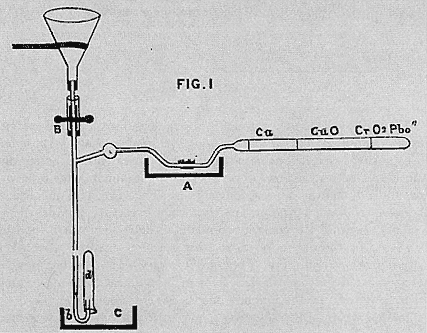
Figure 6.2
Edward Frankland's combustion apparatus for the analysis of the organic
nitrogen and carbon in water. The simplicity is deceptive. The cost of the
apparatus and skill needed to carry out the process meant that few chemists
used it (J Chem Soc 6 (1868): 90).
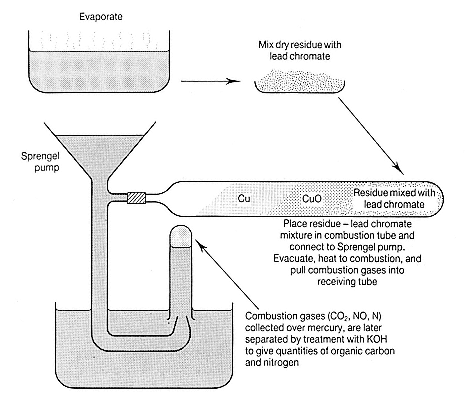
Figure 6.2
(continued)
Yet the revolutionary character of Frankland's analytical system lay less in new processes than in new principles, especially those for interpreting results. The combustion process was not to be simply another, if better, means for measuring the organic matter in a water. Indeed, analysis was no longer to be concerned with the actual discovery of water-borne poisons at all, nor even with the identification of indicators, the constant companions of those poisons. Instead it was to be the means of discovering a water's history of contact with dangerous pollutions. Previous Sewage Contamination, organic nitrogen, and particularly the ratio of organic nitrogen to organic carbon, were to be the indelible marks of that association.
In this scheme PSC acquired a new rationale. Since it was conceivable that living germs could survive even after the non-living sewage matter which brought them to the rivers or wells had decomposed, the presence even of such purified sewage (PSC) was a sign of immediate danger. As for the organic nitrogen and the N:C ratio, they yielded information about the source of the yet-
to-be-decomposed organic substances in the water. By early 1868 Frankland had decided that it was important whether this organic nitrogen was of animal or vegetable origin for the agents of disease were likely to be associated only with animal contamination. He believed that each class of contamination would produce a characteristic nitrogen:carbon ratio, and, in general, that the worst contaminations, sewage for example, would show the greatest proportion of nitrogen. Hence this ratio might be more important than the actual quantity of organic matter present.[27] In practice Frankland only considered the N:C ratio in questionable cases; with regard to London's water, known to be contaminated with sewage, he habitually treated all organic nitrogen as actual sewage contamination and ignored the accompanying carbon.[28] Here too, however, Frankland was not claiming that organic nitrogen was harmful, or even that water having a particular N:C ratio indicated that harmful matter had contaminated the water. It showed only that the water had at some time past been contaminated with dangerous matter that might become actively harmful at any time.
Frankland's designation of a water's history as the primary concern of the analyst may seem obvious to modern readers. If we want to know whether there is anything bad in the water it may seem common sense to ask where it has come from and what kinds of things are likely to have gotten into it. In fact, Frankland's move was not at all obvious, but required the linking of two discrete traditions, the indicator approach of the 1850s and the concept of contingent contagionism.
Those who had used indicator arguments in the '50s, like Hassall and Hofmann, had been concerned with discovering a measurable entity that was present when the danger was present, but they were not much concerned with how the noxious matter had come to exist in the water. Indeed, they often assumed that the danger in water was simply a condition of foulness that water assumed when it contained a high concentration of putrescible matter and a low concentration of oxygen. Frankland's move away from this perspective occurred only gradually over the course of several years. In late 1866 he had still been looking at water quality in this traditional way, arguing that the key index of quality was putrescibility and the key index of putrescibility was the level of dissolved oxygen.[29] But as he became more of a contingent contagionist, convinced that the dangerous matter was a discrete substance that had entered the water at a particular time and place, Frankland became more concerned
with finding the remains of substances that might have entered the water in the company of the dangerous matter. Increasingly, this would become the significance of the organic nitrogen measurement; it was a component of potentially germ-bearing sewage. Similarly, nitrates, nitrites, and ammonia would become important because they showed water had once been polluted and might still bear living germs. Thus no longer were indicators contemporaneous with the harmful substance; now they were to be regarded as fossil records of a dangerous event.
In early 1868 Frankland's conception of germs was still tenuous. In later years, he would continue to admit his ignorance of the nature of water-borne morbid poisons, but germs—germs with definite sizes and capabilities no less—emerged more and more prominently as a model of what morbid poisons might be like, a model which supported the conclusion that once-polluted water could never again be used safely. Vitality, for example, might be exactly the quality that would allow a morbid poison to maintain its virulence during the long flow between the sewage outfalls of upstream towns and the intakes of the London water companies. As an analogy he invited the Water Supply Commission to think of an egg floating down the Thames:
if you were to break an egg and beat up the contents, and mix them with Thames water at oxford, the organic matter so introduced into the Thames . . . probably would be entirely destroyed and converted into mineral matter before it reached Teddington [near the companies' intakes]; but if you were to throw an egg in without being broken, it would be carried down by the stream and would reach Teddington with its vitality undestroyed.[30]
The reason the public could find no security in filtration was that germs might be so small as to pass through filters: 'I should not be prepared to say that after any amount of filtration we should be guaranteed from the presence of those minute germs, which being smaller in some cases . . . than blood globules, would pass through the pores of the chalk . . . like human beings pass through the streets of London.'[31] These examples illustrate the use Frankland was making of the germ concept. It offered an argument that was irrefutable because germs were hypothetical; it was sufficiently vague to be adapted to a wide range of rhetorical requirements, yet concrete enough to convey a vivid image—of a poison resisting the elements, of a poison able to slip between the pores of a filter.