
The Struggle for Free Re-Export of Baltic Grain
Merchant capital for the Baltic trade came increasingly from Amsterdam, and many of the skippers for the "eastbound" or Baltic trade were based either in Amsterdam or in the villages of Waterland, just across the IJ. But its benefits and implications ramified throughout the province, more so than any other commercial activity. The West Frisian ports of Hoorn and Enkhuizen had a stake in the Baltic trade, as did Delft because of its harbor,
Delfshaven. The shipping industry, centered in villages north of the IJ, was directly dependent on the need for "eastwarders." Holland shipwrights could produce forty caravels a year, to maintain an ocean-going fleet estimated at 400 vessels, not counting herring busses.[16] Officials from Brussels apparently viewed arguments in behalf of the Baltic trade as reflecting only the selfish interest of Amsterdam, for they seemed puzzled when other members of the States, sometimes even the nobles, lined up behind Amsterdam. When Leiden's deputies to the States were asked by government commissioners why they supported Amsterdam's position on the Baltic grain trade, they replied that if the Easterlings (north Germans) brought their grain to England instead, they would not be bringing Leiden cloths back home.[17] The herring fishery also depended in part on Baltic markets; herring was caught and processed on busses from Enkhuizen or Schiedam, packed into barrels at Haarlem and sold to Easterling merchants from the wharves near Amsterdam's Haarlem gate.[18] As for towns like Gouda and Dordrecht, traffic along the binnenlandvaart that was so vital to them would have been far less were it not a link between Antwerp and the Baltic.
One must distinguish at the outset between the underlying vigor of Europe's Baltic trade and Holland's strong yet precarious position in that trade. The single most important source of information on the flow of trade is the toll register for Denmark's Øresund, the channel passing from the North Sea into the Baltic between the then Danish province of Skåne (now part of Sweden) and the island of Fyn. Westward voyages through the Sound as recorded in the register rose from a combined total of 2,017 for the first two years on which information is available (1497 and 1503) to annual averages of 1,853 for 1537–1539 and 2,410 for 1557–1559. For 1497 and 1503 together, Netherlands shipping accounted for 70 percent of the west-bound voyages, and ships based in northern Holland accounted for 78 percent of this total. Though rising steeply in absolute numbers, Netherlands voyages over these decades declined as a percentage of the total, to 52 percent in 1557–1560, while shipping from the Wendish cities, including Lübeck and Hamburg, increased dramatically on a percentage basis.[19]
One can thus envision trade between north Germany and the
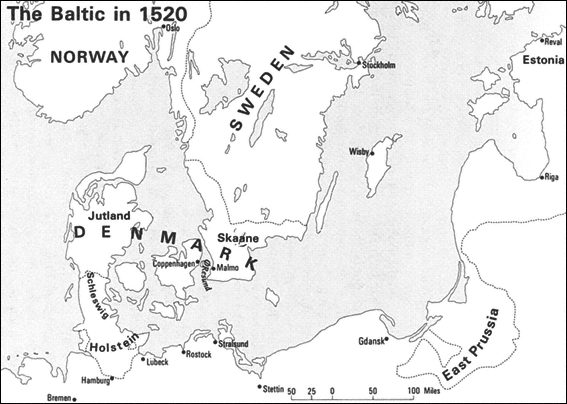
Map 2.
The Baltic in 1520
Netherlands as a series of overlapping arcs. Holland vessels entering the Baltic called mainly at Danzig and other towns in Prussia and Livonia—towns that in the fifteenth century had welcomed an alternative to shipping their goods by way of Lübeck and Hamburg. Lübeck skippers sometimes called at Amsterdam—indeed, one of the inns for north German merchants on Warmoes Straat was called Lübeck Arms. More likely, they eschewed the binnenlandvaart through Holland and chose the more dangerous but nonetheless traditional route through the English Channel to the Scheldt estuary, thence to Bruges where the Hanseatic League had long had its staple. As for Germany's North Sea ports, Bremen seems to have specialized in bringing grain from its own Weser valley hinterland to Amsterdam. Hamburg's ships might first enter the Baltic to take on grain, then choose among three possible destinations: Amsterdam, Bruges, or Antwerp.[20]
There is no series of data that permits comparison of the relative volume of traffic along these various arcs, but from arrangements made for the dowry of a Danish king, one can see how contemporaries judged the participation of various Lowlands provinces in the Baltic trade. When Christiern II (1513–1523) married Isabella of Austria, one of Charles V's sisters (1514), he was promised a dowry of 350,000 Holland pounds. But dowry installments were not paid, and when Christiern seized Holland ships in the Sound (1519), the Netherlands government agreed to have payment of the dowry secured by the ordinaris beden of four provinces. Holland was assigned payments of 20,000 per year; Brabant, 11,000; Zeeland, 10,000; and Flanders, 9,000. This apportionment recognizes the unique importance that the Baltic trade had for the entire province of Holland—it alone had all of its "great cities" individually assessed—but it also shows that Holland's stake in the total Netherlands Baltic trade was reckoned at less than half.[21]
In effect, Holland had potential rivals within the Habsburg Netherlands as well as in the Baltic, and its place in the Baltic trade depended on trading habits that were by no means fixed. If the Netherlands government imposed fiscal exactions on the vital grain trade, north German merchants might decide to
avoid the Netherlands altogether and take their goods elsewhere. Lübeck, always hostile to Holland, could at times induce the King of Denmark to close the Sound to Netherlands shipping, or, worse still, to ships from Holland, while allowing those of Brabant and Zeeland to pass unmolested. Closer to home, the great merchant-bankers of the southern Netherlands might wish to contract in the Baltic for large grain purchases to be shipped directly to Antwerp or even to more distant markets, such as Lisbon, thus bypassing Holland and its binnenlandvaart . One way or another, there were few years in which the States of Holland did not have cause for concern.
Officials in Brussels could hardly be blamed for regarding Holland's Baltic trade as a resource for the entire realm. Jean Ruffault, the Treasurer-General, argued that Amsterdam's privilege for the free re-export of grain (granted by Maximilian I in 1495) must be set aside in order to ensure supplies for the other Netherlands provinces. Margaret of Austria twice forbade Hollanders to export any grain except by purchase of a special license, or congie, but both times the edict was soon withdrawn. Yet the patient Ruffault, so Andries Jacobszoon claimed, admitted to a personal stake in plans for a congie .[22] Moreover, Flanders and Artois, which had their usual sources of grain cut off in time of war with France, had special access to Charles V in Spain, since the two Netherlands members of his council there were Lodewijk van Vlaanderen, lord of Praet (descended from an illegitimate line of the old counts of Flanders), and Adrien de Croy, count of Roeulx and Stadtholder of Artois.[23] In Mechelen, Margaret of Austria was persuaded that the traditional liberties of Holland's commerce were an affront "to the sovereignty of the Emperor in his native provinces."[24] Thus while Ruffault drafted plans for administering the congie, the Regent proclaimed (January 1527) a ban on all grain exports until officials could be appointed to take inventory of existing stocks and collect the export license fees.[25]
Ordered by the Regent to publish the ban on grain export, the Council of Holland took the risk of delaying publication in order to summon, on its own authority, a special meeting of the States. Haarlem seemed unwilling to oppose the Gracious
Lady's will, but Delft and Dordrecht deferred to Amsterdam, as the other cities usually did on such matters. On this occasion one of Amsterdam's burgomasters outlined the dire consequences of a congie: if the new edict were published, prices for spring grain in the Baltic would immediately jump, and rich speculators could drive prices still higher by buying up export licenses to control the market.[26] The States sent a delegation to Mechelen where Jean Carondolet, President of the Privy Council told them that although it had cost him much "trouble," the Regent had agreed to drop the idea of sending commissioners to Holland to take inventory of its grain stocks. A year later, however, Commissioner Jan Pelt arrived in Amsterdam demanding access to grain stored in the attics of patrician houses. But this was a time when the government desperately needed funds for a spring offensive against the Duke of Guelders and his allies. In return for the States' agreement (February 1528) to raise 80,000 pounds by a sale of renten, both Hoogstraten and Margaret of Austria gave assurances that Hollanders would be "contented" in the matter of the export licenses. Thus when Jan Pelt began actual collection of the congie at Dordrecht a few months later, an embarrassed Stadtholder sought to excuse himself by an analogy that fisher folk might understand: "the court is like an eel." The real problem, he said, was that the Emperor was not about to surrender a levy that promised to yield 60,000 pounds a year.[27]
Pelt was apparently ordered to suspend operations for the duration of the current war, but once peace with France was concluded (November 1529), he renewed his collections on the Maas, and, for the Amsterdam trade, stationed agents at the "sea gates" where ships passed from the Zuider Zee channels into the North Sea.[28] Meanwhile, Frans de Wet, Receiver for the Zeeland Toll and a sometime Haarlem burgomaster, obtained from the Privy Council a new interpretation of his prerogatives, permitting him to tax incoming goods belonging to foreign merchants unless intended for consumption in Holland—for example, sea salt and French wine intended for re-export to the Baltic. Hoogstraten believed the Hollanders might have grounds for an appeal to the Grand Council of Mechelen, since the Privy Council made its decision without hearing their side, but he himself
would not support such an appeal: "it were better for the Emperor to have no beden in Holland than for the cities to continue in the freedom from tolls they have hitherto enjoyed." While Frans de Wet "pestered" certain sea captains, who wrote to Amsterdam for "solace and support," a delegation from Holland failed even to obtain a copy of the new regulations. Aert van der Goes, Advocate of the State, had apparently presented their request in a manner that the Privy Council deemed "bitter."[29]
Just at this time, the States were being asked to "anticipate" payment terms on two extraordinaris beden, which meant raising by various means a sum in excess of 100,000 pounds. Andries Boelens and Cornelis Bennink, two of Amsterdam's leading merchant-statesmen, told Hoogstraten that their colleagues would not consent to these requests without concessions on both the congie and the Zeeland Toll. At this assertion the Stadtholder flew into a rage: "Who do you think you are? I will take a plank as thick as my hand is long, and lay you out flat as one of these boards in the floor"! But the men of Amsterdam knew from previous experience of the Stadtholder's "hard words"[30] that one had to wait for the calm that followed a storm. To obtain the votes he needed in the States, Hoogstraten had to agree to have a commissioner of inquiry appointed to collect information concerning the likely effects of a congie (see the following paragraph);[31] he also persuaded his colleagues on the Privy Council to remand the Zeeland Toll dispute to the Grand Council, which, as expected, eventually decided in Holland's favor. The States helped out by agreeing to "corrupt" Treasurer-General Ruffault, who was seen to be Frans de Wet's chief ally in the Privy Council and who was apparently contented by a gift of 1,000 pounds.[32] (In such cases, it was usually the Stadtholder who advised the States on who should receive "gratuities"; the money came from the omslagen that the States regularly collected for their own purposes.)[33]
Meanwhile, Jan van Duvenvoirde, lord of Warmond and a member of the Council of Holland, collected testimony from forty-eight individuals knowledgeable about the Baltic trade, including Antwerp financiers and merchants from Baltic cities. His report, published in 1922 by P. A. Meilink, is an impressive argument for Holland's case. Time and again, Warmond's infor-
mants reported that merchants in the cities that sent grain to Amsterdam—Danzig, Hamburg, and Bremen—were extremely sensitive to novel fiscal exactions and were even now avoiding Low Countries ports. For example, at the mere rumor of a congie, twenty-eight Bremen grain ships were said to have sailed for England, not Holland.[34] Easterling merchants were also taking occasion to sail directly to Lisbon. Ordinarily, it was cheaper to move goods to Iberia by way of the Low Countries, for Netherlands skippers who might otherwise go in ballast to take on salt in the Bay of Biscay were glad to offer low rates so as to have a cargo for their outbound voyages.[35] Now, however, Baltic skippers were taking on Netherlands pilots, even at double the normal wage, for the unfamiliar waters south of the Scheldt estuary. This willingness to venture into unknown seas is understandable in light of the impact an export license fee would have on the slender profit margins of the Baltic trade. For a last of rye (eighty-five bushels) costing some twenty-five pounds, merchants might expect a profit of twenty-four stuivers (1.2 pounds) upon delivery in Antwerp, after paying six stuivers in toll fees on Holland's inland waterway. But the congie would mean a surcharge of eighteen stuivers. Hence no less a personage than Erasmus Schetz, one of Antwerp's premier merchant-bankers, found it worthwhile to hire three large vessels in Middelburg (Zeeland) to go in ballast to Bremen and thence bring grain directly to Lisbon.[36] More than a dozen of Warmond's witnesses testified to another transaction in which the King of Portugal's factor in Antwerp sent the Portuguese humanist, Damião de Gois, to the Baltic to take delivery on 1,500 last of rye bound direct for Lisbon.[37] One has the clear impression, doubtless intended by Warmond (a loyal Hollander), that Holland's middleman role in the grain trade was at risk.
To help steer Warmond's report through the Privy Council, Hoogstraten coached Aert van der Goes on how to speak "graciously and humbly" to the great lords,[38] but only Charles V himself could decide the issue. When the Emperor arrived in Brussels (February 1531) to inaugurate the regency of his sister, Mary of Hungary, there was discussion within the States of Holland about requiring abolition of the congie as a condition not merely for a new extraordinaris bede, but even for renewal of
the current ordinaris bede . Yet this was the occasion on which the Emperor appeared in person to order his subjects in Holland not to "bargain" with their sovereign; rather they should grant unconditionally what was asked and "trust" in his love and affection for them.[39] With an Emperor who spoke in this fashion one did not quarrel. But Hoogstraten was busy behind the scenes distributing gratuities to Francisco de los Cobos and Nicholas Perrenot, lord of Granvelle, the two most influential members of Charles's inner circle. Care was taken to ensure that a speaker of Dutch would be present when Warmond's report was discussed in the newly formed Council of State, and a map was prepared so that the Emperor might see how ships sailed "out and around" from Amsterdam. As a result, the question was remanded to the Grand Council of Mechelen, which in this case too pronounced in favor of Holland's established privileges and thus against the congie .[40]
In 1535 Mary of Hungary issued a new ban on grain export, though the Council of Holland again refused publication. This time, hoping to take advantage of well-known divisions within Holland, Treasurer-General Ruffault caused to be inserted in the Grand Council's 1531 decision a clause providing that only Baltic grain was exempt from export duties, not the grain that came from the Rhineland to be exported via the Maas. In response, Hoogstraten advised the States to "make friends" with IJsselstein's son, Maximiliaan van Egmont, the young Count of Buren, and Reynier van Nassau, the young Prince of Orange.[41] The States also drew up a memorandum explaining that if north Holland lost its seafaring trade, the Emperor would not have at his disposal, in time of war, the 400 ocean-going ships of Amsterdam and Waterland, a fleet more numerous, it was said, than the combined fleets of England, France, and Brittany.[42] Once the great lords had been properly "corrupted" (a term used in the States, not by Hoogstraten), the Council of State took up the issue. President Jean Carondolet confronted Ruffault with his alteration of the 1531 Grand Council decision (no light matter for an official of the Habsburg state), and Orange told Philippe de Lannoy, lord of Molembaix, that he and his colleagues on the Council of Finance would "regret it" if they did not deal with Holland as the majority of the great lords wished. When Mary of
Hungary was to communicate to Charles V the Council of State's favorable decision, Hoogstraten and Buren insisted on seeing a copy of the letter before it was sent. Simultaneously, the States of Holland drew up a list of those to be rewarded: 400 wagenschot of fine lumber (wainscoting) for Hoogstraten and Orange, and smaller amounts in wood or cash for five others.[43] The key to the victory of the States on this occasion was their success in appealing to powerful men like Buren and Orange as ingelande[44] or landowners having a personal stake in Holland's well-being. This common front against the congie marked the beginning of an era of good feelings between States and great lords, whose cooperative efforts the same year sought to prevent Holland from being harmed by the government's Copenhagen project (see the following section).
Some years later, political circumstances permitted Ruffault and the Council of Finance to try the congie yet again, albeit under a different name. Charles V's personal appearance in the Netherlands to suppress a rebellion by the powerful city of Ghent (1540) allowed the Regent and her Councils to act with unwonted firmness when other towns proved refractory. Moreover, Lodewijk van Schore, an able administrator with an exalted conception of princely prerogative, had recently succeeded Carondolet as President of both the Secret Council and the Council of State.[45] In Holland, the influential Hoogstraten (d. 1540) had been replaced as Stadtholder by the still young and inexperienced Reynier van Nassau. Also, the great cities may have been more divided among themselves than usual because of the recent (and long-delayed) verdict by the Grand Council in favor of the Dordrecht staple; for whatever reasons, Dordrecht's deputies broke precedent by refusing (at least initially) to join the other five cities in opposing an export duty on grain. At the same time, Amsterdam's long-time ruling faction (including men like Cornelis Bennink and Ruysch Janszoon) had been replaced by a rival group, the so-called Hendrik Dirkisten, who were not only inexperienced but perhaps a bit scornful of the normal ways of doing business at court.[46] Thus when Holland's great cities were told (November 1540) that an exit fee (exue ) would henceforth be levied on the re-export of "eastern" grain, the States could think of nothing better to do
than to forward to the Queen a formal protest delivered to the Amsterdam city hall by merchants from Danzig and Hamburg, adding a comment of their own: "The Easterling is by nature a hard man, and above all others loves freedom in his trading . . . . He will altogether not abide any new impositions." To deliver this message, the States sent a delegation "upcountry" to hold discussions with the Regent and her Councils, but did not distribute gratuities to the great lords. The deputies sought help from the Prince of Orange, only to learn that the Queen had forbidden him to meddle in this matter.[47]
Amsterdam now sent its own officials to Antwerp and Zeeland to duplicate the kind of information that Warmond had collected in 1530. But "certified" reports that 150 Easterling grain ships had already bypassed Holland during the current sailing season were not sufficient to forestall the moment that Amsterdam had long dreaded. On 2 October 1541 a collector for the grain exue, whom the city fathers had managed to hold off for two months, called at the house of a prominent grain dealer to begin his inquest about grain exported from Amsterdam since the November edict. The collector was told the man he sought was not at home, and when he returned that evening, as announced, a riot broke out, forcing the burgomasters to open one of the town gates to permit the Emperor's tax collector to escape with his life. Amsterdam claimed that this untoward disturbance was provoked by "unknown louts," but the government had information naming eleven men as participants in the riot, including several prominent merchants and grain dealers. While Schore drafted a letter listing the penalties Amsterdam must suffer "to repair the injury done to the Emperor," a delegation from the States, hoping still to discuss the grain exue, was refused a hearing in the Secret Council, owing to the "shameful treatment" meted out to his majesty's tax collector. But all was not lost. After distributing wine worth 420 pounds to six great lords, the States worked out an agreement by which the Emperor would be compensated for his "interest" in the grain export fee by a special extra payment of 25,000 pounds, of which Amsterdam paid half. Meanwhile, friends at court had already told Aert van der Goes that no second collector would be sent to Amsterdam, since (understandably) no one
could be found to take the job. In the end, the exue plan was defeated not by any great political skill on the part of Amsterdam's newly installed ruling faction, but by fierce devotion to the city's privileges on the part of ordinary men and women who filled the streets on the night of 2 October and nearly killed the Emperor's tax collector.[48]
Nonetheless, Mary of Hungary's government refused to abandon its efforts to subject the vital grain trade to some centralized control. In 1545 because of a scarcity in the southern provinces, the export of foreign grain was again prohibited. This time the nobles broke the usual unanimity of the States in opposing such measurers, as Dordrecht had briefly done in 1540. But with help from Granvelle, who was rewarded for his efforts, the States received permission to bring suit before the Grand Council, that stalwart upholder of lawful privilege. Meanwhile, the grain measures of Delft sat patiently in prison rather than providing the information required of them according to the Queen's edict. In the chambers of the Grand Council in Mechelen, government attorneys tried for over a year to prevent Warmond's report of 1530 from being accepted as part of the documentation. When the Grand Council finally ruled in Holland's favor once again (1548), the States seemed to take the result for granted; "for the honor of Holland" they refused to authorize anything more than the usual token gratuities for members of the Grand Council. But Amsterdam subsequently called attention to the fact that the States had not received their official copy of the judgment. As late as 1555, pertinent sacks of documents were still being held by the Secret Council, despite letters patent commanding their release to the secretary of the Grand Council, whose duty it was to engross the official copies of a judgment.[49] Clearly, there were those close to the Regent who continued to view Holland's commercial liberties as inimical to the Emperor's prerogatives, even if they were unable to translate their wishes into law.