
Drug Testing in the Disciplinary Technology of Power
The economic sanction of job jeopardy is only part of a larger answer to the question of how drug testing, relying as it does on negative, private sanctions, can be an effective mechanism of social control. The subtler but more fundamental part of the answer pertains to Foucault's theory of the disciplinary technology of power, a method of social domination that relies on constant surveillance to detect individual deviations from expected standards of behavior at an early stage, when they may be quickly and easily rectified. The surveillance is part of "descending individualization," Foucault's term for the general set of circumstances in which increasingly sophisticated techniques allow detailed and comprehensive information about each member of society to be gathered, stored, and easily retrieved.[29] As is true of lie detection, drug testing also constitutes an advance in surveillance techniques over primitive forms such as the panopticon. Particularly with random testing, there is no need to keep people under constant surveillance. They must conform their behavior to expectations even when no one is watching, because they know that they may be called on at any time to provide a urine sample that will reveal what they have been doing.
Drug testing is particularly relevant to Foucault's ideas about how, over the last few centuries, the power to control and coerce people's behavior has operated in collusion with knowledge.[30] Science—especially medicine—has generated immense amounts of knowledge about physical and mental disease, growth and development, deviance, and other human conditions previously known only dimly, if at all. This knowledge took the form of rich new discourse about these conditions: definitions of what they are, methods for identifying them, theories about what produces them, proposals for what might be done about them. In some cases, such as female hysteria and child sexuality, it is likely that the conditions or pathologies did not even exist prior to discourse about their diagnosis and treatment produced by expanding knowledge.[31] Knowledge about human normalities and pathologies enables power to intrude more intimately into people's lives.
It establishes standards or norms for physical, mental, and behavioral conditions of all sorts. It encourages frequent examination of individuals to ascertain if, where, and how they deviate from those norms. It licenses interventions in the individual's body, mind, and behavior for the purpose of maintaining and enhancing those aspects that are decreed to be normal and for treating those that are identified as disorders. These interventions are done to people for their own good, it is claimed, but nevertheless they constitute the exercise of power over them.
Drug testing fits this pattern perfectly. Urinalysis has been developed as a practicable means for gaining knowledge about individuals' drug use habits (and the future promises even better methods, such as testing hair). Drug use has been identified as a serious disorder for the individual and for society—with ample testimony of ruined lives and the violence of criminal drug distribution networks to prove it. This is used to justify the inspection of individuals by means of drug tests and interventions in the form of prevention and treatment (or failing that, exclusion) in the lives of those who test positive. One example is a bill, introduced into the 1992 Kansas legislature, aimed at reducing the number of "crack babies." The bill would require a woman convicted of a felony drug offense to be implanted with a Norplant contraceptive device as a condition of probation. The device would not be removed until random drug tests certified that she had not used drugs for a period of a year. The exercise of power in this particular plan is too blatant for most tastes: critics labeled the bill unconstitutional, discriminatory against women, and ethically repugnant, and it was turned down unanimously in committee.[32] It signals, nonetheless, a possible future.
More successful applications of disciplinary power come in less obviously punitive packages. Foucault stresses that many deviations (mental illness, sexual maladjustment, juvenile delinquency, etc.) are viewed as disorders deserving treatment rather than crimes demanding punishment. He goes on to discuss how the forms of treatment are considered to be helpful interventions that provide individuals with the opportunity to extinguish deviant behaviors that are deleterious to themselves as well as society. Only after strenuous efforts at treatment have failed are
incorrigibles excluded from normal society, often by incarceration in an insane asylum or prison.[33]
These attitudes and practices are readily apparent in drug testing programs. Corporate policies (I will quote from one) often stress the company's "caring attitude" toward the well-being of its employees, its "sincere interest in making the workplace as safe as possible and to assist employees to rid themselves of dependency problems." The test-intervene-retest regime is designed to achieve those goals, and officials in employee assistance programs work hard to ensure that the indicated treatment is available and that the troubled employee takes advantage of it. It is also true, however, that drug testing may eventually result in exclusion. Under the job jeopardy model, as discussed already, drug-using employees or athletes who fail at rehabilitation (as demonstrated by a positive drug test after returning to work) are likely to be fired or dropped from the team, and those with positive preemployment test results are not hired. Although each instance of exclusion is from a single organization, it is in principle possible that a drug user might experience a series of rejections based on drug tests from different organizations and eventually be excluded from the employed, self-sufficient sector of society altogether.
Although drug testing displays many of the features that Foucault identifies with the disciplinary technology of power, it appears to deviate in one respect. According to Foucault, the disciplinary technology achieves greater efficiency and economy in the application of power than any previous regime. This is true enough when drug testing is compared with a crude mechanism of surveillance such as the panopticon, but the efficiency of drug testing appears nevertheless to leave much to be desired. Massive numbers are tested, but the rate of positive results hovers around 4 percent. That means that for every individual who faces some sort of action or treatment because of a drug test, some twenty-four others test negative and nothing is done with reference to them. Testing twenty-five to locate one is anything but efficient. Nor is it economical. If an organization with a 4 percent positive rate contracts for drug testing at the rate of, say, $26 per test, the cost per positive test result comes to $650.[34]
But this reasoning stems from the assumption that drug testing is exclusively concerned to identify people who use drugs. In fact, there is much more to it than that. Consider a "for-cause" testing policy (under which individuals are tested if their behavior suggests that they are under the influence of drugs or alcohol). To apply a for-cause policy effectively, it is necessary that supervisors notice abnormal behavior. To this end, they are trained to recognize signs of drug-impaired behavior and admonished to observe workers under their supervision. But such observation extends beyond drug-related issues, because the alert supervisor is likely to notice a variety of deviations from mandated behavior in addition to those possibly caused by drugs. Figure 4, which details how supervisors should proceed in deciding whether to take disciplinary action in any circumstance, is an outstanding example of the emphasis placed on general surveillance in the workplace. Note how the "default mode" of the system is "observe employee behavior." The process begins in that mode, and at every point, whether disciplinary action is taken or not, the system returns to it.
In actuality, employees normally respond more positively to a for-cause testing policy than to periodic or random testing, because it limits testing to situations where the employee's on-the-job behavior provokes reasonable suspicion that something is amiss. I myself endorsed it as the most acceptable form of drug testing, for the same reason: managers and fellow employees certainly have the right to expect that workers will show up for work in a condition to do their jobs competently, especially when considerations of safety are involved. Nevertheless, the stepped-up observation procedures connected with a for-cause policy of drug testing also serve to extend the general surveillance so essential in a disciplinary technology of power. This is one of several examples of how, in testing, discipline and control are ingeniously packaged in forms made palatable to those brought under their sway—and where even an analyst who is generally critical of the expansion of disciplinary power, such as myself, is constrained to condone it.
There is more. Although the low rate of positive results appears to render drug testing an inefficient means of exerting power,
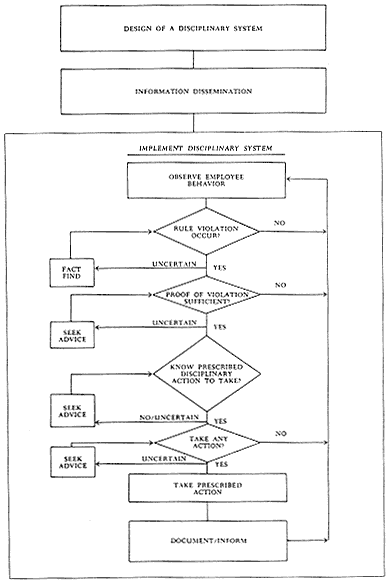
Figure 4.
Steps in the disciplinary process. From McAfee and Chadwick.
"Evaluating an Organization's Disciplinary System," Human
Resource Management 1 (1981):33. Reprinted by permission of
John Wiley & Sons, Inc.
there may be another way of looking at it. If we attempt something akin to figure-ground reversal, we could imagine drug testing to be oriented as much toward the negatives as the positives. That is to say, drug testing might achieve some important result for the 96 percent whose tests do not indicate drug use. If that were the case, our assessment of its efficiency and economy would soar. But what might that result be? It seems that nothing much happens to those with negative test results. If the intention was to hire them, they are hired; if they are already employed, they return to their jobs. Yet I argue that so far as its overall social consequences are concerned, the effect of drug testing is at least as important for those who test negative as for those who test positive.
It has already been indicated that drug testing (particularly random testing) serves to control people's behavior even when they are not under direct surveillance. The possibility that they might be tested at any time is sufficient to prevent some people from using drugs. Therefore, drug testing has a significant impact on them, even when test results show them to be drug-free. More than deterrence is at issue, however, for certainly most people who test negative do not refrain from drug use out of fear that they will be caught by a test. They simply do not want to use drugs and would refrain from using them whether they were subjected to drug tests or not. Does drug testing have any important effect on them?
I think that it does. The reasoning is grounded in Foucault's contention that the disciplinary technology of power produces individuals characterized by "automatic docility." Disciplinary training operates by drill. People are induced to perform specific acts repeatedly, until they do them automatically, by second nature. No effort is made to get them to see the overall picture, to understand the rationale for what they are trained to do. They are conditioned to perform the minute particulars correctly, unthinkingly. If they do that, the resulting totality will come right whether the participants envision it or not. More generally, this type of training develops individuals who are ready to submit without question to new drills that may be handed down. The disciplinary technology of power, that is to say, tends to develop people who are conditioned or disciplined to be automatically docile.[35]
My hypothesis is that drug testing is a disciplinary drill and that those who readily acquiesce—even approve of it—are conditioned to automatic docility. This hypothesis may be applicable to student athletes. It has already been discussed, in chapter 4, how athletes state that they are willing to submit to drug tests because they see it as a means to prevent others from gaining unfair competitive advantage from performance-ehancing drugs. When I discussed possible reasons for the high rate of acceptance of testing among student athletes with a university athletic department official, however, he added another dimension to the issue. He said that coaches make it clear that they must undergo drug testing, and he continued that student athletes do not usually question what they are told to do by their coaches and others in authority. Applying Foucault's terminology, we might say that one reason why student athletes readily accept drug testing is because they have already developed a measure of docility (probably from long experience obeying the commands of coaches in high school, junior high school, little league, etc.). Empirical support for the hypothesis is provided by data from my questionnaire, particularly in the contrasting attitudes expressed by student athletes and trainmen. One question inquired into reactions to one's most recent drug test, the respondent being asked to check possibilities such as "unconcern," "worry," "embarrassment," and "anger." People who submit to drug testing with automatic docility would manifest rather bland attitudes about it; on this question, they would be expected to mark "unconcern" more than the other possibilities. The difference between student athletes and trainmen was considerable: 77 percent of the former reported an attitude of unconcern as opposed to 33 percent of the latter, while the latter much more commonly indicated negative responses such as worry about the possibility of a false positive result (51%, compared with 6% for student athletes) and anger at the distrust implied by testing (trainmen 33%, student athletes 7%). (For full results, see Appendix, table 3). Again, people who are conditioned to submitting to drug testing with automatic docility are likely to express little opposition to the prospect of being tested in the future. The questionnaire asked if experience in an organization that conducts drug tests (as both the railroad
and the university do) would make one more opposed, less opposed, or have no effect on one's attitude toward taking future drug tests. The responses again revealed a marked contrast between trainmen and student athletes. Of those who have taken one or more tests, 22 percent of the trainmen but only 4 percent of the student athletes indicated that they would be more opposed to taking future tests, while only 13 percent of the trainmen but 49 percent of the student athletes stated they would be less opposed (see Appendix, tables 6 and 7).[36]
While drug testing acts to reinforce the automatic docility people already have, it can also, more important, be understood as a drill that develops automatic docility. The optimally disciplined and docile population will submit to any demand or directive without seeking to know a rationale or justification for it. Those forms of drug testing that are done in the absence of reasonable suspicion of drug use constitute good training for this. Random testing is particularly apt because its demands are entirely arbitrary: the essence of randomness is that there simply is no rationale for why one number should come up rather than another. In one chemical plant I studied, when the randomizing computer program produces a number, the employee corresponding to it is immediately summoned. The worker is expected to go dutifully to the medical department, and immediately to produce a urine sample. Given the randomness of the system, some employees have been tested several times, while others have yet to be called. This apparent disparity has provoked complaints, but management anticipates that these will subside as people become accustomed to the system. If and when that should occur—if people come to provide a urine sample for testing at the summons of an arbitrary, random selection procedure as readily and unreflectively as they now reveal date of birth and social security number to almost anyone who asks—the development of automatic docility will have taken a great step forward.
In an effort to test this aspect of the hypothesis, the question about attitudes toward drug tests appeared twice in the questionnaire. Subjects were asked to mark any of several responses describing their reactions to their first drug test, and the next question (directed to those who had been tested more than once)
was identical except that it referred to the most recent drug test. The hypothesis that drug testing is a means of developing automatic docility would predict that attitudes toward the most recent test would be less intense (more "unconcern" and less "worry," "embarrassment," "anger," or "satisfaction") than those toward the first test. The data from these questions (set out fully in the Appendix, tables 4 and 5) support the hypothesis. For example, although trainmen manifest considerably less docility in the matter of drug testing than do student athletes, a shift in that direction is evident among trainmen as they are tested more frequently. Of the trainmen who have taken three or more drug tests, 25 percent remember facing their first test with unconcern, while those unconcerned about their most recent test swelled to 34 percent; fully half of them were worried about a false positive result when they took their first test, but just 38 percent of them continued to worry about that in their most recent test; 44 percent reacted to their first test with anger that drug tests invade their privacy, while those reporting that feeling at their most recent test dropped to 34 percent. However, the question that asked if the experience of belonging to an organization that conducts drug tests would make one more or less opposed to taking them in the future produced ambiguous results for the hypothesis that repeated testing increases automatic docility (see Appendix, tables 6 and 7).[37]
Interestingly, so far as its contribution to the development of automatic docility is concerned, drug testing has nothing to do with drugs. The important thing is to train people to submit readily to being tested; just what is being tested and the results are beside the point.
The application of disciplinary power increases in economy and efficiency with automatic docility because the more docile the populace, the less the resistance to power. If we examine them from this perspective, certain initially curious drug testing programs and proposals become more intelligible. A case in point is Chicago's St. Sabina Academy, a Catholic school that began random drug testing of all children in grades six through eight in 1990. In an interview, an official of St. Sabina parish told me that drug abuse is not presently a problem in the school. However, it
is a serious problem in the neighborhood and church, and community members have been active in their opposition. They have exposed drug dealers in the parks and crack houses in the neighborhood, disrupted business in stores that sell drug paraphernalia, organized marches, and in general have taken any grassroots action they can think of to rid their community of drugs.
The individual I interviewed is convinced that drug dealers are beginning to target children as young as eight to eleven, and he is convinced that steps must be taken to help the children resist the temptation. His opinion is that children need clearly defined expectations in terms of which to structure their behavior, and the drug testing program at St. Sabina Academy is intended to convey the unequivocal message that drugs will not be tolerated in the school. Under the program, some 20 to 25 students are selected at random and tested by urinalysis every quarter. At this rate, about one-third of the students in grades six through eight will be tested every year. The testing is intended primarily as a deterrent: not so much to identify students who currently use drugs (there are few, if any, at present) as to establish a strongly anti-drug climate in the school that will help children to say no if or when they are invited to try drugs. The proposal enjoys strong support in the St. Sabina community. A letter that introduced the program and requested reaction was sent home to some 350 school families. It drew 210 responses in favor and only 4 against. Among the most frequent comments from parents was that the program should not be limited to grades six through eight but begin in kindergarten.
One can certainly appreciate the concern of the St. Sabina community to protect their children from drugs. Nevertheless, it does seem to be a rather extreme move to institute random drug tests of young children in the school when the evidence is that they are not using drugs. If drug testing is also understood as a technique for instilling automatic docility, however, the St. Sabina program makes better sense. People who become habituated to random drug testing as children are likely to continue to submit to it without opposition as adults, and they will be conditioned to accept unquestioningly other disciplinary drills that may from time to time be imposed on them. In that sense, a program such
as this one diminishes resistance to power and thus contributes to the efficiency and economy of its operation.
Certainly the leaders of the St. Sabina community do not intend this. It was obvious from my interview that they are exclusively motivated by concern for the safety and well-being of their community, especially its children. Nevertheless, institutions have a logic of their own, quite apart from the purposes of the people connected with them. Part of the genius of the disciplinary technology of power is that programs that include among their less obvious consequences the extension and perfection of power also have more visible aspects that people perceive to be in their best interest, and these motivate them to bring those programs into being. Such, I suggest, is the case with the random drug testing program at St. Sabina Academy.
Another remarkably successful tactic of drug testing for lessening resistance to the exercise of power is to generate the pressure to submit to tests from within, from the very people who are to be tested, rather than imposing it from the outside. Such internal motivation is sometimes achieved by offering rewards ("positive reinforcement," in the language of operant conditioning) for taking drug tests. Two examples, discussed already, are the $20 bonus given by Princeton Diagnostic Laboratories to employees for every negative test result and the scramble of officials in Reagan's White House to be among the first tested because that constituted a sign of their inclusion in the select group of "senior White House staff." As with the St. Sabina program, in both of these cases, people are motivated to go along with drug testing because they perceive it to be in their own interest to do so. It is similar with those athletes who are willing and anxious to submit to random testing themselves to prevent others from gaining an unfair competitive advantage through use of steroids.
Again, disciplinary power may ingratiate itself among those under its sway by adopting a friendly face. In addition to urinalysis, the massive antidrug program begun by the navy in 1982 included dogs trained to detect drugs. These would be stationed at gangplanks where they would sniff sailors and their possessions when they returned from shore leave, and they were used to search ships for hidden drug caches. The navy found it most
effective to use small dogs for this purpose. Unlike large breeds commonly associated with law enforcement, such as alsatians and dobermans, beagles and other small dogs could more easily investigate cramped places, and their handlers could conveniently hold them aloft to sniff among ceiling pipes. And there were psychological advantages: they "were preferred because they avoided a 'gestapo' image, and . . . the dogs became mascots that the crew protected from mischief or harm."[38] Disciplinary power achieves a high degree of sophistication indeed when its instruments of surveillance and accusation are cute pets that are cuddled and protected by the very population they are used to control.
Peer pressure is another powerful force that moves people to submit to disciplinary techniques such as drug tests. In this case, the motivation may be external to the individual, but it is still internal to the group that is to be tested. As an example, high school students in Bennington, Oklahoma, decided to prove that their school is 100 percent drug-free by having the entire student body of seventy-five voluntarily take drug tests.[39] Of course, the sense of the term "voluntary" is quickly distorted by any formal effort, such as this one, to mandate such tests. A voluntary act is one that may or may not be done, with no external pressure in either direction. Any policy encouraging "voluntary" tests constitutes pressure to take them, and thus they are not voluntary. The pressure can be powerful indeed. In the case of Bennington High School, all seventy-five members of the student body "volunteered" to be tested. The unanimity is not difficult to understand: imagine the kind of suspicion that would have been aroused if one or two students had declined.
Any doubts about the power of community pressure to force people to volunteer for a drug test should be eliminated by a brief dip into the local politics of Lawrence, Kansas. During summer 1989, the fire department was called to rescue a man who had fallen through the hole of an outhouse at a park on the outskirts of town. Apparently the wretch accidentally dropped some money into the offal and fell in while trying to retrieve it. The rumor quickly circulated, however, that it was a member of the City Commission who had been placed in that unfortunate position during the course of a failed drug deal. Although the commis-
sioner in question was in Spain at the time of the incident, the suspicion became sufficiently intense that he took a drug test and eventually had the results published in the local newspaper.[40]