
A Painter of Saints and Whores
Following his break with the Munich Secession, Corinth exhibited only literary or related symbolic subjects at the Munich Glass Palace, apparently because he continued to believe that the key to public acclaim lay in the "meaningful" theme. With the Crucifixion (Fig. 65) of 1897 he turned his attention to the most central image of Christian iconography, hallowed by a long tradition in Western art. The extent to which he subordinated himself to that tradition is readily seen when the painting is compared with Max Klinger's selfconsciously novel interpretation of the same subject (Fig. 66). Corinth surely knew Klinger's composition, for the painting was exhibited in 1893 at the Glass Palace in Munich, where the uncompromisingly naked Christ caused such an uproar in ecclesiastical circles that the figure had to be covered from the waist down with a piece of cloth. Corinth's conception, by comparison, remains safely within the conventions of the late medieval Andachtsbild , although the stylistic handling is as unflinchingly naturalistic as Max Klinger's. The composition closely follows Jordaens's altarpiece in St. Paul's Church in Antwerp, a picture Corinth knew from his sojourn in the Belgian city. Although the two thieves are not included in Jordaens's painting, Corinth derived from that work not only the general distribution of the figures but also some of the details. Within the shallow space the figures are arranged parallel to the picture plane, with John and the Virgin to the left of the cross and the Magdalene and another holy woman to the right. The mourners' gestures and glances achieve a maximum of empathy, keeping the viewer's attention focused on the figure of Christ. When the painting was exhibited at the Munich Glass Palace in 1898, critical attention happened to center on yet another recent picture by Klinger, the monumental Christ on Olympus (1897; Museum der bildenden Künste, Leipzig), an ambitious allegory of the victory of Christianity over the gods of ancient Greece. Corinth, who noted somewhat enviously the fuss being made about Klinger's picture,[88] exhibited the Crucifixion the following year in Dresden and at Eduard Schulte's gallery in Berlin. Soon afterward the picture was purchased by the Munich manufacturer Ernst Heckert,[89] who subsequently gave it to the Protestant Church in the Bavarian town of Bad Tölz, where the work was installed by November 1901. Although this was the kind of success Corinth had least expected, he was especially proud of it.[90]
During these years Corinth, most likely under the banner of Nietzsche's instinctual man, repeatedly turned his attention to the theme of men's physical dominance over women. In 1894 he depicted the subject three times, in
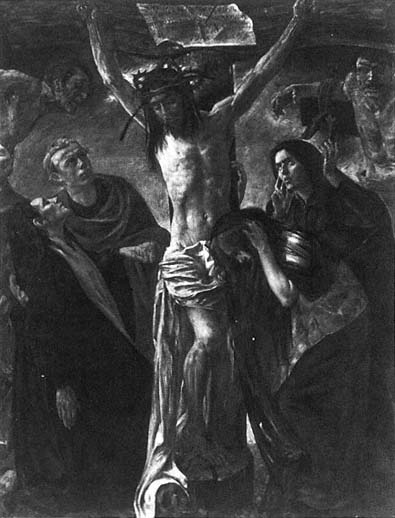
Figure 65
Lovis Corinth, Crucifixion , 1897. Oil on canvas, 229 × 176 cm, B.-C. 138.
Evangelische Kirche, Bad Tölz.
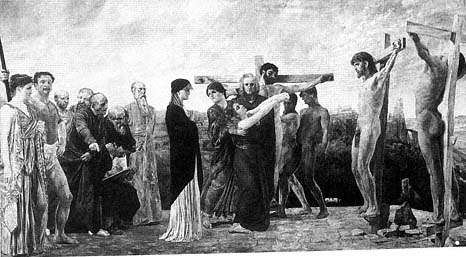
Figure 66
Max Klinger, Crucifixion , 1890. Oil on canvas, 251 × 465 cm.
Museum der bildenden Künste Leipzig (1117).
Rape of the Sabine Women , as in the drawing in Berlin already mentioned in connection with Tragicomedies (see p. 83), and in two etchings, Rape (Schw. 6) and Abduction (Schw. 7). In 1895 he made a color lithograph Rape of Woman (Schw. L13) and the same year repeated the composition in a bronze relief.[91] Related to these various "rapes" is Susanna and the Elders (Fig. 67) of 1897, which places the theme in an Old Testament setting. Like Corinth's earlier version of the subject (see Fig. 34), the painting was derived from a well-known prototype. This time it was Anthony Van Dyck's painting in the Alte Pinakothek that provided the pose and gestures of the voluptuous heroine. The burlesque conception departs notably from the predominantly academic concerns governing the Susanna in Essen and reflects both the influence of Böcklin and the tone of Corinth's own recent Tragicomedies .
In an independent sketch of the same subject done in 1898 (Fig. 68), Corinth freed himself from his prototype to explore the content in a more purely pictorial manner. The forced physiognomic expressions are now subdued and the lines themselves organized so as to create a dynamic equilibrium of movement and countermovement—a pictorial equivalent, in short, of the conflict that in the painting is no more than a parody. The drawing lacks detail without sacrificing meaning. Suggestion rather than description invests the sketch with the expressive strength that eventually was to distinguish Corinth's mature works.
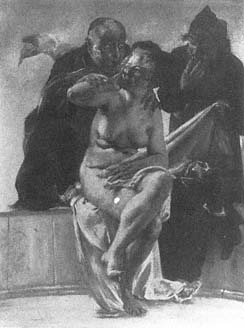
Figure 67
Lovis Corinth, Susanna and the Elders , 1897.
Oil on canvas, 98 × 74 cm, B.-C. 144.
Present whereabouts unknown.
Photo: after Bruckmann.
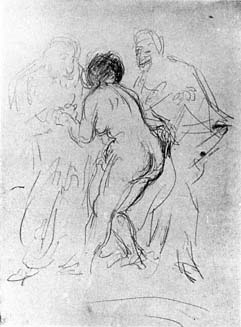
Figure 68
Lovis Corinth, Susanna and the Elders , 1898.
Pencil, c. 44.0 × 34.5 cm. In auction at
Karl und Faber, Munich, 1974;
present whereabouts unknown.
Photo: after Kuhn.
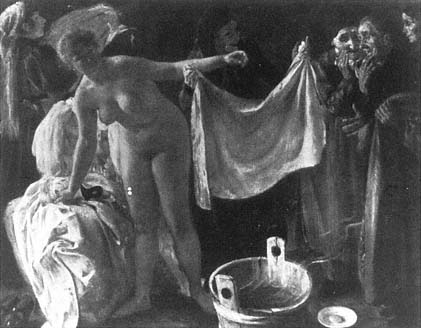
Figure 69
Lovis Corinth, Witches , 1897. Oil on canvas, 94 × 120 cm, B.-C. 145.
Present whereabouts unknown.
Photo: after Bruckmann.
The Nietzschean cult of vitalism rampant in Munich in the 1890s seems to have had a liberating effect on Corinth, for his themes of conflict between man and woman mark the onset of a steamy sensuality that was to inform his works with growing frequency, particularly his depictions of the female nude. Having drawn and painted the nude for years as if it were but another form of still life, he now began to see woman both as the catalyst for man's passion and as a being capable herself of strong physical sensations. The voluptuous nude in Witches (Fig. 69) is fully conscious of her charm. Her bath completed, she prepares to dress for a costume ball while several old women looking on
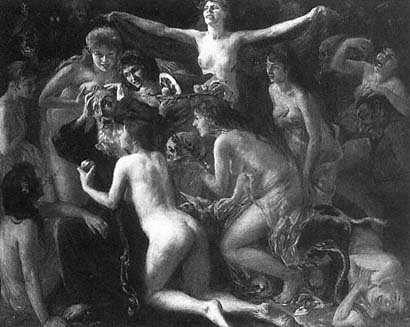
Figure 70
Lovis Corinth, The Temptation of Saint Anthony , 1897. Oil on
canvas, 88 × 107 cm, B.-C. 149. Museum Ostdeutsche Galerie Regensburg.
cackle suggestively. In the Temptation of Saint Anthony (Fig. 70) the devil and the three nudes from the same episode in Tragicomedies (see Fig. 44) are surrounded by a considerable following, and the hermit saint finds himself not merely tempted but set upon by seductive females. Gone is the blasphemous allusion to the crucifix. Instead, the central nude spreads her arms to raise her long strands of hair as if about to descend on the saint like a bird of prey. Some of the nudes offer gifts; others seek to arouse the saint's desire or to satisfy their own. Devils and human skeletons in the background increase both the pictorial congestion and the saint's despair. Corinth's painting of the Crucifixion, Witches, Temptation of Saint Anthony and Susanna and the Elders all in the same year, and seemingly in random order, suggests something of his casual attitude toward any one theme. Although it is impossible to be specific, these pictures evidently created some notoriety, as is suggested by a short story à clef by Joseph Ruederer, in which one of the characters asks Corinth whether he was painting only saints and whores.[92]