
1659: Framing the Body's Politics
The iconographic topoi of The Gifts are not new to the marriage of Louis XIV, but actually repeat and popularize an image predicated on many of the same dynamics between war and marriage, framing and curiosity, politics and sexuality, seen in the almanac images: Rubens's painting of Henri IV receiving the portrait of his intended bride (fig. 2.4), produced approximately thirty-five years earlier in a series depicting the life of Marie de Médicis. In the Rubcns image, illustrated here by an eighteenth-century engraved reproduction, Henri IV has discarded the trappings of war at the sight of his intended wife. In The Gifts of 1659 (see fig. 2.43), while there are wishes for peace, the process of marriage is one not of playful relaxation, but of herculean labor. Is it possible that The Gifts makes a subtle pun on Rubens's painting by replacing the cheerful cherubs at the bottom with two caryatid-like figures straining to support the proscenium arch? The lion's skin between them underlines their herculean effort, reminding the viewer of at least two forms of labor behind making a royal alliance: that of skinning the Spaniards in Flanders (the lion being the symbol of Flanders), and that of holding up (and together) the stage of the king's passions.[23] There are also cherubs in the almanac engraving, but they are located at the top, not the bottom, of the visual field. And they are not playing with the trappings of war, but seriously displaying them, exhibiting the lion's head-helmet on the right and tail-helmet on the left along with the medallions of the battlefield. Rubens's image also includes the battlefield in the distance, evaporating in a wisp of smokc.[24] Finally, in Rubens's painting, the allegorical and the historical figures mingle; they are not separated. Indeed, in the Rubens it seems as if there is no need for any boundary between the allegorical and the historical images. Likewise, there seems to be no need to place the object of desire (the framed image) on a lower register than the king.
Of course, Rubens's painting and the almanac engraving are different genres with different formats. The first is a large, 3.94-by-2.95-meter history painting done in oils and meant to be hung in the palace, while the second is an 80-by-50-centimeter engraving intended for popular circu-
[23] See Schama, Embarrassment of Riches , 52 and 55, for examples of the iconography of Flanders.
[24] Ronald Rofsyth Millen and Robert Erich Wolf, Heroic Deeds and Mystic Figures: A New Reading of Rubens' Life of Maria de Medicis (Princeton: Princeton University Press, 1989), offers the most recent, comprehensive study of Rubens's Médicis cycle.
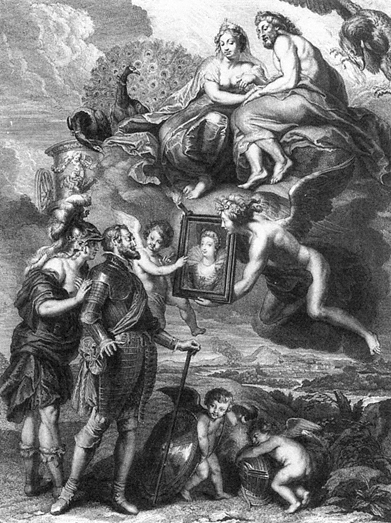
Figure 2.4
Henri IV Deliberating on His Future Marriage , after Rubens,
eighteenth century. By permission of the Bibliothèque Nationale.
lation. The works are also the product of two distinct historical moments: Rubens's piece was painted in the 1620s to describe earlier events, and the almanacs were printed in the late 1650s contemporaneous with the events they depict. One might, nonetheless, pause over the way sexuality seems less fraught, more noble, in the portrayal of Henri IV looking at Marie
de Médicis. Perhaps that is because the image was painted after the king's death and his establishment as the virile Roi vert gallant . Another reason for the elevation of the queen might be that Rubens's painting was not underwritten by the king but by Marie de Médicis herself, who emerged full-bodied in the ensuing paintings in the series. María Teresa also emerged full-bodied onto the scene of the almanacs, but not until after her marriage. It seems as if queens are allowed out of their frame only after the consummation of marriage and of the accords on which it was founded.[25]
The relation between the full-bodied king and framed queen is clarified when Rubens's painting is juxtaposed with another almanac from the year 1659, "The Celebrated Assembly of the Court." In it, Rubens's iconographic topoi are once again reworked (fig. 2-5). This engraving illustrates both the similarities with and differences from Rubens's image, most particularly in the position of the cameo portrait as it is being shown to the king, but also in the relation between the registers of history and allegory and in the juxtaposition of the images of war and passion, all of which affect the presentation of the potentially disorderly political bodies' roles in the (it is to be hoped) more ordered affairs of the body politic.
Once again, it is the banner over the image that guides our reading: "THE CELEBRATED ASSEMBLY OF THE COURT UPON THE CONVALESCENCE OF HIS MAJESTY AND UPON THE SUCCESSFUL OUTCOME OF HIS ARMS" (LA CELEBRE ASSEMBLEE DE LA COUR SUR LA CONVALESCENCE DE SA MAJESTE ET L'HEUREUX SUCCEZ DE SES ARMES ). A new element in the staging of the period between war and marriage appears in this heading: the acknowledgment (after the fact, of course) of the king's nearfatal illness in late June 1658 just after the surrender of the Spanish at Dunes that turned the tide of the war irrevocably toward the French triumph and occasioned the marriage. He had fallen victim to what his own physician Vallot characterized as "a hidden venom" (un venin caché) caused by "the corruption of the Air, the infection of waters, and the large number of ill people, of several dead bodies, and many other circumstances" (la corruption de l'Air, de l'infection des eaux, du grand nombre des malades, de plusieurs corps morts sur la place, et de mille autres circonstances).[26] If the king is shown to be convalescing in this image, it is because his ill-
[25] See images of the king and queen during the marriage from the Qb1 series in BN, Cabinet des Estampes.
[26] Journal de la santé du roi Louis XIV de l'année 1647 à l'année 1711 écrit Vallot, D'Acquin, et Fagon , ed. J.-A. Le Roi (Paris: Auguste Durand, 1862), 52.
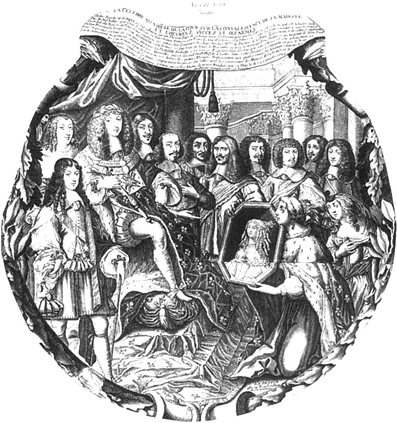
Figure 2.5
The Celebrated Assembly of the Court , 1659.
By permission of the Bibliothèque Nationale.
ness was so serious that even though it occurred in Calais, outside the French field of vision, it could not help but occupy the French imaginary. During the course of the illness, the king almost died: his physicians recorded that the king's body was purple and swollen, he was feverish and convulsive, and, at one moment of crisis, the king was unable to breathe.[27] According to Madame de Montpensier, Louis XIV was even given last rites in the expectation of his death.[28] It is not surprising, therefore, that in announcing the king's convalescence, the Gazette acknowledged that
[27] Ibid., 54–57.
[28] Madame de Montpensier, Mémoires , vol. 2 (Paris: Librairie Fontaine, 1985), 53.
the illness "appeared to threaten France with the most noticeable and distressing loss possible" (semblait ménacer la France de la plus sensible et de la plus désolante perte qu'elle ait pût faire). Of course, in recording the progression of the ailment, the king's physician Vallot was understandably reluctant to suggest that the illness was in any way connected to the monarch's being a weak physical specimen. Indeed, Vallot's notes underline that it was the king's own courage, the "too great impatience and keenness that he had to be present at opportunities, without sparing his life or health" (trop grande impatience et âpreté qu'il avait de se trouver aux occasions, sans ménager ni sa vie ni sa santé), and not any bodily weakness, that caused his malady.[29] Despite these gestures to the immortal body of the king, however, Vallot's journal, Montpensier's memoirs, the Gazette , and even popular almanac engravings all leave no doubt that the illness that threatened the king's body in the summer of 1658 also threatened the body politic.[30]
Concern expressed for the young king during the crisis and convalescence was, therefore, also concern expressed for the health of the Bourbon dynasty. Less than a decade after the crises of the Fronde, and in the midst of victories against the long-time enemy, Hapsburg Spain, the tide seemed to be turning in favor of the Bourbon dynasty, which could at last look forward to the assumption of power by a young and virile king. Were Louis XIV to have succumbed to his illness in July 1658, the vigor of the body politic would have been far less certain. For the crown would have passed to his younger brother, the duke of Anjou. He would have been a less compelling monarch in the French imaginary, since there were already grave reservations about his ability to procreate, let alone rule. It was apparently no secret that the duke of Anjou took after his father, Louis XIII, a king more interested in the bodies of other men than in the more manly affairs of the body politic or state.[31] Indeed, Louis XIII's lack of interest in women had left his marriage barren for many years, underlining the dynasty's dependence on mortal urges for its continuity: if a king sired no heirs to the throne, succession would move laterally to the monarch's brother.
[29] La Gazette, no. 82: 642; Journal de la santé du roi , 52.
[30] For a more complete analysis of the passages about the 1658 illness, see Abby Zanger and Elizabeth Goldsmith, "The Politics and Poetics of the Mancini Romance: Visions and Revisions of the Life of Louis XIV," in The Rhetorics of Life-Writing in Early Modern Europe: Forms of Biography from Casssandra Fedele to Louis XIV , ed. Thomas E Mayer and D. R. Woolf (Ann Arbor: University of Michigan Press, 1995), 341–72.
[31] Jean-Claude Pascal, L'Amant du roi (Paris: Editions du Rocher, 1991).
In this context it seems likely that Louis XIV's "scandalous" romance with Marie Mancini, begun during the king's convalescence and coming to an end only with his marriage in 1660, may have been utilized or even staged by Mazarin to demonstrate to the country that the king's body was once again in good working order after his brush with death.[32] With broadside almanacs widely circulating grim images in late 1658 and early 1659—for example, "FRANCE RESUSCITATED by the remedy sent from the heavens to the greatest monarch in the world for the peace of his people and the confusion of his enemies" (LA FRANCE RESSUCITEE par le remede Envoyé du Ciel au plus grand monarque de la terre pour la paix de son peuple et la confusion de ses ennemis; fig. 2.6)—the idea of a young king giving into passion, that is, lusting after a politically inappropriate or even potentially threatening consort, may have offered an indication of the king's (and France's) ability to erect himself (itself) from the sick bed (or the turmoil of civil war), escaping the shadow or frame of Thanatos to move into the full, fertile field of Eros. Note how, in figure 2.6, the king himself has been relegated to a cameo image, framed by the bed, in a representation resembling the kind of portrait-within-a-portrait noted earlier as a form of containment. Such usage is not surprising in a genre popular in this period not only as a way to introduce potential queens, but also as a way to memorialize dead persons.[33]
In the face of such dire events, it is not surprising that he king's mortal body, framed (or missing) in France Resuscitated , is the very first focus of The Celebrated Assembly (see fig. 2.5). There the descriptive banner that tells the reader/viewer:
Our august monarch is admired on his throne, adorned only by his healthy appearance, because the brilliance of it is so beautiful that it takes away the luster of the richest clothing that he wears. The queen his mother, the duke of Anjou his brother, the duke of Orleans, and the prince of Conty are regarded with the respect owed to the Majesty of one and the conditions of the others. His Eminence the chancellor, Messieurs Turraine, La Ferté, Grammont, Villeroi, augment by their presence the pomp of this assembly, where France is seen presenting the king with the portrait of a princess, who is unnamed, as a certain omen of his future marriage. Flanders, reduced to his mercy, expresses simultaneously by her silence both her admiration and astonishment,
[32] This is the argument I make in "The Politics and Poetics of the Mancini Romance."
[33] The ill king's image, however, is placed in a masculine square frame, which should be contrasted to the round cameo in which the living queen candidates were portrayed. On the commemorative convention of portraits within portraits, see Erica Harth, Ideology and Culture in Seventeenth-Century France (Ithaca: Cornell University Press, 1983), 83.
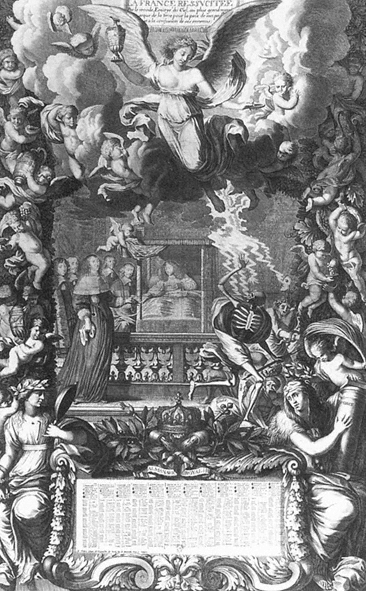
Figure 2.6
France Resuscitated by the Remedy Sent from the Heavens , 1659.
By permission of the Bibliothéque Nationale.
not being able to comprehend the wonders that this great monarch performed in his last campaign, and by the sound of his renown and by the force of his arms, the four elements represented at the four corners, the four successful battles, the great victories of this young conqueror, and the taking of the cities with the ceremonies of the alliance of France with the Elector princes of the empire, as well as the actions of thanks rendered by his majesty upon his convalescence in order to move his people to follow his example.
Nostre Auguste MONARQUE s'y fait admirer sur son Trosne Paré de sa bonne mine Seulement, puis que l'eclat en est si beau qu'il oste le lustre aux Plus Riches habits qu'il porte. la Reyne Sa Mere, le Duc d'anjou son Frere, le Duc D'orleans, et le Prince de Conty, s'y font considerer avec le respect Qu'on doit a la Majeste de l'Une et aux conditions des autres. Son Eminence, le Chancelier, les M.aux de Turaine, de la Ferté, de Grammont, et de Villeroy augmentent de leur Presence la Pompe de Cette ASSEMBLEE , Ou la France se fait Voir en Action de Presenter au ROY le Portrait d'une Princesse qui na point de Nom, Pour un presage certain de son future Himenée. La FLANDRE , Reduitte a sa mercy, Exprime tout a la fois par son Silence, et son admiration, et son Estonnement, ne pouvant comprendre les Merveilles que ce Grand MONARQUE a faittes clans cette derniere Campaigne, et par le bruit de son Renom et par la force de ses Armes, les quatres Elemens Representent aux quatre coings les heureux Combats, les Grandes Victoires de ce Jeune Conquerant et les prises des villes, avec les Ceremonies des Alliances de la France et les Princes Electeurs de Lempire, Comme aussy les Actions de graces Rendues par sa Majesté de sa Convalescence afin d'animer ses peuples a suivre son Exemple.
This image and its prose heading underscore the relation between the health of the king's body and that of the state; in so doing, they legitimize curiosity about the king's mortal body. Indeed, in its insistence that the king is adorned only by his healthy appearance (bonne mine ), the heading focuses attention on the monarch's mortal body. But although the king's power or health is supposed to be discerned by looking at his body alone, a large number of accouterments establish his power qua health in the picture more forcefully. In fact, one perceives the king's "bonne mine" (meaning not just face, but countenance or bearing) in large part from what drapes it, since most of the healthy body is obliterated by clothing. Only the face, the hands, and a leg are visible. The last item, the leg, is actually covered by a silk stocking, although its contour is emphasized, not effaced, by that clinging material. And yet, despite the encasing garments, the eye is drawn to the royal body not just because of the words over the image but because of what one is supposed to admire. The real object of our interest, while covered over, is also exposed, or signified by the leg and scepter rising from it, both now clearly identified with power, sexual
as well as political. The phallic dimension of that martial/marital power is underscored by a new addition to the iconography: the fashionably wide petticoat breeches (wide enough to contain the master's absolutist genitalia) and even the fleur-de-lys motif strewn over the royal robes (the fleur-de-lys being not only the royal emblem of France, but also the emblem of male genitalia and semen).[34]
The healthy appearance that indicates the victory over the disorder of disease is thus a celebration of successful arms (or legs)—or rather tools—the most successful of all being the king's sexual potency (his ability to stay erect) on the battlefield, in his sickbed, and in the marital chamber. In it, the king's mortal-sexual body is an asset to state-building and not the liability it has been too often categorically deemed when evaluated within the framework of constitutional fictions of monarchy generated around funerary symbolism. It may not be the king's sexuality that is a problem in this image, but rather the fact that displaying sexuality requires other images and props (stockings, women, and so on). Indeed, in later representations of Louis XIV the king's sexual power would be one of his icons, as for example in Hyacinthe Rigaud's 1701 Louis XIV en habit de sacré (fig. 2.7), which displays the sixty-two-year-old king as still virile. Louis Marin and Claude Reichler both note the tension in this painting between the sexuality of Louis XIV's leg and the aging face, a tension they argue undermines the power of the image. Their interpretations are clearly inspired by the Kantorowicz-Giesey paradigm, internalizing the funeral ritual's (logical) lack of focus on the king's sexuality. Indeed, in their analyses of this painting both Marin and Reichler focus on sexuality only in terms of decay, the dissonance between Louis XIV's iconic leg and his aging face as portrayed in the painting.[35] Looking at figure 2.7 in terms of the
[34] For information on the petticoat breech and other aspects of men's fashions, see François Boucher, 2000 Years of Fashion: The History of Costume and Personal Adornment (New York: Harry N. Abrams, 1967). One important point to make here is that although this costuming may seem quite effeminate by our standards, silk stockings and high-heeled shoes were the norm at Louis XIV's court. It is generally accepted that the adoption of such excessive style helped Louis XIV to transform his noble class into a court society (from a warrior class).
[35] Claude Reichler, "La Jambe du roi," in L'Age libertin (Paris: Editions de Minuit, 1987); and Louis Marin, "Le Corps glorieux du roi et son portrait," in La Parole mangée et autres essais théologico-politiques (Paris: Klincksieck, 1986). In both cases the critics follow Kantorowicz's formula, focusing on the tension between the king's aging upper body and the iconic sexuality of the leg. Marin has also written on the rhetoric of the king's physicians in discussing his mortal body, in "Le Corps pathétique et son médecin: Sur le Journal de santé de Louis XIV ," in La Parole mangée; also published in a slightly different version in 1985 in Revue des sciences humaines , no. 198. Again, Marin focuses on the mortal body as decaying, not victorious.
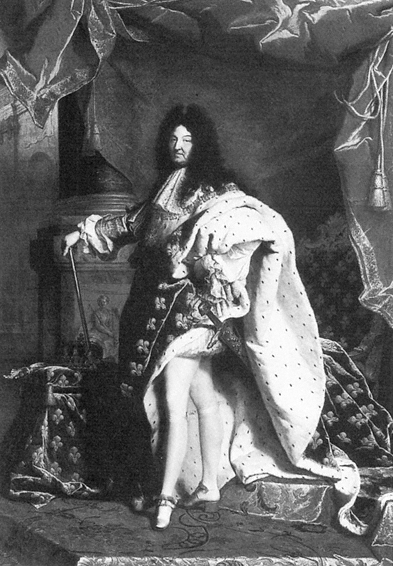
Figure 2.7
Hyacinthe Rigaud, Louis XIV en habit de sacré , 1701. By permission
of the Blbliothéque Nationale.
images discussed in this essay, however, it is particularly striking that the king is the only human figure on the canvas. Portrayed alone, it is as if Louis XIV's potency were innate and eternal, rising like the phoenix out of its own ashes in a vision of absolute, onanistic masculinity. Therefore, as Marin and Reichler suggest, the image is ultimately about decay, for the king alone is sterile. In The Celebrated Assembly , however, as well as in the other almanac engravings considered here, the young virile king is posed (or framed) not just by his royal robes and by the usual lines of the architectural backdrop or stage, but by the group setting that includes those with whom he still shares the spotlight: in the upper register, his mother, his brother, and the duke, and in the lower register, the now legitimate allegorical female supporters, the conquered and awed Flanders and France, seen offering what the prose text refers to as the portrait of an unnamed princess as a sure omen of his marriage, an object labeled in the actual image as "the picture of his desires" (le tableau de ses souhaits).
The dichotomy between allegorical figures paying tribute to historical ones, the gift-exchange model, the equation between submissive cities and submissive women, the unnamed, framed princess, the leg leading to her portrait as libido or drive to its object, Mazarin's hand pointing out and legitimizing his protégé's leg, and the opposition between high and low can now be read as familiar elements of the iconography that merged images of war with those of marriage. Here, however, the potential threats to the king's power—ill health, sexuality, military insubordination—are contained by the various enclosures, of which frames and clothing are two examples. The display of the king's healthy body as evidence of his military/sexual prowess is always dependent on these framing images. As such, the process of celebrating the king is that of celebrating the assembly around him as well as the assembled images and objects. This process plays out the etymological meaning of allegory: from allos , meaning other, and agorein , to speak publicly, as well as agora , assembly, which can be combined, meaning to speak of the other in public assembly. Here the figurative other is not just the king's masculine power or his prospective bride, but also his dependence on other limen : the limbs of the royal entourage—the celebrated assembly of the court, an assemblage of family, courtiers, a cameo female, conquered territories, an implied viewing public, frames, and so forth. Without these elements, would the king's power be secure? Such dependence is nowhere to be seen in Riguad's image of the mature, well-ensconced Sun King.
Indeed, it is the other assembled "bodies," liminal to the king's centering image, that finally attract the viewer's attention in a picture where
passion has been enrobed, conquered, framed, and stabilized for display. These other bodies highlight this passion and offer an acceptable field on which to display or stand the king's desires. Just as the drape of clothing serves to enhance interest in the real site of his male power, so too do modestly dressed and submissive allegorical figures and cameo images with missing bodies (Rage, Envy, and Sedition's limbs amputated and framed into submission) also safely pique our interest first in the king's own well-wrapped limb, and then in the process of peace. But this process of allegoresis, or speaking of the (unspeakable) other in a manner suitable to public assembly, is more complex. For if the unspeakable urges are wrapped up, might they not reemerge in the engraving to disrupt the happy family picture of the successful, virile, and healthy king on his throne, a king with appropriate political and sexual fantasies? Indeed, could not some alternate, competitive desires lurk in the hearts of those happily assembled family members and courtiers? Could disordering fantasies or bodies transgress this scene of family romance?
Answers to these questions may be found by considering the figure on the far left edge of The Celebrated Assembly , the king's younger brother, the duke of Anjou. As previously noted, he was next in line for the throne should Louis XIV die or his projected marriage prove sterile. This potential pretender is the only member of the assembly whose full body is portrayed in the upright position. Interestingly, the frame around the image cuts off the duke's right leg, the very member so prominently displayed by the king on his throne. Does the duke's walking stick, an object longer than the king's scepter, compensate for the elimination of his leg? Note as well that although it totters at the edge of the focal field, the body of the duke of Anjou nonetheless occupies a unique position or site: he straddles the two registers of the engraving, the upper zone of mimetic portrayal of historical characters and the lower, allegorical field of women. Is it perhaps because of the brother's own liminal position that he, like the potential queen, stands in the register of the king's limb? For in 1658 he was the least significant (smallest and youngest) in the royal family, but also crucial because next in line for the throne. Or might his position be, rather, a function of his well-known effeminate tendencies, an urge apparently encouraged in order to further enhance the power of Louis XIV and yet also elided when the duke was married off twice to safeguard the continuity of the Bourbon dynasty. The duke's position is parallel to that of the "imagined" queen who is also necessary yet peripheral, hopefully fertile yet visually castrated. In the engraving, Louis XIV seems to cast his glance more in his brother's direction than in that of the "picture
of his desires," suggesting that in this scenario of precarious health the duke may be a source of anxiety about the virility and power of members or limbs supporting the Bourbon family and thus about the permanence of the titular monarch. As the king recovers his health and the marriage treaty is negotiated and signed, the new queen will replace the prince as the object of such anxiety, being seen in contemporary terms as the vessel necessary for the Bourbon dynastic procreation, but also invoking the memory of the enemy, Philip IV, her father, and his coveted Spanish-Hapsburg throne. It is at this point that she will become the central propping (and anxiety-provoking) image of the fictions generated on the eve of the treaty marriage.[36]
In 1659, however, it is another female figure who visually mediates such unspeakable fantasies, again in the form of a disembodied female head, this time of another former Spanish infanta who became a French queen, Louis XIV's mother, Anne of Austria, a woman intimately acquainted with all sorts of disorders or liminal phenomena: the vagaries of Bourbon homosexuality from her years of marriage to Louis XIII, the nature of competition among the blood princes from her experiences during the Fronde uprisings in the late 1640s and early 1650s, as well as the necessity of the female liminal position to the representation of sovereign masculinity within those dynamics.[37] Positioned unframed between her two sons, she is a reminder that liminality is always lurking at the edge of the absolutist state, since it is, so to speak, the limbs on which the monarchy rests, or the female body that breeds and bears those limbs. As a still-present trace of such liminality, however, she is also the visual proof that if disorderly, ephemeral passions (or props) cannot be fully contained by representational frames, they can at least be utilized and fashioned—shaped—to fit into the larger image of, or frame for, a stable, absolutist, body politic.
In recognizing the role of such liminal images in state-building, one begins to recognize how such fictions have been groomed out of the picture by scholars who examine the portrayal of the king's body solely from the perspective of the political fiction of "the king's two bodies." That
[36] These fictions are the subject of my book Scenes from the Marriage of Louis XV. Nuptial Fictions and the Making of Absolutist Power (Stanford: Stanford University Press, 1997).
[37] Sarah Hanley describes the ritual of the lit de justice ceremony in which, upon the king's death and in the case of a regency, the young minor king took the throne publicly in Parlement. Hanley's discussion of Anne of Austria's transgressive role in Louis XIV's own lit de justice is particularly interesting in light of the idea that she understood the possible symbolic impact she could have on legitimizing her son's ritual activities. See Sarah Hanley, The Lit de Justice of the Kings of France: Constitutional Ideology in Legend, Ritual, and Discourse (Princeton: Princeton University Press, 1983).
paradigm, rooted in the discourses and rituals of death, can account better for the decay of the king's mortal body than for its sexuality. The images examined in this essay were not generated from the funereal model, but were created out of the fictions of marriage. In such a context, highlighting the king's mortality would not be detrimental to, but rather fundamental to, making the ruler (and his rule) seem strong. In the almanac images considered here, display of the king's mortal body as healthy and virile plays a crucial role in state-building, as do all the props and players—persons, limbs, and frames—that work with him to project his (and the state's) vitality. Of course, as the king moves beyond the liminal period between war and marriage, such props and bodies may no longer profitably serve to structure his image. Rather, they become distractions, divertissements , in a symbolic logic predicated on promoting his divine autonomy and authority. The representations of this later period have been productively accounted for by scholars working from the Kantorowicz paradigm precisely because these images do not contain and display liminal. passions, but rather battle against them to produce a portrait of the king alone on his stage, staving off death (real or political) in a struggle to obliterate the many frames and limbs supporting him, to move beyond the liminal moment and toward (the fantasy of) absolute unity and stability.