
Tulsidas and the Ramayan Tradition
The Ramcaritmanas is an original retelling, in a literary dialect of Hindi, of the ancient tale of Prince Ram of Ayodhya—a story that exists in countless variants both within and beyond the Indian subcontinent and represents one of the world's most popular and enduring narrative traditions. The Ram legend has not only given rise to hundreds of literary texts, including several that rank among the masterpieces of world literature, but has also flourished for at least two millennia—and still flourishes today—in oral tradition.
The most influential early text of this tradition is the one called Ramayana[*] ; indeed, in India this name has come to be used as a sort of genre name for all texts of the tradition and even as a colloquial label for any long narrative (as in the Hindi expression "to narrate a Ramayan"—i.e., to go on at great length about some matter). Traditionally attributed to the poet Valmiki, this Sanskrit epic of some 24,000 couplets is thought to have been composed within the first few centuries before the beginning of the Christian Era[5] . Internal evidence suggests that a considerable portion of it may indeed have been the work of a single author, but nothing is known of Valmiki as a historical figure. Popular legend depicts him as a lowborn robber who was transformed into a sage by the grace of Ram and who wrote his narrative during his hero's own lifetime, in the Treta Yuga or second aeon of the current cosmic cycle, which Hindus commonly place in the extremely remote
[5] On the dating of this text, see Goldman, The Ramayana[*]of Valmiki : Balakanda[*] , 20-23. Note, however, that many scholars disagree with Goldman's early attribution.
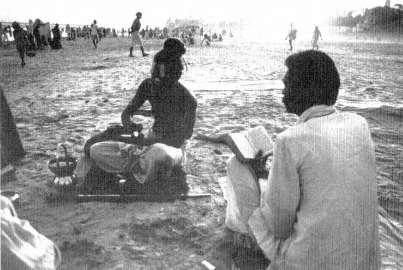
Figure 1.
A pilgrim recites the Manas for a sadhu, in Ayodhya at dawn on
Ram's birth anniversary (Ram Navami)
past—"nine lakh [900,000] years ago." Valmiki is thus hailed by later tradition as adikavi —the first poet, the inventor of the influential sloka meter and the mentor of all later poets, especially those of the Ram narrative tradition.
Although the Sanskrit epic exerted a great influence on later retellings of the Story, the vernacular "Ramayans" that began to be produced from roughly the eleventh century did not offer simple translations of Valmiki's story, but rather reinterpretations of it. Because the specific transformations of the story through various texts have been traced by literary scholars,[6] it suffices here to note that the most important trend in the development of the tradition was the reinterpretation of the narrative in the light of the bhakti (devotional) movement, which effected the transformation of the epic's protagonist from an earthly prince with godlike qualities of heroism, compassion, and justice, to a full-fledged divinity—or rather, the divinity; for in North India today the word Ram is the most commonly used nonsectarian designation for the Supreme Being.
The bhakti movement, in significant contrast to the earlier southward penetration of Aryan Sanskritic culture, appears to have begun in
[6] See, for example, Bulcke, Ramkatha : utpatti aur vikas ; Whaling, The Rise of the Religious Significance of Rama .
South India and slowly spread northward. Although certain of its influential texts were composed in Sanskrit, the movement was characterized by a preference for local languages, reflecting a concern to make its teachings accessible to the widest possible audience, irrespective of caste or class. The earliest texts associated with this new orientation, the hymns of the Vaishnava Alvars and the Shaiva Nayanmars, were composed in Tamil, the Dravidian language spoken near the southern tip of India. The first major vernacular Ramayan was also in Tamil: the Iramavataram of the c. eleventh-century poet Kampan, which remains the best-known Ramayan in Tamil-speaking regions.[7] Already in Kampan's version, Ram as the earthly incarnation (avatar ) of the supreme lord Vishnu retained his divine qualities of omniscience and omnipotence, so that his entanglement in the plot became merely a matter of appearance—or as the tradition would say, of lila : a self-staged divine "sport." Likewise, his beloved wife Sita had acquired many of the titles and attributes of the great goddess, mother of the universe, and her inviolability had become such a matter of principle that the poet had to concoct the device of having her demon abductor scoop up the plot of earth she stood upon, lest the touch of his hands defile her.
Kampan's epic was followed by the c. thirteenth-century Telugu Ramayana[*] of Buddharaja and by the fourteenth-century Bengali epic of Krittibasa. But even by the middle of the sixteenth century, there was still no major Ramayan in any of the dialects of the central Gangetic plain—the region that, ironically, was the geographical locus of the Ram legend. The story remained widely known and was told and retold in Hindu communities; its Sanskrit versions continued to be studied and commented on by members of the religious elite and expounded by them to wider audiences. But it may well reflect on the conservatism of this elite that no major literary rendering of the story had been made in the "impure" language of the people, even though such versions had long won acceptance further to the south and east.
The birthdate of the man who was to compose the Hindi epic of Ram—the poet Tulsidas—cannot be fixed with certainty, but many scholars have settled on 1532 as a likely year.[8] An unresolved and more emotional debate has concerned the poet's birthplace, with no less than seven places in present-day Uttar Pradesh and Bihar states vying for the
[7] For a partial English translation, see Hart and Heifetz, The Ramayana[*]of Kampan .
[8] Gupta, Tulsidas , 138-40; in English see the same author's "Biographical Sketch," in Nagendra, ed., Tulasidasa: His Mind and Art , 64. F. R. Allchin, however, favors a birthdate of 1543; see the introduction to his translation of Kavitavali , 33.
honor of claiming Tulsidas as native son.[9] Most modern accounts of Tulsi's life are based on slender internal evidence from his poetry supplemented by two controversial accounts attributed to contemporaries[10] and by later devotional hagiographies. In several apparently autobiographical verses in the Kavitavali and Vinay patrika —works thought to belong to the poet's old age—Tulsi refers to early abandonment by his parents (traditionally attributed to his having been born during an unlucky astrological conjunction) and to a childhood of loneliness, hunger, and pain, from which he was apparently rescued by a group of Vaishnava sadhus who gave him his first lessons in devotion to Ram, the "purifier of the fallen."[11] Yet it is thought that Tulsi himself did not become a sadhu at once but underwent a period of traditional Sanskrit education, probably at Banaras, and then returned to his native village to marry and live the life of a householder until a personal crisis caused him to renounce home and family. His subsequent wanderings took him to Ayodhya, Ram's birthplace and capital, and later to Banaras, where he settled, composed most of his major works, and died at an advanced age—probably in 1623.
The bare framework of this probable biography has of course been richly embellished by the hagiographic tradition. One of the best-known legends concerns Tulsi's decision to renounce worldly life, which is said to have been precipitated by his infatuation for his wife, Ratnavali. Unable to bear her absence while she was visiting her parents, Tulsi is said to have braved a rain-swollen river to reach his in-laws' house, only to receive, on arrival, a stinging rebuke from Ratnavali in the form of a couplet that has become proverbial.
This passion for my flesh-and-bone-filled body—
had you such for Lord Ram, you'd have no dread of death.[12]
These words are said to have opened Tulsi's inner eye and effected his conversion into a lifelong devotee of Ram, and so Ratnavali is some-
[9] Gupta, Tulsidas , 140-61; "Biographical Sketch," 65-77.
[10] These are the Mulgosaim[*]carit , attributed to Benimadhav Das (d. 1643) and the Gautamcandrika of Krishnadatta Mishra, supposedly composed in 1624; both were discovered only in the twentieth century. The former is widely regarded as spurious; the latter has been cautiously accepted by some scholars. For a brief discussion, see Gopal, Tulasidas , xii.
[11] See Kavitavali 6.73, 7.57, and Vinay patrika 275.1-3. For discussion of these verses, see Allchin's introduction to his translations of both works, Kavitavali , 33-34, and The Petition to Ram , 31-32. "Purifier of the fallen" is a translation of the much-used epithet patit-pavan ; see, for example, the closing chand of the Ramcaritmanas (7.130.9).
[12] The original verses are given by Grierson in "Notes on Tul'si Das," 267.
times cited as his "initiating teacher" (diksa[*]guru ). Other well-known stories concern the poet's ascetic and devotional practices (sadhana ) and his mystical experiences and miracles. Some of these will be recounted later in the words of modern devotees, for they show the reverence in which Tulsi and his poetry continue to be held.
The genesis of the Hindi epic of Ram has received considerable study.[13] Although the influence of Valmiki's classic may be taken for granted, Tulsidas makes significant departures from the older epic's version of the story, and some of these appear to reflect the influence of other Sanskrit texts. Thus the Bhagavatapurana[*] probably inspired his glowing depiction of Ram's childhood, while the drama Prasannaraghava may have influenced his decision to include a romantic encounter between Ram and Sita in a flower garden (phulvari )—a scene that has become one of the Hindi epic's most beloved passages (1.227.3-236). Another likely influence was the Adhyatmaramayana[*] ("spiritual" or "esoteric" Ramayana[*] ), a text probably composed in South India in the late fifteenth or early sixteenth century, which added a significant dimension to the theology of Ram by presenting him as not only an incarnation of the preserver-god Vishnu but as the personification of the ultimate reality or ground of being—the brahman of the Upanishads and of the Advaita or non-dualist school of philosophy.[14] Although this interpretation weakened the narrative and reduced the character of Ram to an austere abstraction who could hardly arouse the devotional sentiments of the masses, it may have helped inspire Tulsi's more successful integration of the Advaita and Vaishnava systems. It also anticipated one of Tulsi's most striking deviations from the traditional story: his introduction of an "illusory Sita" who alone suffers the indignity of abduction and imprisonment in Ravan's stronghold, while the real Sita—Ram's inviolable sakti , or feminine energy—remains safely concealed in the element of fire.[15]
The Ramcaritmanas is both the longest and earliest of the poet's major works; its composition was apparently begun when Tulsidas was in his early forties. The opening section of the poem includes the following well-known passage:
[13] Gupta, Tulsidas ; Vaudeville, Etude sur les sources ; and Bulcke, Ramkathaaur Tulsidas ; an English summary of Bulcke's analysis of the stages of composition is contained in his essay, "Ramacaritamanasa and Its Relevance to Modern Age," 58-75.
[14] Whaling, The Rise of the Religious Significance of Rama , 111. The text is available in an English translation by Bali Nath, The AdhyatmaRamayana[*] .
[15] The relevant passages are 3.24.1-5 (in which Sita conceals herself and substitutes her pratibimb , or "shadow") and 6.108.14-109.14 (in which the shadow is destroyed and the real Sita restored).
Now reverently bowing my head to Shiva
I narrate the spotless saga of Ram's deeds.
In this year 1631 1 tell the tale,
laying my head at the Lord's feet.
On Tuesday, the ninth of the gentle month,
in the city of Avadh, these acts are revealed.
1.34.3-5
Tulsi thus assigns the commencement of his labor to the birthday of Ram in the year 1631 of the Vikram Era—i.e., A.D . 1574—in Ayodhya, Ram's own city. The weighty text must have occupied him for several years, and the fact that its fourth book opens with an invocation to Kashi (Banaras) is generally taken as an indication that the poet had by then shifted his residence to that city.
Even though the immediate reception accorded to Tulsi's epic cannot be historically documented, several passages in the poet's works suggest a concern to anticipate and respond to critics. The invocatory stanzas of the epic include an ironic obeisance to the "ranks of scoundrels" who delight in criticizing others and a reference to "poetic connoisseurs" who are likely to laugh at his efforts, for as he observes,
My speech is the vernacular, my mentality simple.
It's deserving of laughter—no fault in laughing!
My speech lacks every virtue
but one, known to all the world.
Reflecting on this, let those
of pure discrimination listen well.
For herein is the lofty name of Raghupati—
utterly pure, essence of Veda and Purana!
1.9.4, 1.9, 1.10.1
While Tulsi's denial of poetic skill (couched, of course, in verses of great ingenuity) may have been aimed at those who favored the highly contrived Sanskrit poetry still influential in his day, his assertion that his work contains the essence of the scriptures was more likely directed at critics within the Brahmanical elite. That the vernacular Ramayan was initially derided in these conservative quarters is suggested by the hagiographical tradition and by a few verses in Tulsi's later works.[16] Yet such a negative reaction in turn suggests that the work had found an
[16] Thus in Vinay patrika 8:3, the poet complains to Shiva that the god's "servants" in Banaras have been tormenting him. The Gautam candrika speaks of "conceited traditionalists" taking offense at Tulsi's devotional verses.
enthusiastic reception among other groups, which may have included the mercantile class and the lower orders of society, including religious mendicants.
How rapidly the influence of the Hindi epic spread, in the absence of printing and despite the fact of overwhelming illiteracy, may be gauged from the fact that Nabha Das in his Bhaktamal —a work probably composed toward the end of Tulsi's life—hailed the Banarasi poet as Valmiki himself, who had taken birth again to reissue his Ramayana[*] to the world.[17] Nabha is thought to have resided at Galta, a Vaishnava shrine in Rajasthan, roughly a thousand kilometers from Tulsi's home but an important halting place for itinerant sadhus. It is likely that such mendicants played a major role in the early dissemination of the epic and were among its first expounders.
The small number of extant seventeenth-century manuscripts and the much larger number of eighteenth-century ones reveal some interesting features. Perhaps as many as 10 percent are in Kaithi, the script of the Kayasth, or scribal, caste—a writing system favored in political and economic contexts.[18] A smaller but still significant number are in Persian script, and the second-oldest translation of the epic (1804) is into the Persian language. All of this suggests the text's popularity with the aristocracy and business classes. Its association with Brahmans and acceptance by them as a work of the highest religious authority appears to have come about only gradually. As recently as. 1887, F. S. Growse could observe that there were many pandits who "still affect to despise [Tulsi's] work as an unworthy concession to the illiterate masses."[19]
A popular legend highlights the tension that is thought to have surrounded the religious establishment's initial response to Tulsi's epic. The Brahmans of Banaras, censorious of Tulsi for having rendered a sacred story in the common tongue, decided to test the worth of the text by placing it at the bottom of a pile of Sanskrit scriptures in the sanctum of the Vishvanath Temple, which was then locked for the night. When the shrine was opened in the morning, the Hindi work was found to have risen to the top of the pile, and its cover bore the words satyam[*] , sivam[*] , sundaram[*] (truth, auspiciousness, beauty) inscribed by an un-
[17] Rupkala, SriBhaktamal , 756, chappay 129. On the dating of this text, see Gupta, "Priya Dasa," 64.
[18] This estimate was made by C. N. Singh, who examined a large number of early manuscripts while helping edit the Kashiraj Trust edition—the first Manas edition to utilize Kaithi manuscripts; interview, February 1984.
[19] Growse, The Ramayana[*]of Tulasidasa , lv.
known hand. Faced with this divine imprimatur (in Sanskrit, no less), the pandits were forced to give grudging respect to the text.[20]
The legend suggests Tulsi's success at transcending sectarian differences and at synthesizing diverse strands of the Hindu tradition. In the nineteenth century, Growse noted the abundance of sects identifying themselves with the names and teachings of their founders, and Tulsi's overarching and catholic influence: "There are Vallabhacharis and Radha-Vallabhis and Maluk Dasis and Pran Nathis, and so on, in interminable succession, but there are no Tulsi Dasis. Virtually, however, the whole of Vaishnava Hinduism has fallen under his sway; for the principles that he expounded have permeated every sect and explicitly or implicitly now form the nucleus of the popular faith as it prevails throughout the whole of the Bengal Presidency from Hardwar to Calcutta."[21]
Reconciliation and synthesis are indeed underlying themes of Tulsi's epic: the reconciliation of Vaishnavism and Shaivism through a henotheistic vision that advocates worshiping Shiva as Father of the Universe while making him the archetypal devotee of Ram. A similar rapprochement is effected between the nirgun[*] and sagun[*] traditions—between worship of a formless God and of a God "with attributes." Tulsi's contribution is to offer, in Frank Whaling's words, "an integral rather than a new symbol" of Ram,[22] and his hero is at once Valmiki's exemplary prince, the cosmic Vishnu of the Puranas, and the transcendent brahman of the Advaitins. What weaves together such "inconsistent" theological strands is the overwhelming devotional mood of the poem, expressing fervent love for the divine through poetry of the most captivating musicality.
The Ramcaritmanas is one of a dozen works generally accepted as authentic compositions of Tulsidas.[23] These include six "minor" and six "major" texts that together have acquired a sort of canonical status for the Ram tradition, so that their verses may be cited as authoritative "proof" or "validation" (praman[*] ) of any point an expounder or commentator wishes to make. In addition to these literary works, the North Indian oral tradition includes a sizable body of couplets and short songs that claim Tulsidas as their author by inserting his name in the poetic
[20] The legend is recounted in the Mulgosaim[*]carit ; the version given here is based on an oral retelling by a temple priest of Ramnagar; February 1984.
[21] Growse, The Ramayana[*]of Tulasidasa , lix.
[22] Whaling, The Rise of the Religious Significance of Rama , 228.
[23] For a short summary of their contents, see Grierson, "Notes on Tul'si Das," 197-205, 253-59.
"signature line" (bhanita ) common to such poems. Some of these aphorisms and songs are indeed drawn from Tulsi's written works—scores of lines from the Ramcaritmanas have entered folk speech as proverbs[24] —but others belong to none of the poet's known works or are in dialects (such as Khari Boli) or even other North Indian languages (e.g., Punjabi and Gujarati) that he is unlikely to have known.[25] Such fragments belong to a genre of literature in which folk poets assume the name and persona of famous poets—Kabir, Tulsi, Surdas, and Mira being four favorites—in order to invoke a characteristic ethos or aura of authority.[26] But whereas the proliferation of such compositions has sometimes confused or even obliterated the boundaries of a poet's authentic oeuvre,[27] the Tulsidas oral tradition exists as a complement to a distinct and well-attested literary corpus. Thus while editions of Surdas's major work, Sursagar , may contain anywhere from a few hundred to many thousand poems, the numerous published editions of the Ramcaritmanas exhibit only comparatively minor variations.[28]
One other poem needs mention in the context of Tulsi's works, genuine or otherwise. The Hanumancalisa —"forty verses to Hanuman"—which popular belief, backed up by a signature line, universally attributes to Tulsidas, has become one of the most recited short religious texts in contemporary North India.[29] The poem opens with a couplet from the Ramcaritmanas and contains several other lines that appear to be adapted from the epic; the remainder suggests a rather inelegant approximation of Tulsidas's style. But questions of authenticity and literary merit aside, the most striking thing about this poem is its enormous popularity. As a prime text of the flourishing cult of Hanuman—one of the most visible manifestations of popular Hinduism—it is fervently recited by millions of people every Tuesday and Saturday, the two week-
[24] Examples of these may be found in the section on lokokti (folk sayings) in Shukla, ed., Tulsigranthavali 4:93-158.
[25] Some of these compositions may be attributable to later authors who bore the same name, such as Tulsi Sahab of Hathras (1763-1843), a poet of the Sant tradition who is regarded by some devotees as a reincarnation of Tulsidas.
[26] Bhanita literally means "uttered"; such a poetic signature is also known as a chap , or "seal." On this convention, see Hawley, "Author and Authority," 269-90. On its use by Kabir and others, see Vaudeville, Kabir , 62.
[27] On the problem of delineating an "authentic" Surdas, see Bryant, Poems to the Child-God, vii-xi; and Hawley, SurDas , 35-63. Textual problems in Kabir are discussed by Vaudeville, Kabir , 49-70. No early manuscripts exist for the countless poems attributed to Mirabai; see Hawley and Juergensmeyer, Songs of the Saints of India, 122-29.
[28] For a discussion of variant manuscript readings, see Chaube, Manasanusilan , 37-169; or Mishra, ed., Ramcaritmanas , 463-501.
[29] For a rough translation accompanied by some discussion of the poem's message and popularity, see Kapoor, Hanuman Chalisa.
days regarded as especially suitable for worshiping Ram's ideal devotee, and also at other times when special assistance is sought (thus it is said that the onset of annual school examinations brings a flood of college students into Hanuman temples to devoutly' intone the prayer). Authentic or not, the verses of the Hanumancalisa are today among the best-known lines attributed to Tulsidas.[30]
Since the Ramcaritmanas is a text in the Ramayan tradition, for which the Sanskrit epic of Valmiki is the accepted archetype, it is commonly referred to simply as "the Ramayan" and many popular editions bear only this name on their spine and cover, perhaps adding above it in small print: "composed by Goswami Tulsidas" (GosvamiTulsidas-jikrt[*] ).[31] Such use of the generic title is of course revealing of the fact that this epic has become in effect the archetypal Ramayan text for Hindi speakers. The "Ramayan composed by Valmiki" (Valmikikrt[*]Ramayana[*] ) is to the vast majority of people only a famous name for the archetype of a beloved story, not a known or accessible text, and most Hindi versions of it are prose condensations of its story, not literal translations of its verses.[32] Few devotees would be able to describe how Tulsi's version differs from its Sanskrit precursor, for their conception of the story depends overwhelmingly on the Hindi poet's rendition of it. And indeed, the immensely successful Indian television serialization, "Ramayan," which aired during 1987-88, closely followed Tulsi's version of the story.[33]
The significance of Tulsi's own chosen title, Ramcaritmanas —which W. D. P. Hill has rendered "The Holy Lake of the Acts of Ram"—is discussed in some detail below. Although Western authors have sometimes replaced this unwieldy compound with the acronym RCM, the Hindi tradition prefers to shorten it to its final element and call it simply the Manas —a custom I follow here.[34] This abbreviation, as we shall see, is not a mere truncation of the title, but a significant condensation that focuses on the central metaphor of the poem.
[30] Despite his popularity, Hanuman remains little studied. To date, one of the best treatments is Wolcott, "Hanuman."
[31] The term gosvami ("master of cattle" / "master of the senses," commonly Anglicized as "Goswami") is a respectful title given to certain religious leaders; the suffix -ji connotes enhanced respect. In Vaishnava discourse, the term "Goswami-ji" normally refers to Tulsidas.
[32] A typical example is Gupta, Valmikramayan[*] .
[33] See Chapter 6, People of the Book.
[34] Even titles of scholarly works in Hindi often refer to the text by this name; e.g., Chaube, Manasanusilan (A study of the Manas ); Chaturvedi, ManaskiRam Katha (The Ram story in the Manas ). The same abbreviation occurs in speech, and a traditional scholar of the epic is sometimes termed a Manasi (Manas specialist).