
A Moment of Truth: Self-portrait with Skeleton
Unlike the idealized Jugendstil self-portrait in Figure 63, the Self-Portrait with Skeleton (see Plate 9), painted in 1896, shows Corinth without a mask and speaks of a different need for self-assessment. The painting is the first among his self-portraits in which he acknowledged the passage of time, noting his age alongside the signature and the year in the upper right. Although the day and month are not inscribed on the canvas, the painting may indeed have been the first in the long series of Corinth's "birthday pictures," self-portraits he was wont to paint on July 21 or as close to this date as possible. The painting documents Corinth's continued fascination with Böcklin's work, for it clearly derives from the Swiss artist's famous picture of 1872, now in Berlin. The fundamental conception, however, is entirely original, a naturalist's answer to Böcklin's self-conscious posturing. In Böcklin's self-portrait, which also
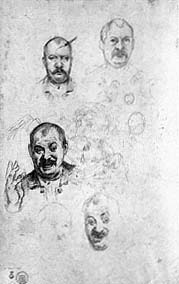
Figure 64
Lovis Corinth, Self-Portrait
Sketches , c. 1896. Pencil,
47.2 × 30.0 cm. Staatliche
Kunstsammlungen Dresden,
Kuperstich-Kabinett.
prompted Hans Thoma's similarly romantic Self-Portrait with Death (1875; Staatliche Kunsthalle, Karlsruhe), the painter, palette and paintbrush in hand, listens to Death as if to an inspiring muse; Death, playing the fiddle, is shown as a "living" counterpart to the painter, whereas in Corinth's picture the specter has been reduced to a studio prop. Instead of Böcklin's evocative chiaroscuro, bright daylight enters the studio through the large window, beyond which lies the suburban landscape of Schwabing, with church steeples and smoking chimneys in the distance. While the skeleton functions as a conventional memento mori , Corinth's own likeness is recorded with such honesty that it is itself an image of transcience. The painter's corpulence belies his age, thirty-eight; the face is bloated; the eyes are dulled from years of excessive drinking. An even more incisive description of physical deterioration is communicated by the self-portrait sketch in the upper left of a sheet of studies preserved in Dresden (Fig. 64). These drawings date from about the same time as the Munich painting and conveniently juxtapose Corinth's stylistic experiments of these years. The stylized self-portrait in the upper right is reflective, but the expression remains subordinate to the idiosyncratic draftsmanship. In the two lower sketches—to the left and below the faint outlines of a caricature of Otto Eckmann—Corinth mimed what he felt or thought he felt, resorting to exaggeration. Only in the upper left sketch did he confront his image with searing objectivity.