
The Impulsive Way
Nature provides big voltages gratis to anyone bold enough to play with lightning. In the summers of 1927 and 1928, three members of the physics institute at the University of Berlin hung an antenna between two mountains in the Italian Alps 660 meters apart. In their definitive arrangement (fig. 2.1), a string of heavy-duty insulators, provided free by their German manufacturer, kept the antenna and the probe line attached to it from ground; the potential reached by the antenna was controlled and measured by the air space between a metal sphere dangling from the probe line and an earthed sphere hanging beneath it. During thunderstorms, the antenna rose to a very high potential over ground, sending sparks between the spheres across as much as 18 meters of pure Alpine air. The intrepid experimenters calculated that, in that case, they were dealing with 15 million volts. The two who survived the experiment, Arno Brasch and Fritz Lange, returned to Berlin to construct a tube that might stand up to a good fraction of this voltage.[9]
In the comparative safety of the Allgemeine Elektrizitätsgesellschaft's research laboratory in Berlin, Brasch and Lange
[9] Brasch and Lange, Zs. f. Phys., 70 (1931), 10–1, 17–8. Their unfortunate companion, Curt Urban, was killed during the experiments of 1928; Livingston, Particle acc. , 2, misdates the experiment and Livingston and Blewett, Particle acc. , 22, kills the wrong man.
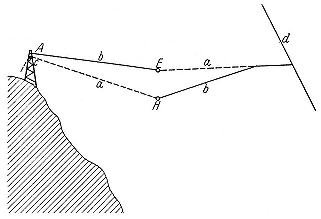
Fig. 2.1
Brasch and Lange's lightning catcher. E and H are the
spheres between which the discharge occurs; AE, the
antenna; a,a, insulators; b,b, conductors; d, a grounded
wire. Brasch and Lange, Zs. f. Phys., 70 (1931), 17.
tested designs for a sturdy discharge tube with the help of an impulse generator able to reach 2.4 MV. Its principle, the "Marx circuit," may be clear from figure 2.2. A transformer at the center of the hexagon to the right of the diagram delivers rectified direct current via the indicated diodes to the string of n capacitors C , which charge in parallel each to the potential V . When V suffices to drive a spark across the gaps F , the capacitors connect briefly in series, the voltage on the last plate rises to nV , and a spark jumps to the top electrode of the constantly pumped special discharge tube figured on the left.[10] Such generators served the electrical industry to test the characteristics of insulators and other equipment during flashovers. The grandest ever made, which could manage 6 MV, was built by General Electric in 1932.[11]
Another industrial high-voltage instrument adapted to nuclear physics was Southern California Edison's million-volt cascade transformer at Caltech. This object did not satisfy Rutherford's requirement of convenient size: it filled a room 300 square feet in area and 50 feet high.[12] As we know, it was adapted to the
[10] Brasch and Lange, Zs. f. Phys., 70 (1931), 29–30.
[11] Livingston and Blewett, ibid., 21.
[12] Lauritsen and Bennett, PR, 32 (1928), 850–1; Kargon in Shea, Hahn , 77; Ising, Kosmos, 11 (1933), 144–7, for industrial forerunners of Lauritsen's design.
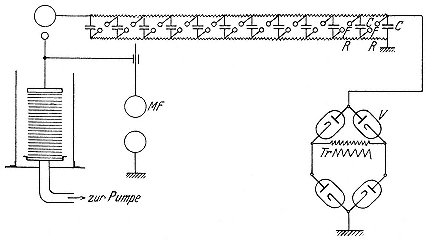
Fig. 2.2
Brasch and Lange's discharge tube and impulse generator. Voltage from the
transformer Tr multiplied by the string of capacitors discharges across the
constantly pumped laminated tube. Brasch and Lange, Zs. f. Phys., 70 (1931), 30.
production of x rays and ion beams by C.C. Lauritsen, who had been so inspired by a lecture by Millikan that he gave up making radios and enrolled at Caltech in 1926, at the age of thirty-four, as a doctoral student. He developed a very fine experimental technique, precise in measurement and simple in style. European visitors judged him to be one of them, free from "the technological extravaganzas that Americans like so much." Brasch, who had reason to know, rated Caltech's engineer turned physicist "an uncommonly good experimenter" with outsized electrical apparatus. Lauritsen's first big challenge as a superannuated graduate student at Caltech was similar to what Brasch and Lange faced at the same time: to make a tube that could stand up to a million-volt generator.[13]
[13] Lauritsen, "Stipulation" to Patent Office, Sep 1933 (Lauritsen P, 1/8); Holbrouw in Weart and Phillips, History , 87; quotes from, resp., W. Elsasser to Joliot,13 Sep 1936 (JP, F28), and Brasch to Szilard, 27 Jan 1939 (Sz P, 29/306).
A third group—Lawrence's chum Tuve and his co-workers at the Department of Terrestrial Magnetism at the Carnegie Institution of Washington—had come to a similar situation with still another approach to high potential. Tuve's Ph.D. thesis, completed at Johns Hopkins in 1926, was a measurement of the height of the ionosphere via radio pulses, using a method devised by Carnegie's theorist Gregory Breit. Tuve and Breit continued this work; but they also wanted something novel to mark Tuve's arrival, and decided to try to force the ordinary Tesla induction coil up to several million volts in the service of atomic and nuclear physics. The rationale offered the officers of the institution for this undertaking in the department's report for 1926/27 was that the Tesla coil might be driven to 30 MV to make cosmic rays in the laboratory. Further formal justification for the development of a program so obviously alien to the department's mission was found in the consideration that, as Tuve put it, "the problems of terrestrial magnetism will never reach a really satisfying solution until we possess an adequate understanding of the basic phenomena of magnetism itself." How else secure this understanding than by knocking the nucleus apart? On this flimsy pretext, the department allied itself with the U.S. Navy, which loaned it transformers, condensers, and a glass blower, and steamed forward to create one of the most important laboratories in the world for nuclear physics during the 1930s.[14]
The Carnegie's coil in its definitive form consisted of a primary of a few turns of copper tubing wrapped into a flat spiral around a secondary of many thousand turns of fine insulated wire wound in a single layer on a pyrex tube (plate 2.2). The primary was driven by the discharge across a spark gap of a very big condenser the navy had used in an old wireless transmitter (fig. 2.3). If tuned to the frequency of the oscillating primary discharge, the secondary could acquire a greater peak potential than the air around it could sustain. By immersing it in oil under pressure, however, Breit and Tuve arranged that the secondary held all the primary delivered,
[14] Abelson, PT, 35:9 (1982), 90–1; CIW, Yb, 26 (1926/7), 169, and 31 (1931/2), 229; Tuve to Lawrence, 13 Nov 1926 (MAT, 4), remarks to the AAAS, 1931 (MAT, 8), and, JFI, 216 (1933), 1–2; J.A. Fleming to F.W. Loomis, 16 Dec 1931 (MAT, 8).
some 5.2 MV (they thought) with a secondary half a wavelength long. Although this estimate appears to have been too high, whatever they had would have driven an effective beam of alpha particles had they had any way to apply their coil. And so, like Lauritsen and Brasch and Lange, having solved the problem of high tension to their satisfaction, they set out, in 1928, to make a tube to withstand it.[15]
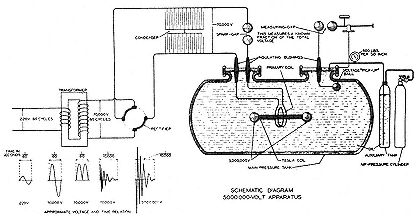
Fig. 2.3
Schematic of the installation of the Carnegie Institution's 5=mV Tesla coil.
Breit, Tuve, and Dahl, PR, 35 (1930), 56.
Lauritsen fielded the first effective tube, which required a scaffolding fourteen feet high of good California redwood for its support (fig. 2.4). Its fundamental features were adapted from the high-potential x-ray tubes developed at General Electric by W.D. Coolidge, who reached some 350 kV in 1926 by shielding the glass walls with a copper tube (fig. 2.5). In this way he defeated the buildup of charge in the walls from electrons driven into them; and hence also the discharges to the walls that punctured the tubes and made the main obstacle to increasing the voltage of x rays. To go beyond 350 kV, Coolidge recommended cascading two or more tubes (fig. 2.6), passing the electron beam through thin windows that would act as anodes for one tube and cathodes for the
[15] CIW, Yb, 26 (1926/7), 169, and 27 (1927/8), 208; Breit and Tuve, Nature, 121 (7 Apr 1928), 535–6; Breit, Tuve, and Dahl, PR, 35 (1 Jan 1930), 53–7 (the definitive coil). Livingston and Blewett, Particle acc. , 17, doubt the 5.2 MV.
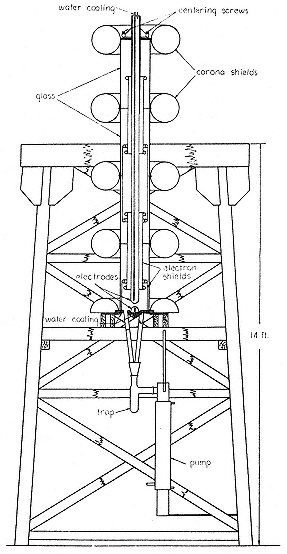
Fig. 2.4
Cal Tech's high-voltage x-ray installation. The corona
shields are attached to the metal rings at the joints
between the gas-pump cylinders constituting the
tube; the very long cathode reaches almost to the
tube's bottom. Lauritsen and Bennett,
PR, 32 (1928), 852.
next and stop positive ions that might otherwise gain high energy and make difficulty. Lauritsen's tube had four segments, to correspond with four cascaded transformers; each tube was twenty-eight inches long and twelve inches in diameter, and made, appropriately to its location, from the glass cylinders then used in pumps in gas stations. The segments joined at steel rings, which also supported the internal wall shields and, externally, circular slips of tin foil to protect against corona losses. The high-potential end of the cascade transformers fed the long central electrode of the tube (a three-inch steel pipe extending to within an inch of the earthed target) through a water resistor. The tube itself was continually pumped to retain a good vacuum. By August 1928 Lauritsen and Bennet could put 750 kV across the tube with no difficulty, and obtain x rays capable of penetrating over 2 cm of lead.[16]
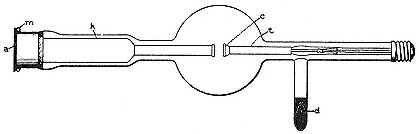
Fig. 2.5
Coolidge's first design for a high-voltage x-ray tube. Its chief feature is the
metal shields around the electrodes, k and t, which prevent buildup of charge
on the glass. Coolidge, JFI, 202 (1926), 696.
Lauritsen patented the design. General Electric had supported Coolidge's work in the hope that very penetrating x rays might be especially effective against cancer. A cheap and efficient high-tension plant had commercial as well as humanitarian possibilities, whence the considerable interest of both industry and medical philanthropy around 1930 in large numbers of volts. As Lauritsen wrote in his patent application that year, his tube, then able to operate at a million volts, could serve "as the full equivalent of
[16] Lauritsen and Bennett, PR, 32 (1928), 851–3, 857; Coolidge, JFI, 202 (1926), 695–6, 719–21.
radium in the treatment of disease, or for therapeutic purposes." A gram of radium then cost $60,000 to $70,000; an x-ray plant of moderate potential, about $30,000. Rewards could be high. And hopes. Many victims of cancer basked briefly in the million volt x rays of the Kellogg Radiation Laboratory.[17]
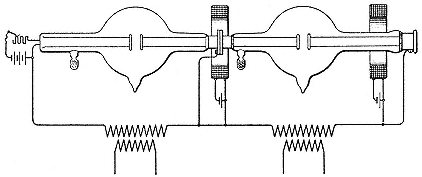
Fig. 2.6
Coolidge's cascade. Two tubes of the type shown in fig. 2.7 are joined together
so that the anticathode of one becomes the anode of the other. Coolidge,
JFI, 202 (1926), 720.
Meanwhile Brasch and Lange were adapting Coolidge's design for use with the AEG impulse generator and the Alpine lightning factory. Late in 1929 they had a porcelain tube over seven feet long, with walls an inch thick studded with 300 nickel rings. They solved the problem of stray electrons not with complete shielding of the walls, as Lauritsen provided, but by enough rings of sufficient capacity to prevent large buildup of unwanted voltages. This great studded stick—made so long in order to space out the longitudinal potential drop—could stand a surge of 1.2 MV. Nine months later, in August 1930, they miniaturized to three feet by immersing the tube in oil to cut out corona discharges from the now high-potential external walls into the air. Careful study showed that the hurdle to going higher was a creep of electrons along the walls between the metal rings. They nipped the creep in a new tube composed of alternating rings of paper, aluminum, and
[17] Benedict Cassen to Lauritsen, 8 Oct 1932 (Lauritsen P), on cost of x-ray plants; Tuve, memo, 23 Jan 1932 (MAT, 8), re radium; supra, §1.2.
rubber of different widths. The spacing of the metal disks remained close, while the creeping distance between them increased enough to discourage the most persistent electron.[18]
Although the vapor pressure of the rubber prevented them from achieving a very high vacuum, Brasch and Lange got spectacular results: the laminated heap withstood the maximum impulse of the generator, 2.4 MV, with transient currents of 1,000 amps; the zippy cathode rays thus produced made x rays that could penetrate 10 cm of lead, and offered a new medical possibility in themselves. Rather than apply very hard x rays against deep cancers, why not try short bursts of million-volt cathode rays, which deliver most of their energy as they come to rest? "Then the irradiation can work very effectively deep within the body without doing so much damage to the parts near the surface." Brasch and Lange's main goal, however, was to adapt their tube to the acceleration of positive ions. They managed to obtain a stream of hydrogen ions at 900 kV, which they thought too low to provoke the transformation of elements. They returned to the Alps to continue their alchemy.[19]
The Department of Terrestrial Magnetism was most impressed by "the spectacular performance" of Brasch and Lange's laminated tube. "They are to be congratulated without reserve," wrote Tuve and his associates, whose own handiwork did not perform quite so well. They had stayed close to Coolidge's design, multiplying segments and decreasing size by immersing the whole in oil. By 1929 their Tesla coil was driving a tube with six segments at 850 kV and one with fifteen segments (all seven feet of it) at 1.4 MV; later, by heatworking the glass to remove bubbles, they operated a twelve-segment tube about a yard long at what they thought was 1.9 MV.[20] Just before Tuve's group learned about the spectacular performance in Berlin, they succeeded in detecting cathode rays and x rays from the tube and fixing their energies at
[18] Brasch and Lange, Nwn, 18 (1930), 16, 765–6, and Zs. f. Phys., 70 (1931), 21–9. The laminations are suggested in fig. 2.3.
[19] Brasch and Lange, Zs. f. Phys., 70 (1931), 30, 33, 35, and Nwn, 21 (1933), 82–3; Badash et al., APS, Proc., 130 (1986), 202.
[20] Tuve, Hafstad, and Dahl, PR, 36 (1 Oct 1930), 1262 (quote); CIW, Yb, 27 (1927/8), 209, and 28 (1928/9), 214; Tuve, Breit, and Hafstad, PR, 35 (1 Jan 1930), 66–7; Tuve, Hafstad, and Dahl, PR, 35 (1 June 1930), 1406–7.
1,250 to 1,500 kV. It remained to accelerate protons, and also to develop a current in the tube sufficiently strong to permit measurement of the intensity, as well as detection of the existence, of the penetrating radiations. The Tesla coil as used in Washington, with its very brief duty cycle, was not a competitor for the medical purse.[21]
In the report of their work for the year 1929/30, Tuve's group pointed out that the tube perfected with the aid of the Tesla coil already outperformed it; and they called for a new generator "in order to adapt this new tool effectively to the studies in atomic and nuclear physics for which it was developed."[22] The tube won them a prize from the AAAS and some attention: page 1 in the New York Times and an advertisement in Time that with their x rays—reported as equivalent in gamma radiation to $187 million worth of radium—they might split atoms and cure cancer. Lawrence congratulated them on "such a fine recognition," meaning the prize, not the puff.[23] Their disappointment with the performance of their Tesla coil evaporated in this sunshine. They tried to accelerate protons, succeeded on December 8, 1931, and directed the beam overambitiously to shattering the elements. Nothing detectable happened; so small was the beam that "further attempts seeking evidence of nuclear disintegration with this set up [were] discontinued." Lawrence again offered encouragement. The tube, he reminded Tuve, was "a terribly important thing!!!—as I have emphasized to you many times (and you try modestly to give Coolidge the credit for)." It remained to find a way to make the tube produce something other than a prize.[24]
[21] Tuve, Hafstad, and Dahl, PR, 36 (1 Oct 1930), 1262; CIW, Yb, 29 (1929/30), 256–7, and 30 (1930/1), 291.
[22] CIW, Yb, 29 (1929/30), 257.
[23] New York Times , 4 Jan 1931, 1; Time, 17:1 (12 Jan 1931), 44; Tuve, Hafstad, and Dahl, PR, 37 (1931), 469, and statement of 19 Feb 1935, re the prize of 1931 (MAT, 14/"lab. letters"); Lawrence to Tuve, 4 Jan [1931] (MAT, 8), adding that Lauritsen had expressed "keen admiration for your work."
[24] CIW, Yb., 30 (1930/31), 292–3; ibid., 31 (1931/32), 231, 229 (last two quotes); Lawrence to Tuve, 15 June [1932] (MAT, 4); Tuve, Hafstad, and Dahl, PR, 39 (1932), 384–5. Cf. Tuve to Lauritsen, 30 Mar 1933 (Lauritsen P, 1/8), advising against trying a Tesla setup for disintegration experiments.