
"Fate Of Nicotine" Study
In addition to conducting the Hippo projects, Battelle also studied how nicotine is absorbed into, distributed within, and eliminated from the body. This work seems to have been part of the overall development process for Project Ariel, an alternative nicotine delivery system discussed later in this chapter. To properly design this delivery system, BAT needed basic pharmacological data on how nicotine was absorbed, distributed, and eliminated from the body. The results of these pioneering experiments are described in a report titled The Fate of Nicotine in the Body , dated May 1963 {1213.01}. The report begins,
There is increasing evidence that nicotine is the key factor in controlling, through the central nervous system, a number of beneficial effects of tobacco smoke, including its action in the presence of stress situations. (Larsen, Haag & Silvette (1960)) In addition, the alkaloid [nicotine] appears to be intimately connected with the phenomena of tobacco habituation (tolerance) and/or addiction. (Larsen et al. (1960)) Detailed knowledge of these effects of nicotine in the body of a smoker is therefore of vital importance to the tobacco industry, not only in connection with their present standard products, but also with regard to future potential uses of tobacco alkaloids.
The numerous effects of nicotine in the body may, at first, be conveniently measured by various physiological and pharmacological experiments. However, the elucidation of the mode(s) of action of nicotine will ultimately depend on biochemical analyses dealing with the behavior of the nicotine molecule on, and its interactions with, the surface of physiologically active, macromolecular cell constituents (enzymes, receptors, etc.). The success of such analyses depends, in turn, on a detailed knowledge of the fate of nicotine in the body, i.e. of the various mechanisms which control the type and the rate of (a) absorption, (b) distribution, (c) breakdown or transformation, and (d) elimination [emphasis added]. {1213.01, pp. 1–2}
Battelle's 1963 report describes a comprehensive series of animal and human experiments on the absorption, distribution, metabolism, and elimination of nicotine.
To study the absorption of nicotine, Battelle used nicotine labeled with radioactive carbon (C14 ) to measure the amount of nicotine absorbed by
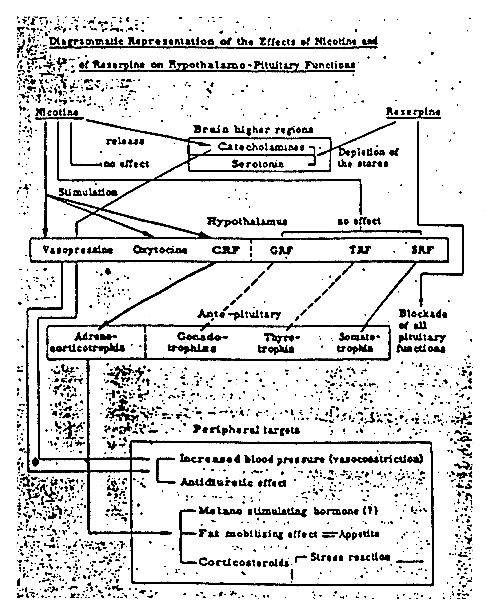
Figure 3.1. By 1962, when it was conducting the Project Hippo research, B&W had a
sophisticated understanding of how nicotine acts on the nervous system. Source: {1211.03, p. 5}
different types of smokers. The two subjects described as "non-inhalers" absorbed 22 percent and 42 percent of the nicotine drawn into their mouths, while most of those who inhaled absorbed between 70 and 90 percent of the ingested dose. The two subjects who "eject[ed] the smoke immediately after inhalation" had nicotine absorption rates in the 40 to 50 percent range. Daily consumption of nicotine among all the subjects in this experiment was found to range from 10 to 91 mg {1213.01, p. 8}. These data demonstrate the importance of inhalation for nicotine absorption from cigarette smoke. Inhalation is unrelated to taste or flavor; it is only important for nicotine absorption into the bloodstream (13). Similar work with C14 -labeled nicotine was not reported in the general scientific literature until a dozen years later (14).
The Fate of Nicotine in the Body also describes Battelle's animal work on nicotine absorption. Using C14 -labeled nicotine in rabbits, the Battelle scientists compared gastric absorption with pulmonary absorption. Gastric absorption was slow, and first pass removal of nicotine by the liver (which transforms nicotine into inactive metabolites) was demonstrated following gastric administration, with consequently low systemic nicotine levels. In contrast, absorption from the lungs was rapid and led to widespread distribution. These results show that nicotine absorbed from the stomach is largely metabolized by the liver before it has a chance to get to the brain. That is why tobacco products have to be puffed, smoked or sucked on, or absorbed directly into the bloodstream (i.e., via a nicotine patch). A nicotine pill would not work because the nicotine would be inactivated before it reached the brain.
Battelle's report also discusses earlier work on nicotine absorption, which had demonstrated that free-base nicotine is absorbed more rapidly than nicotine salts. Nicotine exists in the free-base form at an alkaline pH. In acidic environments nicotine exists as a salt. The more rapid the absorption, the greater the impact nicotine has on the brain. Work such as this on nicotine absorption has nothing to do with taste and flavor.
The Fate of Nicotine report concludes with a discussion of the work on nicotine metabolism in the context of tolerance and addiction. Pharmacologists had recognized that tolerance could develop either from breaking down a drug faster with repeated exposure (metabolic tolerance) or from adaptations to the drug at the level of the target tissue (cellular tolerance). They also recognized that there is an important relationship between the development of tolerance and the potential for a drug to cause addiction.
Although tolerance to some drugs may depend on accelerated enzymatic breakdown, prolonged consumption of others, including morphine, appears to induce cellular adaptions. (Axelrod (1956); Shuster (1961); Takemori (1961) (1962)) In any case, the present results offer no conclusive evidence for any particular mechanism involved in tolerance to nicotine, nor do they indicate a lead to the phenomenon of addiction. We believe that both tolerance and addiction are intimately connected, and that it would be most useful to investigate the two phenomena with regard to cellular adaptation, especially in target organs of the central nervous system [emphasis added]. {1213.01, p. 27}
Within a few weeks of completion of The Fate of Nicotine in the Body , Sir Charles Ellis sent a copy to William S. Cutchins, the president of B&W at the time. In his cover letter, Sir Charles asks that the report be given no wider circulation than the Hippo reports had received.
[The report] is an account of work which has been carried out in association with the other researches which were sent to you recently under the title of HIPPO . I feel sure you will agree that a knowledge of the fate of nicotine in the body is a necessary accompaniment to studying the physiological effects that nicotine can produce. ...
Would you please treat this as confidential document under the same conditions as I described for the report HIPPO . {1200.16}
The documents do not include any acknowledgment from Cutchins, but the person who would shortly replace him as president, E. P. Finch, received the report along with a summary by the B&W vice president of research, T. M. Wade, Jr. {1200.07, 1200.16}