
Chapter Nine—
The Sacramento River Winter Chinook Salmon:
Threatened with Extinction
Jack E. Williams and Cindy Deacon Williams
The Sacramento River winter chinook salmon are nearing extinction. The unacceptable loss of this distinct and valuable race of salmon would be the result of conscious management decisions that demonstrated a lack of concern for the needs of the species. The winter chinook salmon are adapted to entering the main Sacramento River in late winter and spawning far upstream during the early months of the Central Valley's long, hot summer. Their ancestral spawning grounds were in the McCloud River, a tumbling, spring-fed tributary of the upper Sacramento. Eggs hatched and fry matured in the cold, consistent flows of the McCloud, seemingly oblivious to the hot summer weather.
All this changed when Shasta and Keswick dams were built on the Sacramento. Migrating adults, blocked by the dams, no longer could reach historic spawning areas. Pollution, water diversions, and stream channelization also exacted their toll. As recently as 1969, more than 100,000 spawners were tallied. Annual counts from 1982 to 1988 average only 2,334 adult fish—more than a 97 percent decline. At the reduced population levels of recent years, extinction is likely from continued habitat losses or a chance event such as drought or flood.
This disastrous decline has called fishery biologists, anglers, and
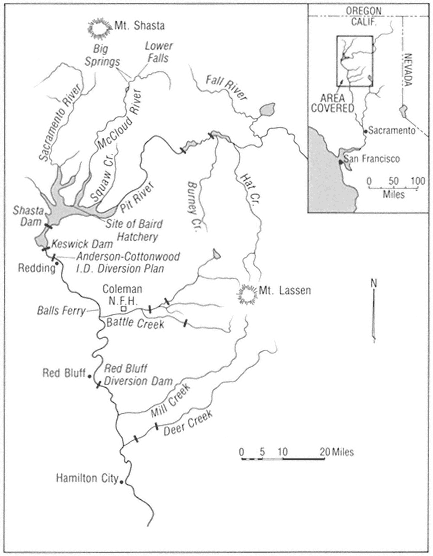
Map 2
Upper Sacramento River and Tributaries
environmentalists to action. They began efforts in 1985 to protect the winter chinook salmon pursuant to federal and state endangered species acts. Faced with the precedent of possibly listing a salmon as endangered or threatened and having to restrict water development in the Sacramento Valley, the National Marine Fisheries Service and the California Fish and Game Commission hesitated to apply the protections afforded by strong endangered species laws and ultimately did so only after extensive legal wrangling and a further precipitous decline to only five hundred and seven spawners in 1989. This chapter traces the unique life history of the Sacramento River winter chinook, efforts to save them from extinction, and the anticipated impact of endangered species protection on sport and commercial anglers, water users, and the fish.
Biological Background
Four races of chinook salmon occur in the Sacramento River system: fall, late fall, winter, and spring runs. The runs are distinguished by timing of adult upstream migration, spawning, egg incubation, and juvenile downstream migration. Most adult winter chinook typically move upstream in December through March and spawn in May and June. Eggs incubate during summer months when water temperatures often are critically high. Downstream migration of winter chinook juveniles occurs from early August through October. In addition to temporal separation of the runs, the winter chinook are further distinguished by their choice of spawning gravels in depths of about ten feet and by their younger age at the time of upstream migration. Historically, winter chinook were mostly three-year-olds, with a few four-year-olds, whereas other runs had a larger proportion of the older fish. Other distinguishing features are their relatively low fecundity, rapid upstream migration of adults, and extended staging period of adults in headwaters before spawning. For these reasons, the winter chinook are considered to be racially distinct from all other runs of chinook salmon.
State of the Resource
Spawning winter chinook salmon were first observed in the McCloud River in 1902 at the site of the Baird Hatchery. In 1942,
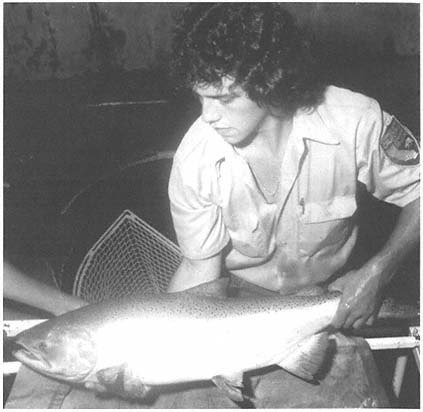
To be extinct? This winter-run Sacramento River chinook salmon, having
traveled more than two hundred miles upriver without feeding, still
appears ocean-fresh. The hardy species, which originally populated the
McCloud River drainage, is nearing extinction.
(California Department of Fish and Game)
however, Sacramento River salmon were blocked from reaching McCloud River spawning habitat by the construction of Shasta and Keswick dams. Neither dam has fish passage facilities. At first, winter chinooks were nearly eliminated because successful spawning was impossible in the warm Sacramento River water below the dams. By 1946, however, releases of cold water from the depths of Shasta Reservoir were cool enough to allow successful egg incubation. By the late 1960s, cool-water releases from Shasta and Keswick dams maintained winter chinook spawning
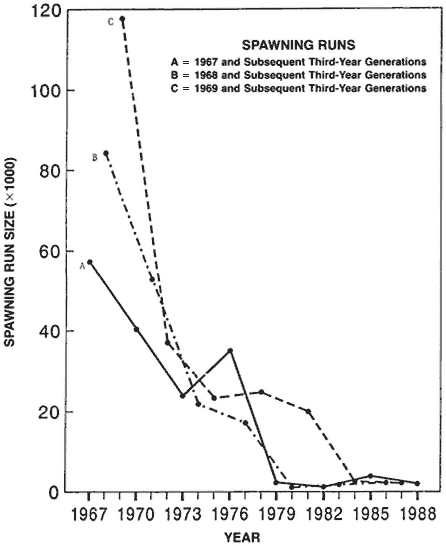
Size of 1967, 1968, and 1969 winter chinook spawning runs passing Red
Bluff Diversion Dam. Subsequent generations are plotted on three-year
cycles to reflect typical ages of spawning adults.
(California Department of Fish and Game, unpublished data)
runs of fifty thousand to one hundred twenty thousand fish. Runs have declined dramatically since that time (see graph).
Many other problems plague the winter chinook: pollution from agricultural runoff, toxic waste from Iron Mountain Mine, gravel mining in tributary streams, channelization and bank stabilization of the Sacramento River, and obstructions to migrating adults and young created by the Anderson-Cottonwood and Glenn-Colusa irrigation districts' diversion dams. Decline of runs was further exacerbated by construction of Red Bluff Diversion Dam in 1966. Water below the dam is rarely cool enough for successful spawning, and fish must ascend fish ladders in order to reach cooler waters released by Shasta and Keswick dams. During the first nine years of operation of that facility, each three-year generation of winter-run fish ascending the ladders declined by one-half. Random environmental events, such as the 1976–1977 drought and the 1982–1983 El Niño, further depressed the winter chinook populations. The 1976 spawning run of 35,096 adults, for example, produced a spawning run of only 2,364 fish three years later.
A Threatened or Endangered Species?
With spawning runs of the winter chinook salmon reduced to only a few thousand fish, the California-Nevada chapter of the American Fisheries Society petitioned the National Marine Fisheries Service in November 1985 to list the run as a threatened species pursuant to the Endangered Species Act of 1973, which establishes that "species" can include "any subspecies of fish or wildlife or plants, and any distinct population segment of any species [of] vertebrate fish and wildlife which interbreeds when mature." The Sacramento River winter chinook salmon thus could be listed as a threatened or endangered species. Furthermore, recent studies elsewhere on the West Coast have documented the genetic distinctiveness of various salmon runs along and within large river systems.
After a review of the winter chinook's status, the National Marine Fisheries Service determined in February 1987 that listing was "not warranted." Although the service found that the run qualified as a species as defined by law and that numbers of winter chinook had seriously declined, it determined that listing was not warranted because resource agencies had informally
agreed to a ten-point conservation plan. Major provisions of the plan include:
1. The U.S. Bureau of Reclamation would raise the gates at Red Bluff Diversion Dam to facilitate passage of winter chinook adults.
2. Gravel would be introduced to supplement riverine spawning habitat.
3. A winter chinook propagation program would be initiated at Coleman National Fish Hatchery.
4. A temperature control curtain would be constructed at Shasta Dam.
5. Iron Mountain Mine would be cleaned up with Superfund money.
6. Fishery restoration plans for the Sacramento River would be developed pursuant to California Senate Bill 1086. (This bill established an advisory committee to develop and recommend recovery actions for Sacramento River fish, wildlife, endangered species, and riparian losses.)
In February 1988, the Sierra Club Legal Defense Fund on behalf of the American Fisheries Society and others filed suit in U.S. District Court to force listing of the Sacramento River winter chinook as a threatened species. The plaintiffs argued that because the run is in fact biologically threatened, the federal government, under the Endangered Species Act, has a nondiscretionary obligation to list the fish. They argued further that the incomplete and nonbinding nature of the planned conservation measures was insufficient to prevent extinction of the species, especially if a drought were to occur or if additional habitat were lost to hydroelectric projects or other human endeavors.
Meanwhile, the Sacramento River Preservation Trust petitioned the California Fish and Game Commission in September 1986 to protect the Sacramento River winter chinook pursuant to California's Endangered Species Act. In June 1987, the commission rejected the petition, refusing to consider the need to protect the winter chinook. After a coalition of eight environmental and sportfishing groups filed suit in state court, the attorney general advised the Fish and Game Commission to accept the petition for consider-
ation. The commission did so in February 1988, granting "candidate" status under the state's Endangered Species Act for one year to provide time for further study.
Late in 1988, pursuant to a stipulated agreement filed with the court, the National Marine Fisheries Service reconsidered their "not warranted" determination, mainly because of poor water condition resulting from low runoff during the previous winter. The service formalized aspects of its ten-point plan by signing an agreement with the U.S. Fish and Wildlife Service, the Bureau of Reclamation, and the California Department of Fish and Game that mandated voluntary compliance but included no penalties for failure to perform. Thus the agreement failed to guarantee that its conservation policies would be implemented fully. The National Marine Fisheries Service nonetheless reaffirmed its negative decision. Concluding that the agreement was seriously flawed, the American Fisheries Society urged the court to set an early trial date on the merits of the lawsuit.
On November 7, 1988, all parties met in U.S. District Court in Sacramento to make their arguments to Judge Haul A. Ramirez. Opening discussions focused on the request of the Pacific Legal Foundation, representing a number of water users and districts, to intervene oil the side of the National Marine Fisheries Service. Ramirez, characterizing the request as one based solely on economic interest and therefore untenable under the Endangered Species Act, denied the motion to intervene. The main ruling, however, went against the salmon. Judge Ramirez ruled that the National Marine Fisheries Service has the authority to determine a species' status and declared he would not interfere. The American Fisheries Society immediately appealed the trial court decision, and in April 1989 the salmon case was joined by a case involving the listing of the spotted owl that had been heard in U.S. District Court in Seattle before Judge Thomas S. Zilly on November 9, 1988. Although the spotted owl case involved a different species and a different agency (the Fish and Wildlife Service), the legal specifics were the same. In both situations an attempt had been made to avoid listing by developing some form of conservation plan. Nonetheless, the respective judges had made opposite rulings.
Meanwhile, disturbing news was coming in from the field. Engineering analysis by the Bureau of Reclamation was calling into
question the feasibility of the critical temperature control curtain proposed for Shasta Dam. With estimated costs jumping from $5 million to $50 million, the project was sent back to the proverbial drawing board. Early estimates of the 1989 run size also were worrisome, indicating approximately five hundred and sixty winter chinook. The final number ultimately dropped to five hundred and seven adults. Further, the Fish and Wildlife Service was able to capture only forty-two of the hundred adults desired for artificial propagation at Coleman National Fish Hatchery.
By early May 1989, the outlines of a disaster at Coleman were becoming clear. More than half of the winter-run adults captured had died before spawning because of antibiotic reaction, fungal infection, and furunculosis. Ultimately eggs could be taken from only one female. The final three survivors were returned to the river in the hope that they might spawn under natural conditions. Serious questions arose about the hatchery's ability to mitigate recent losses.
With the dramatic decline in population size from the two thousand adults that many had argued was the new "stable" population size, the California Fish and Game Commission reversed its February 1989 decision not to list under California law and on May 16 declared that the winter run should be listed under state law as an endangered species. Pressure was building at the federal level, too. In a surprise announcement during a briefing conference on May 25, attorneys for the National Marine Fisheries Service conveyed the service's intent to list the salmon. In the August 4, 1989, issue of the Federal Register, an emergency rule was published that granted threatened status to the winter chinook under federal law. Given the earlier decision by the Fish and Wildlife Service to list the spotted owl, both potentially landmark cases regarding an agency's obligation to list became moot. The legal answer awaits another day.
Effects on Sport and Commercial Anglers
If the Sacramento River winter chinook salmon were to be listed as endangered pursuant to federal law, ordinary taking of the fish (killing, capturing, harming, or angling for it) would be a violation of that law. But since it is to be listed as threatened, as the American Fisheries Society has requested, take agreements can be devel-
oped or special regulations added to allow for sport and commercial harvest in accordance with other applicable regulations. Numerous precedents exist for regulatory flexibility in such cases.
Even more harvest flexibility is present in California's Endangered Species Act. The Fish and Game Commission may authorize sportfishing of any species listed as endangered, threatened, or a candidate. Also, the state act exempts commercial take if it complies with other state laws and regulations.
The National Marine Fisheries Services has noted that winter chinook probably are subjected to a lower ocean harvest rate than other runs of Sacramento River salmon. Because their adult migration is temporally separate from the more numerous fall-run chinook salmon and their average size is smaller, few winter chinooks are harvested commercially. Sportfishing has less impact, as well, but because large inriver take could reduce population numbers unacceptably, the Fish and Game Commission has established a "rolling closure" on this fishery as adults migrate upstream.
Recovery of the Winter Chinook
Chances for survival and eventual recovery of the winter chinook should improve once listing pursuant to federal and state endangered species acts is finalized. Perhaps the most significant consequences of listing under either act would be requirements for interagency consultation. The federal act requires all federal agencies that authorize, fund, or carry out projects affecting the threatened or endangered species to consult with federal fishery offices on possible adverse effects. Projects likely to be subject to this requirement would include bank stabilization work by the U.S. Army Corps of Engineers, operation of all Bureau of Reclamation dams on the Sacramento River, and new hydroelectric projects licensed by the Federal Energy Regulatory Commission. State agency consultation with the Department of Fish and Game will similarly be required when their projects affect the resource.
Projects seldom are stopped through consultation requirements, but they occasionally are modified to mitigate harm to the threatened or endangered species. A 1987 General Accounting Office study found that no western water project was terminated as a result of consultation. Operations of Shasta Dam and Red Bluff
Diversion Dam are key factors ill providing suitable temperatures lot spawning, egg incubation and rearing, and allowing fish access to water of favorable temperature. The Bureau of Reclamation, without pressure from the Endangered Species Act, has yet to guarantee adequate conditions for the winter chinook. In 1988, for example, the bureau raised the gates at Red Bluff Diversion Dam to improve fish passage but prematurely lowered them when conflicts with water contracts became apparent.
Propagation of the winter chinook at the Coleman National Fish Hatchery is a tempting way to recover the run. As has been shown, however, implementing a successful winter chinook propagation program will not be easy. Already more than $2 million has been spent to build deep-water holding ponds at Coleman National Fish Hatchery to accommodate the prolonged period that the winter chinook hold in spawning areas prior to egg maturation.
Numerous other technical problems are likely to be encountered as the effort continues. Some problems are more complex. Salmon produced at hatcheries often are biologically or genetically inferior to wild fish. Researchers from the University of California at Davis have documented that hatchery chinook salmon were more vulnerable to predation by Sacramento squawfish as they pass Red Bluff Diversion Dam than were wild chinooks. Severely depleted anadromous salmon stocks may lack the genetic plasticity necessary to adapt to culture or later readapt to natural environments. Impacts on the success of natural reproduction also must be evaluated before individuals are removed from the wild population to establish a hatchery stock.
Restoration of the Sacramento River ecosystem would be of enormous benefit to other salmon runs in the river. The spring chinook, for example, is seriously depleted from historic levels and fast approaching the need for protection under the Endangered Species Act. In the preamble of the act, Congress declared that "various species of fish, wildlife, and plants in the United States have been rendered extinct as a consequence of economic growth and development untempered by adequate concern and conservation." The act has the tools to rebuild the winter chinook salmon by restoring habitat and reducing mortality factors. Listing is only the first step. It's time we put every available tool to its intended use.