
Perissone Cambio: Madrigals for Five Voices
FORESTIERO: And who have you got here in the way of noteworthy men?
VENETIAN: Starting with musicians, we have Messer Adrian Willaert, who is chapel-master at San Marco, and you know what his fame is.
FORESTIERO: I've heard him called the Prince of Musicians.
VENETIAN: We also have Perissone, a soprano without equal who's been sought out by many princes but wouldn't exchange Venice for any other city.
FORESTIERO: It seems to me he's wise.[27]
Perissone Cambio was Willaert's most prolific disciple in the mid- to late 1540s. In addition to a book of canzoni villanesche alla napolitana dated 1545 he published three independent collections of madrigals, the two five-voice books of 1545 and 1550 and a four-voice book of 1547. All but the last were produced before Perissone even joined the roster at San Marco. Owing to a lack of positions or funds he entered the chapel only on 19 July 1548, before a real post had come available, and then, remarkably, on an unsalaried basis. Perissone owed his position to an unprecedented personal manoeuvre by doge Francesco Donà, who was effective in Perissone's being awarded the next valid opening seven months later, on 8 February 1549.[28] By that time Perissone may have developed connections with Rore as well as with Willaert, for Scotto's edition of Rore's Third Book of madrigals of 1548 (RISM 15489 ) had included one of Perissone's works (as Rore's second book had done four years earlier) and Perissone's Primo libro a quatro voci offered first printings of three
[27] For: E chi ci havete di huomini segnalati?
Ven. Cominciando dà Musici, noi ci habbiamo M. Adriano Vuigliaret, ilquale è Maestro di Capella di S. Marco, e voi sapete quale è la sua fama.
For. Lo ho sentito chiamar Principe de Musici.
Ven. Habbiamo similmente Perissone per Sorano senza alcun paro, ilquale desiderato da molti Principi, ma però non cambiarebbe Venetia per altra Città.
For. Mi par che sia savio.
From Francesco Sansovino, Delle cose notabili che sono in Venetia. Libri due, ne quali ampiamente, e con ogni verità si contengono (Venice, 1565) fol. 33; ded. 17 Sept. 1561. Il Venetiano goes on to name the other great musicians of that time: "il Salo Basso, il Zeffiro, il Franzese, Marc'Antonio, M. Angelo, Don Galeazzo da Pesaro, gentiliss. Spirito, Silvestro da Fontego, i Fauretti, Matteo dalla Viola, il Tromboncino, Annibale Organista, Claudio, Frate Armonio, e molti altri tutti eccellenti" (fols. 33-33').
[28] Ongaro, "The Chapel of St. Mark's," pp. 127-28.
of Rore's madrigals. In addition, the printer Gardane appears to have exploited Perissone's connections with Rore by having him write the dedication to Gardane's edition of Rore's Third Book (RISM 154810 ).
Francesco Donà numbered among several powerful Venetians who took an interest in Perissone's talents — a factor that was instrumental in building up his reputation as a singer and composer during the mid-forties. As we saw in Chapters 3 and 4, Perissone profited from the patronage of Gottardo Occagna, Antonio Zantani, and (most likely) Domenico Venier, and we can imagine him among the impressive performers Doni witnessed in Neri Capponi's salon too. Perissone was probably one of the showiest singers in the salons, a performer who repeatedly won plaudits in print for his singing, and, moreover, a singer of treble parts.[29]
Nothing precise is known of Perissone's origins or of the route that took him to Venice — only that he was Flemish, according to a privilege granted to him by the Senate.[30] By 1544 Perissone's five-voice setting of the anonymous sonnet Che cosa al mondo far potea natura appeared in Rore's Secondo libro and a four-voice setting of Vivo sol di speranza, rimembrando (the sestet of Aspro core ) in Arcadelt's Quinto libro.[31] He made his first major appearance that same year in Doni's Dialogo della musica, where he was designated an interlocutor along with Parabosco, Veggio, and others.[32] Doni's text already places him within a group that pictures itself on the cutting edge of Venetian musical developments. After those assembled sing his setting of Bartolomeo Gottifredi's Deh, perchè com'è il vostro al nome mio, one of the interlocutors praises Perissone as an "accomplished young man and commendable person" with a "beautiful voice" and fine compositional technique.[33]Deh, perchè is one of two madrigals of Perissone's in the Dialogo' s Venetian second half, the other a six-voice setting of Giunto m'ha Amor.[34]
In this early repertory Perissone was already cultivating both stylistic poles of a dichotomy that has been emerging gradually in our discussions of Venetian madrigals — the dichotomy between a songlike polyphony generated directly out of lyric form and meter and a more declamatory, motetlike polyphony shaped by
[29] Though the chapel rolls list Perissone as an alto, Francesco Sansovino's dialogue cited in n. 27 above suggests he must have taken the more difficult upper parts often enough to have been regarded popularly as a soprano, as Giulio Ongaro has argued ("The Chapel of St. Mark's," pp. 105 and 132). Ongaro notes that the term soprano was often used loosely, probably to designate anyone who sang the top line of a composition.
[30] See n. 38 below.
[31] The sestet had earlier been set by Arcadelt and published in his Terzo libro of 1539.
[32] See James Haar, "Notes on the Dialogo della musica of Antonfrancesco Doni," Music & Letters 47 (1966): 198-224, and Chap. 1 above, n. 56.
[33] The praise is initiated by the Piacentine Count Ottavio Landi: "Oh che belle parole, oh che bel canto! Perison certamente ha preso un modo dolce, fugato, chiaro e bellissimo." To this the female interlocutor Selvaggia responds, "Valente giovane e persona virtuosa non poteva far se non divinamente." Depicted here, like the other males in the dialogue, as an amorous courtier, Perissone responds by swearing fealty to Selvaggia (Dialogo della musica, p. 121).
[34] Ibid., pp. 114-20 and pp. 232-42, respectively; in Malipiero's ed. Giunto m'ha Amor is wrongly attributed to Willaert. It reappeared in 1546 in Madrigali di Verdelot et de altri autori a sei voci novamente con alcuni madrigali novi ristampati & corretti [RISM 154619].
rhetorical qualities and proselike diction. Deh, perchè and Giunto m'ha Amor mark the crystallization of this dichotomy. Gottifredi's poem concretizes the internalist poetics of Petrarch in playful, realistic, and sweetly erotic conceits, here encapsulated in the poet's plea that the beloved match his desire as her name does his.
Deh, perchè com'è il vostro al nome mio Oh why, since your name
Parimente conforme Conforms to mine
A mia voglia non è vostro desio? Does not your desire to my longing?
Scaldat', oimè scaldate, Warm, oh warm,
Donna gentil, nel mio amoroso ardore Gentle lady, your frozen desires 5
Vostre voglie gelate, In my loving ardor,
Che se qual esce fuore For if, just as the same sound
De i nomi un suono stesso Issues forth from our names,
Fosse par il voler nei cori impresso: The same desire were only impressed in our hearts,
O che bell'union d'animi santi, Oh what a lovely union of blessed souls, 10
O fortunati amanti! Oh fortunate lovers!
Perissone's setting of Deh, perchè has nothing of the pious Willaertian sobriety and complexity Perissone aspired to (however partially) in sonnet settings. Instead it indulged in sweet cascading melody and light, airy counterpoint to create a clear formal exposition, notable in the way the cantus's opening bars lay out Gottifredi's first period (Ex. 43). Perissone's exordial cantus traces the poetic exposition (vv. 1-3) in a series of ascents that rise by successive steps, peaking on the confinal dd, dropping to a caesura on aa (and "mio"), then reascending for a more ecstatic reiteration of dd ("conform'a mia voglia non è") before the syncopated stepwise descent ("vostro desio"). His writing displays the skill of a great arioso melodist, with the cantus unbroken from start to finish, suspending a large melodic arc between two tonal axes. Unlike the recitational melodies and equal-voiced polyphony of Willaert's and Rore's madrigals, here poetic affect is projected mainly through melodious adornment of the text. With the G-mollis tonality, chiavette cleffing, and delicate coloration, Perissone fashions an engaging chiaroscuro in polyphonic accompaniment to the lyrical cantus. The profusion of cross relations that result (C/C-sharp, F/F-sharp, E/E-flat, and B/B-flat) were ones he continued to exploit in later madrigals.[35] In this lyric and coloristic ebullience, some of the words go breezily misaccented ("pa-ri -men-te ") and in a way that resists the rigors of Willaert's sternly Bembist approach.
If the melodic style of Deh, perchè is pretty and tuneful, the six-voice setting of Giunto m'ha Amor shows that Perissone already knew something of the more severe idiom Willaert reserved for Petrarch's sonnets. Giunto m'ha Amor adheres closely to
[35] On the matter of cross (or false) relations see James Haar, "False Relations and Chromaticism in Sixteenth-Century Music," JAMS 30 (1977): 391-418.
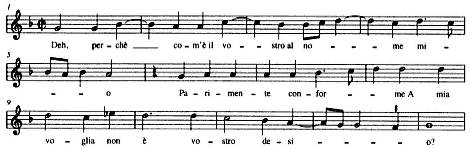
Ex. 43.
Perissone, Deh, perchè com'è il vostro al nome mio (Bartolomco Gottifredi),
cantus, mm. 1-13; Madrigali a 5 (Venice, 1545), no. 1.
the even pulse of Willaert's setting with only occasional syncopations. At the same time it exploits harmonic coloration almost as much as Deh, perchè. A single example may be seen in the sonorities at "Che m'ancidono a torto" (Ex. 44), where Perissone alternately strengthened the fifth motion of the bass from D to B-flat (mm. 14-17) or colored the text through the addition of accidentals.
Reminiscent of Parabosco's 1544 settings, Perissone's Giunto m'ha Amor set only lines 1 through 8. By the time his first collection, Madrigali a cinque voci, was published in 1545, however, Perissone had begun to treat texts more as literary artifacts. Much like Rore's First Book, the Madrigali a 5 published twelve sonnet settings, all unabridged,[36] along with a few lighter settings including Deh, perchè at the head. This is the same mix seen in all the Venetian collections assembled principally for commercial markets, but the bibliographical history of Perissone's book explains more than most about the social context that helped generate it.
The Madrigali a 5 is an unsigned print. According to Jane Bernstein, it was probably produced in the publishing house of Girolamo Scotto — head of a consortium of printers — and most likely printed by Ottaviano Scotto.[37] The venture was engineered by Perissone himself, as made clear enough from the survival of a privilege he applied for from the Venetian Senate in order to print it.[38] As his first publication, the Madrigali a 5 thus represents Perissone's effort to make his name in Venice with a collection devoted exclusively to his own works (as I argued in Chapter 3). These circumstances are corroborated by its long and highly suggestive title page, which implies that the madrigals the book contains originated from a social setting much like the one depicted by Doni.
[36] For my ed. of the book see Sixteenth-Century Madrigal, vol. 2 (New York, 1990).
[37] "The Burning Salamander: Assigning a Printer to Some Sixteenth-Century Music Prints," Music Library Association Notes 42 (1985-86): 483-501, esp. pp. 493 and 497.
[38] Perissone applied for the privilege in June 1545, granted with the description "La musica per lui composta de madrigali sopra li sonnetti del Petrarcha"; see Einstein, The Italian Madrigal 1:439, and Richard J. Agee, "The Privilege and Venetian Music Printing in the Sixteenth Century" (Ph.D. diss., Princeton University, 1982), pp. 95-96 and 179.
It might be of interest that the print has a fairly high number of errors; see the notes that accompany my ed. cited in n. 36 above.
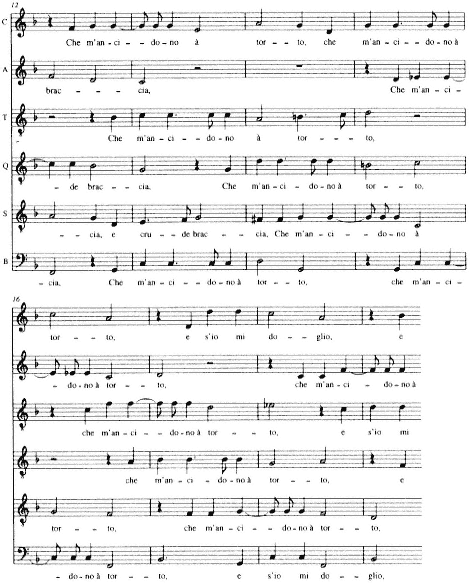
Ex. 44.
Perissone, Giunto m'ha Amor fra belle e crude braccia (Petrarch, no. 164),
mm. 12-19; in Antonfrancesco Doni, Dialogo della musica (Venice, 1544),
fol. 38 in cantus.
Madrigals for five voices by the excellent musician Messer Perissone Cambio, composed for the pleasure of various friends of his and now brought to light at the request of the same, and corrected, revised, and arranged by the composer himself. Never before seen or printed. Five voices. Venice, 1545. With grace and privilege.
Notwithstanding the claim that none of the madrigals had been previously printed, the book does signal Perissone's first major step into the public eye and his first efforts as an entrepreneur. His avowal in the dedication to Occagna that he himself is "having a few of [his] . . . madrigals for five voices printed" tends to confirm this.[39]
To the Noble and Valorous Signor Gottardo Ochagna
My most honorable lord, your virtue, kindness, and courtesy, having obligated me as much as anyone else who considers and experiences them, I cannot but always wish to find a way whereby I might somehow show you some sign of the love that I bear to you, thanks to your divine qualities. Therefore, my lord, knowing that, among the many other such rare virtues in which my lordship delights, Music is one that pleases you exceedingly, I did not want to lose this opportunity. So, since I am having a few of my madrigals for five voices printed — however they may be — I make a gift of them to your lordship in order to give you a small sign of the great desire I have to serve you. Might you then deign to accept with your usual kindness my humble present, keeping ever in mind the affection in my heart. Your perpetual servant, Perissone Cambio
In turning for backing to an afficionado of vernacular letters as well as music, Perissone made visible the symbiotic threads of his inaugural book: its self-promotional origins, its involvement in the new Venetian vogue for setting Petrarch's sonnets, and its appeal to consciously styled literary tastes in the vernacular. Not all the madrigals in it are settings of Petrarch's sonnets (as the privilege implied), but sonnet settings do occupy nearly three-quarters of the book and over half of these are Petrarch's (see Table 10). The others include some novel literary choices: one by Petrarch's early fifteenth-century Florentine imitator, Buonaccorso da Montemagno (no. 8), one by the Neapolitan poet of the early sixteenth century Jacopo Sannazaro (no. 15), and one of mixed attribution, probably by the eminent sixteenth-century Petrarchan Vittoria Colonna (no. 11).[40] All of the sonnet settings, moreover, are complete — still a new practice in the mid-forties, the only real precedent (among printed works) for which was Rore's First Book.
[39] See Chap. 3 above, nn. 13-14, and for the original title page and dedication Plates 9 and 10.
[40] With the exception of Buonaccorso and Colonna, the identifications I make here are found in Il nuovo Vogel 1:304-5. In addition to the poetic source given in Table 10, Buonaccorso's sonnet is reprinted in Poesia del quattrocento e del cinquecento, ed. Carlo Muscetta and Daniele Ponchiroli, Parnaso italiano, no. 4 (Turin, 1959), p. 13. The text of no. 2 is attributed to Colonna in Rime diverse, di molti ecc. autori . . . libro primo, 2d ed. (Venice, 1546), p. 293, but Vogel names its author as Cottemanno, probably on the basis of its inclusion in Philippe de Monte's collection devoted to Cottemano's spiritual poems, Primo libro de' madrigali spirituali a cinque voci (Venice, 1581). The earlier attribution to Colonna seems more likely. The other sonnet settings, nos. 4 and 6, remain anonymous.
| ||||||||||||||||||||||||||||||||||||||||||||||||||||||||||||||||||||||||||||||||||||
(table continued on next page)
(table continued from previous page)
| ||||||||||||||||||||||||||||||||||||||||||||||||
Indeed, Perissone could well have gotten various ideas for his own collection from Rore's, including the idea of ordering the corpus by mode, with high-clef arrangements (chiavette) standing in for authentic modes, lower clefs for plagals. Rore's Primo libro may also have helped inspire Perissone's inclusion of several black-note madrigals using common time signatures (C), copious syncopation, and a wide range of rhythmic values (nos. 6, 9, 12, and 14).
Unlike Rore's, however, all of Perissone's sonnet settings divide (like Willaert's) after the octave, and none of them actually resets sonnets set by Rore. Instead, three of the six Petrarch sonnets (nos. 3, 12, and 16) were among those later published in the Musica nova, making the Madrigali a 5 the first in the stream of books to imitate directly Willaert's madrigalian practice. Two of these, Cantai, hor piango and I piansi, hor canto, respond frankly to an implicit compositional challenge. In Cantai, hor piango Perissone adopted a characteristic imitative procedure from Willaert's exposition, compressed it, and simplified it thematically. (See the beginning of Willaert's setting in Ex. 45a and Perissone's imitation in Ex. 45b.) Following his model, Perissone introduced the downward- and upward-moving versions of the opening motive a semibreve apart but varied the whole texture less than Willaert had. He discarded the simple breve/semibreve motive that Willaert had assigned
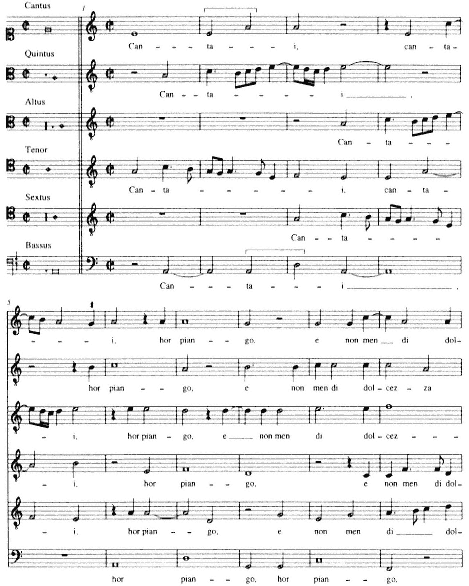
Ex. 45A.
Willaert, Cantai, hor piango, e non men di dolcezza (Petrarch, no. 229),
mm. 1-27; Musica nova (Venice, 1559), no. 17.
(continued on next page)
(continued from previous page)
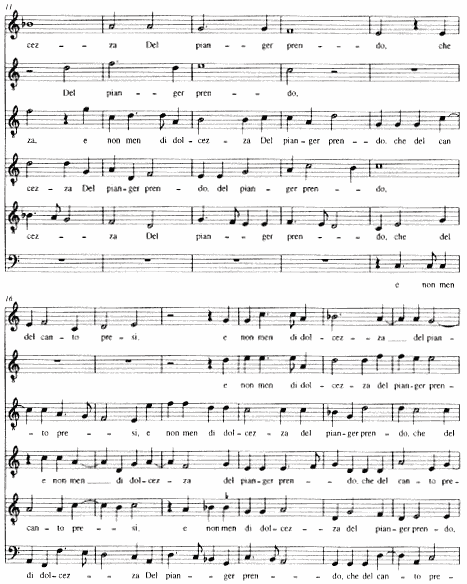
Ex. 45A
(continued)
(continued on next page)
(continued from previous page)
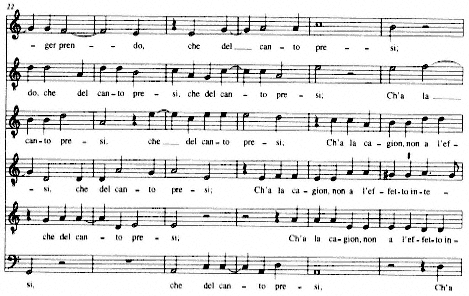
Ex. 45B.
Perissone, Cantai, hor piango, e non men di dolcezza (Petrarch, no. 229),
mm. 15-18; Madrigali a 5 (Venice, 1545), no. 3.
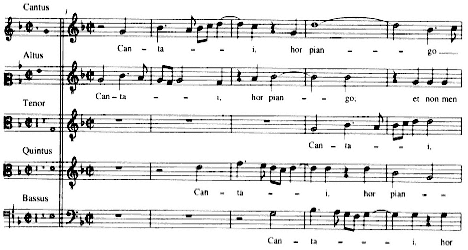
(continued on next page)
(continued from previous page)
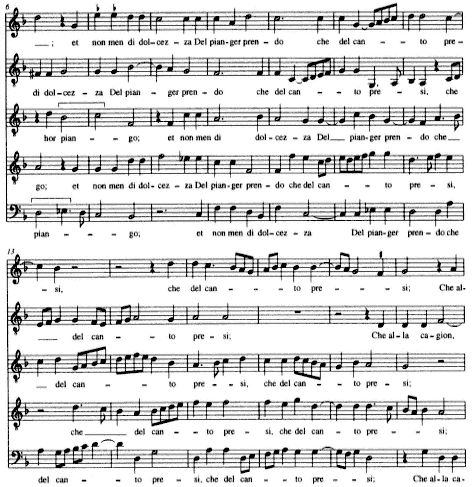
Ex. 45B
(continued)
to "cantai" in the outer parts and in place of Willaert's double-subject counterpoint created a simpler single-subject point of imitation with every voice stating the lone motive either in its original form or in inversion.
Perissone's opening also lacks the chiming multivoiced effect that Willaert achieved by exploiting closely staggered inner parts. In Willaert's setting each of these parts enters on the same note, a, the parts paired symmetrically with quintus inverting tenor, then altus inverting sextus. The contrapuntal and motivic intricacies spread over twelve breves and more before v. I is played out by all voices, as compared with seven in Perissone's setting. Perissone's smaller exposition is characteristic of his generally shorter-winded approach and the smaller proportions of his work as a whole in comparison with Willaert's (53 and 57 measures, as compared with 70 and 69 in Willaert's): the different sizes result from dissimilar ways of handling poetic and musical materials. Willaert's varied parsings often explore a variety
of syntactic divisions and groupings for a single excerpt of text, while Perissone reads more uniformly to produce terser settings overall.
Note, for instance, the array of alternatives Willaert searched out in parsing the first two verses of Cantai, hor piango:[41]
1. Cantus: Cantai / cantai / hor piango / e non men di dolcezza Del pianger prendo / che del canto presi / e non men di dolcezza del pianger prendo / che del canto presi
2. Quintus: Cantai / hor piango / e non men di dolcezza / Del pianger prendo / e non men di dolcezza del pianger prendo che del canto presi / che del canto presi
3. Altus: Cantai / hor piango / e non men di dolcezza / e non men di dolcezza Del pianger prendo che del canto presi / e non men di dolcezza del pianger prendo che del canto presi / che del canto presi
4. Tenor: Cantai / cantai / hor piango / e non men di dolcezza Del pianger prendo / e non men di dolcezza del pianger prendo che del canto presi che del canto presi
5. Sextus: Cantai / hor piango / e non men di dolcezza Del pianger prendo che del canto presi / e non men di dolcezza del pianger prendo che del canto presi
6. Bassus: Cantai / hor piango hor piango / e non men di dolcezza Del pianger prendo che del canto presi / che del canto presi
Each voice presents a different reading, stringing together various syntactic fragments freely and irregularly in a way that elevates variable syntax to the status of a musico-rhetorical ideal. By reading the same text identically in every part, Perissone's practice accords with many of Parabosco's text settings (the only exception is a repetition of "che del canto presi" by the quintus): "Cantai / hor piango / e non men di dolcezza Del pianger prendo che del canto presi / che del canto presi." Not surprisingly, Willaert required nine breves more than Perissone to set the same two lines in a manner that is weightier, broader, more complex and convoluted, but also less lucid and immediately winning than his student's.
Perissone must have taken Willaert's lead in building much of Cantai on harmonic motion by fifth, especially at the opening of the seconda parte. Willaert set the bass moving in circles of fifths a total of three times for the poet's proclamation "Tengan dunque ver me l'usato stile / Amor, Madonna, il mondo et mia fortuna" (Let them keep toward me their accustomed style, Love, my lady, the world, and my fortune): from an E-major triad to one on C-major; from E to C
[41] These verses are not ambiguous in the way of v. 8 from Pien d'un vago pensier, however; see Chap. 7, pp. 246-49.
again at double the harmonic rhythm; and from A to F. Perissone began his seconda parte with fifth motion as well, initially from G to B-flat and (a little later) from A to C and D to F. The progressions and their particular locations differ, but the coloring and sense of drive are similar,[42] Perissone adopting Willaert's fifth motion to reinitiate the syntactic process after the octave break and propel the paratactic series forward at v. 10, "Amor, Madonna, il mondo et mia fortuna." Here it is worth recalling Einstein's observation that even in such polyphonic surroundings, this sort of writing can produce textures in which "the bass takes no part in the motivic structure but functions merely as a support," the four parts above it forming a sort of "concertante."[43]
In sum, Perissone's borrowings in Cantai, hor piango avoid literalism in favor of a free gloss. Comparison of these borrowings with those of Cantai's companion sonnet I piansi, hor canto shows that Perissone's tendency to compress and simplify was habitual. Here too Willaert's model provided a complex exposition in double counterpoint (Ex. 46a), the first subject a three-note stepwise descent that generates harmonic suspensions, the second a fifth-leap followed by a downward step. At first both subjects move solely in breves. The two upper voices give out the opening subject, with the comes introducing suspensions over the dux as well as over lower voices that enter later. The second motive first emerges in the bass as a harmonic support (m. 2), resolving the harmonies set askew by the cantus, and only later takes flight as a melodic motive in its own right. Perissone's exposition (Ex. 46b), like the one in Cantai, is again substantially shorter than Willaert's (the words "I piansi" lasting through four and a half measures as opposed to ten in Willaert's), and his setting is more effulgent. Perissone appropriated Willaert's G-durus tonality but used it at a higher cleffing, replacing c1 with g2 in the cantus. As in Cantai, he smoothed out irregularities in Willaert's version by giving the syntactic readings a simpler, more homogeneous character. Instead of two motives of equal status, he employed just one, similar to the second of Willaert's two. He treated it in a regularized imitation, with each of the five voices entering at equal temporal intervals of a semibreve and moving straight through the rest of the verse ("hor canto che 'l celeste lume") after a single statement of "I piansi."
Along with the simplification and abbreviation that mark Perissone's imitation goes a general lightening of tone. Perissone did away with the descending motive of Willaert's exposition and its pervasive suspensions. Having eliminated the drooping minor second on "piansi," he reduced the number of suspensions to just one (m. 3), working neither of them back into Willaert's second motive — the one he did borrow.
[42] For the scores see Willaert, Opera omnia 13:73-79, and Perissone, Madrigali a cinque voci, ed. Feldman, Sixteenth-Century Madrigal 2:24-40. There are a number of examples of this among Willaert's settings of sestets, e.g., Mentre che 'l cor dagli amorosi vermi, in Willaert, Opera omnia, ed. Hermann Zenck et al., Corpus mensurabilis musicae, no. 3, AIM ([Rome], 1950-), 13:32-36 (on which see Feldman, "Rore's 'selva selvaggia': The Primo libro of 1542," JAMS 42 [1989]: 558-60).
[43] The Italian Madrigal 1:440.
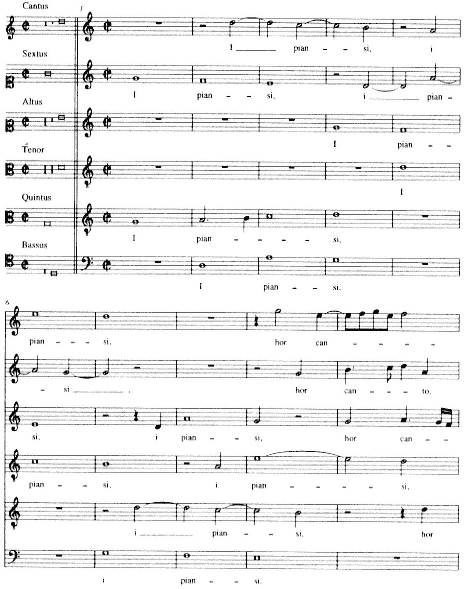
Ex. 46A.
Willaert, I piansi, hor canto, che 'l celeste lume (Petrarch, no. 230),
mm. 1-10; Musica nova (Venice, 1559), no. 16.
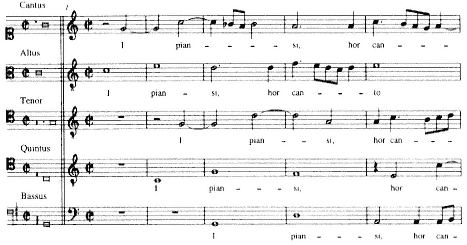
Ex. 46B.
Perissone, I piansi, hor canto che 'l celeste lume (Petrarch, no. 230),
mm. 1-5; Madrigali a 5 (Venice, 1545), no. 16.
In the face of these modifications toward more appealing — and no doubt more public — prototypes, we should not underestimate Perissone's participation in the musical practices of Petrarchism that his teacher epitomized. Two further passages from I piansi help make the point. First, Perissone's I piansi follows Willaert's model in drawing the exposition of v. 5, "Onde suol trar di lagrime tal fiume" (Thus he [Love] is wont to draw from me such a river of tears), over eleven breves. Also, like Willaert, he introduced plaintive B-flat's at "lagrime" and later "pianger" (v. 10) to produce minor seconds and thirds — a gesture that had by then become conventional. Second, at the beginning of the final tercet, "Non lauro o palma, ma tranquilla oliva / Pietà mi manda" (Pity sends me not a laurel or a palm, but the tranquil olive), Perissone emulated Willaert's slowing of the composite rhythm to the semibreve. This type of surface deceleration almost always marks moments of key rhetorical importance in Willaert's writing — a point of symbolic significance, a shift of grammatical person or tense, or an important twist in meaning — especially in articulating structural divides. In the Petrarchan lexicon the words signify the crucial mirror relationship laurel-Laura, of course. Like Willaert, Perissone applied the device a second time at the image of pity drying the poet's tears, "E 'l pianto asciuga" (v. 14),[44] a brief reminder of the opening and one that helps bring the poem full circle.
Perissone's second book a 5 (and his last book of madrigals) continued to extend directions taken up in the Madrigali a 5. Published by Antonio Gardane in 1550, it
[44] In Willaert, mm. 116-18, and Perissone, mm. 111-12.
was given the title Il segondo libro di madregali a cinque voci con tre dialoghi a otto voci & uno a sette voci novamente da lui composti & dati in luce and affixed with a brief dedication to Domenego Roncalli.[45]
To the noble and gentle young man, Mr. Domenego Roncalli, my most eminent lord.
If your lordship will consider well your valor and kindness, you will surely believe without further ado that I have remained such a servant to you from the first day that I came to know you here in Venice; for an ardent desire was born in me to serve and honor you always. I dedicate to you, then, with all my powers, these madrigals of mine, which you might deign to accept not as a gift matched to your worth, but rather as a little sign of the great affection of my reverence, and I kiss your hands with all humility. From Venice on the 3rd of May. Loving servant, Pierisson Cambio.[46]
Domenego Roncalli is not a name that otherwise appears in connection with Venetian music. He may be the same as Giovanni Domenico Roncalli, descendant of a noble Bergamese family that was added in 1545 to the Consiglio Communale of Rovigo, a Venetian outpost. According to his recent biographer, this Roncalli spent a good deal of time at both Padua, where he had a house, and Venice, where in 1554 the doge Francesco Venier made him a cavalier of San Marco.[47] Intriguingly, he gained notoriety in the Veneto by founding an academy in Rovigo in 1553, the Accademia degli Addormentati (later condemned for Calvinist heresies) that was styled after the cultural academies of Venice but with a public aspect that prefigures Badoer's Accademia Veneziana.
Whether this Roncalli is the same as Perissone's dedicatee and what relation he might bear to the print unfortunately remain mysteries. It would be gratifying to connect the two, not least because the Segondo libro counts as yet another Venetian print to attempt some kind of modal ordering, though the least straightforwardly of Perissone's three madrigal books (see Table 11). Like Parabosco's collection, its works are arranged in modal groups without obvious distinctions of ambitus, but unlike Parabosco's they are given in the usual ascending order, protus, deuterus,
[45] There is no mod. ed. of the book at present.
[46] Al Nobile & Gentile Giovane Il Signor Domenego Roncalli Signor mio Osservandissimo.
Se vostra signoria considerera bene il Valore & la gentilezza sua, ella senza piu credera bene ch'io le ristassi tanto servitore il primo giorno che qui in Vinegia la conobbi, che in me sia nasciuto ardente desiderio di sempre servirla, & honorarla. io le dedico adunque insieme con tutto il poter mio questi miei Madrigali: i quali ella si degnera d'acettare, non per presente conveniente al suo Valore: ma si bene per picciolo segno del grandissimo affetto della mia riverenza & a V.S. con ogni humilta bascio le mani. Di Vinegia alli 3 di Maggio. Amorevole Servitore Pierisson Cambio.
[47] See Stefania Malavasi, "Giovanni Domenico Roncalli e l'Accademia degli Addormentati di Rovigo," Archivio veneto, 5th ser., 95 (1972): 47-58, and Gino Benzoni, "Aspetti della cultura urbana nella società veneta del' 5-600: le accademie," Archivio veneto 108 (1977): 114-15. My information relies on Malavasi, to which I can add only that a Giocan da Roncali fu Giovanni Domenico da Rovigo, apparently Roncalli's son, made his will in Venice on 25 May 1596 (I-Vas, Archivio Notarile, Testamenti, Atti Beni, b. 160, fol. 239).
| ||||||||||||||||||||||||||||||||||||||||||||||||||||||||||||||||||||||||||||||||||||
(table continued on next page)
(table continued from previous page)
| ||||||||||||||||||||||||||||||||||||||||||||||||||||||||||||||||||||||||||||||||||||
tritus, and tetrardus, until the four dialogues at the end (nos. 20-23). Only the tritus-mode madrigals appear to distinguish unambiguously between authentics and plagals,


Ambiguities like these confirm that the book's "modal" arrangement was made ex post facto, either by Perissone, who had made or collaborated on the modal ordering of his first five-voice book, or by Gardane in collaboration with Perissone. If I am right that modal ordering and sonnet setting were companion projects among Venetians, then the book's poetic contents show a commitment to sonnet setting about equal to its commitment to modal thinking (both of which were less than Perissone's had been in putting together his Rore-like First Book). Ten of the Segondo libro's poems are Petrarch's, nine of them sonnets (three dialogues), and one a madrigal.[50] The book also contains two sonnets by Bembo and one possibly by Ariosto — poets represented by one poem each in Perissone's earlier two books. The only other poets identifiable at present are Luigi Cassola, author of the madrigal Alma gentil, s'in voi pietà fu mai, and Panfilo Sasso, the late-fifteenth-century Petrarchan poet whose dialogue "Quando nascesti, Amor? Quando la terra" was also included in Willaert's Musica nova. Eight poems remain anonymous.
In all, the Segondo libro contains a record seven settings of texts in the Musica nova.[51]
[48] "Tonal Types and Modal Categories," pp. 451-52.
[50] One of these, the sonnet Amor m'ha posto come segn'al strale, had already been published in 1548 in Scotto's edition of Rore's Terzo libro a 5, RISM 15489.
[51] One other poem was previously set by Willaert, the anonymous Amor, da che tu voi (see Chap. 7 n. 40).
1. I vid' in terra angelici costumi
2. In qual parte del ciel, in qual idea
3. Gionto m'ha Amor fra bell'e crude braccia
4. "Occhi piangete, accompagnate' il core"
5. "Liete e pensose, accompagnat'e sole"
6. "Che fai, alma? Che pensi? Havren mai pace?"
7. "Quando nascesti, Amor? Quando la terra"
Helga Meier noted borrowings from Willaert's settings in five of these madrigals (as well as connections between Perissone's five-voice setting of the anonymous Amor, da che tu voi pur ch'io m'arischi and Willaert's four-voice Amor, Fortuna, et la mia mente schiva ).[52] The Musica nova 's four dialogue sonnets make up four of the seven. They furnish yet another sign of how early the Musica nova had taken shape as a collection and represent through Perissone's placement of them at the end of his book a novel attempt to imitate something of the outer form of Willaert's collection.[53]
As in the Madrigali a 5, Perissone's Second Book's imitations showed a refined melodic flair and general brightening that resists Willaert's sternness. To cite a single example, he replaced the dark
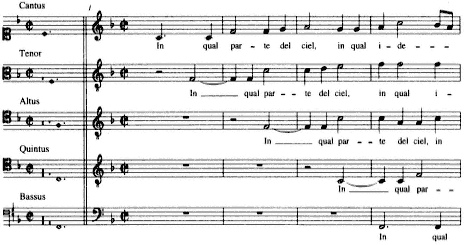
Nonetheless, Perissone's In qual parte del ciel offers a kind of ideal exemplar of emulation practice. Helga Meier pointed out two unambiguous references to Willaert's original: the circle of fifths imitating Willaert's characteristic opening of the seconda parte and its accompanying motivic-contrapuntal structure (Exx. 49a and 49b); and Willaert's soggetto for v. 4, "Mostrar qua giù quanto lassù potea"
[52] The five related settings cited by Meier are: I vidi in terra, In qual parte del ciel, "Liete e pensose," "Che fai, alma?," and "Quando nascesti, Amor?" ("Zur Chronologie der Musica Nova, " p. 76).
[53] At least two other collections made a less sweeping attempt to do this: Donato's Primo libro d'i madregali a 5 & a 6 of 1553 (discussed below) and the Paduan Francesco Portinaro's Primo libro de madrigali a cinque voci of 1550, with five six-voice settings and a seven-voice setting of "Liete e pensose" at the end.
[54] Cf. the triple meter that starts the seconda parte of no. 11. For Qual dolcezza giamai see Willaert, Opera omnia 14:65-70, esp. mm. 64-69.
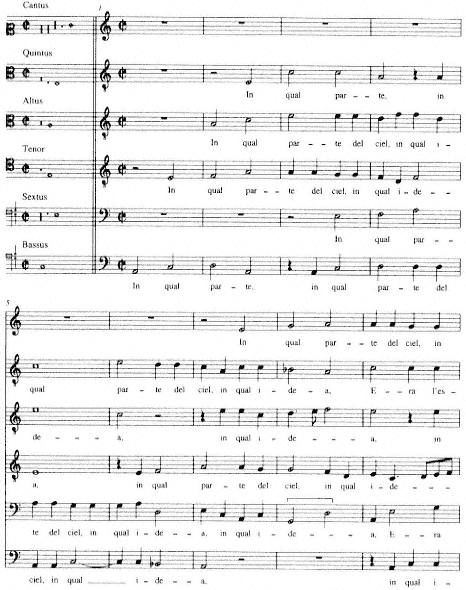
Ex. 47A.
Willaert, In qual parte del ciel, in qual idea (Petrarch, no. 159),
mm. 1-13; Musica nova (Venice, 1559), no. 18.
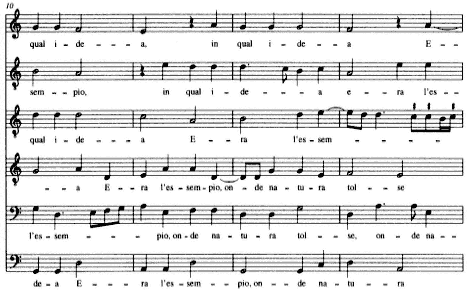
Ex. 47B.
Perissone, In qual parte del ciel, in qual idea (Petrarch, no. 159),
mm. 1-13; Segondo libro a 5 (Venice, 1550), no. 14.
(table continued on next page)
(table continued from previous page)
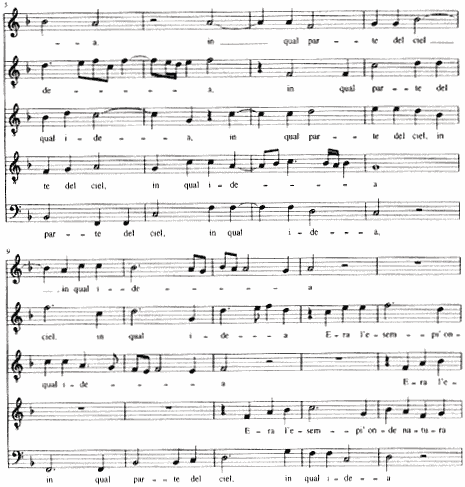
Ex. 47B
(continued)
(compare the altus of each in Exx. 50a and 50b). In fact Perissone adopted Willaert's declamatory gestures even more extensively than this, borrowing the rhythm of Willaert's homorhythmic altus-tenor duet at v. 3 and taking over the four-note figure for "Chiome d'oro" of v. 6. Even so, he continued to avoid the obscuring intricacies of a pervasively varied motivic structure. In both of the cases just cited he turned Willaert's soggetti into unvaried rhythmic figures (or nearly so); Willaert's setting continually alters the rhythms applied to v. 3 by shifting stressed syllables between tonic and agogic accents and also adds small melismas, while Perissone's
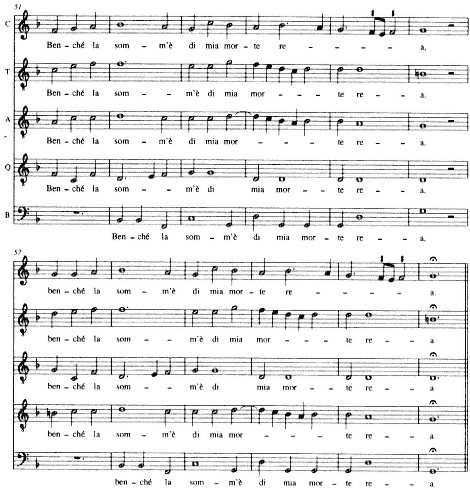
Ex. 48.
Perissone, In qual parte del ciel, in qual idea (Petrarch, no. 159),
mm. 51-62; Segondo libro a 5 (Venice, 1550), no. 14.
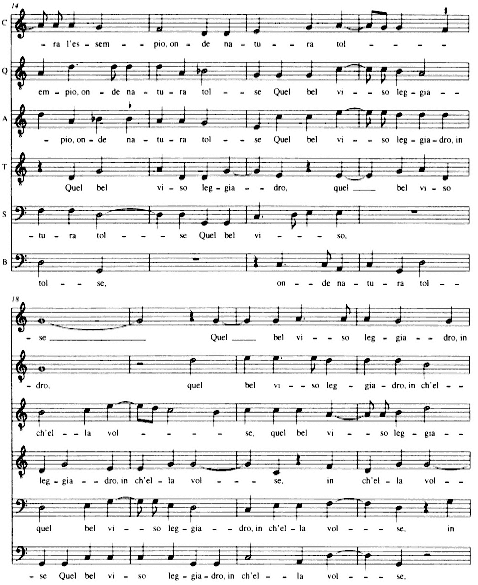
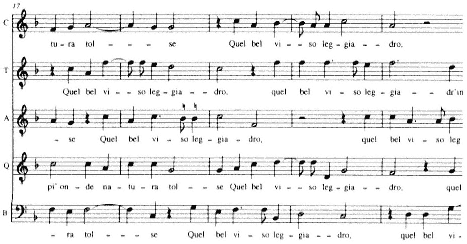
retains the same rhythmic morphology for each entry (Exx. 51a and 51b). Likewise, Willaert made "Chiome d'oro" rhythmically fluid and metrically elusive: four of the six voices start with the syncopated figure and two others on the tactus, nearly transforming the motive into anonymity. Here again Perissone repeated Willaert's rhythm exactly at each of the five entrances — yet never with the precise rhetorical incentive Willaert seems to have had in those rare instances when he avoided motivic variation (see Ex. 15 and Chap. 7 n. 47).
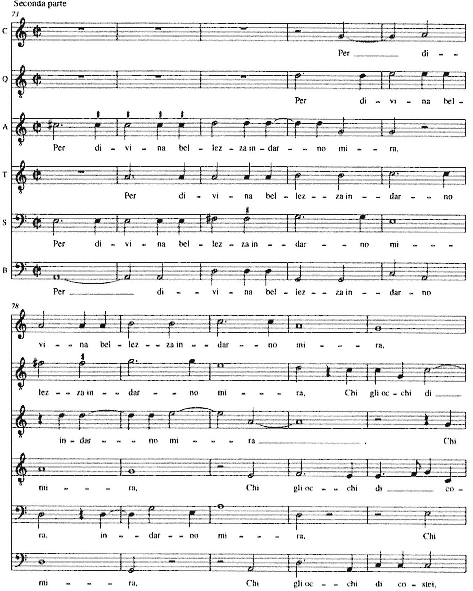
Ex. 49A.
Willaert, In qual parte del ciel, in qual idea (Petrarch, no. 159),
mm. 73-82; Musica nova (Venice, 1559), no. 18.
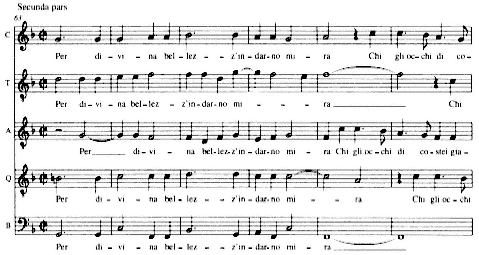
Ex. 49B.
Perissone, In qual parte del ciel, in qual idea (Petrarch, no. 159),
mm. 63-68; Segondo libro a 5 (Venice, 1550), no. 14.

Ex. 50A.
Willaert, In qual parte del ciel, in qual idea (Petrarch, no. 159),
altus, mm. 25-28; Musica nova (Venice, 1559), no. 18.

Ex. 50B.
Perissone, In qual parte del ciel, in qual idea (Petrarch, no. 159),
altus, mm. 29-33; Segondo libro a 5 (Venice, 1550), no. 14.
Ex. 51A.
Willaert, In qual parte del ciel, in qual idea (Petrarch, no. 159),
mm. 14-21; Musica nova (Venice, 1559), no. 18.
Ex. 51B.
Perissone, In qual parte del ciel, in qual idea (Petrarch, no. 159),
mm. 17-21; Segondo libro a 5 (Venice, 1550), no. 14.