
The Conflict Concerning the Future: Globalists and Populists in the Community Party
Western observers (as well as opposition groups in the countries undergoing transformations) do not appreciate differences between factions of reformers with different orientations in the camp conventionally called the "authorities."
These differences and disputes (suspended when there is a threat to the Communist party as a whole but continually resurfacing) express not only conflicts of interests of various institutions of power but also are a sign of more fundamental differences in ways of reasoning that result from, among other things, generational differences and different challenges (as well as training and information) in a given segment of the ruling apparatus.
The conflict in the camp of reformers that I call the "conflict concerning the future" concerns three matters:
• Perception of the nature of the crisis in real socialism. The globalists put the main emphasis on relations with the capitalist system which are based on the systemic subarticulation of the socialist mode of production to the capitalist world. The populists pay more attention to internal contradictions (also within the bloc) and to the "leadership" crisis, which was caused, they think, by following the "leading role of the party" formula in the past.
• Visions of reform . The globalists are supporters of the notion of "ontological opening" (see chapter 2), treating political reforms as a condition for making ownership changes and "introducing market mechanisms" smoothly. The populists, in turn, treat political reforms (such as the workers' self-management movement, reanimation of the party, better representation of interests) as an autonomous element, regarding privatization of the state sector as a temporary maneuver that will allow socialism to "catch its breath."
• Guarantees of the permanence of reforms . The globalists put greater stress on legal guarantees and a social contract with the opposition. The populists emphasize the role of the Communist party (reformed). Characteristic here is the statement of one of the party experts.[1] I quote it in its entirety because both in its language
and argumentation it is a good illustration of the twisted thinking of the members of this faction:
I believe that most of the members of the M.F. Rakowski government are aware that the effectiveness of the government's actions requires a gradual departure from the principles of socialism. The new economic legislation has created rather honest rules of the economic game, in which state and socialized enterprises will be dislodged by more competitive private firms. Due to the workings of the market, in several or a dozen or so years the greater part of the economy will be in private hands, and Poland will become an ever more capitalist country. The right wing wants to speed up this process . . .. That is why it is perhaps better that such breakneck and dangerous changes were initiated by the PUWP, which has numerous, experienced, qualified, often intelligent cadres and the support of the Civic Militia, security force, and army.
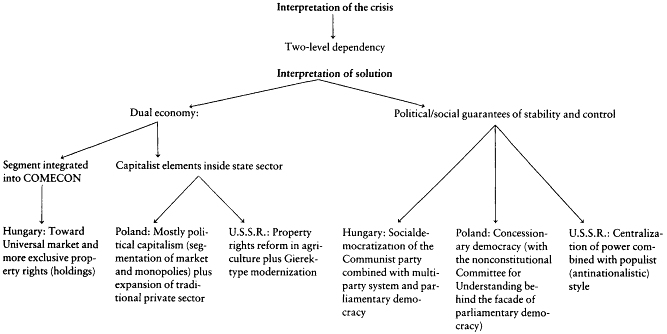
To describe the differences between factions of party reformers in more detail, I start with the problem of the perception of the crisis. Most generally the interpretation of the globalists (in all the countries undergoing reform) can be called the "world-system perspective,"[2] which makes use of the vision of two-level dependency.
Socialism is seen as subarticulated and dependent on capitalism, and as "punished" twice: for being peripheral and for being unable (due to collective property rights) to follow the market logic. The second-level dependency, the politically imposed interdependency in the Eastern bloc (COMECON), is perceived as an adjustment to the first-level dependency. The main aim of this adjustment is to redistribute among the East European countries the costs of subarticulation (costs that are initially unequal, due to the uneven starting levels of the development) and to impose "import substitution specializations" (often in spite of local advantages) as well as politically administered transfers. Such adjustment makes possible the consolidation of the political empire, able to compete with the West in spite of socialism's economic subarticulation to it. But to have both empire and social stability in the Eastern bloc is more difficult. A solution to these problems, as reformers see them, is to build in each country a sort of dual economy , with one of its segments deeply integrated into the COMECON (and administered directly from Moscow)[3] and the other one radically reformed (with capitalist mechanisms, including privatization intro-
duced into the state economy). The latter would eventually reduce the costs of subarticulation, while the former would make adjustment to it more rational from the point of view of Moscow. This plan goes in the opposite direction from the hypothesis of the rapid decline of regional hegemony.[4] Economic reform, based on the property rights shift, is unthinkable without legal and political guarantees (nobody would invest capital without such guarantees). Reformers "from above" understand this and see both the end of "revolutionary legitimacy" and the new relationship between state and society as functional imperatives for a successful economic reform that can save the empire. The basic features of real socialism are given up (including the leading role of the party and collective ownership) in order to accomplish this task. Reforms are based on a high degree of coordination of changes in particular segments, not de-correlation, as K. Jowitt sees it.[5]
The segment of the ruling group which is behind the new world-system interpretation of both the crisis and reform is linked—by its professional responsibilities and training—with foreign policy, counterintelligence, foreign trade, and the scientfic institutions behind these fields, not to the traditional party—police contingent. The latter not only have a local orientation but will be hurt by the reforms. With a dual economy, control over material resources will shift directly to Moscow or partly pass into private hands (through property rights reform inside the state economy). Their hope was that with political reforms, steerability from the top eventually would be restored (and bureaucratic anarchy overcome), but the direct control of the administration on the lower levels would be weakened.
In each country this first faction is confronted with a different vision of reforms represented by the populist faction , linked to a more traditional vision of both crisis and solution. And both of these groups have to fight with the bureaucratic faction, which is linked to the low-level state apparatus, the Communist party hierarchy, and more traditional (control oriented) segments of the police and army.[6]
The main advantage of the globalist faction is that it is insulated from local pressures; its main disadvantage, that it does not have an executive network of its own that has experience in dealing with domestic problems (especially with the economy). In the
above conditions it is no accident that the Moscow globalists were able to make foreign policy more pragmatic, to reinforce reformist tendencies in parts of the Polish and Hungarian power elite, and to introduce a few new rules on the central level, but at the same time were unable to introduce basic changes in the Soviet economy.
The main ideological debate in Eastern Europe is going on in the triangle described above: two competing, reform-oriented factions —with different visions of reforms—confronting not only each other, but also resisting the Communist party bureaucrats. Before I move on to this debate, I would like to describe the different tracks of reforms in Hungary, Poland, and the Soviet Union which are rooted in the local conditions of each country (the factional struggles are only one element of these conditions).
The competing, reform-oriented factions in each country see new links between capitalist mechanisms and socialism in a different way: while the globalists seem to be interested in a more lasting and deeper transformation of the system, the populists support transformation only under the condition that it is a temporary relief (as the New Economic Policy in the U.S.S.R. was), not a lasting evolution. Political control by the Communist party as well as administratively controlled entry are—from the populists' point of view—the necessary framework of property rights reform. In a sense this is reminiscent of the approach of Gierek's team in the 1970s.[7] The populists also emphasize the economic reserves that could be put into circulation after renegotiation of obligations within the COMECON as well as after carrying out a branch restructuralization of the economy. In other words, they emphasize structural changes in the framework of the present model of ownership, while the globalists postulate the rejection of this model. Also the vision of the political structure that would serve as a guarantee of stability/control during the period of transition is different in each faction (as well as in each country, due to its specific, internal tensions). In other words, each country builds its own system of checks and balances.
Hungary is moving toward a multiparty system and tried (unsuccessfully) the revitalization of the Communist party (through its "socialdemocratization") before elections. The Polish experience, with its accelerated corrosion of the new center, seems to be a
discouraging example not only for the ruling group, but also for the Hungarian opposition.
Poland, with its government crisis and problems with carrying out the political trade-offs of the "round table" (due to the collapse of the new center), seems to be moving toward a new form of prerogative state, with an extraordinary center of power behind the phony institutions of parliamentary democracy.[8]
In the Soviet Union the main obstacle to reforms is the middle-level executive apparatus (both party and state), and the main destabilizing factor is nationalistic pressures that are already present inside the power structure (and interpreted by Soviet globalists as a competition between elite groups). In an obvious way political reform in the Soviet Union is a sort of adjustment to these problems. The centralization of power in the hands of a reform-oriented leader (Gorbachev himself) on the one hand, and the new, populist-type activists on the other (activists who entered the power structure after the last elections to the People's Councils) should curb and limit the power of the middle-level apparatus. The two-level electoral procedure was intended (it is not yet clear if it worked that way) to limit access to the power structure at the republic level for people from the dominant nationality in order to make conflicts less visible. Also the recent introduction of some top dissident figures on the list of candidates to the Council at the national level can be treated as a kind of "politics of symbols" (when signs of deeper commitment to liberalization—such as A. Saharov and Roy Miedviedjev as candidates—are used as instruments of manipulation aimed at calming national aspirations that could hurt the reform process).
The patterns of change described above are advocated by the globalist faction in Hungary, Poland, and the Soviet Union and can be presented in a schematic way as follows:
The local conditions responsible for the above differences are as follows:
• stage of the systemic crisis,
• level and pattern of the society's mobilization,
• splits in the ruling elite.
The factional element in the Communist party is important for explaining both recent developments in the political system and its future dynamics. Remember, however, that conflicts between
party factions are usually suspended when there is a threat to the party as a whole. This was clearly evident in Poland during the so-called government crisis (when signs appeared of a collapse of the exising coalition around the PUWP, and the Club of Deputies of the United Peasants' party declared a desire to form a coalition with the Citizens' Parliamentary Club). The newly elected First Secretary of the Communist party, Rakowski, who before this (as prime minister) had been suspended between the factions, brought into the party leadership advocates of the populist (antiapparatus) line—L. Miller, S. Wiatr—but also members of the apparatus— Manfred Gorywoda, Secretary of the Provincial Committee in Katowice, and Janusz Kubasiewicz, Secretary of the Warsaw Committee. At the same time, the politburu seems to support the conception of political capitalism as a method for the privatization of the state sector (an approach that in the past was more stressed by the globalists). This peculiar eclectivism of the program, coupled with signs of appealing to the old sources of power (the support of Moscow,[9] loyalty of the forces of law and order),[10] is an attempt to restore the political position before the "round table" and the elections. This strategy is accompanied by a return of ideological rhetoric.
A similar situation exists in the U.S.S.R. The crisis in China (and the clear politicization of the Soviet army, which is opposed to the globalists' maneuver of "ontological opening") has visibly increased the antireformatory mobilization of the Red Army. This tendency was accompanied by an increase in the number of conflicts over nationality and economic issues and an increase in social disorganization, as measured by a 30 percent increase in crime in 1989 (in comparison with the previous year). In this situation the reaction of the party (threatened with a real loss of power) was to suspend factional struggles and to enter into an alliance with the KGB against the danger of Bonapartism.[11] What is more, as in Poland, use was made of certain organizational proposals of the populist faction: for example, the formation of the Interregional Council of Deputies headed by Yeltsin,[12] which cuts across national representations and uses antiapparatus rhetoric as a substitute for separatist slogans (emphasizing what unites rather than what divides). Besides this apparently symbolic rhetoric, Gorbachev and Yegor Ligachev (the leader of a faction of the apparatus) moved
closer together, united by the common danger to the party as a whole from the army.
In connection with the above, one should not overestimate factional differences within the Communist parties of the reformed countries. Yet these differences must be noted, for they had, and still have, an influence on developments in the political system. An example that clearly brings these differences to light is the recent debate between the Polish version of globalists and populists which took place at the Third Ideological Conference of the PUWP (February 1989), where both factions were present.[13] And before that there was debate at the Tenth Plenum of the Central Committee, where the moderate version of the globalists' proposal was presented as the thesis of the Political Bureau (prepared by M. Orzechowski, ideological secretary and former Minister of Foreign Affairs).[14] The main topics of this debate were:
• the place of the Communist party in "reformed socialism. " Both factions agree that the Communist party is now one of the main obstacles to reform, due to its role as a transmission belt for local and branch interests of industry that oppose a deep restructuring of the economy. Such a role is unavoidable when, as in Poland, one-half of the 1.8 million party members are nomenklatura people, holding managerial posts in the state administration and industry. The solutions proposed by the factions are different: while globalists would like to withdraw the party from the enterprise level[15] (or at least to change the pattern of recruitment of party managers to one based on the selection of managers from their own enterprises),[16] the populists are much more radical. They propose abolition of the nomenklatura as a recruitment mechanism of the managerial cadre.[17] However, they want to keep the party on the enterprise level, close to its "class" base.
• the place of "pluralism on the left. " Radical globalists speak about two parties on the left (reformist and "revolutionary"— whatever this second label means in the context of the ruling party),[18] and less radical globalists about one party but with the right to formulate dissident "platforms."[19] Populists advocate a lively, strong party movement: definitely one party on the left, but with the right to organize and keep "factions" inside the party.[20]
Generally speaking, the moderate globalists in Poland seem to be interested in a weakening of the Communist party, which would
be transformed into a sort of social-democratic party with loose membership, active only during election time, but with a highly mobilized representation ("club") in the parliament.[21] The populists see the Communist party as the center of the power structure. But of course they want a different party, one that operates in a movement-type style (imitating some of the methods of Solidarity during its 1980-1981 state of development). Highly personalized leadership and a willingness to participate in the face-to-face confrontation with members of the opposition are elements of this new style. This has some consequences for the status of the opposition as well: while globalists are interested in the co-optation of the most moderate part of the opposition, populists reject such a development (and during the "round table" worked hard to prevent the formation of the "new center"). Populists, however, are not interested in victimization of the political opposition. They would like to use it as a "sparring partner," making it easier to build up the identity of the party movement. Gierek's "repressive tolerance" pattern seems to be the closest to the populists' vision of the status of the political opposition.[22] We have to remember that such a pattern is not only very dangerous for the legal system, but also corruptive for both sides—the apparatus as well as the opposition itself. The populists seem to be uninterested in both the rule of law (they prefer "substantial," not "formal," justice) and parliamentary procedures (too boring and not spectacular enough for the party movement). Yeltsin in the Soviet Union, I. Pozgoy in Hungary, or the much younger Miller (or A. Miodowicz) in Poland are the most characteristic examples of the populist style.
Both factions are in a deep conflict with the traditional power structure (each for different reasons) in spite of their tactical alliance to face the threat to the party as a whole. I will try to describe in a schematic way recent trends in Poland on the lower and district level of this structure to show the dilemmas that confront both factions.
On one hand, the role of the Communist party is weakened , especially on the local-authority and enterprise level. There is now a less intensive flow of members of the Communist party apparatus into the state economic administration: from 45 percent of those joining the administration in the 1970s to 15 percent in the late 1980s.[23] Also, the previous polymorphic role of the party is
now being taken over by the domestic security network: officials close to the institutions of "justice" and law and order are now more visible in all voluntary organizations than party people.[24] But at the same time, the negative selection to the party apparatus (people entering the party apparatus to increase their chance for managerial positions are generally of lower qualifications than people starting in managuial jobs) is now even more obvious than before: What is more, it is (for different reasons) negative from the point of view of both factions of reformers (globalists and populists). And globalists, with less access to inner party affairs than populists, are without any influence on personnel policy on the low level of the party apparatus. The peculiar pattern of "politicization" as a substitute for "professionalization" exists on the low and middle levels of the power structure in Poland.[25] In spite of the fact that the overwhelming majority (73 percent) of the power holders on the local level are Communist party members and most of them (90 percent) have a college degree, two different career patterns can be observed:[26]
The first pattern is as follows: a person already has a college degree when he or she is picked up for a managerial job in the local power structure in administration or industry. On the average this happens ten years after graduation from college. Such a person treats Communist party membership as an unavoidable tribute to the nomenklatura mechanism and gets a party card about six months before formal nomination to the local power or managerial position. So the first pattern is a college degree combined with short-term rank-and-file party membership before moving to a managerial/administrative position.
The second pattern (followed by more than 60 percent of people in the local power apparatus)[27] is linked with early party membership, a low level of education (vocational or high school), and attending college after being picked up for the power position on the local level. Usually this happens twenty years after graduation from high school. So the second pattern is low educational level combined with work in the professional party apparatus as a start for a managerial/state career. During a crisis (or, as today, during the permanent crisis) there is an additional requirement: recruitment to a low-level post in the party apparatus is based above all on loyalty (or expected loyalty). Those who have waited for their
first power position longer than others are now picked up, which is the best way to build a strong patron-client network that embraces the local and district levels of the party apparatus. And both of these levels resist both the globalists' and populists' visions of reform. Another characteristic feature is reinforced during a crisis: activists are less often promoted than quiet conformists and passive, early party members.[28] This puts the populist faction at a big disadvantage.
On the average, "professionals" in the local power structure are ten years younger than the members of the local party apparatus, and their social background also is different (more often they are from the middle class). They can be treated as a potential (but difficult to reach in organizational terms) social base for globalists. For them, party membership seems to be pure ritual. But those who made a career by using "politicization" as the entry ticket would resist above all a weakening of the party (because they do not have access to other managerial positions); they also resist turning the party into a social movement and are for keeping the nomenklatura mechanism of recruiting.
The situation at the district party level is different, but difficult as well. To get such a position one has to be both politicized (early party membership) and professional. Relatively young people are picked for these jobs, without even entering the lower level of the power structure; often they were active on the top level of a students' association linked to the globalist faction. In spite of the fact that dynamic overachievers are recruited, resistance to reforms exists on this level as well. Too early commitment (when the fate and pattern of the reform are unsure) can harm a brilliant career; passivity is the best tactic. According to recent Party Academy research,[29] 65 percent of all party secretaries on the district level are against reforms (they reject the four trade-offs that were already decided on the top level). Among the 3 5 percent who support the reform, more than half are ideological secretaries (75 percent of all district-level secretaries linked to the ideological department support reforms). This is not surprising, since they recently were selected for their positions by one of the leading members of the globalist faction (Orzechowski, Secretary of the Central Committee and member of the Political Bureau responsible for ideological matters). But the mainstream of recruitment to the
district-level party posts goes through the Central Committee apparatus, not the Political Bureau, and again it is not surprising that the First Secretaries on the district level (decided at the Political Bureau level) are more sympathetic to reforms than the rest of the district apparatus. What is interesting is that the rejection of or support for reforms is not based on an alternative vision of the social order nor on loyalty to the party as a whole. It is very selective rejection or support based on personal experience and individual professional risk caused by reform. Those who in the past had contacts with the opposition (for instance, organizational secretaries who are close to the domestic security structure) are not as afraid of legalization of the opposition as are the others. Economic secretaries, who are more familiar with workers' self-management at the enterprise level, accept this institution but not liberalization at the top or the relegalization of Solidarity. And those with less experience with "pluralism" (party secretaries from the less industrialized districts, where Solidarity and the opposition are weak or absent) reject all proposals aimed at liberalization. It is worth underlining here that personal experience is crucial in the Soviet Union as well: globalists, by their training and experience, are much more familiar with the West and capitalism than the populists are. Globalists also have had experience with the "controlled pluralism" pattern: such a pattern has been used for years as part of the "communist solar system."[30] (A degree of autonomy that is yet under control, but which could be presented as a genuine liberalization, is a more familiar experience for the globalists than for the populist faction. In such a situation it is not surprising that one of the leading figures of glasnost , Fiodor Burlacki, has his political roots in circles that for years flirted with the idea of controlled pluralism.)[31]
Both the local and district-level power structure members are uprooted : they usually get their first position in unfamilar territory in order to prevent intermingling with the local interest groups and using party channels as a transmission belt of their pressures. Such a "preventive" arrangement is even more strange in a situation when local government is now being given more self-management possibilities.
As we see, the power structure in Poland is characterized by a multilevel discontinuity : the local apparatus is cut off from the
society, while the reform-oriented elite in the Communist party is not only divided, but cut off from its own executive apparatus as well. The latter is recruited by the district party apparatus (hostile to reforms) and built into the patronage network.
The discourse between globalists and populists now going on in the countries of Eastern Europe is a sort of continuation of the debate on modernization at the peripheries of Europe initiated in Russia in the nineteenth century. I have in mind here the dispute of the Westernizers with the Slavophiles (later, narodniks) and also the model discussion of the 1920s. Then, as today, arguments were raised about the threat of colonialization by Western capital,[32] and collective ownership was seen as a safeguard that would make penetration more difficult; moral dilemmas were pointed out by the advocates of introducing capitalist relations in a deep crisis and with awareness of the social costs of such a transformation (before the social benefits became visible).[33]
This striking continuity of regional dilemmas and the constantly reappearing topics of discussion were already evident earlier. Moshe Levin noted these things when he wrote about the discussions of Soviet economists in the 1960s.[34] Today these similarities are even more striking. Paradoxically, even the importance of the so-called peasant question is repeated: the necessity for building political alliances with groupings representing peasant interests modifies conceptions of economic policy—both the government's version and the opposition's.[35] Other similarities of the present discussion between populists and globalists and the discussion of the "left" of the 1920s with the supporters of Nikolay Bukharin (and with Bukharin himself) are:
• The initially small differences on economic questions (more on the accents than questioning the general direction of changes, such as the role of the state or the type of guarantees of "equal chances" for the state sector under the conditions of New Economic Policy) quickly deepened and the polarization of positions became ever more clear. The reasons—then as well as now—lie in the political system, which leaves no place for factions to operate legally (and hence also no place for mediatory actions). In this situation, in order to survive, a faction must become the dominant line, destroying the others.
• In the course of the discussion all economic questions became
politicized; through the radicalization of positions each of the factions built up its identity. Labels began to dominate over the substantive context of positions, and even with similar views on some questions (e.g., threats from the bureaucratic apparatus), an alliance became impossible: vide Trotsky's famous statement that he would not fight against Stalin from rightist (Bukharin's) positions.[36]
• Finally, then as well as now, in spite of a polarization of theoretical positions, the urgency of real problems (the budget deficit, inflation) brings the representatives of both factions close together on current issues. This also applies to many practical problems that are being discussed today in Eastern Europe by governments and their opposition. Remember that the pressure of immediate problems and the interest of the administrative apparatus (minimizing uncertainty caused, they thought, by the market, and maximizing control over resources) brought an end to the New Economic Policy. On the whole the ideologists of the "left" did not support the administrative methods that were used. They wanted only to create conditions enabling the state sector to compete with the private sector (which today is again the basic argument of the populists).[37]
Looking at the debate going on inside reformatory circles in the power elite (concerning the manner—and possibility—of introducing capitalist mechanisms into real socialism) it is worth emphasizing that the problem of social actors of market-type reforms keeps coming up. What is more, it comes up in the same context, in connection with the identity of the reforming elite—that is, the problem of who will be the elite in the reformed system. Because the necessity for reform is determined by the "theoretical interest," and the historial subjects interested in its continuation will appear only after ownership changes (e.g., the nomenklatura as owners, before which some of the more idealistic reformers recoil), peasants are beginning to be seen as the protobase of the reform. The latter are closest to the market orientation, though they also think partially in statist terms: vide the fight over parity of incomes guaranteed by the state. Such a shift in the vision of their own "social base" leads to a crisis of identity for people who previously perceived themselves as the "left." One of the attempts to overcome this crisis is the notion of "agrosocialism." Here is a
statement by one of its supporters;[38] some elements of such reasoning are characteristic also of Yeltsin and Gorbachev:
"Real socialism"... came into existence thanks to the accession of the peasant masses and functioned largely at their cost. None the less, in this political system a gradual emancipation, above all an intellectual one, took place of the peasants, who through masses of their most able and active members fed the ranks of the intelligentsia, or, to put it more precisely—constituted from their own body a group of neo-intellectuals, who naturally differ from the traditional intelligentsia with its genealogy in the gentry and middle class. These are the basic facts .... These facts make possible a "third road" that I would call 'agrosocialism." In order to give a somewhat accurate description of this "third road," one would have to make a thorough analysis of the ethoses functioning in our society, especially of the ethos of most of the society, that is, of the peasants. Let us recall that when the war ended 80 percent of Poles were residents of the countryside. Even today countryfolk make up 40 percent of the citizens, and 80 percent of the workers—in the first and second generation (including Walesa[*] )—are migrants from the countryside. Nowadays "new intellectuals" of peasant origin are dominant in positions of authority .... The peasant ethos also differs fundamentally from the nobleman's ethos of combat, the burgher's ethos of profit, and the worker's ethos of work. The ethos of labor is bound up with functioning in direct contact with nature, in small groups .... A fundamental element of this ethos is pragmatism understood as taking account of realities ("you can't fool the land") and such features as tenacity, patience, resistance to setbacks. The complete emancipation of this ethos should result in its sublimation, expressing itself in the spread of protective attitudes .... The organic process taking place in our country, and in the ambit of "real socialism," is a process of the total emancipation and sublimation of the rural ethos. What will be the form of the political system that emerges from this process? This probably will be a system based on different forms of ownership (small: private, medium: cooperative and communal, large: society-state) and institutions of one's "mates" [meaning that these institutions are one's own but not necessarily self-governed—they can be highly centralized: such an understanding of freedom as one's own sphere dominated in Solidarity—J.S.].
What is striking in this attempt to define the identity of party reformers is the rejection of the traditional Marxist philosophy of history—not so much by rejecting the category of the a priori progressive proletariat (is this an effect of the shock of the rejec-
tion of the Communist party by the workers?) as by giving up all thinking in categories of the pholosophy of history in favor of categories from the world of ethics and culture.
The second fascinating element in the statements quoted hereto statements made in the opinion-making circles that the authorities pay heed to (ones that supply them with expert's reports and time-and labor-saving expedients)—is the manner of justifying the necessity for introducing capitalist solutions into socialism. Paradoxically, these arguments are close to the traditional rhetoric of the "left." The manner of linking up this tradition with the vision of transformation is fascinating. I think the materials analyzed here (interviews conducted during a discussion organized by Col. S. Kinatkowski for party intellectuals in their thirties and forties) are just as important for understanding the mentality of party reformers of the 1980s as the statements collected in T. Toranski's book Oni (They), which describes the way of reasoning of Stalinists (who are today in their late seventies).
A striking feature of the rhetoric of party reformers is the continual use (as in the "dogmatic" times, the late 1940s and 1950s) of a peculiar dialectic and conception of the "objective laws of history" (except that now they read differently). Hence the necessity for political and ownership changes is justified as follows.
• The borrowings are two-sided (the chief merit of socialism is its influence on capitalism; in other words, we take from a capitalism that we ourselves have shaped): "Both types of systems... incorporated universal features and solutions... both of them can take positive examples from each other. For decades the capitalist countries have been carefully following socialist experiments and have accepted some of them. Now it is our turn to learn from the capitalists. The principle is simple: what is good for man is also good for socialism—even if it comes from hell."[39]
• Change is an "objective necessity ": "The rules of the market economy or political democracy have an older pedigree than capitalism and the use of them in this system should not limit their usefulness for the next one... what is recognized as 'capitalistic' is simply the result of recognizing objective laws and principles that are independent of the political system. Where the recognition and respect of these principles is involved, there is no problem of rivalry or the 'displacement of the socialistic by the capitalistic.'"[40]
• This is a breakthrough that eliminates the effects of the previous breakthrough ; "progress" is interpreted in categories of the continuity of civilization: "Progress requires taking into consideration the advances of previous systems .... Rejecting the legacy of capitalism must lead to a crisis of socialism. Yet wiping out this legacy leads to regression. This is an objective law of development."[41] And from another statement: "Stalin rejected this law; and not having his own, positive conception of socialism, he recognized that socialism must be the exact opposite of capitalism."[42] Note: Imputed to Stalin here is what Alan Besancon already accused Lenin of.
Besides this continuity of rhetoric, however, which today is used in the service of new goals, there are also elements of rejecting certain themes from the past: Hence there are sharp attacks against the a priori superiority of socialism. One of the interviewers says, "Socialism in and of itself is no value—it is necessary only in so far as it becomes useful for the survival and life satisfaction of wider circles than in capitalism."[43]
A neccessity for departure from revolutionary "creativity" (Hoyecian constructivism) also is expressed. Development is supposed to be "organic." ("A normal tailor sews a suit to fit the customer. A mad tailor cuts the customer to fit the suit... changes are overcoming the barbaric, essentially mad way of ramming the society into discredited political forms and replacing this procedure with a civilized, normal, isolated, evolutionary, reformatory adaptation of the forms of social life to new social needs."[44]
The criticism of the way of reasoning of Stalinists that is formulated today by party ideologists of the period of transformation also goes deeper. Some of the criticisms are:
• hypostatizing concepts: "In the world today the traditional paradigms of 'capitalistic' and 'socialistic' have lost all connection with reality";[45]
• reasoning in dichotomous categories ("private" versus "social" ownership, "spontaneous" versus "guided" processes), whereas in reality there are numerous intermediate forms. What is more, they are permanent, not "temporary" or "incomplete," as they are called by the advocates of dichotomous visions (from various political camps);[46]
• fundamentalism: the belief that "pure" (polar) types of social
relations in some sense are better than "intermediate" types, and hence that social relations should be "improved" (read: transformed into one of the polar forms).[47] 1 call this way of reasoning in politics taxonomic radicalism (the striving toward pure models), which is rather common among leftist (and rightist) ideologues of the older generation;
• totalism: in other words, "the belief that all types of human actions are connected with each other in an unmistakable way, and if this 'unmistakableness' is absent, a 'contradiction' appears that requires 'resolution.'"[48]
The supporters of transformation also use practical arguments. Hence it is asserted that "competition with capitalist forms will aid socialist forms, which hitherto have operated in a vacuum and in an incubator of isolation." And further: "Experience has shown that gaining advantages for the socialist sector with administrative methods and the elimination of other sectors brings harm ...to socialism and the society." "The socialist sector becomes sluggish."[49]
Finally, the experts and ideologues of transformation from the ruling camp are aware that "the 'capitalist' institutions installed in real socialism are still only the appearances of capitalism." "Today we have to do with many attempts to install in Poland elements similar to capitalist ones, but which have few features in common with capitalism or only some inessential features ...most of the economic institutions in our country that think they are capitalistic would not survive more than a few days there ... this is the result of culling out from one cohesive system."[50]
What, in their opinion, ought to be introduced from capitalism? In a nutshell: private ownership of the means of production, incomes from the title of ownership,[51] an active market,[52] recognition of the opposition as a legal element of the public scene,[53] parliament as the main scene of the political contest.[54] It is necessary to "reject socialism as the ideology of the state and reduce it to the role of one of many political orientations."[55]
How to do this? One should "create local capital [a patriotic justification of political capitalism?—J.S.]. Otherwise we are threatened with economic dependency on abroad."[56]
In their opinion, what are the chief dangers? "The most important problem is to avoid economic dependency and what follows—political dependency on capitalist countries. We must al-
ways remember that he who has a strong economy has power (the experience of the 1970s)."[57] "Great stratification of the society will take place... polarization of opposites of wealth. Last year (Polityka , 18 March 1989) 61 percent of those employed earned less than the average monthly wage... 40 percent of families live below the social minimum."[58]
They envision a feudal model of creating owners: "An old pattern is being repeated: royal land is being taken over by state officials (dukes, counts),[59] who regard their office as a title, but property as ancestral in nature." And the opposite argument on this question: "Notables are people with a function but without an occupation .... They will be absorbed by business not so that they can be effective there, but so that they will not stand in the way."[60]
On the strategy of the globalists, one opponent said, "Ideological confusion, collapse of the system of values."[61]
How do those concerned see the field of political forces within the power system—in which they themselves are actors? Here is one of the responses:
The procapitalist [globalist—J.S.] current coexists with an important faction in the PUWP that of late has been gaining ever greater influence, which sees hope of retaining the dominant role of the economic and administrative apparatus (the nomenklatura ) in concluding a "pact" with part of the Solidority opposition. The natural ally of this faction will be the opposition that bases itself on the prospect of "freedom of actors," efficient administration on the basis of a "consensus of elites," and limiting the unproductive social consumption fund in order to reduce the "overprotective function of the state."[62]
And further: other opinions about the faction of globalists (linking up with the apparatus) were expressed by another opponent: "The political flirting of the PUWP with the social right, while at the same time (at least until recently) fighting sharply against the noncommunist left, has put the Polish left on the defensive.[63] ...Increasing pauperization...causes an increase of populist tendencies."[64] Supporters of the populist faction speak about the "restoration of capitalism as the preparation of a better steppingstone to further socialist development. Here one can cite an idea of Marx's: to draw back in order to make a better jump forward.[65] "Though it is not called such directly, this variant is the real current of the Polish reconstruction movement" (as exemplified
by M. Krajewski, M. Gulczynski). "The revival of elements of capitalism and intermediate forms does not create dangers, but conditions for the formation of a socialism better than the original version. Where state capitalism comes into being [temporarily?— J.S.], it should function in the interest of and under the control [political—J.S.] of people of work."[66]
In conclusion I present (in the form of a long quotation from the collection of texts discussed here) a vision of this state capitalism that is different both from the realities of political capitalism discussed in chapter z and from the liberal model of privatization that limits the role of the state in the economy. It seems that this vision was the target program of the Political Bureau in 1989 under the leadership of Rakowski (with two new secretaries from the populist faction and the economic secretary, M. Swiecicki[*] , defending the vision of ownership in the form of holdings, which also would be created by the state (see chapter 2), and finally with newly co-opted members of the party apparatus). Note well that, in the opinion of its authors, the proposal of "state capitalism" is directed both at "peripheral socialism" and "peripheral capitalism," as they call the program of the globalists, which, in their opinion, has insufficient guarantees far strengthening the role of the state in the economy. The greatest danger that they see is "an alliance of peripheral socialism with peripheral capitalism"[67] (e.g., in the form of political capitalism described in chapter 2, which will be harnessed to the colonial structures).
The strategy of building modern state capitalism in the interest of and under the control of workers assumes that:
• in the economy we will make use of carefully studied and suitably adapted experiences and mechanisms of modern capitalism in all areas of economic life: production, trade, banking and fiscal activity, and foreign commerce;
• in the reformed economy prices will be objectively shaped by market mechanisms;
• capital will be under social control, which is crucial for development, and its functionaries will have no less power than modern managers and will behave like modern capitalists, which will be the basic criterion for selecting the cadre directing the economy;
• in addition to pluralism of social and private ownership, pluralism of ownership in the social sector will become a fact in a double sense: (1)
as pluralism of various kinds of ownership (ownership of the Treasury, banks, workers' councils, municipalities, cooperatives, ownership of federations and associations, etc.); and (2) as pluralism of various forms of management (brigade system, workers' council, trusteeship, company, etc.); this is a solution that will ensure mobility and dynamic development of the social sector and at the same time will create a mechanism to counter state-controlled and bureaucratic totalitarianism;
• a strong workers' self-management sector will be portioned out;
• state bank capital will appear, which in symbiosis with big, modern industrial-productive and commercial capital will make up state financial capital and become a new center capable of steering and overseeing the policy of Poland's structural, technological, and technical development;
• we must be aware that without a suitable policy of structural development we will waste every effort, even the most efficient and honest one, of individual workers and enterprises;
• conditions will be created for the mobility of capital, for its socially beneficial shifts;
• in addition to income from work, income from capital will become recognized, also in the state sector (ownership of the Treasury, a cooperative, a municipality, etc.), and both kinds of incomes will be socially controlled and regulated:
• The banking system will develop under the control of workers, thanks to the socialization and capitalization of hitherto nationalized funds: housing, insurance, retirement, and so on. These funds should not be the property of the state, because the state wastes them and steals them. They should be taken from the hands of the state and put under the control of their owners, shareholders of banks, and financial associations and holdings, which would buy shares in the most modern, profitable sectors of the economy. This would create the foundations of a capital market. Flows of capital will speed up the development of modern sectors of the economy, supply credits to build a new society by younger, more energetic and productive generations. The measure of humanism of a given society is its attitude toward old people. In the new society they will become rentiers, owners of financial capital, living from constantly increasing interest revenue, multiplied by the work of the young, productive part of the society;
• social but competent control (chiefly by trade unions, workers' councils, the movement of partnership brigades, professional associations, etc.) will be created, and this control will extend to economic mechanisms, leading to the formation of a system of political verification of the economic process—so that the system could function effectively in the interest and under the control of workers;
• a modern political system will arise based on socialist pluralism, i.e., on a system in which at least two parties exist with a definite socialist orientation, capable of governing the country in turn; (1) pluralism in socialism will be created; i.e., it will be possible for nonsocialist parties to operate, capable of entering into a government coalition or being a parliamentary-constitutional opposition; (2) opposition within the party may appear, or a coalition of the opposition outside the actual government coalition may form, so that a change of the leading party could take place; (3) elections to the Seym will be elections between at least two programs, two election lists of parties with a clearly socialist orientation; (4) the socialist parties can form coalitions, and then in elections people will vote for such a coalition list.
These are—in our opinion—the initial slogans of a strategic conception of Poland's development toward modern socialism. We do not want an artifically contrived system, however, but one that grows out of real experiences and is socially better and economically more efficient than developed capitalism. Such a socialism will become a reality only when the young part of the society takes over the helm of the state.
The long quotations presented here are not regarded as intellectual revelations, but as characteristic of changes in the consciousness of the party elite during the period of transformation. I preferred to quote this document word for word instead of summarizing it in order to illustrate the language used by the power elite in speaking about the changes taking place: they justify the changes while retaining the previous ideological rhetoric. The authors of the statement are people of the middle and young generation of party intellectuals and sometimes are a reference group for the party leadership, even though some of them are no longer in the party (e.g., the former activists of the horizontal structures of 1980 and 1981). The argument cited here is repeated at meetings of the party leadership with its apparatus, with functionaries of departments crucial for stability (the army, police), and finally, in the internal party debate between the two factions of reformers described here and in contacts with communist parties of other countries of the bloc. As the program of reforms is made more precise, the differences noted in these statements deepen, which is an essential element of the breakup of the new center. Understanding the reasoning of these people makes it easier to grasp the pattern of thinking of the people who now support Gorbachev in the Soviet Union.