
Escaping the Noose
Whereas in preceding late prehistoric images (Figs. 26, 28, 33) the absence of the ruler's decisive blow appeared as an ellipsis in the text while the viewer chased the narrative image, the pursuit of the ellipsis on the Narmer Palette is advanced into the text itself. As they twist together the necks of the serpopards (Fig. 41), the ruler's retainers are also depicted as tightening a noose around the wild space in the center of the image, the cosmetic saucer, where the ruler's blow at the instant it strikes its target must fall. In continually flipping the palette to retrieve the image caught and recaught in its twist (Fig. 42), the viewer thus seems to come closer and closer to seeing the falling of the blow, to pulling the noose tight around it with his or her own hands.
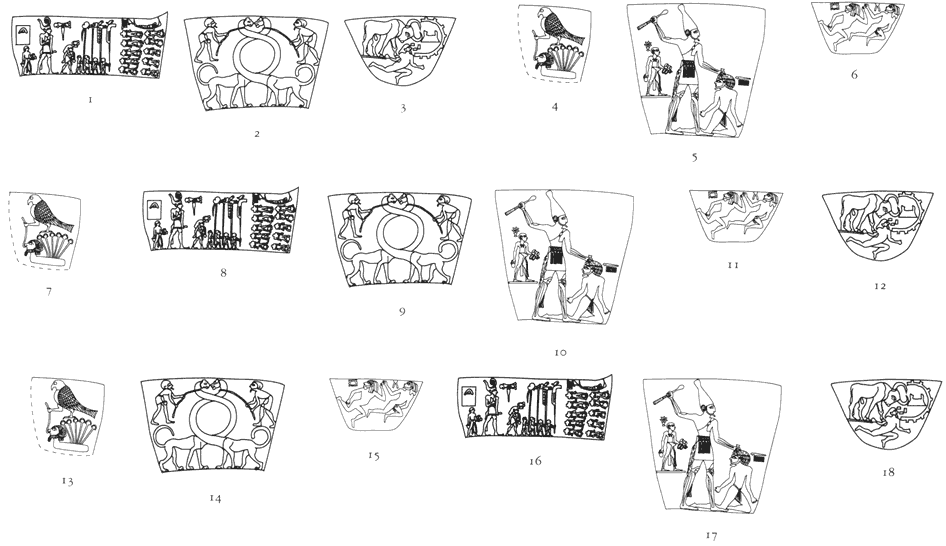
Fig. 43.
Canonical form of the narrative image on the Narmer Palette.
But in fact, although the picture of Narmer raising his mace appears again and again in the canonical form of the image, the blow escapes depiction and the image continues to mask it. While there is no need to describe all of its textual properties and relations (we have looked briefly at the first segment), the full viewing sequence through ten flips gives the narrative image on the Narmer Palette a complete, canonical text of eighteen zones—that is, the three sets of possible ways of scanning the six zones on the two sides according to the general conditions of intelligibility of late prehistoric image making, these sets sequenced in turn to accord with the same conditions. This complete text can be mapped as follows (Fig. 43):
1. OBV top (Episode Four)
2. OBV middle (cipher/after the blow)
3. OBV bottom (Episode Two)—flip
4. REV top (Episode Three)
5. REV middle (before the blow)
6. REV bottom (Episode One) [completes top-to-bottom set]
7. REV top (Episode Three)—flip
8. OBV top (Episode Four)
9. OBV middle (cipher/after the blow)—flip
10. REV middle (before the blow)
11. REV bottom (Episode One)—flip
12. OBV bottom (Episode Two) [completes side-to-side set]—flip
13. REV top (Episode Three)—flip
14. OBV middle (cipher/after the blow)—flip
15. REV bottom (Episode One)—flip
16. OBV top (Episode Four)—flip
17. REV middle (before the blow)—flip
18. OBV bottom (Episode Two) [completes double-twist set]
Several features stand out in this text. First, the rate of flipping speeds up as the text progresses—it literally becomes three times faster at the end than at the beginning. By the end of the text casual viewers may long since have abandoned it; but viewers accepting the general conditions of intelligibility and following the instructions of the cipher key will experience its accumulating excitement as a physical sensation—like a roller-coaster ride that begins slowly and then rockets through the final stretch.
Second, in the first set of flips (top to bottom, zones 1–6), the enemies' execution (Episode Four) and the enemies' flight (Episode One) begin and end the segment or "chapter" (as zones 1, 6). In the fabula these episodes are separated by the greatest temporal span. In the next and second set of flips (side to side, zones 7–12), the enemies' capture (Episode Three) and the taking of the town (Episode Two) begin and end the segment (as zones 7, 12). In the fabula these episodes are separated by a lesser temporal span. In the center of this segment, and of the text as a whole (zones 9, 10), the viewer seems as close temporally to the blow as it is possible to get insofar as the blow is not directly depicted (9, 10 = "after the blow" followed by "before the blow," the least temporal span of all). But in the third and final set of flips (double twist, zones 13–18), that temporal closeness is forced open again. The enemies' capture
(Episode Three) and the taking of the town (Episode Two), as they had earlier (zones 13, 18 = zones 7, 12), enclose the aftermath of the blow and what precedes the blow (zones 14, 17 = zones 9, 10); but they, in turn, enclose the greatest temporal span in the fabula (zones 15, 1 6)—namely, the enemies' flight (Episode One) and the enemies' execution (Episode Four). In sum, despite the increasing pace of the viewing, or precisely because of it, the image relates the greatest possible temporal span of the fabula as entirely caught up within the king's blow, the central, focal moment. The viewer is not led closer and closer to the blow, for the blow is outside and around whatever the viewer's viewing unfolds. In the way it relates details and passages of depiction, the storying works to establish a principal metaphor of the image—an expression of the continuousness of the ruler's blow.
Third, it is not just that the viewer fails to see the ruler's blow; it comes at the viewer from precisely where the viewer is not looking. While in the ten obverse-to-reverse flips of the palette the ruler's retainers twist the serpopards together clockwise (Figs. 41, 42), the ruler with his mace raised to strike (Fig. 44)—poised precisely on the other side of the place where the viewer begins—is always about to strike counterclockwise in the reverse-to-obverse direction. Therefore—like the lion on the Hunter's Palette (Fig. 28)—the viewer fails to see the ruler coming up around and "behind" him. The noose will twist off the head of the viewer before it is tight enough to capture the ruler's blow; in the viewer's cumulative and dizzying viewing of the image, the ruler pulls the noose tight as his blow, and the viewer becomes its victim. At the beginning of the text, then, like the ruler viewing his executed enemies, the viewer is invited by the image to enter the scene (obverse top, zone 1): the viewer marches beside the ruler and looks down on the decapitated corpses. But at the end of the text (by zone 18), the viewer understands the real import of the scene initially viewed—it was, after all, the "last" scene (Episode Four): the viewer leaves the text as yet another victim of the ruler's blow.
Considering what we have noted so far, it is not surprising that although in viewing the image the viewer may seem to unmask the ruler's appearances and come ever closer to seeing the blow taking place throughout, ten flips of the palette serve finally to remask the ruler. The ruler is always escaping the
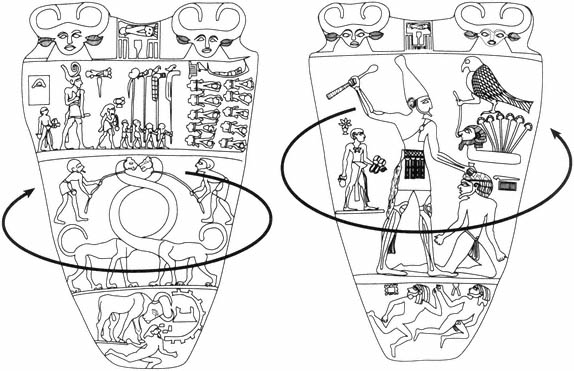
Fig. 44.
Direction of retainers' twist and viewer's flips and direction of ruler's blow on the Narmer Palette, obverse and reverse.
depiction of the identity the viewer believes to be wielding the actual blow. According to the scheme whereby the six zones of the two sides of the palette (eighteen in all in the canonical form of the image [Fig. 43]) are presented in two visibly different modes of pictorial textuality—a descriptive or ekphrastic mode (D ) and a hieroglyphic (H ) mode—the sequence of these modes can be mapped as follows:
D H H H D D (top-to-bottom set, zones 1–6);
H D H D D H (side-to-side set, zones 7–12);
H H D D D H (double-twist set, zones 13–18).
In the first set of flips (top to bottom), after a graphic description of the final episode, Episode Four, the enemies' execution (zone 1), the preceding episodes are presented in less descriptive, hieroglyphic pictorial text (zones 2–4), then reviewed in more descriptive terms (zones 5, 6). For the viewer setting out to view the image, it would seem that the "masked" depictions of the ruler—as Bull and Falcon—are to be unmasked and his human person smiting his enemy revealed.
The lure of unmasking the ruler, and of finding the real climax of the narrative, sets the viewer off on a further series of flips, resulting in entrapment in the ruler's noose (zones 7–18). A parallel device can be found in other late prehistoric images—for example, on the Oxford Palette a victim moves toward the lure of the hunter's presence only to be attacked from behind (Fig. 27)—but the Narmer Palette handles this arrangement as a metaphor in its turn: the viewer is now a "victim." After a dizzying exchange of maskings and unmasings (zones 7–12), in which the viewer can never be certain where the ruler really is in the narrative (indeed he appears to be throughout it), the viewing ends with the thRee moSt descriptive depictions of the ruler (zones 15–17) enclosed by the three most hieroglyphic (zones 13, 14, 18). Since the arrangement of episodes in the story embeds the gReatest temporal span within the least temporal span, the pictorial text for this story can be said to embed descriptive specificity within hieroglyphic generality. It turns what would ordinarily be a simple inversion of spatiotemporal and causal logic, for the purposes of arranging a story, into a metaphor for the narrative as a whole—an expression of the universality of the blow paralleling its continuousness. Visible every time
the viewer flips to the reverse side of the palette (flips 1, 3, 5, 7, and 9), the picture of Narmer smiting his enemy is textually present in a full half of the narrative.
For these reasons the picture of Narmer smiting his enemy becomes not only an episode of or story element in the narrative in which it is embedded but also a symbol of that narrative. In fact it advances into a single passage of text (reverse middle zone) the pictorial dynamics of the entire narrative image as it is spread over a series of passages segmented and sequenced in various ways. In other words the reverse middle zone with the ruler smiting his enemy presents the metaphor that is not directly depicted in any one of the zones but rather is constructed by the complete concatenation of all the zones: it is the pictorial symbol of the metaphorical content of the narrative.