
Heat-Flow Calculation
There is one important limitation of the simple thermal resource estimation described above: the volcanic products must be erupted from a crustal magma chamber that is sufficiently young to retain much of its initial heat. This limitation has been studied in detail by Smith and Shaw (1975; 1979) and applied to numerous volcanic fields where the volume and age of underlying magma chambers have been estimated from both geomorphological constraints (for example, caldera size, vent distribution, and volume of silicic pyroclastic deposits) and geophysical anomalies. Thus, for the 1.0-km3 pyroclastic deposit shown in Fig. 2.6, one can apply the cooling calculations of Smith and Shaw (1975) as shown in Fig. 1.5. Assuming that (1) the pyroclastic deposit age reflects the time over which the magma chamber has cooled from solidus temperatures, and (2) the deposit represents about one-tenth of the magma-chamber volume, then it follows that the deposit would have to be younger than ~10,000 yr for exploitable temperatures to exist in and around the magma chamber. This estimate is conservative even if the magma chamber has cooled as a result of hydrothermal convection in roof rocks above the magma chamber. If cooling were solely conductive, the age limit could be extended to nearly 20,000 yr.
In making a detailed estimation of thermal resource (Htr ), the thermal resource volume function (Vtr ) of Eq. (2-6) can be modeled by heat flow calculations. A first-order model assumes heat flow by conduction only, which requires solution of Fick's second law of diffusion:

for which H = the heat content or enthalpy (which is directly proportional to temperature) and kt = the rock thermal diffusion coefficient, which can be directionally and spatially dependent. Equation (2-9) can be conveniently solved with an explicit numerical procedure (Appendix E) for a variety of geometric, initial temperature, and diffusivity conditions. An approximation for convective transport is included in the numerical procedure to better estimate heat flow in areas where hydrothermal convection is important. The procedure, given in FORTRAN in Appendix E, can be adapted for personal computers. It solves thermal diffusion in two dimensions for a variety of rocks, geologic structures, and effective x and y diffusion coefficients. The problem
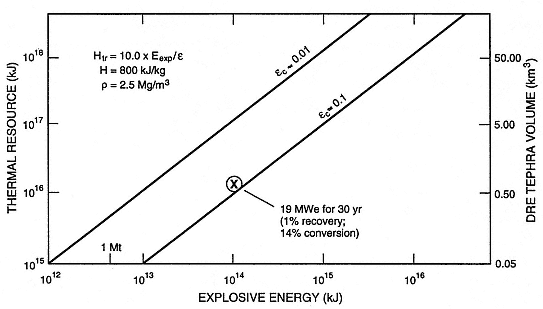
Fig. 2.6
Thermal resource (total heat contained in a magma body) and tephra volume are related to explosive
energy [1 Megaton (Mt) equivalent] by the conversion efficiency (ec ) of the magma's thermal
energy to explosive energy (kinetic) during an eruption. For this plot, it is assumed that
the tephra volume of an eruption represents 10% of the magma body volume (Smith, 1979),
the magma density (r ) = 2.5 × 10³ kg/m3 , and the magma body is young enough to have a heat
content (H) = 800 kJ/kg. This example (X) depicts a volcano that recently erupted a 1.0-km3
pyroclastic deposit (at 0.65 km3 DRE) with an explosive energy equivalent of about 24 Mt
(ec = 0.077), which represents a magma chamber with a thermal resource (Htr ) of 1.3 × 10¹⁶ kJ.
Assuming about 1% of the magma chamber's thermal resource can be exploited with ~14%
conversion to electrical energy, a geothermal plant could produce
nearly 19 MWe for 30 yr by either hydrothermal or hot dry rock methods.
for this calculation is set up in a manner similar to that outlined in Eq. (2-6). The results of this calculation give a two-dimensional representation of Vtr for any time after formation of a magma chamber. One should be cautious when using this routine to model measured geothermal gradients; the case described here is considered mathematically ill-posed because solutions may not be unique.
Figure 2.7 shows results of the above heat flow calculation for a cooling, subvolcanic pluton 2.5 km wide and 4 km below the surface. The results are compared for 100 and 200 ka of cooling, with and without a convective zone above the magma chamber. At an age of 100 ka, the two-dimensional thermal resource volume (Vtr ) within the calculated area ranges from 2 to 9 km2 (the latter value is for the model with convection). This result is based on a volume of rock with temperatures above 150°C within 3 km of the surface. From Fig. 2.7b, one can see from thermal gradients that Vtr would be slightly greater after 200 ka of heat flow. Although the convection model produces a higher near-surface thermal gradient than the nonconvective model does, the gradient can not be reliably projected to greater depths. Such modeled or measured geothermal gradients are an significant initial step in evaluating the geothermal potential of an area. Figure 2.8 plots several general types of thermal gradients and their general relationship to geothermal potential.
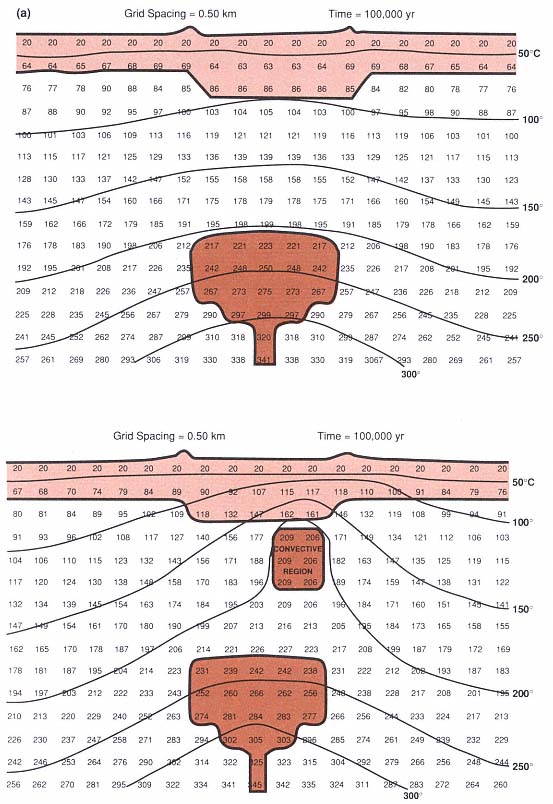
Fig. 2.7
(a) Results of heat flow calculation for a 2.5-km-wide magma body (dark shading) at a depth
of 4.0 km below a caldera filled and surrounded by volcanic rocks (light shading). This problem is
similar to that outlined in Fig. 2.5. The top plot depicts purely conductive heat flow;
the bottom plot includes the effects of a convective region (dark shading) below one side of
the caldera. The numbers in the grid show rock temperatures (°C) and temperature contours
after 100,000 yr of cooling.
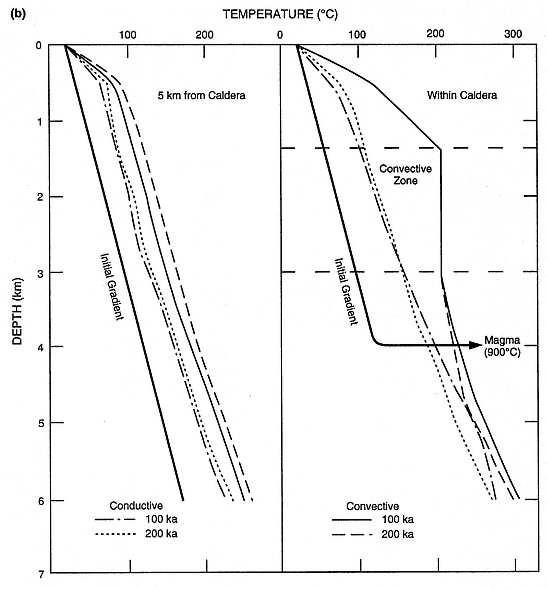
Fig. 2.7
(b) Plots of calculated thermal gradients at 100 and 200 ka of
cooling compare conductive and convective gradients for locations 5 km from the caldera
and within the caldera itself. Note the high gradient for convective heat flow in the upper 1.0 km;
if projected to greater depths, this gradient would give false predictions of maximum temperatures.