
Cases in Which the Follower and Innovator Have Learning Curves of Different Shape
So far we have noted that a pair of learning curves can be flatter or steeper, or closer together or farther apart on the x-axis (the axis indicating number of units produced or time spent in production). Both affect
the size of the monopoly advantage, with steeper curves farther apart being advantageous to the innovator. A third difference in the relationship between the curves is that the imitator may learn faster (e.g., if imitation is not as hard as innovation, or if the imitator can hire experienced labor from the innovator, leading to a steeper learning curve). Even if the imitator approaches the learning curve of the innovator as an asymptote, never producing more cheaply than the innovator, faster learning for the follower reduces the distance between the curves and so reduces the total monopoly advantage of the innovator. Ordinarily, faster learning of the follower will eventually bring the follower to a lower overall cost of production than the innovator.
In Fig. 6, the right-hand curve is steeper than the left-hand one, so the follower curve approaches the innovator curve faster than in Figs. 4 and 5. This is shown by triangle G , with its shorter base, indicating that for the same amount of cut in costs (the vertical of the triangle), the follower needs to produce a smaller number of units (or a shorter amount of time has to pass). Because the follower curve approaches the innovator's curve faster, the point at which we judge the innovator advantage to be trivial comes at point H rather than, as before, at point D . Because the follower reaps cost advantages in less time, and because the follower more quickly reaches a point at which the innovator's advantage is trivial, the total area representing the excess profits of monopoly is smaller.
For example, IBM apparently learned something that was essential for success faster than Remington Rand (Univac) in the computer market, since Univac started with the innovation and IBM was a follower (Fishman 1981, 29–47). Relatively soon after IBM entered the market, however, it could compete at least equally with Univac. That is, point H occurred earlier than point D (the point of follower competitiveness with identical learning curves for follower and innovator) because of IBM's more rapid learning than Univac's.
Obviously, if some component of costs is lower for the follower—for example, a follower in Hong Kong may have cheaper labor, making its total curve lower from the beginning—the advantage of the innovator will be smaller after the competitor starts because the right-hand curve is in general shifted downward. Unless the firm with higher labor costs learns faster (it may be that innovation itself is a measure of the capacity "to learn," in the sense measured by the curves), the Hong Kong producer will eventually have lower costs than the innovator and should be able to drive the innovator from the market.
In Fig. 7, the right-hand curve starts lower than the innovator's curve did, because of the lower cost of some factor of production, though at
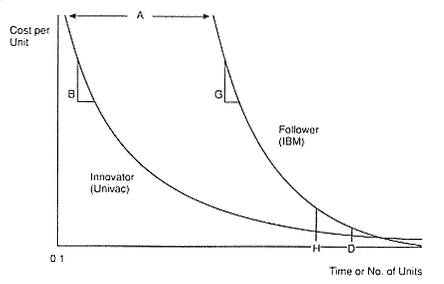
Fig. 6.
The "IBM Effect": A Steeper Learning Curve by the First Follower Reduces the Monopoly
Advantage of the Innovator
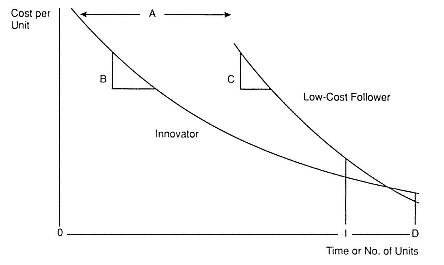
Fig. 7.
The "Hong Kong Effect": A Follower with Cheaper Labor Reduces the Innovator's Monopoly
Advantage, Eventually Driving the Innovator Out of the Market
first it is still above the innovator's curve because production in the cheaper location is not yet routinized. As experience moves the low-cost follower along the learning curve, it becomes essentially competitive with the innovator at point I , rather than at point D as before. Further, with increasing experience the follower in the low-cost location has lower costs than the innovator, eventually perhaps driving the innovator from the market it created.
So the size of the monopoly advantage created by the learning curve increases with: (1) longer delay between the first production of the innovation and the start of production by the first competitor (longer A in Fig. 4) and (2) steeper decline of costs with experience in production (steeper rather than flatter learning curves in Fig. 5). The size of the monopoly advantage decreases with (3) the "IBM effect," faster learning by the first follower than by the innovator (steeper right hand curve in Fig. 6) and (4) the "Hong Kong effect," cheaper labor or other factors of production by the follower (as in Fig. 7).