
Appendix F—
Core and Drill Cuttings:
Geothermal Well Logs
Cores
In geothermal exploration, continuous coring and geophysical logging techniques are an effective means of evaluating the lithologies, permeabilities, degree of hydrothermal alteration, temperatures, and reservoir potential. Continuous wireline coring (lowering core barrels on a cable into the drilling string) is used to retrieve 2.5- to 7.5-cm-diameter cores. Wireline retrieval is commonly used in the mining industry, but it can also be used effectively for geothermal-gradient well drilling. Although larger diameter cores can be collected, this process usually requires pulling up the entire drill string to retrieve the core. For a comprehensive review of coring technologies, see Rowley (1985).
If cores are to be used efficiently, an on-site geologist is needed during the entire coring operation. This person's job can be tedious, but it is essential for the successful collection and use of the cores. Before the drilling rig is in place, the well-site geologists should agree on consistent record-keeping procedures, description forms, and the best means of storing the core. This consistent approach is extremely important because by the time the project is complete, there may be several thousand meters of core.
For each core brought up by the drilling crew, the geologist should:
(1) mark the top and bottom of the core and draw a line down the long axis;
(2) note the well number and depth from which the core was taken;
(3) provide a brief lithologic description (a more complete description should be completed after drilling, when time permits detailed examination;
(4) note and mark with a number or letter all of the pieces of the core (in geothermal areas, cores rarely arrive in one piece because of fracturing and hydrothermal alteration);
(5) wrap the core with foil and then dip it in hot wax to retain fluids within the rock if this is crucial for any laboratory geophysical measurements;
(6) note the length of core and compare that measurement with the depth drilled (obtained from the driller) to determine the percentage of core recovery; and
(7) box the core and number the box.
More detailed procedures for core curation are described in Goff (1986), SPWLA (1982), and in many oil, mining, or geothermal company handbooks.
After drilling is complete, the cores can be described in a more pleasant environment, removed from the pressures of the next core barrel or rainstorm. After the major lithologic units have been identified, pieces can be cut for thin sections or chemical analysis, the hydrothermal minerals from major fractures can be sampled, and fracture orientations and frequency can be measured. These fracture data are useful for later comparison with well log measurements of temperature and flow from the reservoir.
All the core information should be ploted and interpreted on long strips of paper (Fig. F.1). If done by hand and pencil, this can be a very slow job; it is much more efficient to store the observational data in a computer where the output can be continuously modified and quickly printed out at nearly any scale. Some of this work might easily be done onsite with a portable computer.
Drill Cuttings
Rocks in geothermal areas are usually hydrothermally altered and fractured. Drill cuttings from geothermal areas, brought to the surface by circulating drilling mud, are sometimes difficult to interpret. The production of cuttings depends on not only the rock type itself, but also the type of drill bit, drilling speed, and the characteristics of the drilling mud (Hulen and Sibbett, 1982).
To maximize the data from drill cuttings, cuttings should be collected from shaker screens through which the mud is sieved. A sample should be collected for every 3 m drilled. If the wells are drilled with compressed air, cuttings can be collected from the mound around the wellhead orifice or from the muffler.
Cuttings should be placed in cloth or plastic bags and labeled with the current drilling depth in waterproof marking ink. However, the drilling depth is likely to be greater than the actual depth from which the sample came and must be corrected (Low, 1977). This discrepancy between recorded and actual depths is negligible if the well is being drilled with air.
After cuttings are washed, the coarser fractions should be examined with a binocular microscope before thin sections of epoxy-impregnated cuttings are prepared. Cuttings can be examined quickly if representative samples are mounted on continuous strips with an adhesive; these "chip boards" are an efficient means of storing samples and provide a stratigraphic record (Hulen and Sibbett, 1982).
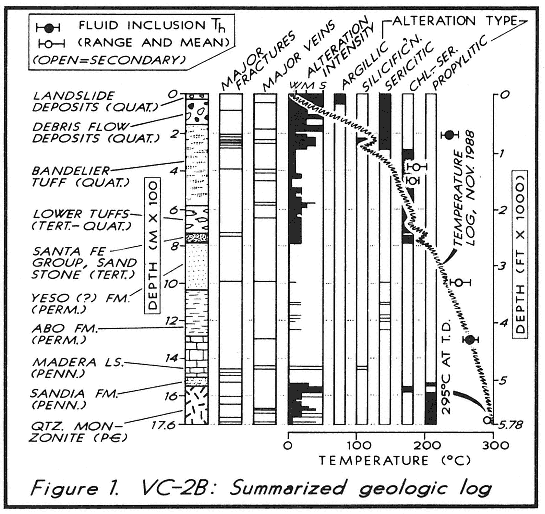
Fig. F.1
Summarized geologic log for geothermal well VC-2B in the Valles Caldera of New Mexico.
(From Jeff Hulen, University of Utah Research Institute.)
Cuttings can be contaminated by collapse of portions of the drillhole, materials added to the drilling mud, etc. Most of these contaminants can be recognized because they are very different from the materials in the cuttings; for a full treatment of this problem, consult Hulen and Sibbett (1982), who discussed potential problems with different rock types and drilling methods.
Geothermal Well Logs
Geophysical well logging in geothermal fields can be used in place of lithologic logs (although they are not as accurate) or as a supplement to lithologic logs (for which they are quite accurate). Logging is necessary for characterizing reservoir characteristics and size (Mathews, 1982), which in turn
can be used to measure temperature, pressure, flow, borehole geometry, and fracture frequency (Table F.1). Most of these parameters are controlled by the reservoir and its fluids; they change with time and cannot be determined solely from the core or cuttings. The interpretation of well logs requires specific training, which can be acquired from intensive short courses followed by work with experienced well log analysts. Another approach is to work directly with well log analysts employed by a logging service.
Most logging tools and cables available from commercial logging services have an upper operating temperature of 260°C and cannot be used in some geothermal systems. Some high-temperature tools have been developed, but they are not yet available commercially.
| ||||||||